Copyright2001 by the Genetics Society of America
Multiple Functional Interactions Between Components of the
Lsm2–Lsm8 Complex, U6 snRNA, and the Yeast La Protein
Barbara K. Pannone, Sang Do Kim, Dennis A. Noe and Sandra L. Wolin
Departments of Cell Biology and Molecular Biophysics and Biochemistry, Howard Hughes Medical Institute, Yale University School of Medicine, New Haven, Connecticut 06536
Manuscript received November 29, 2000 Accepted for publication February 13, 2001
ABSTRACT
The U6 small nuclear ribonucleoprotein is a critical component of the eukaryotic spliceosome. The first protein that binds the U6 snRNA is the La protein, an abundant phosphoprotein that binds the 3⬘ end of many nascent small RNAs. A complex of seven Sm-like proteins, Lsm2–Lsm8, also binds the 3⬘ end of U6 snRNA. A mutation within the Sm motif of Lsm8p causesSaccharomyces cerevisiaecells to require the La protein Lhp1p to stabilize nascent U6 snRNA. Here we describe functional interactions between Lhp1p, the Lsm proteins, and U6 snRNA.LSM2andLSM4, but not otherLSMgenes, act as allele-specific, low-copy suppressors of mutations in Lsm8p. Overexpression ofLSM2in thelsm8mutant strain increases the levels of both Lsm8p and U6 snRNPs. In the presence of extra U6 snRNA genes, LSM8 becomes dispensable for growth, suggesting that the only essential function ofLSM8is in U6 RNA biogenesis or function. Furthermore, deletions ofLSM5,LSM6, orLSM7causeLHP1to become required for growth. Our experiments are consistent with a model in which Lsm2p and Lsm4p contact Lsm8p in the Lsm2–Lsm8 ring and suggest that Lhp1p acts redundantly with the entire Lsm2–Lsm8 complex to stabilize nascent U6 snRNA.
T
HE process of pre-mRNA splicing requires five Racineet al.1997;Achselet al.1999;Mayeset al.1999; Salgado-Garridoet al.1999). In yeast, there are nine small ribonucleoprotein particles, the U1, U2, U4,U5, and U6 snRNPs. These small RNPs associate with of these Sm-like proteins (named Lsm1–Lsm9 forLike Sm). Two distinct heptameric complexes of these Sm-each other, with the mRNA, and with a large number
of splicing factors to form the spliceosome (reviewed like proteins have been described. One complex, con-sisting of the Lsm2–Lsm8 proteins, binds to the 3⬘end byBurgeet al.1998). The U1, U2, U4, and U5 snRNPs
of the U6 snRNA and is required for the stable accumu-each consist of an RNA molecule, seven common
pro-lation of U6 snRNPs (Pannone et al.1998; Achselet teins known as Sm proteins, and additional
snRNP-spe-al. 1999; Mayes et al. 1999; Salgado-Garrido et al. cific proteins. In vertebrates, binding of the Sm proteins
1999;Vidalet al.1999). A second complex, consisting to the snRNA occurs in the cytoplasm and is required
of the Lsm1–Lsm7 proteins, functions in mRNA degra-for hypermethylation of the 5⬘cap structure and
reim-dation, most likely at the decapping step (Boecket al. port of the snRNPs into the nucleus (Kambach et al.
1998; Bouveretet al.2000; Tharunet al. 2000). The 1999a). All Sm proteins share a conserved Sm motif
Lsm2–Lsm8 complex was recently purified from human consisting of two short submotifs, Sm1 and Sm2. The
cells and found to resemble a doughnut, similar in size crystal structures of two Sm heterodimers have revealed
and shape to the core Sm snRNPs (Achselet al.1999). that the Sm motif folds into an N-terminal␣-helix,
fol-This finding, coupled with the fact that each of the lowed by a five-stranded antiparallelsheet (Kambach
Lsm2–Lsm8 proteins can be specifically aligned with et al.1999b). From these structures, a model has been
one of the bona fideSm proteins (Fromont-Racineet proposed in which the seven Sm proteins interact via
al. 1997; Salgado-Garrido et al.1999), suggests that their Sm motifs to form a heptameric ring around the
the Lsm proteins assemble into analogous heptameric snRNA (Kambachet al.1999b).
ring structures. The order of the Lsm2–Lsm8 proteins In addition to the canonical Sm proteins, other Sm
within the ring is unknown. motif-containing proteins have been identified in many
Although the Lsm2–Lsm8 complex binds the 3⬘end eukaryotes and certain archaebacteria (Cooper et al.
of U6 RNA and is required for the stable accumulation 1995;Hermannet al.1995;Seraphin 1995;Fromont
-of U6 snRNPs, the precise role -of this complex in U6 biogenesis and function is unknown. The first protein known to bind U6 RNA is the La protein, an abundant Corresponding author:Sandra L. Wolin, Departments of Cell Biology nuclear phosphoprotein that binds and stabilizes many and Molecular Biophysics and Biochemistry, Howard Hughes Medical
newly synthesized small RNAs (RinkeandSteitz1982,
Institute, Yale University School of Medicine, 295 Congress Ave., New
Haven, CT 06536. E-mail: [email protected] 1985;Pannoneet al.1998;Kufelet al.2000;Xueet al.
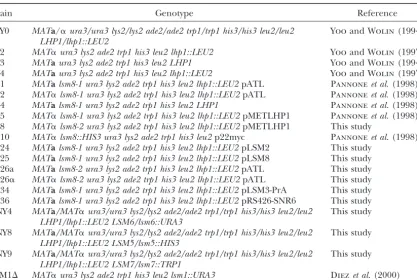
TABLE 1
Yeast strains used in this study
Strain Genotype Reference
CYY0 MATa/␣ura3/ura3 lys2/lys2 ade2/ade2 trp1/trp1 his3/his3 leu2/leu2 YooandWolin(1994)
LHP1/lhp1::LEU2
CY2 MAT␣ura3 lys2 ade2 trp1 his3 leu2 lhp1::LEU2 YooandWolin(1997) CY3 MATaura3 lys2 ade2 trp1 his3 leu2 LHP1 YooandWolin(1994) CY4 MATaura3 lys2 ade2 trp1 his3 leu2 lhp1::LEU2 YooandWolin(1997) BP1 MATalsm8-1 ura3 lys2 ade2 trp1 his3 leu2 lhp1::LEU2pATL Pannoneet al.(1998) BP2 MAT␣lsm8-1 ura3 lys2 ade2 trp1 his3 leu2 lhp1::LEU2pATL Pannoneet al.(1998) BP4 MATalsm8-1 ura3 lys2 ade2 trp1 his3 leu2 LHP1 Pannoneet al.(1998) BP5 MAT␣lsm8-1 ura3 lys2 ade2 trp1 his3 leu2 lhp1::LEU2pMETLHP1 Pannoneet al.(1998) BP8 MAT␣lsm8-2 ura3 lys2 ade2 trp1 his3 leu2 lhp1::LEU2pMETLHP1 This study
BP10 MAT␣lsm8::HIS3 ura3 lys2 ade2 trp1 his3 leu2p22myc Pannoneet al.(1998) BP24 MATalsm8-1 ura3 lys2 ade2 trp1 his3 leu2 lhp1::LEU2pLSM2 This study
BP25 MATalsm8-1 ura3 lys2 ade2 trp1 his3 leu2 lhp1::LEU2pLSM8 This study BP26a MATalsm8-2 ura3 lys2 ade2 trp1 his3 leu2 lhp1::LEU2pATL This study BP26␣ MAT␣lsm8-2 ura3 lys2 ade2 trp1 his3 leu2 lhp1::LEU2pATL This study BP34 MATalsm8-1 ura3 lys2 ade2 trp1 his3 leu2 lhp1::LEU2pLSM3-PrA This study BP36 MATalsm8-1 ura3 lys2 ade2 trp1 his3 leu2 lhp1::LEU2pRS426-SNR6 This study DNY4 MATa/MAT␣ura3/ura3 lys2/lys2 ade2/ade2 trp1/trp1 his3/his3 leu2/leu2 This study
LHP1/lhp1::LEU2 LSM6/lsm6::URA3
DNY8 MATa/MAT␣ura3/ura3 lys2/lys2 ade2/ade2 trp1/trp1 his3/his3 leu2/leu2 This study
LHP1/lhp1::LEU2 LSM5/lsm5::HIS3
DNY9 MATa/MAT␣ura3/ura3 lys2/lys2 ade2/ade2 trp1/trp1 his3/his3 leu2/leu2 This study
LHP1/lhp1::LEU2 LSM7/lsm7::TRP1
LSM1⌬ MAT␣ura3 lys2 ade2 trp1 his3 leu2 lsm1::URA3 Diezet al.(2000)
2000). The La protein binds the UUUOHat the 3⬘end acts redundantly with the assembled Lsm2–Lsm8 com-plex to stabilize newly synthesized U6 RNA.
of these RNAs (Stefano 1984), which, for U6 RNA, overlaps the binding site of the Lsm2–Lsm8 complex (Achselet al.1999; Vidal et al.1999). Thus, binding
MATERIALS AND METHODS by the Lsm2–Lsm8 complex to the 3⬘end of U6 RNA
may displace the La protein. Consistent with this idea,
Yeast media, strains, and plasmids:Yeast media and manipu-yeast cells containing a mutation in LSM8 require lations were as described inSherman(1991). The strains used Lhp1p, the yeast La protein homologue, to stabilize in this study are listed in Table 1. Thelsm1⌬strain (Diezet al. 2000) was a gift of P. Ahlquist (University of Wisconsin). newly synthesized U6 RNA (Pannoneet al.1998).
How-Synthetic lethal screen:The synthetic lethal screen was per-ever, it is unclear whether mutations in other Lsm
pro-formed as described byPannoneet al. (1998) with the follow-teins cause cells to require Lhp1p. ing modifications. CY2 cells carrying pATL, a centromeric To better understand the functions of individual plasmid containingLHP1, TRP1, andADE2(Pannoneet al. members of the Lsm2–Lsm8 complex, we examined the 1998), were mutagenized with ethylmethane sulfonate to 15% survival and plated on synthetic complete media containing genetic interactions between Lhp1p, U6 RNA, and the
limiting amounts of adenine (SCiade). Colonies were Lsm proteins in the yeast Saccharomyces cerevisiae. We
screened at 25⬚for the inability to lose pATL and form red report that LSM2andLSM4 function as allele-specific
sectors. Of 185,000 colonies screened, 68 did not form red suppressors of two mutations inLSM8, consistent with sectors. These candidates were transformed with a second the speculation (He and Parker 2000; Pannoneand plasmid, pSLL28 (Yoo and Wolin 1997), which contains
LHP1,URA3, andLYS2, and tested for the ability to lose pATL. Wolin 2000) that Lsm2p and Lsm4p directly contact
Forty-nine candidates were able to form sectoring colonies. Lsm8p in the Lsm2–Lsm8 ring. Consistent with a direct
Of the 49 that sectored, 15 were dead on media containing interaction, overexpression ofLSM2in thelsm8-1
mu-1 g/ml 5-fluoroorotic acid, indicating they could not lose tant strain increases the levels of the mutant Lsm8 pro- pSLL28. Backcrossing to CY4 revealed that five strains carried tein. In the presence of high levels of U6 RNA, the nor- a single recessive mutation that caused them to require pATL. Complementation analysis with BP2 demonstrated that one mally essentialLSM8becomes dispensable for growth,
strain failed to complement thelsm8-1mutation. This strain indicating that the only essential function of LSM8 is
was backcrossed three times to CY2 to generate BP26a and in U6 RNA biogenesis and/or stability. Furthermore,
BP26␣. The characterization of the other strains will be pre-deletions ofLSM5,LSM6, orLSM7, but notLSM1, are sented elsewhere (S. D.Kimand S. L. Wolin, unpublished synthetically lethal with deletions ofLHP1. Our experi- results).
Figure1.—Sequence of Lsm-8p. The sites of thelsm8-1and
lsm8-2mutations are indicated, as is the sequence of the pep-tide used to generate anti-Lsm8p antibodies. The posi-tions of the ␣-helix and five
-strands that make up the Sm motif are modeled on the crys-tal structures of the SmD3B and
SmD1D2 heterodimers ( Kam-bachet al. 1999b).
subcloned into pRS316 (CEN, URA3; Sikorski and Hieter ferred to ZetaProbe GT membranes (Bio-Rad) in 0.5⫻TBE at 150 mA for 16 hr. Hybridization with [␥-32P]ATP-labeled
1989) as described below. Plasmids carrying theLSM3,LSM5,
LSM6, andLSM7genes fused to two IgG-binding domains of oligonucleotides was done as described byTarnet al. (1995). Oligonucleotides used were U4: 5⬘-AGGTATTCCAAAAATTC
Staphylococcus aureusprotein A (PrA) were gifts of B. Seraphin
(Seraphin1995;Salgado-Garridoet al. 1999). The plasmid CCTAC-3⬘ and U6D2: 5⬘-CGAAATAAATCTCTTTGTAAAA CGG-3⬘.
pBS959 was digested withBamHI andHindIII and the
LSM5-PrA-containing fragment was subcloned into the same sites Disruption of theLSM5,LSM6, andLSM7genes:To disrupt
LSM5, theHIS3 gene from pRS313 (Sikorski and Hieter of pRS316 to create pLSM5-PrA. The plasmid pBS1296 was
digested withBamHI andSacI and the fragment containing 1989) was amplified using forward and reverse primers that contained 45 and 49 nucleotides (nt) ofLSM5sequence at
LSM6-PrAwas ligated into theBamHI-SacI sites of pRS316 to
create pLSM6-PrA. The plasmid pBS957 was digested with their 5⬘ends, respectively. This PCR product was transformed into CYY0, where it replaced one allele of theLSM5 open
BamHI andHindIII and the fragment containingLSM7-ProtA
was subcloned into theBamHI-HindIII sites of pRS316 to cre- reading frame withHIS3, leaving only 11 nt ofLSM5coding sequence at the 5⬘terminus and 13 nt at the 3⬘terminus. This ate pLSM7-PrA. The plasmid pBS867 containsLSM3-PrA in
vector pRS316. To create untagged versions, PCR was used to generated strain DNY8. To disrupt LSM6, the URA3 gene from pRS316 (SikorskiandHieter1989) was amplified using amplify the LSM genes from plasmids pLSM5-PrA,
pLSM6-PrA, pLSM7-pLSM6-PrA, and pBS867. In each case, the oligonucleo- forward and reverse primers that contained 39 and 53 nt of
LSM6sequence at their 5⬘ends, respectively. This PCR product tide used to amplify the 3⬘portion of eachLSMgene
intro-duced a stop codon at the end of theLSMcoding sequence. was transformed into CYY0 where it replaced one allele of
LSM6withURA3, leaving only 17 nt ofLSM6coding sequence The resulting DNAs were cloned into theBamHI-EcoRI sites
of pRS316 to create pLSM3, pLSM5, pLSM6, and pLSM7. at the 5⬘terminus and 15 nt at the 3⬘terminus. This generated strain DNY4. To disruptLSM7, theTRP1gene from pRS314 Plasmid pSDB23-1 (Cooperet al. 1995; a gift from J. Beggs)
was digested withHindIII and the 1.4-kb fragment containing (SikorskiandHieter1989) was amplified using forward and reverse primers that contained 48 and 50 nt ofLSM7sequence
LSM4was subcloned into theHindIII site in pRS316 to create
pLSM4. Plasmid pJD09 (a gift from P. Ahlquist, University at their 5⬘ ends, respectively. This PCR product was trans-formed into CYY0 where it replaced one allele ofLSM7with of Wisconsin) was digested withHindIII andEcoRI and the
1.5-kbLSM1fragment was subcloned into theHindIII-EcoRI TRP1, leaving 10 nt ofLSM7coding sequence at both the 5⬘ and 3⬘termini. This generated strain DNY9.
sites of pRS316 to create pLSM1. Plasmids p22U and pSNPU (Pannone et al. 1998) contain the LSM8 and LSM2 genes, respectively, in pRS316. pLSM1, pSNPU, pBS867, pLSM4,
pLSM5, pLSM6, pLSM7, p22U, pRS426-SNR6 (a gift from D. RESULTS
Brow, University of Wisconsin), and pRS316 were transformed
individually into strains BP5 and BP8. Allele-specific suppression oflsm8mutations by Lsm Anti-Lsm8p antibody synthesis: Anti-Lsm8p peptide anti- proteins: To identify additional mutations that cause bodies were generated by AnaSpec. A C-terminal Lsm8p cells to requireLHP1, we performed a genetic screen peptide (H Cys Asn Lys Ile Glu Asn Glu His Val Ile Trp
-using a previously described strategy (Pannone et al. Glu-Lys-Val-Tyr-Glu-Ser-Lys-Thr-Lys-OH) was conjugated to
1998;Xueet al. 2000). Anade2strain lackingLHP1in BSA and injected into rabbits. The antisera was affinity purified
against the peptide following the fifth bleed. the genome, but containingLHP1,ADE2, andTRP1on Native gels, Northern blots, and oligonucleotides:Extracts a centromeric plasmid, was mutagenized with ethyl-were prepared by vortexing 5 OD600units of cells in 4 volumes methane sulfonate and screened for the inability to lose
of buffer A (50 mmTris HCl pH 7.5, 25 mm NaCl, 5 mm
the plasmid. As a red pigment accumulates in ade2 MgCl2) with 0.25 m phenylmethylsulfonyl fluoride in the
strains, cells that lose the plasmid are red, while cells presence of glass beads. The extract was sedimented at
100,000⫻gin a Beckman TLA100 rotor for 20 min. A total that retain it are white. To determine if any mutants of 0.1 OD260units of each supernatant was mixed with an equal were allelic to previously isolated mutations (Yoo and
volume of buffer A containing 8% glycerol and loaded on a Wolin 1997; Pannone et al. 1998; Xue et al. 2000), 4% polyacrylamide gel (80:1 acrylamide:bis) in 25 mmTris,
we performed complementation analyses. Each mutant 25 mmboric acid, and 1 mmEDTA that had been prerun at
strain was mated to our previously isolated mutant 250 V for 30 min at 4⬚. Gels were run at 300 V until the
Figure 2.—Extra copies of certain LSM genes or U6 snRNA eliminate the require-ment for LHP1 in lsm8 mu-tants. Plasmids containing the indicated LSM or LSM-PrA
genes in the low-copy plasmid pRS316 were introduced into
lhp1::LEU2strains carrying the
lsm8-1(A) orlsm8-2(B) muta-tion. The strains also contained the pMETLHP1 plasmid ( Pan-none et al. 1998) in which
LHP1 is under the control of theMET3promoter. Cells were streaked to single colonies on medium containing 2 mm me-thionine, which represses the
MET3 promoter (Cherest et al. 1987), and grown at 25⬚. As controls, strains were trans-formed with the pRS316 vector. To determine whether mul-tiple U6 RNA genes would eliminate the requirement for
LHP1, the lsm8 strains were transformed withSNR6in the high-copy plasmid pRS426. In-troduction of pRS426 had no effect on the requirement for
LHP1inlsm8-1(Pannoneet al. 1998) orlsm8-2cells (data not shown).
lose the LHP1-containing plasmid. One strain, which ments, LSM3, LSM5, LSM6, and LSM7 were tested as fusion proteins, as we used plasmids in which the C we refer to aslsm8-2, failed to complement thelsm8-1
strain. Sequencing of LSM8 in the strain revealed a terminus of each coding sequence was fused to two IgG-binding domains of the S. aureus protein A (PrA; single base change that converted the tryptophan at
position 119 to a stop codon. Because the requirement Salgado-Garrido et al. 1999). For the lsm8-1 mutant strain, introduction of eitherLSM2,LSM3-PrA, orLSM8 for LHP1 in this strain could be complemented by a
low-copy plasmid containing LSM8, we conclude that on the low-copy plasmid eliminated the requirement forLHP1(Figure 2A), as these strains were able to grow the requirement for LHP1 is due to truncation of
Lsm8p. The positions of thelsm8-1andlsm8-2mutations on high methionine-containing media. Overexpression ofLSM1,LSM4,LSM5-PrA,LSM6-PrA,LSM7-PrA, or the are shown in Figure 1. Similar to thelsm8-1strain (
Pan-none et al. 1998), the lsm8-2 strain was slightly cold parent vector failed to eliminate the requirement for LHP1, although the background growth was reproduci-sensitive for growth (data not shown).
Previously, we identified LSM2, which encodes an- bly higher in the presence of extra copies of LSM4 (Figure 2A).
other Sm-like U6 snRNP protein, as a low-copy
suppres-sor of the lsm8-1 mutation (Pannone et al. 1998). To To determine whether the protein A tags affected the ability of LSM3 and LSM5-7 to suppress the lsm8 determine whether other Sm-like proteins were able
to eliminate the requirement forLHP1, we performed mutations, each of these genes was cloned without the tag into pRS316 and tested in the mutant strains. This suppression analyses. Each of the LSM1–LSM8 genes
was subcloned into the low-copy plasmid pRS316 and revealed that, while theLSM3-PrAfusion suppressed the requirement forLHP1, wild-typeLSM3did not (Figure tested for the ability to eliminate the requirement for
LHP1 in the lsm8 strains. For these experiments, we 2A, fourth panel). Similar to the result obtained with the PrA fusions, the wild-typeLSM5-LSM7failed to sup-used lsm8 mutant strains that contained LHP1 under
control of theMET3promoter. Because theMET3pro- press the requirement for LHP1 in the mutant strain (data not shown).
moter is repressed by high concentrations of
methio-nine (Cherestet al. 1987), thelsm8strains are unable Interestingly, the second lsm8 mutant allele, lsm8-2, exhibited a different pattern of suppression by LSM to grow on plates containing 2 mm methionine (not
LSM4partially suppresses theLHP1requirement in the lsm8-2 cells. However, as previously reported for the lsm8-1allele (Pannone et al. 1998), expression of U6 snRNA on the high-copy plasmid pRS426 eliminates theLHP1requirement of thelsm8-2strain (Figure 2B, pSNR6sector). Thus, despite the differences in suppres-sion of the two alleles byLSMgenes, at least part of the requirement for LHP1in both strains is likely due to defects in U6 snRNP biogenesis or stability.
Extra copies of LSM2 and LSM3-PrA increase pre-mRNA splicing efficiency in thelsm8-1 mutant strain: To explore the mechanism by which extra copies ofLSM and U6 genes eliminated the requirement for Lhp1p, we createdlsm8strains in whichLHP1was replaced by extra copies of these genes. We started withlsm8 ade2strains in which the only copy of LHP1 was supplied on an ADE2-containing plasmid. These strains are white as long as theADE2plasmid is present. Following transfor-mation with plasmids containingLSMor U6 RNA genes, the strains were screened for the ability to lose theLHP1 and ADE2-containing plasmid and form colonies with red sectors. In the presence of either LSM2or LSM3-PrAon a centromeric plasmid, orSNR6on a high-copy plasmid, thelsm8-1strains were able to lose the LHP1-containing plasmid. However, when LSM4 was ex-pressed in the lsm8-2 strain, the strain was unable to lose theLHP1plasmid and remained white, suggesting that at least a low level ofLHP1expression was required for efficient growth. Thus, while expression of LSM4 allows lsm8-2 strains to grow under conditions where Figure3.—In the presence of extra copies of LSM2,
pre-mRNA splicing in thelsm8-1strain is more efficient and the LHP1transcription is repressed (Figure 2B), it may not levels of Lsm8p increase. (A) Total RNAs isolated from wild- completely eliminate the requirement forLHP1. Even type cells (lane 1),lhp1::LEU2cells (lane 2),lsm8-1cells
con-though theMET3promoter is tightly regulated by me-taining chromosomalLHP1(lane 3),lsm8-1 lhp1::LEU2cells
thionine (Cherestet al. 1987), a small amount of Lhp1p containing the indicatedLSMgenes in the low-copy plasmid
may still be synthesized under repressive conditions. pRS316 (lanes 4–6) orSNR6in the high-copy plasmid pRS426
(lane 7) were subjected to Northern analysis and probed to Since the lsm8-1 mutation results in a pre-mRNA detect U3 RNA. The asterisk indicates a degradation product splicing defect (Pannone et al. 1998), we determined of pre-U3 RNA (Hughes and Ares 1991). (B) Extracts of
whether extra copies ofLSM2andLSM3-PrAincreased wild-type (lane 1),lsm8-1cells containing chromosomalLHP1
the efficiency of pre-mRNA splicing in the mutant (lane 2), andlsm8-1cells containingLHP1on a centromeric
strains. Total RNA was extracted from each strain and plasmid (lane 3) were analyzed for the presence of Lsm8p by
Western blotting with anti-Lsm8p antibodies. To verify that subjected to Northern analysis to detect the U3 small the detected band was Lsm8p, lane 4 contains extract from nucleolar RNA, since this RNA contains an mRNA-type a strain in which three copies of the human c-myc epitope
intron (Myslinskiet al.1990). As previously described (KolodziejandYoung1991) were fused to the C terminus
(Pannoneet al. 1998), cells containing the lsm8-1 mu-of Lsm8p. (C) Extracts mu-of wild-type cells (lane 1),lhp1::LEU2
tant allele accumulate unspliced pre-U3 RNA (Figure cells (lane 2),lsm8-1cells containing chromosomalLHP1(lane
3), andlsm8-1 lhp1::LEU2cells containing either the indicated 3A, lane 3). In the presence of extra copies ofLSM2or LSM genes in the low-copy plasmid pRS316 (lanes 4–6) or LSM3-PrA, the splicing defect was less evident (lanes 4
SNR6in the high-copy plasmid pRS426 (lane 7) were subjected
and 5), consistent with the finding that these genes to Western blotting to detect Lsm8p.
function as low-copy suppressors of thelsm8-1mutation. However, while extra copies ofSNR6 also allowlsm8-1 cells to grow in the absence ofLHP1, only a slight de-on the low-copy plasmid, allowed the mutant cells to
grow on the 2-mmmethionine medium (Figure 2B, also crease in pre-U3 RNA was detected in this strain (lane 7). Thus, while extra copies ofLSM2, LSM3-PrA, and data not shown). In contrast, expression of LSM4
al-lowed some growth, although less than whenLSM8was SNR6 all allow lsm8-1 cells to grow in the absence of LHP1, LSM2and LSM3-PrAare more efficient at sup-expressed in the mutant cells (Figure 2B). Thus, while
al. 1999;Uetzet al. 2000) and that these proteins have been proposed to be adjacent in the Lsm2–Lsm8 com-plex (HeandParker2000;PannoneandWolin2000). Thus, binding of Lsm2p to Lsm8p may stabilize the mutant Lsm8 protein.
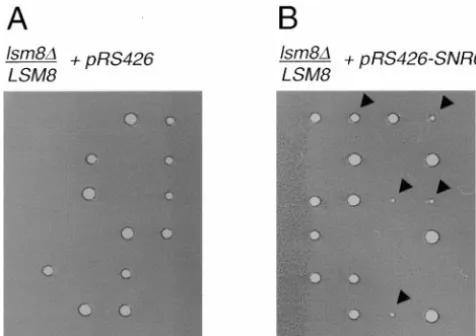
LSM8is not essential in the presence of multiple U6 RNA genes:The observation that the levels of the mu-tant Lsm8p were drastically reduced in the presence of extra copies of SNR6 was surprising, since LSM8 is essential for yeast viability (Fromont-Racineet al.1997; Pannone et al. 1998). We thus determined whether LSM8becomes dispensable for growth in the presence of multiple copies ofSNR6. We transformed the high-copy plasmid containing SNR6, or the empty vector alone, into a diploid strain in which one allele ofLSM8 Figure4.—LSM8is dispensable in cells containing multiple was replaced with HIS3 (Pannone et al. 1998). In the U6 snRNA genes. Either the high-copy vector pRS426 (A) or presence of the empty vector, sporulation of the diploid
SNR6cloned into pRS426 (B) was introduced intolsm8::HIS3/
and tetrad dissection yielded only two viable segregants LSM8 diploids. Following sporulation at 25⬚, the resulting
per tetrad (Figure 4A), all of which required histidine tetrads were dissected and incubated at 30⬚. Arrowheads
lanes 3 and 6), with a concomitant decrease in the free U4 snRNPs (Figure 5B, lane 6). Thus, while bothLSM2 andLSM3-PrAsuppress the requirement forLHP1, only LSM2 restores the levels of U6-containing snRNPs in lsm8-1cells to near wild-type levels.
Expression of the high-copy plasmid containingSNR6 in the lsm8-1 strain also did not significantly increase the level of the U4/U6.U5 tri-snRNP (Figure 5, A and B, lane 8). Instead, a heterogeneous smear of U6 RNA-containing particles migrated both with and ahead of the U4/U6 snRNP (lane 8). The smallest detectable band (asterisk, lane 8) comigrated with free U6 snRNA (data not shown). However, probing the blot to detect U4 RNA revealed that U4/U6 snRNP levels were re-stored to near wild-type levels (Figure 5B, lane 8). Thus, in the presence of additional copies ofSNR6, U6 RNA assembles with U4 RNA to form the U4/U6 snRNP. However, assembly with the U5 snRNP remains im-paired in the mutant strain.
LHP1 is essential in strains lacking LSM5, LSM6, or LSM7:Since our synthetic lethal screens identified two Figure5.—The levels of the free U6 snRNP increase when
lsm8alleles that cause yeast to requireLHP1, but did not LSM2is overexpressed in thelsm8-1strain. Extracts from
wild-type cells (lane 1),lhp1::LEU2cells (lane 2),lsm8-1cells con- reveal mutations in otherLSMgenes, we asked whether taining chromosomalLHP1(lane 3),lsm8-1cells containing mutations in other components of the Lsm2–Lsm8
com-LHP1on a centromeric plasmid (lane 4), andlsm8-1 lhp1::
plex would cause a requirement for Lhp1p. LSM2, LEU2cells containing eitherLSM2(lane 5),LSM3-PrA(lane
LSM3, andLSM4are all essential for viability (Cooper 6), or LSM8 (lane 7) in the centromeric plasmid pRS316
et al. 1995;Mayes et al. 1999;Salgado-Garrido et al. were fractionated in 4% polyacrylamide gels and subjected to
Northern analysis. The blot was probed with an oligonucleo- 1999), and nonlethal mutations in these genes have not tide complementary to U6 snRNA (A) or U4 snRNA (B). Lane been described. However, LSM6 and LSM7 are both 8 contains extract from lsm8-1 lhp1::LEU2 cells containing nonessential genes (
Mayeset al. 1999;Salgado-
Gar-SNR6in the high-copy plasmid pRS426. The asterisk denotes
ridoet al. 1999), and LSM5 has been reported to be the position at which naked U6 RNA migrates on these gels
both essential (Mayeset al. 1999) and nonessential ( Sal-(data not shown).
gado-Garridoet al. 1999). To determine whetherLHP1 becomes essential in cells lacking one of these genes, we disrupted the genes encoding LSM5, LSM6, and the free U6 snRNP is undetectable inlsm8-1 cells
car-rying chromosomalLHP1, and both the U4/U6 com- LSM7in aLHP1/lhp1::LEU2 diploid strain. When our diploid strain (lsm5::HIS3/LSM5, lhp1::LEU2/LHP1) was plex and U4/U6.U5 tri-snRNP are drastically reduced
(lane 3). In addition, free U4 snRNPs accumulate in sporulated at 25⬚, followed by incubation of the dis-sected spores at 30⬚, we obtained two viable segregants the mutant strain, consistent with a defect in U6 snRNP
assembly (Figure 5B, lane 3; alsoPannoneet al. 1998). per tetrad (Figure 6A, left), consistent with the report that LSM5 is essential (Mayes et al. 1999). However, When the sole copy of LHP1is supplied on a
centro-meric plasmid (which raises the levels of Lhp1p two- when the dissected spores were incubated at 25⬚, we obtained tetrads containing either two, three, or four to threefold), the levels of the U4/U6.U5 tri-snRNP
increase, consistent with the presence of more func- viable progeny (Figure 6A, right). In all cases, two se-gregants were large and lacked the LSM5 disruption tional U6 snRNPs in this strain (Figure 5A, lane 4; also
Pannoneet al. 1998). Interestingly, expression of extra marker. The remaining progeny were all small (Figure 6A) and His⫹, indicating that they contained the dis-copies ofLSM2(lane 5), but notLSM3-PrA(lane 6), in
thelsm8-1strain resulted in a large increase in the levels rupted LSM5 gene. Thus, at 25⬚, segregants lacking LSM5are viable in our strain background. Examination of U6-containing snRNPs and a decrease in the levels
of free U4 snRNPs. In the presence of theLSM2plasmid, of the leucine requirement revealed that all His⫹ prog-eny required leucine for growth, indicating that they both the tri-snRNP and U4/U6 snRNP levels increased
to ⵑ90% of wild-type levels and mature U6 snRNPs contained the wild-typeLHP1allele. Furthermore, all double mutants containing both the lhp1::LEU2 and became detectable (Figure 5A, lane 5). However, while
theLSM3-PrAplasmid also eliminated the requirement lsm5::HIS3alleles were dead (as deduced from the geno-types of the live segregants in each tetrad). Thus,LHP1 of lsm8-1 cells for LHP1, the only detectable change
Figure7.—Functional interactions detected betweenLSM8
and other LSMgenes. The model for the order of the Sm proteins within the heptameric ring is fromKambach et al.
(1999b). The order of the Lsm2–Lsm8 proteins in this heptam-eric ring is unknown, but has been speculated to be similar Figure6.—Mutations in other components of the Lsm2p– to the proposed order for the Sm ring (HeandParker2000; Lsm8p complex cause yeast cells to require LHP1. (A) An PannoneandWolin2000). Arrows joined by solid lines
indi-lsm5::HIS3/LSM5, lhp1::LEU2/ LHP1 diploid was sporulated cate functional interactions detected betweenLSM8,LSM2, at 25⬚, and the resulting tetrads dissected and incubated at and LSM4. The genetic interaction between LSM3PrA and either 30⬚(left) or 25⬚(right). At 30⬚, only two viable progeny LSM8is indicated by a dashed line.
were recovered per tetrad, all of which were auxotrophic for histidine. At 25⬚, tetrads contained two, three, or four viable progeny. In all cases, two haploid spores gave rise to two large
with UUUOH(Stefano1984;Ternset al. 1992;Yooand
colonies that were auxotrophic for histidine. The additional
colonies were all small, His⫹, and required leucine for growth. Wolin1994), mature U6 RNA ends with either a 2⬘,3⬘ -(B) Anlsm7::TRP1/LSM7, lhp1::LEU2/LHP1diploid was sporu- cyclic phosphate (in mammals) or a 3⬘monophosphate lated at 25⬚, and the resulting tetrads dissected and incubated
(in yeast;LundandDahlberg1992). Thus, while either at 25⬚. All tetrads gave rise to two large colonies that required
Lhp1p or the Lsm2–Lsm8 complex can bind the nascent tryptophan for growth. In addition, some tetrads also gave
transcript, mature U6 RNA will only be bound by the rise to small colonies, all of which were Trp⫹and required
leucine for growth. Lsm2–Lsm8 complex. Consistent with the idea that
ei-ther Lhp1p or the Lsm2–Lsm8 complex can bind na-scent U6 RNA, Lhp1p is not required for U6 RNA bio-LHP1 (data not shown) and lsm7::TRP1/LSM7 lhp1:: genesis in otherwise wild-type yeast. However, Lhp1p LEU2/LHP1(Figure 6B) diploids and tetrad dissection becomes required to stabilize newly synthesized U6 RNA revealed that LHP1 was also required for viability in when cells contain a mutation in Lsm8p (Pannone et strains lacking eitherLSM6or LSM7. al. 1998). Our experiments reveal that mutations in at Another nonessentialLSMprotein, Lsm1p, associates least fourLSMgenes (LSM5,LSM6,LSM7, andLSM8) with Lsm2–Lsm7 to form a complex that participates in cause cells to require Lhp1p. Thus, the requirement for mRNA degradation (Boecket al. 1998;Bouveretet al. Lhp1p may be caused by any mutation that slows or 2000;Tharunet al. 2000). To determine whetherLHP1 impairs binding of the Lsm2–Lsm8 complex to U6 RNA. is required in strains lacking functional Lsm1p, we In this situation, Lhp1p may be required to stabilize mated ourlhp1::LEU2strain to a temperature-sensitive newly synthesized U6 RNA, thus allowing assembly of strain carrying a large disruption withinLSM1(Diezet the U6 snRNP.
al. 2000). Sporulation of the diploid and dissection of Our result thatLSM8becomes dispensable for growth the resulting tetrads revealed thatlsm1mutant progeny in the presence of excess U6 RNA genes strongly sug-lackingLHP1were able to grow at 30⬚(data not shown). gests that the only essential function of the Lsm2–Lsm8 Thus,LHP1only exhibits genetic interactions with the complex is in U6 snRNA metabolism. Consistent with LSMgenes that encode components of the U6 snRNP. these results, it was previously demonstrated that U6 snRNA overproduction suppressed the growth defect caused when a strain harboring aGAL1-regulated copy DISCUSSION
of LSM8 was grown on glucose-containing medium (Mayeset al. 1999). However, in these experiments, it In yeast, newly synthesized U6 RNA is bound and
stabilized by Lhp1p, the yeast La protein. Since both could not be ruled out that a small amount of Lsm8p (due to incomplete depletion and/or leakiness of the Lhp1p and the Lsm2–Lsm8 complex bind the 3⬘end
of U6 RNA (Achselet al. 1999;Vidalet al. 1999), Lhp1p GAL1promoter) was required for viability. The fact that LSM8can be deleted in the presence of extra U6 snRNA and the Lsm2–Lsm8 complex may bind consecutively
to U6 RNA during U6 snRNP assembly (Pannoneet al. genes establishes that the requirement for Lsm8p in U6 biogenesis and function can be bypassed as long as 1998; Achselet al. 1999). However, while Lhp1p and
Lsm8p becomes undetectable in the presence of excess interacts with each of the other six members of the Lsm2–Lsm7 complex (Fromont-Racine et al. 1997, U6 snRNA (Figure 3) suggests that cells may possess
mechanisms for downregulating LSM8 expression in 2000;Mayeset al. 1999;Uetzet al. 2000). We note that, in two-hybrid analyses, the two proteins being tested are response to increased U6 RNA levels.
Although the human Lsm2–Lsm8 complex forms a expressed as fusion proteins. Thus, it is possible that if the fusion proteins are incorporated into the Lsm2– ring of similar size and shape to the core Sm snRNPs,
the order of the individual subunits around the rings is Lsm8 ring, the additional sequences appended to one or both proteins could result in interactions that do unknown. From the crystal structures of two Sm protein
heterodimers, together with data from biochemical frac- not occur between the wild-type proteins. This scenario would be compatible with the observation that Lsm3p tionation and two hybrid experiments, a model has been
proposed in which specific Sm proteins interact with only suppresses the requirement for LHP1when extra sequences are appended to the C terminus.
one another through their Sm motifs to form a
heptam-eric ring (Kambachet al. 1999b). Because each of the Because a small fraction of yeast pre-RNase P RNA is bound by six Sm-like proteins (Lsm2–Lsm7;Salgado -Lsm2–Lsm8 proteins can be aligned with one of the
Sm proteins (Fromont-Racine et al. 1997; Salgado- Garrido et al. 1999; B. K. Pannoneand S. L. Wolin, unpublished data) and small changes in the levels of Garridoet al. 1999), Lsm proteins may interact in an
analogous fashion (HeandParker2000;Pannoneand certain RNA polymerase III RNAs have been observed at late times after depletion of Lsm proteins (Mayeset Wolin2000; diagrammed in Figure 7). In this model,
Lsm8p contacts Lsm2p and Lsm4p. We have demon- al. 1999), it has been suggested that Sm-like proteins may function in the biogenesis of other small RNAs. strated that both Lsm8p and U6 snRNP levels increase
when Lsm2p is overexpressed in cells carrying a muta- Our result thatLSM8becomes dispensable whenSNR6 is overexpressed reveals that these other possible func-tion in the Sm motif of Lsm8p. These findings are
consis-tent with the specific interaction of these proteins within tions are not essential roles of Lsm8p. In this regard, we note that Lsm8p, unlike Lsm2p–Lsm7p, is not detected the Lsm2–Lsm8 complex. Our result that Lsm4p, when
overexpressed in yeast carrying a truncation of Lsm8p, bound to pre-RNase P RNA (Salgado-Garrido et al. 1999; B. K. Pannone and S. L. Wolin, unpublished partially suppresses the requirement for Lhp1p is
consis-tent with the idea that Lsm4p and Lsm8p directly inter- data). Thus, there may be yet another complex of Lsm proteins, distinct from the Lsm2–Lsm8 and Lsm1–Lsm7 act within the complex. Furthermore, the fact thatLSM2
does not suppress the requirement forLHP1in thelsm8-2 complexes, that functions in these other processes. truncation mutant suggests that Lsm2p may contact the We thank Doug Rubinson for help with the synthetic lethal screen. C terminus of Lsm8p (in addition to the Sm motif). We are grateful to Bertrand Seraphin, Jean Beggs, Paul Ahlquist, and David Brow for gifts of plasmids and yeast strains. We also thank
Curiously, whileLSM3-PrAis also a low-copy
suppres-Elisabetta Ullu for comments on the manuscript. This work was
sup-sor of thelsm8-1mutation, Lsm3-PrAp overexpression
ported by grant R01-GM48410 from the National Institutes of Health.
did not increase Lsm8p and only moderately increased
S.L.W. is an Associate Investigator of the Howard Hughes Medical
U4/U6 snRNP levels. Since LSM3-PrA overexpression Institute. can substitute forLHP1in thelsm8-1strain, one
possibil-ity is that the excess Lsm3-PrA protein functions similar to Lhp1p in binding and stabilizing newly synthesized
LITERATURE CITED U6 RNA. However, since we did not detect a Lsm3-PrA/
Achsel, T., H. Brahms, B. Kastner, A. Bachi, M. Wilmet al., 1999
U6 complex when the U6-containing particles were
frac-A doughnut-shaped heteromer of human Sm-like proteins binds
tionated on native gels (Figure 5), this complex would to the 3⬘-end of U6 snRNA, thereby facilitating U4/U6 duplex
formation in vitro. EMBO J.18:5789–5802.
have to be considerably less stable than the Lhp1p/U6
Boeck, R., B. Lapeyre, C. E. BrownandA. B. Sachs, 1998 Capped
RNA complex. SinceLSM3-PrA, but not wild-typeLSM3,
mRNA degradation intermediates accumulate in the yeastspb8-2 suppresses the requirement forLHP1, another possibil- mutant. Mol. Cell. Biol.18:5062–5072.
Bouveret, E., G. Rigaut, A. Shevchenko, M. WilmandB. Seraphin,
ity is that the extra C-terminal sequences in the
Lsm3-2000 A Sm-like protein complex that participates in mRNA
PrA fusion interact with the Lsm8p tail to stabilize or
degradation. EMBO J.19:1661–1671.
enhance the function of the mutant Lsm2–Lsm8 com- Burge, C. B., T. TuschlandP. A. Sharp, 1998 Splicing of precursors
to mRNA by the spliceosomes, pp. 525–560 inThe RNA World,
plex. This enhancement of Lsm2–Lsm8 function could
edited by R. F.Gesteland, T. R.Cechand J. F.Atkins. Cold
occur at a later stage of the U6 snRNP cycle, such as
Spring Harbor Laboratory Press, Cold Spring Harbor, NY.
U4/U6 snRNP assembly or recycling of the U6 snRNP Cherest, H., P. KerjanandY. Surdin-Kerjan, 1987 The Saccharo-myces cerevisiae MET3gene: nucleotide sequence and relationship
following splicing. Consistent with an interaction with
of the 5⬘noncoding sequence to that ofMET25. Mol. Gen. Genet.
the Lsm8p C terminus, excess Lsm3-PrA did not
sup-210:307–313.
press the requirement for Lhp1p in thelsm8-2trunca- Cooper, M., L. H. JohnstonandJ. D. Beggs, 1995 Identification
and characterization of Uss1p (Sdb23p): a novel U6
snRNA-tion mutant.
associated protein with significant similarity to core proteins of
Interestingly, the genetic interactions that we have
small ribonucleoproteins. EMBO J.14:2066–2075.
identified are far more restricted than those identified Diez, J., M. Ishikawa, M. KaidoandP. Ahlquist, 2000
Identifica-tion and characterizaIdentifica-tion of a host protein required for efficient
template selection in viral RNA replication. Proc. Natl. Acad. Sci. 5S ribosomal RNA and transfer RNAs are bound by a cellular protein reactive with anti-La lupus antibodies. Cell29:149–159. USA97:3913–3918.
Rinke, J., andJ. A. Steitz, 1985 Association of the lupus antigen Fromont-Racine, M., J.-C. RainandP. Legrain, 1997 Toward a
La with a subset of U6 snRNA molecules. Nucleic Acids Res.13:
functional analysis of the yeast genome through exhaustive
two-2617–2629. hybrid screens. Nat. Genet.16:277–282.
Salgado-Garrido, J., E. Bragado-Nilsson, S. Kandels-Lewisand Fromont-Racine, M., A. E. Mayes, A. Brunet-Simon, J. C. Rain, A.
B. Seraphin, 1999 Sm and Sm-like proteins assemble in two Colleyet al., 2000 Genome-wide protein interaction screens
related complexes of deep evolutionary origin. EMBO J.18:3451– reveal functional networks involving Sm-like proteins. Yeast17:
3462. 95–110.
Seraphin, B., 1995 Sm and Sm-like proteins belong to a large family: He, W., andR. Parker, 2000 Functions of Lsm proteins in mRNA
identification of proteins of the U6 as well as the U1, U2, U4 degradation and splicing. Curr. Opin. Cell Biol.12:346–350.
and U5 snRNPs. EMBO J.14:2089–2098. Hermann, H., P. Fabrizio, V. A. Raker, K. Foulaki, H. Horniget
Sherman, F., 1991 Getting started with yeast. Methods Enzymol. al., 1995 snRNP Sm proteins share two evolutionarily conserved
194:3–21. sequence motifs which are involved in Sm protein-protein
interac-Sherman, F., 1997 Yeast genetics, pp. 302–325 inThe Encyclopedia tions. EMBO J.14:2076–2088.
of Molecular Biology and Molecular Medicine, edited by R. A.Meyers. Hughes, J. M., andM. Ares, Jr., 1991 Depletion of U3 small
nucleo-VCH Publishing, Weinheim, Germany.
lar RNA inhibits cleavage in the 5⬘external transcribed spacer of Sikorski, R. S., andP. Hieter, 1989 A system of shuttle vectors and yeast pre-ribosomal RNA and impairs formation of 18S ribosomal yeast host strains designed for efficient manipulation of DNA in
RNA. EMBO J.10:4231–4239. Saccaromyces cerevisiae. Genetics122:19–27.
Kambach, C., S. WalkeandK. Nagai, 1999a Structure and assembly Stefano, J. E., 1984 Purified lupus antigen La recognizes an oligour-of the spliceosomal small nuclear ribonucleoprotein particles. idylate stretch common to the 3⬘termini of RNA polymerase III
Curr. Opin. Struct. Biol.9:222–230. transcripts. Cell36:145–154.
Kambach, C., S. Walke, R. Young, J. M. Avis, E. De La Fortelleet Tarn, W.-Y., T. A. Yario and J. A. Steitz, 1995 U12 snRNA in al., 1999b Crystal structures of two Sm protein complexes and vertebrates: evolutionary conservation of 5⬘sequences implicated their implications for the assembly of the spliceosomal snRNPs. in splicing of pre-mRNAs containing a minor class of intron. RNA
Cell96:375–387. 1:644–656.
Kolodziej, P. A., andR. A. Young, 1991 Epitope tagging and protein Terns, M. P., E. LundandJ. E. Dahlberg, 1992 3⬘-end dependent surveillance. Methods Enzymol.194:508–519. formation of U6 small nuclear ribonucleoprotein particles in Kufel, J., C. Allmang, G. Chanfreau, E. Petfalski, D. L. Lafon- Xenopus laevisoocyte nuclei. Mol. Cell. Biol.12:3032–3040.
taineet al., 2000 Precursors to the U3 small nucleolar RNA Tharun, S., W. He, A. E. Mayes, P. Lennertz, J. D. Beggset al., 2000 Yeast Sm-like proteins function in mRNA decapping and lack small nucleolar RNP proteins but are stabilized by La
bind-decay. Nature404:515–518. ing. Mol. Cell. Biol.20:5415–5424.
Uetz, P., L. Giot, G. Cagney, T. A. Mansfield, R. S. Judsonet al., Lund, E., andJ. E. Dahlberg, 1992 Cyclic 2⬘,3⬘phosphates and
2000 A comprehensive analysis of protein-protein interactions nontemplated nucleotides at the 3⬘end of spliceosomal U6 small
in Saccharomyces cerevisiae. Nature403:623–627. nuclear RNAs. Science255:327–330.
Vidal, V. P., L. Verdone, A. E. MayesandJ. D. Beggs, 1999 Charac-Mayes, A. E., L. Verdone, P. LegrainandJ. D. Beggs, 1999
Charac-terization of U6 snRNA-protein interactions. RNA5:1470–1481. terization of Sm-like proteins in yeast and their association with
Xue, D., D. A. Rubinson, B. K. Pannone, C. J. YooandS. L. Wolin, U6 snRNA. EMBO J.18:4321–4331.
2000 U snRNP assembly in yeast involves the La protein. EMBO Myslinski, E., V.Segaultand C.Branlant, 1990 An intron in
J.19:1650–1660. the genes for U3 small nucleolar RNAs of the yeastSaccharomyces
Yoo, C. J., andS. L. Wolin, 1994 La proteins fromDrosophila melano-cerevisiae. Science247:1213–1216.
gasterandSaccharomyces cerevisiae: a yeast homolog of the La au-Pannone, B. K., andS. L. Wolin, 2000 Sm-like proteins wRING the
toantigen is dispensable for growth. Mol. Cell. Biol.14:5412–
neck of mRNA. Curr. Biol.10:R478–R481. 5424.
Pannone, B. K., D. XueandS. L. Wolin, 1998 A role for the yeast Yoo, C. J., andS. L. Wolin, 1997 The yeast La protein is required La protein in U6 snRNP assembly: evidence that the La protein for the 3⬘endonucleolytic cleavage that matures tRNA precursors. is a molecular chaperone for RNA polymerase III transcripts. Cell89:393–402.
EMBO J.17:7442–7453.