DOI: 10.1534/genetics.104.026344
Genome-Wide Patterns of Nucleotide Substitution Reveal Stringent Functional
Constraints on the Protein Sequences of Thermophiles
Robert Friedman,* John W. Drake
†and Austin L. Hughes*
,1*Department of Biological Sciences, University of South Carolina, Columbia, South Carolina 29208 and†Laboratory of Molecular Genetics,
National Institute of Environmental Health Sciences, Research Triangle Park, North Carolina 27709-2233 Manuscript received January 8, 2004
Accepted for publication April 16, 2004
ABSTRACT
To test the hypothesis that the proteins of thermophilic prokaryotes are subject to unusually stringent functional constraints, we estimated the numbers of synonymous and nonsynonymous nucleotide substitu-tions per site between 17,957 pairs of orthologous genes from 22 pairs of closely related species of Archaea and Bacteria. The average ratio of nonsynonymous to synonymous substitutions was significantly lower in thermophiles than in nonthermophiles, and this effect was observed in both Archaea and Bacteria. There was no evidence that this difference could be explained by factors such as nucleotide content bias. Rather, the results support the hypothesis that proteins of thermophiles are subject to unusually strong purifying selection, leading to a reduced overall level of amino acid evolution per mutational event. The results show that genome-wide patterns of sequence evolution can be influenced by natural selection exerted by a species’ environment and shed light on a previous observation that relatively few of the mutations arising in a thermophilic archaeon were nucleotide substitutions in contrast to indels.
H
IGHLY thermophilic species, inhabiting environ- ing) nucleotide substitutions by comparing 17,957 pairs of orthologous gene pairs from closely related species of ments where temperatures can exceed 100⬚, havebeen described for both domains of prokaryotic life Bacteria and Archaea. We compared 16 pairs of closely related Eubacteria (usually congeners) whose genomes (Woese et al.1990), the Bacteria (or eubacteria) and
the Archaea (or archaebacteria). Considerable interest have been completely sequenced, completely se-quenced genomes from three genera of Archaea (in-has focused on understanding the mechanisms that make
life possible under these extreme conditions (Brown cluding the thermophiles Pyrococcus and Sulfolobus), and sequences from partially sequenced genomes of andLupas 1998). Both analyses of protein structures
three thermophilic genera of Bacteria (Thermotoga, and genome-wide comparisons of amino acid
composi-Thermoanaerobacter, and Thermus). tion have revealed widely shared characteristics of
pro-We estimated the number of synonymous nucleotide teins encoded by the genomes of thermophiles; these
substitutions per synonymous site (dS) and the number
include the presence of surface ion networks, location
of nonsynonymous nucleotide substitutions per nonsyn-of hydrophobic residues in partly surface-exposed
posi-onymous site (dN) between orthologous gene pairs.
Be-tions, avoidance of thermally unstable amino acid
resi-cause synonymous mutations are less likely than nonsyn-dues, and overall compact protein structure (Perutz
onymous mutations to be selectively deleterious, dS
1978; Brown and Lupas 1998; Gromiha et al. 1999;
between two related sequences is expected to reflect
Cambillau and Claverie 2000; Kumar et al. 2000;
both the mutation rate and the time since the
se-KumarandNussinov2001;Chenet al.2003;Criswell
quences’ last common ancestor (Nei1987). By contrast,
et al.2003). In addition, there is evidence that the
pro-dNwill reflect mainly the effects of purifying selection,
teins of thermophiles are characterized by a distinct
pat-which acts to eliminate deleterious mutations. Thus, the tern of amino acid composition (Kreil and Ouzounis
dN/dS ratio is a measure of the strength of purifying
2001; Tekaia et al. 2002). The evident survival value
selection at the amino acid level, a lower ratio implying conferred by adaptive protein features is expected to
stronger selective constraint. result in strong purifying (conservative) natural
selec-tion on protein-coding genes of thermophiles.
We tested this prediction by estimating the numbers METHODS of synonymous and nonsynonymous (amino
acid-alter-Sequences analyzed:We compared orthologous gene pairs identified in 16 complete genomes of Bacteria and three complete genomes of Archaea (Table 1).
1Corresponding author:Department of Biological Sciences, University
In addition, available sequences were compared within
of South Carolina, 700 Sumter St., Columbia, SC 29208.
E-mail: [email protected] three genera of thermophilic Bacteria for which
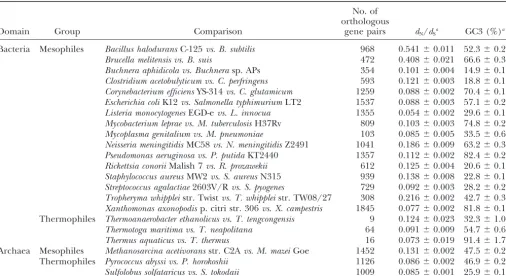
TABLE 1
Sequences used in analyses
No. of orthologous
Domain Group Comparison gene pairs dN/dSa GC3 (%)a
Bacteria Mesophiles Bacillus haloduransC-125vs.B. subtilis 968 0.541⫾0.011 52.3⫾0.2
Brucella melitensis vs.B. suis 472 0.408⫾0.021 66.6⫾0.3
Buchnera aphidicola vs.Buchnerasp. APs 354 0.101⫾0.004 14.9⫾0.1 Clostridium acetobulyticum vs.C. perfringens 593 0.121⫾0.003 18.8⫾0.1 Corynebacterium efficiensYS-314vs.C. glutamicum 1259 0.088⫾0.002 70.4⫾0.1 Escherichia coliK12vs.Salmonella typhimuriumLT2 1537 0.088⫾0.003 57.1⫾0.2 Listeria monocytogenesEGD-evs.L. innocua 1355 0.054⫾0.002 29.6⫾0.1 Mycobacterium leprae vs.M. tuberculosisH37Rv 809 0.103⫾0.003 74.8⫾0.2 Mycoplasma genitalium vs.M. pneumoniae 103 0.085⫾0.005 33.5⫾0.6 Neisseria meningitidisMC58vs.N. meningitidisZ2491 1041 0.186⫾0.009 63.2⫾0.3 Pseudomonas aeruginosa vs.P. putidaKT2440 1357 0.112⫾0.002 82.4⫾0.2 Rickettsia conoriiMalish 7vs.R. prozawekii 612 0.125⫾0.004 20.6⫾0.1 Staphylococcus aureusMW2vs.S. aureusN315 939 0.138⫾0.008 22.8⫾0.1 Streptococcus agalactiae2603V/Rvs.S. pyogenes 729 0.092⫾0.003 28.2⫾0.2 Tropheryma whippleistr. Twistvs.T. whippleistr. TW08/27 308 0.216⫾0.002 42.7⫾0.3 Xanthomonas axonopodisp. citri str. 306vs.X. campestris 1845 0.077⫾0.002 81.8⫾0.1 Thermophiles Thermoanaerobacter ethanolicus vs.T. tengcongensis 9 0.124⫾0.023 32.3⫾1.0 Thermotoga maritima vs.T. neapolitana 64 0.091⫾0.009 54.7⫾0.6
Thermus aquaticus vs.T. thermus 16 0.073⫾0.019 91.4⫾1.7
Archaea Mesophiles Methanosarcina acetivoransstr. C2Avs.M. mazeiGoe 1452 0.131⫾0.002 47.5⫾0.2 Thermophiles Pyrococcus abyssi vs.P. horokoshii 1126 0.086⫾0.002 46.9⫾0.2 Sulfolobus solfataricus vs.S. tokodaii 1009 0.085⫾0.001 25.9⫾0.1
aMean⫾standard error.
plete genomes were not available (Table 1). We identi- also estimateddS anddNby the modified Nei-Gojobori
method (Zhanget al.1998); because the results of both fied orthologous gene pairs (genes homologous by
de-scent from a common ancestral gene without gene methods were similar, only the ML results are presented here. We excluded from analyses those cases in which duplication) between each of these pairs of species. We
applied the BLASTCLUST computer program, available there were no synonymous differences or wheredSwas
undefined; of 19,606 comparisons between putative or-from the collection of BLAST tools (Altschul et al.
1997), to cluster protein translations to define protein thologs, 1649 (8.4%) were excluded on these grounds. We estimateddS and dN between putative orthologs
families (single-linkage method). Homology search
be-tween sequences was performed using an E value of in pairs of closely related species (Table 1). Note that because these comparisons were between orthologous 10⫺50 and a minimum of 20% identity across at least
30% of the sequence lengths. These strict search criteria genes from pairs of closely related species, each nucleo-tide difference between pair members must have arisen were used to increase our chance of identifying
ortholo-gous gene pairs rather than paralogues. Only families with since the most recent common ancestor of the two species. Thus, each comparison is phylogenetically and statistically one member from each species in the pair were used in
analyses, to avoid the problem of paralogous comparisons. independent of each other comparison (Felsenstein
1985). In statistical analyses, we assumed that each or-Sequences were aligned at the amino acid level using the
CLUSTALW program (Thompson et al. 1994) and the thologous gene pair evolves independently of other genes in the genome. However, because we used the alignment was imposed on the coding sequences.
Evolutionary analyses:The maximum-likelihood (ML) orthologous gene pair as the unit of statistical analysis, our analyses did not require the assumption that each method (YangandNielsen2000) implemented in the
PAML program (Yang1997) was used to estimate the nucleotide site evolves independently, a biologically un-realistic assumption that is routinely made in studies of number of synonymous nucleotide substitutions per
syn-onymous site (dS) and the number of nonsynonymous molecular evolution.
We also used phylogenetically independent compari-nucleotide differences per nonsynonymous site (dN).
We used the F3X4 model, which incorporates the nucle- sons in the analysis of nucleotide content. Nucleotide content (both G⫹C content and A⫹G content) was otide composition and transition/transversion ratios
Figure2.—(a) Mean percentage of G⫹C at third codon positions (GC3) in genes used in analyses. (b) Mean percent-age of A⫹G at third codon positions (AG3) in genes used in analyses. T, thermophilic species; NT, nonthermophilic
Figure1.—(a) MeandN/dSratio in comparisons of
ortholo-species. gous genes between closely related species pairs of
thermo-philic (T) and nonthermothermo-philic (NT) Bacteria and Archaea. Numbers of comparisons in each category are shown. (b)
MeandN/dSin comparisons of orthologous genes excluding the higherd
N/dSratio we observed in nonthermophiles
cases withdSordNⱖ1.5.
might be simply due to a reduction in observeddS
re-sulting from compositional bias in nonthermophile spe-cies. To test whether such a phenomenon could be between the two members of each orthologous pair.
Thus values of G⫹ C at the third position (GC3) and responsible for our results, we examined the percentage of G⫹C at third-codon positions (GC3) in the genes of A⫹G at the third position (AG3) were obtained for
each orthologous gene pair. in our data set (Figure 2a). Factorial analysis of variance showed a significant difference in mean GC3 between the two prokaryotic domains (F1,17956 ⫽ 142.27; P ⬍
RESULTS
0.001) and a significant difference between thermo-philes and nonthermothermo-philes (F1,17956⫽5.76;P⫽0.016).
Factorial analysis of variance in mean dN/dS ratio
showed no significant difference between the two pro- There was also a significant interaction between domain and thermophily (F1,17956⫽40.28;P⬍ 0.001).
karyotic domains (Bacteria and Archaea) but a
signifi-cant difference between thermophiles and nonthermo- These results are explained by the observation that mean GC3 was higher in thermophiles than in nonther-philes (F1,17956⫽19.09;P⬍0.001; Figure 1a). There was
no significant interaction between domain and ther- mophiles in the case of Bacteria, but lower in thermo-philes than in nonthermothermo-philes in the case of Archaea mophily, indicating a similar difference between
ther-mophiles and nontherther-mophiles in the two prokaryotic (Figure 2a). In both Bacteria and Archaea, GC3 was closer on average to 50% in nonthermophiles than in domains.
Although the ML method (YangandNielsen2000) thermophiles (Figure 2a). In the entire data set, there was a modest but significant negative correlation be-corrects for nucleotide content bias, it is well known
that under simple models, nucleotide content bias at tween dSand GC3 (r ⫽ ⫺0.101;P ⬍0.001). Thus, on
the basis of G⫹C content alone, thedN/dSratio would
third-codon positions can affect the observed numbers
lowest in thermophilic Archaea. The fact that this pat-tern was not observed (Figure 1) supports the hypothesis that G⫹C content bias was not a major factor in yielding the observed pattern in dN/dSratios. When GC3 was
in-cluded as a covariate in the analysis of variance indN/dS,
there was a significant effect of the covariate (F1,17956 ⫽
5.10;P⫽0.024), but the significant effect of thermophily remained (F1,17956⫽19.44;P⬍0.001). This result
indi-cates that the association between thermophily and a reduceddN/dSwas statistically independent of the linear
relationship betweendN/dSand GC3.
In the case of thermophiles, some data suggest a pref-erence for purines in mRNAs (LaoandForsdyke2000;
Lambroset al.2003). On the hypothesis that a bias in nucleotide content is most likely to be expressed at
Figure3.—Plot ofdNvs.dSfor comparisons of orthologous
third-codon positions, we examined the percentage of gene pairs from thermophilic (red dots) and nonthermophilic A⫹ G at third-codon positions (AG3) in the genes in (green dots) species of Bacteria and Archaea. Analysis of covar-iance in dN withdS as covariate showed a significant effect
our data set (Figure 2b). Factorial analysis of variance
of the covariate (F1,17956⫽ 1072.16;P⬍0.001), a significant
showed a significant difference in mean AG3 between
difference between thermophiles and nonthermophiles
the two prokaryotic domains (F1,17956⫽60.53;P⬍0.001) (F
1,17956 ⫽7.15;P⫽0.007), and a significant interaction
be-and a significant difference between thermophiles be-and tween thermophily and the covariate (F
1,17956⫽ 133.60;P⬍
nonthermophiles (F1,17956⫽250.718;P⬍0.001). There 0.001).
was also a significant interaction between domain and thermophily (F1,17956⫽13.99;P⬍0.001). Consistent with
significant effect of thermophily (F1,9965 ⫽ 7.61; P ⫽
previous results (LaoandForsdyke2000;Lambroset
0.006).
al. 2003), in both Bacteria and Archaea, mean AG3
In the complete data set, the correlation coefficient was higher in thermophiles than in nonthermophiles
betweendNanddSin thermophiles (r⫽0.485;P⬍0.001)
(Figure 2b). This difference was more pronounced in
was similar to that in nonthermophiles (r⫽0.454;P⬍
Archaea than in Bacteria (Figure 2b).
0.001). However, analysis of covariance indicated that In contrast to the case of GC3, there was a modest
there was a significant difference between thermophiles but significant positive correlation betweendSand AG3 and nonthermophiles with respect to the slope of the
(r ⫽ 0.090; P ⬍ 0.001). As with GC3, when AG3 was
linear relationship between dN and dS (Figure 3). We
included as a covariate in the analysis of variance indN/ fitted linear regression lines through the origin on the
dS, there were significant effects of both the covariate assumption thatd
NanddSare both initially zero at the
(F1,17956⫽25.21;P ⬍0.001) and thermophily (F1,17956⫽ moment of lineage divergence for thermophiles and
24.31;P⬍ 0.001). Thus, the association between
ther-nonthermophiles. The slope of the former line was mophily and a reduced dN/dS was statistically indepen- 0.077, while that of the latter was 0.129. These results
dent of the linear relationship betweendN/dSand AG3. suggest thatd
Nincreases for a given increase indSⵑ1.67
In certain comparisons, the ML method estimated times faster in nonthermophiles than in thermophiles. that multiple substitutions had occurred per site, espe- Our results are consistent with the hypothesis that cially in the case of synonymous sites. Although some the proteins of thermophiles are subject to unusually authors have argued that such estimates are reliable strong functional constraints in amino acid sequence, (Blancet al.2003), the accuracy of estimation may be which is reflected in a reduced level of nonsynonymous problematic because the sites have been saturated with nucleotide substitution for a given level of synonymous changes. To test whether our observed results were af- substitution. As a further test of the hypothesis that this fected by saturation, we reanalyzed the data after exclud- constraint arises from the high-temperature environ-ing all comparisons for whichdSordNwas estimated to ment, we made pairwise comparisons of shared
or-beⱖ1.5. The results (Figure 1b) were similar to those thologs between the hyperthermophilic archaeal genus observed with the complete data set. In a factorial analy- Pyrococcus and both the mesophilic genus Methanosar-sis of variance the only significant effect was that of cina and the moderately thermophilic genus Sulfolobus thermophily (F1,9966⫽7.49;P⫽0.006). When GC3 was (Madiganet al.2003).
included in the model as a covariate, there was no sig- Examining pairs of orthologs present in both genera, nificant effect of the covariate, but there was a significant we found that dN/dS ratios for the same genes were
effect of thermophily (F1,9965 ⫽ 7.41;P ⫽ 0.007). Simi- significantly higher in Methanosarcina than in
more deleterious in a thermophile than in a nonthermo-phile. On this hypothesis, the especially deleterious na-ture of mutation in thermophiles would have favored the evolutionary fixation of modifiers that specifically decrease the rates of base-substitution mutagenesis. Strong selec-tion against amino acid replacements in thermophiles would impact their molecular evolution in two ways. First, because most selectively neutral mutations that reach fixation are base substitutions and not indels, the overall rate of molecular evolution would be reduced. Second, within this generally reduced rate of molecular evolution, the fixation of nonsynonymous substitutions would be reduced compared to that of synonymous substitutions. This study provides support for the latter prediction.
It has been suggested that Archaea evolve more slowly than either Bacteria or Eukaryotes. A recent test of this hypothesis concluded that amino acid sequences of Bac-teria and Eukaryotes evolve at indistinguishable rates but that those of Archaea evolve 10–40% more slowly (KollmanandDoolittle2000). However, in that anal-ysis, 10% of the Bacteria butⵑ78% of the Archaea were thermophiles. By contrast, our results imply that natural selection eliminates a higher proportion of nonsynony-mous mutations in thermophiles than in nonthermo-philes, resulting in a lower average rate of amino acid replacement per mutational event in thermophiles,
Figure4.—Plots ofdN/dSfor orthologous gene pairs shared whereas nonthermophilic Archaea and
nonthermo-by Archaeal genera. In each case the line has a slope of 1. (a) philic Bacteria are indistinguishable with respect tod
N/
dN/dSforMethanosarcina acetivorans vs.M. mazeiplotted against
dS. Likewise, thermophilic Archaea and thermophilic
dN/dSfor the orthologous genes inPyrococcus abyssi vs.P.
horo-Bacteria are indistinguishable with respect to dN/dS.
koshii (N ⫽ 192). (b) dN/dS for Sulfolobus solfataricus vs. S.
tokodaiiplotted againstdN/dSfor the orthologous genes inP. Thus, our results imply both that strong purifying
selec-abyssi vs.P. horokoshii(N⫽152). tion against amino acid changes in thermophiles
oper-ates in a similar fashion across both prokaryotic domains and that rates of evolution are likely to be indistinguish-cus (0.044 ⫾ 0.002; paired t ⫽ 12.29; two-tailed P ⬍
able in Bacteria and Archaea but to depend critically 0.001). Similarly,dN/dSratios were significantly higher
on optimal growth temperature. in Sulfolobus than in Pyrococcus (Figure 4b). The mean
Examination of protein-coding sequences from a for Methanosarcina (0.0584 ⫾ 0.002) differed
signifi-wide variety of organisms has provided evidence of the cantly from that for Pyrococcus (0.037⫾0.002; paired
near ubiquity of “purifying” or conservative natural
se-t ⫽ 7.94; two-tailed P ⬍ 0.001). This result provided
lection, which acts to eliminate deleterious mutations evidence of an unusually reduced rate of
nonsynony-(Nei1987). Because of their effect on protein structure, mous substitution in a hyperthermophile. This, in turn,
nonsynonymous mutations are more likely than synony-provides additional support for the hypothesis that life
mous mutations to be deleterious. As a result, over time at high temperatures imposes unusual functional
con-the rate of synonymous nucleotide substitution per syn-straints on the primary structure of proteins.
onymous site (dS) is predicted to exceed the rate of
nonsynonymous nucleotide substitution per
nonsynony-DISCUSSION mous site (d
N), and this prediction is supported in the
case of most genes (Kimura1977;Nei1987). There is An analysis of mutation in a thermophilic archaeon
evidence that some, if not most, prokaryote codon usage (Groganet al.2001) revealed a mutation rate close to
is subject to selective constraint (Sharp andLi 1986; or slightly less than that characteristic of all DNA-based
Bulmer1991;Lynnet al.2002). Where selection favors microbes examined to date. However, the fraction of
certain synonymous codons over others, purifying selec-mutations that were base substitutions was half or less
tion may occur at synonymous as well as nonsynonymous of that observed in eubacterial and eukaryotic microbes
sites. However, that overalldN/dS ratios in prokaryotes
and in mammals. This observation generated the
mococcus celer: thermal stability and RNA binding. Biochemistry
at synonymous sites is of negligible magnitude in
com-42:2857–2865.
parison to that at nonsynonymous sites. Criswell, A. R., E. Bae, B. Stec, J. KoniskyandG. N. Phillips,
Jr., 2003 Structures of thermophilic and mesophilic adenylate
In a survey of 40 prokaryotic genomes, Lynn et al.
kinases from the genusMethanococcus.J. Mol. Biol.333:1087–
(2002) found that the factor explaining the largest
pro-1099.
portion (ⵑ25%) of the variance in codon usage was G⫹ Felsenstein, J., 1985 Phylogenies and the comparative method.
Am. Nat.125:1–15.
C content in the genome. The second most important
Grogan, D. W., G. T. CarverandJ. W. Drake, 2001 Genetic fidelity
factor, related to optimal growth temperature,
ac-under harsh conditions: analysis of spontaneous mutation in the
counted for an additional 10% of the variance (Lynnet thermoacidophilic archaeonSulfolobus acidocaldarius.Proc. Natl. Acad. Sci. USA98:7928–7933.
al.2002). These authors found that the major difference
Gromiha, M. M., M. OobatakeandA. Sarai, 1999 Important amino
between thermophiles and nonthermophiles related to acid properties for enhanced thermostability from mesophilic to their use of arginine and isoleucine codons. Other stud- thermophilic proteins. Biophys. Chem.82:51–67.
Kimura, M., 1977 Preponderance of synonymous changes as
evi-ies have suggested that thermophiles have a preference
dence for the neutral theory of molecular evolution. Nature267:
for purines in mRNAs, which is also expected to affect 275–276.
codon usage (LaoandForsdyke2000;Lambroset al. Kollman, J. M., andR. F. Doolittle, 2000 Determination of the relative rates of change for prokaryotic and eukaryotic proteins
2003). If thermophiles are subject to greater constraint
with anciently duplicated paralogs. J. Mol. Evol.51:173–181.
on codon usage than nonthermophiles, this would be Kreil, D. P., andC. A. Ouzounis, 2001 Identification of thermo-expected to reduce dS and thus to increase the dN/dS philic species by the amino acid compositions deduced from their
genomes. Nucleic Acids Res.29:1608–1615.
ratio in thermophiles. That we observed overall lower
Kumar, S., andR. Nussinov, 2001 How do thermophilic proteins
mean dN/dSin thermophiles than in nonthermophiles deal with heat? Cell. Mol. Life Sci.58:1216–1233.
suggests that, even if greater constraint on codon usage Kumar, S., C. J. Tsaiand R. Nussinov, 2000 Factors enhancing protein thermostability. Protein Eng.13:179–191.
is present in thermophiles than in nonthermophiles,
Lambros, R. J., J. R. MortimerandD. R. Forsdyke, 2003 Optimum
such constraint is not of sufficient magnitude to mask growth temperature and the base composition of open reading the strong difference with respect to constraint on frames in prokaryotes. Extremophiles7:443–450.
Lao, P. J., andD. R. Forsdyke, 2000 Thermophilic bacteria strictly
amino acid sequences.
obey Szybalski’s transcription direction rule and politely
purine-The factors that influence variations among organ- load RNAs with both adenine and guanine. Genome Res.10:
228–236.
isms with respect to patterns of synonymous and
nonsyn-Lynn, D. J., G. A. C. SingerandD. A. Hickey, 2002 Synonymous
onymous nucleotide substitution remain poorly
under-codon usage is subject to selection in thermophilic bacteria.
Nu-stood. Our results suggest that one such factor can be cleic Acids Res.30:4272–4277.
Madigan, M. T., J. M. MartinkoandJ. Parker, 2003 Brock Biology
genome-wide differences among organisms with respect
of Microorganisms, Ed. 10. Prentice Hall, Upper Saddle River, NJ.
to the strength of purifying selection. Furthermore, our
Nei, M., 1987 Molecular Evolutionary Genetics. Columbia University
results demonstrate that a species’ environment repre- Press, New York.
Perutz, M. F., 1978 Electrostatic effects in proteins. Science201:
sents a source of selection that can leave a clear imprint
1187–1191.
on the pattern of long-term genomic evolution.
Sharp, P. M., andW.-H. Li, 1986 An evolutionary perspective on synonymous codon usage in unicellular organisms. J. Mol. Evol. We are grateful for comments on the manuscript by D. W. Grogan.
24:28–38. This research was supported by grant GM66710 to A.L.H. from the
Tekaia, F., E. YeramianandB. Dujon, 2002 Amino acid composi-National Institutes of Health.
tion of genomes, lifestyles of organisms, and evolutionary trends: a global picture with correspondence analysis. Gene297:51–60.
Thompson, J. D., D. G. HigginsandT. J. Gibson, 1994 CLUSTAL W: improvement of the sensitivity of progressive multiple se-LITERATURE CITED quence alignment through sequence weighting, position-specific gap penalties and weight matrix choice. Nucleic Acids Res.22:
Altschul, S. F., T. L. Madden, A. A. Schaffer, J. Zhang, Z. Zhang
4673–4680. et al., 1997 Gapped BLAST and PSI-BLAST: a new generation
Woese, C. R., O. Kandlerand M. L. Wheelis, 1990 Towards a of protein database search programs. Nucleic Acids Res.25:3389– natural system of organisms: proposal for the domains Archaea,
3402. Bacteria, and Eucarya. Proc. Natl. Acad. Sci. USA
87:4576–4579.
Blanc, G., K. HokampandK. H. Wolfe, 2003 A recent polyploidy Wolfe, K. H., P. M. SharpandW.-H. Li, 1989 Mutation rates differ superimposed on older large-scale duplications in theArabidopsis among regions of the mammalian genome. Nature337:283–285. genome. Genome Res.13:137–144. Yang, Z., 1997 PAML: a program package for phylogenetic analysis
Brown, J. R., andA. N. Lupas, 1998 What makes a thermophile? by maximum likelihood. Comput. Appl. Biosci.13:555–556. Trends Microbiol.6:349–351. Yang, Z., andR. Nielsen, 2000 Estimating synonymous and
nonsyn-Bulmer, M., 1991 The selection-mutation-drift theory of synony- onymous substitution rates under realistic evolutionary models. mous codon usage. Genetics129:897–907. Mol. Biol. Evol.17:32–43.
Cambillau, C., andJ. M. Claverie, 2000 Structural and genomic Zhang, J., H. F. RosenbergandM. Nei, 1998 Positive Darwinian correlates of hyperthermostability. J. Biol. Chem.275:32383– selection after gene duplication in primate ribonuclease genes.
32386. Proc. Natl. Acad. Sci. USA98:3708–3713.
Chen, Y. W., M. BycroftandK.-B. Wong, 2003 Crystal structure