ABSTRACT
ISIK, GOZDE. Policy Responses to Financial Crises: Capital Controls as an Alternative to IMF Programs. ( Under the Direction of Dr. John Lapp )
The purpose of this study is to compare the post–treatment economic performances of countries which implemented IMF- designed recovery programs, and the counterfactual, all-encompassing capital and exchange controls, as a policy response to financial crisis. By doing so, I aim to find out which policy response provides crisis-hit countries better assistance in the short-run recovery process.
I extend the scope of the Rodrik & Kaplan study by including additional IMF-assisted crisis countries Turkey, Brazil and Russia, and using them as comparators to Malaysia, which embarked on a range of strict capital and exchange controls.
By employing a time shifted difference–in-differences model, I obtain empirical evidence, consistent with the findings of Rodrik & Kaplan, which are overwhelmingly in favour of the capital controls as a provider of quicker and more successful recovery in the short-run.
Policy Responses to Financial Crises:
Capital Controls as an Alternative to IMF-Programs
By
GÖZDE I
Ş
IK
A Thesis submitted to the Graduate Faculty of North Carolina State University in Partial fulfillment of the requirements for the Degree Master of Arts
ECONOMICS
Raleigh
December 2002
APPROVED BY:
Chair of Advisory Committee Member
BIOGRAPHY
Gözde Işõk , born in Ankara, Turkey in 1978, after spending 11 years in the United
Kingdom, returned back to Ankara where she graduated from Gazi Anadolu Lisesi in 1995.
She attended Ankara University, Faculty of Political Science (SBF). Upon graduation in 2001, she enrolled in the Master’s program in the Department of Economics at the North Carolina State University.
ACKNOWLEDGEMENTS
I would like to thank Dr. John Lapp for providing excellent guidance and helping me get on track within a very tight schedule.
I am very grateful to Dr. Alastair Hall for assisting me with my model and regressions during my introduction period to the elaborate world of econometrics.
Dr. John Seater , whom I am also very grateful to, provided me with valuable help and insights throughout the various stages of this thesis.
I would also like to sincerely thank Dr. Matt Holt, whom, during my frequent visits, helped me greatly towards establishing the empirical foundation of this study.
Finally, I am very grateful to Dr. Areendam Chanda, who very kindly took the time to provide me with some crucial data that I was missing.
Contents
List of Tables………vii
List of Figures……….viii
I. Introduction………
1II.
Financial Crises in Emerging Markets………
4A.
Definitions and Underlying Mechanisms of Financial Crisis………....4B.
The Economic Environment Prior to the Implementation of Crisis Recovery Programs: Country Experiences with Financial Crisis…..10i- Turkey……….10
ii- Brazil………...17
iii- Russia………..21
III. Policy Responses to Financial Crisis:
IMF-Supported Programs and Capital Controls………..
27A.
IMF-Supported Recovery Programs and Policies………27B.
Capital Controls……….. 28i- Why do Countries Use Capital Controls………..……...30
ii- Forms of Capital Controls……… 37
C.
The Malaysian Capital and Exchange Rate Controls ……….….40i- Build Up to the Crisis and underlying Vulnerabilities……….……..42
ii- The Control Package……….44
iii- The Post-Treatment Environment: Results of the Controls………..47
IV. Empirical Considerations……….
54A.
The Model: Time Shifted Difference-in-Differences Model………….54B.
Underlying Assumptions……….59I. Empirical
Results……….
61A.
Turkey vs. Malaysia……….61B.
Brazil vs. Malaysia………. .70C.
Russia vs. Malaysia………. 74D.
Pooled Regressions……….. 79II. Concluding
Remarks………...
83References……….
86List of Tables
Table III. 1 Distribution of Private Capital Flows………..31
Table III. 2 Sovereign Credit Ratings………..50
Table V. 1 OLS Joint Regressions: Turkey vs. Malaysia………...63
Table V. 2 OLS Single Regressions: Turkey ……….………...64
Table V. 3 OLS Single Regressions: Malaysia………....69
Table V. 4 OLS Joint Regressions: Brazil vs. Malaysia……….…72
Table V. 5 OLS Single Regressions: Brazil………...73
Table V. 6 OLS Joint Regressions: Russia vs. Malaysia……….…77
Table V. 7 OLS Single Regressions: Russia………...…...77
Table V. 8 OLS Joint Regressions: Pooled………...…...81
Appendix Table 1 GLS Joint Regression Results:
Turkey vs. Malaysia……….. .93
Appendix Table 2 GLS Joint Regression Results:
Brazil vs. Malaysia……….. ...93
Appendix Table 3 GLS Joint Regression Results:
Russia vs. Malaysia……….. ..94
Appendix Table 1 GLS Joint Regression Results:
Pooled………. .94
List of Figures
Figure II.1 Industrial Production Index (Turkey) ………13
Figure II.2 Nominal Interest Rates (Turkey)………...13
Figure II.3 Nominal Exchange Rate (Turkey)……….14
Figure II.4 Stock Market Index (Turkey)………15
Figure II.5 CPI (Turkey)………..16
Figure II.6 Capital Flows (Turkey)………..16
Figure II.7 Trade Balance (Turkey)……….17
Figure II.8 Foreign Reserves (Turkey)………18
Figure II.9 CPI (Brazil)……….19
Figure II.11 Stock Market Index (Brazil)………21
Figure II.12 Nominal Exchange Rate (Brazil)……….21
Figure II.13 Nominal Interest Rates (Brazil)………...…22
Figure II.14 Capital Flows (Brazil)………...22
Figure II.15 Foreign Reserves (Brazil)……….……23
Figure II.16 Nominal Interest Rates (Russia)……….….23
Figure II.17 Industrial Production Index (Russia)……….24
Figure II.18 CPI (Russia)………..25
Figure II.19 Foreign Reserves (Russia)………25
Figure II.20 Trade Balance (Russia)………...26
Figure II.21 Nominal Exchange Rate (Russia)………....27
Figure II.22 Stock Market Index (Brazil)……….…...28
Figure III.2 Nominal Interest Rates (Malaysia)………..50
Figure III.3 Nominal Exchange Rate (Malaysia)………....51
Figure III.4 Stock Market Index (Malaysia)………...….…...52
Figure III.5 Imports – Exports Growth Rates (Malaysia)……….53
Figure III.6 CPI (Malaysia)………..………..54
I
.
Introduction
The liberalization of capital accounts in many emerging markets throughout the 80’s, followed in the 90’s by immense developments in communications and increased access to information helped facilitate the integration of world financial markets and to create a globalized trade system.
The introduction and wide use of new financial instruments and transactions such as call and put options, derivatives, buying on margin, and hedge funds have all expanded the range of assets and created increased scope for leverage, thus expanding the possibilities of speculation. New financial instruments and transactions have extended the credit system and created new financial markets, where new bubbles can form and burst.
These developments in turn led to highly open and linked economies and markets to emerge and unprecedented amounts of cross-border capital flows, that eventually were to contribute to severe recurring periods of financial crises experienced by many developing and transition countries. Such examples of these episodes of crisis can be named as; the Mexican crisis of December 1994, the Asian crisis that started in the July of 1997, the financial crises that followed in Russia in August 1998, Brazil in January 1999, and Turkey and Argentina in early 2001.
There have been two main observed responses that these crisis-hit countries have applied into policies:
The first of these policy responses is turning to the International Monetary Fund for assistance in crisis recovery, and in return for a loan, following macroeconomic stabilization and structural reform programs designed and monitored by the IMF. These programs mainly include policies such as floating the exchange rate generally followed by currency depreciation, maintaining high interest rates, cutting down on government expenditures, privatization and closing down insolvent banks and other financial institutions.
to stem rapid outflows. This approach to overcome financial crisis takes account of such policies as fixing the domestic currency, fiscal expansion, tax levies on capital and currency exiting domestic markets, lowering interest rates and segmenting domestic markets from international and offshore currency and capital markets.
Capital controls and IMF programs are, for the purpose of this paper, assumed to be the only rational responses to overcoming crises and the exact opposite of each other; the counterfactual policy response to IMF supported programs is capital controls.
However, another policy response would be not to implement capital controls or IMF prescribed programs and maintain existing policies. In reality this is never a viable option because when experiencing financial crisis, countries are typically faced with declines in output and employment, pressure on the domestic currency, substantial increases in interest rates and inflation and a downturn in the business environment. Therefore, existing policies are proved to be non-sustainable; new policies, aimed at easing the effects of the crisis, eliminating the underlying causes and subsequently restoring confidence in domestic markets, have to be designed, implemented and enforced
Malaysia and its policy responses to crisis will be the subject of emphasis in this study. This paper aims to compare Malaysia’s post-recovery performance to that of the IMF assisted countries performances.
I will be extending the study carried out by Rodrik & Kaplan1 by introducing additional IMF-assisted countries into the time shifted difference-in-differences model, such as Russia, Brazil and Turkey, all of which were struck by crisis subsequent to the Asian crisis. And, in the context of financial crisis, make an economic evaluation of the Malaysian capital controls as opposed to its counterfactual policy response IMF designed and supported recovery programs. Rather than making valuations on the post-control performance of the Malaysian economy per se, this study is about comparing the performance of the post-control Malaysian economy to that of the countries that appealed to the IMF for assistance.
It is still too early to make any assessments on the long-term affects of the Malaysian controls on capital flows on real, monetary and financial features of the economy;
however, some short-term evaluations can be made. Therefore, the one-year period following the application of the recovery program, whether it is IMF prescribed or in the form of controls on capital and exchange rates, will be taken as the period of interest for the purpose of comparison.
I will be drawing out comparisons that are related to financial and monetary aspects of the economy and the performance of the real economy.
Main emphasis shall be placed upon the post-treatment performance of the economy, reflected through indicators such as interest rates, exchange rates, international reserves, stock market index, consumer price index, and industrial production index.
The contents of this paper can be outlined as follows:
II
.
Financial Crises in Emerging Markets
Throughout the last decade, the international financial system has been characterised by financial crises in emerging markets all over the world, creating devastating effects on all aspects of the economy. The turmoil that began with the collapse of the Thai Baht in July 1997 was quick to precipitate depreciation in currencies and decline in equities in both the region and in other emerging markets.
In the words of well-cited economist Paul Krugman on the Asian Crisis2:
“ Never in the course of economic events-not even in the early years of the Depression – has so large a part of the world economy experienced so devastating a fall from grace.”
It was not just emerging markets that were hit by crises, before the Tequila Crises of 94’ there was the European Monetary System crisis in 1992 and 1993. In 1992 the fixed Exchange Rate Mechanism of the European Union Countries started to crumble when the United Kingdom and Italy were forced to abandon the rigid exchange system and leave the Pound and the Lira to float freely, and later in 1993 other members of the ERM like Spain and Portugal floated their currencies with a new central parity3.
2Krugman, (1999b)
(A) Definitions and Underlying Mechanisms of
Financial Crisis
What exactly is a financial crisis that has led to the collapse of so many currencies and huge declines in economic activity over the last decade and what were the underlying mechanisms? There are various aspects to a financial crisis, such as a currency crisis, banking crisis, balance of payments and debt crisis. Generally a currency crisis is believed to exist when there is an abrupt nominal devaluation in the domestic currency accompanied by a substantial real change in the exchange rate. It is important to differentiate between nominal and real changes in the exchange rate, in order to tell apart devaluation caused by hyperinflation and a currency crisis.
All this implicitly implies that a currency crisis has to occur under a fixed or pegged exchange rate system. At the onset of crises in South East Asia, Brazil, Russia and Turkey, all countries had some form of a rigid exchange rate system in place, which was to be abandoned after realization that the peg was no longer sustainable.
Market participants, under various circumstances that will be explained below, start excessively purchasing the foreign currency that the domestic currency is pegged or linked to, usually the U.S. Dollar, because they believe that the central bank will no longer be able to maintain the fixed exchange rate. This excessive buying of foreign exchange is called a ‘speculative attack’.
An economy will be exposed to this kind of attack if there are certain vulnerabilities in existence. One of these is a misaligned exchange rate system.4 This kind of vulnerability is observed in countries that implement exchange rate–based disinflation, also known as stabilization, programs. These programs are aimed at bringing down persistent inflation, but do so at the cost of a substantial real appreciation of the domestic currency. This appreciation making exports more expensive and imports cheaper causes a widening in the current account deficit and a decline in growth, because less is being produced due to a fall in exports. The other reason for a reduction in growth is that the fall in exports also
means less foreign currency entering the economy, therefore, in order to continue financing this deficit, interest rates increase sharply, thus resulting in even more of a reduction in real economic activity. All this suggests that the program cannot be sustained forever, and at some point market participants question this situation. This is when the speculative attacks begin.
In order to maintain the fixed exchange rate authorities will attempt to fight off these speculative attacks by purchasing the domestic currency using foreign reserves, therefore, preventing the domestic currency from depreciating against the currency it is linked to. This effort to preserve a fixed exchange rate has on most occasions proved to be futile because increased interest rates and reduced reserves make it impossible to defend the fixed exchange rate against speculative attacks, and has led to the further depletion of reserves.
A substantial loss of foreign reserves may set off another form of crisis: a balance of payments crisis. A balance of payments crisis, in turn, may lead to a debt crisis, if the loss of reserves is large enough to render weak a government’s ability to service debt that is denominated in foreign currency. This situation could result with a default on debt payments, like in the case of Russia in the summer of 1998.
Another form of a financial crisis is a banking crisis
Banks and other financial institutions both lend and borrow money within the financial system and do so under problems arising from imperfect information. They also have to maintain a balance sheet, that is, their assets have to equal their liabilities.
The financial sector of an economy can place itself in a vulnerable situation to a number of events that could set off a crisis. The primary sources of these vulnerabilities lay in the balance sheet, in the form of non-performing loans, currency and maturity mismatched exposures5.
In the case where the balance sheet contains a substantial amount of non-performing loans, interest rate defence can be a vital problem. Existence of non-performing loans limit the scope for interest rate adjustment; if interest rates are increased, the loan
portfolio sinks even further, and if interest rates are decreased, there is the danger of the currency coming under attack.
Short-term public debt combined with a large budget deficit, like the financial sector, can cause balance sheet problems for the public sector. Declining real growth, that causes the budget deficit to grow further, leaves the public sector exposed to interest rate risk, thus undermining debt sustainability and raising questions about the ability to service debt. This situation results with a flight from public debt towards foreign assets, thus a funding crisis for the public sector that causes interest rates to rise sharply. Under these circumstances, if the exchange rate is fixed, reserve depletion leads to the emergence of currency risk as well. If the exchange rate is flexible, depreciation of the domestic currency follows, thus placing the foreign currency denomination sections of the balance sheet under pressure. An example of this is Brazil’s crisis in January 1999, where public debt was mainly short-term and denominated in foreign currency.
A currency crisis may also set off a banking crisis or vice versa. When creditors of short-term interbank links and depositors withdraw their funds from banks and other financial institutions they believe are illiquid or perhaps insolvent, this causes fund to flow offshore, thus initiating a loss of reserves, rising interest rates and ultimately depreciation resulting with a major currency crisis. Or alternatively, when the domestic currency comes under speculative attack, eventually leading to a substantial depreciation in the real exchange rate, the financial sector, if exposed to currency or maturity mismatches or both, could be faced with a decline in lending and soaring interest rates, which may well lead to a full-blown banking crisis. An economy may also experience both a currency and a banking crisis at the same time, in the literature; this has come to be known as the ‘twin crises’6. A fine example of this situation is the Turkish financial crisis of December 2000,
when a banking crisis, in a matter of six weeks, led to the collapse of the Turkish Lira and the abandonment of the pegged exchange rate system.
Like the financial sector, the corporate sector has balance sheets too, and is vulnerable to the same kinds of risks as the banks and other financial institutions are. The larger the
corporate sectors short term debt in the national balance sheet, the more the economy will become vulnerable to a funding crisis, eventually leading to a currency crisis. When a certain sector appears to be suspicious to market participants, funds are drawn back causing capital outflow, which in turn may lead to currency crisis.
The corporate sectors of Korea and Indonesia during the Asian Crisis reflect this situation nicely. The corporate sectors in these countries had huge debt equity ratios and a very large amount of this debt was short-term and denominated in foreign currency, when this came into realization, massive amounts of capital outflow began to take place throwing the countries into a severe financial crisis7.
As we have seen, all these different forms of crises go hand in hand, usually one triggers another. It is rather difficult to disentangle these crises from each other and to explain which crisis actually leads to the other.
In order to clearly understand this somewhat of a predicament, I believe it is useful to realize the fundamental problem that the financial system is faced with. The common underlying cause that brings up a potential financial crisis is the problem of imperfect information.
A financial system, through its institutions, channels funds to firms and individuals that have productive investment opportunities. Participants in financial markets within this system have to make decisions under problems arising from asymmetric information, where one side to a financial contract has less information than the other. This leads to two main problems: adverse selection and moral hazard. Adverse selection takes place before the financial transaction itself and is when a potentially risk bearing credit selection is made. Sides that give out credit will try to overcome this aspect of the asymmetric information problem by screening out good from bad credit risks, however this may lead to a reduction in credit allocation thus increasing interest rates and creating adverse effects on the real economy.
Moral hazard occurs after the financial transaction takes place, and is a situation where a borrower that has incentives to invest in projects with high risk in which the lender will
end up bearing the risk if the project is to fail. This problem also occurs when the borrower has incentives to use the funds towards their personal use, that is, to misallocate funds. Moral hazard, like adverse selection, also leads to sub-optimal levels of lending and investment.
Definitions of the asymmetric information problem illustrated above can be used to describe what a financial crises is in essence:
A financial crisis is a situation where financial markets are experiencing disturbances resulting from problems of adverse selection and moral hazard, where markets are no longer capable of efficiently allocating funds to investment opportunities that are most productive, thus leading to a decline in economic activity8.
Asymmetric information has been the principal cause that has brought about the factors promoting financial crises in our countries of interest.
Under whichever definition, Brazil, Russia, Turkey and Malaysia all experienced severe episodes of financial crisis with devastating effects on the whole of the economy.
The effects of a financial crisis reflect on all aspects of an economy, bearing very high costs. In a crisis, governments will most often bail out troubled banks and corporations. This bail out will come at the expense of a very high public debt; the burden on a government resulting from bailouts can be as large as 20-30 % or more of GDP. Increased public debt, in turn, will lead to future tax liabilities. However, since high interest rates and a fall in output, thus income, and depreciation of the domestic currency, all which are associated with a state of financial crisis, will cause an almost certain decline in tax revenues9.
Financial crises, currency crises in particular, result with substantial amounts of reserve loss, which is usually lost in attempts to defend a fixed exchange rate or to bailout banks
8Mishkin (2000)
and companies. This could impair a countries ability to service debt and therefore deteriorate its credit rating. This would mean a high cost in terms of international capital. A crisis also redistributes wealth and income, usually to the advantage of a minute group. Emerging market crises enrich those who are able to convert their assets into foreign currency just in time before the devaluation takes place. While the ones who are able to pull this off are a small elite with close political and financial sector relations, for the remainder of the population , financial crisis translates into a dramatic fall in real wages and employment and bankruptcy for small debtors, that is, banks and firms that are not considered big enough to bail out.
In conclusion, a financial crisis, in whichever form it shows itself, will bring on poor economic performance, reduction in real growth rates, short horizons, reductions in the standard of living and a deteriorated social and economic infrastructure.
(B) The Economic Environment Prior to the
Implementation of Crisis Recovery Programs:
Country Experiences with Financial Crisis
How does all this information given in the last section apply to our countries of interest? Under this heading I will be drawing out connections between the different types of financial crises and the underlying mechanisms and the individual experiences of Turkey, Brazil and Russia by providing information on the economic environment and the sequence of events leading to the onset of the financial crisis and how prevailing policies were no longer sustainable, therefore requiring some kind of intervention in the form of a crisis recovery program. The experience of Malaysia will be discussed in the next section.
i- Turkey ( February 2001 )
in December 1999 after signing a stand-by agreement worth $ 15 billion. This program was aimed at pulling the economy out of the deep recession it had been in throughout 1999.
However, this program, as mentioned above, had led to a real appreciation of the Lira, which in turn had caused a decline in growth and foreign reserves. The current account deficit increased from 1% of GDP in 1999 to around 5% in 200010. The foundations for a currency and balance of payments crisis had been set.
A potential balance of payments and currency crisis were, unfortunately, not the only prospects the Turkish economy was face to face with. A serious banking crisis was becoming more and more a possibility. Despite all steps taken towards establishing a sound prudential framework, they turned out to be weak and ineffective and failed to prevent banks, including state owned banks, and other financial institutions from taking on excessive risk.11
10Ghosh et al, (2002 )
11 Following the crisis of 1994, Turkish authorities put into practice policies and laws that aimed
The large budget deficit and high inflation, despite a disinflation program in place, led to volatile interest rates. This volatility led to banks preferring to engage in short-term lending and arbitrage activities that were a lot more profitable than traditional banking activities.
Turkish banks were highly exposed to currency and maturity mismatches.12 The financial sector was also exposed to credit, exchange and interest rate risks which were due to extensive forms of connected lending and borrowing through the interbank system and large open positions on foreign exchange13. Most of these banks in question also had weak capital adequacy ratios.
12 These mismatches were mainly caused by extensive investment in government securities
financed with short-term external borrowing in foreign currency.
13Banks were able to take on large open positions due to the crawling peg, since it was
In late November 2000, two of the largest Turkish banks closed their large credit lines to three smaller banks, due to the smaller banks’ high exposure to interest rate risk, but essentially to their need for liquidity to close open positions. This was a case of good banks closing their credit line to bad banks14. Then there was the rapid drop in the prices of government securities that many banks had been excessively investing in by borrowing short-term abroad. These developments caused panic among international investors, shortly after causing a run on banks and currency. Interest rates soared in order to prevent capital flight, but nevertheless, huge amounts of capital outflow occurred. The rigid exchange rate regime, together with capital outflow, led to a substantial decline in foreign reserves15.
14Ozatay & Sak (2002)
As the central bank intervened by injecting large amounts of liquidity into the market, expectations of an inevitable devaluation and the abandonment of the crawling peg increased. There was a huge inconsistency between high interest rates and the pre-announced rate of depreciation.
Another factor, although not a financial one, that contributed to the worsening of the economy was the devastating earthquakes that hit Turkey in August and November of 1999, claiming the lives of over 30 thousand and causing billions of dollars of damage16. All of these factors combined, had left Turkey highly vulnerable to a full-blown financial crisis in the event of a possible turn in market sentiment. This turn in sentiment was not
late to come; it was quite obvious to everyone that the program could not be sustained for much longer.
In the February of 2001, expectations turned into reality, prevailing policies were no longer sustainable; the central banks’ abilities to defend the peg were almost exhausted. The Turkish economy was experiencing a full-blown financial crisis; a blend of currency, banking and balance of payments crisis all in one, which was to be triggered by an unusual event during a regular National Security Council meeting when the President threw a hardback copy of the constitution at the Prime Minister during a hot debate. That day, overnight interest rates hit a record high of 2058% that night, and 4019% the next. 17 On February 22, 2001 the exchange rate system collapsed, the crawling peg was abandoned and the Turkish Lira was left to float freely against all currencies, followed by a huge devaluation of around 40%. The dollar jumped from 685 thousand Liras to almost 1 million in one day.
Prior to the crisis of 2000-2001, Turkey had already been undergoing an IMF – supported stabilization program. After the most recent crisis, a new 19 billion $ deal with the IMF
17Luckily on that date US markets were closed and the central bank was unable to fully meet the
was agreed on. In return the new board of the central bank and the treasury under the new finance minister would take additional measures to strengthen the prudential regulatory system and set up a fiscal stability program. Insolvent banks would be closed down and troubled state banks would be merged.
Government spending would be cut in order to strengthen the budget to accommodate the fiscal costs of bank recapitalization and privatization would be accelerated.
ii- Brazil ( January 1999 )
The Brazilian government, under the Real Plan in 1995, had set an adjustable band for the Real linked to the U.S. Dollar, and the currency was to crawl within that band. This was a similar exchange rate regime to the one that was in place in Turkey before the crisis of February 2001.
Prior to the financial crisis that resulted with the floating of the national currency, the Real, in January 1999, the Brazilian economy had placed itself in a vulnerable position to crisis, due to its increasing internal and external imbalances.
The broad availability of money up until the Asian crisis, had created opportunities for arbitrage by taking advantage of interest rate differentials through domestic markets and setting up leverage transactions with sovereign and private debt securities on the international market18.
Brazilian banking institutions had also invested heavily in foreign currency denominated assets such as Eurobonds, which were also issued by companies, and sovereign debt in the form of Brady and global bonds. These investments were financed mostly by overnight borrowing or by issuing short-term bonds, thus leaving the economy vulnerable to mismatch problems.
Shortly after the Asian Crisis broke out, the Real started to come under pressure. The reason for this was that there was a general decline in the credit line to all emerging markets, this credit crunch led to the rapid liquidation of assets. This quick delevaraging, in turn, caused a high increase in the demand for foreign currency.
Capital outflows reached $ 9.7 billion at the end of 199719. The central bank, at first, tried
to avoid raising interest rates, attempting to restore a positive interest rate differential, it injected currency into the market. However, this attempt was unsuccessful and a sharp rise in overnight rates could not be prevented.
But the worst was yet to come for Brazil. In the spring of 1998, conditions in international markets were deteriorating as the situation in Russia was worsening. The condition in Russia had contractionary effects on developed country financial markets, thus causing a strong decline in capital availability to all emerging markets. This large reduction in funds increased the interest on pre-fixed government securities. In response to this, the Brazilian authorities issued short-term bonds that were indexed to high overnight rates.
When crisis eventually broke out in Russia in August 1998, with the Russian government defaulting on its bonds, Brazil’s portion of post-fixed debt stood at 60% of total stock of government debt.
This further worsening of the economic situation in Brazil set off a speculative attack on the Real in early November 1999. This large-scale speculative attack, along with unsuccessful attempts at fiscal adjustment caused huge amounts of reserve loss. The central bank, in attempts to keep the Real within its band lost almost $ 40 billion of its currency reserves20. Prevailing policies were no longer sustainable. The central bank, first tried to widen the exchange rate band, failing to do so, 2 days later on January 15 1999 the existing exchange rate system was abandoned and the Real was left to float.
iii- Russia ( August 1998 )
The next couple of years following the implementation of the stabilization program, Russia’s budget deficit continued to grow to around 7-8.5 % of GDP21.
This increasing widening of the fiscal deficit resulted with a huge debt burden, most of the debt being short-term in maturity and foreign currency denominated22.
In addition to the deficit and growing debt, external terms of trade had also been worsening which was due to a fall in international prices for Russia’s primary exports23. Thus, adding to the current account deficit and putting the crawling exchange rate under pressure.
Interest rates were increased sharply to help cope with the weakening of the balance of payments. Until the summer of 1998, the Russian central bank managed to successfully maintain the Rouble within its band at the expense of a loss of foreign reserves.
21Goldfajn & Baig , (2000)
22These short-term government bonds were known as GKO’s and were officially created in 1993.
This depletion in reserves has also been associated to the Russian Government’s failure to implement decisive fiscal adjustments.24
These factors resulted with a rapid outflow of capital as investors rushed to withdraw their funds from the country as it was becoming more and more inevitable that the Russian authorities could not keep the Rouble in its band for much longer. As market participants continued to exit the government debt market, foreign reserves dropped drastically. In addition to capital flight, a large number of banks had invested heavily in treasury bills and had exposed themselves to currency risk by borrowing in foreign currencies.
In July 1998, the situation in Russia was worsening, reserves were falling and credit availability had been declining, whereas the government had to roll over $ 1 billion a week in short-term debt. Current policies at the onset of the crisis were obviously not a valid choice and could no longer be continued. Russia’s crisis recovery program came in the form of a $ 22 billion IMF-package.
switch to longer-term dollar obligations. But after the Duma rejected two crucial tax measures, serious doubts were raised about Russia’s policy commitments25.
The Russian government announced a restructuring of Rouble-denominated short-term government debt and a de facto devaluation by widening of the exchange rate band, which would subsequently be abandoned altogether in September 1998, allowing the Rouble to float26.
A 90-day unilateral moratorium was imposed on the repayment of private external debt and the government started negotiations with creditors for a rescheduling of debt that was due 1999 and 2000.
The results of the Russian crisis in comparison to those of the ones that had preceded it were somewhat different. Russia’s crises, resulting with default on sovereign debt, proved to have international spillover effects on not just regional and other emerging
25Hahnel ( 1999 )
26As a response the IMF suspended any further disbursements of the $ 22 billion deal, only to
markets but also on developed countries27. The near collapse of the U.S. Long Term Capital Management hedge Fund ( LTCM ) in September 1998 is an example of this spill-over effect28.
The Russian crisis was also unique in a sense that it had an impact on countries with very little in common, defying traditional explanations of contagion models that were
based on trade links, competitive devaluation and regional effects, opening up a whole new range of contagion literature trying to explain this phenomena29.
In conclusion, the fundamental problems that led to a financial crisis in Russia were not in the corporate or financial sector, but more in the public sector. The crisis did not start within currency or capital markets but through the international bond market.
27 Dungey et al. (2002)
28The duration of the LTCM crisis was to be short-lived, lasting only a few weeks due to
aggressive intervention by the Federal Reserve. The Fed came up with a huge bailout plan by cutting interest rates sharply and encouraging 14 banks to invest in the hedge fund for a stake in the firm to save it.
(Dungey et al. 2002 )
III
.
Policy Responses to Financial Crises:
IMF- Supported Programs and Capital Controls
Counties have developed various policies to cope with crisis. As opportunities to borrow from international markets became limited, and in most cases impossible, some countries had no option but to turn to the IMF for assistance in crisis management, and in return were required to undergo IMF designed and monitored fiscal and monetary policies and structural adjustment programs.
(A) IMF-Supported Crisis Recovery Programs and Policies
IMF supported crisis-resolution packages that come under the names of stand-by arrangements and enhanced fund facility, are typically aimed at restoring confidence in markets and stemming further capital flow, involving tightened macroeconomic and fiscal policies accompanied by structural adjustment30.
Fiscal, monetary and structural policies are instituted in way that help adjust public sector imbalances, maintain interest rates at sufficiently high levels to compensate investors for higher risk and attract new flows, and address structural issues such as weaknesses in the banking and corporate sectors.
IMF – designed stabilization and adjustment programs would prescribe the following remedies for crisis recovery31:
30 Ghosh et al. ( 2002 )
● Monetary Austerity: Tightening the money supply so that it would lead to the increase of domestic interest rates, which would attract new capital into the economy and stabilize the value of the local currency. But this policy has been highly criticized on the basis that it worsens further the performance of the real sector, which, as a result of the crisis had been declining already. High interest rates do not help in boosting private consumption and investment.
● Fiscal Contraction: Government spending is cut dramatically and sources of tax revenue and collection are increased. This policy is also opposed to on the same basis as above.
● Acceleration of Privatization: State – owned enterprises are sold off to the private sector. Closing insolvent banks and merging or selling banks with liquidity and capitalization problems.
● Financial Liberalization: Restrictions on the inflow and outflow of cross-border capital movements and the operations of foreign corporations and banks are removed.
● Structural Adjustment: Establishing or strengthening the prudential and regulatory system of the financial and corporate sector.
(B) Capital Controls
Starting from the early 80’s, the rapid liberalisation of capital accounts in emerging markets and transition economies all over the world have led to immense volumes of capital flows from developed countries to these emerging markets.
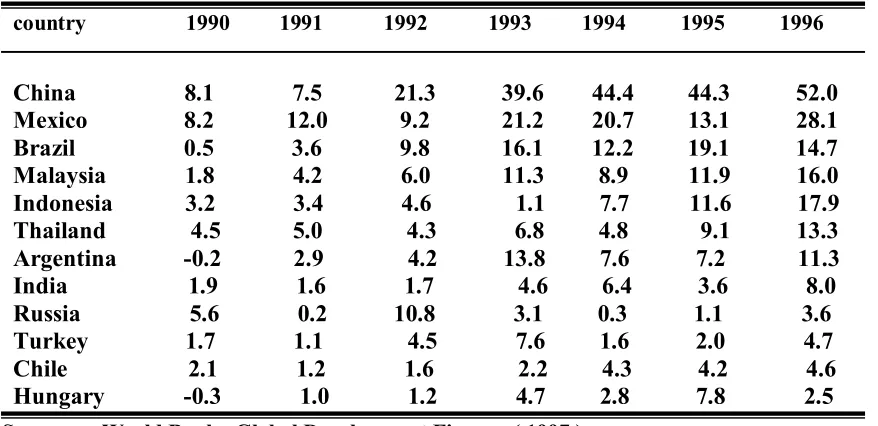
Table III.1. shows the distribution of private capital inflows to these middle-income and rapidly industrialising countries, for the first half of the 90’s, when cross-border capital flows were at their highest volume.
Table III . 1 Distribution of Private Capital Flows ( Billion $ )
country 1990 1991 1992 1993 1994 1995 1996
China 8.1 7.5 21.3 39.6 44.4 44.3 52.0 Mexico 8.2 12.0 9.2 21.2 20.7 13.1 28.1 Brazil 0.5 3.6 9.8 16.1 12.2 19.1 14.7 Malaysia 1.8 4.2 6.0 11.3 8.9 11.9 16.0 Indonesia 3.2 3.4 4.6 1.1 7.7 11.6 17.9 Thailand 4.5 5.0 4.3 6.8 4.8 9.1 13.3 Argentina -0.2 2.9 4.2 13.8 7.6 7.2 11.3 India 1.9 1.6 1.7 4.6 6.4 3.6 8.0 Russia 5.6 0.2 10.8 3.1 0.3 1.1 3.6 Turkey 1.7 1.1 4.5 7.6 1.6 2.0 4.7 Chile 2.1 1.2 1.6 2.2 4.3 4.2 4.6 Hungary -0.3 1.0 1.2 4.7 2.8 7.8 2.5
Source : World Bank , Global Development Finance ( 1997 )
Looking at Table 1, we can see that China, Mexico and Brazil were the countries that got the lion share of private capital flows throughout this period. The 12 countries listed in the table above, between themselves, accounted for almost three-fourths of total capital flows32.
Before 1993, there was a lot more equality in the distribution of private capital among these 12 countries. And when we approach the end of the period, in 1996, we can see that China is the largest recipient of private capital, by attracting more than 50 Billion $ in private capital inflows.
There is a wide range of literature on capital controls: The economic mainstream has been divided into two about the justification and effectiveness of the use of capital controls.
More conservative economists such as Dornbush (2000) have claimed that capital controls are not effective in recovery from financial crisis. A number of economists, such as Krugman (1999), argue that globalisation has simply gone too far and that free capital mobility has rendered the international financial system fragile and unstable. Another name with a parallel view is former World Bank Chief Economist Joseph Stiglitz (1999), who states that developing countries need to manage volatile markets by considering policies that help stabilize the economy, including Chilean style capital controls. This suggestion has also been put forward by Ito and Portes (1998) and Eichengreen (1999). The idea of using capital controls in order to reduce macroeconomic instability is not a new concept. James Tobin (1978) suggested taxing foreign exchange transactions to help reduce speculative attacks. In the mid-90’s, Tobin’s proposal was discussed again after the EMS crisis broke out. Eichengreen and Wyplosz (1993) claimed that Tobin taxes could be used to discourage short-term speculators from betting against the British Pound and the Italian Lira.
However, the majority of economists conclude that open capital markets and full currency convertibility are extremely important aspects of economic development and growth, and that it is absolutely crucial to open up the capital account and make the domestic currency fully convertible in order to establish a deep and efficient financial system. The argument is that capital controls should be used when the economy is undergoing a transition process and the financial infrastructure is incomplete and markets do not function efficiently. See Eichengreen (1999a)
i- Why do Countries Use Capital Controls ?
Various forms of controls on capital account transactions have found areas of practice all over the world in the last two decades, but especially in emerging markets throughout periods of financial crises in the second half of the 90’s.
and adverse selections, capital controls could offset the adverse effects that would be brought on by market imperfections, thus contributing to a general increase in economic welfare33.
Many different motivations lay behind the implementation of capital controls across various countries.
One reason for using capital controls is to provide governments assistance with the management of balance of payments and macroeconomic policies. Countries, in particular, ones with weak balance of payments, have often turned to this claim to justify the usage of capital controls.
Another motivation for using capital controls as macroeconomics management is to provide governments with debt servicing facilities. When a country comes up upon a problem in financing the balance of payments or fiscal deficit, it can use capital controls to maintain its facility to finance this deficit by means of low interest rates. In this context capital controls can be used to reduce the domestic debt servicing costs by keeping domestic interest rates low by imposing some form of a ceiling.
But this is not considered to be a sustainable method, because keeping domestic interest rates artificially low will lead to a decline in domestic savings, thus making domestic assets less attractive for investors. An interest rate ceiling could also lead to the creation of an offshore market for the national currency, due to a large interest rate differential. Capital control measures have also been used for the justification of providing governments with monetary autonomy. Controls help to reconcile conflicting domestic and external policies. Countries are faced with a dilemma while implementing domestic interest rate policies and determining exchange rate systems. If authorities were in a
33 Developing country economies are faced with weak financial infrastructure. Institutions in the
situation where they were required to tighten monetary policy, depress domestic interest rates, then this would lead to pressures to depreciate the exchange rate.
However, imposing capital controls could help avoid this situation. For instance, if for some reason a surge of capital outflow were to take place, this would normally lead to a loss of reserves in an attempt to preserve the exchange rate, or if reserves were not sufficient, would ultimately end up with the depreciation of the currency. But if capital controls on outflows were to be used, and then there would be no need to tighten monetary conditions, since controls would ease the outflow of foreign exchange, thus maintaining the exchange rate.
Similarly, if a country is experiencing high volumes of capital inflow, unless sterilization34 takes place, this would lead to inflationist pressures on the economy. A
rapid increase in the foreign currency base caused by capital inflows, will lead to inflation because basically the amount of money in the economy has increased, and if this money is not sterilized by the central bank it will increase the domestic inflation rate. Also, an increase in foreign currency reserves will cause the exchange rate to appreciate, thus causing exports to decline, and creating adverse effects on the balance of payments. The main goal for these governments is to sustain monetary and financial stability against rapid inflows or outflows of capital. Therefore, in times of rapid capital inflows, countries can use capital controls to prevent inflationist pressure and the real appreciation of the exchange rate, and when experiencing capital outflows, controls on capital account transactions can be used to avoid currency depreciation, without having to compromise control over domestic monetary conditions35.
Capital controls have also been used in an attempt to mitigate risks involved with asymmetric information problems and herding behaviour in capital and money markets. Due to these problems, capital flows, short-term in particular, and exchange rates are prone to high volatility.
34 Sterilization interventions : Open market operations, measures to reduce the money
multiplier, including increases in the statutory required reserves for banks, and transferring government banking deposits to the central bank.
Capital control measures have been designed to control short – term inflows, especially speculative transactions on currency, in order to defend the exchange rate and prevent runs on currency. Governments, in order to protect themselves from these kinds of speculative attacks that could lead to runs on currency, huge losses in international reserves, and potentially a full-blown financial crisis, put into practice capital controls on short-term inflows.
These controls are usually in the form of direct or indirect taxation on short-term flows and transactions, usually referred to as a ‘Tobin Tax’36. Various types of taxation will be examined in more detail further on in the paper.
Countries that maintain a fixed exchange rate system also turn to capital controls to help protect this regime. In an economy where exchange rates are not free to float, short-term flows of capital could potentially lead to volatile fluctuations in exchange rates, domestic interest rates, and international reserves, which could all contribute to the eventual collapse of the fixed exchange rate regime, and possibly ending up in financial crisis. So, countries have justified using capital controls in order to help preserve the fixed exchange rate regime37.
Another usage of capital controls for macroeconomic policy management is preserving the value of the national currency. Under a fixed or rigid exchange rate regime, capital controls help maintain the fixed rate. In the case of rapid capital inflows, currency pours into the economy, causing an appreciation of the national currency that would lead to the exchange rate falling.
When an economy is experiencing capital outflow, the exchange rate system in practice plays a very important role; when fixed, rapid outflow could cause a depletion of foreign reserves that could lead to the eventual collapse of the currency, thus the exchange rate system. If the system is flexible, then outflow will cause the national currency to systematically depreciate, creating uncertainty amongst international market participants. Capital controls can assist governments to preserve a fixed exchange rate or prevent a flexible one from depreciating rapidly. When restrictions or absolute prohibitions are
36Tobin ( 1978 )
placed on currency exiting domestic markets, in the short run, this will prevent a loss of reserves and exchange rate from raising dramatically, thus a possible currency crisis. When there is capital inflow creating real appreciation of the currency and inflationist pressure on the economy, controls limiting the amount and cost of capital entering domestic markets will prevent the exchange rate from falling, thus maintaining it at its fixed level or keeping it within its predetermined band38.
Inadequate development in domestic financial markets and institutions is also another rationale for the use of capital controls.
The desire to protect infant industries is one example. The infant industry argument tries to justify the implementation of temporary tariffs, quotas and other barriers to trade. It argues that tariffs imposed on trade will protect the infant industry, and help it realise economies of scale and thus increase output and income. Infant industries argument also states that, by means of protection, the industry will move up the learning curve, meaning that it will lower the costs involved in the production process by learning to do so in repeated production. Protecting infant industries is most often justified in the case when the financial infrastructure is weak, where markets and institutions are unable to function efficiently. Since financial markets are not able to function efficiently and allocate funds to investment opportunities, it will be difficult to obtain the necessary funding for promoting infant industries and supporting them to become competitive on an international basis. In this sense, capital controls could help to promote infant industries by making up for market imperfections in the financial sector by allowing funds to be allocated towards these industries.
Nonetheless, it is a rather difficult task to justify protection in any economy, since the costs and benefits involved are hard to evaluate. Various studies indicate that taking measures that would directly work towards the elimination of the distortion in financial markets and institutions would be a far more effective method for supporting infant
38
industries. Subsidization and improving the financial infrastructure would help prevent adverse effects on consumption and other domestic sectors and industries39.
Another reason to why countries turn to capital controls is to establish or preserve the prudential framework of the financial system. In countries where the ability to sufficiently design, implement and enforce prudential measures is limited because the prudential and supervisory institutions are in the process of being developed, authorities may turn to capital controls for prudential motives.
International financial transactions involve various types of risks such as, transfer risk, sovereign risk and country risk. These risks involved in trading financial assets in international financial markets are rather different and higher in comparison to risks that are inherent in trade in goods and services. Financial transactions and flows are, in essence, uncertain. What they basically are is a whole range of promises to pay in the future. However, in a world where the future is uncertain and tightly associated with numerous risks, costs and distortions, evaluations of financial transactions, ex-ante and ex-post, can be significantly different.
39Johnston & Tamirisa ( 1998 )
The infant industry argument is often referred to as a ‘second best solution’. In an economy, suffering from a certain distortion that is very hard to undertake directly, the addition of another distortion that would offset the initial one, could make it possible to increase welfare. The first best solution would, of course, be to implement policies that would work towards eliminating the underlying distortion. These distortions that most developing and transition countries tend to suffer from can be listed as asymmetric information and free rider problems, weak or insolvent banking systems, moral hazard and adverse selection problems due to official guarantees and insufficiently developed financial markets. These various distortions can lead to sub-optimal levels of equilibrium and herd like behaviour resulting in runs and panics.
Therefore, controls in the form of differential requirements for transactions on foreign securities in the domestic market, such as listing and trading, could be used in order to mitigate the adverse effects that different supervisory and accounting standards and difficulties in enforcement in the different national jurisdictions could potentially create. Capital controls can help to control excessive foreign exchange exposure of domestic banks and other financial institutions, and help make their maturities on liabilities longer. Therefore, maintaining the stability of the financial system can also be considered another rationale for the use of capital controls. But restrictions on the capital account may lead to an increase in investment risk by thwarting portfolio diversification, and they can also reduce liquidity and thus the overall quality of domestic financial assets by slowing down the growth and development of financial markets and institutions.
As a result, controls that intend on limiting the volume and composition of flows and transactions could be justified in an environment where the financial system is unsound and the country faced with this problem does not have sufficient time to restructure the financial system and design, implement and enforce the required prudential measures. So, in this case capital controls can only be justified for a temporary period of time, once the financial infrastructure is established and the required prudential standards are met, restrictions on capital flows will need to be lifted in order to prevent distortions within the economy.
Countries may also turn to capital controls for reasons associated with security, domestic politics, and social and cultural related issues. The domestic political economy aspect of capital controls is a matter outside the scope of this study, therefore, will not be examined further on in the paper, when taking a look at the Malaysian capital controls.
Such controls are usually applied to short-term financial transactions, and are designed to hold long-term flows and direct foreign investments exempt from the imposed restrictions.
Capital controls, in this context, will be the main focus of this thesis and in the next section of the paper will be examined in further detail as a policy response to financial crises, along with the counterfactual policy response of IMF - prescribed recovery programs and various country experiences.
ii- Forms of Capital Controls
Restrictions on capital account transactions take various forms; they can be extensive and imposed on numerous aspects of the economy, as well as being limited to restrict specific activities and transactions.
There are two main types of capital controls : Administrative (direct) and Market based (indirect) controls.
Administrative ( Direct ) Capital Controls :
These types of capital controls are overt prohibitions, quantitative limitations and rule based or discretionary approval procedures on capital account transactions. The main purpose of administrative controls is to directly influence the volume of cross-border financial transactions and is carried out via the banking system under governmental obligations.
Market Based ( Indirect ) Capital Controls :
Indirect capital controls aim at discouraging certain capital transactions and movements, rather than directly prohibiting them. Governments that intend on restricting certain capital flows and transactions of interest, do this by increasing the costs associated in engaging in such activities. The objective of indirect capital controls is to, either affect the price, or both price and volume of certain capital account transactions.
One way of creating such effects is through dual or multiple exchange rates. In these exchange rate systems, different transactions are subject to different exchange rates, rather than the one official exchange rate. Dual or two-tier foreign exchange markets come about in economies where authorities are trying to prevent speculative activities motivated by high short-term interest rates. The authorities attempt to divide the domestic currency market into two by requiring domestic financial institutions to discontinue lending to speculators. By doing so, the cost of speculative activities are increased, thus these kinds of undesired flows and transactions are reduced. Speculators’ access to domestic credit required to create a net short domestic currency position, is made more costly, while at the same time, demand for domestic credit, which is of a non-speculative nature, can have access to it at the prevailing market rates40.
Another effect that two-tier exchange rate systems create is that it can thwart the exchange rate from overshooting for current account transactions by helping the economy cope with excessive capital inflows.
While dual exchange rate systems help to reduce the volume of speculative capital flows and transactions, they allow foreign exchange transactions related to trade flows, foreign direct investments and equity investments to take place without being adversely affected, by holding these activities exempt from the two-tier market rates.
Other forms of indirect capital controls are direct and indirect taxation of cross-border movements.
Direct taxation discriminates between foreign and domestic assets and between residents and non-residents by imposing direct taxes and levies on international financial transactions, income in the form of foreign financial assets held by residents and income created by the holding of domestic financial assets owned by non-residents. These tax rates can be differentiated in order to discourage specific types of transactions and maturities, they aim at reducing the return on certain assets subject to controls and increasing their cost, thus causing a decrease in the engagement in such transactions. Indirect taxation has been the most widely practiced form of capital controls on cross-border flows. These, in the form of non-interest bearing compulsory reserve requirements are referred to as unremunerated reserve requirements (URR). Under the URR, banks and other non-bank financial institutions are obliged to deposit a certain percentage of their inflows or net positions in foreign currency at a zero percent interest rate with the central bank.
URRs can also be differentiated to discourage certain undesired transactions and maturities. It aims to limit capital inflows by reducing their return. URRs increase the sensitivity of capital to domestic interest rates, thus can also help to control capital outflows when there is downward pressure on the local currency, because the URR percentage imposed can be increased at times like these, therefore increasing the cost of for banks to switch from domestic to foreign currency.
Not all types of capital controls aim directly at affecting the volume or price of capital account transactions in order to control capital movements. Some forms of capital controls aim at establishing a prudential framework. Such controls include; certain credit rating requirements to borrow abroad, provisions for net external positions of commercial banks, asymmetric open position limits discriminating between residential status and maturities, and reporting requirements for certain transactions such as derivative and non-trade related transactions with non-residents.41
(C) The Malaysian Capital and Exchange Rate Controls:
Under this heading I will examine the events leading up to financial crisis, and the subsequent capital account restrictions that Malaysia imposed as a recovery program. These restrictions came mostly in the form of direct and indirect controls on the outflow of capital, rather than restrictions to limit the volume and affect the price of cross-border capital inflows. Controls were aimed to put an end to attacks on the ringgit and eliminate the offshore ringgit market.
Although there have been, and still are, various countries other than Malaysia to have imposed capital account restrictions such as Chile, India, China, Russia, Romania and Thailand, however, none of them have been able to implement wide-ranging strict controls, particularly on outflows for the purpose of crisis recovery in a sense that Malaysia was able to.
Countries like Chile, India and China practice capital controls which are long-lasting and targeted to control capital inflows, thus not designed as temporary policy responses to financial crisis, so the controls that these countries have imposed are outside the scope of this study42.
Other countries like Russia, Romania and Thailand have imposed temporary controls on capital account transactions in the context of financial crisis but, nonetheless, the experience of these countries will also not be included in this paper because these countries, did not carry out these controls until the end of the recovery program, at some point during the crisis, they abandoned the controls and turned to the IMF for assistance, therefore, they cannot be considered as implementing the counterfactual policy response to IMF-supported recovery programs, which in this study, is assumed to be capital controls
Malaysia’s experience is unique in a way that it is considered to be the only country to apply wide-ranging capital controls, producing successful results in the recovery process;
42Chile does actually have restrictions on capital outflows also, however, they were not designed
the controls implemented by the other listed countries were limited in scope, and only able to achieve partial, if any, success.
As a result, the only country among these to be included in the empirical section as a comparator to IMF designed recovery programs will be Malaysia.
Starting from the early 90’s, the countries of South East Asia experienced a surge in private capital flows to the region in the form of portfolio and foreign direct investment. These countries, often referred to as the ‘Asian Tigers’, were hailed as the biggest success stories among developing countries by international markets.
In the summer of 1997, however, came the downturn as crisis broke out in Thailand, soon after spreading to Korea, Indonesia, Malaysia, and the Philippines. So-called contagion effects were not limited to the countries of South East Asia, this huge financial crisis was soon to hit a whole line of emerging economies and causing turmoil in domestic and international financial markets all over the globe.
One country took an alternative route to recovery:
Following the onset of the Asian crisis, Malaysia embarked on a wide-ranging policy of strict controls on capital flows and exchange rate transactions.
Instituting the complete opposite policies of IMF designed recovery packages included, rejecting the orthodox path by fixing the exchange rate followed by a 10% appreciation, imposing exit levies on capital, cutting interest rates and increasing government spending.
The controls were aimed to limit, directly or indirectly, the volume and/or the costs associated with various operations and flows such as; Bank and banking system transactions, portfolio and other investments, real estate transactions, stock market transactions, offshore ringgit market transactions, export and import of ringgit and foreign currencies, borrowing and lending in ringgit and foreign currencies, and swap and forward transactions.