Numerical simulation of the tsunami generated by the 2007 Noto Hanto
Earthquake and implications for unusual tidal surges
observed in Toyama Bay
Ikuo Abe1, Kazuhisa Goto1, Fumihiko Imamura1, and Katsuyoshi Shimizu2
1Disaster Control Research Center, Graduate School of Engineering, Tohoku University, Aoba 06-6-11-1106, Aramaki, Sendai 980-8579, Japan 2Marine Information Division, Port and Airport Research Institute, 3-1-1 Nagase, Yokosuka 239-0826, Japan
(Received June 30, 2007; Revised September 18, 2007; Accepted October 4, 2007; Online published February 19, 2008)
We conducted a numerical analysis of the tsunami generated by the 2007 Noto Hanto Earthquake (Mj=6.9)
that occurred on 25 March 2007 near the Noto Peninsula on the northwest coast of Honshu Island, Japan. Our numerical simulation reproduced well the behaviors of the tsunami as recorded at the Wajima tidal observatory and showed that the computed tsunami arrived in Toyama Bay more than 1 h after the earthquake. However, a crew of a small boat in the bay felt the shock and, despite calm weather conditions, their boat capsized just 3 min after the earthquake. Although abnormal tidal surges were recorded at several locations around Toyama Bay, the timing of these is inconsistent with the surges being a direct result of the tsunami generated at the source area of the earthquake. We used “backward wave propagation analysis” to estimate the likely source area of the abnormal tidal surges in the bay and carried out the a simulation of landslide-induced tsunami. Our conclusion is that these abnormal tidal surges were likely caused by a submarine landslide on the steep sea floor on the western side of Toyama Bay.
Key words:The 2007 Noto Hanto Earthquake, tsunami, Toyama Bay, abnormal wave.
1.
Introduction
At 9:42 a.m. (Japan Standard Time) on 25 March 2007,
an earthquake occurred near the Noto Peninsula (37.19◦,
136.55◦), Japan. The Japan Meteorological Agency (JMA)
estimated the earthquake was of magnitude 6.9. A tsunami was generated by the earthquake and arrived at Wajima (Fig. 1(a)) at about 10:04 a.m. The maximum height of the wave was 8 cm (Fig. 1(b)).
Sharp tidal surges were also recorded at three tidal obser-vatories (Fig. 1(a)) within Toyama bay just 5 min after the earthquake (Fig. 2). The short interval between the earth-quake and the tidal surge suggests, however, that the surge may not have been a tsunami generated directly by fault movement at the seismic source off the Noto Peninsula. The tsunami from the earthquake would have required at least several tens of minutes to an hour to propagate around the Noto Peninsula over a distance of more than 200 km to reach Toyama Bay (Fig. 1(a)). However, it is notewor-thy that a small boat capsized in Toyama Bay immediately after the earthquake (Prime Minister of Japan and His Cab-inet, 2007). According to the boat crew, the weather was fine with no strong waves or swell before the boat sud-denly capsized shortly after the crew heard a radio report of the earthquake at around 9:45 a.m. Therefore, it is diffi-cult to attribute the boat’s capsize to the tsunami generated by fault movement at the seismic source. On the basis of
Copyright cThe Society of Geomagnetism and Earth, Planetary and Space
Sci-ences (SGEPSS); The Seismological Society of Japan; The Volcanological Society of Japan; The Geodetic Society of Japan; The Japanese Society for Planetary Sci-ences; TERRAPUB.
these observations, we speculate that unusual phenomena may have occurred locally in Toyama Bay immediately fol-lowing the earthquake. In the study reported here, we un-dertook a numerical analysis of the tsunami generated by the 2007 Noto Hanto Earthquake with the aim of modeling the generation and propagation of the tsunami and estimat-ing its arrival time in Toyama Bay. We also investigated the possible cause of the unusual tidal surge in Toyama Bay by using back-propagation analysis to determine the source of the observed wave.
2.
Numerical Calculation of the Tsunami
Gener-ated by the 2007 Noto Hanto Earthquake
2.1 Method for the numerical calculation
We calculated a propagation model of the tsunami using the fault model proposed by the Geographical Survey Insti-tute (GSI) (2007). This is a fault that is 21.2 km long and 13.9 km wide. The upper depth of the fault is 1.2 km, and it has a strike of 55◦, a dip at 63◦, with a slip angle of 137◦, and a dislocation of 1.65 m. The water-level distribution immediately after movement on the fault plane (Fig. 1(a)) was calculated using fault parameters from Mansinha and Smylie (1971). We applied a model for tsunami propagation and inundation that uses non-linear shallow-water equa-tions, including a bottom-friction term (Imamura, 1995). This model uses a finite-difference method, which is known as the staggered leap-frog method. We used bathymetric data with a 150- and 450-m grid-cell size. The calculation time was 3 h and the time-step interval was 0.1 s.
(b)
Fig. 1. (a) Map of the study area showing the tsunami source area,
locations of tidal observatories (gray circles), and cities from which weather records were obtained (gray triangles). The contours at tsunami source show the vertical disturbance of water by the 2007 Noto Hanto Earthquake (0.1-m interval). (b) Comparison of computed and observed tidal data at Wajima. Observed tidal data was provided by the Port and Airport Research Institute.
2.2 Results and discussion
According to the record at the Wajima tidal observatory on the northern coast of the Noto Peninsula, a tsunami generated by the earthquake arrived at Wajima at about 10:04 a.m. Its maximum wave height was 8 cm (Fig. 1(b)). The modeled arrival time of the first tsunami was approx-imately 10:03 a.m. and its wave height was estimated as 7 cm (Fig. 1(b)). These modeled results are consistent with the observations.
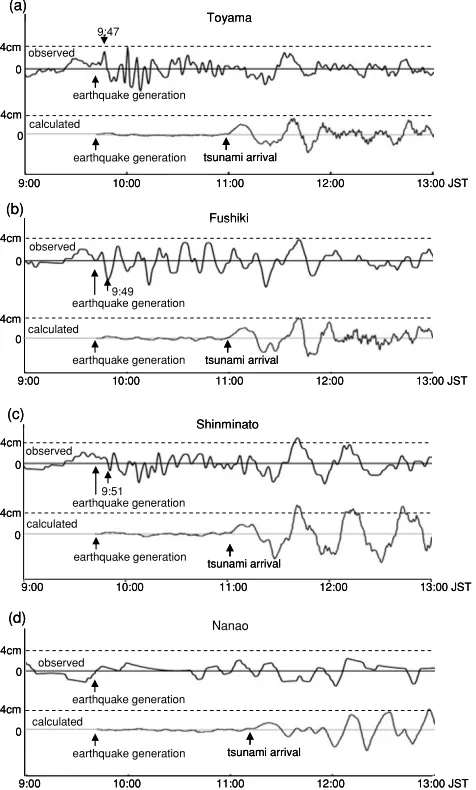
Tidal surges were also recorded at observatories in Toyama Bay (Fig. 2). At the Toyama observatory, a sudden sea level rise started at 9:45 a.m. and peaked at 9:47 a.m. (Fig. 2(a)). At the Fushiki observatory, the sea level started to drop suddenly at 9:46 a.m., reaching its lowest level at 9:49 a.m. (Fig. 2(b)). Similarly, at the Shinminato observa-tory, a sudden drop of sea level started at 9:49 a.m., reaching its minimum level at 9:51 a.m. (Fig. 2(c)). No tidal change was recorded at the Nanao observatory immediately after the earthquake (Fig. 2(d)).
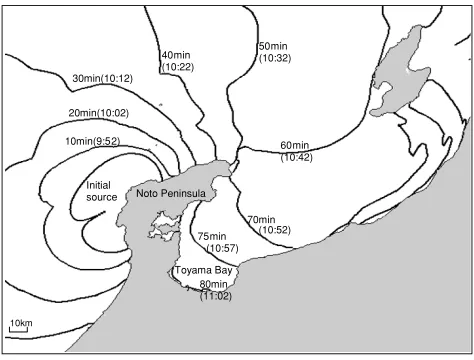
Figure 3 shows wave front lines of our modeled tsunami propagation at every 10 min after the earthquake genera-tion. The modeled tsunami arrived at Toyama Bay 75 min (10:57 a.m.) after the earthquake generation (Fig. 3). This
observed
Fig. 2. Time-series variations of observed and calculated tidal levels at (a) Toyama, (b) Fushiki, (c) Shinminato, and (d) Nanao tidal observatories. Observed tidal data were provided by the Port and Airport Research Institute.
result strongly suggests that the tidal surges recorded in Toyama Bay during the hour immediately following the earthquake cannot be explained by the tsunami generated at the seismic source.
3.
Description of the Capsize of the Boat
A small boat (6.3 m long according to the Asahi news-paper, 2007) capsized near the southern shore of Toyama Bay shortly after the earthquake (Fig. 1(a)). According to the boat crew, who informed the Japan Coast Guard, the boat started to vibrate and was suddenly uplifted while at anchor and facing west. Two or three minutes later, at about 9:45 a.m., the boat crew heard the radio announce-ment about the earthquake, and the boat was again strongly uplifted. Shortly after the second uplift, the boat overturned toward the port side.
No unnatural waves, such as a bow wave or ship’s wake, were observed by the boat crew both before and after
the capsize. Moreover, weather conditions on southern
veloc-Noto Peninsula
Fig. 3. The map showing wave fronts of the calculated tsunami wave
(10-min interval), which suggests that the earthquake-induced tsunami arrived at Toyama bay 70–80 min after generation.
ity around 2 m s−1 (JMA, 2007). According to weather
data recorded at 10-min intervals at Uozu and Himi on the shore of Toyama Bay (Fig. 1(a)), there was a westerly wind
with a wind velocity of 1 to 2 m s−1 at that time (JMA,
2007). Therefore, neither waves from boat activity nor
wind-generated waves can explain the capsizing of the boat. According to the crew, the boat was overturned toward the port side while anchored with the bow facing west. Therefore, it is possible to speculate that an extraordinary wave (or waves) traveling from north to south (landward) might have struck the starboard side of the boat and caused it to capsize.
4.
Possible Cause of the Unusual Tidal Surges in
Toyama Bay
Our numerical analysis revealed that the arrival time of the tsunami at Toyama Bay was about 11:00 a.m. There-fore, it is very difficult to explain how the capsize of the boat might have been induced by the tsunami generated by fault movement at the seismic source off Noto Penin-sula. The seaquake may have been generated by the 2007 Noto Hanto Earthquake. Seaquakes are sometimes gener-ated by large earthquakes and are a major cause of boats and ships capsizing immediately following an earthquake (e.g., Okamoto and Sakuta, 1995). Considering the arrival time of the seaquake, the first vibration felt by the crew immediately after the earthquake might have been caused by the seaquake, although the boat did not capsize as a re-sult of this first vibration. On the other hand, unusual tidal surges were observed at some tidal observatories (Toyama, Fushiki, and Shinminato) in Toyama Bay. The onset of the tidal surge was almost consistent with the time that the boat capsized. Therefore, we prefer the hypothesis that not the seaquake but the tidal surge in Toyama Bay caused the boat to capsize.
If so, what caused the tidal surge, which was observed only within Toyama Bay? Because of the steep bathymetry in Toyama Bay and the surrounding area (Fig. 4(a)), sub-marine landslides are common. They have been attributed to floods or failures on fan delta frontal slopes as well as
to seismic activity (Nakajimaet al., 1998). Based on
analy-ses of drill cores from the Toyama deep-sea channel system, turbidites have been regularly deposited there at intervals of
approximately 70 years (Nakajimaet al., 1998; Nakajima,
2006). Therefore, it is possible that a submarine landslide was triggered near the southern margin of Toyama Bay by the 2007 Noto Hanto Earthquake. Interestingly, a fisher-man who was on a boat offshore of Himi city (Fig. 1(a)), mentioned that the seawater became muddy after he heard a large sound immediately following the earthquake (from a survey by the Fisheries Agency, personal communication), probably due to the suspension of the sea bottom sediments. Based on these observations, we suggest that the likely ex-planation is that a local submarine landslide, triggered by the 2007 Noto Hanto Earthquake, caused the tidal surge in Toyama Bay.
Because the tidal surge was observed at several observa-tories in Toyama Bay, we can estimate the source area of the submarine landslide using a back-propagation method.
5.
Estimation of the Possible Source of the
Sub-marine Landslide
The onset of the sharp tidal surge at Toyama observatory arrived 3 min after the earthquake (9:45 a.m.), and the peak level arrived 5 min after the earthquake (9:47 a.m.). If we assume that the tidal surge was generated within Toyama Bay immediately after the earthquake (9:42 a.m.), we can consider a virtual source of the wave at the Toyama ob-servatory and back-calculate the propagation time of the wave from the observatory. Figure 4(a) shows the loci of points from which the onset and the peak of the wave that arrived at the Toyama observatory may have come. Sim-ilarly, we back calculated propagation times for the onset of the sharp drop of tidal level observed at the Fushiki ob-servatory (4 min after the earthquake, 9:46 a.m.) and the lowest level (7 min after the earthquake, 9:49 a.m.). In the case of the Shinminato observatory, the onset of the sharp drop in tidal level occurred at 5.5 min after the earthquake (9:46 a.m.) and the lowest level at 8 min after the earth-quake (9:50 a.m.). The loci of the possible origin of the onset and peak of this wave are also shown on Fig. 4(a). To reproduce the peak of the tidal surge at the Toyama, Fushiki and Shinminato observatories, the wave source must lie be-tween the lines defining the 3- and 5-min propagation times for Toyama, between those defining the 4- and 7-min prop-agation times for Fushiki and also between those defining the 5.5- and 8-min propagation times for Shinminato.
The proper analysis of wave generation and propagation due to a possible submarine landslide requires a numerical calculation using a landslide-generated wave model (e.g.
Imamura and Imteaz, 1995; Matsui et al., 2002).
Fig. 4. (a) Map showing the loci of the possible origins of the onset and peak of the tidal surges recorded at Toyama, Shinminato and Fushiki observatories, which are estimated by backward wave propagation analysis. (b) Proposed source area of the tidal surge, flow direction of the landslide, and vertical displacement. (c) Cross section showing the ideal geometry of the landslide, and the wave it generated, and our model. (d) Map showing the place that metals such as Pb and Zn are exceptionally high (based on Imaiet al., 1997).
model. As a preliminary interpretation, taking into account the sea-floor physiography of the bay, we considered a vir-tual vertical sea displacement either along the slope or at the bottom of a valley in Toyama Bay (Fig. 4(b)) as pos-sible source areas of the submarine landslide. This in turn indicates that we did not consider the sea floor displacement in this calculation but just set the vertical sea displacement at the possible landslide area. These locations and sizes of the area were set to satisfy the range of arrival times that we estimated from back propagation times.
To imitate the motion of the sea water during the land-slide flow process, we assumed negative vertical displace-ment when we set the wave source on the slope (Fig. 4(c)). On the other hand, we assumed positive vertical sea dis-placement when we set the wave source on the flat floor. We found that the onsets of the tidal surge at Toyama and
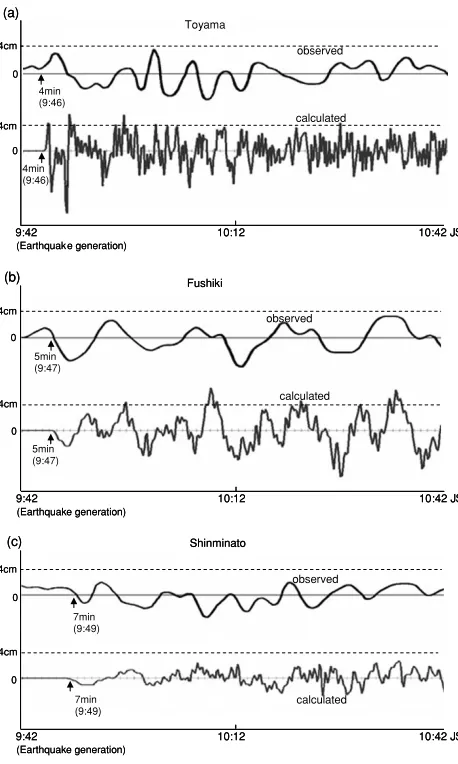
Fushiki can be successfully explained (Fig. 5) only when we set an initial source of the wave on the slope of the western part of the Toyama Bay (Fig. 4(b)). Therefore, the landslide was likely generated in the western part of the Toyama Bay in the area offshore of Fushiki.
4cm
Fig. 5. Comparison of time-series variations of the observed and calcu-lated tidal levels at the Toyama, Fushiki, and Shinminato tidal obser-vatories. The calculations are obtained by the simulation of submarine landslide-induced tsunami, shown in Fig. 4. Although the calculated tidal levels could be same as the observed ones overall, the former in-clude the shortened wave period component movement.
eastward at the source area, which is consistent with the slope direction, a positive wave would propagate toward the Toyama observatory, and a negative wave would propagate toward the Fushiki observatory. This suggests that the land-slide might have initially flowed down the eastward dipping slope (Fig. 4(b)).
We also tested several initial displacements of sediment to reproduce the height of the initial wave at each observa-tory. We found that a sharp rise at the Toyama observatory (Fig. 5(a)) and drops at Fushiki and Shinminato observato-ries (Fig. 5(b) and (c)) are well explained if we set the initial
displacements at+0.1 m in the eastern part of the source
area and−0.1 m in the western part (Fig. 4(b)), although
the wave periods at each observatory are very different from the observed data. We also used this model to calculate the amplitude of the tidal surge at the location where the small boat capsized. Our calculations show that the tidal level would have drastically increased by more than 10 cm at this location at about 9:47 a.m. (Fig. 6), which is consistent with the time at which the boat capsized.
10cm
Fig. 6. Time-series variation of tidal level calculated at the location where the boat capsized.
6.
Implications for Future Work
On the basis of these preliminary results, we suggest that a submarine landslide, which likely occurred on the western slope of Toyama Bay, may have been the source of the unusual tidal surges (Fig. 4(b)). This tidal surge may have caused the boat to capsize in Toyama Bay, although it is still uncertain whether the 10-cm height of the wave would have been capable of inducing the capsize of the boat. Further careful research is required to clarify the physical process of the capsize of the boat based on the details of the boat (e.g., size, weight, and structure) as well as the flow characteristics of the unusual tidal surges.
As previously stated, to confirm that the submarine land-slide did occur, we require a sounding survey and core-drilling program in the channels of Toyama Bay. Sedimen-tary analysis of the deposits in and around the channels and an investigation of their heavy metal concentrations would provide useful data for investigating the distribution of the sediments involved in the possible submarine
land-slide. Geochemical analysis by Imai et al. (1997) shows
that concentrations of heavy metals such as Pb and Zn are exceptionally high around the southern landward margin of Toyama Bay (Fig. 4(d)), the likely source area of the sub-marine landslide that may have occurred as a result of the 2007 Noto Hanto Earthquake.
Although our landslide model broadly reproduced the observed tidal records, with the exception of those at the Toyama observatory, the wave periods we calculated at each observatory were considerably shorter than those of the ob-served records (Fig. 5). These results were to be expected, because the period of the wave generated by a submarine landslide is closely related to the scale, density, and initial
velocity of the landslide (e.g., Matsuiet al., 2002).
How-ever, our preliminary model has not been included these ef-fects. Thus, these data must be investigated by using geo-logical methods to allow further, more detailed numerical implementation of a landslide-generated wave model.
Acknowledgments. We especially thank K. Akiyama and K. Ootsuka who provided us useful information about the damage in Toyama Bay. We also thank Y. Tanioka, T. Iidaka, and an anony-mous reviewer for their valuable suggestions and comments.
References
at Toyama and Niigata prefectures, http://www.asahi.com/special/ 070325/TKY200703250271.html, 2007 (in Japanese).
Geographical Survey Institute, Diastrophism due to the 2007 Noto Hanto Earthquake, http://www.gsi.go.jp/WNEW/PRESS-RELEASE/ 2007/0328/05.pdf, 2007 (in Japanese).
Imai, N., S. Terashima, H. Katayama, T. Nakajima, K. Ikehara, and M. Taniguchi, Geochemical behavior of heavy metals in coastal marine sediments from the eastern margin of the Japan Sea,Bull. Geol. Surv. Jpn.,48, 511–529, 1997 (in Japanese with English abstract).
Imamura, F., Review of tsunami simulation with a finite difference method, inLong-Wave Runup Models, edited by H. Yeh, P. Liu, and C. Synolakis, pp. 25–42, World Scientific Publishing Co., 1995.
Imamura, F. and M. M. A. Imteaz, Long waves in two-layers, Governing equations and numerical model,Sci. Tsunami Haz.,13(1), 3–24, 1995. JMA (Japan Meteorological Agency), Statistical information of past
weather data, http://www. jma.go.jp, 2007 (in Japanese).
Manshiha, L. and D. E. Smylie, The Displacement Fields of Inclined Faults,Bull. Seismol. Soc. Am.,61, 1433–1440, 1971.
Matsui, T., F. Imamura, E. Tajika, Y. Nakano, and Y. Fujisawa, Generation and propagation of a tsunami from the Cretaceous/Tertiary impact event,
inCatastrophic Events and Mass Extinctions: Impact and Beyond, C. Koeberl and G. Macleod (Eds),Geol. Soc. Am. Special Paper,356, 69– 77, 2002.
Nakajima, K., Hyperpycnites deposited 700 km away from river mouths in the central Japan Sea,J. Sediment. Res.,76, 60–73, DOI: 10.2110/ jsr.2006.13, 2006.
Nakajima, K., M. Satoh, and Y. Okamura, Channel-levee complexes, ter-minal deep-sea fan and sediment wave fields associated with the Toyama Deep-Sea Channel system in the Japan Sea,Mar. Geol.,147, 25–41, 1998.
Okamoto, K. and M. Sakuta, Numerical Simulation Technique for Time-History Pressure of Floating Structure in Seaquakes,Proceedings of Ocean Cites, 308–311, 1995.
Prime Minister of Japan and His Cabinet, Details of the 2007 Noto Hanto Earthquake, http://www.kantei.go.jp/jp/kikikanri/jisin/isikawa/ isikawa1530.html, 2007 (in Japanese).