MP-07.01
Rapid prediction of personalized response to chemotherapy using sub-millimeter ex-vivo biopsy samples on chip
Lateef, Muhammad Abdul1; Péant, Benjamin1; Rousset, Nassim2; Simeone, Kayla1; Kendall-Dupont, Jennifer1; Mari Orimoto, Adriana1; Mes-Masson, Anne-Marie1; Gervais, Thomas2; Saad, Fred1
1Institut du cancer de Montréal, Centre hospitalier de l’Université de Montréal Research Centre, Montreal, QC, Canada; 2Institut de génie bio-médical and Department of Engineering Physics, Polytechnique Montréal, Montreal, QC, Canada
Introduction and Objectives: Evaluating prostate cancer response to therapy
can often take three months and decisions should not be made before that time according to Prostate Cancer Clinical Trials Working Group (PCWG)-2 recommendations. Early response predictor identification is a major objec-tive towards personalized medicine. The emergence of microfluidic devices has allowed for ex-vivo response measurement to a given therapy in 3D tumour tissue. We have optimized a method to obtain microdissected tis-sues (MDTs) from patient biopsies, with a viability that is maintained for 14 days. Using a microfluidic, on-chip system, we studied the ex-vivo
response of the MDTs to a given chemotherapeutic drug by flow cytometry.
Methods: We have developed a method to precisely section biopsies into
MDTs of sub-millimeter size. We have also designed a microfluidic chip, capable of trapping 25 MDTs, in which they can be exposed to different drugs. With our novel approach, we have initiated drug testing on patient samples using different combinations of docetaxel alone (100 nM) or in combination with bicalutamide (1 mM). The treatment regimen was initiated after 24-48 hours of tissue recovery, post-surgery. The following cycles of treatment was performed on chip: first treatment for 24 hours, first recovery for 48 hours, second treatment for 24 hpurs, second recovery for 48 hours, then cell viability analysis.
Results: After 24 hours in culture, we observed more than 85% viability
of MDTs. We observed a variable response in individual patient samples treated with per protocol on chip (<65-100% survival). For each patient included in our study, we predicted a personalized potential drug response profile based on the ex- vivo response to tested drugs. We are presently comparing these profiles to the clinical response to ongoing therapy in these patients.
Conclusions: The ex-vivo drug response of MDTs from patient biopsy
sam-ples on-chip can be performed in a time-effective manner and may eventually contribute to a more personalized approach to clinical decision-making.
MP-07.02
Prostate stereometry by transrectal ultrasonography and magnetic resonance imaging is significantly correlated to the actual volume measured after radical prostatectomy
Nouh Ahmed, Mohammed1,2; Finelli, Antonio1; Kulkarni, Girish S.1; Hamilton, Robert J.1; Toi, Ants3; Fleshner, Neil E.1
1Division of Urology, Department of Surgical Oncology, University Health Network, Toronto, ON, Canada; 2Department of Urology, Sohag University Hospital, Sohag, Egypt; 3Department of Medical Imaging, University Health Network, Toronto, ON, Canada
Introduction and Objectives: To compare prostate
volumes obtained by transrectal ultrasonography (TRUS) and magnetic resonance imaging (MRI) to assess the reliability of both techniques in predict-ing the actual volume.
Methods: Data of 825 prostate cancer (PCa) patients
who underwent radical prostatectomy between October 2010 and May 2014 was reviewed. A total of 134 had both preoperative TRUS and MRI for prostate evaluation and fulfilled the inclusion criteria. Prostate volume (PV) measured by TRUS and MRI were compared to the actual volume reported after surgery. Prostate size was estimated using the prolate ellipsoid formula (height x width x length xπ/6); with the antero-posterior (A-P) diam-eter measured using a mid-sagittal view for TRUS and an axial view for MRI. Also, the relation of PV estimates to clinic-pathological parameters of PCa
Poster Session 7: Prostate Cancer (2)
June 28, 2016 0730-0900
was assessed. Pearson’s correlation, linear regression, and paired t-test were performed to compare PV estimated via both imaging modalities.
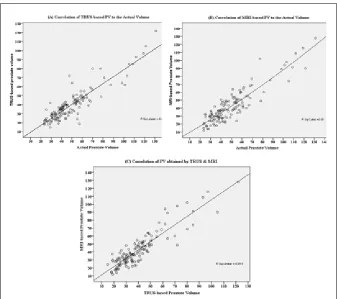
Results: The mean PV was 39.9 ± 18.3, 42.5 ± 21.3, and 49.7 ± 21.3 for
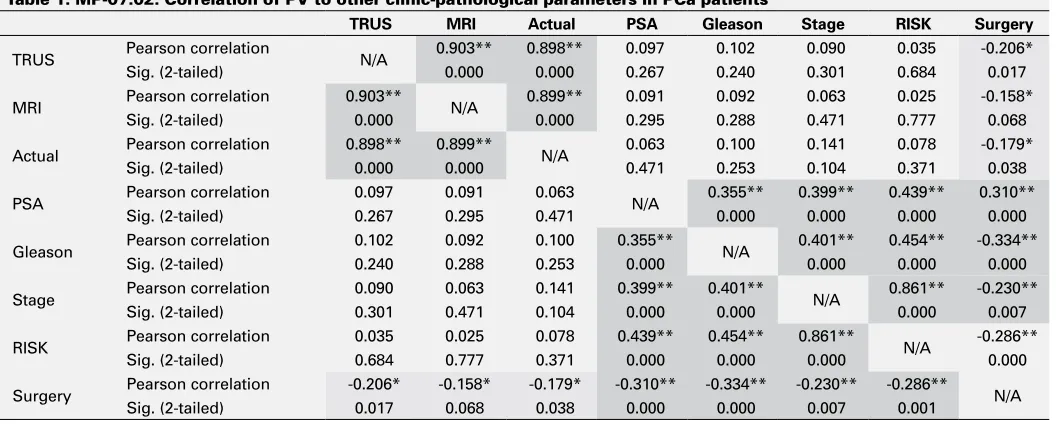
TRUS, MRI, and the actual volume, respectively. The average TRUS- and MRI-based PV was significantly correlated to and underestimated the actual volume (R=0.898; p<0.001 and R=0.899; p<0.001, respectively) and to each other (R=0.903; p<0.001). Stratifying our cohort into three groups using 30 and 60 ml actual volume as cutoff points, both techniques remained correlating to the actual volume and to each other and were underestimating the PV, which was only significant in the large prostate group. Also, neither preoperative estimates, nor the actual volume was correlated to any of clinic-pathological parameters in our patients.
Conclusions: PV estimations by TRUS and MRI are highly correlated to
the actual volume. So, in the hands of an experienced sonographer, TRUS is not only efficient and economic, but also an accurate and reproducible modality to estimate prostate size.
MP-07.03
An update on hospital admission rates for urological complications after transrectal ultrasound-guided prostate biopsy
Alaina, Garbens1; Wallis, Christopher J.D.1; Saskin, Refik2; Liu, Ying2; Nam, Robert K.1
1Division of Urology, Sunnybrook Health Sciences Centre, University of Toronto, Toronto, ON, Canada; 2Institute of Clinical Evaluative Sciences, Sunnybrook Research Institute, Toronto, ON, Canada
Introduction and Objectives: We were the first to report in 2010 rising
rates of complications following transrectal ultrasound (TRUS)-guided prostate biopsy for prostate cancer detection from 1996-2005. Many centres have since confirmed these findings. We conducted a followup study from 2006 to 2013 to further examine these rates.
Methods: This was a retrospective, population-based study of men who
underwent TRUS-guided prostate biopsy in Ontario, Canada between January 1, 2006 and December 31, 2013. Using the Canadian Institute of Health Information (CIHI) Registry, provincial fee codes, and the Ontario Cancer Care Registry, we were able to determine mortality rates and hospital admission rates within 30 days post-TRUS prostate biopsy for hematuria, urinary obstruction, and genitourinary infection.
Results: In total, 61 910 men underwent a TRUS-guided prostate biopsy
from 2006-2013. The overall mortality rate was 0.08% and did not change throughout the study. We focused only on the healthy men (30 996/61 910) with no cancer from biopsy. The 30-day hospital admission rate was
3.45% for men without prostate cancer. Among them, 76.5% (1128/1460) men were admitted due to infection. The rates of 30-day hospital admis-sion due to infection did not significantly increase from 2006-2013 (p=0.74). The adjusted odds ratio for admission for infection was 1.21 (95% CI 0.38-3.89) for patients from 2013, compared to patients in 2006. The number of TRUS biopsies performed annually remained stable and then abruptly fell by 30.6% in 2013 compared to the average annual biopsy rate. The rate of hospital admission in 2013, however, remained the same at 4.1% (compared to 4.0% in 2006).
Conclusions: The 30-day post-TRUS biopsy hospital admission rates
remained stable for the duration of the study. Interestingly, we witnessed an abrupt drop in biopsy rates in 2013, which could be due to the recent U.S. Preventative Services Task Force (USPSTF) recommendation against PSA screening.
MP-07.04
Initial Canadian experience with 18 F fluoromethylcholine positron emission tomography/computed tomography in bio-chemical recurrence after definitive treatment of prostate cancer Bladou, Franck1; Gauvin, Simon2; Probst, Stephan3; Cerentola, Yannick1; Anidjar, Maurice1
1Urology, Jewish General Hospital and McGill University, Montreal, QC, Canada; 2Radiology, Jewish General Hospital, Montreal, QC, Canada; 3Nuclear Medecine, Jewish General Hospital, Montreal, QC, Canada
Introduction and Objectives: To correlate 18 F fluoromethylcholine
positron emission tomography/computed tomography (18F-FCH PET/ CT) results with patient characteristics and other conventional imaging modalities and to determine factors predictive of positivity.
Methods: Retrospective study including 44 18F-FCH PET/CT scans of patients
with (biochemical recurrence (BCR) after initial radical prostatectomy (RP) or radiation therapy (RT). Results were compared to findings on magnetic resonance imaging (MRI), CT, bone scan (BS), and histological analysis when available. Univariate and multivariate analysis were performed to correlate results with qualitative and quantitative patient characteristics (age, trigger prostate-specific antigen (PSA), doubling time (PSADT), T/N stage, Gleason score, initial/salvage treatment, concomitant androgen-deprivation therapy).
Results: 26 PET scans (59%) were positive, 14 negative (32%), three
equivocal (7%), and one non-diagnostic (2%). Of the positive PET scans, 11 demonstrated local recurrence (10 in patients with initial treatment consisting of RT and one for RP), 11 regional/distant lymph nodes (10 RP, one RT), two bone metastasis and two LN + bone metastasis. Among Table 1. MP-07.02. Correlation of PV to other clinic-pathological parameters in PCa patients
TRUS MRI Actual PSA Gleason Stage RISK Surgery
TRUS Pearson correlation N/A 0.903** 0.898** 0.097 0.102 0.090 0.035 -0.206*
Sig. (2-tailed) 0.000 0.000 0.267 0.240 0.301 0.684 0.017
MRI Pearson correlation 0.903** N/A 0.899** 0.091 0.092 0.063 0.025 -0.158*
Sig. (2-tailed) 0.000 0.000 0.295 0.288 0.471 0.777 0.068
Actual Pearson correlation 0.898** 0.899** N/A 0.063 0.100 0.141 0.078 -0.179*
Sig. (2-tailed) 0.000 0.000 0.471 0.253 0.104 0.371 0.038
PSA Pearson correlation 0.097 0.091 0.063 N/A 0.355** 0.399** 0.439** 0.310**
Sig. (2-tailed) 0.267 0.295 0.471 0.000 0.000 0.000 0.000
Gleason Pearson correlation 0.102 0.092 0.100 0.355** N/A 0.401** 0.454** -0.334**
Sig. (2-tailed) 0.240 0.288 0.253 0.000 0.000 0.000 0.000
Stage Pearson correlation 0.090 0.063 0.141 0.399** 0.401** N/A 0.861** -0.230**
Sig. (2-tailed) 0.301 0.471 0.104 0.000 0.000 0.000 0.007
RISK Pearson correlation 0.035 0.025 0.078 0.439** 0.454** 0.861** N/A -0.286**
Sig. (2-tailed) 0.684 0.777 0.371 0.000 0.000 0.000 0.000
Surgery Pearson correlation -0.206* -0.158* -0.179* -0.310** -0.334** -0.230** -0.286** N/A
Sig. (2-tailed) 0.017 0.068 0.038 0.000 0.000 0.007 0.001
the 26 positive PET scans, 15 underwent conventional imaging (CT, BS, and/or pelvic MRI), of which it was negative in three patients. The age (p=0.003), trigger PSA (p=0.03), PSA velocity (p=0.04), and PSADT (p=0.046) were significantly different when comparing positive and nega-tive PET scans. Using univariate log regression analysis, patients with positive PET scans were significantly more likely to have had RT initially (OR 6.0, 95% CI 1.1-32.3) and a trigger PSA level higher than 2 ng/mL (OR 15.3, 95% CI 2.6-91.9). Trigger PSA of 2.6 ng/mL and PSADT of 4.3 months had the optimal capacity to differentiate between positive and negative scans (sensitivity 86% and 79%, specificity 71% and 50%, respectively; ROC curves).
Conclusions: 18 F-FCH PET/CT demonstrates high detection rate for local,
lymph node and bone metastases in BCR patients. A trigger PSA above 2.6 ng/mL seems optimal for appropriate patient selection.
MP-07.05
Anatomic location of positive margins vary between surgeons during robotic radical prostatectomy
Bastiampillai, Ravin J.1; Lavallee, Luke T.1,2; Cnossen, Sonya2; Mallick, Ranjeeta2; Cagiannos, Ilias1; Morash, Christopher G.1; Breau, Rodney H.1,2 1Division of Urology, Department of Surgery, The Ottawa Hospital, Ottawa, ON, Canada; 2Clinical Epidemiology, Ottawa Hospital Research Institute, Ottawa, ON, Canada
Introduction and Objectives: Surgical technique is associated with risk
of positive tumour margins during radical prostatectomy. The purpose of this study was to determine if the risk of a positive surgical margin at specific anatomic locations varied by surgeon.
Methods: All patients who received a robotic radical prostatectomy at
The Ottawa Hospital between October 2011 and September 2015 were reviewed. Patient characteristics, clinical data, and pathological findings were obtained from the medical record. Prostatectomy specimens were reviewed by genitourinary pathologists. The presence of a positive surgical margin was reviewed at four anatomic locations of the prostate: anterior apex, posterior apex, non-apex posterolateral, and bladder neck.
Results: During the study period, 571 patients received a radical
prosta-tectomy by one of six surgeons. The number of procedures per surgeon ranged from 24-185. Median preoperative prostate-specific antigen (PSA) was 6.9 (interquartile range (IQR) 5.0, 9.5) and 250 (43.9%) patients had palpable tumours. Gleason sum was 3 + 3 in 37 (6%), 3 + 4 in 325 (57%), 4 + 3 in 163 (29%), 4 + 4 in 8 (2%), and 4 + 5 in 35 (6%). Almost half of patients had pT3 tumours (259; 45%). There were no statistically signifi-cant differences in baseline characteristics between surgeons (p>0.05). Bilateral nerve-spare was performed in 325 (57%), unilateral nerve-spare in 135 (24%) and no nerve-spare in 111 (19%). There were statistically significant differences in positive surgical margins between surgeons at the posterior apex (range 5-27%; p<0.0001) and the bladder neck (range 0-7.4%; p=0.03). There was no difference between surgeons for the risk of a positive surgical margin at the anterior apex (36; 6.3%; p=0.9) or the non-apex posterolateral (85; 15%; p=0.9) locations.
Conclusions: Significant variability in the incidence of positive surgical
margins between surgeons was observed at the posterior apex and bladder neck. These data suggest that an adjustment in surgical technique may improve oncologic outcomes.
MP-07.06
Baseline prostate-specific antigen levels in midlife predict total and aggressive prostate cancer in African-American men Preston, Mark A.1; Wilson, Kathryn M.2; Gerke, Travis2; Carlsson, Sigrid3; Sjoberg, Daniel D.4; Kibel, Adam S.1; Trinh, Quoc-Dien1; Signorello, Lisa5; Steinwandel, Mark6; Vickers, Andrew4; Lilja, Hans3; Mucci, Lorelei2 1Urology, Brigham and Women’s Hospital, Boston, MA, United States; 2Epidemiology, Harvard School of Public Health, Boston, MA, United States; 3Department of Surgery (Urology Service), Memorial Sloan-Kettering Cancer Center, New York, NY, United States; 4Department of Epidemiology and Biostatistics, Memorial Sloan-Kettering Cancer Center, New York, NY, United States; 5Cancer Prevention Fellowship Program, National Cancer Institute, Bethesda, MD, United States; 6International Epidemiology Institute, Rockville, MD, United States
Introduction and Objectives: Prostate-specific antigen (PSA) level in midlife
predicts prostate cancer (PCa) mortality in Caucasian populations. It is poorly studied whether PSA measured during midlife predicts aggressive PCa among African-American (AA) men.
Methods: We performed a nested case-control study among AA men age
40-65 years who gave blood at enrollment in the Southern Community Cohort Study between 2002 and 2009 and followed for median of nine years. Baseline kallikrein levels (total PSA, free PSA, intact PSA, and human kallikrein 2[hK2]) were measured in 197 PCa cases and 569 age-matched controls. 55 men had aggressive PCa defined as Gleason 4 + 3 = 7, AJCC Stage III or IV, or cancer-specific death. Exact conditional logistic regression was used to estimate odds ratios (ORs) and 95% confidence intervals (CIs) for association between PSA and risk of total/aggressive PCa. Area under the curve (AUC) for prediction of total/aggressive PCa by PSA and a previously reported four-kallikrein risk score was calculated using logistic regression.
Results: Median PSA among controls was 0.72, 0.80, 0.94, and 1.03
ng/mL for men 40-49, 50-54, 55-59, and 60-64 years, respectively. Risk of total PCa was strongly associated with baseline PSA in midlife. PSA was also highly predictive of aggressive PCa. All 22 aggressive cases in men <55 years occurred among those with PSA above the age-specific median; among men 40-49 years, all nine cases of aggressive PCa were among those with PSA >90th percentile. Across age groups, the OR of aggressive PCa for PSA >90th percentile vs. < median was 38.8 (95% CI 10.0-237), using age-specific cut-points. PSA in midlife predicted total (AUC 0.88, 95% CI 0.85-0.91) and aggressive (AUC 0.87, 95% CI 0.81-0.92) PCa with high discrimination. Among men with total PSA >2 ng/ ml, the four-kallikrein risk score improved prediction of aggressive PCa compared to PSA alone.
Conclusions: PSA level in midlife strongly predicted total and aggressive
PCa in a cohort of AA men subject to opportunistic screening.
MP-07.07
Inhibiting invadopodia formation can abrogate cancer cell extravasation and prevent prostate cancer metastasis
Siddiqui, Khurram1; Arora, Metthew1; Kim, Yohan1; Telmer, Patrick1; Desantis, David1; Jardine, Emily1; Chin, L.K. Joseph1; Izawa, Jonathan I.1; Leong, Hon1
1Surgery/Urology, Schulich School of Medicine and Dentistry, Western University, London, ON, Canada
Introduction and Objectives: Inhibition of Tks4 and Tks5 expression can
block invadopodia formation in metastatic cancer cells, leading to the inability of these cells to undergo extravasation. We sought to determine if this was also the case in metastatic prostate cancer cells.
Methods: We used PC3MLN4 and LNCAP prostate cancer cell lines.
Lentiviral infection was performed to knockdown four clones each for Tks4 and Tks 5 for both the cell lines. Gene knock-down efficiency was assessed by quantitatve reverse transcription polymerase chain reac-tion (qRT-PCR). Using CAM-model, we then assessed the extravasareac-tion efficiency of these cells (labeled with green fluorescent protein) using confocal microscopy.
Results: Using PC-3M-LN4 and LNCaP metastatic prostate cancer cells,
we knocked down Tks4 and Tks5 mRNA levels with RNAi to 64% and 78% of control levels respectively. In our model of in vivo cancer cell extravasation, we determined that extravasation rates dropped to 12+/-3% and 3.4+/-1.6% compared to 37.3+/-5.8% in empty vector controls with the PC-3M-LN4 cell line. When the same cells were used to understand the impact on metastatic colony formation, 12.3+/-4.6 and 0.4+/-1.2 colonies were observed (n>8/group) for shTks4 and shTks5 PC-3M-LN4 cells compared to 47+/-9 in shLUC control cells. However, when in vitro gelatin-Alexa594 ECM degradation assays were performed, no degrada-tion signal voids were observed in any of the cell lines including the con-trols. Instead, we performed intravital imaging experiments to determine the incidence of cell protrusions at t=5 hours post-injection, revealing few to no cells forming protrusions in vivo, whereas the control cells formed protrusions in 10% of cells at that time point.
Conclusions: Blocking the expression of Tks4/5 in prostate cancer cells
formed in vivo. These findings suggest that targeting key steps of the metastatic cascade may be a realistic approach for advanced prostate cancer treatment.
MP-07.08
Treatment trends and cost for localized prostate cancer in elderly patients
Valiquette, Anne Sophie1; Dell’Oglio, Paolo2; Tian, Zhe1; Leyh-Bannurah, Sami3; Trudeau, Vincent1; Saad, Fred1; Briganti, Alberto2; Montorsi, Francesco2; Larcher, Alessandro2; Karakiewicz, Pierre1
1Department of Urology, Université de Montréal, Montreal, QC, Canada; 2Department of Urology and Division of Experimental Oncology, URI, Urological Research Institute, IRC, San Raffaele Scientific Institute, Milan, Italy; 3Department of Urology, Martini-Clinic, Prostate Cancer Centre Hamburg-Eppendorf, Hamburg, Germany
Introduction and Objectives: The absolute and proportional numbers of
elderly patients diagnosed with localized prostate cancer (PCa) are on the rise. We examined treatment trends and reimbursement figures in localized PCa patients aged 80 years and more.
Methods: Between 2000 and 2008, we identified 30 217 localized PCa
patients aged 80 years and more in Surveillance Epidemiology and End Results (SEER)-Medicare-linked database. Alternative treatment modalities consisted of conservative management (CM), radiation therapy (RT), radi-cal prostatectomy (RP), and primary androgen-deprivation therapy (PADT). For all four modalities, use and cost trends were examined.
Results: PADT was the most frequently used treatment modality between
2000 and 2005 in elderly patients. CM became the dominant treatment modality from 2005 to 2008. RP rates were marginal and RT ranked third. RT annual utilization rate increased from 20.77% in 2000 to 29.13% in 2008. The highest median individual cost was related to RT, ranging from $29 343 in 2000 to $31 090 in 2008, followed by RP (from $20 560 in 2000 to $19 580 in 2008), PADT (from $18 901 in 2000 to $8000 in 2008), and CM (from $1 824 in 2000 to $1938 in 2008). RT contrib-uted to most of cumulative cost from 2003 (49.24%) to 2008 (72.97%). PADT share of cost ranked first from 2000 (54.56%) to 2002 (50.49%), but decreased by 19.40% in 2008. CMs contribution to cumulative cost increased from 4.42% in 2000 to 6.96% in 2008. RP share of cost was stable during the study period.
Conclusions: Our results, focusing on localized PCa treatment in patients
aged 80 years and more, showed an important increase in rates, median cost, and proportion of cumulative cost related to RT. Moreover, a surpris-ing elevated proportion of elderly patients received RT.
MP-07.09
Focal high-intensity focused ultrasound for localized prostate cancer: A single-centre experience
Haddad, Nicholas1; Anidjar, Maurice1; Loutochin, Oleg1; Bladou, Franck1 1Urology, Jewish General Hospital and McGill University, Montreal, QC, Canada
Introduction and Objectives: Men with localized prostate cancer (PCa)
are currently faced with the decision to either undergo radical therapy or enter active surveillance protocol. Focal high-intensity focused ultrasound (HIFU) may be an alternative treatment option for some of these men that may be spared the side effects of radical prostatectomy and radiation or released from anxiety of living with untreated cancer in active surveillance protocol. The objective of this study is to present preliminary outcomes in selected patients treated with focal HIFU.
Methods: We report preliminary findings of a prospective, single-centre,
phase 2, single-arm, cohort study offering focal HIFU (Ablaterm®/Focal One®) to men with histologically proven localized, low-to-intermediate-risk PCa (prostate-specific antigen (PSA) <15, Gleason score (GS) ≤7) with a magnetic resonance imaging (MRI) index lesion confirmed by MR-targeted transrectal ultrasound (TRUS) biopsies. Factors assessed included PSA levels, control MR-targeted TRUS biopsy at six months post-HIFU, oncologic results, re-treatments, side effects, and validated questionnaires assessing urinary and bowel function, sexuality, and qual-ity of life.
Results: A total of 21 patients have been recruited from September 2013 to
January 2016, 14 of whom had control MRI-guided biopsy at six months. The mean followup is 9.9 months. In the group of patients with six-month control biopsy, the mean initial PSA was 6.9 ng/ml (standard deviation (SD) 2.8) and mean six-month PSA 3.2 ng/ml (SD 3.2). The mean prostate volume was 35.6 cc (SD 17.3) and the mean percent of volume treated was 41.8% (SD 6.6) of the prostate gland. Nine had negative biopsies (12 cores + targeted biopsies on the treated area) (64.2%). In five patients with positive biopsies, three had cancer in the treated area (considered as failures; 21.4%) and two in a non-treated part of the gland. Four patients have been re-treated, one underwent a radical prostatectomy, one was referred for external beam radiation and hormone therapy, and two underwent repeat focal HIFU with no complication. There have been no serious adverse events Side effects included erectile dysfunction need-ing phosphodiesterase type-5 inhibitor (IPDE5) in two patients (9.5%), lower urimart tract symptoms (LUTS) in three patients (14.2%), two mild hematuria, one mild rectal bleeding, and one epididymitis.
Conclusions: Focal therapy may be a strategy that could complement the
current choices available to men with localized PCa. Our preliminary experience tells us it is a safe procedure, very well-accepted by patients. However, longer followup and larger numbers of patients are needed to confirm our early results. The impact it may have on function and quality of life, in addition to its cost-effectiveness, are currently being assessed.
MP-07.10
ATLAS: A randomized, double-blind, phase 3 study of ARN-509 in patients with high-risk localized or locally advanced prostate cancer receiving primary radiation therapy
McKenzie, Michael1; Dearnaley, David2; Tombal, Bertrand3; Baskin-Bey, Edwina4; Freedland, Stephen J.5; Roach, Mack6; Widmark, Anders7; Bossi, Alberto8; Dicker, Adam P.9; Wiegel, Thomas10; Shore, Neal D.11; Smith, Matthew R.12; Yu, Margaret4; Kheoh, Thian13; Thomas, Shibu14; Sandler, Howard15
1Radiation Therapy Program, British Columbia Cancer Agency, Vancouver, BC, Canada; 2Department of Academic Radiotherapy, The Royal Marsden Hospital and The Institute of Cancer Research, London, United Kingdom; 3Department of Urology, Cliniques Universitaires Saint-Luc, Brussels, Belgium; 4WC Clinical Oncology, Janssen Research & Development, Los Angeles, CA, United States; 5Department of Surgery, Cedars-Sinai Medical Center, Los Angeles, CA, United States; 6Department of Radiation Oncology, Helen Diller Family Comprehensive Cancer Center, San Francisco, CA, United States; 7Department of Radiation Sciences, Umeå University, Umeå, Sweden; 8Department of Radiation Oncology, Gustave Roussy Cancer Institute, Villejuif, France; 9Department of Radiation Oncology, Kimmel Cancer Center, Thomas Jefferson University, Philadelphia, PA, United States; 10Department of Radiation Oncology, University Hospital Ulm, Ulm, Germany; 11Carolina Urologic Research Center, Atlantic Urology Clinics, Myrtle Beach, SC, United States; 12Department of Hematology/Oncology, Massachusetts General Hospital Cancer Center, Harvard Medical School, Boston, MA, United States; 13Clinical Biostatistics, Janssen Research & Development, San Diego, CA, United States; 14Oncology Translational Research, Janssen Pharmaceuticals, Spring House, PA, United States; 15Department of Radiation Oncology, Cedars-Sinai Medical Center, Los Angeles, CA, United States
Introduction and Objectives: At present, high-risk localized and locally
advanced prostate cancer (PCa) patients receiving primary radiation ther-apy (RT) and long-term androgen-deprivation therther-apy (ADT; gonadotropin-releasing hormone [GnRH] agonist +/- antiandrogen) have a high risk of metastases and PCa-specifc death. We hypothesize that the addition of ARN-509 (JNJ 56021927), a selective androgen receptor (AR) antagonist, to GnRH agonist will improve metastasis-free survival in high-risk patients treated with primary RT.
Methods: This is a randomized, multicentre, double-blind,
European Union, or other). All patients will receive active treatment with a GnRH agonist throughout the 30 28-day treatment cycles. Randomization: 1:1 to ARN-509 or control. Neoadjuvant/concurrent (cycles 1-4) to RT (74-80 Gy): ARN-509 240 mg/d vs. bicalutamide 50 mg/d; adjuvant to RT (cycles 5-30): ARN-509 240 mg/d vs. placebo. Primary endpoint: metastasis-free survival. Secondary endpoints: time to local-regional recurrence, time to castration-resistant disease, time to distant metastasis, and overall survival. Imaging with computed tomography (CT) or magnetic resonance imaging (MRI) and bone scan will be conducted at baseline and then every six months following biochemical failure until documented distant metastasis by blinded-to-arm independent central review or death. Approximately 1500 patients will be accrued globally to provide appropriate statistical power to detect the hypothesized risk reduction (25%) in metastasis or death. An inde-pendent data monitoring committee is commissioned to review trial data. ClinicalTrials.gov Identifier: NCT02531516.
MP-07.11
WITHDRAWN
MP-07.12
MRI-fused cone beam CT-guided biopsy of the prostate: A novel method of prostate biopsy
Izard, Jason P.1,2; Siemens, D. Robert1,2; Leveridge, Michael J.1,2; Menard, Alexandre3
1Department of Urology, Queen’s University, Kingston, ON, Canada; 2Department of Oncology, Queen’s University, Kingston, ON, Canada; 3Department of Diagnostic Radiology, Queen’s University, Kingston, ON, Canada
Introduction and Objectives: Real-time 3D fluoroscopy guidance using
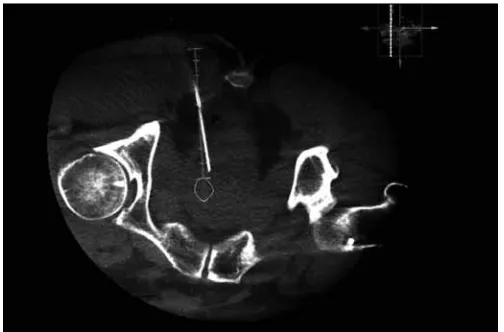
a cone beam computed tomography (CT) fused to a magnetic resonance imaging (MRI) can project an MRI-detected lesion on to the screen of a cone beam CT scan (Fig. 1). This allows an operator to advance a needle directly into the software-generated lesion using real-time fluoroscopy to confirm biopsy needle placement within the lesion (Fig. 2). To date, there have been no reports or investigations on the use of this new technology for prostate biopsies. We prospectively assessed the safety and feasibility of MRI-fused cone beam CT-guided prostate biopsies.
Methods: We prospectively identified six patients who had either negative
transrectal ultrasound of the prostate (TRUSP) biopsies or TRUSP biopsies showing small volume Gleason 6 disease with a clinical suspicion of higher-volume, higher-grade disease. All patients had an MRI showing a prostate imaging reporting and data system (Pi-RADS) 4 or 5 lesion in the prostate. Patients underwent site-directed MRI-fused cone beam
CT-guided biopsies through a transgluteal approach. Biopsy results and immediate and 30-day complication rates were recorded.
Results: The biopsies were well-tolerated by all patients. No patient
expe-rienced an immediate or 30-day complication. Of the six patients, three had previous negative biopsies and three had biopsies harbouring low-volume Gleason 6 disease. Of the three patients with previous negative biopsies, one patient had a positive CT-guided biopsy with seven of nine cores positive for Gleason 4 + 4 = 8/10. Of the three patients with low-volume Gleason 6 disease, two patients had CT-guided biopsies showing prostate cancer; one patient with similar low-volume Gleason 6 disease and the second patient’s CT-guided biopsy showed upgrading with five out of five cores positive for Gleason 3 + 4 = 7/10 prostate cancer.
Conclusions: MRI-fused cone beam CT-guided biopsy of the
pros-tate appears to be technically feasible with a reasonable safety pro-file. Additional experience will be required to further delineate the diag-nostic accuracy of this novel method of prostate biopsy.
MP-07.13
The impact of public awareness campaigns on internet searches for prostate cancer and PSA testing: Comparison to breast and colon cancer
Veldhoen, Richard1; Matta, Rano2; Leveridge, Michael J.3
1Medicine, Queens University, Kingston, ON, Canada; 2Surgery, University of Toronto, Toronto, ON, Canada; 3Urology, Queens University, Kingston, ON, Canada
Introducation and Objectives: Cancer Awareness Months (CAMs) aim to
raise awareness and funds for cancer charities and research. The American Cancer Society recognized 12 distinct CAMs. Over 2/3 of people seek health information on the internet. We used internet search volumes to identify changes in relative volume of cancer- and screening-specific searches during CAMs.
Methods: We used Google Trends to identify relative search volumes for
prostate, breast, and colon cancer, as well as ″PSA test,″ ″mammogram,″ and ″colonoscopy″ from 2004-2014. We searched volumes in Canada, the United States (U.S.), Britain (U.K.), and Australia. Google Trends reports search terms as a proportion of all Google searches in the same time period; relative results over time are normalized to values between 0 and 100. We used ANOVA to compare mean search volumes for each month against all other months; the Tukey-Kramer post-hoc test assessed CAMs agains each other month.
Results: Breast cancer search volume was always much higher than that
for prostate or colon cancer. Prostate cancer searches are not higher
Fig. 1. MP-07.12. Needle guidance planning image with fused image of the patient’s MRI lesion projected on to a cone beam CT scan with computer-generated needle tract. Green graduated marker represents the planned needle tract. Orange perimeter indicates the lesion identified on MRI. Magenta elongated oval represents the expected biopsy trajectory through the lesion. (Colour version available online)
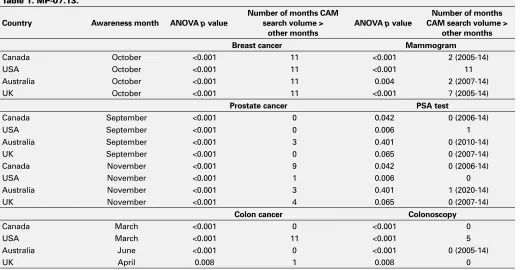
in September (prostate CAM), but yearly peaks are seen in Canada in November, corresponding to the ″Movember″ campaign. Colon cancer searches peak in March (colon CAM) in the U.S.; breast cancer searches universally peak each October (breast CAM). Data from specific CAMs vs. all other months are presented in Table 1. Among screening tests, only ″mammogram″ was searched significantly more often in breast CAM in the U.S.
Conclusions: The Movember campaign, but not prostate CAM, appears to
have traction in influencing disease-specific internet searches in Canada,
but not elsewhere; neither affects searches regarding PSA testing. Breast CAM is universally associated with higher internet search volume for the disease and for mammography in the U.S. Cancer organizations should note these results as an opportunity to reach patients who are already online in significant numbers.
MP-07.14
Paternal family history of p r o s t a t e c a n c e r a m o n g patients undergoing radical prostatectomy across Quebec is associated with better pathologic parameters and greater familial breast cancer
Hamd, Dina1; Chevalier, Simone1,2; McKercher, Ginette2; Brimo, Fadi1; Latour, Mathieu3; Têtu, Bernard4; Ekindi-Ndongo, Nadia5; Scarlata, Eleonora1; Aprikian, Saro1; Saad, Fred3; Lacombe, Louis4; Carmel, Michel5; Aprikian, Armen-G.1,2 1McGill University Health Centre, Montreal, QC, Canada; 2PROCURE, Montreal, QC, Canada; 3Centre Hospitalier de l’Université de Montréal, Montreal, QC, Canada; 4Centre Universitaire de Québec, Quebec, QC, Canada; 5Centre Universitaire de Sherbrooke, Sherbrooke, QC, Canada
Introduction and Objectives: Men with a positive family history of
prostate cancer (PCa) have a higher risk of developing prostate cancer. Several hereditary diseases have a higher incidence in Quebec due to the “founder effect.” The relationship of degrees of familial PCa,
clini-Breast Cancer
CA
N
200420052006200720082009201020112012201320142004200520062007200820092010201120122013201420042005200620072008200920102011201220132014
US
UK
AU
S
Prostate Cancer Colon Cancer
Fig. 1. MP-07.13. Monthly relative search volume (normalized values).
Table 1. MP-07.13.
Country Awareness month ANOVA p value
Number of months CAM search volume >
other months
ANOVA p value
Number of months CAM search volume >
other months Breast cancer Mammogram
Canada October <0.001 11 <0.001 2 (2005-14)
USA October <0.001 11 <0.001 11
Australia October <0.001 11 0.004 2 (2007-14)
UK October <0.001 11 <0.001 7 (2005-14)
Prostate cancer PSA test
Canada September <0.001 0 0.042 0 (2006-14)
USA September <0.001 0 0.006 1
Australia September <0.001 3 0.401 0 (2010-14)
UK September <0.001 0 0.065 0 (2007-14)
Canada November <0.001 9 0.042 0 (2006-14)
USA November <0.001 1 0.006 0
Australia November <0.001 3 0.401 1 (2020-14)
UK November <0.001 4 0.065 0 (2007-14)
Colon cancer Colonoscopy
Canada March <0.001 0 <0.001 0
USA March <0.001 11 <0.001 5
Australia June <0.001 0 <0.001 0 (2005-14)
copathologic parameters, and outcome is unclear. Our objective was to examine the association of family history in the PROCURE cohort of PC patients with clinicopathologic parameters.
Methods: 1856 PCa patients scheduled for radical prostatectomy in four
Quebec teaching hospitals (2007-2012) filled a self-administered and then verified questionnaire as part of enrolment in PROCURE Biobank.
Results: 686 men (36.4%) reported a family history of PCa, including
father (n=347), brothers, grandfathers, uncles, and cousins. The 347 patients with paternal PCa (pPCa) were diagnosed at an earlier age com-pared to no pPCa (61.5 vs. 62.5; p=0.0007). Patients with pPCa had better clinicopathologic parameters: 2.0% vs. 17.4% had a serum pros-tate specific antigen (PSA) level >10ng/ml, less extraprostatic extension (30.3% vs. 35.7%), and less seminal vesicle invasion (8.6% vs. 11.2%). Patients with pPCa had one or more family members with PCa (41% vs. 22%) and came from a smaller family (three siblings vs. five; p<0.0001). Brothers accounted for 50% of these PCa. Patients with pPCa reported more breast cancer (BrCa) (27.0% vs. 18.4%) in their family. More than 80% had up to two family members with BrCa with more mothers affected (41.1% for pPCa vs. 30.9% for no pPCa). Patients with pPCa who had additional family members with PCa had lower PSA (5.8 vs. 9.3 ng/ml; p=0.033), extraprostatic extension (25.2% vs. 33.8%), seminal vesicle invasion (5.6% vs. 10.8%), and reported more BrCa (32.2% vs. 24.0%).
Conclusions: Paternal family history of PCa in the PROCURE cohort of
Quebec men undergoing radical prostatectomy, was associated with bet-ter clinicopathologic paramebet-ters, and additional family members with PCa and BrCa.
UP-07.01
Differential regulation of mechanistic target of rapamycin path-ways in hormone-dependent and independent prostate cancer Patel, Premal1; Dypiangco, Andrea2; Dubey, Arbind3; Drachenberg, Darrel E.1; Shrivastav, Anuraag2
1Section of Urology, University of Manitoba, Winnipeg, MB, Canada; 2Department of Biology, University of Winnipeg, Winnipeg, MB, Canada; 3Section of Radiation Oncology, University of Manitoba, Winnipeg, MB, Canada
Introduction and Objectives: Mechanistic target of rapamycin (mTOR),
which is the downstream target of PI3K/Akt pathway, is a complex central hub for various signaling pathways regulating protein synthesis, cellular differentiation, proliferation, and transformation. In prostate cancer (PCa), alterations in the signaling members of the PI3K/Akt/mTOR pathway have been reported in 42% of primary and 100% of metastatic PCa. The mTOR signaling is often dysregulated in human cancer, including PCa and has been pursued as a therapeutic target. The activation of PI3K/Akt/mTOR pathway has been demonstrated in castration-resistant prostate cancer (CRPC). N-myristoyltransferase (NMT) catalyzes myristoylation of pro-teins that regulate mitogenic pathways. We previously demonstrated that activation of Akt1 leads to phosphorylation of NMT1, which attenuates its activity. However, the mechanism of regulation of NMT by activated Akt is not known. Therefore, we investigated whether NMT is mediated via mTOR.
Methods: To determine differential alteration in PI3K/Akt/mTOR
path-way in hormone-dependent and independent PCa, we treated LNCaP (hormone-dependent), PC3, and Du145 (both hormone-independent) PCa cells with metformin and/or rapamycin. Both metformin and rapamycin inhibit mTOR through different effectors.
Results: We demonstrate high levels of NMT activity in
hormone-inde-pendent cell lines as compared to our hormone-sensitive cell line. There was increased expression of pAMPK in PC3 cells treated with rapamycin and metformin and rapamycin.
Conclusions: We observed differential effect of metformin and rapamycin
on hormone-independent and dependent PCa cells. We also report for the first time that NMT is a downstream target of mTOR in PCa. Together, our data suggest PI3K/Akt/mTOR pathway is differentially regulated in hormone-dependent and independent PCa cells and regulation of NMT by mTOR may provide further insight into the pathogenesis and progres-sion of PCa.
UP-07.02
What false negative rate are active surveillance patients willing to accept in order to avoid prostate biopsy?
Sayyid, Rashid1; Dingar, Dharmendra1; Yao, Erik2; Thorburn, Taylor3; Diamond, Joshua4; Hersey, Karen1; Finelli, Antonio1; Zlotta, Alexandre1; Hamilton, Robert J.1; Kulkarni, Girish S.1; Jewett, Michael A.1; Fleshner, Neil E.1
1Urology, Princess Margaret Cancer Centre, Toronto, ON, Canada; 2University of Toronto, Toronto, ON, Canada; 3Acadia University, Wolfville, NS, Canada; 4McGill University, Montreal, QC, Canada
Introduction and Objectives: Prostate biopsies are associated with
sig-nificant complications. Imaging and blood/urine-based non-invasive tests are being developed in order to better predict disease grade and volume. We conducted a survey among active surveillance (AS) patients (and their partners) to determine what thresholds of false-negative (FN) they would accept in such a tests(s) to avoid biopsies, and their willingness to pay out-of-pocket for these tests if they were not reimbursed by our public healthcare system.
Methods: We developed a validated eight-question survey for men and
their partners to determine the acceptable FN rate for non-invasive test(s) and their acceptable out-of-pocket cost should they not be reimbursed by third-party payers. All patients had confirmed prostate cancer and were managed by AS at our centre. Data was collected on age, level of educa-tion, annual income, marital status, number of prior prostate biopsies in order to determine if these covariates were associated with responses.
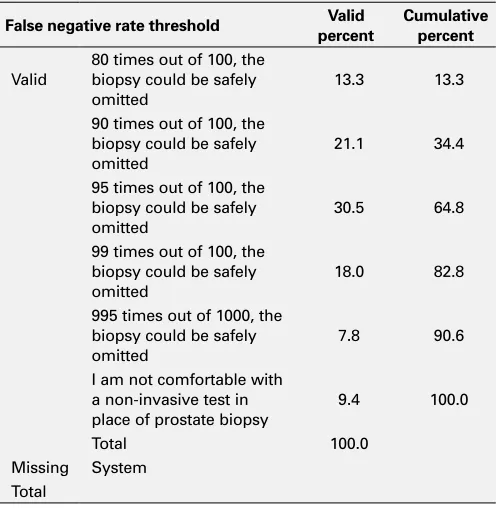
Results: 130 men completed the survey (number of spouses 23). 90.6% of
patients were comfortable with the concept of a non-invasive test in place of a prostate biopsy. 82.8 % would accept a test(s) with a FN rate of 1%, while 64.8% would accept a test(s) with a FN rate of 5%. Significantly, 10% of patients were not comfortable with any alternative to biopsy. Demographics were not associated with response, and spousal responses were similar to those of patients. As for expenditures, 9% would not pay out-of-pocket, while 16.4% would pay $1000 or more and 26.5% $500 or more.
Conclusions: Our results suggest that the vast majority of patients would
accept a non-invasive test in place of a transrectal ultrasound (TRUS)
Table 1. UP-07.02. Patient’s false negative rate threshold for non-invasive test(s)
False negative rate threshold Valid percent
Cumulative percent
Valid
80 times out of 100, the biopsy could be safely omitted
13.3 13.3
90 times out of 100, the biopsy could be safely omitted
21.1 34.4
95 times out of 100, the biopsy could be safely omitted
30.5 64.8
99 times out of 100, the biopsy could be safely omitted
18.0 82.8
995 times out of 1000, the biopsy could be safely omitted
7.8 90.6
I am not comfortable with a non-invasive test in place of prostate biopsy
9.4 100.0
Total 100.0
prostate biopsy, however it appears that FN rate of 1% will need to be achieved. Given the limitation of current imaging/biomarkers, periodic prostate biopsy will be needed in routine management of men on AS for low-risk prostate cancer.
UP-07.03
Does surgical delay for radical prostatectomy affect patient pathological outcome: A retrospective analysis on 1258 patients Zanaty, Marc1,2; Alnazari, Mansour 1,2; Rajih, Emad S.1,2; Alenizi, Abdullah M.1,2; Hueber, Pierre-Alain 1; El-Hakim, Assaad1,2; Zorn, Kevin C.1,2 1Urology, Centre hospitalier de l’Université de Montréal, Hôpital Saint-Luc, Montreal, QC, Canada; 2Urology, Hôpital du Sacré-Coeur de Montréal, Montreal, QC, Canada
Introduction and Objectives: Given limitations to resources in a
publi-cally funded healthcare system, we sought to assess the impact of surgical wait time (SWT) to robot-assisted radical prostatectomy (RARP) on final pathological outcome.
Methods: Retrospective review of 1258 patient records operated by RARP
performed between 2006 and 2015 was conducted. SWT was defined as period from prostate biopsy to surgery. Primary outcome was the impact on postoperative Cancer of the Prostate Risk Assessment (CAPRA) score, which has been well-documented to correlate with biochemical recur-rence, cancer-specific and overall survival. Patients were stratified accord-ing to D’Amico risk categories. Univariate and multivariate analysis with a generalized linear model was used to evaluate the effect of SWT and other predictive factors (age, body mass index (BMI), biopsy Gleason score, clinical stage and, percentage of positive cores) on pathological outcome in each risk group and on the overall sample.
Results: 835 patients were eligible for analysis. High and intermediate
D’Amico risk categories were grouped together in the same strata, due to the limited number of men (55) in D’Amico high-risk category. Mean SWT was significantly different between the two groups: 162.9 days in high/intermediate-risk group vs. 179.3 in low-risk group (p=0.009). After stratification on D’Amico risk group, SWT did not significantly affect postoperative CAPRA score on univariate analysis in both strata. In mul-tivariate analysis, SWT was significantly correlated to CAPRA score only in high/intermediate-risk group (p=0.049). There was no correlation in multivariate analysis in the low-risk group and in the overall cohort. Predictors of higher CAPRA score in the multivariate model were: older age (p=0.030), biopsy Gleason score (p<0.001), percentage of positive cores (p=0.001), clinical stage (p<0.001), and SWT (p=0.049).
Conclusions: In the present study, evaluating SWT for Canadian men
in a publically funded system, increased delay for surgery could affect the pathological outcome. Further studies are needed to give more solid proof and assess the impact of SWT on biochemical-free survival, cancer-specific survival, and disease-free survival.
UP-07.04
Prostate cancer patients’ met and unmet supportive care needs: A cross-sectional, population-based survey
Bender, Jackie1; Feldman-Stewart, Deb2; Tong, Christine2; Pai, Howard3; Au, Jacky1; Brundage, Michael D.2; Robinson, John4; Carolan, Hannah5; Chin, L.K. Joseph6; Davison, Joyce7; Kazanjian, Arminee8
1ELLICSR, University Health Network/ University of Toronto, Toronto, ON, Canada; 2Queen’s University, Kingston, ON, Canada; 3British Columbia Cancer Agency - Vancouver Island Centre, Victoria, BC, Canada; 4Tom Baker Cancer Centre, Calgary, AB, Canada; 5Bristish Columbia Cancer Agency, Vancouver, BC, Canada; 6London Health Sciences Centre, London, ON, Canada; 7University of Saskatchewan, Saskatoon, SK, Canada; 8University of British Columbia, Vancouver, BC, Canada
Introduction and Objectives: To determine the met, unmet, and total
supportive care needs of prostate cancer patients.
Methods: Surveys were conducted in three provinces (BC, AB, SK) from
2014-15, using a modified Dillman mail-survey methodology. A random sample of ~55% of men in each provincial registry diagnosed with pros-tate cancer in the last half of 2012 was surveyed. Supportive care needs were assessed using a modified version of the 34-item Supportive Care Needs Survey, supplemented with the eight-item Prostate Cancer Survey.
Results: Response rates ranged from 46-55% (n=1007). Overall mean
age was 69 years. Most were either receiving followup monitoring after active treatment (49%) or were on active surveillance or watch-ful waiting (22%). Respondents reported more met (M=7.7, SD=9.1) than unmet needs (M=3.8, SD=6.2), t (937)=10.9; p<0.001. In order of frequency, domains of need (based on average frequency of reported total met or unmet need) were: sexual (41%), health system and infor-mation (39%), psychological (25%), care and support (24%), prostate cancer specific (21%) and physical and daily living (19%). Top five met needs were being informed about test results as soon as possible (45%), being informed that the cancer is under control (37%), being treated as a person (34%), being informed about benefits and side effects of treatments (33%), and being informed about the things one can do to help get well (32%). Top five unmet needs were related to sexual feelings (24%), changes in sexual relationships (23%), perceived loss of manhood (21%), uncertainty about the future (17%), and being given information about sexual relationships (17%). Respondents who received active treatment (surgery, external beam radiation, or brachy-therapy) reported more total (met or unmet) needs (M=16.3, SD=15.1) than those who received surveillance or watchful waiting (M=10.5, SD=13.6) (t (890)=3.78; p<0.001), but did not report significantly more unmet needs (t (890)=1.58; p<0.12).
Conclusions: A considerable proportion of prostate cancer patients have
unmet supportive care needs. Most unmet needs relate to changes in sexual feelings or sexual relationships, and uncertainty about the future. Interventions are needed to assist prostate cancer patients in adapting to sexual changes, address their information needs, and support their psychological well-being.
UP-07.05
Castration-resistant prostate cancer patients in Quebec: Medication use in the last year of life
Dragomir, Alice1; Vanhuyse, Marie2; Cury, Fabio3; Aprikian, Armen-G.1; Hu, Jason1
1Urology, McGill University, Montreal, QC, Canada; 2Medical Oncology, McGill University, Montreal, QC, Canada; 3Radiation Oncology, McGill University, Montreal, QC, Canada
Introduction and Objectives: The current management of metastatic
cas-tration-resistant prostate cancer (mCRPC) has become very complex with the approval of several new drugs. The study objective was to describe medication use in the last year of life of patients dying of prostate cancer in Quebec.
Methods: The study cohort consists of patients who received medical
or surgical castration, became castration-resistant and died between January 2001 and July 2013 in Quebec. CRPC was defined as patients who received chemotherapy, abiraterone (Abi), palliative radiotherapy, bone-targeted therapy (BTT) or an anti-androgen. For each patient in the study cohort, medication use (CRPC-related and overall) was identified from the RAMQ pharmaceutical database by 12-, six-, three- and one-month periods prior to death.
Results: The cohort consists of 1692 patients who died of CRPC in the
study period. 767 (45.3%) and 169 (10.0%) patients had received BTT and Abi, respectively. Of the patients receiving BTT at any time, 54.4%, 73.7%, 80.8% and 89.8% received a prescription in the one-, three-, six- and 12-month period before death, respectively. Among the patients receiving Abi at any time, the corresponding figures were: 49.1%, 65.7%, 79.9%, and 96.5%, respectively. The percentage of patients receiving androgen-deprivation therapy (ADT) in the one-, three-, six- and 12-month period before death were: 10.7%, 59.6%, 74.8%, and 83.6%, respec-tively. The median number of prescriptions per month was 7.1 (interquar-tile range (IQR 4.6-10.1) in the last 12 months of life, 7.8 (IQR 5.1-11.3) in the last six months, 8.7 (IQR 5.1-12.8) in the last three months, and 1.7 (IQR 0-5.7) in the last month of life.
Conclusions: In the CRPC group, a large proportion of patients maintained
UP-07.06
TrueNTH peer navigation for prostate cancer patients and their caregivers: Initial discovery and lessons learned
Kazanjian, Arminee1; Soheilipour, Shimae1; Parvin, Lisa1; Maharaj, Nandini1; Miller, Aaron2; Flora, Parminder2; Bender, Jackie2
1School of Population and Public Health, University of British Columbia, Vancouver, BC, Canada; 2ELLICSR Health, Wellness & Cancer Survivorship Centre, University Health Network, Toronto, ON, Canada
Introduction and Objectives: As part of TrueNTH initiatives, we are
devel-oping a program of peer navigation to improve prostate cancer (PCa) patients’ experience of care. PCa survivors are trained as peer providers of informational and emotional support services. The discovery phase aims to review the status and challenges of existing peer-support programs in order to define the TrueNTH intervention.
Methods: A systematic review of published literature, an environmental
scan, and semi-structured interviews of stakeholders were undertaken.
Results: Only six of the 34 Canadian programs are peer-led and none
are specific to PCa patients, suggesting the existence of a care gap in this group. Identified peer-led programs provide one-time connects (single phone call or visit) or short-term communication. Evaluation of outcomes show high satisfaction and acceptability rates among the majority of cancer patients who participated in peer-support programs. Two one-on-one peer-support intervention studies were specific to PCa, one-on-one indicated improvement in psychological distress from baseline and another identi-fied lower depression and higher self-efficacy for the intervention group. Our interviews with healthcare professionals (HCPs) found positive and supportive perspectives to peer navigation for PCa patients. The best point of entry is suggested to be immediately after diagnosis. HCPs believe anything that helps patients make more informed and considered deci-sions is beneficial to clinical practice. A well-designed training program for peer navigators is necessary for provision of appropriate personal support to PCa patients.
Conclusions: Drawing from available resources and the literature,
well-trained and experienced cancer survivors provide cognitive and emo-tional support to cancer patients to help reduce the psychosocial burden of cancer. Our intervention will provide a unique opportunity for PCa patients, matched with peers based on their individual preferences and communication needs, move forward through their cancer journey in a supportive environment.
Funded by Prostate Cancer Canada through Movember Foundation. (http://au.movember.com/programs/prostate-cancer).
UP-07.07
Real-world experience of degarelix, a luteinizing hormone-releasing hormone antagonist in prostate cancer
Sadikov, Evgeny1; Dubey, Arbind1; Amjad, Asim1; Koul, Rashmi1; Leong, Nelson1; Dolata, Wojciech1; Jancewicz, Miroslav1; Torri, Vamsee1; Tai, Patricia1
1Departments of Radiation and Medical Oncology, Allan Blair Cancer Centre, Regina, SK, Canada
Introduction and Objectives: Luteinizing hormone-releasing hormone
(LHRH) antagonists showed remarkable response in trials. There are few case series outside clinical trials. This is the first report in a Canadian community setting.
Methods: Data from patients in electronic medical records were entered
and analyzed. The primary outcome is response rate.
Results: From January 2011 to April 2015, degarelix was recommended to
176 patients. Seven patients declined due to drug interaction, comorbidi-ties, or inconvenience. The remaining patients were categorized as Group Adjuvant (27), Biochem (49, asymptomatic prostate-specific antigen (PSA) relapse), Met (74), and Primary (19 primary treatment for non-metastatic disease). Group Biochem had a PSA response of 80% (20/25 evaluable patients) with first-line degarelix and 62% (8/20) after failing LHRH ago-nist with/without anti-androgens; while group Met had a 76% (29/38) and 28% (7/25) response, respectively. 25 patients were given degarelix monotherapy initially and at time of PSA progression, 21 responded when bicalutamide was added. Some patients have multiple side effects, which mainly included 13 local pain, three local swelling, eight fever/chills, five rashes, five hot flashes, and one pulmonary embolism (possibly related).
There were no other documented cardiovascular complications. There were 24/133 (18%) patients requested to stop the drug due to side effects, without any supportive medications to prevent or treat them. However, only 1/22 (4.5%) patients stopped degarelix if given Benadryl, Tylenol, topical lidocaine or steroid, and/or dexamethasone 0.5-1 mg. Patients with non-severe reactions were compliant to continue after physician explanation of the superiority of degarelix over LHRH agonists.
Conclusions: The addition of an anti-androgen to degarelix as total
andro-gen blockade improves its effectiveness. Improved communication with patients and family doctors, and supportive medications can help patients to stay on degarelix longer.
UP-07.08
Feasibility and early experience of a multidisciplinary prostate cancer clinic at a community hospital
Canning, Sarah1; Schaeffer, Rhona1; Grant, Judy1; Sparks, Sarah1; Ramirez, Alvaro1; Singh, Rajiva1; Martin, Paul1
1Bluewater Health, Sarnia, ON, Canada
Introduction and Objectives: Patients with prostate cancer represent a
diverse patient population with often complex medical needs. Treatment options for patients in all disease states have expanded in the last several years. Not all patients have ready access to a tertiary care cancer cen-tre. We sought to assess the feasibility of a dedicated multidisciplinary prostate cancer clinic at a community hospital and to assess the impact of the clinic on cost and quality of care.
Methods: The planning, development, and early experience of the prostate
cancer clinic are described. Data was prospectively collected during the initial six months of clinic operation. Clinic volumes, patient satisfaction, and patient characteristics, such as disease state and Eastern Cooperative Oncology Group (ECOG) status, are presented. Patient use of hospital resources and impact on hospital revenue is also described.
Results: During six months of the clinic, there were 602 patient
vis-its. 374 unique patients were seen; 118 patients had multiple visits to the clinic. Patients with biochemical failure represented 17% of visits. Patients with metastatic disease or castrate-resistant disease represented 32% of visits. 17% of patients had ECOG scores of 2-4. 22% of the visits involved use of the hospital outpatient laboratory. 45% of visits involved use of the hospital outpatient pharmacy. The use of the hospital pharmacy led to $29 216 in additional hospital revenue, as well as direct savings for many patients. Community support for this program has resulted in $80 000 in donations through the hospital foundation. Wait times for surgery were within provincial targets 100% of the time. Patient satisfaction was high, with 100% of patients reporting the care they received as positive.
Conclusions: The creation of a dedicated prostate cancer clinic at a
com-munity hospital is feasible and offers several potential advantages to the patient, clinician, and institution.
UP-07.09
Association between obesity and pathologic upgrading in localized prostate cancer
Wu, Christopher H.1; Hoogenes, Jen1; Patterson, Lisa2; Shayegan, Bobby1 1Department of Surgery, Division of Urology, McMaster University, Hamilton, ON, Canada; 2Boris Family Centre for Robotic Surgery Research Program, St. Joseph’s Healthcare Hamilton, Hamilton, ON, Canada
Introduction and Objectives: Obesity is an increasingly prevalent health
concern worldwide. Studies have tested the association between obesity and prostate cancer with conflicting results. Obesity (body mass index (BMI) of ≥30 kg/m2) has been linked to higher prostate cancer incidence, grade, risk of biochemical recurrence, and cancer-specific mortality. Gleason score on biopsy remains one of the strongest prognostic indica-tors for predicting prostate cancer aggressiveness. Gleason score upgrad-ing (GSU) rates of up to 57% have been reported. As such, there remains a significant risk of undertreating prostate cancer using the biopsy Gleason score alone. Identifying GSU risk factors is an increasingly important issue. A paucity of data exists that address the risk of GSU and obesity.
Methods: We retrospectively analyzed the records of a consecutive series
prostate-spe-cific antigen (PSA), biopsy and pathological Gleason scores, and prostate weight were analyzed against BMI.
Results: 204 patients met the inclusion criteria. Of this patient population,
by using calculated BMI, 37% were obese. No significant difference in the age at surgery (61.7 vs. 62.0 years; p=0.84) or PSA level (8.06 vs. 10.04 ng/ml; p=0.14) was found between groups. However, prostate weight (51.0 vs. 56.9 g; p=0.04) was larger in the obese group. No difference was found in the rate of pathologic upgrading in obese vs. non-obese patients (27.5% vs. 33%; p=0.52).
Conclusions: In patients undergoing RARP for clinically localized prostate
cancer, in our sample obesity was not associated with a higher rate of pathologic upgrading. These results contribute to the paucity of existing data on whether obesity is a significant contributor to pathologic upgrad-ing. Our study suggests that obese patients undergoing RARP are not more likely to have aggressive prostate cancer. As data entry is ongoing, we anticipate have over 500 cases for further evaluation.
UP-07.10
The androgen-deprivation therapy educational program: A Canadian True NTH initiative
Robinson, John1; Wassersug, Richard J.2; Walker, Lauren M.1,3; Wobowo, Erik2; Matthew, Andrew4; McLeod, Deborah L.5
1Oncology, Tom Baker Cancer Centre and University of Calgary, Calgary, AB, Canada; 2Department of Urological Sciences, University of British Columbia, Vancouver, BC, Canada; 3Oncology, University of Calgary, Calgary, AB, Canada; 4GU Survivorship Program, Princess Margaret Cancer Centre, Toronto, ON, Canada; 5Psychosocial Oncology Team, QEII Health Sciences Centre, Halifax, BC, Canada
Introduction and Objectives: Androgen-deprivation therapy (ADT) is
com-monly used to treat prostate cancer, but has many adverse effects that can directly impair patients’ quality of life and, indirectly, that of their intimate partners. In five Canadian cities, we offer a program on how patients and their partners can stay physically and emotionally healthy and co-supportive when the patient is on ADT.
Method: Patients recently prescribed ADT and their partners attend a
1.5-hour class and receive the book Androgen-Deprivation Therapy: An essential guide for men with prostate cancer and their partners (Wassersug et al., 2014). Attendees learn strategies for managing ADT side effects and use goal-setting exercises to make beneficial lifestyle adjustments to help manage ADT side effects. To evaluate the effectiveness of the educational program, participants complete questionnaires before attending the class and again 2-3 months later. The questionnaires assess: 1) ADT side effect frequency and bother; 2) self-efficacy in side effect management; 3) physi-cal activity; and 4) relationship adjustment.
Results: As of December 2015, 232 patients and 150 partners have
attended the program in Halifax, Toronto, Victoria, Vancouver, and Calgary. 86 participants consented to participate in the evaluation of the ADT Educational Program. Participant feedback has been overwhelm-ingly positive.
Conclusions: The ADT Educational Program is becoming usual care at
these centres. It remains to be seen how effective the program is in limit-ing the bother from ADT side effects and helplimit-ing couples maintain strong relationships. An online version of the program will soon be available for patients across Canada.
UP-07.11
Quality assessment of the Canadian Prostate Cancer Biomarker Network platform using the validated prostate cancer biomarker nuclear factor-kappa B p65
Ouellet, Veronique1; Grosset, Andree-Anne1; Fragoso, Gabriela1; Barrès, Véronique1; Delvoye, Nathalie1; Latour, Mathieu1; Trudel, Dominique1; Aprikian, Armen-G.2; Bergeron, Alain3; Brimo, Fadi2; Bristow, Robert4; Chevalier, Simone2; Drachenberg, Darrel E.5; Fazli, Ladan6; Fleshner, Neil E.4; Gleave, Martin E.6; Karakiewicz, Pierre1; Klotz, Laurence H.7; Lacombe, Louis3; Lattouf, Jean-Baptiste1; van der Kwast, Theodorus4; Mes-Masson, Anne-Marie1; Saad, Fred1
1Centre de recherche CHUM, Urology and Pathology, Centre hospitalier de l’Université de Montréal, Montreal, QC, Canada; 2MUHC Research
Centre, Urology and Pathology, McGill University Health Centre, Montreal, QC, Canada; 3Centre de recherche and Urology, CHU de Quebec, Université Laval, Quebec, QC, Canada; 4Urology and Radio-Oncology, University Health Network, Toronto, ON, Canada; 5Manitoba Prostate Centre, Cancer Care Manitoba, Winnipeg, MB, Canada; 6Vancouver Prostate Centre, Vancoucer Coastal Health Research Institute, Vancouver, BC, Canada; 7Urology, Sunnybrook Health Sciences Centre, Toronto, ON, Canada
Introduction and Objectives: The Canadian Prostate Cancer Biomarker
Network (CPCBN) is a program that gathers researchers from several insti-tutions from four different Canadian provinces. This network assembled a validation tissue-microarray (TMA) resource composed of 1508 patients treated by radical prostatectomy (RP) separated within test-TMA and full TMA series. This richly annotated resource is available for prostate cancer researchers who wish to access a large cohort to validate their prognostic biomarkers.1 Over the last decade, we and others have uncovered a robust association between the nuclear localisation of nuclear factor-kappa B (NF-kB) p65, prostate cancer aggressiveness, and biochemical recurrence (BCR).2,3 Thus, for quality assurance, the CPCBN series was challenged for p65 expression analysis.
Methods: Automated immunohistochemistry staining of p65 was
per-formed using the CPCBN test-TMAs. This test series contains a minimum of three cores of tumour tissues and two cores of adjacent benign tissues from 250 RP specimens. Two independent observers scored percent of nuclear staining. Statistical analyses were performed using SPSS software.
Results: By Kaplan-Meier analysis, we validated the significant association
between an increase in nuclear frequency of NF-kB p65 and biochemical relapse (log rank, p=0.05, cutoff of 3%) while Cox regression analyses showed a trend (dichotomized p65: p=0.06, Exp(B) 1.58, 95% CI 0.99-2.53). Nuclear frequency of p65 was also associated with increase risk of developing bone metastasis (Cox regression, p=0.03, Exp(B) 1.06, 95% CI 1.006-1.117), although this will need to be confirmed on a larger cohort.
Conclusions: Our study recapitulates previous observation linking NF-kB
p65 with disease progression using a large cohort of Canadian men and also highlight its role as a predictor of bone metastasis.
1. http://www.tfri.ca/en/research/translational-research/cpcbn.aspx . Accessed April 21, 2016.
2. Gannon PO, Lessard L, Stevens LM, et al. Large-scale independent validation of the nuclear factor-kappa B p65 prognostic biomarker in prostate cancer. Eur J Cancer 2013;49:2441-8. http://dx.doi. org/10.1016/j.ejca.2013.02.026
3. Labouba I, Le Page C, Communal L, et al. Potential cross-talk between alternative and classical NF-κB pathways in prostate can-cer tissues as measured by a multi-staining immunofluorescence co-localization assay. PLoS One 201510:e0131024. http://dx.doi. org/10.1371/journal.pone.0131024
UP-07.12
Describing perspectives of healthcare professionals about active surveillance
Fitch, Margaret1; Pang, Kittie1; Ouellet, Veronique2; Chevalier, Simone3; Drachenberg, Darrel E.4; Finelli, Antonio5; Hamel, Lucie3; Lattouf, Jean-Baptiste2; Li, Kathy5; Palmer, Maureen6; Sitarik, Paula4; So, Alan I.6; Sutcliffe, Simon7; Tanguay, Simon3; Saad, Fred2; Mes-Masson, Anne-Marie2 1Sunnybrook Health Sciences Centre, Toronto, ON, Canada; 2Centre de recherche and Urology, Centre hospitalier de l’Université de Montréal, Montreal, QC, Canada; 3MUHC Research Centre and Urology, McGill University Health Centre, Montreal, QC, Canada; 4Manitoba Prostate Centre, Cancer Care Manitoba, Winnipeg, MB, Canada; 5Urology, University Health Network, Toronto, ON, Canada; 6Vancouver Prostate Centre, Vancoucer Coastal Health Research Institute, Vancouver, BC, Canada; 7British Columbia Cancer Agency, Vancouver, BC, Canada
Introduction and Objectives: Practice of active surveillance (AS) for men
with low-risk prostate cancer (PCa) is growing across Canada. This study seeks to gain a deeper understanding of healthcare professionals’ (HCP) perspectives in regards to AS and the factors that influence men’s decision to follow this course of action.
Methods: Focus groups (n=5) were held with HCP who care for men