R E S E A R C H
Open Access
Nearfield target localization with a few
snapshots for sonar array
Zhuo Li
1,2, Deliang Liu
3*, Xiwei Guo
3and Peng He
3Abstract
Sonars can be used for detection of targets located on the sea floor where the signal undergoes multipath propagations which may arise large localization errors. Besides, underwater environment is often highly unstable so that a large number of snapshots which means long time sampling are not reliable. In sonar systems, the wideband chirp signals are usually used. This paper presents a nearfield target localization method for underwater environments. First, the time of arrival (TOA) and the direction of arrival (DOA) for nearfield wideband chirp signals are estimated with only a few snapshots by using the fractional Fourier transform (FRFT) and the SPICE algorithm. Then, the virtual station method which is proposed in our previous work is used so that the multipath problems can be converted into line-of-sight (LOS) problem and its Cramer-Rao lower bound (CRLB) is also analyzed. Finally, simulation results demonstrate the effectiveness of the proposed method.
Keywords:Sonar, Target localization, Multipath, Nearfield
1 Introduction
Sonar systems have been widely used for decades to detect an underwater target [1–3]. The active sonar transmits an acoustic signal at a predetermined inter-val and then receives signals using a sensor array to find echoes that are reflected from a target, while the passive sonar which contains sensor array receives the acoustic signal which is transmitted from the target. The received signal usually contains an echo signal, ambient noise, and reverberation signals induced by underwater environments [4–6] which is also called multipath problem. The conventional localization methods for free space environment are limited in underwater environment because of the multipath sig-nal propagation. To mitigate these impacts, a variety of algorithms have been proposed in the literatures. A detection scheme in [7] is used to detect and discard multiple-bound scattering paths, which will not work when all signal paths are multiple-bound scattering paths. Joint iterative phase reconstruction and weighted localization algorithm is used in [8], but the transmitted and received signal paths at the same reader may be different which may cause large errors.
Robust schemes in [9, 10] derive the line of possible mobile device (LPMD) but they cannot apply to the multiple-bound scattering conditions. In our previous work [11], a virtual station (VS) method has been proposed to solve the multipath problem and it will be directly used in this paper.
Another challenge emerges when the number of snapshots available for the estimation of the location parameters such as time of arrival (TOA) and direc-tion of arrival (DOA) is limited. In underwater condi-tions, a large number of snapshots are not reliable due to the motion of the target and the highly non-stationary of the environment which is caused by complex electromagnetic environment and the people who appear randomly. Therefore, the performance of the conventional array processing methods, such as MUSIC and ESPRIT, which require a large amount of snapshots to provide super-resolution DOA and TOA estimation, will be dramatically degraded. Several methods have been proposed in the literature to solve this problem. IAA, SLIM, and SPICE algorithms [12] are sparsity-based techniques that can estimate the DOA depending on a few snapshots with high reso-lution and low sidelobes. But they only apply to nar-rowband signals, because the steering vector of the received wideband signal model is time-variant. So
* Correspondence:[email protected]
3Army Engineering University, Shijiazhuang 050003, China
Full list of author information is available at the end of the article
some extensions to this method have been proposed to deal with the wideband signals, such as spatial re-sampling (SR) method [13], the accuracy of which is not high due to using an approximate model for wideband chirp signals.
In this paper, a joint TOA and DOA localization method for wideband chirp signals which is able to locate underwater targets with only a few snapshots is proposed. First, wideband chirp signal was trans-formed with a specific transform order into sine wave with a single frequency in fractional Fourier transform (FRFT) domain, so that the time-invariant steering vector of the wideband chirp can be obtained. Then, the SPICE algorithm is utilized to estimate the TOA and DOA of the targets with two snapshots. Finally, the VS method is used to estimate the target location using the hybrid TOA and DOA values and its Cramer-Rao lower bound (CRLB) is also analyzed.
The rest of this paper is organized as follows. In Section 2, the SPICE method is developed in the FRFT domain to estimate the nearfield TOA and DOA of wideband chirp signal. In Section 3, the VS method which utilizes the TOA and DOA measure-ments is directly used and the CRLB is also analyzed. Section 4 presents the experimental results. The paper is concluded in Section 5.
2 Joint DOA and TOA estimation with a few snapshots
2.1 Sonar array model
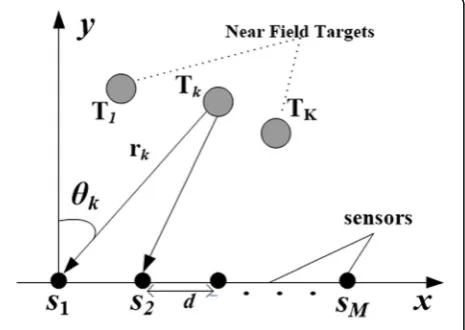
Considering a passive sonar array system as shown in Fig. 1. A nearfield model is used in this paper. The linear array of the sonar has M sensors uniformly placed along the x-axis. The distance between two ad-jacent sensors is d. T1, T2, …, TK are K targets at [r,
θ], where r= [r1, r2,…, rK] represent the distances of the targets and θ= [θ1, θ2,…, θK] represent the direc-tions of the targets. Here, K is usually unknown, so it
is considered to be the amount of potential targets (scanning points) in the region and it is much larger than the amount of actual ones. Only a few signal power estimates of the potential targets will be non-zero, so sparsity-based algorithm can be used in array processing applications.
The target emits a chirp signal that can be expressed as [14]
x tð Þ ¼aexp j2πf0tþjπμt2
ð1Þ
where a is the signal amplitude, f0 is the center fre-quency, andμis the chirp rate.
The received signal at the sensor m can be expressed as the sum of K delayed versions of x(t), given by [14]
xmð Þ ¼t X K
k¼1
ρkxk t−τmk
þemð Þt ð2Þ
where em(t) for m= 1, 2, …, M is the additive white Gaussian noise at the sensor m, ρk is the path loss coefficient of target k for k= 1,2,…,K. τm
k is the time delay of the kth signal traveling to the sensor mrelative to the reference sensor (the first sensor), which can be expressed as [14]
τm k ¼
rk−
ffiffiffiffiffiffiffiffiffiffiffiffiffiffiffiffiffiffiffiffiffiffiffiffiffiffiffiffiffiffiffiffiffiffiffiffiffiffiffiffiffiffiffiffiffiffiffiffiffiffiffiffiffiffiffiffiffiffiffiffiffiffi
rk sinθk−ðm−1Þd
½ 2þ
r2 k cosθk
q
c ð3Þ
wherecis the wave speed.
Ignoring the high-order terms from the Taylor expan-sion, Eq. (3) can be given as [14]
τm k ≈
−ðm−1Þd sinθkþ1 2ðm−1Þ
2
d2 cos2θk=rk
c ð4Þ
The received signals at the sensors can be written in matrix form as [14]
xð Þ ¼t asð Þ þt eð Þt ð5Þ
where s(t) = [s1(t), s2(t), …, sK(t)]T is the waveform vector and a= [a(θ1), a(θ2),…, a(θK)]T is the steering vector with
að Þ ¼ ½θk exp −j2πf0τ1þjπμτ21
expð−j2πμτ1tÞ;…;
exp −j2πf0τMþjπμτ2M
expð−j2πμτMtÞT ð6Þ
When the narrowband signal is used in the system,
a(θk) can be considered as time-invariant (i.e., the
term exp.(−j2πμτmt) in (6) can be neglected). In this paper, we focus on wideband chirp, so the steering vector a(θk) depends on the timet, and the SPICE
al-gorithm for narrowband signals cannot be applied
directly to wideband signals. To solve this problem, we derive the FRFT method.
2.2 The FRFT of wideband chirp
The FRFT of x(t) in (1) about angle α can be repre-nals [15] with N which denotes the number of snap-shots and fs is the sampling frequency.
C¼acosαdp1ffiffiffiffiffiffiffiffiffiffiffiffiffiffiffiffiffiffiffiffiffiffiffiþ jtanαd exp½−jπf20 sinαdcosαd is a constant. By taking the FRFT, the chirp signal be-comes a sine wave with a single frequency f=f0 cosαd.
At the sensor m, the received chirp from target k in the FRFT domain according to the time shift charac-teristic of FRFT can be given as
Xmkðαd;uÞ ¼ Fp x t−τmk
Therefore, the FRFT of (5) can be given as
X¼ASþE ð11Þ assumed to be white Gaussian noise. The power spectrum density of a random signal x(t) in FRFT do-main with angle α is
Pðα;uÞ ¼ lim T→∞
E Xj ðα;uÞj2
2T ð14Þ
The observation time is [−T,T].
Considering the relationship between the power spectrum density and the autocorrelative function, we can get
Considering the correlation function of white noise in the FRFT domain, we can get
Rðα;τÞ ¼N0 exp−jπτ 2 cotα
ð Þ
cscα δ τð Þ ð17Þ
the white noise in FRFT domain with angle α can be given as
Pðβ;uÞ ¼N0 ð18Þ
We can see that the power spectrum density in the FRFT domain of the white noise is changeless, so the FRFT will not change the statistical characteristics of the white noise, and E in (17) is still Gaussian.
2.3 Joint TOA and DOA estimation by SPICE
The discrete form of (11) can be given as
Xð Þ ¼n ASð Þ þn Eð Þn ð19Þ
wheren= 1, 2,…,Nis the number of snapshots.
LetPbe aK×Kdiagonal matrix, whose diagonal contains the power at each angle on the scanning grid. The initial es-timatesP^ðk0Þcan be obtained using the SFLS method [16]
^ Pð Þk0 ¼
XN
n¼1
AkHXð Þn
2
AkHAk
2
N ð20Þ
The noise covariance matrixRofX(n) can be given as
Rð Þi ¼E XX H¼AP^ði−1ÞAH ð21Þ
Then, in thei+ 1 iteration, the power at each angle on the scanning grid can be updated as
pðkiþ1Þ¼
jβð Þi k j
w1k=2X K
l¼1
w1l=2jβð Þli j
ð22Þ
where
wk¼k kak 2
trð ÞR ; βk
2
¼QX X HXXHQH kk=N
2;
Q¼PAR‐1
Then, iterate (21)–(22) untilP^kwill not change obviously.
Finally, we search the 2-D positions of the spectral peak ofP^k, the coordinatesrandθof which are the
dis-tances and DOA estimates of the targets. r/c are the TOA estimates. The details of SPICE algorithm can be found in [12].
3 Target localization in underwater environment
In underwater environment where the seafloor is smooth and the water is stable, the target location can be ob-tained with TOA and DOA estimates using one sensor array. But there are ocean currents, rocks, and undersea mountains, which may cause multipath and
non-line-of-sight (NLOS) propagations and will dramatically degrade the performance of the localization method for LOS conditions. In our previous work [11], a virtual station (VS) method was proposed to solve the NLOS and mul-tipath problems with TOA and DOA measurements. Therefore, it can be directly used in this work when more sensor arrays which can be seen as base stations (BSs) are used. In order to make it simple, the details of the VS method will not be stated in this paper.
To calculate the CRLB of the proposed method, we as-sume that the underwater environment is simple that the signals undergo no more than two-bound scattering (reflection or diffraction), and multi-bound scattering can be ignored as they suffer from severe fading and may be too weak to be observed.
There are several signal paths between the BS and the target. The first and second detectable paths are utilized in the proposed localization method. We use a new par-ameterpki
i to represent the probability of that the first or
second detectable path is the path ki (ki= 1, 2, …, Ki)
which represents the VS number, wherei= 1, 2,…,N de-notes the BS number.
When the underwater signal channel is stable, the first and second detectable paths are stable too. The two path numbers areq1 andq2. We can get
pkii ¼
1 ki¼q1or q2 0 ki≠q1or q2
ð23Þ
When the underwater signal channel is complicated with relatively large flow of fish, the first and second de-tectable paths may be not the same in every measure-ment, sopki
i needs to be practically measured.
The probability that the paths q1 and q2 are the first and second detectable paths can be obtained as
Pq1q2i ¼pq1i þpq2i −1 ð24Þ
The Fisher information matrix of the proposed method can be given as
J0¼E
∂
∂w lnfðΛjwÞ
∂
∂w lnfðΛjwÞ
T
( )
¼K1! X
K2!…KN!
j¼1
Pj ∂∂w lnf Λjjw
∂
∂w lnf Λjjw
T
ð25Þ
where
Pj¼1¼P11;2P
Λis the measurement vector with Λj¼1¼ Λ11;2;Λ
The CRLB can be given as
σ2
whereQis the covariance matrix and His the Jacobian matrix ofμ(w) and can be given as 4 Simulation results
4.1 Simulation of TOA and DOA estimation
We investigate the performance of our algorithm about angular resolution, sidelobe level, and accuracy in the an-gular spectrum. We also compare it with FrFT-MUSIC al-gorithm [14] which utilizes MUSIC algorithm combined with FrFT. But in order to apply for passive sonar, the ro-tation angleαhas been changed from -arccotμto arctanμ.
The chirp signal with a center frequency of 1500 Hz and a bandwidth of 100 Hz is used in the simulation. The array contains eight sensors which are uniformly spaced at half wavelength. The number of snapshots is 2. We consider two targets at (14°, 14 m) and (16°, 16 m). The noise is as-sumed to be Gaussian random processes with zero mean and the SNR is 20 dB. The scanning grid for the both algorithms is 1° and 1 m. The number of iterations is 10. One hundred independent runs are simulated to obtain the angular spectrum. We can see from Fig.2a that the FrFT-MUSIC method can approximately detect the targets but it suffers from lower angular resolution than the other two with low snapshots so that it cannot separ-ate the two targets and consider them as one target at (14°, 34 m). From Fig.2b, our FrFT-SPICE algorithm has exactly estimated the TOA and DOA of the two targets and produces the angular spectrum with lower sidelobe levels, higher angular resolution, and higher accuracy in low snapshots conditions.
4.2 Simulation of the VS method
method for the NLOS and multipath underwater environments, so there is no need to simulate it again in this paper. The CRLB of the proposed VS method which has not been analyzed in previous works will be simu-lated in this section.
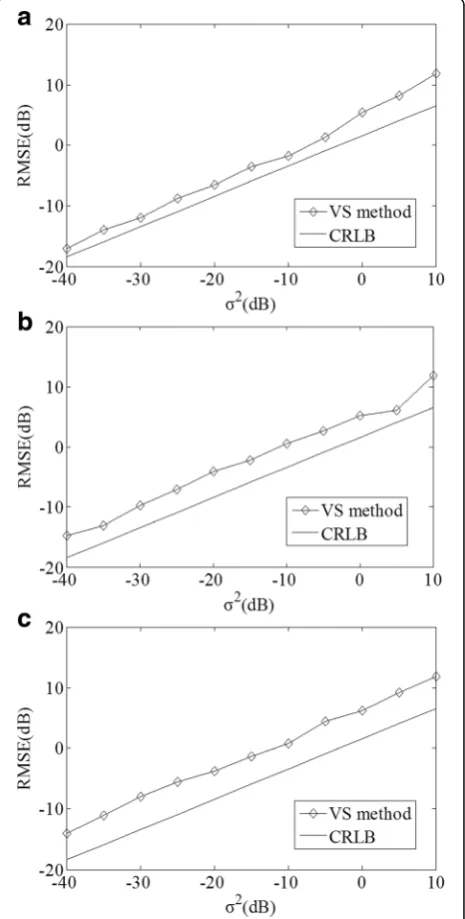
The CRLB in Fig.3 is obtained in the same situations as in [11]. The target is located at three different places at A, B, and C where the multipath problem becomes more and more complicated. Most of the paths are dir-ect paths when the target is located at point A. At point B, all paths are one-bound scattering paths. At point C, almost all paths are multiple-bound scattering paths. We assume that p1
i ¼p2i ¼…¼pKii. It can be seen that our
VS method is close to the CRLB, but the distance be-tween the RMSE and the CRLB has a slow increase as the multipath conditions become more serious.
5 Conclusions
This paper has presented a nearfield target localization method for sonar system which uses wideband chirp sig-nal. In underwater conditions, the signal channel is not stable and there exists multipath problem which can cause large localization errors when the traditional
localization methods are used. We extend the SPICE al-gorithm in the FrFT domain so that the TOA and DOA of wideband chirp signals can be estimated with a few snapshots. The proposed method has high angular reso-lution and low sidelobe levels. We also utilize the pro-posed VS method to solve the multipath problem. The simulation results have demonstrated the effectiveness of the proposed method.
Abbreviations
BS:Base station; CRLB: Cramer-Rao lower bound; DOA: Direction of arrival; FRFT: Fractional Fourier transform; LOS: Line-of-sight; NLOS: Non-line-of-sight; TOA: Time of arrival; VS: Virtual station
Fig. 2Comparison of the angular spectrum.aFrFT-MUSIC.bFrFT-SPICE
Funding
The experiments of this research are funded by the National Natural Science Foundation of China under Grant numbers 61601494 and 61602346.
Authors’contributions
All authors contributed to the work. DL conceived and designed the study. ZL carried out most of the analyses. DL drafted the manuscript. XG and PH performed the experiments. All authors read and approved the final manuscript.
Competing interests
The authors declare that they have no competing interests.
Publisher’s Note
Springer Nature remains neutral with regard to jurisdictional claims in published maps and institutional affiliations.
Author details
1Tianjin Key Laboratory of Wireless Mobile Communications and Power
Transmission, Tianjin Normal University, Tianjin 300387, China.2College of Electronic and Communication Engineering, Tianjin Normal University, Tianjin 300387, China.3Army Engineering University, Shijiazhuang 050003, China.
Received: 5 November 2017 Accepted: 11 April 2018
References
1. Z Li, K Liu, Y Zhao, et al., MaPIT: an enhanced pending interest table for NDN with mapping bloom filter. IEEE Commun. Lett.18(11), 1915–1918 (2011). 2. Z Li, Y Chen, H Shi, et al., NDN-GSM-R: a novel high-speed railway
communication system via named data networking. EURASIP J. Wirel. Commun. Netw.48, 1–5 (2016).
3. X Liu, Z Li, P Yang, et al., Information-centric mobile ad hoc networks and content routing: a survey. Ad Hoc Netw. (2016)https://doi.org/10.1016/j. adhoc.2016.04.005.
4. Z Li, L Song, H Shi, et al., Approaching the capacity of k-user MIMO interference channel with interference counteraction scheme. Ad Hoc Netw. (2016)https:// doi.org/10.1016/j.adhoc.2016.02.009.
5. Z Li, Y Chen, K Liu, Hybrid wireless networks with FIB-based named data networking. EURASIP J. Wirel. Commun. Netw.54, 1–7 (2017).
6. Z Li, Y Xu, K Liu, Performance analysis of a novel 5G architecture via content-centric networking. Phys. Commun. (2017)https://doi.org/10.1016/j.phycom. 2017.04.002.
7. CK Seow, SY Tan, Non-line-of-sight localization in multipath environments. IEEE Trans. Mob. Comput.7(5), 647–660 (2008).
8. YT Ma, LJ Zhou, KH Liu, Iterative phase reconstruction and weighted localization algorithm for indoor RFID-based localization in NLOS environment. IEEE Sensors J.14(2), 597–611 (2014).
9. CS Tai, SY Tan, CK Seow, Robust non-line-of-sight localization system in indoor environment. Electron. Lett.46(8), 593–595 (2010).
10. CK Seow, SY Tan, Non-line-of-sight unidirectional mobile localization in multipath environment. Electron. Lett.44(2), 141–142 (2008).
11. D Liu, K Liu, Y Ma, J Yu, Joint TOA and DOA localization in indoor environment using virtual stations. IEEE Commun. Lett.18(8), 1423–1426 (2014).
12. P Stoica, P Babu, J Li, New method of sparse parameter estimation in separable models and its use for spectral analysis of irregularly sampled data. IEEE Trans. Signal Process.59(1), 35–46 (2011).
13. Z Chen, J Li, P Stoica, KW Lo, inProc. IEEE OCEANS. Iterative adaptive approach for wide-band active sonar array processing (Sydney, IEEE, 2010), pp. 1–10. 14. P Luo, K Liu, W Shi, G Yan, inProc. 10th ICSP. 2-D DOA estimation of
wideband LFM signals for arbitrary planar array (2010), pp. 307–310. 15. HM Ozaktas, O Arikan, MA Kutay, Digital computation of the fractional
Fourier transform. IEEE Trans. Signal Process.44(9), 2141–2150 (1996). 16. JD Scargle, Studies in astronomical time series analysis. II. Statistical aspects of