Volume 2008, Article ID 624542,7pages doi:10.1155/2008/624542
Research Article
Space-Time Convolutional Codes over Finite Fields
and Rings for Systems with Large Diversity Order
Mario de Noronha-Neto1and B. F. Uch ˆoa-Filho2
1Telecommunications Systems Research and Development Group, Federal Center of Technological Education of Santa Catarina,
88103-310 S˜ao Jos´e, SC, Brazil
2Communications Research Group-GPqCom, Department of Electrical Engineering, Federal University of Santa Catarina,
88040-900 Florianopolis, SC, Brazil
Correspondence should be addressed to B. F. Uch ˆoa-Filho,[email protected]
Received 26 October 2007; Revised 18 March 2008; Accepted 6 May 2008
Recommended by Yonghui Li
We propose a convolutional encoder over the finite ring of integers modulo pk,Z
pk, wherepis a prime number andkis any positive integer, to generate a space-time convolutional code (STCC). Under this structure, we prove three properties related to the generator matrix of the convolutional code that can be used to simplify the code search procedure for STCCs overZpk. Some STCCs of large diversity order (≥4) designed under the trace criterion forn =2, 3, and 4 transmit antennas are presented for various PSK signal constellations.
Copyright © 2008 M. de Noronha-Neto and B. F. Uch ˆoa-Filho. This is an open access article distributed under the Creative Commons Attribution License, which permits unrestricted use, distribution, and reproduction in any medium, provided the original work is properly cited.
1. INTRODUCTION
Since the discovery of space-time trellis codes (STTCs) by Tarokh et al. [1], much research has been done in this area. Some authors [2–5] have concentrated their efforts to generate STTCs through an encoding structure wherein the inputs are binary symbols, the encoding operations are realised modulo 2k, wherekis any positive integer, and the
2k-ary outputs are matched to a 2k-ary signal constellation.
Although this encoding structure facilitates the code search procedure, this search becomes prohibitively complex as the number of transmit antennas, states, or modulation size increases.
In order to simplify the design of STTCs, Abdool-Rassool et al. [6] have proven two theorems that allow one to significantly reduce the computational effort of the code search. In [7], utilising an alternative structure, the authors have considered STTCs generated by a convolutional encoder over the Galois field GF(p) ≡ Zp, p a prime, where the
information symbols, the convolutional encoder tap gains, and the output symbols are elements of Zp, allowing for
a spectral efficiency of log2(p) b/s/Hz. These codes are referred to as space-time convolutional codes (STCCs). Using the structure proposed in [7], Hong and Chung [8] and
Noronha-Neto and Uch ˆoa-Filho [9] have presented some new STCCs over GF(p) for two transmit antennas.
The design of good STTCs is based on the well-known rank and determinant [1] criteria or the trace [2,3] criterion, depending on the system’s diversity order. If the diversity order is greater or equal to 4, the trace criterion should be used in substitution of the determinant criterion while the rank criterion may be relaxed.
In this paper, utilising a nonsystematic feedfoward con-volutional encoder over the finite ring of integers modulopk,
g0,1
Figure1: Rate 1/nconvolutional encoder overZpkwith memory orderK. The multiplierΨcontrols the number of encoder states.
We should mention the important work of Carrasco and Pereira [10] that considers nonbinary space-time convolu-tional codes. There are significant differences between the present work and [10]. First, Carrasco and Pereira considered a systematic feedback convolutional encoder, which has approximately the same number of nonbinary coefficients as compared to the encoder in nonsystematic feedfoward form proposed in this paper. However, our structure gives rise to the three properties mentioned above for code equivalences, by which we can reduce the code search effort. Another important difference between our work and the work of Carrasco and Pereira is that in [10] they consider the determinant criterion regardless of the number of received antennas.
The remainder of this paper is organised as follows.
In Section 2, we describe the proposed space-time coded
system based on convolutional codes overZpk, and present the design criteria for obtaining good STCCs. InSection 3, we prove the three properties mentioned above and present guidelines for finding good STCCs overZpk. The new STCCs found with the code search are tabulated inSection 4. Also provided in that section is the frame error rate (FER) for some of the new STCCs obtained from computer simulations. Comparison results with existing STTCs are also given. Finally, inSection 5, we conclude the paper and make some final comments.
Throughout this paper, the conjugate, transpose, and hermitian (conjugate transpose) of a matrix/vector A are denoted byA∗,AT, andAH, respectively.
2. THE SPACE-TIME CONVOLUTIONALLY CODED SYSTEM AND DESIGN CRITERIA
We consider a space-time coded system employingn trans-mit antennas and m receive antennas. In the transmitter, at each discrete time t, a Zpk-valued information symbol ut is encoded by a rate 1/nconvolutional encoder overZpk with encoder memory K, shown in Figure 1. The encoder output at time t is a block of n coded symbols over Zpk, transmit antennaiand memory depthxis denoted bygx,i.
The coded symbols are mapped into a complex pk-PSK
signal constellation and transmitted simultaneously via the ntransmit antennas. A complex codewordcof lengthlof the space-time code is a sequence of blocks
c=c1t,c2t,. . .,cnt
=ej(2π/ pk)v1t,ej(2π/ pk)v2t,. . .,ej(2π/ pk)vnt (2)
fort=1, 2,. . .,l, wherecitis the signal transmitted from the ith antenna at timet. The set of all codewordscis called the STCC, and is denoted byC.
Note that in Figure 1 there is a multiplier Ψ between the (K−1)th and theKth memory depths. This multiplier, a positive integer that divides pk, has the purpose of
controlling the number of encoder states. A similar structure has been adopted for the Gaussian channel by Massey and Mittelholzer in [11]. For Ψ = 1, the number of encoder states is pkK. But forΨ > 1 the number of encoder states
is reduced due to the ring property that the product of two nonzero ring elements may be zero, which reduces the range of possible integer values that can be stored in the Kth encoder memory. We set the value of this multiplier to pk−z, wherez = 1, 2,. . .,k−1, to obtain encoders with
intermediate number of states between powers of pk. The
number of encoder states becomes pkK/Ψ. For example, the
encoders overZ4with (K =1,Ψ=1), (K=2,Ψ=2), and
(K=2,Ψ=1) have 4, 8, and 16 states, respectively.
In the space-time coded system, the signal received by the jth antenna at timet,dtj, is given by
where Es is the average energy of the transmitted signal, ηtj is a zero-mean complex white Gaussian noise with
varianceN0/2 per dimension, andαi,jdenotes the flat fading
coefficient of the channel from the ith transmit antenna to the jth receive antenna. Under the Rayleigh fading assumption, αi,j, for 1 ≤ i ≤ n and 1 ≤ j ≤ m, are
In practice, to achieve independent fading the antennas must be physically separated by a distance in the order of a few wavelengths. For the quasistatic, flat-fading channel, it is assumed that the fading coefficients remain constant during a frame and change independently from one frame to another.
Also, we assume that the receiver perfectly knows the channel state information and that the Viterbi algorithm with the Euclidean metric is used in the decoder. Under these conditions, and for high signal-to-noise ratio (SNR), Tarokh et al. [1] have shown that the pairwise error probability is upperbounded by
where r is the rank of the difference matrix of complex codewords (arranged as a matrix):
B(c,e)=Δ we should maximise the minimum rank r of the matrix B(c,e) over all pairs of distinct complex codewords (rank criterion), and maximise the minimum geometric mean (ηdet) of the nonzero eigenvalues of the matrixA(c,e) over
all pairs of distinct complex codewords with minimum rank (determinant criterion).
As shown by Chen et al. [2, 3], the rank and the determinant criteria should be adopted wheneverrm <4. If rm≥4, they have shown that the pairwise error probability is upperbounded by
which indicates that to minimise P(c→e) we should max-imise the minimum squared Euclidean distance over all pairs of distinct complex codewords (trace criterion). It should be noted that the squared Euclidean distance betweencande
is equal to the trace ofA(c,e), denoted byηtr. In this paper,
we consider only systems withrm≥4, butrneeds not to be equal ton.
3. GUIDELINES FOR FINDING GOOD SPACE-TIME CONVOLUTIONAL CODES OVERZPK
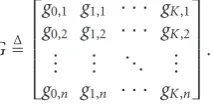
In this section, we prove three properties that can be used to reduce the code search procedure for STCCs overZpk. But first, let us denoteGas then(K+ 1) scalar generator matrix
of the rate 1/n convolutional encoder overZpk ofFigure 1, which is defined in this paper as
G=Δ
The first property is based on a result in [6, Section 3.2] for STCCs generated by an encoder with binary input and 2k-ary tap gains. Herein, this result is extended to the case of
a convolutional encoder overZpk.
Property 1. Consider an STCC C over Zpk generated by a generator matrixGwith coefficientsgx,i, forx =0, 1,. . .,K have the same rank, determinant, and trace. Therefore, the two STCCsCandC are entirely equivalent.
Proof. Consider that the output of the encoder shown in
Figure 1is as given in (1). Changing the encoder coefficient topk−g
x,iyields the following output:
Table1: New good STCCs over finite fields based on the trace criterion.
pk n ϑ G rank η
tr ηdet
3
3 3 [1 1 ; 1 2 ; 2 1] 2 18 —
3 9 [1 1 1 ; 1 1 2 ; 1 2 1] 3 27 3
3 27 [1 0 1 2 ; 1 1 1 1 ; 1 1 2 1] 3 33 4.32
4 3 [1 1 ; 1 1 ; 1 1 ; 1 2] 2 24 —
4 9 [0 2 1 ; 1 1 1 ; 1 2 1 ; 2 2 1] 3 33 —
4 27 [2 1 2 2 ; 2 0 2 1 ; 1 1 2 2 ; 2 2 2 1] 4 45 3
5
3 5 [1 1 ; 1 2 ; 2 2] 2 15 —
3 25 [1 1 1 ; 1 3 2 ; 2 3 1] 3 21.38 1
4 5 [1 2 ; 1 2 ; 2 1 ; 2 1] 2 20 —
7 3 7 [2 4 ; 3 5 ; 6 1] 2 14 —
4 7 [1 1 ; 1 2 ; 2 3 ; 3 3] 2 17.19 —
SinceA(c,e) is Hermitian, thenA(c,e) andA(c,e)∗have the same rank, determinant, and trace.
Note that by this property it is possible to reduce by approximately one half the number of STCCs to be tested without any sacrifice in terms of finding the best code.
Now, we present the second property, which is also an extension of a result in [6, Theorem 2] to the ringZpk.
Property 2. Consider an STTC C overZpk generated by a generator matrix G. Any STCC over Zpk generated by a generator matrix whose rows correspond to a permutation of the rows ofGis entirely equivalent toC.
Proof. A permutation of the rows ofGimplies a permutation of the encoder outputs inFigure 1, and also induces the same permutation of the rows of B(c,e). It is easy to show that the rank, determinant, and trace of the corresponding matrix A(c,e) are not affected by any permutation of the rows of B(c,e).
Observe that with Property 2it is possible to obtain a reduction in the code search space by a factor of approxi-mately n!. In this paper, we utilised Properties1 and2 to reduce the code search effort under the trace criterion, but they can also be applied to the rank and the determinant criteria. The last property, presented next, applies to the trace criterion only.
Property 3. Consider an STCC overZpkgenerated by a matrix Gwith coefficientsgx,i, forx=0, 1,. . .,Kandi=1, 2,. . .,n.
Changing the coefficientsgx,iofχrows ofGtopk−gx,i, where
1≤χ≤n, does not affect the trace of the matrixA(c,e) for any pair of STCC codewordscande.
Proof. Consider a rateR = 1/nconvolutional encoder over Zpkwith scalar generator matrixG. As proved inProperty 1, if the coefficients gx,i, where x = 0, 1,. . .,K, of the ith
row of the matrix G are changed to their corresponding complements modulo pk, that is, pk −g
x,i, where x =
0, 1,. . .,K, then the ith row of the matrixB(c,e) changes to its complex conjugate. Since A = BBH, then the ith
diagonal elementai,iof the matrixAis the sum of the squared
modulus of the elements of theith row ofB. Since|bi,j|2 =
|bi,j∗|2, and the trace of a matrix is the sum of its diagonal
elements,Property 3is proved.
By utilisingProperty 3, it is possible to reduce the code search space by a factor of 2n. Note that when all rows ofG
are changed to their corresponding complements modulopk,
that is, whenχ=n, this property becomesProperty 1. It is worth mentioning that the structure of convolutional encoders overZpk, adopted in this paper, offers a reduced search space as compared to the structure based on binary inputs. For our structure, the number of possible codes is pkn(K+1), while for the structure with binary input (standard
structure) this number ispk2n(K+1)
. This reduction is possible because the structure over Zpk yields a smaller number of coefficients. Of course, since we consider a smaller search space, it is possible that in some cases the standard structure will produce better codes. On the other hand, the code search based on the standard structure becomes prohibitive as the number of transmit antennas, states, or constellation size increases, and quite often only partial (nonexhaustive) search results are presented (see, e.g., [12]). The STCCs presented herein have, in many cases, the same performance parameters of the STCCs found with the standard structure for the same number of antennas and the same complexity. For the cases where the STCC is over GF(p), that is,k =1, the structure utilised in this paper becomes the only option.
We should also mention that a computer program routine to discard those equivalent codes, according to the three properties, can be easily prepared. So the cut in the search effort is quite significant.
As a final consideration, we should note that although in this paper we utilise only PSK constellations, quadrature amplitude modulation (QAM) constellations could also be used. However, Properties 1 and 3 would not hold for QAM, and the search space reduction provided by these properties would be lost. On the other hand, Property 2
Table2: New good STCCs over finite rings based on the trace criterion.
pk n ϑ G rank η
tr ηdet
4
2 4 [1 1 ; 1 2] 2 10 2
2 8 [1 1 0 ; 2 1 1] 2 12 3.46
2 16 [1 1 2 ; 2 1 3] 2 16 3.46
2 64 [1 0 1 2 ; 1 1 2 1] 2 18 5.29
3 4 [1 1 ; 1 1 ; 1 2] 2 16 —
3 8 [3 3 0 ; 1 0 1 ; 1 3 1] 2 18 —
3 16 [1 1 1 ; 1 2 2 ; 2 1 3] 2 24 —
3 64∗ [2 2 3 3 ; 1 2 1 3 ; 1 1 3 2] 3 32 2.88
4 4 [1 1 ; 1 1; 1 2 ; 1 2] 2 20 —
4 8 [1 0 1 ; 1 1 0 ; 1 1 1 ; 1 3 1] 2 26 —
4 16 [1 1 1 ; 1 1 2 ; 1 2 2 ; 2 1 3] 3 32 —
4 64∗ [1 3 2 3 ; 1 2 1 1 ; 2 2 1 2 ; 3 3 1 0] 4 40 2
8
2 8 [1 2 ; 4 3] 2 7.17 1.41
2 16 [2 1 0 ; 3 0 1] 2 8 2
2 64∗ [5 1 6 ; 1 1 3] 2 10.58 1.17
3 8 [1 1 ; 2 2 ; 3 4] 2 12 —
4 8 [1 1 ; 1 2 ; 2 3 ; 3 4] 2 16.52 —
9 3 9 [1 3 ; 6 4 ; 7 2] 2 12 —
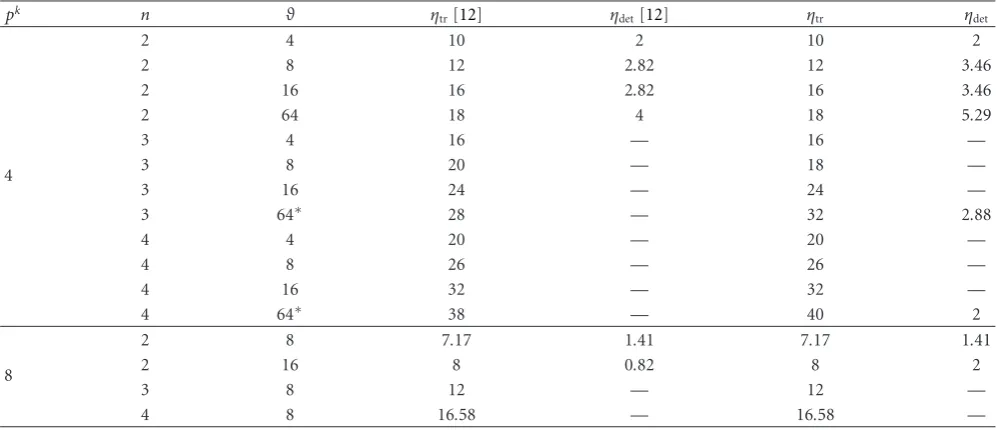
Table3: Comparison of STCCs found with different encoder structures.
pk n ϑ η
tr[12] ηdet[12] ηtr ηdet
4
2 4 10 2 10 2
2 8 12 2.82 12 3.46
2 16 16 2.82 16 3.46
2 64 18 4 18 5.29
3 4 16 — 16 —
3 8 20 — 18 —
3 16 24 — 24 —
3 64∗ 28 — 32 2.88
4 4 20 — 20 —
4 8 26 — 26 —
4 16 32 — 32 —
4 64∗ 38 — 40 2
8
2 8 7.17 1.41 7.17 1.41
2 16 8 0.82 8 2
3 8 12 — 12 —
4 8 16.58 — 16.58 —
the encoding structure proposed in this paper, it is possible that STCCs for QAM constellation better than STCCs for PSK constellation of the same size exist. However, since the demonstration of algebraic properties to reduce the code search effort constitutes an important part of this paper, QAM will not be considered herein.
4. CODE SEARCH AND SIMULATION RESULTS
In this section, we present some new STCCs generated by a rate 1/nconvolutional encoder over Zpk, and show their
performance on the quasistatic flat Rayleigh fading channel. Since we are considering large diversity order, the code search was based only on the trace criterion. Tables1and2show the search results for STCCs over finite fields and rings, respectively, with various pk-PSK modulations, number of
states (ϑ), and number of transmit antennas (n). In these tables, the STCCs marked with∗are the result of a partial search. All other codes are optimal for the structure of
Figure 1. In [12], we can find STCCs for the 4 and 8-PSK
100
10−1
10−2
10−3
FER
0 2 4 6 8 10 12 14
SNR (dB) 3-states,m=2
9-states,m=2 27-states,m=2
3-states,m=3 9-states,m=3 27-states,m=3
Figure2: FER versus SNR for the STCCs overZ3for 3-PSK based
on the trace criterion withn=3,m=2, 3, and 3, 9, and 27 states.
100
10−1
10−2
10−3
FER
0 2 4 6 8 10 12 14 16
SNR (dB) 4-states,m=2
8-states,m=2 16-states,m=2
4-states,m=3 8-states,m=3 16-states,m=3
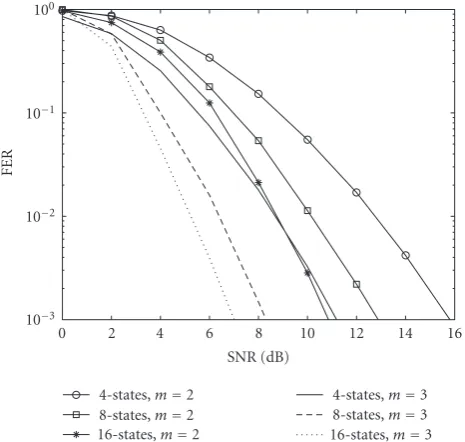
Figure3: FER versus SNR for STCCs overZ4for 4-PSK based on
the trace criterion withn=3,m=2, 3, and 4, 8, and 16 states.
trace as the STCCs presented in Table 2.Table 3 compares STCCs for the 4 and 8-PSK modulations found with different structures. It can be seen that with the proposed structure we obtained an STCC with improved trace in two cases, a worse trace in one case, and the same trace in all other cases.
All the new STCCs inTable 1and the STCC for 9-PSK in
Table 2have no corresponding competitors in the literature.
The STCCs over GF(p) with two transmit antennas based on the trace criterion can be found in [9].
In Figures 2 and 3, we show the FER versus SNR (in decibels) curves for the STCCs over GF(3) and Z4,
100
10−1
10−2
10−3
FER
0 2 4 6 8 10 12 14
SNR (dB) 4-states, [11]
8-states, [11] 64-states, [11]
4-states, new 8-states, new 64-states, new
Figure4: Performance comparison of STCCs for 4-PSK obtained
with different encoder structures forn=3,m=2, and 4, 8, and 64 states.
respectively, where we can observe the performance of the codes for different numbers of states and receive antennas. In
Figure 4, we show the performance comparison of the STCCs
for 4-PSK found with the encoder structure over Zpk and with the standard structure. Forn = 3 transmit antennas, m = 2 receive antennas, and for 4, 8, and 64 states, we can observe that the performances of these codes are very similar, although the codes have been generated by different encoder structures and have different traces in the cases of 8 and 64 states. In all simulations presented in this section, we considered a frame lengthl=130 symbols.
5. CONCLUSION AND FINAL COMMENTS
In this paper, we have considered space-time convolutional codes over finite fields and rings for the quasistatic, flat Rayleigh fading channel. Based on this encoding structure, we proved three properties that can be used to simplify the code search based on the trace criterion. Good STCCs forn= 2, 3, 4 transmit antennas and various pk-PSK constellations
were presented. The resulting spectral efficiencies, namely, log2(pk) b/s/Hz, can serve a wide range of multimedia
applications.
As the STCCs presented herein are designed by the trace criterion, they do not achieve the optimal diversity-multiplexing gain (DM-G) tradeoff[13,14] for system with more than one receive antenna. Therefore, it is possible that STTCs constructed to achieve the optimum DM-G tradeoff perform better than the codes in this paper, under the same spectral efficiency.
ACKNOWLEDGMENTS
and Technological Development (CNPq) under Grants no. 484391/2006-2 and 303938/2007-2.
REFERENCES
[1] V. Tarokh, N. Seshadri, and A. R. Calderbank, “Space-time codes for high data rate wireless communication: performance criterion and code construction,”IEEE Transactions on Infor-mation Theory, vol. 44, no. 2, pp. 744–765, 1998.
[2] Z. Chen, J. Yuan, and B. Vucetic, “Improved space-time time trellis coded modulation scheme on slow Rayleigh fading channels,”Electronics Letters, vol. 37, no. 7, pp. 440–441, 2001. [3] Z. Chen, B. Vucetic, J. Yuan, and K. L. Lo, “Space-time trellis codes for 4-PSK with three and four transmit antennas in quasi-static flat fading channels,” IEEE Communications Letters, vol. 6, no. 2, pp. 67–69, 2002.
[4] S. Baro, G. Bauch, and A. Hansmann, “Improved codes for space-time trellis-coded modulation,”IEEE Communications Letters, vol. 4, no. 1, pp. 20–22, 2000.
[5] R. S. Blum, “Some analytical tools for the design of space-time convolutional codes,”IEEE Transactions on Communications, vol. 50, no. 10, pp. 1593–1599, 2002.
[6] B. Abdool-Rassool, M. R. Nakhai, F. Heliot, L. Revelly, and H. Aghvami, “Search for space-time trellis codes: novel codes for Rayleigh fading channels,”IEE Proceedings: Communications, vol. 151, no. 1, pp. 25–31, 2004.
[7] M. de Noronha-Neto, R. D. Souza, and B. F. Ucha-Filho, “Space-time convolutional codes over GF(p) achieving full 2-level diversity,” inProceedings of the IEEE Wireless Communica-tions and Networking Conference (WCNC ’03), vol. 1, pp. 408– 413, New Orleans, La, USA, March 2003.
[8] S. K. Hong and J.-M. Chung, “Prime valued space-time con-volutionslZwcode achieving full 2-level diversity,”Electronics Letters, vol. 40, no. 4, pp. 253–254, 2004.
[9] M. de Noronha-Neto and B. F. Uchoa-Filho, “Space-time convolutional codes over GF(p) for two transmit antennas,” IEEE Transactions on Communications, vol. 56, no. 3, pp. 356– 358, 2008.
[10] R. A. Carrasco and A. Pereira, “Space-time ring TCM codes for QAM over fading channels,”IEE Proceedings: Communica-tions, vol. 151, no. 4, pp. 316–321, 2004.
[11] J. L. Massey and T. Mittelholzer, “Convolutional codes over rings,” inProceedings of the 4th Joint Swedish-Soviet Interna-tional Workshop on Information Theory, pp. 14–18, Gotland, Sweeden, August-September 1989.
[12] B. Vucetic and J. Yuan,Space-Time Coding, John Wiley & Sons, New York, NY, USA, 2003.
[13] L. Zheng and D. N. C. Tse, “Diversity and multiplexing: a fundamental tradeoffin multiple-antenna channels,”IEEE Transactions on Information Theory, vol. 49, no. 5, pp. 1073– 1096, 2003.