Volume 2008, Article ID 390489,15pages doi:10.1155/2008/390489
Research Article
Distributed Iterative Multiuser Detection through
Base Station Cooperation
Shahid Khattak, Wolfgang Rave, and Gerhard Fettweis
Vodafone Chair Mobile Communications Systems, Technische Universit¨at Dresden, 01062 Dresden, Germany
Correspondence should be addressed to Shahid Khattak,[email protected]
Received 1 August 2007; Revised 18 December 2007; Accepted 13 February 2008
Recommended by Huaiyu Dai
This paper deals with multiuser detection through base station cooperation in an uplink, interference-limited, high frequency reuse scenario.Distributed iterative detection(DID) is an interference mitigation technique in which the base stations at different geographical locations exchange detected data iteratively while performing separate detection and decoding of their received data streams. This paper explores possible DID receive strategies and proposes to exchange between base stations only the processed information for their associated mobile terminals. The resulting backhaul traffic is considerably lower than that of existing cooperative multiuser detection strategies. Single-antenna interference cancellation techniques are employed to generate local estimates of the dominant interferers at each base station, which are then combined with their independent received copies from other base stations, resulting in more effective interference suppression. Since hard information bits or quantized log-likelihood ratios (LLRs) are transferred, we investigate the effect of quantization of the LLR values with the objective of further reducing the backhaul traffic. Our findings show that schemes based on nonuniform quantization of the “soft bits” allow for reducing the backhaul to 1–2 exchanged bits/coded bit.
Copyright © 2008 Shahid Khattak et al. This is an open access article distributed under the Creative Commons Attribution License, which permits unrestricted use, distribution, and reproduction in any medium, provided the original work is properly cited.
1. INTRODUCTION
An ever growing demand for new broadband multimedia services emphasizes the need for higher spectral efficiency in future wireless systems. A higher-frequency reuse is therefore proposed, resulting in the interference from cochannel users outside the cells to dominate, thereby forming a single most important factor limiting the system performance. This interference coming from outside the cell boundaries is commonly referred to asother cell interference(OCI). OCI has been treated in [1], where it was suggested that advanced receiver and transmitter techniques can be employed in the uplink and downlink of a cellular system, respectively. Given that the mobile terminals (MTs) are low-cost, low-power independent entities, and are not expected to cooperate to perform transmit or receive beamforming, they are assumed to be as simple as possible with most of the complex processing of a cellular system moved to the base stations (BSs).
In this paper, we restrict ourselves to advanced receiver techniques for uplink communication. Different advanced
receiver techniques, suggested in the literature for the uplink, give tradeoffs between complexity and performance. Optimum maximum likelihood detection (MLD) [2, 3] is prohibitively complex for multiple-input multiple-output (MIMO) scenarios employing higher-order modulation. Linear receivers [4–7] are simpler, but less effective in decoupling the incoming multiplexed data streams, and offer low spatial diversity for full-rank systems. Iterative receivers [8–10] with soft decision feedback offer the best compromise between complexity and performance, and they have been universally adopted as a strategy of choice.
user significantly exceeds that of a conventional cellular system [12,13].
Recently, decentralized detection using the belief propa-gation algorithm for a simple one-dimensional Wyner model was proposed in [14]. The belief propagation algorithm effectively exchanges the estimates for all signals received at each BS, by alternately exchanging likelihood values and extrinsic information. This idea was extended to 2D cellular systems in [15–17], where the limits compared to MAP decoding were studied, showing the great potential of BS cooperation with decentralized processing (at least for regular situations). Unfortunately, for a star network (commonly used today) interconnecting the BSs, this results in a huge backhaul traffic.
Another approach to convert situations where cochannel users interfere each other with comparably strong signals into an advantage for a high-frequency reuse cellular system was proposed in [18]: different BSs cooperate by sending quantized baseband signals to a single central point for joint detection and decoding. Such adistributed antenna system (DAS) not only reduces the aggregate transmitted power, but also results in much improved received SINR [19]. Using appropriate receive strategies, both array and diversity gains are obtained, resulting in a substantial increase in system capacity [20,21]. The DAS scheme, however, is less attractive for network operators due to the large amount of backhaul it requires and the cooperative scheduling necessary between the adjacent DAS units in order to avoid interference. Here, backhaul is defined as the additional communication link between different cooperating entities. Although the band-width of wired links used for backhaul can be very high, they are usually owned by a third party, making it attractive for the cellular system operators to reduce the backhaul in order to minimize operating costs. The influence of limited backhaul on capacity in DAS has been investigated in [22,23].
Similarly as in the mentioned works, we are interested in asymmetric multiuser detection scenarios. We assume that the resource management of the cellular network can detect (e.g., via signal strength indicators) groups of MTs that are strongly received at several base stations. However, in contrast to [15,17] and related work, our main interest is not the network wide optimum information exchange, but rather its decentralized implementation. To this end, the concept of distributed iterative detection (DID) was introduced in [24,25]: each base station initially performs single-user detection for the strongest MT, treating the signals received from all other mobile terminals as noise. The information that becomes available at the decoder output is then sent to neighboring BS while mutually receiving data from its own neighbors in order to reconstruct and cancel the interference of its own received signal. Single-user detection is then applied to this interference-reduced signal by applying parallel interference cancellation [26]. Further improvements can be achieved by repeated application of this procedure. The questions we try to answer here are as follows.
(i) How much improvement can we get with respect to conventional single-user detection in different scenarios (varying strength of the user coupling through the channel)?
(ii) Which additional gain is possible if we replace the single-user detection step in the 0th iteration with single-antenna interference cancellation (SAIC) which is implemented asjoint maximum likelihood detection(JMLD) in the symbol detector acting as the receiver frontend?
(iii) What is a reasonable trade offbetween the amount of information exchange and improvement beyond single-user detection? Or, stated otherwise, what happens under constraints for the maximum available data rate over the backhaul links between base stations and associated finite precision effects due to quantization?
The organization of the remainder of this paper is as follows. Section 2 presents the system model, where the coupling among users/cells and the channel model are described.Section 3discusses in detail various components of distributed iterative receivers. InSection 4different decen-tralized detection strategies are compared. In Section 5we examine the effect of quantization of reliability information. We compare various quantization strategies in terms of information loss and necessary backhaul traffic. Numerical results are presented in Section 6 before conclusions are drawn.
Notation
Throughout the paper, complex baseband notation is used. Vectors are written in boldface. A set is written in double stroke font such as I and its cardinality is denoted by|I|. The expected value and the estimates of a quantity such ass
are denoted asE{s}ands, respectively. Random variables are written as uppercase letters and their realization with lower-case letters.A posteriori probabilities(APPs) will be expressed as log-likelihood ratios (L-values). A superscript denotes the origin (or receiver module), where it is generated. We distinguishLd1,Ld2, andLextwhich are APPs generated at the
detector and the decoder of a given BS or externally to it.
2. TRANSMISSION MODEL
We consider an idealized synchronous single-carrier (narrow band) cellular network in the uplink direction. N is the number of receive antennas andMis the number of transmit antennas corresponding to the number of BSs and cochannel MTs, respectively.
A block of information bitsumfrom user antenna mis
encoded and bit-interleaved leading to the sequence xm of
lengthK, wherem=1· · ·M. This sequence is divided into groups ofqbits each, which are then mapped to a vector of output symbols for usermof sizeKs=K/qaccording tosm=
[sm,1,. . .,sm,Ks]=map(xm). Each symbol is randomly drawn
from a complex alphabetAof sizeQ=2qwithE{sm,k} =0
andE{|sm,k|2} =σs2form=1· · ·M.
A block ofKssymbol vectorss[k]=[s1,k,s2,k,. . .,sM,k]T
(corresponding to one respective codeword) is transmitted synchronously by allMusers. At any BSl, a corresponding block of symbolsrl[k] is received, where the indexkis related
to time or subcarrier indices (1≤k≤Ks):
Withnwe denote the additive zero mean complex Gaussian noise with variance σ2
n = E{n2}. For ease of notation, we
omit the time indexkin the following, because the detector operates on each receive symbolrlseparately.
The row vector gl is the elementwise product gl,m =
hl,m√ρl,m of weighted channel coefficients hl,m of M
co-channels seen at thelth BS. The channel coefficient vector
hl, obtained as the current realization of a channel model
(the channel is passive on the average, i.e.,E{|hl,m|2} = 1),
is assumed to be known perfectly. The coupling coefficients
ρl,mreflect different user positions (path losses) with respect
to base stationl. These will be abstracted in the following by two coupling coefficientsρiandρjwhich characterize the BS
interaction with strong and weak interferers.
Equation (1) can therefore be written in terms of the desired signal (denoted with the index d) and weak and strong interferences:
the two-dimensionalW yner model. With Il we denote the
set of indices of all strongly received interferers at BSlwith cardinality|Il| =ml−1, wheremlis total number of strongly
received signals at BSl. Additionally,Ilis the complementary
set for all weakly received interferers:|Il∪Il| =M−1.
Note that the received signal-to-noise ratio (SNR) is defined as the ratio of received signal power at the nearest BS and the noise power. Specifically, the SNR at thelth BS can be written as SNR=E{hldsd2}/E{n2} =σs2/σn2.
The considered synchronous model is admittedly some-what optimistic and was recently criticized due to the impos-sibility to compensate different delays to different mobiles (positions) simultaneously [27]. However, the reason to ignore synchronization errors is twofold. First, it allows to study the possible improvement through base station cooperation without other disturbing effects to obtain bounds (the degradation from nonideal synchronization should thereafter be included as a second step). Second, for OFDM transmission or frequency domain equalization that we envisage in order to obtain parallel flat channels enabling separate JMLD on each subcarrier, we argue that it is possible to keep the interference due to timing and frequency synchronization errors at acceptable levels.
Increased delay spreads of more distant MTs have to be handled by an appropriately adjusted guard interval in the cooperating region. Timing differences between mobiles lead to phase shifts in the channel transfer function, which are taken into account with the channel estimate. Concerning frequency offsets due to variations among oscillators and Doppler effects, one has to evaluate the intercarrier interference induced by relative shifts of the subcarrier spectra of different users. Roughly estimating this with the sinc2(f / fsub) function of the power spectral
density for adjacent subcarriers, the SINRshould still be
Cell 1 Cell 2 Figure1: An example setup showing a rectangular grid of 4 cells, with power control assumed with respect to associated BS.
well above 20 dB, if the frequency offset can be kept at the order of 1% and therefore become negligible with respect to the interference to be cancelled on the same resource (oscillator accuracies of 0.1 ppm considered, e.g., in the LTE standardization translate to around 1% in terms of the subcarrier spacing of 15 kHz). We, however, leave the detailed study of asynchronous transmission for future work. As an example for a cellular scenario that we intend to capture with our model, a rectangular grid of 4 cells is shown inFigure 1, whereρThis the path-loss threshold introduced
to distinguish between weak and strong interferers. It is defined as the minimum path loss required for an interferer to be detected separately during the BS processing. It depends upon the constellation size andml; for example, for 16-QAM
andml = 2 we useρTh = −12 dB. Periodic or nonperiodic
boundary conditions are possible, allowing for representing extended joint operation or isolated groups of cooperating BSs.
3. DISTRIBUTED ITERATIVE RECEIVER
The setup for performing distributed detection with infor-mation exchange between base stations is shown inFigure 2. It comprises one input for the signal rl generated by the
mobile terminals and received at the base station antenna. In addition, it contains a communication interface for exchang-ing information with the neighborexchang-ing base stations. This information is either in the form of hard bitsulor likelihood
ratiosLdl2 of the locally detected signal and corresponding
quantities about the estimates of the interfering signals delivered from other base stations. This communication interface is capable of not only transmitting information about the detected data stream to the other base stations, but also receiving information from these base stations.
The receiver processing during initial processing involves either SAIC/JMLD or conventional single-user detection followed by decoding. In subsequent iterations, interfer-ence subtraction is performed followed by conventional single-user detection and decoding. Different components of the distributed multiuser receiver are discussed in what follows:
(i) interference cancellation,
gl·si modulatorSoft rl yl Detector Decoder
Ld2d
Figure 2: A DID receiver at thelth base station. The subscripts
d and i represent the desired data stream and the dominant interferers. Variables designated by†are evaluated only in the first pass of the processing through the receiver. The superscripts 1 and 2 correspond to variables associated with detector and decoder, respectively.
(iii) soft decoding,
(iv) (soft) interference reconstruction.
3.1. Interference canceller and effective
noise calculation
At the beginning of every iterative stage, interference of neighboring mobile terminals is subtracted from the signal received at each base station. Ifrl is the signal received at
thelth base station, the interference-reduced signalylat the
output of the interference canceller is
yl=rl−gl·si=rl−
i∈Il∪Il
glisi, (3)
wheresi ∈ C[1×nT] is a vector of symbol estimates. If we
exchange only hard decisions about the information bits, then no reliability information is conveyed. Under such condition, additional noise due to the variance of the symbol estimates is not available and the effective noise varianceσ2
eff
is underestimated and taken to be equal to that of receiver input noise, that is,σ2
eff=σn2. On the other hand, if reliability
information for the received bits is available, a vector of error variances e2i for the estimated symbol streams can
be calculated. It is then added to the AWGN noise for the subsequent calculations:
ulator (see Figure 1) and are discussed in detail in
Section 3.4.
Note that if the contributions of weak interfererssi∈Il
in (4) and (5) are neglected, an error floor will occur in the performance curves, especially at higher-order modulation.
Since bothe2
i ands2i are evaluated upon arrival of
esti-mates from the neighboring base stations, the interference
subtractor is not activated during the first pass andrlis fed
directly into the detector. The effective noise due to inherent interference present in the signal during the first pass is calculated based on the mean transmitted signal power and the number md of received signals that are to be jointly
detected. Therefore, for the first pass, the effective noiseσ2 eff
3.2. Detection and demapper APP evaluation
The interference-reduced signal yl and its corresponding
noise value are sent to a demapper to compute the a posteriori probability, usually expressed as anL-value [28]. If
mddata streams (each withqbits/sample) are to be detected,
the a posteriori probabilities Ld1(x
k|yl) of the coded bits
(wheremlis the number of strong signals at the BSl)
JMLD-based single-antenna interference cancellation is applied. We make the standard assumption that the received bits from any of the md data streams in yl have been encoded
and scrambled through an interleaver placed between the encoder and the modulator. Therefore, all bits within yl
can be assumed to be statistically independent of each other. Using Bayes’ theorem and exploiting the independence
of x1,x2,. . .,xqmd by splitting up joint probabilities into
products, we can write the APPs as
Ld1xk|yl
Calculating likelihood functions
The signal yl at the detector input contains not only md
signals that are to be detected at a BS, but also noise and weak interference. For a typical urban environment (assumed here), the number of cochannel interferers from the surrounding cells can be quite large. We therefore make the simplifying assumption that the distribution of the effective noise due to the (M −md) interferers together
with the receiver noise is Gaussian. The likelihood function
p(yl|sd) can then be written as
symbols. For single-user detection, sd = sd and the sum
term in the exponent of (10) disappears (the subscript “d” inmdandsddenotes the detected streams). This should not
be confused with thedesireduser meant by the scalarsd.
To evaluate (10), the standard trick that we exploit in our numerical simulation is the so-called “Jacobian logarithm”:
lnex1+ex2=maxx 1,x2
+ ln1 +e−|x1−x2|. (11)
The second term in (11) is a correction of the coarse approximation with the max-operation and can be neglected for most cases, leading to the max-log approximation. The APP at the detector output at thelth BS as given in (9) can then be simplified to
Ld1x
Despite the max-log simplification, the complexity of calcu-lating Ld1(x
k|yn) is still exponential in the number of the
detected bits inx. To find a maximizing hypothesis in (12) for each xk, there are 2qmd−1 hypotheses to search over in
each of the two terms (e.g., 16-QAM modulation withmd =
2 already requires a search over 256 hypotheses to detect a single bit unless other approximations like tree-search techniques [29] are introduced; for lower-order modulation, more than 2 users can certainly be simultaneously detected with acceptable complexity).
3.3. Soft-input soft-output decoder
The detector and decoder in our receiver form a serially concatenated system. The APP vectorLd1(for each detected
stream) at the demapper output is sent after deinterleaving as a priori informationLa2to themaximum a posteriori(MAP)
decoder. The MAP decoder delivers another vector Ld2 of
APP values about the information as well as the coded bits.
The a posterioriL-value of the coded bitxk, conditioned on
La2, is
codewords x, where bit k equals ±1, respectively, this can after some mathematical manipulation (see [30]) be simplified to
The decoded APP values received from neighboring BS are combined with local information to generate reliable symbol estimates before interference subtraction. It is therefore critical that the dominant interferers are correctly evaluated. Soft symbol vectorssiestimating the signals of the strongest
interferers at BSlare generated from the exchanged extrinsic LLR values Lexti and local dominant interference estimate
Ld2
i , wheresi =[s1,s2· · ·sM]T removing the component of
the desired signal with sd = 0. Since the channels for the
links between one MT and different BSs can be assumed to be uncorrelated, the extrinsic and local LLR values are combined by simply adding them [16], that is,
Ltoti =Lexti +Ldi2. (15)
The soft symbol estimate si (one element of the vectorsi)
is evaluated in the soft modulator [31] by calculating the expectation of the random variable Si given the combined
likelihood ratios associated with the bits of the symbol taken fromLtoti :
The variance of this estimate is equal to the power of the estimation error and it adds to the receiver noise as described in Section 3.1. Any element of the variance vector e2i =
[e2
The error powere2i depends upon the extent of quantization
of the LLR values (see Section 5). If only hard bits are transferred,si∈Aand the estimated symbol error becomes
zero, resulting in degraded performance.
4. DECENTRALIZED DETECTION STRATEGIES
4.1. Basic distributive iterative detection
In the basic version of distributive iterative detection, the decentralized detection problem is treated as parallel inter-ference cancellation by implementing information exchange between the BSs. To keep complexity and backhaul low, only the signal from the associated MT is detected and exchanged between the BSs, while the rest of the received signals are treated as part of the receiver noise. Consider
Figure 2, showing the receiver for BSl, where only the desired datasdis detected with single-user detection and transmitted
out to other BSs. The APPs at the output of the soft detector are approximated as
Ld1x
k|yl
∼
= max
x∈Xk,+1
− 1
σ2 eff
yl−hldsd2
− max
x∈Xk,−1
− 1
σe2ff
yl−hldsd2 .
(18)
The decoded estimates of the desired streams are exchanged after quantization. The incoming decoded data streams from the neighboring BS are used to reconstruct the interference energy. Since only the desired data stream is detected, no local estimates of the strongest interferersLdi2are available,
making the symbol estimates less reliable. This scheme needs a higher SIR than the ones presented in Sections4.2and4.3
to converge. It is therefore beneficial only in the case of low-frequency reuse.
4.2. Enhanced distributive iterative
detection with SAIC
The performance of the basic distributed detection receiver degrades for asymmetrical channels encountered in high-frequency reuse networks when dominant interferers are present and the SIR→0 dB.
The error propagation encountered in the basic DID scheme is reduced by improving the initial estimate through single-antenna interference cancellation. Although all the detected data streams are decoded, in this approach only the decoded APPs for the desired users are exchanged between the BSs to limit the amount of backhaul. However, the APPs for the dominant interferers are not discarded, but used in conjunction with reliability information from other BSs to cancel the interference. The performance of this scheme is, however, limited by the number of nondetected weak interferers and/or by the quantization of the exchanged reli-ability information. Therefore, also the number of required exchanges between the BSs to reach convergence is slightly higher than for the unconstrained scheme described next.
Unlike the basic DID scheme, the performance curves for SAIC aided DID to converge even if the SIR is around or below 0 dB (this is similar to the situation in spatial multiplexing with strong coupling among the streams). Since a BS does not receive multiple copies of the desired signal from several neighboring BSs, there is a loss of array gain and spatial diversity for the desired signals.
4.3. DID with unconstrained backhaul
In this version of decentralized detection, all estimates of the received data streams are detected at each BS, and all available soft LLR values are exchanged. This approach uses multiple exchanges of extrinsic information between the BSs and is similar to message passing (although we may use an ML detector during the first information pass). Since all detected input streams are exchanged, both diversity and array gain are obtained. In addition, the algorithm converges more quickly than the ones with constrained backhaul. While the simultaneous detection of multiple data streams through SAIC during initial iteration can further speed up convergence, low-complexity SUD detection during the first iteration is normally sufficient and results in only marginal degradation in performance. The amount of backhaul per iteration for a fully coupled system (ml = M), however,
grows cubically in the cooperating setup size, that is, backhaul ∝ MN(M−1), making this scheme impractical even for a few BSs in cooperation.
5. QUANTIZATION OF THE RELIABILITY INFORMATION
A posteriori probabilities at the decoder must be quantized before transmission causing quantization noise, which is equivalent to information loss in the system. By increasing the number of quantization levels, this loss will decrease at the cost of added backhaul, which has to stay within guaranteed limits from the network operator’s standpoint.
The information content associated withL-values varies with their magnitude. While single-bit quantization will incur little information loss at high reliability values, it leads to considerable degradation in performance for L-values having their mean close to zero. Therefore,L-values follow-ing a bimodal Gaussian distribution should not simply be represented using uniform quantization. Even nonuniform quantization according to [32,33] applied directly to theL -values by minimizing the mean square error (MSE) between the quantized and nonquantized densities is not optimum as we will show. In what follows we develop a quantization strategy based on information-theoretic concepts, such as “soft bits” and mutual information. Representation of the
L-values with these quantities takes the saturation of the information content (with increasing magnitude of the L -values) into account and improves the backhaul efficiency.
5.1. Representation ofL-values based on
mutual information
Mutual information I(X;L) between two variablesx andl
measures the average reduction in uncertainty aboutxwhen
lis known and vice versa [34]. We use mutual information to measure the average information loss about binary data if theL-values are quantized. A general expression for mutual information based on entropy and conditional entropy is
Assuming equal a priori probability for the binary variable
x ∈ {−1, +1}, a simplified expression for the mutual information betweenx and the a posteriori L-value at the decoder output is (in what follows all logarithms are with respect to base 2)
IX;L=1
Exploiting the symmetry and consistency properties of the
L-value density [28], (20) becomes
If in the last relation the expected bit values or “soft bits” [28] defined asλ=E{x} =tanh(l/2) are used, then an equivalent expression for the mutual information betweenXandLis
I(X;L)=Eln(1 +λ). (22)
In practice, the expectation in (21) and (22) is approximated by a finite sum over theL-values in a received codeword:
I(X;L)1− 1
An expression to calculate the conditional mutual infor-mation based solely on themagnitude|l|of the APP values was provided in [35]. Consider the entropyHb(x) of a binary
random variable x ∈ {0, 1} with Pr(x=0) = P given by
Hb(x) = −P1d(P)−(1−P)1d(1−P).If we calculate the
binary entropy of the (instantaneous) bit error probability
Pe(l) = e−|l|/2/(e|l|/2 + e−|l|/2), the probability that hard
decisions based on the L-values lead to the wrong sign,
lkxk = −1, is given by "∞
0 p(|l|)Pe(l)d|l|. Now the mutual
information betweenXandLcan be compactly written (as the expectation of the complement of the binary entropy of the bit error ratePe[36]):
From the above expressions, three different L-value representations are conceivable for quantization. They are sketched as a function of the magnitude of theL-values in
Figure 3:
(i) originalL-values, (ii) soft bits:λ(l)=tanh(l/2),
(iii) mutual information:I(l)=1−Hb(Pe).
The underlyingL-value density depends only on a single parameterσL, because mean and variance are related byμL=
σ2 representations of the LLR plotted as a function of the magnitude |l|of the LLR.
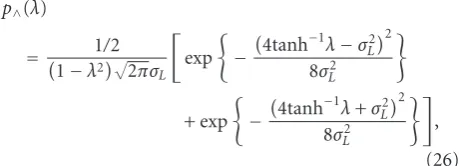
Using the distribution function (cdf) of pL(l) and the
inverse function l = 2tanh−1λ, the transformed soft value density can be obtained in closed form as
p∧(λ)
while a mutual information density based on (23) can only be calculated numerically. The three densities that can be alternatively quantized are illustrated inFigure 4. The mutual information density is mirrored at the ordinate to conserve the sign as in the LLR orλ-representations. The performance of different quantization schemes will be investigated next.
5.2. Quantization strategies
Mutual information evaluated withHb(Pe) and similarly the
soft-bit representation are nonlinear functions of L-values that saturate with increasing magnitude. This suggests that nonuniform quantization schemes that minimize the mean-squared quantization error should be able to exploit this and have in addition an advantage over uniform quantization. We adopted the well-knownLloyd-Max quantizer to verify our hypotheses.
Nonuniform quantization in the LLR domain
The optimal quantization scheme due to Lloyd [32] and Max[33] was applied to theL-value density of the decoder output. Thereconstructionlevelsriare determined through
an iterative process after the initialdecisionlevelsdihave been
set. The objective function to calculate the optimalrireads
σ2
Figure4: Comparison of the distribution ofL-values represented in the original bimodal Gaussian form (a) or by soft bits (b) or mutual information (c).
This is iteratively solved by determining the centroidsriof
the area ofp(l) between the current pairs of decision levelsdi
anddi+1:
and later updating the decision level for the next iteration as
di=1
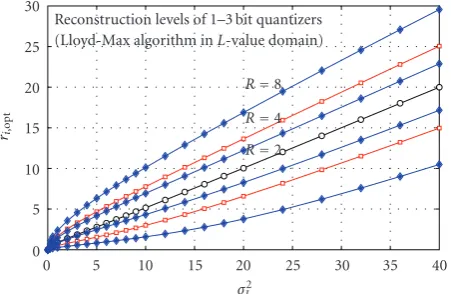
The number of quantization levels and the number of quantization bits are denoted withR=2bandb, respectively. Results forb=1, 2 and 3 bits can be found in the appendix.
Figure 5: Mutual information loss ΔI(X;L) for nonuniform quantization levels determined in the LLR and soft-bit domains (1– 3 quantization bits).
Nonuniform quantization in the soft-bit domain
In this approach, the optimum reconstruction and decision levels to quantize theL-values were calculated in the “soft-bit domain” again in accordance with (27)-(29). Detailed results forb = 1−3 quantization bits are shown again in the appendix. It should be stressed that the final quantization still occurs in the L-value domain, because the optimized levels are mapped back vial = 2tanh−1(λ). Note that only the number of quantization levels and the variance of theL -values have to be communicated between the BSs to interpret the exchanged data, because the optimized levels can be stored in lookup tables throughout the network.
Mutual information loss
Based on the set of levelsdiandri, the mutual information
for quantized and nonquantized L-value densities was cal-culated. The difference represents the reduction or loss in mutual informationΔIdue to quantization:
ΔI=Inon-quant−Iquant. (30)
This loss is shown inFigure 5as a function of the average mutual information of the nonquantizedL-values.
Inon-quantwas found with pL(l|x = +1) evaluating (21).
Using the optimized reconstruction and decision levels from the appendix,Iquantwas determined explicitly as
Iquant=
10−1 10−2 10−3 10−4 10−5 10−6
BER
0 1 2 3 4 5 6 7 8
Es/N0=σL2/8 (dB)
No quantization LLR quantization Soft bit quantization
R=2 R=4
R=8
Figure 6: BER after soft combining of L-values for quantized information exchange with optimized levels in either the soft-bit or LLR domain.
100
10−1
10−2
FER
0 5 10 15 20
Eb/N0(dB) Isolated
DID-ρi= −6 dB DID-ρi= −3 dB SAIC-ρi= −6 dB
SAIC-ρi= −3 dB ρj=0(−∞dB) ml=4
DID-UB-ρi= −6 dB DID-UB-ρi= −3 dB 3×3 setup, 1/2 pccc (mem 2), 4-QAM, IID Rayleigh channel
Figure7: FER curves for different receive strategies in decentralized detection: distributed iterative detection (DID), SAIC-aided DID (SAIC), DID with unconstrained backhaul (DID-UB).
We also tested the combining of two mutual information values with and without quantization as it occurs in decen-tralized detection with limited backhaul. For transmission of BPSK symbols over an AWGN channel, the relation between SNR and the associated variance of theL-value at the channel output is given by Es/N0 = σL2/8 [36]. Generating two
independent distributions for the same σL2 and combining
the unquantized L1 with L2 according to Ltot = L1 +L2,
we compared the bit error rates (probability of theL-value having the wrong sign) for unquantized L2 and quantized L2based either on optimized quantization levels in the LLR
or in the soft-bit domain.Figure 6shows the BER again for
b=1– 3 quantization bits.
We note that the curves for quantization based on the soft-bit domain already for only 1 quantization bit approach the performance of 2 to 3 quantization bits based on theL -value domain.
6. NUMERICAL RESULTS
In this section, we provide simulation results to illustrate the performance of distributed iterative strategies in an uplink cellular system. A synchronous cellular setup of 3×3 cells (N =M =9) or 2×2 cells (N =M =4) is assumed. The number of strongly received signalsmlvaries from 1 to 5. The
dominant interferers for any BSlare defined by the index set
Il=
i:l(modM) + 1≤i≤l+ml(modM) + 1
, (32)
where 1 ≤ l ≤ M and x(mody) represents the modulo operation. As an example, the 2×2 setup with ml = 2
strong interferers andρj=0 is characterized by the following
coupling matrix:
ρ=
⎡ ⎢ ⎢ ⎢ ⎣
1 ρi ρi 0
0 1 ρi ρi
ρi 0 1 ρi
ρi ρi 0 1
⎤ ⎥ ⎥ ⎥
⎦. (33)
The number of symbols in each block (codeword) is fixed to 504. A narrowband flat fading i.i.d. Rayleigh channel model is assumed with an independent channel for each symbol. It is further assumed that the receiver has perfect channel knowledge for the desired user signal as well as the interfering signals. A half-rate memory two-parallel concatenated convolutional code with generator polynomials (7, 5)8 is used in all simulations with either 4-QAM or
16-QAM modulation. The number of information exchanges between neighboring base stations is fixed to five unless otherwise stated.
6.1. Comparison of different decentralized
detection schemes
The performance of different decentralized detection sch-emes described inSection 4is presented inFigure 7for a 3×3 setup and 4-QAM modulation.
Three dominant interferers are received at each BS, that is,ml = 4, with normalized dominant interferer path loss
ρi∈ {0.25 0.5}(−3 and−6 dB, resp.). The path loss for the
weak interferersρj is assumed to be zero, and unquantized
L-values are exchanged. As already mentioned, both basic DID and DID with SAIC have the inherent disadvantage that they only utilize the desired user energy received at the associated BS for signal detection. As a consequence, they do not benefit from array gain or additional spatial diversity and are bounded by the isolated user performance. Although the performance of the basic-DID scheme is comparable to that of SAIC-DID for low values of ρi, the difference becomes
for higher-order modulation (16-QAM or higher), the basic-DID scheme does not converge.
In terms of performance, the strategy of exchanging all processed information between the BSs with unlimited backhaul (DID-UB) is the clear winner. This advantage, however, comes at the cost of huge backhaul, with an increase in the number of exchanges between the BSs per iteration
∝ ml. Besides, the large array gain of the near-optimal
scheme diminishes (not shown here) for less-robust higher-order modulation, that is, 16-QAM.
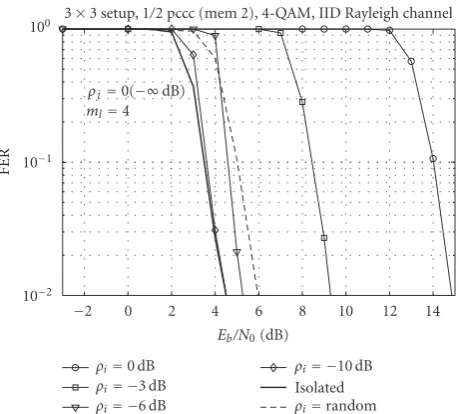
Figure 8shows the FER curves for the (3×3) cell setup with ml = 4, ρj = 0, while the normalized path losses
ρi of the dominant interferers vary from 0 to 1. Physically,
this can be interpreted as an interferer moving away from its own BS towards the base station where the observations are being made. For a network with more than a single tier of neighbors, it is physically impossible to have a high normalized path loss between all the communicating entities. The curve for ρi = 0 dB is practically not possible and
serves only as the indication of the lower performance limits of the receiver. The results for 4-QAM modulation show that the performance stays quite close to an isolated user performance, and has a loss of less than 1 dB at FER of 10−2 forρi≤ −6 dB.
To show the behavior of a setup with random path losses, the elementsρliof the path-loss vector are randomly
gener-ated with uniform distribution at every channel realization, where i ∈ Il and 0 ≤ ρi ≤ 1. The simulation results are
shown by the dashed curve labeled as “random”, which is comparable toρi= −6 dB curve.
Figure 9 illustrates the iterative behavior of the SAIC-based receive strategy. There is a large improvement in performance after the initial exchange of decoder APPs, which diminishes with later iterations. We therefore restrict all subsequent simulations to five iterations as very little performance improvement is gained beyond this point.
Figure 10 shows the FER for SAIC-DID plotted as a function of the number of dominant cochannel signals ml
at SNR = 5 dB. The FER curve forρi = −10 dB indicates
that the performance is relatively independent ofmlat low
interference levels. However, whenρi→1, the performance
degrades considerably with additional interferers. For exam-ple, forml=5 andρ >−6 dB, the SAIC-DID schemes only
start converging at an SNR higher than 5 dB. For a typical cellular setup using directional BS antennas with down-tilt,
mlnormally stays between 2 and 4 for 4-QAM, resulting in
the FER water fall to be located around 5 dB.
6.2. SAIC-DID with unquantized LLR exchange
To see how the performance of a receive strategy scales with the size of the network, Figure 11 depicts a 2 ×2 cell network in comparison to a 3 ×3 cell network for different values of the normalized path lossρi. The number
of dominant received signals at each BS is fixed to 4. For the solid curves, the setIlis defined according to (32), with the
modulo operation ensuring that symmetry conditions are incorporated; that is, each MT is received by 4 BSs, while each BS receives 4 MTs. Interestingly, the performance for a 2×2
100
10−1
10−2
FER
−2 0 2 4 6 8 10 12 14
Eb/N0(dB) ρi=0 dB
ρi= −3 dB ρi= −6 dB
ρi= −10 dB Isolated ρi=random ρj=0(−∞dB)
ml=4
3×3 setup, 1/2 pccc (mem 2), 4-QAM, IID Rayleigh channel
Figure8: Effect of path loss of the dominant interfererρi, SAIC-DID. For the dashed curve labeled as “random”, each element of the path-loss vector 0 ≤ρl,m ≤1,l /=m, is randomly generated with uniform distribution.
100
10−1
10−2
FER
0 5 10 15 20
Eb/N0(dB) 0 iteration
1 iteration 2 iteration
5 iterations 10 iterations Isolated ρi=0.25(−6 dB) ρj=0(−∞dB) ml=4
3×3, DID, 1/2 pccc (mem 2), 4-QAM, IID Rayleigh channel
Figure 9: Iterative behavior of SAIC-DID exchanging soft APP values.
cell network with greater mutual-coupling is only slightly worse than in a 3×3 cell setup. The mutual-coupling in a 3×3 cell setup can be increased by symmetrically placing the dominant interferers on either side of the leading diagonal. The resulting difference in performance between the setups of two sizes is further reduced (dashed lines). This suggests that for a given number of dominant interferers ml and
coupling ρi, the performance depends on the sizes of the
100
10−1
10−2
10−3
FER
1 2 3 4 5
ml
ρi= −10 dB ρi= −6 dB ρi= −3 dB SNR=5 dB ρj=0(−∞dB)
3×3, DID, 1/2 pccc (mem 2), 4-QAM, IID Rayleigh channel
Figure10: FER for SAIC-DID, plotted as function of the number of dominant cochannel signalsmlat SNR=5 dB.
100
10−1
10−2
10−3
FER
−2 0 2 4 6 8 10 12 14
Eb/N0(dB) 2×2-ρi= −6 dB
2×2-ρi= −3 dB 2×2-ρi=0 dB
3×3-ρi= −6 dB 3×3-ρi= −3 dB 3×3-ρi=0 dB ρj=0(−∞dB)
ml=4
1/2 pccc (mem 2), 4-QAM, IID Rayleigh channel
Figure11: SAIC-DID performance comparison for 2×2 and 3×3 cells setup. Each MT is received strongly at 4 BSs, while each BS receives signals from 4 MTs. The two curves for 3×3 cell setup give the bounds for different possible combinations of couplings within the setup.
Figure 12 shows the performance of SAIC-DID for 4-QAM and 16-4-QAM modulations, employing a 2×2 cellular setup with only a single dominant interferer,ml = 2, and
varying the coupling strength. While the performance of 4-QAM degrades only marginally for ρi = 0 dB at the
FER of 10−2, the loss of the performance for 16-QAM is already more than 3 dB. This indicates that with additional impairments, strong cochannel interferers are difficult to handle for 16-QAM modulation.
100
10−1
10−2
10−3
FER
0 2 4 6 8 10 12
Eb/N0(dB) Isolated
ρi= −6 dB
ρi= −3 dB ρi=0 dB ρj=0(−∞dB)
ml=2
4Tx-4Rx, DID, 1/2 pccc (mem 2), IID Rayleigh channel
4-QAM 16-QAM
Figure 12: Effect of path loss of the dominant interfererρi for
different modulation orders. Each BS sees just two dominant signals
ml=2.
100
10−1
10−2
10−3
FER
11 12 13 14 15 16
Eb/N0(dB) Unquantized LLR
R=2, LLR (opt) R=8, LLR (opt) R=2, soft-bit (opt)
R=4, soft-bit (opt) R=8, soft-bit (opt) R=8, soft-bit (opt)∗ ρi=1(0 dB)
ρj=0(−∞dB) ml=4
4Tx-4Rx, DID, 1/2 pccc (mem 2), 4-QAM IID Rayleigh channel
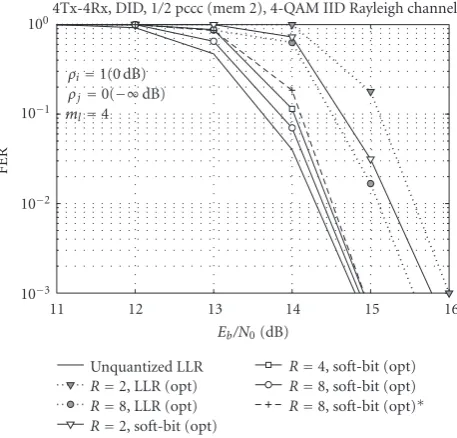
Figure13: Effect of quantization of the exchanged decoder LLR values, whereρi = 0 dB. Curve labeled with “+” exchanges only
those bits that have changed signs between iterations, and adaptively sets the number of quantization intervals during each iteration to reduce backhaul.
6.3. Quantization ofL-values and backhaul traffic
The performance of the proposed scheme for the two different quantization strategies, optimal quantization in the soft-bit and LLR domains, and for different numbers of quantization bits is presented inFigure 13. The normalized path loss ρi = 1 (0 dB) is chosen such that any loss of
result in a performance loss of one dB which is reduced to almost one quarter of a dB for 2-bit quantization (R = 4). Any further increase in quantization bits will bring limited gains.
For the dashed curve labeled with a plus sign (“+”) only those bits that have changed signs between iterations are exchanged, and the number of quantization intervalsRis set adaptively during each iteration to save backhaul capacity. The maximum number of reconstruction levels isRmax=8.
It is illustrated that despite a large improvement in backhaul, the performance degrades only marginally.
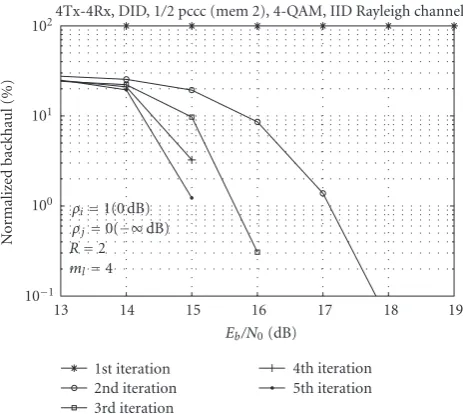
As already mentioned, all decoded information bits are only exchanged during the first iteration to minimize the backhaul, while in the later iterations only those bits that have changed signs are exchanged after applying some lossless compression, for example, run-length encoding [38] or vector quantization techniques [39].Figure 14shows that the average backhaul traffic during different iterations is plotted as a function of SNR for a hard information bit exchange. In the operating region of interest (Eb/N0 >
15 dB), there is negligible traffic after 3 iterations. The total backhaul in this operating region lies between 100% and 150% of the total number of information bits received, which is a substantial gain over DAS backhaul traffic requirement [19]. It must be mentioned that any additional overhead, required for the compression technique (such as run-length) and used for exchanging a fraction of the estimates, was not taken into account.
6.4. Sensitivity to additional interference
FinallyFigure 15shows the degradation in the performance of the receiver in the presence of additional weak interferers. As an example, a (2 × 2) cellular system is considered with three interferers. It is assumed that two interferers are strongly received (ml = 3) with the normalized path loss
ρi=1 (0 dB), while the third one is a weak interferer whose
normalized path loss ρj can be varied. As illustrated, the
performance deteriorates sharply if ρj > −10 dB. This is
due to the fact that the product constellation of the three stronger streams is quite densely populated and any small additional noise may result in a large change in the demapper output estimates, thereby making the decoder less effective. As to be expected, the schemes become more sensitive to this additional noise after quantization. With comparison to
Figure 11 (2 × 2, 0 dB curve), one can conclude that it is more beneficial for the considered scenario to jointly detect all four incoming signals if the normalized path loss for the weak interferer exceeds−10 dB.
7. CONCLUSIONS AND FUTURE WORK
Outer cell interference in future cellular networks can be suppressed through base station cooperation. We presented an alternative strategy to the distributed antenna system (DAS) for mitigating OCI which we termed as distributed iterative detection (DID). An interesting feature of this approach is the fact that no special centralized processing units is needed. In addition, we explored its implementation
102
101
100
10−1
N
o
rm
aliz
ed
backhaul
(%)
13 14 15 16 17 18 19
Eb/N0(dB) 1st iteration
2nd iteration 3rd iteration
4th iteration 5th iteration ρi=1(0 dB)
ρj=0(−∞dB) R=2 ml=4
4Tx-4Rx, DID, 1/2 pccc (mem 2), 4-QAM, IID Rayleigh channel
Figure14: Backhaul traffic normalized with respect to total infor-mation bits. Single-bit quantization of LLR values is performed. Only those bits that have changed signs between iterations are exchanged (ρi=0 dB).
100
10−1
10−2
FER
0 2 4 6 8 10 12 14 16 18
Eb/N0(dB) R=4-ρj= −∞dB
R=4-ρj= −20 dB R=4-ρj= −10 dB R=4-ρj= −6 dB
R=2-ρj= −∞dB R=2-ρj= −20 dB R=2-ρj= −10 dB R=2-ρj= −6 dB
ρi=1(0 dB) ml=3 4Tx-4Rx, 1/2 pccc (mem 2), 4-QAM, IID Rayleigh channel
Figure15: FER for SAIC-DID in the presence of a weak interferer.
ρjrepresents the path loss of the weak interferer.
stations. The scheme is limited by (undetected) background interference.
An extension of this work could address the question under which conditions reliability information for more than one stream should be exchanged to obtain diversity and array gain and when this does not pay. This should provide some further insight into the tradeoff between capacity increase and affordable complexity.
APPENDIX
OPTIMUM QUANTIZATION OF THEL-VALUE DENSITY
To optimize the reconstruction (quantization) levelsri and
decision levels di for a given density p(x), we have to
iteratively compute the integrals updating the reconstruction levels given the current decision levelsdi(see (29)).
Consider first the bimodal Gaussian density ofL-values given in (25). The integrals to be evaluated become (with
μL=σL2/2)
The optimum positive quantization levels are displayed in
Figure 16(the negative levels are obtained by inversion due to symmetry). As to be expected, for one quantization bit, the level equals the mean more or less exactly. With additional bits, the levels are placed on both sides around the mean. Similar integrals have to be evaluated to quantize nonuniformly in the “soft-bit” domain. Here only one integral can be carried out:
di+1
has to be evaluated by numerical integration. The derived optimum quantization levels converted back to the LLR domain withL=2tanh−1(λ) are shown inFigure 17. Reconstruction levels of 1–3 bit quantizers (Lloyd-Max algorithm inL-value domain)
Figure16: Optimum nonuniform quantization levels obtained by optimization in theL-value domain.
0
Reconstruction levels of 1–3 bit quantizers (Lloyd-Max in ‘soft bit’ domain)
Figure17: Optimum nonuniform quantization levels obtained by optimization in the “soft-bit” domain.
−0.25
We observe that now the optimized levels show some saturation with increasing mean/variance of the L-value density, because the increase in reliability is not important. Rather it pays more to distinguishL-values of intermediate magnitude, say, roughly in the range 2≤l≤6.
For practical evaluation, it is more convenient to deter-mine the necessary quantizer resolution according to the variance of theL-values. We therefore provide a plot corre-sponding toFigure 5withσ2
Las the abscissa inFigure 18.
REFERENCES
[1] J. G. Andrews, “Interference cancellation for cellular systems: a contemporary overview,” IEEE Wireless Communications, vol. 12, no. 2, pp. 19–29, 2005.
[2] H. Dai, A. F. Molisch, and H. V. Poor, “Downlink capacity of interference-limited MIMO system with joint detection,”
IEEE Transactions on Wireless Communications, vol. 3, no. 2, pp. 442–453, 2004.
[3] J. G. Proakis, Digital Communication, McGraw-Hill, New York, NY, USA, 4th edition, 2001.
[4] S. Verdu, “Demodulation in the presence of multiuser interfer-ence: progress and misconceptions,” inIntelligent Methods in Signal Processing and Communications, pp. 15–44, Birkhauser Boston, Cambridge, Mass, USA, 1997.
[5] R. Lupas and S. Verdu, “Linear multiuser detectors for synchronous code-division multiple-access channels,” IEEE Transactions on Information Theory, vol. 35, no. 1, pp. 123– 136, 1989.
[6] U. Madhow and M. L. Honig, “MMSE interference sup-pression for direct-sequence spread-spectrum CDMA,”IEEE Transactions on Communications, vol. 42, no. 12, pp. 3178– 3188, 1994.
[7] D. Seethaler, G. Matz, and F. Hlawatsch, “An efficient MMSE-based demodulator for MIMO bit-interleaved coded mod-ulation,” in Proceedings of IEEE Global Telecommunications Conference (GLOBECOM ’04), vol. 4, pp. 2455–2459, Dallas, Tex, USA, November-December 2004.
[8] P. D. Alexander, M. C. Reed, J. A. Asenstorfer, and C. B. Schlegel, “Iterative multiuser interference reduction: turbo CDMA,”IEEE Transactions on Communications, vol. 47, no. 7, pp. 1008–1014, 1999.
[9] B. Lu and X. Wang, “Iterative receivers for multiuser space-time coding systems,” IEEE Journal on Selected Areas in Communications, vol. 18, no. 11, pp. 2322–2335, 2000. [10] H. Lee, B. Lee, and I. Lee, “Iterative detection and decoding
with an improved V-BLAST for MIMO-OFDM systems,”IEEE Journal on Selected Areas in Communications, vol. 24, no. 3, pp. 504–513, 2006.
[11] A. D. Wyner, “Shannon-theoretic approach to a Gaussian cellular multiple-access channel,”IEEE Transactions on Infor-mation Theory, vol. 40, no. 6, pp. 1713–1727, 1994.
[12] S. Shamai and A. D. Wyner, “Information-theoretic considera-tions for symmetric, cellular, multiple-access fading channels. I,”IEEE Transactions on Information Theory, vol. 43, no. 6, pp. 1877–1894, 1997.
[13] W. Choi, J. G. Andrews, and C. Yi, “Capacity of multicellular distributed antenna networks,” inProceedings of the Interna-tional Conference on Wireless Networks, Communications and Mobile Computing (WIRLES ’04), vol. 2, pp. 1337–1342, Maui, Hawaii, USA, June 2005.
[14] A. Grant, S. Hanly, J. Evans, and R. M¨uller, “Distributed decoding for Wyner cellular systems,” in Proceedings 5th
Australian Communications Theory Workshop (AusCTW ’04), pp. 77–81, Newcastle, Australia, February 2004.
[15] E. Aktas, J. Evans, and S. Hanly, “Distributed decoding in a cellular multiple-access channel,” inProceedings of the IEEE International Symposium on Information Theory (ISIT ’04), p. 484, Chicago, Ill, USA, June-July 2004.
[16] E. Aktas, J. Evans, and S. Hanly, “Distributed base station processing in the uplink of cellular networks,” inProceedings of IEEE International Conference on Communications (ICC ’06), vol. 4, pp. 1641–1646, Istanbul, Turkey, June 2006.
[17] O. Shental, A. J. Weiss, N. Shental, and Y. Weiss, “Generalized belief propagation receiver for near-optimal detection of two-dimensional channels with memory,” in Proceedings of the IEEE Information Theory Workshop (ITW ’04), pp. 225–229, San Antonio, Tex, USA, October 2004.
[18] A. Sklavos and T. Weber, “Interference suppression in multi-user OFDM systems by antenna diversity and joint detection,” in Proceedings of the COST 273 Management Committee Meeting (MCM ’01), Bologna, Italy, October 2001, TD(01)020. [19] S. Khattak, W. Rave, and G. Fettweis, “SIC based multiuser turbo detection in a distributed antenna system for non gray mapping,” inProceedings of the 9th International Symposium on Wireless Personal Multimedia Communications (WPMC ’06), San Diego, Calif, USA, September 2006.
[20] W. Roh and A. S. Paulraj, “MIMO channel capacity for the distributed antenna systems,” inProceedings of the IEEE 56th Vehicular Technology Conference (VTC ’02), vol. 2, pp. 706– 709, Vancouver, BC, Canada, September 2002.
[21] S. Verdu, Multiuser Detection, Cambridge University Press, Cambridge, UK, 1998.
[22] P. Marsch and G. Fettweis, “A framework for optimizing the uplink performance of distributed antenna systems under a constrained backhaul,” inProceedings of the IEEE International Conference on Communications (ICC ’07), pp. 975–979, Glas-gow, Scotland, June 2007.
[23] A. Sanderovich, O. Somekh, and S. Shamai, “Uplink macro diversity with limited backhaul capacity,” inProceedings of the IEEE International Symposium on Information Theory (ISIT ’07), Nice, France, June 2007.
[24] S. Khattak and G. Fettweis, “Distributed iterative detection in an interference limited cellular network,” inProceeding of the 65th IEEE Vehicular Technology Conference (VTC ’07), pp. 2349–2353, Dublin, Ireland, April 2007.
[25] T. Weber, A. Ahrens, and S. Deng, “Decentralized interference cancellation in mobile radio networks,” inProceedings of the IEEE Wireless Communications and Networking Conference (WCNC ’07), pp. 2190–2194, Kowloon, China, March 2007. [26] V. K¨uhn, “Combined MMSE-PIC in coded OFDM-CDMA
systems,” inProceedings of Conference IEEE Global Telecom-municatins Conference (GLOBECOM ’01), vol. 1, pp. 231–235, San Antonio, Tex, USA, November 2001.
[27] H. Zhang, N. B. Mehta, A. F. Molisch, J. Zhange, and H. Dai, “Joint transmission by cooperative base stations in multiuser MIMO cellular downlinks with asynchronous interference,”
IEEE Transactions on Wireless Communications, vol. 7, no. 1, 2008.
[28] J. Hagenauer, E. Offer, and L. Papke, “Iterative decoding of binary block and convolutional codes,”IEEE Transactions on Information Theory, vol. 42, no. 2, pp. 429–445, 1996. [29] E. Zimmermann, S. Bittner, and G. Fettweis, “Complexity
[30] B. M. Hochwald and S. ten Brink, “Achieving near-capacity on a multiple-antenna channel,”IEEE Transactions on Communi-cations, vol. 51, no. 3, pp. 389–399, 2003.
[31] W.-J. Choi, K.-W. Cheong, and J. M. Cioffi, “Iterative soft interference cancellation for multiple antenna systems,” in Proceedings of the IEEE Wireless Communications and Networking Conference (WCNC ’00), vol. 1, pp. 304–309, Chicago, Ill, USA, September 2000.
[32] S. Lloyd, “Least squares quantization in PCM,”IEEE Transac-tions on Information Theory, vol. 28, no. 2, part 1, pp. 129–137, 1982.
[33] J. Max, “Quantizing for minimum distortion,”IEEE Transac-tions on Information Theory, vol. 6, no. 1, pp. 7–12, 1960. [34] T. M. Cover and J. A. Thomas,Elements of Information Theory,
John Wiley & Sons, New York, NY, USA, 1991.
[35] I. Land, P. A. Hoeher, and S. Gligorevic, “Computation of symbol-wise mutual information in transmission systems with LogAPP decoders and application to Exit charts,” in
Proceedings of the 5th International ITG Conference on Source and Channel Coding (SCC ’04), pp. 195–202, Erlangen, Germany, January 2004.
[36] J. Hagenauer, “The Exit chart,” in Proceedings of the 12th European Signal Processing Conference (EUSIPCO ’04), pp. 1541–1548, Vienna, Austria, September 2004.
[37] S. ten Brink, “Convergence behavior of iteratively decoded parallel concatenated codes,”IEEE Transactions on Communi-cations, vol. 49, no. 10, pp. 1727–1737, 2001.
[38] S. Golomb, “Run-length encodings,” IEEE Transactions on Information Theory, vol. 12, no. 3, pp. 399–401, 1966. [39] A. Gersho and R. M. Gray,Vector Quantization and Signal