Volume 2010, Article ID 103406,11pages doi:10.1155/2010/103406
Research Article
Design and Implementation of a Testbed for IEEE 802.15.4
(Zigbee) Performance Measurements
Patrick R. Casey, Kemal E. Tepe, and Narayan Kar
Electrical and Computer Engineering Department, University of Windsor, Windsor, Ontario, Canada N9B 3P4
Correspondence should be addressed to Kemal E. Tepe,[email protected]
Received 1 June 2009; Revised 2 October 2009; Accepted 19 February 2010
Academic Editor: Christian Ibars
Copyright © 2010 Patrick R. Casey et al. This is an open access article distributed under the Creative Commons Attribution License, which permits unrestricted use, distribution, and reproduction in any medium, provided the original work is properly cited.
IEEE 802.15.4, commonly known as ZigBee, is a Media Access Control (MAC) and physical layer standard specifically designed for short range wireless communication where low rate, low power, and low bandwidth are required. This makes ZigBee an ideal choice when it comes to sensor networks for monitoring data collection and/or triggering process responses. However, these very characteristics bring into question ZigBee’s ability to perform reliably in harsh environments. This paper thoroughly explains the experimental testbed setup and execution to demonstrate ZigBee’s performance in several practical applications. This testbed is capable of measuring the minimum, maximum, and average received signal strength indicator (RSSI), bit error rate (BER), packet error rate (PER), packet loss rate (PLR), and the bit error locations. Results show that ZigBee has the potential capabilities to be used in all four tested environments.
1. Introduction
As digital technology is rapidly advancing in the 21st century, much of this technology is oriented toward efficiently moni-toring and reacting accordingly. Whether it is monimoni-toring for building automation, assembly line manufacturing, or even National Security, sensor networks play a crucial role. There are several mediums in which to construct sensor networks with each having their own strengths for certain applications. IEEE 802.15.4 (ZigBee) is a leading technology for wireless short-range sensor networks. In order to discover the full potential of ZigBee devices, it is necessary to challenge them in as many diverse applications as possible. In order to do this a reliable and efficient testbed is necessary. Such a testbed can be used to discover physical layer performance boundaries to increase utilization of ZigBee networks. The goal of this paper is to thoroughly describe a testbed design, and release statistics describing ZigBee’s physical and medium access control (MAC) layer reliability.
There are studies regarding ZigBee’s performance based on theory and simulations such as [1, 2]. Hameed et al.
in [1] put forward a scheduling scheme for guaranteed time slots for real-time applications, and in [2] Zeghdoud
et al.obtained optimal throughput for different clear channel assessment modes in the presence of IEEE 802.11 interfer-ence. On the other hand, performance studies that examine transmission reliability for off the shelf ZigBee devices are scarce. Ilyas and Radha in [3] is one of these studies that investigated the error process in IEEE 802.15.4 devices for indoor and outdoor environments. Using transmission data, they collected and modelled the channel using the bit error rate (BER) probability density function and correlation coefficient. Industry is interested in the performance of ZigBee in different applications, such as in vehicles and in industrial settings like [4,5] by General Motors, and General Electric and Sensicast Systems, respectively. These studies combined with this paper’s experimental results for several environments will give researchers an excellent foundation for ZigBee’s ability to optimally perform in many real-time applications.
smart meter technology. Reinisch et al.in [6] demonstrated that ZigBee is the most appropriate communication tech-nology for home automation and Kim et al. in [7] put forward a scheduling scheme for frames and subframes in order to acquire optimal network parameters. Huo et al. in [8] conducted in home experiments to determine interference levels of common household products. The largest interfering agent was IEEE 802.11b, however, for the most part its effects could be avoided through proper ZigBee channel selection. The microwave oven creates a tolerable but unavoidable interference on the entire 2.45 GHz band. Bluetooth technology was the least interfering agent. Both the microwave oven and bluetooth interference can be minimized further by an increase in distance separation of only a couple of meters.
Although this paper focuses on home automation, there are other similar applications that would benefit from physical layer assessment of indoor locations. One of these would be personal area networks (PAN) for patient monitoring. Fort et al. in [9] create a model to understand radio narrow band propagation near the body at the 915 MHz and 2.45 GHz bands. A model is developed for path loss, small-scale fading, and RMS delay spread. Another indoor application is building monitoring. Wilson et al.in [10] created an advanced monitoring system that is completely dependent upon a reliable wireless network. Some functions of this system include firefighter localization and electronically determining safe and hazardous escape routes through sensors for smoke, carbon monoxide, and temperature. All this information would be integrated onto a digital building layout which is displayed in each firefighters’ mask.
One possible outdoor application of ZigBee is environ-mental monitoring, which would be beneficial to scientists and the agricultural industry. ZigBee would provide the ability to network a wide range of sensors which detect soil and air moisture, the richness of the soil, temperature, solar radiation, wind speed and direction, and atmospheric pressure. This data can then be used to predict weather pat-terns, or determine optimal times to dispense water or other nutrients to plants. Siuli Roy and Bandyopadhyay in [11] provided a ZigBee network where soil properties are sensed for real-time monitoring. Another outdoor application is looking after city water distribution systems as proposed by Lin et al. in [12]. ZigBee sensor nodes are concluded to be feasible for use in monitoring water leaks. A path loss model for underground to above ground communication is also developed. Utilizing wireless sensor networks (WSNs) for transmission line and power grid monitoring has also gained much momentum. Casey in [13] employed ZigBee technology coupled with IEEE 802.11 to give support to a transmission line fault detection system. An end-to-end prototype is developed and a complete explanation is given. Effects of multiple access on throughput is also conducted. Additionally, Huang et al.in [14] use ZigBee devices and GSM as a backbone to detect ice build up and to deice transmission lines. Sensors measure the ice thickness and current weather conditions so the minimum power needed to melt the ice can be determined. A testbed that determines
the performance of ZigBee devices in outdoor environments would help these applications to flourish.
The idea of wireless communication within a vehicle is gaining interest for many reasons. Primarily, it results in much faster installation times by cutting the need for wiring many components together from all corners of the vehicle, and it also greatly reduces the weight of the vehicle by eliminating the need to install up to several kilometers of cables. Ahmed et al.in [4] state issues as to why ZigBee technology is not yet ready for automotive applications, however these do not include transmission error reliability. Two main reasons are that ZigBee does not necessarily meet timing requirements depending on the sensor (shown in the popular NS-2 simulator), and these devices are still too expensive to be offset by the savings in cable costs. Although these issues are out of the scope of this paper, the designed testbed is used to verify ZigBee’s communication capabilities in vehicle environments at the bit level. Tsai et al. in [15] conducted packet level experiments to also challenge ZigBee’s communication capabilities. In addition to engine noise, the in-car bluetooth device was operated simultaneously to study its effects. An adaptive strategy was developed to recognize a fading channel and to take appropriate action.
Many industry solutions are now going wireless in an attempt to cut costs. It is not uncommon for data cables to snap which are connected to sensors on robotic arms or other mobile parts. The down time to repair and replace these cables create an unnecessary cost to manufacturers. Additionally, the installation time for a wireless solution is much faster. Gungor and Hancke in [16] thoroughly discuss challenges, development, and design goals and approaches about modern industrial wireless sensor networks. Some of the topics that are covered include resource constraints, dynamic topologies, harsh conditions, QoS requirements, integration with other networks, and scalable architectures. It was determined that these networks do possess the poten-tial for usefulness in industrial settings. A machine shop would be an accurate representation for a manufacturing facility. The University of Windsor’s machine shop was used for the experiments conducted in this paper. Tang et al. in [17] is an example of a ZigBee wireless channel investigation for a similar environment. Their analysis is primarily based on RSSI and the link quality indicator (LQI). The packet error rate (PER) is calculated by assuming if a packet did not arrive then it was in error. This is not necessarily the case. It is possible that a packet could not arrive simply because the ZigBee radios are out of range, or there was a physical obstruction blocking the transmission. Furthermore, many of the papers published in this area focus on the latency issues of wireless networks and do not address error rates. For this reason, this research focuses on physical layer corruption during data transmissions in several key application scenarios.
Control packet
AM header Payload BS added
data
Figure1: Packet structures for control and data packets.
building blocks and its structure. Specific details regarding the functionality of the testbed is also explained. Section 3 describes the experimental procedure that was conducted for each test environment and comments on the results. Furthermore, a clear representation of the test sites and transmitter locations are given. The paper is concluded in Section 4.
2. Testbed Components and Structure
There are two types of nodes in the designed testbed. The first node is referred to as the base station (BS), which encompasses a ZigBee mote on a Crossbow MIB510 [18] programming board connected to a laptop. This connection is made via an RS-232 to USB cable. The second node is simply the transmitter, which is a stand alone ZigBee mote. The ZigBee motes that are used are the Crossbow MicaZ mote, which utilize the Chipcon CC2420 radio. The TinyOS-2.x environment [19] is used to program the MicaZ devices and they transmit data on channel 26 with a maximum transmission power of 0 dBm (1 mW). The BS laptop communicates with the serial port (and therefore, the ZigBee programming board and mote) using a Java program during the experiment execution. This program is referred to as BaseStation.java. Furthermore, the laptop has Java Development Kit (JDK) 6 installed, and this runs in an open source Mandriva Linux 2008 environment.
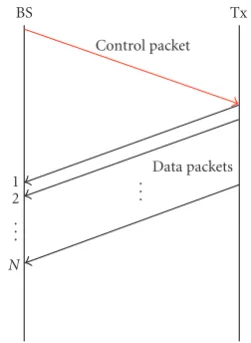
Once the BS and transmitter nodes are in place and activated, the test begins by running BaseStation.java as a console command. Three of the input arguments include: the node ID of the transmitter node that is asked to send the data packets, the number of data packets the transmitter is to send in return, and the packet transmission rate (how many of these packets are to be sent within one second). Passing these arguments to BaseStation.java increases the flexibility of the testbed and allows the parameters of each trial to be changed. It also allows consecutive trials to be conducted without the need to turn the transmitter node
BS
Figure2: Testbed Structure.
BS Tx
1 2 . . .
N
. . . Control packet
Data packets
Figure3: Packet transmission sequence.
In order for the BS to calculate the number of errors caused by the wireless channel, the transmitter node always transmits the same data packet. The first 8 octets are AM
header information and the dummy data payload is decimal number 85 which was chosen simply because it is alternating 0’s and 1’s in binary. The total packet length is 32 octets.
Upon receiving these data packets, the BS mote adds two additional octets of information (shown in blue) on to the end of the packet before it forwards them through the serial port to the laptop. The first octet is a counter value, which will be discussed later, and the second octet is the radio’s calculation of the RSSI for that particular packet. All of these packets are picked up by BaseStation.java listening on the USB port and it saves each consecutive packet in a file for future analysis. A new file is created for each trial.
A second Java program (Analyze.java) was developed to analyze the saved files containing the received packets. Since the transmitted data is known, this program can easily calculate the bit error rate (BER) and PER for all received packets in each trial. In addition, it determines packet loss rate (PLR) for each trial, the bit error locations, the number of packets received, and the maximum, minimum, and average RSSI values for every trial. A conversion chart for CC2420’s RSSI values to dBm is given in [20, page 49]. The BER, PER, and PLR characteristics are defined as follows:
BER= (Number of incorrect bits) (Total number of received bits)
PER=
Number of received packets with at least one error +Number of partial packets received Total number of received packets
PLR=
Number of packets sent −Number of packets received Number of packets sent
(1)
By default, the ZigBee mote radio chips conduct a cyclic redundancy check (CRC) on each packet. Packets that do not pass the CRC are immediately dropped by the CC2420 radio and would not be available for analysis. This poses a problem when there is a need to calculate BER and even PER, and creates ambiguity because it is not known whether the packet had an error or was lost. Also, the BER would be impossible to determine when erroneous packets are dropped after CRC. In order to circumvent this, some modifications to the TinyOS driver files for the radio chip were made in order to allow not only the correct packets through, but also the packets that have errors.
The BS ZigBee mote appends a counter value to the end of incoming packets. Since this mote has been modified to allow error packets through, occasionally only partial packets will be received during poor channel conditions. Sizes of these partial packets vary, which would make for an unnecessarily complicatedAnalyze.javaprogram to deal with them correctly. Instead, simply the occurrences of partial packets are counted and such packets are dropped. Consequently, accepted packets do not have errors in the length field of the packet header. Partial packets are included in the PER calculation.
3. Experiment Procedure and Results
In this section, the experimental procedures and results will be provided, along with a clear representation of the test sites and transmitter locations. The indoor, outdoor, vehicle, and machine shop test sites were chosen because most application environments will relate to one of these settings. The numerical results for all trials are shown in Table 1. This includes the approximate distance between the nodes, the BER, PER, PLR, the maximum, minimum, and average RSSI, and the number of partial packets received.
Table1: Test locations and results.
Transmitter Location Approximate
BER PER PLR Maximum Minimum Average Number of Partial (Description) Distance(m) RSSI RSSI RSSI Packets Dropped
Indoor: BS in Kitchen
1 (Below One Floor) 3.69 0.00176 0.05527 0.024 −37 −51 −48.838 1 2 (Dishwasher) 2.00 0.00101 0.00702 0.003 −30 −47 −38.772 0 3 (Basement Fridge) 8.27 No Reception
4 (Kitchen Fridge) 2.50 0 0 0 −27 −29 −28.745 0 5 (Fusebox) 3.50 0.00062 0.00502 0.004 −27 −29 −28.964 0
6 (Furnace) 6.08 No Reception
7 (Hot Water Heater) 8.47 No Reception
8 (Hydro Meter) 3.00 0.00119 0.01103 0.003 −31 −43 −41.686 0
9 (On Stove) 2.80 0 0 0 −27 −38 −29.109 0
Indoor: BS at Fuse Box
1 (Dishwasher) 1.90 0.00228 0.02010 0.006 −29 −46 −40.785 1 2 (Basement Fridge) 8.50 0.00299 0.03473 0.021 −33 −50 −47.753 0 3 (Kitchen Fridge) 4.58 0.00292 0.02823 0.008 −29 −44 −42.812 0 4 (Furnace 1) 6.73 0.00197 0.03644 0.012 −35 −50 −47.868 0 4 (Furnace 2) 6.73 0.00513 0.05555 0.029 −35 −51 −48.157 1 5 (Hot Water Heater Trial 1) 8.63 0.00660 0.32110 0.136 −35 −51 −49.257 8 5 (Hot Water Heater Trial 2) 8.63 0.00638 0.11207 0.074 −36 −51 −48.640 2 6 (Hydro Meter) 2.00 0.00155 0.01515 0.010 −41 −46 −45.102 0 7 (TV) 7.30 0.00185 0.01301 0.001 −23 −31 −30.957 0 8 (Up Two Floors) 4.33 0.00243 0.02020 0.010 −33 −47 −46.021 0 9 (Washing Machine) 6.05 0.00184 0.01511 0.007 −27 −38 −36.992 0
Indoor: BS at Furnace
1 (Thermostat) 4.26 0.00095 0.00903 0.003 −37 −50 −44.742 0 Outdoor
2 0 0 0 −20 −29 −23.054 0
10 0 0 0 −31 −35 −33.311 0
20 0 0 0 −39 −45 −43.725 0
25 0.03134 0.79167 0.978 −48 −50 −49.318 2 (1.2 m Tx Height) 25 0.00050 0.03704 0.029 −44 −49 −46.765 1 30 0.00004 0.00502 0.004 −44 −49 −47.444 0 (1.2 m Tx Height) 30 0 0 0 −42 −47 −44.640 0
40 0 0 0 −43 −47 −44.859 0
50 0 0 0 −44 −46 −45.101 0
60 0.00002 0.00100 0.003 −45 −49 −47.039 0 70 0.00010 0.00906 0.007 −46 −49 −48.048 0 80 0.00688 0.48765 0.241 −46 −51 −49.501 10 85 0.03819 0.96970 0.822 −48 −52 −50.820 20 90 0.00375 0.34777 0.157 −48 −51 −49.491 11 95 0.09005 1.00000 0.997 −51 −52 −51.333 0
Vehicle Idle: Engine Off
1 (Behind Driver’s Visor) 0 0 0 −6 −15 −10.476 0
2 (Behind Peddles) 0 0 0 −8 −21 −12.385 0
3 (Inside Door Handle) 0 0 0 −11 −43 −21.746 0 4 (Inside Door Handle) 0 0 0 −9 −30 −16.027 0 5 (Inside Door Handle) 0 0 0 −10 −26 −17.794 0 6 (Inside Door Handle) 0 0 0 −7 −21 −12.102 0 7 (On Centre of Dash Board) 0 0 0 −5 −11 −8.898 0
8 (In the Trunk) 0 0 0 −8 −15 −11.766 0
Table1: Continued.
Transmitter Location Approximate
BER PER PLR Maximum Minimum Average Number of Partial (Description) Distance(m) RSSI RSSI RSSI Packets Dropped 10 (Under Hood, Drivers Side) 0 0 0 −23 −35 −26.287 0 11 (Under Hood, Bottom of Grill) 0 0 0 −37 −43 −39.781 0 12 (Under hood, Passengers Side) 0 0 0 −31 −33 −31.340 0
Vehicle Idle: Engine On
1 (Behind Driver’s Visor) 0 0 0 −8 −33 −15.565 0
2 (Behind Peddles) 0 0 0 −4 −41 −19.350 0
3 (Inside Door Handle) 0 0 0 −8 −21 −11.545 0 4 (Inside Door Handle) 0.00003 0.00050 0.002 −9 −46 −18.018 0 5 (Inside Door Handle) 0 0 0 −8 −19 −11.689 0 6 (Inside Door Handle) 0 0 0 −5 −16 −10.363 0 7 (On Centre of Dash Board) 0 0 0 −5 −12 −9.232 0 8 (In the Trunk) 0 0 0.001 −9 −19 −14.925 0 9 (Under Driver’s Seat) 0 0 0 −8 −36 −13.164 0 10 (Under Hood, Drivers Side) 0 0 0 −23 −30 −26.169 0 11 (Under Hood, Bottom of Grill) 0.00052 0.03711 0.030 −43 −51 −46.409 0 12 (Under hood, Passengers Side) 0 0 0 −27 −31 −29.126 0
Vehicle Driving: Street
11 (Central to Walker) 0 0 0.003 −36 −50 −42.355 0 11 (Across City) 0.00024 0.00881 0.016 −35 −52 −42.880 1 9 (Across City) 0.00002 0.00067 0 −14 −50 −22.095 0 11 (Walker Rd.) 0.00021 0.00672 0.01 −31 −51 −36.367 1 11 (Across City) 0.00032 0.00517 0.011 −37 −51 −43.620 1 11 (Riverside Dr.) 0.00085 0.03706 0.113 −32 −52 −43.735 4 11 (Howard Ave.) 0.00025 0.01690 0.013 −32 −51 −44.320 0
Vehicle Driving: Expressway
11 (Central to Lesperance) 0.00017 0.01076 0.009 −37 −51 −41.985 1 11 (Lesperance to Central) 0.00125 0.04766 0.193 −37 −52 −44.097 6 11 (Central to Lesperance) 0.00128 0.04348 0.082 −37 −52 −44.903 2 11 (Banwell to Walker) 0.00005 0.00250 0.001 −32 −51 −37.704 0 11 (Central to Banwell) 0.00025 0.01087 0.019 −37 −51 −43.200 0 11 (Banwell to Howard) 0 0 0 −32 −43 −37.357 0
Machine Shop: BS in Office
1 (Head Height) 10.6 0.00022 0.00503 0.006 −35 −50 −38.354 0 2 (Shoulder Height) 11.5 0.00387 0.13726 0.493 −41 −52 −47.809 3 2 (On Light Banister: 2.4 m) 11.5 0.00047 0.00804 0.005 −41 −51 −44.994 0 3 (Shoulder Height: Off) 7.6 0 0 0 −33 −46 −38.079 0 3 (Shoulder Height: On) 7.6 0 0 0 −33 −48 −36.855 0 4 (Shoulder Height) 13.6 0.00051 0.02156 0.026 −40 −51 −45.188 0 5 (Shoulder Height) 15.4 0.00119 0.05606 0.130 −40 −51 −46.939 4 6 (Shoulder Height) 10.9 0.08955 1.00000 0.976 −46 −52 −51.125 6 7 (Waist Height) 5.8 0.00010 0.00201 0.004 −33 −51 −39.376 0 8 (Head Height) 6.2 0.00423 0.07000 0.101 −35 −52 −42.795 1 9 (Head Height) 8.6 0.00220 0.04158 0.064 −36 −53 −44.581 2
Machine Shop: BS in Centre of Shop Floor
1 (Head Height) 4.0 0 0 0 −26 −33 −28.839 0 2 (Shoulder Height) 4.0 0 0 0 −29 −37 −33.631 0 3 (Shoulder Height) 3.5 0.00001 0.00100 0.001 −33 −49 −39.208 0 4 (Shoulder Height) 5.6 0 0 0 −29 −37 −31.397 0 5 (Shoulder Height) 7.8 0 0 0 −33 −42 −36.819 0 6 (Shoulder Height) 8.7 No Reception
Up
Down
Hydro meter
BS spot 1 2
3
5
6
1
3
6
1
(a)
BS spot 3
BS spot 2
Up
HW
Fuse box
Fu
r
nac
e
1 4
2 4 5
7 9
8
(b)
Figure4: (a) Main Floor Layout. (b) Basement Layout. The triangles represent the transmitter test locations. Red is for trials conducted with the BS in the kitchen. Green is for trials with the BS at the fuse box. Blue is for the trial with the BS at the furnace.
there was no movement of residents in the house during test execution and each location/trial called for 1000 packets to be transmitted at a rate of 5 packets per second.
The results were very good when the BS was located in the kitchen while the transmitter was placed at either the various kitchen appliances, the electricity (hydro) meter directly outside of the kitchen wall, or one floor below. However, reception was either extremely poor or nonexistent for certain key areas such as the hot water heater and furnace
in the basement. In these cases the direct transmission path was impeded by several walls and appliances such as a refrigerator, stove, or furnace.
8
Figure5: Test vehicle and transmission locations.
and 0.09% BER demonstrating that a wireless connection between furnace and thermostat is viable.
Since no two indoor environments are the same, it is difficult to formulate precise conclusions. Nevertheless, these results give a good indication on how ZigBee may perform in a home automation system. Although performance greatly depends on the indoor layout and node locations, it may be a good idea to have a BS for every floor in a home, or one for every 7 meters (m) radius. This radius can be increased if ZigBee uses mesh network technology, where some nodes may relay packets for others.
3.2. Outdoor. The outdoor tests were conducted in two different large open fields. The results for both were very similar. The transmitter node was placed on a tripod so that its antenna was 1.5 m above the ground. The BS’s receiving antenna was 1.15 m above the ground and the laptop was positioned behind and below it to minimize interference. For each trial 1000 packets were transmitted at 5 packets per second. It was mostly sunny and there was no precipitation during these tests.
As can be seen, the error rates start to significantly climb beyond a 70 m distance. Strangely, the devices experienced a poor communication region between 20 m and 30 m. However, when the height of the transmitter was changed, reception greatly improved. This was likely caused by multi-paths destructively interfering given the original height of the antennas and the distance between them. Furthermore, the reception at 90 m was more reliable than at 80 m and 85 m. This could be attributed to small scale fading as described in the 20 m to 30 m fading region. Although extremely poor, there was still reception at 95 m, and no reception was experienced at 100 m. This test showed that a distance of 70 m appears to be a reliable range if the transmitter is at least 1 m above the ground with no obstructions.
3.3. Automotive Internal Monitoring. For this test a 1994 Toyota Corolla was used. The BS mote receiver was placed in the closed glove box closest to the centre of the car. In the event that ZigBee technology is used in this environment, we hypothesized that the master node would be located somewhere in the front dashboard. Also, only one person was present in the car during the trials and was sitting in the driver’s seat. The transmitter node was placed at twelve key locations around the car including under the hood, in the trunk, and in the passenger cabin as shown inFigure 5. All twelve trials were conducted both when the engine was
on and off, but always in park. Each trial had 1000 packets transmitted at 5 packets per second. Although the state of the engine had little effect on the performance, errors only occurred when the engine was running. Generally, all packets were received and error free in almost all trials. The biggest interferer seemed to be the human body if it was located in between the transmitter and receiver nodes.
In addition to the above automotive tests, trials were conducted with the transmitter under the hood (at position 11) while driving on the expressway and through the city. The city driving trials were typical 15-minute drives (4500 packets at 5 packets per second) while zigzagging across the city. There were plenty of stops, turns, and straight runs. The speed of the car ranged from 0 km/h to 65 km/h. The wireless transmissions performed the best when the car was either stopped or moving at an approximate constant velocity. The
majority of the bit errors were observed to occur during acceleration. This isnotto say that they occurred duringall
accelerations,nordid they only occur during acceleration. The expressway test was interesting in that on some trials almost all packets were transmitted perfectly, and on others trials packet transmission was not so impressive. It is possible that the wind from the high speeds altered the antenna position when driving in one direction and not the other. The speed of the car during the expressway trials ranged from 100 km/h to 120 km/h and trials had either 1500 or 1200 packets transmitted at 5 packets per second. The communication performance in the car was much better than expected, particularly for the expressway and city driving tests with the worst case scenario having a PER of 4.8%.
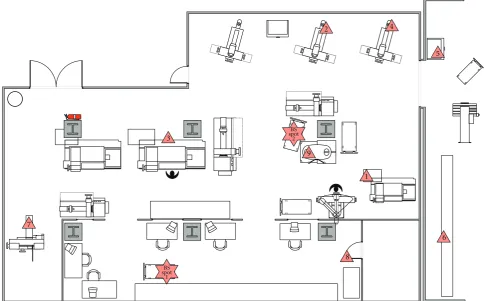
3.4. Machine Shop Floor. Trials were conducted in a similar fashion as in the indoor test. Two separate locations were used for the BS while several key spots were chosen to place the transmitter. Figure 6 shows the layout of the machine shop. Shop workers were present and were free to move around during testing. Shop machines were on and offas the workers proceeded with their normal daily work schedule.
When the BS was at the first location there are two noteworthy points to make. The first is that when the transmitter was on the CNC lathe machine (position 3), the test was conducted twice, once with the machine off and then once with it running. The running lathe machine had virtually no effect on the results from the first trial. The second noteworthy point is the drastically improved reception at position 2 when the transmitter was placed high on the ceiling lights compared to at shoulder height.
BS spot 2
BS spot 1
1
2 4
3
5
6 7
8
9
Figure6: Machine shop layout.
3.5. Bit Error Locations. As was mentioned, this testbed is able to determine the position of every bit error that occurs. Figure 7displays the bit error distributions for the individual tested environments. A uniform distribution is discovered for all locations except for the machine shop. This exception is represented by a slight increase in bit errors toward the end of the packets.
3.6. Multiple Access. The transmit and receive buffer sizes for the CC2420 radio on the MicaZ motes are equivalent. As a result, the motes are capable of receiving data at the same rate they can send data. With only one transmitter sending data to the BS, a maximum transmit rate of 19.7 kilo bits per second (kbps) is found. This transmission rate is bounded by the serial connection speed. Otherwise ZigBee allows up to 250 kbps operation in the wireless channel.
The ZigBee motes implement carrier sense multiple access (CSMA). This means that before the radio transmits, it senses the wireless channel to see if it is currently busy. If not then there is a small back off time before the transmission that is the same for all devices. If the channel is currently in use, then the device will wait a small random amount of time and then try again. The drawback transpires when two motes want to transmit at the same time. Both motes will sense that the channel is not being used, they will transmit, and a collision will take place. This can be avoided using a more sophisticated multiple access scheme, or scheduling algorithm. At its best, the BS will receive all the transmitted packets as long as the combined sending rate
of all transmitters do not exceed the maximum transmission rate of the interface between ZigBee and the computer. In our set-up, this rate was 19.7 kbps.
4. Conclusion
30 Indoor (BS at fusebox)
0 Machine shop (BS out on floor)
0
An important general point is that, all the environments tested do not necessarily require strict, low-power consump-tion restricconsump-tions. The ZigBee devices can transmit at a higher power without considering battery life if they are connected to the power supply of a building, or vehicle. Connecting directly to the power supply would also help avoid the need to regularly change batteries. With this in mind, it is possible to use ZigBee devices with a higher transmitting power in order to help overcome interference from noise or obstructions.
References
[1] M. Hameed, H. Trsek, O. Graeser, and J. Jasperneite, “Per-formance investigation and optimization of IEEE802.15.4 for industrial wireless sensor networks,” inProceedings of the IEEE Symposium on Emerging Technologies and Factory Automation
(ETFA ’08), pp. 1016–1022, Hamburg, Germany, September
2008.
[2] M. Zeghdoud, P. Cordier, and M. Terr´e, “Impact of clear channel assessment mode on the performance of ZigBee operating in a WiFi environment,” inProceedings of the 1st Workshop on Operator-Assisted (Wireless-Mesh) Community
Networks (OpComm ’06), Berlin, Germany, September 2006.
[3] M. U. Ilyas and H. Radha, “Measurement based analysis and modeling of the error process in IEEE 802.15.4 LR-WPANs,”
in Proceedings of the 27th IEEE Conference on Computer
Communications (INFOCOM ’08), pp. 1948–1956, Phoenix,
Ariz, USA, April 2008.
[4] M. Ahmed, C. U. Saraydar, T. Elbatt, J. Yin, T. Talty, and M. Ames, “Intra-vehicular wireless networks,” inProceedings of the IEEE Global Telecommunications Conference
(GLOBE-COM ’07), Washington, DC, USA, November 2007.
[5] D. Sexton, M. Mahony, M. Lapinski, and J. Werb, “Radio channel quality in industrial wireless sensor networks,” in Proceedings of the ISA/IEEE Sensors for Industry Conference
(Sicon ’05), pp. 88–94, Houston, Tex, USA, February 2005.
[6] C. Reinisch, W. Kastner, G. Neugschwandtner, and W. Granzer, “Wireless technologies in home and building automation,” inProceedings of the IEEE International
Confer-ence on Industrial Informatics (INDIN ’07), vol. 1, pp. 93–98,
Vienna, Austria, July 2007.
[7] H. S. Kim, J.-H. Song, and S. Lee, “Energy-efficient traffic scheduling in IEEE 802.15.4 for home automation networks,”
IEEE Transactions on Consumer Electronics, vol. 53, no. 2, pp.
369–374, 2007.
[8] H. Huo, Y. Xu, C. C. Bilen, and H. Zhang, “Coexistence issues of 2.4 GHz sensor networks with other RF devices at home,”
inProceedings of the 3rd International Conference on Sensor
Technologies and Applications (SENSORCOMM ’09), pp. 200–
205, Athens, Greece, June 2009.
[9] A. Fort, C. Desset, P. Wambacq, and L. V. Biesen, “Indoor body-area channel model for narrowband communications,”
IET Microwaves, Antennas and Propagation, vol. 1, no. 6, pp.
1197–1203, 2007.
[10] J. Wilson, V. Bhargava, A. Redfern, and P. Wright, “A wireless sensor network and incident command interface for urban firefighting,” in Proceedings of the 4th Annual International Conference on Mobile and Ubiquitous Systems: Computing,
Networking and Services (MobiQuitous ’07), Philadelphia, Pa,
USA, August 2007.
[11] A. D. Siuli Roy and S. Bandyopadhyay, “Agro-sense: precision agriculture using sensor-based wireless mesh networks,” in
Proceedings of the 1st ITU-T Kaleidoscope Academic Confer-ence: Innovations in NGN: Future Network and Services
(K-INGN ’08), Geneva, Switzerland, May 2008.
[12] M. Lin, Y. Wu, and I. Wassell, “Wireless sensor network: water distribution monitoring system,” inProceedings of the
IEEE Radio and Wireless Symposium (RWS ’08), pp. 775–778,
Orlando, Fla, USA, January 2008.
[13] P. Casey, Design and implementation of a cross-platform
sensor network for transmission line monitoring, M.S. thesis,
University of Windsor, Windsor, Canada, 2009.
[14] X. Huang, Q. Sun, and J. Ding, “An on-line monitoring system of transmission line conductor de-icing,” inProceedings of the 3rd IEEE Conference on Industrial Electronics and Applications
(ICIEA ’08), pp. 891–896, Singapore, June 2008.
[15] H.-M. Tsai, O. K. Tonguz, C. Saraydar, T. Talty, M. Ames, and A. MacDonald, “Zigbee-based intra-car wireless sensor networks: a case study,”IEEE Wireless Communications, vol. 14, no. 6, pp. 67–76, 2007.
[16] V. C. Gungor and G. P. Hancke, “Industrial wireless sen-sor networks: challenges, design principles, and technical approaches,”IEEE Transactions on Industrial Electronics, vol. 56, no. 10, pp. 4258–4265, 2009.
[17] L. Tang, K.-C. Wang, Y. Huang, and F. Gu, “Channel characterization and link quality assessment of IEEE 802.15.4-compliant radio for factory environments,”IEEE Transactions
on Industrial Informatics, vol. 3, no. 2, pp. 99–110, 2007.
[18] Crossbow Technology, May 2009,http://www.xbow.com. [19] TinyOS, May 2009,http://www.tinyos.net.