R E S E A R C H
Open Access
Basins of attraction of certain rational
anti-competitive system of difference
equations in the plane
Samra Moranjki´c and Zehra Nurkanovi´c
**Correspondence: [email protected] Department of Mathematics, University of Tuzla, Tuzla, Bosnia and Herzegovina
Abstract
We investigate the global asymptotic behavior of solutions of the following anti-competitive system of rational difference equations:
xn+1=
γ
1ynA1+xn
, yn+1=
β
2xnA2+B2xn+yn
, n= 0, 1,. . .,
where the parameters
γ
1,β
2,A1,A2andB2are positive numbers and the initial conditions (x0,y0) are arbitrary nonnegative numbers. We find the basins of attraction of all attractors of this system, which are the equilibrium points and period-two solutions.MSC: 39A10; 39A11
Keywords: difference equations; anti-competitive; map; stability; stable manifold
1 Introduction
A first-order system of difference equations
xn+=f(xn,yn), yn+=g(xn,yn),
n= , , . . . , (x,y)∈R, ()
whereR⊂R, (f,g) :R→R,f,g are continuous functions iscompetitiveif f(x,y) is
non-decreasing inxand non-increasing iny, andg(x,y) is non-increasing inxand non-decreasing iny.
System () where the functions f andg have a monotonic character opposite of the monotonic character in competitive system will be calledanti-competitive.
We consider the following anti-competitive system of difference equations:
xn+=
γyn A+xn
, yn+=
βxn A+Bxn+yn
, n= , , . . . , ()
where the parametersA,γ,A,Bandβare positive numbers and the initial conditions
(x,y) are arbitrary nonnegative numbers. In the classification of all linear fractional
sys-tems in [], System () was mentioned as System (, ).
Competitive and cooperative systems of the form () were studied by many authors such as Clark and Kulenović [], Clark, Kulenović and Selgrade [], Hirsch and Smith [], Ku-lenović and Ladas [], KuKu-lenović and Merino [], KuKu-lenović and Nurkanović [, ], Garić-Demirović, Kulenović and Nurkanović [, ], Smith [, ] and others.
The study of anti-competitive systems started in [] and has advanced since then (see [, ]). The principal tool of the study of anti-competitive systems is the fact that the second iterate of the map associated with an anti-competitive system is a competitive map, and so the elaborate theory for such maps developed recently in [, , ] can be applied.
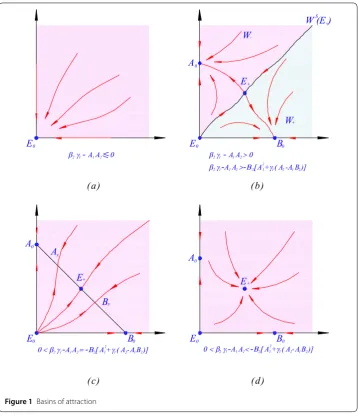
The main result on the global behavior of System () is the following theorem.
Theorem
(a) Ifβγ≤AA, then E= (, )is a unique equilibrium, and the basin of attraction of
this equilibrium isB(E) ={(x,y) :x≥,y≥}(see Figure (a)).
(b) Ifβγ–AA> –B[A +γ(A–AB)]andβγ–AA> , then there exist two
equilibrium points: E which is a repeller and E+which is an interior saddle point, and
minimal period-two solutions A= (,βγγ–BAA)and B= (βγA–BAA, )which are locally
asymptotically stable. There exists a setC⊂R=[,∞)×[,∞)such that E∈C, and
Ws(E
+) =CEis an invariant subset of the basin of attraction of E+. The setCis a graph
of a strictly increasing continuous function of the first variable on an interval and separates
Rinto two connected and invariant components, namely
W–:=
x∈R\C:∃x ∈Cwithxsex
, W+:=
x∈R\C:∃x ∈Cwithx sex
,
which satisfy (see Figure (b)): (i) If(x,y)∈W+, then
lim
n→∞(xn,yn) =
βγ–AA
AB
,
=B
and
lim
n→∞(xn+,yn+) =
,βγ–AA
γB
=A.
(ii) If(x,y)∈W–, then
lim
n→∞(xn,yn) =
,βγ–AA
γB
=A
and
lim
n→∞(xn+,yn+) =
βγ–AA
AB
,
=B.
(c) If <βγ–AA= –B[A+γ(A–AB)], then (see Figure (c))
(i) There exist two equilibrium points: Ewhich is a repeller and E+∈int(R)which is a
non-hyperbolic, and an infinite number of minimal period-two solutions
Ax=
x,βγ–AA–xAB
γB
Bx=
βγ–AA–xAB
B(x+A)
, –xβγ (A–γB)(x+A)
for x∈[,βγ–AA
AB ], that belong to the segment of the line () in the first quadrant.
(ii) All minimal period-two solutions and the equilibrium E+are stable but not
asymp-totically stable.
(iii) There exists a family of strictly increasing curvesC+,CAx,CBxfor x∈(,
βγ–AA
AB )and
CA=
(x,y) :x= ,y> , CB=
(x,y) :x> ,y=
that emanate from Eand Ax∈CAx, Bx∈CBx for all x∈[,
βγ–AA
AB ), such that the curves
are pairwise disjoint, the union of all the curves equalsR
+. Solutions with initial points
inC+ converge to E+and solutions with an initial point inCAx have even-indexed terms converging to Axand odd-indexed terms converging to Bx; solutions with an initial point in
CBx have even-indexed terms converging to Bxand odd-indexed terms converging to Ax. (d) If <βγ–AA< –B[A+γ(A–AB)], then System () has two equilibrium
points: Ewhich is a repeller and E+which is locally asymptotically stable, and minimal
period-two solutions Aand B which are saddle points. The basin of attraction of the
equilibrium point E+is the set
B(E+) =
(x,y) :x> ,y>
and solutions with an initial point in{(x,y) :x= ,y> }have even-indexed terms con-verging to Aand odd-indexed terms converging to B, solutions with an initial point in
{(x,y) :x> ,y= }have even-indexed terms converging to Band odd-indexed terms
con-verging to A(see Figure (d)).
2 Preliminaries
We now give some basic notions about systems and maps in the plane of the form (). Consider a mapT= (f,g) on a setR⊂R, and letE∈R. The pointE∈Ris called afixed
pointifT(E) =E. Anisolatedfixed point is a fixed point that has a neighborhood with no other fixed points in it. A fixed pointE∈Ris anattractorif there exists a neighborhood
U ofEsuch thatTn(x)→Easn→ ∞forx∈U; thebasin of attractionis the set of all
x∈Rsuch thatTn(x)→Easn→ ∞. A fixed pointEis a global attractor on a setKif
Eis an attractor andKis a subset of the basin of attraction ofE. IfT is differentiable at a fixed pointE, and if the JacobianJT(E) has one eigenvalue with modulus less than one and a second eigenvalue with modulus greater than one,Eis said to be asaddle. See [] for additional definitions.
Here we give some basic facts about the monotone maps in the plane, see [, , , ]. Now, we write System () in the form
x y
n+
=T
x y
Figure 1Basins of attraction
where the mapT is given as
T:
x y
→
⎛ ⎝
γy
A+x
βx
A+Bx+y
⎞ ⎠=
f(x,y) g(x,y)
. ()
The mapTmay be viewed as a monotone map if we define a partial order onRso that the
positive cone in this new partial order is the fourth quadrant. Specifically, forv= (v,v),
w= (w,w)∈Rwe say thatvwifv≤wandw≤v. Two pointsv,w∈R+are said
to berelatedifvworwv. Also, a strict inequality between points may be defined asv≺wifvwandv= w. A stronger inequality may be defined asv≺≺wifv<w
andw<v. A mapf :intR+→IntR+isstrongly monotoneifv≺wimplies thatf(v)≺≺
f(w) for allv,w∈IntR
+. Clearly, being related is an invariant under iteration of a strongly
configuration
+ –
– +
.
The mean value theorem and the convexity ofR
+may be used to show thatTis monotone,
as in [].
Forx= (x,x)∈R, defineQl(x) forl= , . . . , to be the usual four quadrants based at
xand numbered in a counterclockwise direction, for example,Q(x) ={y=(y,y)∈R:
x≤y,x≤y}.
The following definition is from [].
Definition LetSbe a nonempty subset ofR. A competitive mapT:S→Sis said to
satisfy condition (O+) if for everyx,yinS,T(x)neT(y) impliesxney, andT is said to satisfy condition (O–) if for everyx,yinS,T(x)neT(y) impliesynex.
The following theorem was proved by de Mottoni-Schiaffino for the Poincaré map of a periodic competitive Lotka-Volterra system of differential equations. Smith generalized the proof to competitive and cooperative maps [].
Theorem LetSbe a nonempty subset ofR. If T is a competitive map for which (O+)
holds then for all x∈S,{Tn(x)}is eventually componentwise monotone. If the orbit of x has compact closure, then it converges to a fixed point of T . If instead (O–) holds, then for all x∈S,{Tn}is eventually componentwise monotone. If the orbit of x has compact closure inS, then its omega limit set is either a period-two orbit or a fixed point.
The following result is from [], with the domain of the map specialized to be the Carte-sian product of intervals of real numbers. It gives a sufficient condition for conditions (O+) and (O–).
Theorem LetR⊂Rbe the Cartesian product of two intervals inR. Let T:R→Rbe
a Ccompetitive map. If T is injective anddetJ
T(x) > for all x∈Rthen T satisfies (O+). If T is injective anddetJT(x) < for all x∈Rthen T satisfies (O–).
Next two results are from [, ].
Theorem Let T be a competitive map on a rectangular regionR⊂R. Letx∈Rbe a
fixed point of T such that:=R∩int(Q(x)∪Q(x))is nonempty (i.e.,xis not the NW or
SE vertex ofR), and T is strongly competitive on. Suppose that the following statements are true.
a. The mapT has aCextension to a neighborhood ofx.
b. The Jacobian matrix ofTatxhas real eigenvaluesλ,μsuch that <|λ|<μ, where
|λ|< , and the eigenspaceEλassociated withλis not a coordinate axis.
Then there exists a curveC⊂Rthroughxthat is invariant and a subset of the basin of attraction ofx, such thatCis tangential to the eigenspace Eλatx, andCis the graph of a
Theorem (Kulenović & Merino) LetI,Ibe intervals inRwith endpoints a, aand
b, bwith endpoints respectively, with a<aand b<b, where–∞ ≤a<a≤ ∞and
–∞ ≤b<b≤ ∞. Let T be a competitive map on a rectangleR=I×Iandx∈int(R).
Suppose that the following hypotheses are satisfied:
. T(int(R))⊂int(R)andTis strongly competitive onint(R). . The pointxis the only fixed point ofT in(Q(x)∪Q(x))∩int(R).
. The mapT is continuously differentiable in a neighborhood ofx. . At least one of the following statements is true:
a. Thas no minimal period two orbits in(Q(x)∪Q(x))∩int(R).
b. detJT(x) > andT(x) =xonly forx=x. . xis a saddle point.
Then the following statements are true.
(i) The stable manifoldWs(x)is connected and it is the graph of a continuous
increasing curve with endpoints in∂R.int(R)is divided by the closure ofWs(x)into two invariant connected regionsW+(“below the stable set”), andW–(“above the
stable set”), where
W–:=
x∈R\Ws(x) :∃x ∈Ws(x)withxsex,
W+:=
x∈R\Ws(x) :∃x ∈Ws(x)withx sex
.
(ii) The unstable manifoldWu(x)is connected, and it is the graph of a continuous decreasing curve.
(iii) For everyx∈W+,Tn(x)eventually enters the interior of the invariant setQ(x)∩R,
and for everyx∈W–,Tn(x)eventually enters the interior of the invariant set
Q(x)∩R.
(iv) Letm∈Q(x)andM∈Q(x)be the endpoints ofWu(x), wheremsexseM. For everyx∈W–and everyz∈Rsuch thatmsez, there existsm∈Nsuch that Tm(x)sez, and for everyx∈W+and everyz∈Rsuch thatzseM, there exists m∈Nsuch thatMseTm(x).
3 Linearized stability analysis Lemma
(i) Ifβγ–AA≤, then System () has a unique equilibrium pointE= (, ).
(ii) Ifβγ–AA> , then System () has two equilibrium pointsEandE+= (x,y),
x> ,y> .
Proof The equilibrium pointE(x,y) of System () satisfies the following system of equa-tions:
x= γy A+x
, y= βx
A+Bx+y
. ()
It is easy to see thatE= (, ) is one equilibrium point for all values of the parameters, and
E+= (x,y) is a positive equilibrium point ifβγ–AA> . Indeed, substitutingyfrom the
first equation in () in the second equation in (), we obtain thatxsatisfies the following equation:
f(x) =x+ (A+Bγ)x+
A+ABγ+Aγ
By using Descartes’ theorem, we have that equation () has one positive equilibrium if the condition
βγ–AA> ()
is satisfied,i.e.,βγ>AA.
Theorem
(i) Ifβγ<AA, thenEis locally asymptotically stable.
(ii) Ifβγ=AA, thenEis non-hyperbolic.
(iii) Ifβγ>AA, thenEis a repeller.
Proof The mapTassociated to System () is of the form (). The Jacobian matrix ofTat the equilibriumE= (x,y) is
JT(x,y) = ⎛ ⎝ –
γy
(A+x)
γ
A+x
β(A+y)
(A+Bx+y) –
βx
(A+Bx+y)
⎞
⎠ ()
and
JT(, ) =
γ
A
β
A
.
The corresponding characteristic equation has the following form:
λ– βγ AA
= ,
from whichλ,=±
βγ
AA.
(i) Ifβγ<AA, then|λ,|< ,i.e.,Eis locally asymptotically stable.
(ii) Ifβγ=AA, then|λ,|= , which implies thatEis non-hyperbolic.
(iii) Ifβγ>AA, then|λ,|> , which implies thatEis a repeller.
Theorem
() Assume thatβγ>AAand
βγ–AA> –B
A+γ(A–AB)
. ()
Then the positive equilibriumE+is a saddle point.
() Assume that
<βγ–AA= –B
A+γ(A–AB)
. ()
Then the positive equilibriumE+is a non-hyperbolic point and
x= –A+
γ(AB–A), y=
(–A+
γ(AB–A))
γ(AB–A)
γ
() Assume that
Then the positive equilibriumE+is locally asymptotically stable.
Proof The Jacobian matrix ofT at the equilibriumE+= (x,y) is of the form () and the
corresponding characteristic equation has the following form:
Now, for the positive equilibrium, it holds
+p+q> ⇔ φ(x) < ,
+p+q= ⇔ φ(x) = ,
+p+q< ⇔ φ(x) > .
IfA
+γ(A–AB)≥, thenφ(x) > for allx> , which implies thatE+is a saddle point.
IfA
+γ(A–AB) < , thenφ(x) = forx±= –A±
γ(AB–A) (x–< ,x+> ).
Now we have three cases:x+<x,x+=xorx<x+. Functionsf(x) andφ(x) are increasing
forx> .
() Ifx+<x, then =φ(x+) <φ(x),i.e., +p+q< andf(x+) <f(x) = . So,
f(x+) =f
–A+
γ(AB–A)
<
⇔ –A+
γ(AB–A)
+ (A+Bγ)
–A+
γ(AB–A)
+A+ABγ+Aγ
–A+
γ(AB–A)
+γ(AA–βγ) < ,
from which it follows
γB(AB–A) < (βγ–AA) +AB,
i.e.,
βγ> (A–γB)(A–AB). ()
Now we have
βγ–AA> –B
A+γ(A–AB)
,
so we can see that the conditions () and () are sufficient forE+= (x,y) to be a saddle
point.
() Ifx+=x, then =φ(x+) =φ(x), hence +p+q= ,i.e.,
f(x+) =f(x) =f
–A+
γ(AB–A)
= ,
from which
βγ= (A–γB)(A–AB). ()
If conditions () and () are satisfied, then
βγ–AA= –B
A+γ(A–AB)
>
holds,i.e.,E+= (x,y) is a non-hyperbolic point of the form
x=x+= –A+
γ(AB–A), y=
(–A+
γ(AB–A))
γ(AB–A)
γ
() Ifx<x+, thenφ(x) <φ(x+) = and
=f(x) <f(x+) =f
–A+
γ(AB–A)
,
from which
βγ< (A–γB)(A–AB). ()
Hence, if conditions () and () are satisfied, then
<βγ–AA< –B
A+γ(A–AB)
holds, soE+is a locally asymptotically stable.
4 Periodic character of solutions
In this section, we give the existence and local stability of period-two solutions.
Lemma Assume thatβγ>AA. Then System () has the following minimal period-two
solutions:
A=
,βγ–AA
γB
and B=
βγ–AA
AB
,
. ()
If
<βγ–AA= –B
A+γ(A–AB)
,
then System () has an infinite number of minimal period-two solutions of the form
Ax=
x,βγ–AA–xAB
γB
,
Bx=
βγ–AA–xAB
B(x+A)
, –xβγ (A–γB)(x+A)
for x∈[,βγ–AA
AB ], located along the line
H=
(x,y) :xA+γy+A+γ(A–AB) = ,x∈
,βγ–AA AB
. ()
Proof The second iterate ofTis (). Equilibrium curves of the mapT(x,y) are
CT=
(x,y)∈[,∞):xβγ(x+A) =x(y+A+xB)
A+xA+yγ
()
and
CT=
(x,y)∈[,∞):yβγ(y+A+xB) =y
AA+xβ+xA+xAB+xyA
+xβA+yAA+yγB+yγAB+xAAB+xyγB
We get period-two solutions as the intersection point of equilibrium curves () and () in the first quadrant. Ifx= ,y= , then System (), () is reduced to the equation
βγ(x+A) =A(A+xB)(x+A),
and the positive solution of this equation is
x=βγ–AA AB
> , forβγ–AA> .
Ifx= ,y= , then System (), () is reduced to the equation
βγ(y+A) = (y+A)(AA+yγB),
with the positive solution
y=βγ–AA
γB
> , forβγ–AA> .
On the other hand, ifx> ,y> , then we have
βγ(x+A) = (y+A+xB)
A
+xA+yγ
βγ(y+A+xB) =AA+xβ+xA+xAB+xyA+xβA+yAA
+yγ
B+yγAB+xAAB+xyγB
⎫ ⎪ ⎪ ⎬ ⎪ ⎪ ⎭ ,
that is
(x+A)(βγ–AA) = (y+xB)
A+xA+yγ
+yγA ()
and
xβ+xA+xAB+xyA+xβA+yγB+yγAB+xyγB
= (y+xB+A)(βγ–AA). ()
Therefore, it must be (βγ–AA) > in order to get any positive solution. By eliminating
the term (βγ–AA) from () and using condition (), we get
(y+xB+AB)
yγ+xA+A+γA–γAB
= ,
which implies
yγ+xA+A+γ(A–AB) = ,
hence
y= –
γ
xA+A+γ(A–AB)
Now, by eliminatingyand the term (AA–βγ) from (), we get the identity
(x+A)(x+A–γB)
βγ– (A–AB)(A–γB)
γ
= .
Ifx=γB–A, we have
y= –
γ
xA+A+γ(A–AB)
= –A< , γ= .
So, periodic solutions are located along line () with endpoints given by () using con-ditions (). It is easy to see thatAx,Bx∈Hifβγ–AA= –B[A+γ(A–AB)].
Let (x,y)∈H, then the corresponding Jacobian matrix of the mapThas the following
form:
JTH(x,y) =
a b c d
, ()
wherea:=Fx(x,y),b:=Fy(x,y),c:=Gx(x,y),d:=Gy(x,y).
Lemma Assume that <βγ–AA= –B[A +γ(A–AB)]. Then the following
statements are true.
(a) The pointsAx,Bx∈Hare non-hyperbolic fixed points for the mapT, and both of them have eigenvaluesλ= andλ∈(, ).
(b) Eigenvectors corresponding to the eigenvaluesλandλare not parallel to coordinate
axes.
Proof
(a) From () we haveyH(x) = –A
γ < . Since
H=(x,y)∈[,∞):F(x,y) =x=(x,y)∈[,∞):G(x,y) =y,
by implicit differentiation of equationsF(x,y) =xandG(x,y) =yat the point (x,y)∈H, we obtain
yH(x) = –a
b =
c –d= –
A
γ
< . ()
Sincea> ,b< ,c< andd> , from (), we get
<a< and <d< . ()
The characteristic polynomial of the matrix () at the point (x,y)∈His of the form
P(λ) =λ– (a+d)λ+ (ad–bc).
Now, using () we have ( –a)( –d) =bc, and since
we getλ= , and due to Vieta’s formulas and condition (), it follows
On the other hand, we have
and the corresponding eigenvalues are
so it comes to the same conclusion!
5 Global results
In this section, we present the results on the global dynamics of System ().
Lemma Every solution of System () satisfies . xn≤Aγ·Bβ,yn≤Bβ,n= , , . . ..
Proof From System (), we have
yn+=
Proof of . and . is an immediate checking.
Lemma The map Tis injective anddetJ
T(x,y) > , for all x≥and y≥.
Proof
(i) Here we prove that map T is injective, which implies that T is injective. Indeed,
Tyx=Tyximplies that
By solving System () with respect tox,xory,y, we obtain that (x,y) = (x,y).
(ii) The mapT(x,y) =GF((xx,,yy))is of the form T(x,y)
= ⎛ ⎝
xβγ(x+A)
(y+A+xB)(A+xA+yγ)
yβγ(y+A+xB)
AA+xβ+xA+xAB+xyA+xβA+yAA+yγB+yγAB+xAAB+xyγB
⎞
⎠ ()
and
JT(x,y) =
Fx Fy Gx Gy
,
where
Fx=βγ
AA+yA+ xAA+xAA+ xyγ+ xyA+xyA
+yγA+ xyγA+yγAA+xyγB
/yγ+xA+A
(y+A+xB)
,
Fy= –
xβγ(x+A)(yγ+xA+A+γA+xγB)
(yγ+xA+A)(y+A+xB)
,
Gx= –yβγ
A+ yA+yA+ xAB+ xyβ+ xβA+yβA
+xAB+βAA+xβB+ xyAB
/AA+xβ+xA+xAB+xyA+xβA+yAA
+yγB+yγAB+xAAB+xyγB
,
Gy=βγ(x+A)
A+ yA+yA+ xAB+ xyβ+xβA+xAB
+xβB+ xyAB
/AA+xβ+xA+xAB+xyA+xβA+yAA
+yγB+yγAB+xAAB+xyγB
.
Now, we obtain
detJT(x,y) =FxGy–FyGx=UV,
where
U=β
γ(x+A)(xA+yA+AA)
(yγ+xA+A)(y+A+xB)
> ,
V=AA+xAA+yAA+xβA
+xβA+yγA+yγA+xAAB+xAAB+xyAA+xyγAB
/AA+xβ+xA+xAB+xyA+xβA+yAA
+yγB+yγAB+xAAB+xyγB
>
Corollary The competitive map T satisfies the condition (O+). Consequently, the
se-quences{xn},{xn+},{yn},{yn+}of every solution of System () are eventually monotone.
Proof It immediately follows from Lemma , Theorem and .
Now, we have
Lemma The map Tassociated to System () satisfies the following:
T(x,y) = (x,y) only for(x,y) = (x,y).
Proof SinceTis injective, thenT(x,y) = (x,y) =T(x,y)⇒(x,y) = (x,y).
Proof of Theorem Case βγ≤AA
EquilibriumEis unique (see Lemma ), and by Lemma , every solution of System ()
belongs to
which is an invariant box. In view of Corollary and Theorem , every solution converges to minimal period-two solutions orE. System () has no minimal period-two solutions
(Lemma ). So, every solution of System () converges toE.
Case βγ–AA> –B[A+γ(A–AB)] andβγ–AA>
By Lemmas , , and Theorems and , there exist two equilibrium points:Ewhich
is a repeller andE+which is a saddle point, and minimal period-two solutionsAandB
which are locally asymptotically stable. ClearlyTis strongly competitive and it is easy
to check that the pointsAandBare locally asymptotically stable forTas well.System
The existence of the setCwith the stated properties follows from Lemmas , , , , Corol-lary , Theorems and .
Case <βγ–AA= –B[A+γ(A–AB)]
Cases (i) and (ii) from (c) in Theorem are the consequence of Lemmas , , and Theorems and .
SinceTis strongly competitive and pointsAxandBx, for allx∈[,βγA–BAA), are non-hyperbolic points of the map T, by Lemmas , , , , , Corollary , Theorems , , and , it follows that all conditions of Theorem are satisfied for the mapT with
R=[,∞)×[,∞). By Lemma , it is clear that
CA=
(x,y) :x= ,y> and CB=
(x,y) :x> ,y= .
Case <βγ–AA< –B[A+γ(A–AB)]
Lemma implies that System () has minimal period-two solutions (). Furthermore, Corollary and Theorem imply that all solutions of System () converge to an equi-librium or minimal period-two solutions, and since, by Theorem ,E is a repeller, all
solutions converge toE+(which is, in view of Theorem , locally asymptotically stable) or
minimal period-two solutions (). The pointsAandBare saddle points of the strongly
competitive mapT; and by Lemma , the stable manifold ofA
(underT) is
B(A) =
(x,y) :x= ,y>
and the stable manifold ofB(underT) is
B(B) =
(x,y) :x> ,y=
and each of these stable manifolds is unique. This implies that the basin of attraction of the equilibrium pointE+is the set
B(E+) =
(x,y) :x> ,y> ,
and Lemma completes the conclusion (d) of Theorem .
Competing interests
The authors declare that they have no competing interests.
Authors’ contributions
Both authors contributed to each part of this study equally and read and approved the final version of the manuscript.
Acknowledgements
The authors are very grateful to Professor M.R.S. Kulenovi´c for his valuable suggestions. They thank also the referees for their useful comments.
Received: 20 March 2012 Accepted: 23 August 2012 Published: 4 September 2012
References
1. Camouzis, E, Kulenovi´c, MRS, Ladas, G, Merino, O: Rational systems in the plane - open problems and conjectures. J. Differ. Equ. Appl.15, 303-323 (2009)
2. Clark, D, Kulenovi´c, MRS: On a coupled system of rational difference equations. Comput. Math. Appl.43, 849-867 (2002)
4. Hirsch, M, Smith, H: Monotone Dynamical Systems. In: Handbook of Differential Equations. Ordinary Differential Equations, vol. 2, pp. 239-357. Elsevier, Amsterdam (2005)
5. Kulenovi´c, MRS, Ladas, G: Dynamics of Second Order Rational Difference Equations with Open Problems and Conjectures. Chapman and Hall/CRC, Boca Raton (2001)
6. Kulenovi´c, MRS, Merino, O: Discrete Dynamical Systems and Difference Equations with Mathematica. Chapman and Hall/CRC, Boca Raton (2002)
7. Kulenovi´c, MRS, Nurkanovi´c, M: Asymptotic behavior of a system of linear fractional difference equations. J. Inequal. Appl.2005, 127-144 (2005)
8. Kulenovi´c, MRS, Nurkanovi´c, M: Asymptotic behavior of a competitive system of linear fractional difference equations. Adv. Differ. Equ.2006, 1-13 (2006)
9. Brett, A, Gari´c-Demirovi´c, M, Kulenovi´c, MRS, Nurkanovi´c, M: Global behavior of two competitive rational systems of difference equations in the plane. Commun. Appl. Nonlinear Anal.16, 1-18 (2009)
10. Garic-Demirovi´c, M, Kulenovi´c, MRS, Nurkanovi´c, M: Global behavior of four competitive rational systems of difference equations in the plane. Discrete Dyn. Nat. Soc.2009, Article ID 153058 (2009)
11. Smith, HL: Planar competitive and cooperative difference equations. J. Differ. Equ. Appl.3, 335-357 (1998) 12. Smith, HL: The discrete dynamics of monotonically decomposable maps. J. Math. Biol.53, 747-758 (2006) 13. Kalabuši´c, S, Kulenovi´c, MRS: Dynamics of certain anti-competitive systems of rational difference equations in the
plane. J. Differ. Equ. Appl.17, 1599-1615 (2011)
14. Garic-Demirovi´c, M, Nurkanovi´c, M: Dynamics of an anti-competitive two dimensional rational system of difference equations. Sarajevo J. Math.7(19), 39-56 (2011)
15. Kalabuši´c, S, Kulenovi´c, MRS, Pilav, E: Global dynamics of anti-competitive systems in the plane (submitted) 16. Kulenovi´c, MRS, Merino, O: Competitive-exclusion versus competitive-coexistence for systems in the plane. Discrete
Contin. Dyn. Syst., Ser. B6, 1141-1156 (2006)
17. Kulenovi´c, MRS, Merino, O: Global bifurcation for discrete competitive systems in the plane. Discrete Contin. Dyn. Syst., Ser. B12, 133-149 (2009)
18. Robinson, C: Stability, Symbolic Dynamics, and Chaos. CRC Press, Boca Raton (1995)
19. Kulenovi´c, MRS, Merino, O: Invariant manifolds for competitive discrete systems in the plane. Int. J. Bifurc. Chaos20, 2471-2486 (2010)
20. Clark, D, Kulenovi´c, MRS, Selgrade, JF: Global asymptotic behavior of a two dimensional difference equation modelling competition. Nonlinear Anal. TMA52, 1765-1776 (2003)
21. Kulenovi´c, MRS, Merino, O: A global attractivity result for maps with invariant boxes. Discrete Contin. Dyn. Syst., Ser. B 6, 97-110 (2006)
doi:10.1186/1687-1847-2012-153