FORMULATION APPROACHES FOR SUSTAINED RELEASE DOSAGE FORMS: A REVIEW
SUDHIR KARNA*, SHASHANK CHATURVEDI, VIPIN AGRAWAL, MOHAMMAD ALIM
Department of Pharmaceutics, Invertis Institute of Pharmacy, Invertis University, Bareilly, Uttar Pradesh, India.Email: [email protected]
Received: 30 May 2015, Revised and Accepted: 14 July 2015 ABSTRACT
Over the past 30 years, as the expense and complications involved in marketing new drug entities have increased, with concomitant recognition of the therapeutic advantages of controlled drug delivery, greater attention has been focused on development of sustained or controlled release drug delivery systems (DDS). For many disease states, a substantial number of therapeutically effective compounds already exist. The effectiveness of these drugs is often limited by side effects or necessity to administer the compound in an ethical setting. The goal in designing sustained drug delivery is to reduce the frequency of dosing or to increase the effectiveness of the drug by localization at the site of action, reducing the dose required or providing uniform drug delivery. The design of oral sustained release DDS depends on various factors such as, physicochemical properties of drug, type of delivery system, disease being treated, and patient condition, and treatment duration, presence of food, gastrointestinal motility, and co-administration of other drugs.
Keywords: Sustained release drug delivery system, Dose frequency, Biological half-life, Physicochemical properties of drugs.
INTRODUCTION
Oral drug delivery has been known for decades as the most widely utilized route of administration among all the routes that has been explored for the systemic delivery of drugs via various pharmaceutical products of the different dosage form. Traditional drug delivery system (DDS) has been characterized by immediate release and repeated dosing of the drug which might lead to the risk of dose fluctuation, this arises the need of a formulation with control release that maintain a near-constant or uniform blood level. Therefore, nowadays the most of the pharmaceutical scientists are involved in developing an ideal DDS. This ideal system should have the advantage of single-dose for the whole duration of the treatment, and it should deliver the drug directly at a specific site at a controlled manner [1,2]. The design of oral sustain DDS should be primarily aimed to achieve the more predictability and reproducibility to control the drug release, drug concentration in the target tissue and optimization of the therapeutic effect of a drug by controlling its release in the body with lower and less frequent dose [3].
The goal in designing sustained or sustained delivery systems is to reduce the frequency of the dosing or to increase effectiveness of the drug by localization at the site of action, reducing the dose required or providing uniform drug delivery. So, sustained release (SR) dosage form is a dosage form that release one or more drugs continuously in a predetermined pattern for a fixed period of time, either systemically or to a specified target organ [4,5].
DEMERITS OF CONVENTIONAL RELEASE DOSAGE FORM [6,7] 1. If the drug has a short half-life, it has to be administered frequently,
so there are chances of missing the dose.
2. If the drug is not taken at a periodic interval, peak-valley plasma
concentration-time profile obtained is not steady.
3. The fluctuations of drug plasma level that occurs during conventional
release may produce under medication or overmedication. 4. Poor patient compliance.
The therapy of many chronic diseases requires a repeated dosing of a drug. Drugs having a short half-life have to administer up to several times daily within short intervals. To reduce the application frequently sustained formulations have been developed [8]. By the SR method
therapeutically effective concentration can be achieved in the systemic circulation over an extended period of time, thus achieving better compliance of patients. In many instances, the conventional method is more preferred to deliver the drug, but some drugs are unstable and toxic by frequently dosing. These kinds of the drug have the narrow therapeutic range and face solubility difficulties. In such cases, sustained DDS is used, which maintain the drug plasma level in the therapeutic index [2,9].
If one were to imagine the ideal DDS, two prerequisites would be required. First, it would be a single-dose for the duration of treatment, whether it is for days of weeks, as with infection, or for a lifetime of the patient, as in hypertension or diabetes. Second, it should deliver the drug directly to the site of action, thereby minimizing or eliminating side effects [10]. SR has received most of the attention because of the fact that there is more feasibility in dosage form [11].
The infrared DDS lacks some features such as dose maintenance, SR rate, and site targeting. The oral sustained drug delivery has some potential advantage such as SR rate and dose maintenance in plasma. The SR formulations have some swelling polymer or waxes or both which controls the release rate. The use of reservoir system is also well-known for controlling release rate [12].
The goal of an SR dosage form is to maintain therapeutic blood or tissue levels of the drug for an extended period. This is usually accomplished by attempting to obtained zero-order release from the dosage form. Zero-order release constitutes drug release from the dosage form that is independent of the amount of drug in the delivery system (i.e., a constant release rate). SR systems generally do not attain this type of release and usually try to mimic zero-order release by providing the drug in a slow first-order fashion (i.e., concentration dependent). Fig. 1 shows the relation between plasma concentration verses time [13].
RATIONALE OF DEVELOPING SR DDS [13]
• To extend the duration of action of the drug • To reduce the frequency of dosing
• To minimize the fluctuations in plasma level • Improved drug utilization
ADVANTAGES OF SR DDS OVER THE CONVENTIONAL DOSAGE FORM [6-13]
• Reduced dosing frequency • Dose reduction
• Improved patient compliance
• A constant level of drug concentration in blood plasma • Reduced toxicity due to overdose
• Reduces the fluctuation of peak-valley concentration • Night time dosing can be avoided
• Economic
• The total amount of drug administered can be reduced, thus: • Maximizing availability with minimum dose
• Minimize or eliminate local side effects • Minimize or eliminate systemic side effects • Minimize drug accumulation with chronic dosing.
DISADVANTAGES OF SR DDS [1]
• Probability of dose dumping
• Reduced potential for dose adjustment
• Cost of single unit higher than conventional dosage forms • Increase potential for first-pass metabolism
• The requirement for additional patient education for proper
medication
• Decreased systemic availability in comparison to immediate release
conventional dosage forms
• Poor in vitro and in vivo correlations.
DRUG SELECTION FOR ORAL SR DDS
The biopharmaceutical evaluation of a drug for potential use in SR DDS requires knowledge on the absorption mechanism of the drug form the gastrointestinal (GI) tract, the general absorbability, the drug’s molecular weight, pKa, solubility at different pH, and apparent partition coefficient as shown in Table 2 [1,10,24].
Similarly, there are some pharmacokinetic parameters for drug selection which includes drug’s elimination half-life, total clearance, absolute bioavailability, possible first-pass effect, and the desired steady concentrations for peak and trough as shown in Table 3 [1,10,24].
CHARACTERISTIC THAT MAKES A DRUG UNSUITABLE FOR SR FORMULATION [24]
• Short elimination half-life, i.e., t1/2 <2 hrs
• Long elimination half-life, i.e., t1/2 >8 hrs
• Narrow therapeutic index • Large doses
• Poor absorption • Low or slow solubility • Extensive first-pass clearance.
TERMINOLOGY SR
These are DDS that are designed to achieve a prolonged therapeutic effect by continuously releasing medication over an extended period of time after administration of single-dose of drug [25].
Controlled-release dosage forms
They are the class of pharmaceuticals or other biologically active products from which a drug is released from the delivery system in a planned, predictable, and slower-than-normal manner for a longer period of time [26].
Extended release
Pharmaceutical dosage forms that release the drug slower-than-normal manner at a predetermined rate and necessarily reduces the dosage frequency by two folds [27].
Delayed release
Delayed release systems are those systems that use repetitive, intermittent dosing of a drug from one or more immediate release units incorporated into a single dosage form [28].
Repeat action DDS
These are the alternative system of SR which multiple contains doses of the drug within the dosage form, and each dose is released at regular intervals [29].
Prolonged release system
They are designed to release the drug slowly and to provide a continuous supply of drug over an extended period. They prevent very rapid absorption of the drug, which could result in extremely high peak plasma drug concentration [30].
Timed release DDS
Timed release DDS are used to obtain the drug release after a lag time of
about 4-5 hrs. Enteric coated dosage forms of cellulose acetate phthalate are designed to provide protection in the stomach. Application of a thick
coat causes a delay in the drug release in the small intestine and delays the drug release. This time controlled drug release may be retarded upto 5 hrs this targets the drug to the colon [31].
Site-specific and receptor release
They are designed to target the drug directly to a certain biological location. In the case of site-specific release, the drug directly target to a certain organ or tissue, while in receptor release, the target on the particular receptor within an organ or tissue [28].
FACTORS AFFECTING THE FORMULATION OF ORAL SR DDS
There are two major factors that affect the release rate from the DDS. They are:
1. Physicochemical factors 2. Biological factors.
PHYSICOCHEMICAL FACTORS
a. Aqueous solubility
b. Partition coefficient (P [O/W])
c. Drug pKa and ionization at physiological pH d. Drug stability
e. Molecular weight and diffusivity
f. Protein binding g. Dose size.
AQUEOUS SOLUBILITY
Most of the drugs are weak acids or weak bases. Drugs with low water
solubility will be difficult to incorporate into SR mechanism. For a drug with high solubility and rapid dissolution rate, it is often quite
difficult to retard its dissolution rate. A drug of high water solubility
can dissolve in water or GI fluid readily and tends to release its dosage form in a burst and thus is absorbed quickly leading to a sharp increase in the blood drug concentration compared to less soluble drug. It is often difficult to incorporate a highly water-soluble drug in the dosage form and retard the drug release, especially when the dose is high. The pH-dependent solubility, particularly in the physiological pH range, would be another problem for SR formulation because of Fig. 1: Plasma drug concentration profile for conventional release, a
the variation in the pH throughout the GI tract and variation in the dissolution rate [6,32].
The biopharmaceutical classification system allows estimation of
the likely contribution of three major factors which affect the oral
absorption.
• Solubility • Dissolution and • Intestinal permeability.
Class III (high solubility-low permeability) and Class IV (low
solubility-low permeability) drugs are poor candidates for SR dosage form compound with solubility <0.1 mg/ml face significant
solubilization obstacles and often compounds with solubility 10 mg/ml present difficulties to solubilization dosing formulation. In general, highly soluble drugs are undesirable for formulation into an SR product [12].
PARTITION COEFFICIENT
The partition coefficient is defined as the fraction of drug in an oil phase
to that of an adjacent aqueous phase. Partition coefficient influences not
only the permeation of the drug across the biological membranes but also diffusion across the rate controlling membrane or matrix between the time when a drug is administered, and when it is eliminated from the body, it must diffuse through a variety of biological membranes that
act primarily as lipid-like barriers. A major criterion in evaluation of the
ability of a drug to penetrate these lipid membranes (i.e., its membrane permeability) in its apparent oil or water partition coefficient defined as,
K =C C o
w
Where,
Co = Equilibrium concentration of all forms of the drug in an organic phase at equilibrium,
Cw = Equilibriumconcentration of all forms in an aqueous phase.
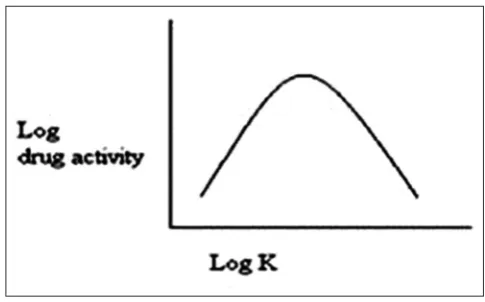
In general, drugs with an extremely large value of K are very oil soluble and will partition into membranes quite readily. The relationship between tissue permeation and partition coefficient for the drug is generally defined by the Hansch correlation, which describe a parabolic relationship between the logarithm of its partition coefficient as shown in Fig. 2 [6,33].
DRUG PKA AND IONIZATION AT PHYSIOLOGICAL PH
Drugs existing largely in an ionized form are poor candidates for oral
SR DDS. Absorption of the unionized drugs is well whereas permeation
of ionized drug is negligible because the absorption rate of the ionized drug is 3-4 times less than that of the unionized drug. The pKa range for an acidic drug whose ionization is pH sensitive is around 3.0-7.5 and pKa range for a basic drug whose ionization is pH sensitive is Table 2: Physicochemical parameters for drug selection
Parameter Preferred value
Molecular weight/size <1000 Daltons
Solubility >0.1 mg/ml for pH 1-7.8
Apparent partition coefficient High
Absorption mechanism Diffusion
General absorbability From all GI segments
Release Should not be influenced
by pH and enzymes
GI: Gastrointestinal
Table 3: Pharmacokinetic parameters for drug selection
Parameter Comment
Elimination half-life Preferably between 2 and 8 hrs Total clearance Should not be dose dependent
Elimination rate constant Required for design
Apparent volume of distribution (Vd)
The larger Vd and MEC, the larger will be the required dose size
Absolute bioavailability Should be 75% or more Intrinsic absorption rate Must be greater than release rate
Therapeutic
concentration Css
The lower Css and smaller Vd, the loss among of drug required Toxic concentration Apart the values of MTC and MEC,
safer the dosage form. Also suitable
for drugs with very short half-life
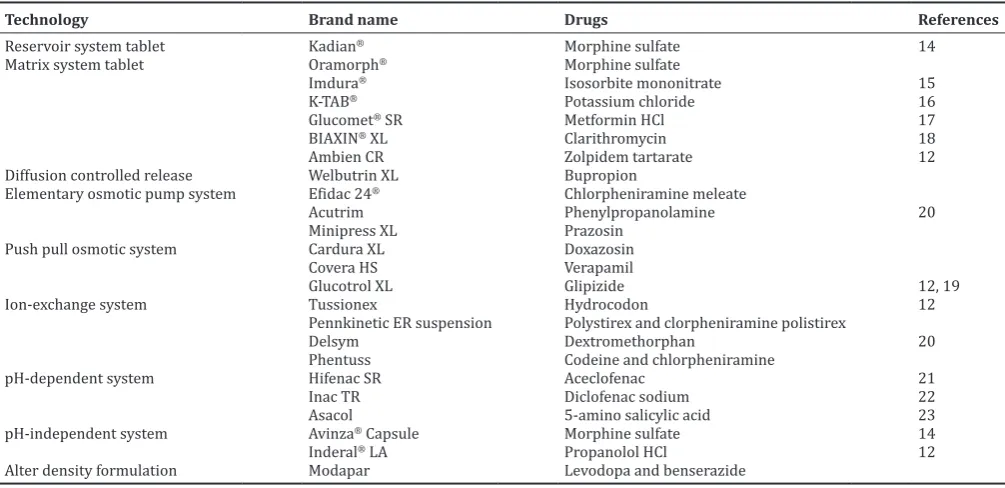
Table 1: List of some marketed sustained release formulations
Technology Brand name Drugs References
Reservoir system tablet Kadian® Morphine sulfate 14
Matrix system tablet Oramorph® Morphine sulfate
Imdura® Isosorbite mononitrate 15
K-TAB® Potassium chloride 16
Glucomet® SR Metformin HCl 17
BIAXIN® XL Clarithromycin 18
Ambien CR Zolpidem tartarate 12
Diffusion controlled release Welbutrin XL Bupropion
Elementary osmotic pump system Efidac 24® Chlorpheniramine meleate
Acutrim Phenylpropanolamine 20
Minipress XL Prazosin
Push pull osmotic system Cardura XL Doxazosin
Covera HS Verapamil
Glucotrol XL Glipizide 12, 19
Ion-exchange system Tussionex Hydrocodon 12
Pennkinetic ER suspension Polystirex and clorpheniramine polistirex
Delsym Dextromethorphan 20
Phentuss Codeine and chlorpheniramine
pH-dependent system Hifenac SR Aceclofenac 21
Inac TR Diclofenac sodium 22
Asacol 5-amino salicylic acid 23
pH-independent system Avinza® Capsule Morphine sulfate 14
Inderal® LA Propanolol HCl 12
around 7.0-11.0 are ideal for optimum positive absorption. Drug shall be unionized at the site to an extent 0.1-5.0% [32,34].
DRUG STABILITY
Drugs undergo both acid/base hydrolysis and enzymatic degradation when administered oral route. Drugs that are unstable in gastric pH can be developed as slow release dosage form and drug release can be delayed until the dosage form reaches the intestine. Drugs that undergo gut wall metabolism and show instability in the small intestine are not suitable for SR system. In such case, the drug can be modified chemically to form prodrugs, which may possess different physicochemical properties or a different route of administration should be chosen [4,35].
MOLECULAR WEIGHT AND DIFFUSIVITY
Diffusivity is defined as the ability of a drug to diffuse through the membrane. Diffusivity depends on size and shape of the cavities of the membrane. The diffusion co-efficient of intermediate drug molecular weight is 100-400 Daltons; through flexible polymer range is 10−6-10−9 cm2/seconds. Molecular size or weight is indirectly proportional to the diffusibility. Drugs with larger molecular size are a poor candidate for oral SR system [32].
PROTEIN BINDING
It is well-known that many drugs bind to plasma proteins with concomitant influence on the duration of drug action. Since blood proteins are four the most part re-circulated and not eliminated, drug protein binding can serve as the depot for drug producing a prolonged release profile, especially if a high degree of drug binding occurs. The drug interaction and the period of binding with mucin-like protein also influence the rate and extent of oral absorption [4,36,37].
DOSE SIZE
For orally administered systems, there is an upper limit to the bulk size of the dose to be administered. In general, a single dose of 0.5-1.0 g is considered maximal for a conventional dosage form. This also holds for sustained-release dosage forms. Those compounds that require large dosing size can sometimes be given in multiple amounts or formulated
into liquid system. Another consideration is the margin of safety
involved in the administration of large amounts of a drug with narrow therapeutic range [13].
BIOLOGICAL FACTORS
a. Absorption
b. Distribution
c. Metabolism
d. Biological half-life/duration of action
e. Margin of safety/therapeutic index
f. Side effect g. Disease state.
ABSORPTION
The constant blood or tissue concentration of drug can be obtained from the oral SR systems through uniform and consistent release as well as absorption of the drug. The desirable quality of the sustaining
system is that it should release completely absorbed. Apparently the
release of the drug from the system is the rate limiting step, where rapid absorption relative to the drug release is always expected, i.e., Kr << Ka [4].
If we assume the transit time of dosage forms in the absorptive areas of GI tract is about 8-12 hrs, the maximum half-life for absorption should be approximately 3-4 hrs. Otherwise, the dosage form will pass out of absorptive regions before drug release is complete. Therefore, the compounds with lower absorption rate constants are poor candidates. Some possible reasons for the low extent of absorption are poor water solubility, small partition co-efficient, protein binding, acid hydrolysis and metabolism or site specific or dose-dependent absorption. Drugs with the high apparent volume of distribution, which influence the rate of elimination of the drugs, are a poor candidate for oral SR DDS.
A drug which extensively metabolizes is not suitable for SR DDS. A drug
capable of inducing metabolism, inhibiting metabolism, metabolized at the site of absorption or first-pass effect is the poor candidate for SR delivery, as it could be difficult to maintain constant blood level. Drugs that are metabolized before absorption, either in the lumen or the tissues of the intestine, can show decreased bioavailability from the sustained releasing systems [12].
DISTRIBUTION
The distribution of drug molecules into the tissue and cells can be the primary factor in particularly drug elimination kinetics. Since it not only lowers the concentration of circulating drug, but it also can be rate limiting in its equilibrium with blood and extravascular tissue. The distribution includes the binding of the drug to the tissues and blood proteins. Protein-bound drugs molecules are considered as inactive and unable to permeate biological membranes, and a high degree of protein binding provides prolonged therapeutic action. The apparent volume of distribution is one of the important parameters of the drugs that describes the magnitude of distribution as well as protein binding within the body. The apparent volume of distribution is the proportionality constant of the plasma concentration of the drug to the total drug amount in the body. Thus for the design of sustain release products, one must have information of the disposition of drug [4,37].
METABOLISM
Metabolism of the drug is either an inactivation of an active drug or conversion of an inactive drug to an active metabolite. Metabolism
of the drug occurs in a variety of tissues, which are containing more enzymes. Drugs that are significantly metabolized before absorption, either in the lumen or tissue of the intestine, can show decreased
bioavailability from slower-releasing dosage forms. Most intestinal wall enzyme systems are saturable. As the drug is released at a slower rate
to these regions, less total drug is presented to the enzymatic process during a specific period, allowing more complete conversion of the drug to its metabolites. The formulation of these enzymatically susceptible compounds as prodrugs is another viable solution.
Drugs that are capable of either inducing or inhibiting enzyme synthesis, they are the poor candidate for SR delivery system due to difficulty in maintaining uniform blood levels.
Drugs possessing variation in bioavailability due to the first-pass effect or intestinal metabolism are not suitable for SR DDS [4,36].
BIOLOGICAL HALF-LIFE/DURATION OF ACTION
The usual goal of an oral sustained-release product is to maintain therapeutic blood levels over an extended period. The duration of action significantly influences the design of oral SR delivery system and it is dependent on the biological half-life. Factors influencing the biological half-life of a drug include its elimination, metabolism and distribution patterns. Drugs with short half-lives required frequent dosing to minimize fluctuations in the blood levels. SR dosage forms would appear very desirable for such drugs. For a given steady state drug concentration, the zero-order rate of release of a drug from its dosage form is directly proportional to its rate of elimination. Thus drug with very short half-lives require faster rate of release, for a modest duration of time while dosage form requires large dosage. In general, drugs with half-lives shorter than 2 hrs are poor candidates for
sustained-release preparations. Compounds with long half-lives, more
than 8 hrs, are also generally not used in sustaining forms, since there effect is already sustained [4,35,36].
MARGIN OF SAFETY/THERAPEUTIC INDEX
Margin of safety of a drug can be described by considering therapeutic
index, which is the ration of median toxic dose and median effective dose.
Therapeutic index = TD50/ED50
A drug is considered to be relatively safe with therapeutic index more than 10 i.e., larger the ratio the more safely is the drug. Margin of the
safety of the drugs determined on the basis of therapeutic index is the range of plasma concentration in which the drug is considered to the safe and therapeutically effective. The drugs with narrow therapeutic indices the release pattern should be more precise to maintain the plasma concentration within the narrow therapeutic and safety range. The unfavorable therapeutic index of a drug can be overcome by suitable employment of the SR mechanisms [4,35].
SIDE EFFECT
The side effects of the some drugs are mainly developed due to fluctuation in the plasma concentrations. The incidences of side effects can be minimized by controlling the concentration within therapeutic range at any given time. The SR drug delivery is the most widely used to incidences of the GI (local) side effects rather than a systemic side effect of the drug. The drug properties which induce local or systemic side effect can be circumvented or modified by their incorporation in a suitable oral SR delivery system that employs a specific controlled release mechanism [4].
DISEASE STATE
Disease state and circadian rhythm are not drug properties, but they are equally important as drug properties in considering a drug for SR.
For
example:-• Aspirin is a drug of choice for rheumatoid arthritis though it is not
suitable for SR dosage form. Still, aspirin SR dosage form could be advantageous to maintain therapeutic concentrations, particularly throughout the night, thus alleviating morning stiffness.
• Asthma attacks are commonly occurring before bedtime, due to a
low cortisol level. The highest cortisol level occurred between 12 midnight and 4 a.m. These variations entail for the design an oral SR delivery in accordance to circadian rhythm [4,35].
CLASSIFICATION OF SR DDS [27]
A. Diffusion sustained system
a. Reservoir type
b. Matrix type
B. Dissolution sustained system a. Reservoir type
b. Matrix type
C. Methods using Ion-exchange
D. Methods using osmotic pressure E. pH-independent formulation F. Altered density formulation
DIFFUSION SUSTAINED SYSTEM [27,30,38]
Diffusion systems are characterized by the release rate of a drug being dependent on its diffusion through an inert membrane barrier. Basically, diffusion process shows the movement of drug molecules from a region of a higher concentration to one of the lower concentration. The flux of
the drug J (in amount/area−time), across a membrane in the direction
of decreasing concentration is given by Fick’s law.
J Ddc
dxL =−
D = diffusion coefficient in area/time
dc/dx = change of concentration “c” with distance “x”
In common form, when a water-insoluble membrane encloses a core of drug, it must diffuse through the membrane, the drug release rate dm/ dt is given by,
dm ADK C= dt L
∆
Where, A = area
K = Partition coefficient of drug between the membrane and drug core L = diffusion path length [i.e. thickness of coat]
Δc= concentration difference across the membrane.
In general, two types or subclasses of diffusional systems are recognized:
Reservoir types
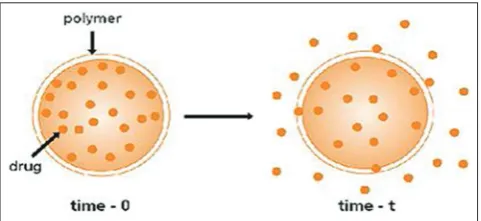
In the system, water insoluble polymeric material encases a core of drug. The drug will partition into the membrane and exchange with the fluid surrounding the particle or tablet. The additional drug will enter the polymer, diffuse to the periphery and exchange with the surrounding media [27] (Fig. 3).
Description
• Drug core surrounded by polymer membrane that controls release
rate [30].
Advantages [30]
• Zero-order delivery is possible. • Release rate variable with polymer type.
Disadvantages [30]
• System must be physically removed from implants site. • Difficult to deliver high molecular weight compound.
• Generally increased cost per dosages unit. • Potential toxicity, if the system fails.
Matrix types
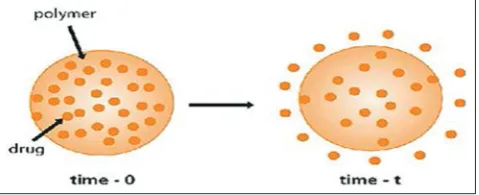
In a matrix system, the drug is dispersed as solid particles within a porous matrix formed of a water-insoluble polymer. The drug particles located at the surface of the release unit will be dissolved first and drug release rapidly. Thereafter, drug particles at a successively increasing distance from the surface of the release unit will be dissolved and release by the diffusion in the pores to the exterior of the release unit. Thus, the diffusion distance of dissolve drug will increase as the release process proceeds [25] (Fig. 4).
Description [30]
• Homogeneous dispersion of solid drug in a polymer mix.
Advantages [30]
• Easier to produce than reservoir devices • Can deliver high molecular weight compounds.
Disadvantages [30]
• Cannot obtain zero-order release
• Removal of remaining matrix is necessary for implanted system.
DISSOLUTION SUSTAINED SYSTEM
A drug with a slow dissolution rate will demonstrate sustaining
properties, since the release of the drug will be limited by the rate of dissolution. SR preparation of drugs could be made by decreasing their rate of dissolution. The approaches to achieve this include preparing appropriate salts or derivatives, coating the drugs with slowly dissolving materials or incorporating it into a tablet with a slowly dissolving carrier. Dissolution sustained system can be made by different ways [30].
Reservoir type
The drug is coated with a given thickness coating, which is slowly dissolved in the contents of GI tract. By alternating layers of the drug with the rate controlling coats, a pulsed delivery can be achieved. If the outer layer is quickly releasing bolus dose of the drug, initial levels of the drug in the body can be quickly established with pulsed intervals.
An alternative method is to administer the drug as a group of beads
that have coating of different thickness. Since the beads have different coating thickness, their release occurs in a progressive manner [27] (Fig. 5).
Matrix type
The more common type of dissolution sustained dosage form as it can be either a drug impregnated sphere or a drug impregnated tablet,
which will be subjected to slow erosion [27].
METHODS USING ION-EXCHANGE [30]
Ion-exchange systems generally use resins composed of water-insoluble cross-linked polymers. These polymers contain salt-forming functional
groups in repeating positions on the polymer chain. The drug is bound to the resin and released by exchanging with appropriately charged ions in contact with the ion-exchange groups.
Resin+ - drug− + X− →→ Resin+ - X− + drug
-Resin− - drug+ + Y+ →→ Resin− - X+ + drug+
Where, X− and Y+ are ions the GI tract.
The rate of drug diffusing out of the resin is controlled by the area of diffusion, diffusion path length, and rigidity of the resin, which is the function of the amount of cross-linking agent used to prepare the resin. For the better release in this system is to coat the ion-exchange resin with hydrophobic rate-limiting polymer.
Advantages
• Suitable for the drugs that are highly susceptible to degradation by enzymatic processes.
Disadvantages
• The release rate is proportional to the concentration of the ions
present in the area of administration, and the release rate of a drug can be affected by variability in diet, water intake, and individual intestinal content.
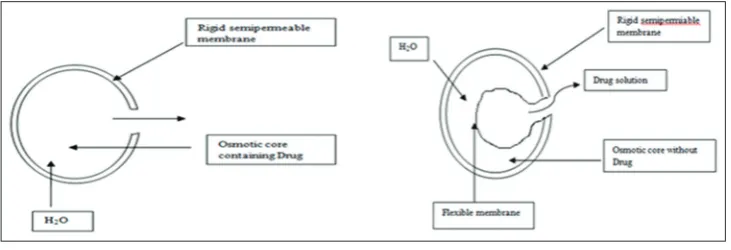
SR FORMULATION BASED ON OSMOTIC PRESSURE [25]
In this system, the flow of liquid into the release unit driven by a difference in osmotic pressure between the inside and the outside of the release unit is used as the release-controlling process. In osmosis SR system, the following sequences of steps are involved in the release
process:
• Osmotic transport of liquid into the release unit. • Dissolution of the drug within the release unit.
• Convection transport of a saturated drug solution by pumping of the solution through a single orifice or through pores in the
semi-permeable membrane (Fig. 6).
Description [30]
• Drug surrounded by semi-permeable membrane and release
governed by osmotic pressure.
Advantages [30]
• Zero-order release obtainable.
• Reformulation not required for different drugs.
• The release of a drug independent of the environment of the system.
Disadvantages [30]
• The system can be much more expensive than the conventional
counterpart.
• Quality control more extensive than most conventional tablets.
pH-INDEPENDENT FORMULATION
Since most drugs are either weak acids or weak bases, the release from SR formulations is pH-dependent. However, buffers such as salts of amino acids, citric acid, phthalic acid, phosphoric acid or tartaric acid can be added to the formulation, to help to maintain a constant
pH thereby rendering pH-independent drug release. A buffered SR
formulation is prepared by mixing a basic or acidic drug with one or more buffering agent, granulating with appropriate pharmaceutical excipients and coating with GI fluid permeable film forming a polymer.
When GI fluid permeates through the membrane, the buffering agents adjust the fluid inside to suitable constant pH thereby rendering a constant rate of drug release [27].
ALTERED DENSITY FORMULATIONS [27,38]
It is reasonable to expect that unless a delivery system remains in the vicinity of the absorption site until most, if not all of its drug contents is Fig. 4: Schematic representation of diffusion sustained drug
released, it would have limited utility. To this end, several approaches have been developed to prolong the residence time of DDS in the GI tract.
High-density approach
In this approach, the density of the pellets must exceed that of normal stomach content and should therefore, be at least 1-4 g/cm3.
Low-density approach
Globular shells which have an apparent density lower than that of gastric fluid can be used as a carrier of the drug for SR purpose.
CONCLUSION
SR system that achieves slow release of drug over an extended period of time by minimizing the peak and valley effect in plasma. The oral route of administration for SR systems has received greater attention because of more flexibility in dosage form design and patient’s compatibility. The design of oral SR DDS depends on various factors such as, physico-chemical properties of drug, type of delivery system, disease being treated, patient condition, treatment duration, presence of food, GI motility, and co-administration of other drugs. Difference between controlled release and SR is that controlled release is perfectly zero-order release that is, the drug releases with time irrespective of concentration, while on the other hand, SR implies slow release of drug over a time period. SR may or may not be controlled release.
REFERENCES
1. Chein YW. Novel Drug Delivery System. Revised and Expanded. 2nd ed. New York: Marcel Dekker; 2005.
2. Vamsy KA, Srinath KR, Chowdary PC. Formulation development and evaluation of divalproex sodium extended release tablet. Int J Res Pharm Biomed Sci 2011;2:809-32.
3. Jivraj I I, Martini LG, Thomson CM. An overview of the different excipients useful for the direct compression of tablets. Pharm Sci Technolo Today 2000;3(2):58-63.
4. Vyas SP, Khar RK. Controlled Drug Delivery: Concepts and Advance. New Delhi: Vallabh Prakashan; 2002. p. 155-95.
5. Longer MA, Robinson JR. Sustained release drug delivery system. In: Remington JP, editor. The Science and Practice of Pharmacy. 18th ed.
Philadelphia: The Philadelphia College of Pharmacy and Science; 1990. p. 1677-9.
6. Wani MS, Controlled release system-A. Rev 2008;6(1): www. pharmainfo.net/review. Available from: http://www.pharmainfo.net/ reviews/controlled-released-system-review.
7. Bechgaard H, Nielson GH. Controlled release multiple units and single unit dosage. Drug Dev Ind Pharm 1978;4(1):53-67.
8. Bhowmik D, Kumar KP, Dutta A, Paswan S. Trends in scope and opportunities of control release oral drug delivery systems. Crit Rev Pharm Sci 2012;1:20-33.
9. Patel H, Panchal DR, Patel U, Brahmbhatt T. Matrix type drug delivery system: A review. J Pharm Sci Biosci Res 2011;1(3):143-51.
10. Dixit N, Maurya SD, Bhanu PS. Sustained release drug delivery system. Indian J Res Pharm Biotechnol 2013;1:305-10.
11. Kola R, Kumar BP. A detailed description of synthetic and natural polymers which are used in the formulation of sustained release drug delivery system: A review. J Chem Pharm Sci 2013;6:161-9.
12. Ratnaparkhi MP, Gupta JP. Sustained release oral drug delivery system – An overview. Int J Pharm Res Rev 2013;2:11-21.
13. Pundir S, Badola A, Sharma D. Sustained release matrix technology and recent advance in matrix drug delivery system: A review. Int J Drug Res Tech 2013;3:12-20.
14. Amabile CM, Bowman BJ. Overview of oral modified-release opioid products for the management of chronic pain. Ann Pharmacother 2006;40(7-8):1327-35.
15. Efentakis M, Peponaki C. Formulation study and evaluation of matrix and three-layer tablet sustained drug delivery systems based on Carbopols with isosorbite mononitrate. AAPS PharmSciTech 2008;9(3):917-23.
16. Available from: http://www.rxlist.com/k-tab-drug.htm.
17. Nanjwade BK, Mhase SR, Manvi FV. Formulation of extended release of metformin HCl matrix tablet. Trop J Pharm Res 2011;10(4):375-83. 18. Packiaraj JM, Vankateswaran CS, Janakiraman K. Formulation
and evaluation of extended release matrix tablet of clarithromycin using fluid bed granulation process. Int J Res Pharm Biomed Sci 2013;4:1318-32.
19. Gupta BP, Thakur N, Jain NP, Banweer J, Jain S. Osmotically controlled drug delivery system with associated drugs. J Pharm Pharm Sci 2010;13(4):571-88.
Fig. 6: Schematic illustration of drug release from osmosis sustaining system
Fig. 5: (a) Single bead-type device with alternating drug and rate-controlling layers; (b) beads containing drug with differing thickness of dissolving coats
20. Patel RR, Patel JK. Novel technologies of controlled release drug delivery systems. Syst Rev Pharm 2010;1(2):128-32.
21. Panikkarakayil H, Nampoothiri M, Kachapilly G, Shameem M, Raghunath P, Anitha Y. Formulation optimization and evaluation of aceclofenac sustained release dosages form based on Kollidon sustained release. Asian J Pharm 2013;7(1):8-14.
22. Manjunatha KM, Ramana MV, Satyanarayana D. Design and evaluation of diclofenac sodium controlled drug delivery systems. Indian J Pharm Sci 2007;69(3):384-9.
23. Nidhi, Rashid M, Kaur V, Han SS, Sharma S, Mishra N. Microparticles as controlled drug delivery carrier for the treatment of ulcerative colitis: A brief review. Saudi Pharm J 2014;Doi: 10.1016/j.jsps.2014.10.001. 24. Chauhan MJ, Patel SA. A concise review on sustained drug delivery
system and its opportunities. Am J Pharm Tech Res 2012;2:227-38. 25. Aulton ME. Aulton’s Pharmaceutics - The Design and Manufacture of
Medicine. 3rd ed. New York: Churchill Livingstone; 2007.
26. Marroum PJ. Bioavailability/Bioequivalence for Oral Controlled Release Products, Controlled Release Drug Delivery Systems: Scientific and Regulatory Issues, Fifth International Symposium on Drug Development, East Brunswick, NJ: May-15-17, 1997.
27. Kumar KP, Bhowmik D, Srivastava S. Sustained release drug delivery system potential. Pharm Inov 2012;1:48-60.
28. Lee TW, Robinson JR. In: Gennaro AR, editor. Remington: The Science and Practice of Pharmacy. 20th ed. Baltimore: Lippincott Williams and Wilkins; 2000. p. 903-29.
29. Scientific and Regulatory Issues. Fifth International Symposium on Drug Development, East Brunswick, NJ: May 1997. p. 15-7.
30. Banker GS, Rhodes CT. Sustained and controlled drug delivery system. Modern Pharmaceutics. 4th ed. New York: Marcel Dekker; 2002. 31. Shargel L, Pong SW, Yu AB. Modified release drug products. Applied
Biopharmaceutics & Pharmacokinetics. 5th ed. New York: McGraw-Hill Medical; 2004.
32. Bramhamankar DM, Jaiswal SB. Biopharmaceutics and Pharmacokinetics: Pharmacokinetics. 2nd ed. New Delhi: Vallabh
Prakashan; 2009. p. 399-401.
33. Ratilal DA, Gaikwad PD, Bankar VH, Pawar SP. A review on: Sustained release technology. Int J Res Ayurveda Pharm 2011;2:1701-8. 34. B. K. Bansal, Shakya. V, Rewar. S. A New Trend in Oral Sustained
Release Technology; As J Pharm Res Dev 2014;2:91-5.
35. Robinson JR, Lee VH; Controlled Drug Delivery Fundamentals and Applications. Revised and expanded. 2nd ed. New York: Marcel Dekker;
1987.
36. Khalane L, Alkunte A, Birajdar A. Sustained release drug delivery system: A concise review. Available from: http://www.pharmatutor. org/articles/sustained-release-drug-delivery-system-concise-review?page=0,0.
37. Ankit B, Rathore RP, Tanwar YS, Gupta S, Bhaduka G. Oral sustained release dosage form: An opportunity to prolong the release of drug. Int J Adv Res Pharm Biosci 2013;3(1):7-14.
![Fig. 1: Plasma drug concentration profile for conventional release, a sustained release and zero order controlled release formulation [13]](https://thumb-us.123doks.com/thumbv2/123dok_us/1008298.1124874/2.595.55.297.70.164/plasma-concentration-profile-conventional-release-sustained-controlled-formulation.webp)