Volume 2011, Article ID 105675,16pages doi:10.1155/2011/105675
Research Article
Design and Implementation of a Lightweight Security Model to
Prevent IEEE 802.11 Wireless DoS Attacks
Mina Malekzadeh, Abdul Azim Abdul Ghani, and Shamala Subramaniam
Faculty of Computer Science and Information Technology, Universiti of Putra Malaysia, 43400 UPM Serdang, Selangor, Malaysia
Correspondence should be addressed to Mina Malekzadeh,[email protected]
Received 9 August 2010; Revised 29 November 2010; Accepted 20 January 2011
Academic Editor: I. Moerman
Copyright © 2011 Mina Malekzadeh et al. This is an open access article distributed under the Creative Commons Attribution License, which permits unrestricted use, distribution, and reproduction in any medium, provided the original work is properly cited.
The protection offered by IEEE 802.11 security protocols such as WEP, WPA, and WPA2 does not govern wireless control frames. The control frames are transmitted in clear-text form, and there is no way to verify their validity by the recipients. The flaw of control frames can be exploited by attackers to carry out DoS attacks and directly disrupt the availability of the wireless networks. In this work, focusing on resource limitation in the wireless networks, a new lightweight noncryptographic security solution is proposed to prevent wireless DoS attacks. In order to prove the ability of the proposed model and quantify its performance and capabilities, a simulation topology is developed, and extensive experiments are carried out. Based on the acquired results, it is concluded that the model successfully prevents wireless DoS attacks, while the security cost is not remarkable compared to the model achievements.
1. Introduction
Wireless control frames facilitate and complement deliv-ery of data frames. These frames include request-to-send (RTS), clear-to-send (CTS), acknowledgment (ACK), and contention-free control frames which are End and
CF-End-ACK [1]. The RTS frame is used to address the hidden
node problem in the virtual carrier sensing mechanism. The CTS frame is transmitted as a respond to the RTS frame. The ACK frame is used to acknowledge the successful reception of the data frames. The contention-free control frames are applied to reset the network allocation vector (NAV) and
subsequently release the channel [1].
The general structure of RTS, CTS/ACK, and CF-End/
CF-End-ACK control frames are presented in Tables 1(a),
1(b), and1(c), respectively.
As deliberated in the structure of the control frames, these frames consist of duration field which reserves the channel for the duration time required to transmit the data frames. All the wireless stations utilize this duration value to
set the NAV. The maximum NAV value is 32767µs, and the
wireless stations are not allowed to transmit until the NAV
reaches zero [1].
While the duration field and the NAV mechanism while are used to minimize the collision probability, they present a prime opportunity for the attackers to trigger DoS attacks on the wireless networks. The attacker continuously transmits forgery control frames with large duration to exhaust the memory and processing capacity of the wireless network. Since there is no way for the recipients to verify validity or duplication of the received control frames, these forgery
frames are accepted by the target wireless network [2,3].
The DoS attack quickly consumes all available band-width, resulting in the network no longer being able to operate in the way it was designed to. These attacks directly target the network availability and disrupt the normal communication between the wireless stations. The main purpose of the attacker is to cause a complete loss of availability and prevent legitimate use of the resources by the
authorized users [4].
Table1
(a) 802.11 RTS control frame
Frame control Duration Receiver address Sender address FCS
Octets 2 2 6 6 4
(b) 802.11 CTS and ACK control frames
Frame control Duration Receiver address FCS
Octets 2 2 6 4
(c) 802.11 CF-End and CF-End-ACK control frames
Frame control Duration Receiver address BSSID FCS
Octets 2 2 6 6 4
from being exploited by the attackers. In addition, these solutions are not able to simultaneously ensure low overhead and less computation power while maintaining strong level of security. A mechanism to prevent replay attacks is also further ignored.
On the other hand, utilizing cryptographic-based solu-tions to protect wireless control frames and prevent DoS attacks are expensive solutions in terms of excessive overhead and resource consumption caused by the encryption and decryption operations. Thus, there is a need to develop a security mechanism to protect all types of control frames while supporting the required aspects such as less overhead,
legacy compatibility, replay attack protection, and sufficient
level of security.
In this work, we present the ACFNC model as a lightweight noncryptographic security solution by encom-passing these required aspects to provide a countermeasure against DoS attacks based on the control frames in wire-less networks. In order to implement the ACFNC model
and evaluate its performance and effectiveness, we use
the OMNeT++ simulator. Different experiments with the
explicit purposes are conducted to quantify capabilities of the
ACFNC model under different network conditions.
The rest of the paper is organized as follows. Section 2
presents the related works with respect to the wireless DoS attacks. The structure of the proposed ACFNC model is
explained in Section 3. Section 4 describes the simulation
system. InSection 5, the experimental design to conduct the
experiments is described. Results from the implementation of the model and corresponding analysis are presented in Section 6. Finally, inSection 7, we draw our conclusions.
2. Related Works
In order to mitigate DoS attacks on the wireless net-works, several schemes have been proposed. These schemes can be categorized into three general groups which are
cryptographic-based [2,5,6], detection [7,8], and the NAV
validation methods [9–11].
The authors in [2] investigated the control frames
vulnerabilities and adopted enhanced md5 and hmac-sha1 (EHMAC) algorithms. The format of RTS, CTS, and ACK frames was modified by adding extra 80 to 160 bits
to include the output of hmac algorithms. They also added a 48 bits transmitter address to the CTS and ACK frames. However, the most important drawback of the model is the lack of ability to prevent the replay attacks which keeps the model vulnerable to DoS attacks. In addition, the overhead of the model is high, while still DoS attacks are possible against wireless network by exploiting contention-free control frames.
To address the DoS attacks, the authors in [5] proposed
a packet-by-packet encryption scheme for the RTS and CTS control frames. The formats of the control frames were mod-ified by adding extra 160 bits to attach the encrypted fields. Two new fields as a 32-bit timestamp and a 32-bit sequence number were considered to avoid replay attack. However, implementation of the model demands high computation power for the overall encryption and decryption process. Besides, the model is unable to prevent the attacks via other types of control frames.
In [6], a per-packet authentication scheme was proposed
based on a modified pseudorandom function (PRF-16) authentication mechanism using hmac-sha1 with 16 bits output results. They utilized a new CRC-16 algorithm instead of the current CRC-32 algorithm. However, in addition to modification of the CRC-32 algorithm, the very short authentication element length is considered as the other issue of the model. Besides, the model is unable to prevent the replay attacks, and wireless DoS attacks are still possible against the wireless networks.
The prevention of wireless DoS attacks based on the NAV validation methods was initially deliberated by Bellardo
and Savage [9]. In the proposed scheme, a limit was set on
duration value of the control frames. However, the model does not specify the prevention of contention-free control frames DoS attacks. The NAV validation methods also have
been discussed in [10,11]. Furthermore, the DoS detection
schemes have been presented in [7,8], which limit their scope
to detect the attacks but not preventing them.
3. Proposed ACFNC Model
noncryptographic solutions (ACFNC) model. By consider-ing the resource limitation in the wireless networks, the main objectives throughout design of the ACFNC model
are providing sufficient level of security and accuracy,
avoiding unnecessary overheads, and preserving high effi
-ciency. Furthermore, the model is legacy compatible and can be implemented only with firmware upgrades, and thus eliminating the need for massive replacement of the existing network hardware. The details of the ACFNC structure are as follows.
3.1. Define TS Security Field. The ACFNC model defines a new field as a placeholder to carry out security element. This field is called TS with 4 bytes in size which is appended at the end of wireless control frames before the FCS to provide secure control frames.
3.2. Secure Time Synchronization Function (STSF). In the wireless communication, time synchronization is an impor-tant function for time-critical applications, in which the order or simultaneously launching of the events is necessary. To achieve this goal, IEEE 802.11 defines a synchronization function which is called timing synchronization Function (TSF). The TSF utilizes the beacon frames to present the
new system clock as a timestamp field [12]. At each beacon
interval, which is every 100 ms, the TSF presents the current system clock, while all other stations must set their clock according to this value.
The ACFNC model is rely on synchronization between the access point and the wireless stations. Thus, providing accurate synchronized time is important in the ACFNC model to perform its respective functions. The TSF
spec-ified by the 802.11 standard, despite its efficiency in term
of communication overheads, has been designed without
taking into account security [13]. Consequently, the
unpro-tected beacon frames can be exploited by the attackers to desynchronize the wireless stations through the following
synchronization attacks [14,15].
(i) Manipulation attacks: the beacon frames are not
protected [16], thus the attacker can modify their
timestamp field to assign incorrect values.
(ii) Spoofing attacks: the attacker can forge new beacon frames with wrong timestamp.
(iii) Replay attacks: the attacker may replay a beacon frame with some delay latter.
All the above attacks on time synchronization have one main goal, which is to mislead the TSF protocol. The attackers perform either of these attacks by sending false beacon frames with wrong clock information to convince the wireless stations to adjust their clock based on the erroneous information. Once this happens, the stations will be out of synchronization with the access point. Losing the synchronization can cause problems on the ACFNC model which relies on the accurate synchronized time. The synchronization attacks may lead to discarding the frames including control frames. Consequently, the wireless
stations request the retransmission of the missed frames,
resulting in resource exhaustion which affects the bandwidth,
latency, and loss rate. Hence, secure time synchronization is prerequisite to limit the attacker’s ability and thereby to guarantee the correct operation of the ACFNC model.
Many mechanisms have been proposed to address time
synchronization issue in the wireless networks [17–19].
However, most of these mechanisms do not take into account security to address TSF vulnerabilities against the
synchronization attacks. The authors in [20] propose a
secure time synchronization mechanism called TESLA to authenticate the broadcast beacon frames. However, TESLA is not suitable for limited recourses wireless networks for
two main reasons [21]. First, TESLA utilizes the digital
signatures which are too expensive to compute in wireless networks. Second, TESLA has an overhead of about 24 bytes per each beacon frame which is large overhead for wireless networks. Thus, TESLA introduces high computation and communication overheads and cannot directly be applied in the resource constrained wireless networks.
In order to detect malicious synchronization attacks using the beacon frames, we use the secure clock
synchro-nization proposed in [22] which is based onµTESLA [21],
a simplified version of TESLA. It is a lightweight broadcast
authentication mechanism based on efficient one-way hash
chains to provide authenticity and integrity for the beacon frames. The mechanism is suitable for infrastructure wireless networks and is included in the access point as the base
station [23]. We give a short description of the mechanism,
while more details can be found in [13,21,23,24].
The mechanism uses one-way hash chains which are much faster than asymmetric algorithms and can be per-formed in an on-the-fly way such that it causes almost no
additional delay [25]. The secure time synchronization is
calculated by the access point and verified by the wireless stations as follows.
(A) Access Point Side. The access point chooses random
numberknand generates a sequence of keys (key chain) by
repeatedly applying the one-way hash functionHwithnbits
length so thatki =H(ki+1) for alln,wheren > i≥0 . Due
to one-way nature of hash functions, givenki+ 1, everybody
can calculate forward to obtaink0,. . .,ki. However, nobody
by givenk0,. . .,ki, can calculate backward to obtain ki+1. The
access point divides the time into intervals and associates
each key from the key chain with one interval. During theith
interval, the access point calculates the tag over the beacon
frame withki from the key chain. Then, the beacon frame
with its tag is transmitted to the stations. The access point
discloses thekiafter a certain period of time. This means that
each beacon frame discloses the previous key and that theki
cannot be used to spoof beacon frames after theith interval
time.
Table2: System parameters and related values.
Parameter Value
Short interframe space (SIFS) 10µs
Slot time,St 20µs
Basic bitrate,Br 2 Mbps
Physical bitrate, PHYr 1 Mbps
Physical header, PHYh 192 bits
Propagation delay time,Pt 1µs
was not meet, the beacon frame is discarded, otherwise, the
receiver stores it in the buffer. Now, the receiver station is
assured that the key is known only by the access point, and it has not been forged by the attackers. Then, at the time of the key disclosure when the access point reveals the key, the receiver uses the disclosed key to authenticate the beacon frame.
We utilize this mechanism to make a secure TSF (STSF) for the ACFNC model. The SHA1 is used as the one-way hash function to create the key chain, while the length of each key in the key chain is considered 64 bits. Adoption of a 64-bit key extends the time taken to crack to a few thousand years
[26].
3.3. Replay-Preventing Mechanism. Based on the STSF, fur-ther extensions are done by designing and developing a replay attack protection mechanism in the ACFNC model based on the threshold time windows to validate the freshness of the received control frames. The replay prevent-ing mechanism is accomplished by taggprevent-ing each outgoprevent-ing control frame with an identifier which is creation time of that control frame. We formulize five distinct threshold time windows which are related and mapped to the five control frames and represent their maximum acceptable age. In order to determine these five threshold time windows, some
IEEE 802.11 standard notations [1,27] are used which are
identified inTable 2.
In the IEEE 802.11 standard, except for the unicast data and management frames that are transmitted in the normal data rates, the other frames including multicast, broadcast,
and control frames are transmitted in the basic bitrate [28,
29]. Considering this rule, we defineTCFas the required time
for the transmission of the entire control frame including its physical header as follow:
TCF=LBCF
r +
PHYh
PHYr. (1)
In (1), LCF is the length of the secure control
frames after adding the TS security field. The TCF is the
required time considered for all types of control frames as
TRTS, TCTS, TACK, TCF-End, andTCF-End-ACK for transmission of the secure RTS, CTS, ACK, CF-End, and CF-End-ACK control frames, respectively. The calculation of these timeout values by the ACFNC model is accomplished as follows.
(A) Amount ofTCTSandTACK. Since the length of the secure CTS and ACK control frames are the same, the required time
for their transmission also is the same. In order to calculate
the amount ofTCTS, andTACKwe have length of the secure RTS, CF-End, and CF-End-ACK frames are the same, the required time for their transmission also is the same, and we calculate them as follow:
TRTS=TCF-End=TCF-End-ACK=
The basic idea of our proposed replay attack protection mechanism is to use distinct threshold time windows for each control frame. Thus, we calculate the maximum amount of the time window at which the control frame is expected to be sensed in the wireless channel. This threshold presents a time window at which a received control frame is valid. Thus, if the control frame is sensed after this threshold timeout, it is regarded as an old frame and is discarded by the receiver. We call the timeout window for the RTS, CTS, ACK,
CF-End, and CF-End-ACK frames as TORTS, TOCTS, TOACK,
TOCF-End,and TOCF−End−ACK, respectively.
It is important to note that determining the value of each timeout window must be accomplished carefully
with sufficient duration to avoid any unexpected network
behavior. Each timeout value must be large enough to avoid any increase in the number of retransmissions and must be small enough to avoid unnecessary delays. Assigning the right value for each timeout has a direct impact on the wireless network performance so that a wrong value can significantly degrade the performance due to retransmissions or collisions.
We formulize and calculate the threshold time windows related to the secure control frames in the ACFNC model as follows:
Then, we define two new attributes, which are the following.
(i) Creation time of the control frames: it represents the time at which the control frame has been created to be placed into the channel for transmission. The creation time is tagged into the TS field.
beacon frames and represents arrival time of the control frames.
Creation time of each outgoing control frame is tagged into the TS field, and then the control frame is transmitted to the destination address. Upon receiving the control frame, the recipient must verify if its TS value is fresh. In order to accomplish this verification, the recipient utilizes the following equation:
0≤CCT− received TS≤Δt, (5)
where Δt is corresponding threshold time window.
The two major advantages of the proposed replay attack protection mechanism are as follows.
(i) Wireless networks are limited in terms of their
resources such as bandwidth, buffer, computation
power, and battery lifetime [30]. In this regard, since
the overall process of the protection mechanism is based on a simple subtraction, the entire process of the ACFNC model is very fast which enable the model
to be highly efficient for the limited resources wireless
networks. The recipient of the control frame only needs to do a simple subtraction to verify the validity
of the received control frames using (5).
(ii) By using this mechanism, there is no need to keep track of the control frames or their reception sequence. The model is not memory dependent, which reduces the overall algorithm complexity with-out demanding extra cache or memory.
The flowchart of the proposed replay attack prevention
mechanism is provided inFigure 1.
3.4. Procedure of the ACFNC Model. The process of DoS attacks prevention by the ACFNC model consists of two main phases which are generation phase and verification phase. The details are as follows.
(A) Generation Phase. This phase is carried out by the sender station to generate value of the TS security field. In this phase, the sender station determines creation time of the outgoing control frame. Then, this value is tagged into the TS field of the control frame and the frame is transmitted to the receiver.
(B) Verification Phase. This phase is carried out by the receiver station to verify the validity of the received control frames. Upon receiving the control frame, if the frame does not have the TS field, it is immediately discarded due to
its wrong format. Otherwise, the receiver applies (5) and
subtracts the CCT from the value of the TS field in the received control frame. This is to check whether the result is less than or equal to the corresponding timeout value. If the required condition is met, the receiver considers the control frame as a fresh frame. Now, if the frame is ACK, CTS, or RTS frame, it is accepted by the receiver as a valid control frame and the corresponding function is implemented. In contrast, if the frame is CF-End or CF-End-ACK, the receiver must
verify duration field of these frames. If the duration field of these frames is not zero, the frame is discarded as an invalid frame due to its wrong format. However, zero duration in the frame results in accepting the frame by the receiver as a valid control frame. The general process of the ACFNC model along with its two corresponding phases is presented inFigure 2.
4. Simulation System Description
Using the OMNeT++ simulator, we develop two simulation environments which are called A and B. The simulation environment A is related to the IEEE 802.11 current model and the simulation environment B is related to the ACFNC model. The topology of the two environments is identical to provide fair conditions to compare the results. The size of
the simulation environments is 300×300 m2which include
two areas as authorized and attacker area. The details are as follows.
4.1. Simulation of the IEEE 802.11 Current Model. The simulation environment A is developed to implement the IEEE 802.11 current model. It consists of two areas as authorized and attacker. The authorized area consists of two wireless stations associated to the access point which follow the IEEE 802.11 standard MAC layer. The attacker
area belongs to the attacker station who launches different
types of wireless DoS attacks against the authorized wireless
network. Figure 3shows the simulation environment A to
implement the IEEE 802.11 current model.
In order to carry out different types of wireless DoS
attacks by the attacker, we need to develop a new network interface card (NIC) for the attacker station. Therefore, we created a new wireless host which is named 80211DoS-Host with the 80211DoS-NIC. This new node is considered as the attacker and includes a new MAC layer to conduct the wireless DoS attacks. We have written the new MAC layer in C++ code and have added it to the OMNeT++ as a simple module which is called the 80211DoS-MAC. This new MAC layer is able to generate all types of forgery control frames
with large duration value as 32767µs to trigger different
types of wireless DoS attacks.
4.2. Simulation of the ACFNC Model. In order to imple-ment the ACFNC model, the simulation environimple-ment B is developed. It consists of two areas as authorized and attacker. The authorized area consists of two protected wireless stations associated to the protected access point which follow the ACFNC model. The attacker area belongs to
the attacker to launch different types of wireless DoS attacks
and synchronization attack against the ACFNC model in the protected wireless network. The simulation environment B
to implement the ACFNC model is shown inFigure 4.
CF-End CF-End-ACK
CCT-TS≤TOCF-End TOCF-End-ACK
ACK
Frame is fresh T
CCT-TS≤TORTS
CCT-TS≤TOACK
CCT-TS≤TOCTS
Has TS
CTS RTS
T
T
T CCT-TS≤
T
T
Check TS field
Wrong format, discard
Frame is old, discard
Figure1: Replay attack preventing mechanism in the ACFNC model.
Phase 1: Secure MAC Layer. The ACFNC model focuses on the provisioning the secure control frames at the MAC layer. Thus, we need to develop a new secure MAC layer and include the respective ACFNC codes in the both wireless stations and access point. Therefore, we created a wireless NIC which is called 80211-ACFNC-NIC. This secure NIC includes a secure MAC layer which is called 802.11-ACFNC-MAC layer. The ACFNC code to secure control frames has been written in C++ and included in the 802.11-ACFNC-MAC layer.
Phase 2: Secure Time Synchronization (STSF). The synchro-nization process is a service related to the MAC sublayer management entity (MLME). The MLME is part of the MAC layer to monitor the events and create appropriate MAC management services such as beacon transmission and synchronization. Thus, in order to implement the STSF, we created a new management sublayer in the 80211-ACFNC-NIC for the wireless stations and access point which are called 80211MgmtSTA-STSF and 80211MgmtAP-STSF, respectively. The ACFNC source code to secure time synchronization in the access point and wireless stations is included in the 80211MgmtAP-STSF and 80211MgmtSTA-STSF sublayers, respectively.
The structure of the 80211-ACFNC-NIC for the access point including the secure MAC layer and secure Mgmt
sublayer is presented inFigure 5.
5. Experimental Design
In order to quantify and evaluate the performance of the ACFNC model, we conduct variety types of experiments.
The methodology to conduct the experiments and obtain the results is described in the following subsections.
5.1. Characterization of Traffic Type. For all the experiments, we apply both types of data communications as connection-oriented and connectionless. This enables us to extensively
evaluate the impact of the traffic type on the performance of
the ACFNC model in the wireless network. Three types of
traffics are considered, which are the following.
(i) For the connection oriented traffic, we apply the FTP
packets. The FTP traffics source is set to a constant
bit rate, while the length of each packet is 1000 B. The FTP packets are transmitted with interval times of 0.5 seconds.
(ii) For the connectionless traffic video packets are
transmitted as a video stream with maximum size of 10000 MB. The length of video packets in this stream is 1000 B, which are transmitted at constant bit rate of 0.5 seconds intervals.
(iii) We use ICMP packets to obtain results from packets lost due to the attacks and also to obtain the average of round trip response time. The properties of the ICMP packets are set as the default in real world with 56 bytes length and interval of every 1 second.
5.2. Performance Measures. The following performance met-rics are investigated.
Verification phase Current
control frame TS
Duration=0 TS is fresh
Accepting valid TS
Creation time
Secure control frame
T
Discarding old control frame
T T
Generation phase
FCS
Transmit “secure control frame” to destination
CF-End/ CF-End-ACK
frames
Discarding invalid CF-End/
CF-End-ACK frames Control frame is
CF-End/CF-End-ACK Accepting fresh
ACK/CTS/RTS frames
Figure2: Algorithm of the ACFNC model.
until it is successfully received at the destination node.
(ii)Throughput. It is computed by dividing the amount of data successfully received by destination node with the time taken to arrive at this node.
(iii)Packet lost ratio (PLR). The PLR is measured as
the number of dropped packets divided by the total number of sent packets during data transmission. (iv)Round trip response time (RTT). The RTT is the time
required for a packet to travel from the source to the destination and back again.
(v)Detection accuracy. Accuracy of the ACFNC model is investigated in terms of false negative (FN), false positive (FP), true negative (TN), and true positive
(TP) [31]. The FN is when the received forgery
control fames incorrectly are regarded and accepted as valid control frames by the recipient. The FP is the incorrectly discarding of a valid control frame which is considered as a forgery frame by the recipient. The TN is the correctly discarding of the forgery control frames by the receiver. The TP is the correctly accep-tance of the valid control frames by the recipient.
Access point
Wireless station1
Wireless station2
Attacker: 1: DoS attacks
Authorized area
Attacker area
Figure3: Simulation environment A for the IEEE 802.11 current model.
Protected access point Attacker: 1: DoS attacks 2: Synchronization attack
Authorized area Attacker area Protected
wireless station1
Protected wireless station2
Figure4: Simulation environment B for the ACFNC model.
Modified tcpApp [numTcpApps]
tcp udp
80211 ACFNC NIC
80211 ACFNC MAC 80211 MgmtAP STSF q: #
q: # q: #
pingApp
Radio
NotificationBoard Modified udpApp [numudpApps]
InterfaceTable
NetworkLayer
Figure5: Structure of the protected 80211-ACFNC-NIC in the simulation environment B.
the percentage of performance degradation is calculated as compared to the current model under normal conditions without any DoS attacks.
5.3. Attacks Scenarios. The performance of the ACFNC model is evaluated in terms of its ability to prevent both wireless DoS attacks and synchronization attacks as the following scenarios.
5.3.1. DoS Attacks. The details of the strategy to conduct variety types of wireless DoS attacks against the ACFNC model is described in the following.
(i) The total simulation time for each experiment is 90 seconds, which is further divided into three parts. The first 30 seconds is considered a duration at which the network is under normal conditions with no attack. The second 30 seconds is the attack duration.
During the entire period, different types of DoS
attacks are conducted separately over the ACFNC and the current model. The third 30 seconds presents conditions of the wireless network after the attacks. (ii) For all types of the DoS attacks, the attack cycle
is considered to be 100 forgery control frames per second (0.01 s attack rate).
(iii) We set duration field of the forgery control frames to
the maximum possible value which is 32767µs.
(iv) According to the IEEE 802.11, there are two types of communication modes in wireless networks as
enabled and disabled RTS/CTS handshake [1]. Since
our proposed model directly deals with the wireless control frames, enabling or disabling of the RTS/CTS
handshake can provide significant differences in the
network performance in terms of the metrics. There-fore, all the experiments are performed under the both communication modes. The disabled RTS/CTS handshake is denoted as Dis.rtscts, and the enabled RTS/CTS handshake is denoted as En.rtscts.
(v) The experiments are also implemented in the base-line mode which evaluates the performance of the ACFNC model under normal conditions without the presence of the attackers. The results provide helpful insight to demonstrate the security cost of the ACFNC model compared to the current model.
0.09 0.08
0.07 0.06 0.05 0.04
0.03 0.02 0.01
0
Dis.rtscts En.rtscts Dis.rtscts En.rtscts Dis.rtscts En.rtscts Time (s)
0–30 s 30–60 s 60–90 s
Current 0.028082 0.029759 0 0 0.032119 0.085268
ACFNC 0.029941 0.033637 0.037011 0.049861 0.034331 0.038039
T
C
P
E
nd-t
o-End
dela
y
(s)
(a) 0.2
0.18
0.14
0.12
0.1
0.08
0.004 0.0035 0.003 0.0025 0.002 0.0015 0.001 0.0005
Current 0.002356 0.003598 0 0 0.116142 0.185079 ACFNC 0.002371 0.003603 0.002405 0.003736 0.002376 0.003583
0.16
0
Dis.rtscts En.rtscts Dis.rtscts En.rtscts Dis.rtscts En.rtscts Time (s)
0–30 s 30–60 s 60–90 s
UDP
End-t
o
-End
dela
y
(s)
(b)
Figure6: (a) TCP, (b) UDP delay comparison under attacks.
performance of the STSF in the ACFNC model compared to the TSF. The third 30 seconds presents conditions of the wireless network after the synchronization attacks.
6. Results and Discussion
In this section, the performance of the ACFNC model is evaluated and compared with the current model under the attacks and in the baseline mode as follows.
6.1. Performance Evaluation of the ACFNC Model under DoS Attacks. The experiments are carried out for the TCP and
UDP traffics separately to evaluate the effectiveness of the
ACFNC model to prevent wireless DoS attacks.
6.1.1. TCP/UDP Delay Comparison. The results of the TCP
and UDP delay are presented in Figures 6(a) and 6(b),
respectively.
As represented by the above results, we can confirm the
effectiveness of the ACFNC model to successfully prevent
the wireless DoS attacks. During the attacks in the protected
wireless network using the ACFNC model, normal traffics
In contrast, as the both TCP and UDP results show, during 30 seconds attacks times (30–60 s), the current model entirely fails to maintain the regular communication. The wireless network completely is overwhelmed by the forgery control frames and the performance practically drops to null. In the TCP experiment, we observe that when the attacks start, instantly the connection between the wireless nodes is broken, and they are unable to transmit or receive any data. The queued packets before the attacks have to wait until the attack comes to an end. This is the reason of high delay for TCP packets in the standard model after the
attacks period. However, the UDP results represent different
behavior during the DoS attacks. Unlike the TCP, due to
connectionless nature of the UDP traffics, when the attacks
start the UDP transmission is possible. However, all the packets go in the queue and are not transmitted to the destination. The UDP packets enter in the queue until the queue becomes full, and the rest of the packets are dropped. Al these UDP packets in the queue must wait there until the end of the attacks. Therefore, in the standard model, delay of the UDP packets after the attacks is higher than the TCP packets.
6.1.2. TCP/UDP Throughput Comparison. The results of the
TCP and UDP throughput are presented in Figures7(a)and
7(b), respectively.
The above findings and results lead us to conclude that the ACFNC model, unlike the standard model, is able to successfully prevent the wireless DoS attacks. In the standard model before the attack (0–30 s), the amount of throughput is observed normal. But during the attacks (30–60 s), the network is flooded with high volume of the forgery control frames which consumes the available bandwidth so that the network is not able to handle the valid requests made from the authorized users. Consequently, the communication between the users is broken, and the network throughput quickly drops to null. Comparing the null throughput of the current model during the attacks with the high throughput of the proposed model further advocates that the ACFNC model is able to successfully block the attacks and significantly improve the performance of the IEEE 802.11 wireless networks (100%) under the DoS attacks.
6.1.3. RTT/PLR Comparison. We measure the average round trip response time of the ACFNC model and compare it with the current model. The result of this comparison is presented inFigure 8.
Based on the above results, the RTT of the proposed model and the current model before the attacks (first 30 seconds) are similar in the achievement. However, when the standard model goes under the attacks, the network completely is rendered unusable and the provided resources are unavailable for the intended users. During the attacks over the standard model, the RTT is null because there is no
traffic. The forgery frames of the attacker make buffer of the
access point full of useless frames such that it is no longer able to respond to the legitimate requests. The packets in the
Table3: PLR comparison.
Model # Sent # Received # Lost PLR %
Current 90 56 34 36
ACFNC 90 90 0 0
queue must wait there until termination of the attacks, thus they experience high delay after the attacks (60–90 s).
While the current model absolutely fails to prevent the wireless DoS attacks, the proposed model successfully prevents the attacks. Comparing the very high RTT of the standard model with the normal RTT of the ACFNC model after the attacks further justifies that the protected wireless
network has not been affected by the DoS attacks.
We also provide comparison over the number of lost packets between the standard model and the ACFNC model.
The results of this comparison are presented inTable 3.
As the above results indicate, the number of packets lost due to the attacks in the current model is very high. From the 90 transmitted ICMP packets, about 34 packets lost during the attacks which increase the amount of lost ratio substantially to about 36%. The very high amount of lost ratio in the current model proves its weakness and disability to confront the DoS attacks. However, in the wireless network protected by the ACFNC model, it is observed that all the 90 transmitted ICMP packets are successfully received by their destination and number of lost packets is zero. The null amount of lost ratio in presence of the ACFNC model provides evidence for strong ability of the model to prevent DoS attacks over the wireless networks.
6.2. Performance Evaluation of the ACFNC in the Baseline Mode. The previous experiments have been accomplished in presence of the attacker and forgery control frames. In this section, we investigate the performance of the ACFNC model in baseline mode. We study the wireless network behavior during the time at which there are only legal users
and their legal traffics over the wireless network. Evaluation
of the proposed model in baseline mode determines very helpful insights to demonstrate lifetime overhead and overall security cost imposed to the wireless networks using the ACFNC model under normal conditions. The results are provided as follows.
6.2.1. TCP/UDP Delay Comparison. The impact of the ACFNC model on delay of the TCP and UDP packets are
presented in Figures9(a)and9(b), respectively.
As the above results show, regardless of the type of
traffic or the models, the amount of delay is higher when
Dis.rtscts En.rtscts Dis.rtscts En.rtscts Dis.rtscts En.rtscts Time (s)
0–30 s 30–60 s 60–90 s
250000
200000
150000
100000
50000
Current 232011.56 196617.11 0 0 219335.48 183199.98
ACFNC 222912.76 185525.91 219594.47 171411.16 225289.41 188152.14 0
T
C
P
th
roug
h
p
ut
(Bps)
(a)
ACFNC 350000
300000
250000
200000
150000
100000
50000
Current 289448.41 241731.23 0 0 345545.11 248722.05
267761.51 235630.13 253378.38 228463.58 265425.72 246340.59
UDP
thr
o
ug
hput
(Bps)
Dis.rtscts En.rtscts Dis.rtscts En.rtscts Dis.rtscts En.rtscts Time (s)
0–30 s 30–60 s 60–90 s
0
(b)
Figure7: (a) TCP, (b) UDP throughput comparison under attacks.
0.0025 0.003
0.002 0.0015 0.001
0.0005
Current
ACFNC
0 0–30 s
0.002265 0.002313
30–60 s 0
0.002655
60–90 s 0.220087 0.002328 0.25
0.2
0.15 0.1
R
ound
tr
ip
time
(s)
Time (s)
0.029759
Dis.rtscts En.rtscts Dis.rtscts En.rtscts Dis.rtscts En.rtscts Time (s)
0–30 s 30–60 s 60–90 s
Dis.rtscts En.rtscts Dis.rtscts En.rtscts Dis.rtscts En.rtscts Time (s)
0–30 s 30–60 s 60–90 s
Figure9: (a) TCP, (b) UDP delay comparison in baseline mode.
6.2.2. TCP/UDP Throughput Comparison. The impact of the ACFNC model on the TCP and UDP throughput are
presented in Figures10(a)and10(b), respectively.
As for the throughput, the results complement the delay results. Based on the findings, it is clear that applying the ACFNC model does not cause substantial security cost to the wireless networks. The security cost caused by the ACFNC model due to additional overhead (TS field) compared to the standard model is about 4% and 6% when the handshake is disabled and enabled, respectively. The 4% or 6% security
cost prove high efficiency and practically of the ACFNC
model when comparing with devastating impact of the DoS attacks on the wireless networks.
Furthermore, based on the results, we observe that there is a linear relationship between delay and throughput
regardless of the type of traffic. It is observed that they are
negatively correlated so that whenever one of them increases, the other one decreases.
6.2.3. RTT Comparison. This experiment is carried out to evaluate impact of the proposed model over the RTT in the
wireless network. The results are presented inFigure 11.
The above results represent almost the same amount of RTT for the standard model and the ACFNC model. This proves that by using the ACFNC model in the wireless
networks, the packets do not experience any significant changes in the response time compared to the standard model.
6.3. Detection Accuracy. In order to evaluate accuracy of the ACFNC model, we investigate the probability of the cor-rect/incorrect detection of the valid/forgery control frames by the ACFNC model. The results are presented as follows.
6.3.1. False Negative (FN). From implementation of the ACFNC model, we observed that during the DoS attacks, only the first forgery control frame is verified as a valid control frame and accepted by the recipient. Accepting one forgery control frame out of the 3000 transmitted forgery control frames provides 0.033% FN rate. In contrast, the standard model accepts all the 3000 forgery control frames as valid frames to implement. Thus, comparing very low FN rate of the ACFNC model with 100% FN rate of the standard model proves strong ability of the ACFNC model to prevent wireless DoS attacks.
T
Dis.rtscts En.rtscts Dis.rtscts En.rtscts Dis.rtscts En.rtscts Time (s)
0–30 s 30–60 s 60–90 s
Dis.rtscts En.rtscts Dis.rtscts En.rtscts Dis.rtscts En.rtscts Time (s)
0–30 s 30–60 s 60–90 s
Figure10: (a) TCP, (b) UDP throughput comparison in baseline mode.
R
Figure11: RTT comparison in baseline mode.
rate proves that the ACFNC model correctly follows the IEEE 802.11 standard.
6.3.3. True Negative (TN). Based on results of the ACFNC implementation, we observed that other than the first forgery control frame the rest of 2999 forgery control frames are correctly discarded by the recipient. Thus, discarding forgery control frames by the ACFNC model provides 99.966% TN
rate. Comparing significantly high TN rate of the ACFNC model with the 0% TN rate of the standard model proves that the ACFNC model strongly prevents DoS attacks against the wireless network.
Table4: Detection accuracy of the ACFNC model.
Detection ACFNC model Current model
FP 0% 0%
Figure12: Impact of synchronization attack on delay: (a) for the disabled handshake and (b) for the enabled handshake.
without any mistake. Hence, successful acceptance of the all valid control frames provides 100% TP rate for the ACFNC model which is identical to the standard model.
The summary of comparison between the accuracy rate of the ACFNC model and the standard model is provided in Table 4.
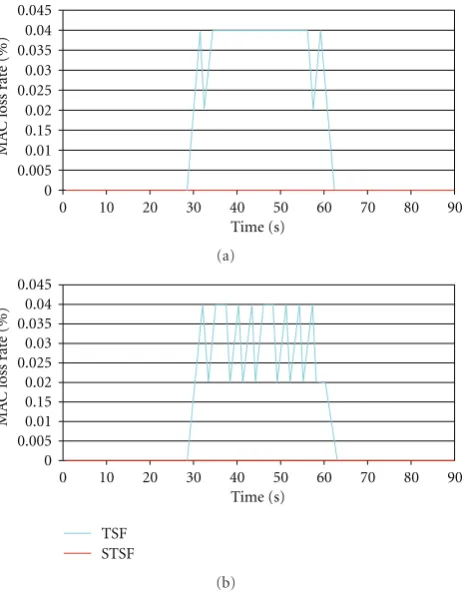
6.4. Performance Evaluation of the STSF in the ACFNC Model. In this section, we evaluate performance of the STSF in the ACFNC model compared to the current TSF. The delay and MAC loss rate are measured under the normal conditions and under synchronization attack as follows.
6.4.1. Delay Comparison: STSF versus TSF. The results of delay under synchronization attack against the ACFNC model for the disabled and enabled handshake are presented
in Figures12(a)and12(b), respectively.
0.045
Figure 13: MAC loss rate comparison: (a) for the disabled handshake and (b) for the enabled handshake.
As the above results show, the forgery beacon frames with incorrect timestamps have direct impact on the delay of the TSF. During the 30 seconds attack time (30–60 s), the delay is higher in presence of the TSF compared to the STSF. Comparing the delay of the disabled and enabled handshake shows interesting results. When the handshake is disabled, under normal conditions (i.e., before and after the synchronization attack) the delay is lower than the enabled handshake. However, during the attack, the results are opposite so that in the disabled handshake, the delay is higher than the enabled handshake. The reason is that when the handshake is enabled, the attack causes to drop mostly the RTS and CTS frames which lead to their retransmission. In contrast, when the handshake is disabled, the attack causes to drop the ACK frames, which consequently lead to retrans-mission of the data frames that is more time consuming than the retransmission of the RTS or CTS frames. As a result, using the TSF, the attacker can intentionally delay the beacon frames by sending low rate forgery beacon frames.
In contrast, the synchronization attack does not have any impact over the normal performance of the ACFNC model. The STSF mechanism preserves the correct and valid synchronization between the authorized stations in the wireless network.
against the ACFNC for the disabled and enabled handshake
are presented in Figures13(a)and13(b), respectively.
Based on the above results it is observed that during 30 seconds synchronization attack (30–60 s) over the TSF, the attacker’s forgery beacon frames interrupt the active connection between the wireless stations. The attacker sends double forgery beacon frames compared to the normal beacon frames interval. This leads to more instability in the current clock and causes significant desynchronization and dropping the packets.
In contrast, the MAC loss rate is zero in presence of the STSF regardless of the handshake status which shows that the ACFNC model is robust against the synchronization attack. The ACFNC model can detect malicious synchro-nization attack and prevent the wireless network from being desynchronized by the forgery beacon frames with erroneous time values. As a result, the attacker is not able to modify or destroy the clock information sent by the authorized access point and the ACFNC model correctly performs its respective functions.
7. Conclusion
In this work, we proposed a noncryptographic security model, ACFNC, to prevent the wireless DoS attacks based on control frames vulnerabilities. The ACFNC model has been implemented and further evaluated for validation through a series of extensive experiments to compare with the IEEE 802.11 standard model.
Our findings and results have clearly lead us to the con-clusion that while the IEEE 802.11 standard model is highly vulnerable to prevent the DoS attacks, the ACFNC model has been successful in overcoming the drawbacks and strongly prevents the wireless DoS attacks. Based on the results, we deduce that the simple structure of the ACFNC model does not demand remarkable computational resources. The secu-rity cost of the ACFNC model is negligible and comparable with the standard model under normal conditions.
The lack of complexity through the simplicity of the overall computation and implementation process, legacy compatibility, high accuracy, and small security cost and communication overhead are the substantial advantages of
the ACFNC model which make it practical and efficient in
the limited resources wireless networks.
References
[1] IEEE 802.11, “Information technology-telecommunications and information exchange between systems-local and metropolitan area networks-specific requirements—part 11: Wireless LAN Medium Access Control (MAC) and Physical Layer (PHY) Specifications,” 2007.
[2] A. Rachedi and A. Benslimane, “Impacts and solutions of control packets vulnerabilities with IEEE 802.11 MAC,” Wireless Communications & Mobile Computing, vol. 9, no. 4, pp. 469–488, 2009.
[3] K. Bicakci and B. Tavli, “Denial-of-service attacks and coun-termeasures in IEEE 802.11 wireless networks,” Computer Standards & Interfaces, vol. 31, no. 5, pp. 931–941, 2009.
[4] R. Bansal, S. Tiwari, and D. Bansal, “Non-cryptographic meth-ods of MAC spoof detection in wireless lan,” inProceedings of the 16th International Conference on Networks (ICON ’08), pp. 1–6, New Delhi, India, December 2008.
[5] Y. Zhou, D. Wu, and S. M. Nettles, “Analyzing and preventing MAC-layer denial of service attacks for stock 802.11 systems,” inProceedings of the IEEE Workshop on Broadband Wireless Services and Applications (BWSA ’04), San Jose, Calif, USA, 2004.
[6] M. A. Khan and A. Hasan, “Pseudo random number based authentication to counter denial of service attacks on 802.11,” inProceedings of the 5th IEEE and IFIP International Con-ference on Wireless and Optical Communications Networks (WOCN ’08), pp. 1–5, Surabaya, Indonesia, May 2008. [7] W. Chen, D. Chen, G. Sun, and Y. Zhang, “Defending
against jamming attacks in wireless local area networks,” in Proceedings of the 4th International Conference on Autonomic and Trusted Computing: Bringing Safe, Self-x and Organic Computing Systems into Reality (ATC ’07), vol. 4610 ofLecture Notes in Computer Science, pp. 519–528, Hong Kong, July 2007.
[8] Z. Zhang, J. Wu, J. Deng, and M. Qiu, “Jamming ACK attack to wireless networks and a mitigation approach,” in Proceedings of the IEEE Global Telecommunications Conference (GLOBECOM ’08), pp. 4966–4970, New Orleans, La, USA, 2008.
[9] J. Bellardo and S. Savage, “802.11 denial-of-service attacks: real vulnerabilities and practical solutions,” inProceedings of the 12th USENIX Security Symposium, Washington, DC, USA, August 2003.
[10] R. Negi and A. Rajeswaran, “DoS analysis of reservation based MAC protocols,” inProceedings of the IEEE International Conference on Communications (ICC ’05), vol. 5, pp. 3632– 3636, Seoul, Korea, May 2005.
[11] D. Chen, J. Ding, and P. K. Varshney, “Protecting wireless networks against a denial of service attack based on virtual jamming,” inProceedings of the 9th ACM International Con-ference on Mobile Computing and Networking (MobiCom ’03), San Diego, Calif, USA, September 2003.
[12] A. Safonov, A. Lyakhov, and S. Sharov, “Synchronization and beaconing in IEEE 802.11s mesh networks,” inProceedings of the International Conference on Telecommunications (ICT ’08), pp. 1–6, Saint-Petersburg, Russia, June 2008.
[13] L. Chen and J. Leneutre, “A secure and scalable time synchronization protocol in IEEE 802.11 ad hoc networks,” in Proceedings of the International Conference on Parallel Processing Workshops (ICPP ’06), pp. 207–214, Columbus, Ohio, USA, August 2006.
[14] K. Xing, S. Srinivasan, M. Rivera, J. Li, and X. Cheng, “Attacks and countermeasures in sensor networks: a survey,” Tech. Rep. GWU-CS-TR-010-05, The George Washington University, 2005.
[15] G. Khanna, A. Masood, and C. N. Rotaru, “Synchronization attacks against 802.11,” inProceedings of the 12th Annual Net-work and Distributed System Security Symposium (NDSS ’05), San Diego, Calif, USA, February 2005.
[16] L. Wang and B. Srinivasan, “Analysis and improvements over DoS attacks against IEEE 802.11i standard,” inProceedings of the 2nd International Conference on Networks Security, Wireless Communications and Trusted Computing (NSWCTC ’10), vol. 2, pp. 109–113, Wuhan, China, April 2010.
Implementation (OSDI ’02), vol. 36, pp. 147–163, Boston, Calif, USA, 2002.
[18] S. Ganeriwal, R. Kumar, and M. B. Srivastava, “Timing-sync protocol for sensor networks,” in Proceedings of the 1st International Conference on Embedded Networked Sensor Systems (SenSys ’03), pp. 138–149, Los Angeles, Calif, USA, November 2003.
[19] M. Mar ´oti, B. Kusy, G. Simon, and A. L´edeczi, “The flooding time synchronization protocol,” inProceedings of the Second International Conference on Embedded Networked Sensor Sys-tems (SenSys ’04), pp. 39–49, Baltimore, Md, USA, November 2004.
[20] S. Fries and H. Tschofenig, “RFC 4442. Bootstrapping Timed Efficient Stream Loss-Tolerant Authentication (TESLA),” 2006.
[21] A. Perrig, R. Szewczyk, J. D. Tygar, V. Wen, and D. E. Culler, “SPINS: security protocols for sensor networks,” Wireless Networks, vol. 8, no. 5, pp. 521–534, 2002.
[22] K. Sun, P. Ning, C. Wang, AN. Liu, and Y. Zhou, “TinySeR-Sync: secure and resilient time synchronization in wireless sensor networks,” inProceedings of the 13th ACM Conference on Computer and Communications Security (CCS ’06), pp. 264–277, Alexandria, Va, USA, November 2006.
[23] Y. Zhou and Y. Fang, “BABRA: batch-based broadcast authen-tication in wireless sensor networks,” inProceedings of the IEEE Global Telecommunications Conference (GLOBECOM ’06), pp. 1–5, San Francisco, Calif, USA, December 2006.
[24] T. Kwon and J. Hong, “Secure and efficient broadcast authen-tication in wireless sensor networks,” IEEE Transactions on Computers, vol. 59, no. 8, pp. 1120–1133, 2010.
[25] L. Chen and J. Leneutre, “Toward secure and scalable time syn-chronization in ad hoc networks,”Computer Communications, vol. 30, no. 11-12, pp. 2453–2467, 2007.
[26] A. Talbot, “Beacon timestamp. A proposal allowing automatic QSL information to be appended to beacon transmissions,” November 2006, http://www.g4jnt.com/BeaconTimestamp .pdf.
[27] L. Green, K. Balmy, and M. Emmelmann, “Theoretical throughput limits,” doc. 11-06/928, IEEE 802.11 TGt Wireless Performance Prediction Task Group, San Diego, Calif, USA, July 2006.
[28] A. Sheth and R. Han, “SHUSH: reactive transmit power control for wireless MAC protocols,” inProceedings of the 1st International Conference on Wireless Internet (WICON ’05), pp. 18–25, Budapest, Hungary, July 2005.
[29] M. Youssef, E. Thibodeau, and A. C. Houle, “Fairness enhancement of IEEE 802.11 ad hoc mode using rescue frames,” inInnovative Algorithms and Techniques in Automa-tion, Industrial Electronics and Telecommunications, pp. 311– 316, Springer, New York, NY, USA, 2007.
[30] M. K. Denko, “Detection and prevention of denial of service (DoS) attacks in mobile ad hoc networks using reputation-based incentive schemes,”Journal of Systemics, Cybernetics and Informatics, vol. 3, no. 4, pp. 1–9, 2005.