PD01.01
Assessing individual risk for prostate cancer
RK Nam1, LH Klotz1, J. Trachtenberg1, MAS Jewett1, S. Appu1, MW Kattan2 1Sunnybrook Health Sciences Centre, 2Princess Margaret Hospital, Toronto, ON;3 Western Hospital, Melbourne, Australia; 4Cleveland Clinic, Cleveland, OH
Introduction and Objective:There is significant confusion on how to interpret normal and abnormal levels of PSA. New methods to interpret PSA values are needed. We constructed a comprehensive nomogram to estimate individual risk for having prostate cancer for patients who under-go PSA screening, using all risk factors known for prostate cancer.
Methods:We conducted a case-control study of 3108 men who all under-went a prostate biopsy for prostate cancer detection which included a subset of 408 volunteers with normal PSA levels. Factors including age, family history of prostate cancer, ethnicity, urinary voiding symptoms, PSA, free:total PSA ratio and DRE were incorporated in a predictive model. A nomogram was constructed to assess risk for any and aggressive prostate cancer (GS 7 or more). Area under the curves (AUC) were examined using receiver operating characteristic (ROC) analysis.
Results:Of the 3108 men, 1304 (42.0%) were found to have prostate can-cer at biopsy, and 1804 (58.0%) had no evidence of cancan-cer. Among the 408 subset of men with a normal PSA (<4.0 ng/mL), 99 (24.3%) had cancer at biopsy. All risk factors and tumor markers were important pre-dictors for prostate cancer by multivariate analysis (p values 0.01 to 0.0001). The AUC for the nomogram in predicting cancer which includ-ed age, ethnicity, family history of prostate cancer, urinary symptoms, free:total PSA ratio, PSA and DRE was 0.74 (95%CI: 0.71–0.81) and 0.77 (95%CI: 0.74–0.81) for predicting high grade cancer. This was sig-nificantly greater than the AUC for a model that considered using the con-ventional screening method of PSA and DRE only (0.62, 95%CI: 0.58–0.66 for any cancer; 0.69, 95%CI: 0.65–0.73 for high grade cancer). From ROC analysis, risk factors including age, ethnicity, family history, symptoms and free:total PSA ratio contributed significantly more predictive informa-tion than PSA and DRE. In a subgroup of patients with a normal PSA level (<4.0 ng/mL), age was the most important determinant for prostate can-cer and not PSA nor the free:total PSA ratio.
Conclusion:In a prostate cancer screening program, it is important to consider age, family history of prostate cancer, ethnicity, urinary voiding symptoms and free:total PSA ratio, in addition to PSA and DRE. These factors provide important predictive information that enhance estimates for cancer risk, and we provide a comprehensive nomo-gram that considers all these factors to individualize cancer risk for pri-mary care physicians.
Key Words:prostate cancer, risk factors
PD01.02
Mortality at 120 days after prostatic biopsy: a population-based study of 22175 men
QD Trinh1, A. Gallina1, F. Montorsi2, J. Walz1, M. Graefen3, L. Valiquette1, F. Bénard1, P. Perrotte1, F. Saad1, PI Karakiewicz1
1Université de Montréal, Montréal, QC; 2Vita-Salute University San Raffaele, Milan, Italy; 3Martini Clinic, Hamburg, Germany
Introduction:Prostate cancer (PCa) is one of the most common male malignancies in North America. Transrectal ultrasound (TRUS) guided biopsy of the prostate represents the diagnostic standard, but its mortal-ity rate has never been examined.
Methods:We performed a population-based study of mortality at 120 days after prostate biopsy in 22175 patients, who underwent one or more prostate biopsy sessions between 1989 and 2000. Univariable and mul-tivariable logistic regression analyses were used and a nomogram
predict-ing 120-day mortality after prostate biopsy was developed. Risk variables consisted of patient age at biopsy, the Charlson comorbidity index and of the cumulative number of biopsy procedures. The nomogram was exter-nally validated.
Results:Overall mortality at 120 days after prostate biopsy was 1.3%. Of men aged 60 years or less, 0.2% died within 120 days vs. 2.5% of 76–80 year old men. Mortality rate of 0.7% was recorded for patients with Charlson comorbidity index score equal to zero vs. 2.2%, if the score was 3–4. In the multivariable model, increasing age and increasing comorbid-ity score were associated with higher mortalcomorbid-ity rate. The first ever biop-sy procedures carried a higher mortality risk than subsequent procedures. The nomogram was 79% accurate in predicting the probability of mor-tality at 120 days and the negative predictive value of 0.5% nomogram cut-offs was 99.7%.
Conclusions:Prostate biopsy may be associated with a fatal outcome. Our nomogram can highly accurately identify individuals at negligible risk of mortality at 120 days.
Key Words:biopsy, prostate cancer, risk factors
PD01.03
Nomogram predicting 10 year life expectancy after radical prostatectomy or radiation therapy for prostate cancer
C. Jeldres, QD Trinh, J Walz, F. Saad, G. Hutterer, M. McCormack, L. Valiquette, P. Perrotte, F. Bénard, PI Karakiewicz
Université de Montréal, Montréal, QC
Introduction:Candidates for definitive therapy for localized prostate can-cer should have life expectancy in excess of 10 years. However, LE esti-mation is difficult. To circumvent this problem, we developed a nomo-gram predicting 10 year LE in patients treated with either radical prostatectomy (RP) or external-beam radiotherapy (EBRT) and compared it to an existing tool.
Methods:Between 1989 and 2000, 9131 men were treated with either RP (n=5,955) or EBRT (n=3,176), without any secondary therapy and all deaths were considered unrelated to PCa. Age at treatment and Charlson Comorbidity Index (CCI) predicted 10 year LE in Cox regression mod-els. Two 50% split samples were used for development and validation.
Results:Median age was 66 years, median CCI was 1, median follow-up was 5.9 years and median actuarial survival was 13.8 years. Advanced age (p<0.001), elevated CCI score (p<0.001) and treatment type (EBRT vs. RP, p<0.001) were independent predictors of poor 10 year LE. The nomogram predicting 10 year LE after either RP or EBRT was 85.1% accu-rate in split sample validation and was 2.9% (p=0.007) more accuaccu-rate than the existing tool. A cut-off of 70% or less was 86% accurate in identifying men who did not survive beyond 10 years.
Conclusion:Our nomogram can accurately identify those individuals who do not have sufficient LE to warrant definitive PCa treatment and can help optimizing therapy decision-making.
Key Words:nomogram, radiation, radical prostatectomy
PD01.04
Natural history of untreated prostate cancer; cohort of 186 men with 5 years follow up
MF Al Otaibi, N. Fahmy, P. Ross, J-F Ethier, W. Kassouf, S. Jeyaganth, J. Steinberg, LR Begin, K. Sircar, A. Aprikian, S. Tanguay
McGill University Health Center, Montréal, QC
Introduction:Watchful waiting in patients with prostate cancer (Pca) is an established treatment option for selected patients. We present a cohort of patients with 5 years of follow up.
Methods:186 patients with Pca and favorable parameters or refusing
treat-2007 CUA ABSTRACTS
ment were managed with watchful waiting. The decision to treat was based on histological upgrading in repeated biopsy, biochemical progres-sion, or patient preference. PSA level and physical exam were done every 3 to 6 months. The patients were offered re-biopsy annually or if there was a change on DRE or PSA value. Progression was defined as; ≥cT2b, ≥3 positive cores, >50% of cancer in at least one core or predominant Gleason pattern of 4 in re-biopsy.
Result: Mean age at diagnosis was 69±6.6 years. Median PSA at diag-nosis was 6.6 ng/dl. Initial Gleason score was <7, 3+4, 4+3, ≥8 in 131, 25, 9 and 14 patients, respectively. Median follow up was 59 months. 54 patients met the criteria of progression; 28 of whom were treated. Median PSADT of these patients was 64 months compared to 103 months of those who did not progress.53 patients (28%) were treated; 10 of whom due to patient preference, 41 due to either biochemical or local progression or both and 2 due to distant metastasis. All 9 patients treated with radi-cal prostatectomy had organ confined disease except one. Mean time to treatment was 44.5 months ranging from 7–188 months; 6 patients developed metastasis; 4 of whom refused treatment when recommend-ed by the treating urologist and developrecommend-ed metastasis before treatment or within the first 3 years post-treatment and the other 2 (4%) devel-oped metastasis despite treatment. One patient died of the disease.
Conclusion:A significant proportion of patients with prostate cancer on watchful waiting will remain with stable disease for a long time and may not require treatment. A significant proportion of them will also have a negative PSA velocity.
In patients with favorable prostate cancer, watchful waiting with regu-lar evaluation and repeated biopsies allow treatment when the disease shows signs of progression and should result in low rate of metastasis and death from Pca.
Key Words:prostate cancer, prostate volume, prostatitis
PD01.05
Thirty-day mortality after radical prostatectomy in over 9000 patients: validation of a predictive nomogram
QD Trinh1, J. Walz1, A. Gallina1, F. Montorsi2, M. Graefen3, L. Valiquette1, M. McCormack1, P. Perrotte1, F. Saad1, PI Karakiewicz1
1Université de Montréal, Montréal, QC; 2Vita-Salute University San Raffaele, Milan, Italy; 3Martini Clinic, Hamburg, Germany
Introduction:Thirty-day mortality associated with radical prostatec-tomy (RP) ranges from 0.5% to 0.64%. It is influenced by age, comorbidi-ties and possibly surgical volume (SV). To date there is no tool assess-ing the combined effects of these variables to predict the probability of 30 day mortality.
Methods:We assessed 30-day mortality after RP in a population-based cohort of 9208 consecutive patients treated between 1989 and 2000. Univariable and multivariable logistic regression analyses were used and a nomogram predicting 30-day mortality after RP was developed and inter-nally validated with 200 bootstrap resamples. Patient age at RP, the Charlson Comorbidity Index (CCI) and the annual SV of the urologic surgeon represented predictors.
Results:Overall 30-day mortality was 0.52%. Of men aged <69 years,
0.44% died within 30 days vs. 0.97% aged 69 years or older. Thirty-day mortality increased with increasing CCI score (0.23% if CCI score = 0 vs. 3.3% if CCI score >6). Surgical volume dichotomized as >27 RPs (0.07% 30-day mortality) vs. <27 RPs (0.6% 30-day mortality) rep-resented the most informative SV cut-off. The CCI demonstrated the high-est predictive accuracy (64.8%) vs. age (64.3%) vs. SV (60%). In multi-variable analyses, age, CCI and SV represented independent predictors of 30-day mortality. The nomogram was 76.4% accurate and had a 99.7% negative predictive value, when a 0.5% cut-off was used.
Conclusion:There is a non-negligible risk of short term mortality after RP. The nomogram can accurately identify those at an over-average risk of 30-day mortality. Alternative treatment options may be more actively pur-sued in those patients.
Key Words:prostate cancer, radical prostatectomy, risk factors
PD01.06
Comparing PSA triggers for treatment for men with prostate cancer on active surveillance
DA Loblaw1, L. Zhang2, LH Klotz3
Departments of 1Radiation Oncology; 2Clinical Trials and Epidemiology; 3Surgery, Toronto Sunnybrook Regional Cancer Centre, Toronto, ON
Background:Active surveillance is becoming an accepted management option for men with localized prostate cancer. PSA metrics are the most commonly used triggers for starting treatment. The objective of this study is to compare commonly used PSA triggers.
Methods:A prospective phase II study of patients with favorable clini-cal parameters (stage T1b-T2b N0M0, Gleason score ≤7, PSA ≤15 ng/ml) on active surveillance with selective delayed intervention (AS) was ini-tiated in 1995. Those who had a PSAdt ≤3 y, grade progression on rebiop-sy or doubling in size of a clinical nodule were offered radical inter-vention. The remaining patients were closely monitored and formed the cohort for this study. The proportion and frequency of patients who would have been offered treatment based on the following PSAdt triggers were calculated: i) PSA threshold (PSAt) of 10 ng/ml for patients with an ini-tial PSA < 10; ii) PSAt of 20; iii) a linear regression of ln(PSA) vs time < 2y for all PSA values (LR-PSAdt); iv) ln(PSA) vs time < 2y using the first and last PSA on record (FL-PSAdt); v) actual PSA velocity (aPSAv) > 2y over last year; vi) calculated PSA velocity > 2y (cPSAv); and vii) a gen-eral linear mixed model (GLMM) of ln(PSA).
Results:231 patients had more than 6 mo follow-up; 134(58%) remain on AS and form the cohort for this study. As of March 2006, the medi-an follow-up was 4.9 y (1.0–9.6 y). No patient has died of prostate cmedi-an- can-cer or had metastatic disease; 14 (10.4%) have died of other causes. The following proportion patients would have received treatment for the various definitions: 14.9%, PSAt > 10; 10% PSAt > 20; 39% LR-PSAdt < 2y; 39% FL-PSAdt < 2 y; 49% aPSAv > 2y; 49% cPSAv > 2y. No patient had a PSAdt < 2y using GLMM.
Conclusion:Patients followed on AS may be overtreated if the PSAdt is calculated using PSAt > 10, PSAt > 20, LR-PSAdt, FL-PSAdt, aPSAv > 2y or cPSAv > 2y.
Key Words:prostate cancer, PSA, surveillance
PD02.01
High surgical volume is associated with lower rate of second-ary therapies after radical prostatectomy for localized prostate cancer
C. Jeldres1, QD Trinh1, J Walz1, M. Soubra1, F. Saad1, M. McCormack1, L. Valiquette 1, P. Perrotte1, F. Montorsi2, PI Karakiewicz1
1Université de Montréal, Montréal, QC; 2Vita-Salute University, Milan, Italy
Introduction:Surgical volume (SV) defined as the number or radical prosta-tectomies (RP) performed within one calendar year may represent an important determinant of cancer-control. We assessed the relationship between SV and the rate of use of secondary therapies after RP.
Methods:The cohort consisted of 7937 men treated with RP between 1989 and 2000. Median follow-up was 6 years. All were treated by 130 sur-geons who had an average individual annual treatment volume of 16.6 cases (median 13, range 1–52). Secondary treatment was defined as radiotherapy or hormonal therapy or orchiectomy. Univariable and mul-tivariable Cox regression analyses targeted the rate of secondary treatment after RP. SV was coded as a cubic spline. Age and Charlson comorbidi-ty index at RP represented covariates.
Results:Secondary treatment was delivered to 1982 (25%) of 7937 patients. The median failure-free survival was not reached (mean 11.8 years). The average SV was 16.6 (median 13) RP. SV was indirectly related to the use of secondary treatment and represented independent predictor of sec-ondary treatment use after RP (p=0.02). Multivariate cubic spline analy-ses showed that the rate of secondary treatment sharply decreased with increasing SV. This trend persisted up to SV of 24 RP per year.
Conclusion:Surgical volume is a determinant of treatment-failure, evi-denced by the use of secondary therapies. Surgeons performing 24 RPs per year had the lowest rate of secondary treatment use.
Key Words:prostate cancer
PD02.02
Androgen deprivation therapy is associated with high preva-lence of metabolic syndrome and diabetes mellitus
H. Razvi2, T. Spaic1, SHM Van Uum1, SE Pautler2, L. Nott2
1Division of Endocrinology and Metabolism, Department of Medicine, 2Division of Urology, Department of Surgery, Schulich School of Medicine and Dentistry, University of Western Ontario, London, ON.
Introduction: Androgen deprivation therapy (ADT) is the main thera-peutic approach for men with locally invasive or metastatic prostate cancer. Several studies in patients on ADT suggest an increased preva-lence of metabolic syndrome (MetS) and increased insulin levels, both of which are associated with an increased risk for cardiovascular events. We evaluated patients on ADT for incidence of new, previously not diag-nosed MetS and diabetes mellitus type 2 (DM2).
Methods: We reviewed the charts of consecutive patients on androgen deprivation therapy, and first determined the prevalence of diabetes mel-litus and hyperlipidemia. Patients without any these diagnoses underwent an evaluation, including measurement of blood pressure and waist cir-cumference, and a laboratory evaluation (fasting cholesterol profile and glucose tolerance test). The presence of MetS was diagnosed according to the revised NCEP/ATPIII criteria (2005), DM2 was diagnosed based on a glucose tolerance test (GTT).
Results: Thirty-five charts were reviewed, 2 patients were excluded because of adrenal insufficiency and chronic renal failure. DM2 was present in 7 patients, 3 of these had been diagnosed after the initiation of ADT. Five patients were taking a statin, indicating dyslipidemia. Of the remain-ing 21 patients, 12 agreed to undergo evaluation. The median age (range)
was 75 (63–90) years, ADT was given for 50 (0–120) months. A new diag-nosis of MetS was made in 5 (42%) patients, and of DM2 in 2 patients.
Conclusion: In this small group of patients on androgen deprivation therapy, we found a high prevalence of previously undiagnosed MetS and DM2. Prospective studies are required to determine if the relation between ADT and these metabolic changes is associative or causative, and if prop-er management of MetS and DM2 decreases the high risk for cardiovas-cular events.
Key Words:diabetes, hormone therapy, prostate cancer
PD02.03
Androgen deprivation therapy for prostate cancer treatment: the role of the time of exposure on the risk of bone fractures
PI Karakiewicz1, A. Gallina1,C. Jeldres1, J. Walz1, GC Hutterer1, P. Perrotte1, M. McCormack1, L. Valiquette1, M. Graefen2, F. Saad1 1Université de Montréal, Montréal, QC; 2Martini Clinic, Hamburg, Germany.
Introduction:Recent reports highlighted the increase in the rate of bone fracture in patients (pts) subjected to androgen deprivation therapy (ADT) for prostate cancer (PCa). We tested the hypothesis that the ADT expo-sure and its magnitude may affect the rate of bone fractures in PCa pts.
Methods: Within a large cohort, 5715 (38.5%) PCa pts were treated with ADT (defined as orchiectomy or GhRH inhibitor) at various times after PCa diagnosis. Conversely, 9124 PCa pts were never exposed to any kind of hormonal therapy. Univariable and multivariable Cox regres-sion analyses addressed the association between ADT and fracture rate. Age and baseline comorbidities, administration of anti-antrogens and ADT exposure were used as covariates in multivariable analyses.
Results: Median age was 68 years (range 29–97) and the median num-ber of baseline comorbidities was 2 (range 0–14). Of 5715 pts, 238 (4.2%) pts received ADT for less than 3 months, 3032 (53.1%) pts for 3–24 months and 2445 (42.8%) pts for more than 24 months. In univariable analy-ses, ADT was associated to a 1.74-fold increase in the risk of bone frac-ture (p<0.001). After adjusting for age, number of comorbidities and deliv-ery of anti-androgen therapy, ADT remained associated to a 1.67-fold increase in the risk of bone fracture (p<0.001). When the time of expo-sure was added to the multivariable model, independently from the length of the exposure, ADT was associated to a higher risk of bone fracture (HR 1.45–2.01) compared to pts who never received any hormonal treat-ment (p<0.001).
Conclusion: Our findings confirm the increase in the risk of fractures relat-ed to ADT in PCa patients. Moreover, even brief exposures increase the risk.
Key Words:androgen, prostate cancer
PD02.04
Disease outcome of patients with a PSA ≥20 NG/ ML treated by radical prostatectomy: analysis of 185 patients
F. Pouliot, R. Tiguert, L. Lacombe, F. Harel, Y. Fradet CHUQ and Université Laval, Québec, QC
Introduction:Patients with high PSA levels have often been recommend-ed treatment with either radiation therapy or androgen deprivation because of the high risk of metastasis. We reviewed our experience in patients treated by radical prostatectomy (RP) in order to identify favourable prog-nosis variable as well as disease free survival in patients with a serum PSA ≥20. Furthermore, we evaluated the effect of adjuvant hormone and exter-nal beam radiation therapy on the pathological stage and risk of bio-chemical failure.
Methods: Between January 1989 and December 1999, 185 patients with
Podium Session 2: Prostate Cancer
a median age of 62.5 ± 6 years and having a preoperative PSA≥20, under-went a RP. None of these patients had distant metastasis on radiologi-cal exam. Pathologiradiologi-cal and cliniradiologi-cal data (staging, Gleason score, recur-rence, neoadjuvant and adjuvant treatment) for each patient was examined. The Kaplan-Meier method was used to analyze the disease-free survival for PSA and clinical recurrence.
Results: Median PSA was 42.06 ± 46.48. 89 (48%) had a PSA between 20 and 30, while 82 (33%) ≥40. With a median follow up of 7.41 years 29 (16%) patients died from prostate cancer, 17 (9%) developed bone metastasis and 92 (50%) remained biochemical free with or without radi-ation and / or androgen deprivradi-ation treatment.
Conclusion: These results suggest that radical prostatectomy has a role in treating select patients with a preoperative serum PSA ≥20. While surgery alone is not sufficient, the adjunct of radiation and / or andro-gen deprivation may prolong survival.
Key Words:prostate cancer, PSA, radical prostatectomy
PD02.05
Clinical T3 prostate cancer treated with radical prostatecto-my: pathological and long-term outcomes
P. Perrotte1, C. Jeldres1, A. Gallina1, J. Walz1, J. Eastham2, P. Scardino2, E. Klein3, A. Reuther3, H. Huland4, P. Karakiewicz1
1Cancer Prognostics And Health Outcomes Unit, University of Montréal Health Center, Montréal, QC; 2Department of Urology, Memorial Sloan Kettering Cancer Center, New York, NY; 3Department of Urology, Cleveland Clinic Foundation, OH; 4Department of Urology, University Medical Centre Eppendorf, Hamburg, Germany
Introduction:Locally advanced prostate cancer (cT3) is found in up to 5 percent of newly diagnosed men. However, the role of radical prosta-tectomy (RP) in these patients is controversial. We assessed the rate of favorable pathology at RP and of BCR-free survival in men with cT3.
Methods: Of 15,767 patients, 208 (1.3%) were cT3, and were treated with RP at 6 different institutions in North America and Europe. Statistical analy-ses addressed pathological stage at RP and Kaplan-Meier analyanaly-ses addressed the rate of BCR after RP.
Results: Mean age was 61 years (range 39–79) and mean PSA was 13.8 ng/ml (range 0.12–47.3). Of all cT3 patients, 87 (41.8%) had favorable pathological findings at RP manifested by 9.1% OC stage or specimen confined (32.7%) disease (ECE positive, negative SVI, negative LNI and negative surgical margins), or pathological Gleason sum 2-6 regardless of pathological stage (7.2%). The overall actuarial median time to BCR was 2.8 years and at 5 years 73 (35.2%) patients were BCR-free (Fig. 1). As shown in figure 2, the actuarial median time to BCR was 5.6 vs. 1.8 years, respectively for those with favorable outcomes vs. the others (p<0.001). At 5 years, 120 (57.9%) patients were BCR-free vs. 42 (20.3%) for those with unfavorable pathology (p<0.001).
Conclusion: Despite clinically adverse presentation (cT3), almost half of these patients show favorable pathological characteristics at final pathology and 57.9% of those with favorable pathology are BCR-free at 5 years. These find-ings suggest that RP is a valid treatment option for patients with cT3 PCa.
Key Words:prostate cancer, relapse, stage
PD02.06
Salvage therapy with bicalutamide 150 mg in patients with psa failure under LHRH therapy or surgical castration for advanced prostate cancer
Y. Fradet
Université Laval and CHUQ, Hôtel-Dieu de Québec, Québec, QC
Introduction: The objective of the current study was to evaluate the poten-tial benefit of sequenpoten-tial introduction of Bicalutamide 150 mg therapy in patients with rising PSA under definitive LHRH therapy or surgical cas-tration for advanced prostate cancer
Methods: The cohort comprises 27 patients in which 4 received defini-tive therapy with LHRH or a surgical castration for metastatic cancer and in 23 prostatectomy patients with positive lymph nodes or locally advanced cancer initiated immediately after surgery or upon first evidence of PSA failure. A retrospective analysis of the management evaluated the duration of response initial to hormonotherapy and prior use of anti-androgen alone or in combination. All patients received Bicalutamide 150 mg in addition to their LHRH therapy when PSA failure was con-firmed by at least three consecutive rises in the serum value. A decrease of more than 50% of the PSA value was considered a partial response and the duration of this response was assessed until PSA rose back to the pre-treatment level.
Results: A partial or complete response was observed in 17/27 (63%) patients. The duration of response ranged from 6 to 72 months with a mean of 22 months and a median of 18 months. In four patients, two sec-ondary responses were observed with the sequential introduction of first Bicalutamide 50 mg resulting in a response lasting between 8 to 43 months and an additional 8 to 29 month response when increasing the dose to Bicalutamide 150 mg after failure of the 50 mg regimen. It is of note that all 10 patients who showed no response to Bicalutamide 150mg ther-apy had prior therther-apy involving the use of an anti-androgen for variable lengths of time either as neoadjuvant or adjuvant. In all cases the use of anti-androgen was stopped several months and more often years before the introduction of Bicalutamide 150 mg. Interestingly, 11/17 responding patients had received prior anti-androgen therapy during the course of their disease.
Conclusion: Bicalutamide 150 mg appears to be an effective second line therapy that can provide a significantly lengthy response averaging 1 fi to 2 years in patients with PSA failure under definitive hormonotherapy.
Key Word:PSA
PODIUM SESSION 3: RENAL CANCER AND MINIMALLY INVASIVE
SURGERY
MONDAY, JUNE 25, 13:00-13:50
PD03.01
Robot-assisted laparoscopic radical prostatectomy at a Canadian institution: initial experience at the University of Western Ontario
GR Wignall, JL Chin, PP Luke, SE Pautler
Divisions of Urology and Surgical Oncology, The University of Western Ontario, London, ON
Introduction:Robot-Assisted Laparoscopic Radical Prostatectomy (RALRP) is an accepted surgical option for localized prostate cancer. This tech-nique offers the advantages of laparoscopic surgery while adding the benefits of enhanced vision, intuitive movements and greater degrees of freedom. Thus far, experience with this technique has been limited in Canada, primarily due to high operating costs. We present our expe-rience with 72 cases of RALRP at The University of Western Ontario.
Methods:From April 2004 to November 2006 we performed RALRP in 72 patients with localized prostate cancer. With institutional approval we prospectively collected baseline demographics including age, serum PSA, prostate volume, clinical stage and biopsy Gleason score. Intraoperative outcomes including operative time, estimated blood loss (EBL), usage of nerve-sparing technique, and open conversion rates were recorded. Complications, pathologic stage, margin status and pathologic grade were collected postoperatively.
Results:Average patient age was 60.6 years with an average prostate vol-ume of 38.6g. Clinical stage was T1c (68.1%), T2a (23.6%), T2b (5.5%), T2c (1.4%) and T3a (1.4%). Average preoperative PSA was 6.51 with biop-sy Gleason scores of 5(3%), 6 (70%) and 7 (27%). The mean operative time was 272 minutes and the mean blood loss was 432 mL. Nerve-sparing technique (either unilateral or bilateral) was utilized in 47 (65.3%) patients. Conversion to open surgery was required in 5 patients howev-er this was primarily in the early stages of the program. Eighteen patients had perioperative or postoperative complications with the majority being minor in nature. Overall, 25 (34.7%) patients had positive surgical mar-gins with higher rates in pT3 patients (50.0%) vs. those with pT2 dis-ease (31.5%). One surgeon collected continence data using the UCLA PCI questionnaire in 27 patients with 20 (74.1%) using 0-1 pads per day by 3 months.
Conclusion:RALRP is a safe and effective operation with minimal mor-bidity. The results of our study correspond with the initial outcomes from several other centres utilizing this technique. With increasing sur-gical volume, we expect to see continued improvement in outcomes with decreased operative times, EBL and rate of positive surgical margins. Further analysis of both mid and long term outcomes is required.
Key Words:laparoscopy, prostate cancer, robotics
PD03.02
The natural history of small renal masses: a prospective multi-center Canadian trial
K. Mattar, J. Azuero, J. Basiuk, R. Rendon, C. Morash, R. Siemens, J. Chin, A. Kapoor, A. Evans, N. Fleshner, B. Gallie, M. Haider, J. Kachura, L. Klotz, P. MacGregor, R. Nam, T. Panzarella, M. Jewett
Department of Surgical Oncology, Division of Urology, Princess Margaret Hospital, University Health Network, University of Toronto, Toronto, ON
Introduction:The incidence of asymptomatic renal masses is increas-ing, in part due to widespread imaging. This has led to a stage and grade migration in new renal cell carcinomas (RCC) to small, lower grade tumours, which have limited growth potential. To better define the
nat-ural history of small renal masses presumed to be RCC, we evaluated patients newly diagnosed with T1aN0M0 renal tumors who elected con-servative management with surveillance.
Methods:Eight Canadian centers prospectively enrolled 100 patients with 121 renal tumors (99 solid and 22 complex cystic masses) from 2002 until 2006. Patients were eligible if elderly, had comorbidity or refused treatment. They were invited to undergo percutaneous biopsy for pathological diag-nosis, genomic analysis and tissue banking. Active surveillance with seri-al imaging was scheduled at 3 months intervseri-als in year 1 and 6 months in year 2 or until progression occurred (increase to 4 cm or volume dou-bling in <12mo). Pathologically benign tumors were imaged annually. The study endpoints were the time to and rate of tumour progression.
Results:The mean tumor diameter at diagnosis was 2.1 cm (range 0.4– 3.9 cm; mean volume 6.4 cm3). Forty-four biopsies were performed which confirmed malignancy in 56% of the specimens. Of the remaining 34%, 11 were normalidney, 2 angiomyolipoma and 1 oncocytoma. Four biop-sies were not diagnostic. Over a mean follow-up of 10 months, the aver-age growth rate was 0.14 cm/year, and did not differ statistically from zero growth (p=0.07). Two patients met out criteria for tumor progression but continue to be followed conservatively due to the presence of comor-bidities. Only one patient died from an unrelated cause, and no patient developed metastatic disease. Molecular studies of prognostic factors for progression are in progress.
Conclusion:A number of studies have demonstrated that most but not all small renal masses are RCC and most appear to grow slowly and have limited potential for metastases in the short term. This is the first multi-centre prospective study and the first to involve routine needle biopsy. Initial active surveillance with serial imaging and delayed surgery for pro-gression appears to be a safe option in short term in our population. Delayed treatment for tumor progression is unlikely to adversely affect long-term outcomes.
Key Words:renal cell carcinoma, surveillance
PD03.04
Watchful waiting strategy for selected patients with renal masses: updated results and long-term follow up
T. Abou Youssif, W. Kassouf, J. Steinberg, A. Aprikian, M. Laplante, S. Tanguay
McGill University Health Center, Montréal, QC
Introduction:The aim of this study was to evaluate the outcome of watch-ful waiting strategy in patients with renal masses.
Methods:Medical records of patients with renal masses diagnosed between January 1992 and May 2006 were reviewed retrospectively. We identi-fied 45 patients with renal masses under observation. Of these 45 patients, 35 with 44 renal masses smaller than 4 cm in diameter at the time of diag-nosis and followed for at least 6 months were included in this review. Patients elected for observation because of age, co-morbidity, mass in solitary kidney or bilateral renal masses with fear of dialysis. Medical records were reviewed to determine size and volume changes as well as clinical progression requiring treatment, development of metastatic dis-ease or death.
months, respectively. Of the 35 patients 2 (5.7%) were lost follow up, 8 (22.9%) underwent surgical resection, and 8 (22.9%) died of other caus-es. Mean size growth rate of 0.21 cm/year ranging from –0.03 to 1.9. Mean and median volume growth rate was 2.7, and 1.4 cc/year, respectively. Progression to metastatic disease was identified in two patients (5.7%).
Conclusion:Most renal masses will grow if observed and may require treatment. Initial tumor size cannot predict the natural history of renal cancer. A risk of developing metastatic disease exists in this patient pop-ulation. Further research should focus on the role of biopsy and on iden-tification of prognostic parameters allowing more accurate prediction of tumor growth and metastasis.
Key Words:renal cell carcinoma, surveillance, watchful waiting
PD03.05
Teaching laparoscopic radical prostatectomy in academic and private hospitals: the mentored approach
ED Matsumoto1, TM Webster2, B. Blew3, J. Watterson3, J. Preiner4, P. Luke5, A. Kapoor1, R. VandenEykel1, JP Whelan1
1McMaster University, Hamilton, ON; 2Grey Bruce Health Services, Owen Sound, ON; 3The Ottawa Hospital, Ottawa, ON; 4Southlake Regional Health Centre, Newmarket, ON; 5London Health Sciences Centre, London, ON
Introduction:We developed a novel teaching and mentoring method called “block” surgery to simplify and improve time efficiency and safe-ty while maintaining acceptable oncological and functional outcomes during the learning curve of laparoscopic radical prostatectomy (LRP).
Methods:Videos of a LRP were analyzed and broken down into 10 key “blocks” assigned different levels of difficulty. Mentorees progressed grad-ually through each “block”. We compared the clinical outcomes when the mentoree did <50% of the case (group I), >50% of the case (group II), 100% of the case (group III) and when the mentor did the case alone (± fellow or resident) (group IV). This was a multi-center study.
Results:Prior to the study all mentorees had at least 100 laparoscopic cases completed and the mentor had completed 62 LRPs. A total of 230 cases (Group I – 32 cases, Group II – 26 cases, Group III – 38 cases, Group – 134 cases) were completed. There were no significant demo-graphic differences between the 4 groups and no differences were noted between group I, II, III and IV with respect to the following parameters: median blood loss (225, 300, 350, 200 mL), mean morphine use post-op (3.14, 1.55, 0.18, 0.5 mg), length of stay (36, 48, 24, 42 hrs), conver-sion rate (0 in all groups), complications, staging and positive margins. A difference was noted in the mean operative time (219, 232, 213,180*, p<0.05). At 6 months, 129 subjects were available for continence and erectile functional assessment. For continence 80% were using no pads and 20% were using 1-2 pads. For erectile function, return of erections were similar in all 4 groups.
Conclusion:LRP surgery minimizes some of the morbidity associated with open surgery but it’s complex and requires advanced laparoscopic skill sets. Participation in our “block” surgery mentorship programme has dimin-ished the learning curve and has allowed safe implementation of a LRP programme with acceptable oncological and functional outcomes.
Key Words:education, laparoscopy, prostate cancer
PODIUM SESSION 4: PEDIATRIC UROLOGY
MONDAY, JUNE 25, 15:20-16:10
PD04.01
Competence in pediatric urology upon graduation from residency: perceptions of residents, program directors and pediatric urologists
AE MacNeily1, JJ Mickelson1, D Samarasekara1, D Beiko2, K Afshar1 1Department of Pediatric Urology – University of British Columbia, Vancouver, BC; 2Department of Urology, Queens University, Kingston, ON
Purpose:To clarify the scope of pediatric urologic interventions that Canadian Urology Residents should be competent to perform upon graduation.
Methods:A web and paper based survey was conducted from April 05 – June 06. Senior Urology Residents (SUR), Urology program directors (UPD), and Pediatric Urologists of Canada (PUC) members from all 12 Canadian training Programs were surveyed. Questions focused on which of 23 pediatric urologic procedures the 3 study groups felt that Residents would be competent to perform and which they would perform upon completion of residency without further fellowship training. Procedures were based upon the “A”, “B” and “C” lists of procedures (least com-plex to most comcom-plex) as outlined in the Royal College of Physicians and Surgeons of Canada (RCPSC) objectives of training for Urology.
Results:Response rates were 78%, 100% and 78% for SUR, UPD and PUC respectively. Exposure to pediatric urology during residency was uni-form (average 5 months total time) and considered sufficient by 71% of UPD and 69% of SR, but only 45% of PUC members. Overall, the 3 groups agreed upon the level of competence and probability of performing level “A” and “C” procedures. However, there was significant disagree-ment between PUC members and UPD (p=0.005) as well as between PUC members and SUR (p=0.004) regarding competence in the “B” list of pro-cedures which are defined in the RCPSC objectives as “should know how to do…but may not have actually done independently during residency.” PUC members tended to rate competence much lower than program direc-tors and senior residents for these procedures.
Conclusions:Perceived ultimate competence is consistent between Residents, Program Directors and PUC members for procedures at the extremes of complexity. Fellowship trained Pediatric Urologists per-ceive Canadian residents’ exposure to Pediatric Urology as insufficient and their competence for procedures of moderate complexity as inade-quate. Ongoing assessment of the RCPSC objectives for training in Pediatric Urology is required.
Key Words:education, pediatric, residency
PD04.02
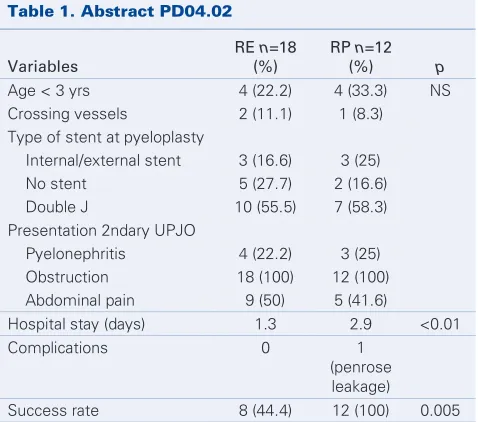
Failed pyeloplasty in children: comparative analysis of retrograde endopyelotomy vs. re-do pyeloplasty
LHP Braga, JL Pippi Salle, S. Skeldon, S. Dave, AJ Lorenzo, DJ Bagli, AE Khoury, WA Farhat
Division of Urology. The Hospital for Sick Children, Toronto, ON
Purpose:To compare retrograde endopyelotomy (RE) to open re-do pyelo-plasty for treatment of failed pyelopyelo-plasty in children.
Methods:478 patients underwent pyeloplasty between 1997 and 2005. Of these, 30 (6.3%) had a secondary UPJO which was managed by ret-rograde endopyelotomy in 18 and re-do pyeloplasty in 12. Age, opera-tive findings, stent placement and type at initial pyeloplasty, presentation of secondary UPJO, hospital stay, complications and success rate (SR) were compared between the 2 groups. Success was defined as radiograph-ic relief of obstruction, as determined by ultrasound or diuretradiograph-ic renog-raphy at the latest follow-up (F/U). An indwelling ureteral stent was placed in all patients and removed 8-12 weeks post-operatively.
Results:Mean F/U after primary surgery was 15.8 (3–60) mo for RE and 47 (3-108) for RP. Mean age at RE was 7.4 (2–14) yrs and at RP 7.3 (1–17).
Mean F/U after RE was 47 (15–132) m and after RP 33.1 (12–78). RP was performed through a flank incision (10 dismembered/ 2 ureterocalycos-tomy). RE technique consisted of laser and cautery wire balloon in 10 and 8 pts respectively. RP was successful in all pts, while RE failed in 55.6% of cases (4- stricture >1cm / 4- age <3 yr at surgery). Cautery wire bal-loon endopyelotomy had a SR of only 12.5% (p=0.05). After failed RE (n=10), 3 pts underwent RP (SR=100%), 2 antegrade endopyelotomy (AE) (SR=50%) and 5 repeated RE (SR=40%). The child who failed AE under-went RP and was cured. Of the 3 pts who failed a 2nd RE, 1 had RP, 1 AE and 1 a 3rd RE. All children remain free of obstruction at last F/U.
Conclusion:Single RE had a significantly lower success rate than RP after failed pyeloplasty in children. We speculate that age less than 3 yrs, long stricture at the UPJ and use of cautery wire balloon are bad prognos-tic factors for success of RE in the management of secondary UPJO.
Key Words:obstruction, pediatric, ureteroscopy
PD04.03
Blunt renal trauma in a tertiary pediatric trauma center: management, outcome and complications
LA Guerra, A. Al-Sayyad, J. Pike, M. Leonard
University of Ottawa, Children’s Hospital of Eastern Ontario, Ottawa, ON
Introduction:Renal injuries accounts for 1.3% of the traumas in the pedi-atric population. It is usually managed conservatively. Higher grades of renal trauma have a greater likelihood of morbidity. We review the man-agement, outcome and complications of these injuries in children. Material and methods: Retrospective analysis of the patients with blunt renal trauma seen at a pediatric tertiary trauma center from 1996 to 2005.
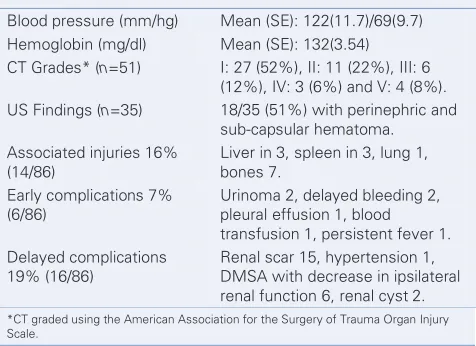
Results:86 patients, 67 boys, median 14 years of age, right kidney trau-ma in 43 (50%) cases. Gross hetrau-maturia in 65/86 (76%), microhetrau-ma- microhema-turia in 19/86 (24%) and 2 had no blood in the urine. The Table shows clinical parameters and imaging findings. Mechanism of trauma: sports 42/86(49%), playground activity 17/86(20%), MVA 13/86(15%), bike 10/86 (12%), others: 4/86(4%).
Podium Session 4: Pediatric Urology
Table 1. Abstract PD04.02
Variables
RE n=18 (%)
RP n=12
(%) p
Age < 3 yrs 4 (22.2) 4 (33.3) NS
Crossing vessels 2 (11.1) 1 (8.3)
Type of stent at pyeloplasty
Internal/external stent 3 (16.6) 3 (25)
No stent 5 (27.7) 2 (16.6)
Double J 10 (55.5) 7 (58.3)
Presentation 2ndary UPJO
Pyelonephritis 4 (22.2) 3 (25)
Obstruction 18 (100) 12 (100)
Abdominal pain 9 (50) 5 (41.6)
Hospital stay (days) 1.3 2.9 <0.01
Complications 0 1
(penrose leakage)
All patients were managed conservatively. One patient needed a double-J stent for urinary extravasation. Mean stay in hospital was 3.4 days, mean follow up 8.1 months (1–72).
Sixteen children (19%) had delayed complications, and amongst them 56% (9/16) were class I to III.
Conclusion:Blunt renal trauma in pediatric population can be safely man-aged conservatively. All 86 patients were followed clinically and only one case needed a double J stent. Early complications were more common in high grade (IV, V), but interestingly 56% (9/16) of those with delayed morbidity were low-grade lesions. Further studies are necessary in this subgroup of children, meanwhile it seems to be important to consider counseling the parents about the potential morbidity of classes I-III renal trauma.
Key Words:kidney, pediatric, trauma
PD04.04
Laparoscopic extravesical ureteral reimplantation in children
J-P Capolicchio, E. Tamarkina
Montreal Children’s Hospital, Montréal, QC
Introduction:Laparoscopic extravesical ureteral reimplantation in chil-dren is technically demanding with sparse literature to aid in mastering the learning curve. We present a video demonstrating our current tech-nique and lessons learned after 20 cases in children 4–15 years of age.
Methods:We utilize a 4 port transperitoneal technique with the patient in the supine position and the bladder controlled with transurethral irri-gation. We find it useful for learning purposes to divide the case into 4 segments: 1. access 2. uretero-vesical junction exposure 3. detrusor tun-nel dissection 4. tuntun-nel suturing. Megaureters, duplicated ureters and bilat-eral high grade reflux are relative contra-indications initially.
Results:1. Access is obtained under direct vision at the umbilicus with a 5mm 00 degree telescope. Three other 5mm ports are placed at the level of the anterior-superior iliac spine. 2. Initially we exposed the ureter at the pelvic brim and followed it down to the bladder but have since moved to open the peritoneum directly adjacent to the bladder. The assistant
holds the ureter with a vessel loop to facilitate mobilization up to the pelvic brim. The detrusor tunnel is measured and marked in a straight pos-terior-anterior line and exposed with 2 percutaneous traction sutures. 3. The superficial detrusor tunnel is scored with electrocautery. The deep-er detrusor tunnel is dissected with a combination of sharp dissection with scissors and cutting current with a right-angled electrocautery. 4. The tun-nel is closed with back-hand, interrupted 5-0 PDS sutures on a RB1 nee-dle, controlled with 3 mm forceps and needle driver (KOH micro, Storz).
Conclusion:The learning curves for ureter exposure and tunnel sutur-ing are quite reasonable and these segments are efficient when performed methodically. The tunnel dissection remains a challenge, especially in thick walled or thin walled bladders where mucosal perforation becomes a nuisance, with time lost for mucosal repair. Improvements in right-angle electrocautery technology would facilitate this portion of the procedure. Though not perfected, the technique remains an alternative for those seek-ing a minimally invasive, yet durable option.
Key Words:laparoscopy, pediatric, vesicoureteric reflux
PD04.05
Prospective comparative study of polymethylsiloxane vs hyaluronic acid injection for treatment of vesicoureteral reflux
K. Moore, S. Bolduc
Centre Mère-Enfant CHUL, CHUQ, Québec, QC
Introduction:Endoscopic treatment of vesicoureteral reflux (VUR) with subureteral injection of a bulking agent is becoming the first line of treatment for low grade VUR. We prospectively recorded our results to compare efficacy of two products commercialised in Canada for VUR.
Methods:Between January 2003 and December 2006, 94 patients (24 males, 70 females) followed for primary VUR were prospectively enrolled in a comparative study to be endoscopically treated with subureteral injec-tion of either polydimethylsiloxane or hyaluronic acid. 160 ureters were injected. A total of 116 ureters were treated with Macroplastique™; their grade was I in 12 ureters, II in 34, III in 46, IV in 21 and V in 3. 44 ureters were injected with Deflux™; their grade was I in 5, II in 16, III in 15, IV in 6 and V in 2. Surgical indications were breakthrough urinary tract infec-tion (65%), persistent reflux (20%) or renal scars (15%). Duplex systems were present in 21 refluxing units (13%). The procedure was performed by a single surgeon on an outpatient basis, with the patient under gener-al anesthesia. Patients were followed with rengener-al ultrasonography and void-ing cystourethrography 3 months after the surgery.
Results:Based on their characteristics, both groups were equivalent. For Macroplastique™, vesicoureteral reflux was fully corrected in 98 (84%) of 116 ureteral units and was ameliorated in 3 injected ureters. However, complete resolution of VUR was only recorded in 28 (64%) of 44 ureters treated with Deflux™. Obstruction was found in 2 ureters injected with polydimethylsiloxane and in 1 with hyaluronic acid. Univariate and mul-tivariate analyses were performed and did not allow the identification of any characteristics of our population that could explain the signifi-cant difference in the success rate between the two groups.
Conclusion:Subureteral injection of polydimethylsiloxane is an effec-tive treatment for vesicoureteral reflux and gives a better success rate than hyaluronic acid injection. The rate of resolution obtained with Deflux™ was lower than the level recorded by other groups due to the inclusion of high grade VUR. The lower cost of polydimethylsiloxane makes it an interesting product to use for the correction of VUR.
Key Words:pediatric, vesicoureteric reflux
Podium Session 4: Pediatric Urology
Table 1. Abstract PD04.03
Blood pressure (mm/hg) Mean (SE): 122(11.7)/69(9.7)
Hemoglobin (mg/dl) Mean (SE): 132(3.54)
CT Grades* (n=51) I: 27 (52%), II: 11 (22%), III: 6 (12%), IV: 3 (6%) and V: 4 (8%).
US Findings (n=35) 18/35 (51%) with perinephric and
sub-capsular hematoma. Associated injuries 16%
(14/86)
Liver in 3, spleen in 3, lung 1, bones 7.
Early complications 7% (6/86)
Urinoma 2, delayed bleeding 2, pleural effusion 1, blood transfusion 1, persistent fever 1. Delayed complications
19% (16/86)
PODIUM SESSION 5: LUTS AND INCONTINENCE
TUESDAY, JUNE 26, 09:15-10:05
PD05.01
The adjustable continence therapy (ACT®) system: prelimi-nary results of the North America ACT clinical study group
M. Carmel1, LM Tu1, S. Aboseif2, S. Nash3, N. Baum4, N. Galloway5, P. Pommerville6, J. Bresette7, K. Whitmore8, J. Slutsky9
1CHUS, Urology, Sherbrooke, QC; 2Kaiser Permanente, Urology, Los Angeles, CA; 3Kansas City Urology Care, Urology, Kansas City, MS; 4Memorial Medical Center, Neil Baum Urology, New Orleans, LA; 5Continence Center, Urology, Atlanta, GA; 6Can-Med Clinical Research, Inc., Urology, Victoria, BC; 7Lahey Clinic, Urology, Burlington, MA; 8Graduate University Hospital, Pelvic and Sexual Health Institute, Philadelphia, PA; 9Riverside Medical Center, Urological Surgeons, Kankakee, IL
Introduction and Objective:The management of stress urinary inconti-nence (SUI) associated with intrinsic sphincteric deficiency can be chal-lenging, particularly after failed therapies. The Uromedica Adjustable Continence Therapy system (ACT) is a new device that provides bulk at the bladder neck with balloons to improve urethral coaptation and blad-der neck support. The objective of this study is to determine the clini-cal efficacy, safety, adjustability and techniclini-cal feasibility of the ACT system for treatment of female SUI.
Materials and Methods:The study population involves female patients with recurrent S.U.I. with or without urethral hypermobility. Baseline and follow-up tests were performed at 6 weeks, 3 months, 6 months, 9 months, 12 months and annually thereafter including urinalysis, a 3-day voiding diary, provocative pad weight tests, direct visual stress test, Stamey score and questionnaires to assess the degree of stress incontinence, voiding dysfunction, sexual function and quality of life.
Results:A total of 82 subjects have been implanted and followed through 12 months. The mean age is 67.6 years (31-94 years). Improvement in Stamey score of at least 1 grade was reported in 78% of patients at 12 months (N=62). Improvement in quality of life as measured by the Incontinence Quality of Life Questionnaire score suggests improvement in quality of life at 12 months (p<0.001); mean baseline score of 52.42 (SD 20.02) compared to 85.30 (SD 22.32) at 12 months. Regarding the provocative pad weight tests, the average pad weight at twelve months was 11.6 grams compared to 56.2 at baseline. The mean number of adjust-ments in balloon volume through 12 months was 2.0 (range 0–6). Regarding technical feasibility of implanting the ACT device, 63% of procedures were rated as mild difficulty, 29% as moderate difficulty, while 8% were rated as severe difficulty. 49% percent (N=40) have experienced at least one com-plication related to device or implant procedure. The main device or pro-cedure complications include pain/discomfort (N=9), port erosion (N=10), balloon erosion (N=8), urinary retention (N=6) balloon migration (N=11) and bladder perforation at the time of implant (N=4) 0.81% percent of report-ed complications were considerreport-ed to be of mild severity.
Conclusion:The preliminary data suggest the Uromedica ACT system is an effective and simple procedure for recurrent stress urinary inconti-nence. Balloons can be easily adjusted to enhance urethral coaptation and bladder neck support. Complications are usually of mild severity. Longer follow-up is needed to evaluate the durability of the ACT sys-tem in managing SUI
Key Words:incontinence, QOL, urinary stress incontinence
PD05.02
Prevalence of overactive bladder: Canadian results from the EPIC study
S. Herschorn1, L. Valiquette2, D. Irwin3, J-P Roussy4, I. Defoy4 1Sunnybrook and Women’s College Health Sciences Centre, Toronto, ON;
2CHUM, Montréal, QC; 3University of North Carolina, Chapel Hill, NC; 4Pfizer Canada Inc., Kirkland, QC
Introduction:Overactive bladder (OAB) is defined as urinary urgency, with or without urge urinary incontinence (UUI), usually with frequen-cy and nocturia. The purpose of this study was to ascertain the prevalence of OAB in Canada and to determine to what extent UUI or other types of incontinence coexist with OAB.
Methods:A cross-sectional population-based survey of people aged ≥18 years in Canada was undertaken. Telephone interviews were con-ducted with a geographically stratified random sample of the population. The 2002 International Continence Society definition of OAB and incon-tinence types were used to classify participants. Age and gender preva-lences were calculated by adjusting for the age and gender distributions within Canada at the time of the survey.
Results:A total of 4499 participants (mean age, 47 years) were includ-ed in the analysis. The prevalence of OAB for the population age ≥18 years was 9.4% (8.5% men; 10.2% women). The prevalence increased with age in both genders. For the following age groups 18–39, 40–59 and 60 and more, the prevalences of OAB were 5.5% (4.3% men; 6.7% women), 9.3% (9.0% men; 9.5% women) and 16.6% (16.3% men, 16.9% women), respectively. Based on these prevalences, it is estimated that approximately 2.3 million people suffer from OAB in Canada. Among participants who reported having OAB, 12.8% (11.6% men; 13.8% of women) were found to have UUI. Considering any type of urinary incon-tinence (UUI, stress, mixed and other urinary inconincon-tinence), 51.1% of OAB respondents were found to suffer from incontinence (41.2% men; 58.8% women).
Conclusion:The overall prevalence of OAB in Canada was 9.4%, or almost 1 in 10 adults. Half of OAB adults also suffer from some type of incon-tinence. OAB was more prevalent in women than men across all age groups. However, the differences tend to disappear with increasing age. Over the years, a fourfold increase in the prevalence of OAB in men was observed. The results confirm that OAB is a common condition in both men and women in the general adult population and that OAB may or may not be associated with incontinence.
Key Words:detrusor, incontinence, overactive bladder
PD05.03
Male sling for moderate to severe stress urinary incontinence: efficacy and mechanism
B. Hage, S. Hanna, G. Schmutz, M. Carme, Y. Ponsot, LM Tu Centre Hospitalier Universitaire de Sherbrooke, QC
Introduction:Stress urinary incontinence (SUI) after prostate surgery has significant impact on patient’s quality of life. Recently, bulbourethral sling has gained popularity for the treatment of this condition. We pres-ent further evaluation of the male sling procedure using objective, sub-jective measurements and dynamic magnetic resonance imaging (MRI).
Methods:A total of 33 consecutive men (mean age 68) underwent the bulbourethral bone anchored sling for post prostatic surgery SUI. The pro-cedure was performed with the AMS InVance™ male sling kit. Pre and postoperative evaluation consisted of AUA symptoms score, incontinence/quality of life questionnaire, UCLA/RAND, cystoscopy, ICS1H pad test and videourodynamic study. Reassessment was done 2, 6, 12 months after the surgery and yearly thereafter. One third of the patients were randomly selected to have a pelvic dynamic MRI before and 6 months after the male sling.
surgery was negative in 72.7% of the patients. Seventeen (51.5%) were dry, 11 (33.3%) used 1 to 2 pads and 5 (15.1%) used more than 3 pads. Post operative videourodynamic demonstrated unobstructed voiding pat-terns. Mean results reported on the visual anagogic scale about discom-fort caused by SUI were 75.8% and 20.0% before and after the male sling respectively. Twenty six patients (83.9%) said to be satisfied/very satisfied from the surgery and 22 (71%) said to be cured/almost cured. Outcomes were not significantly affected by the degree of SUI neither by adjunc-tive radiotherapy. Dynamic MRI and fluoroscopic images did not show any difference in bladder neck position or mobility. Instead, the mesh seemed to dynamically compress and elevate the posterior bulbar urethra by creating a kink at this level.
Conclusion:This study shows that bone anchored male sling appears to have high success rate, both subjectively and objectively in patients with moderate to severe SUI. Mechanism of action could be dynamic pos-terior compression with a secondary elevation of the bulbar urethra, allow-ing better transmission of intra-abdominal pressure.
Key Word:incontinence
PD05.04
Prevalence of lower urinary tract symptoms (LUTS) in men: Canadian results from the epic study
S. Herschorn1, L. Valiquette2, D. Irwin3, J-P Roussy4, I. Defoy4 1Sunnybrook and Women’s College Health Sciences Centre, Toronto, ON; 2CHUM, Montréal, QC; 3University of North Carolina, Chapel Hill, NC; 4Pfizer Canada Inc., Kirkland, QC
Introduction:Lower urinary tract symptoms (LUTS) are categorized as storage symptoms, voiding symptoms, and postmicturition symptoms. The purpose of this analysis was to evaluate the prevalence of LUTS in the general population of men in Canada.
Methods:A cross-sectional population-based survey of people aged ≥18 years in Canada was undertaken. Telephone interviews were con-ducted with a geographically stratified random sample of the population. LUTS was classified according to the 2002 International Continence Society definitions. Storage symptoms included urgency; frequency; nocturia; and urgency, stress, mixed, and other types of incontinence. Voiding symp-toms included intermittency, slow stream, straining, and terminal dribble. Postmicturition symptoms included incomplete emptying and postmic-turition incontinence. Age-specific prevalences were calculated by adjust-ing for the age distribution within Canada at the time of the survey.
Results:1750 men (mean age, 47 years) were included in this analysis. Overall prevalence of LUTS in the population of men aged ≥18 years was 67.1%. The percentage of men reporting any storage, voiding or postmic-turition symptoms increased with age, ranging from 53.4% in the 18– 29 years group, to 84.7% in the 70+ years group. Storage symptoms were present in 59.7% of participants whereas voiding and postmicturition symptoms were present in 24.3% and 18.5%, respectively. Among respon-dents, 19.3% reported both storage and voiding symptoms, 15.1% report-ed both storage and postmicturition symptoms, 11.6% reportreport-ed both void-ing and postmicturition symptoms and finally, 10.1% reported havvoid-ing all 3 symptoms (storage, voiding, postmicturition). The most commonly reported storage symptom was nocturia (56.4%), followed by urgency and frequency (8.5% each). Intermittency was the most common voiding symp-tom (10.7%) and incomplete emptying (13.3%) was the most frequently reported postmicturition symptom.
Conclusions:LUTS is prevalent, experienced by almost 7 out of 10 men
in the general population. The prevalence of storage symptoms was high-er than that of both voiding and postmicturition symptoms. Storage and voiding symptoms were the 2 symptom types that occurred together most often. All categories of symptoms increased with age.
Key Words:BPH, incontinence
PD05.05
Finasteride monotherapy maintains stable urinary symptoms (IPSS) in men newly diagnosed with benign prostatic hyper-plasia for 9 months after 9 months of combination therapy using both an alpha-blocker and finasteride
JC Nickel1, J. Barkin2, C. Koch3, C. Dupont4, M. Elhilali5, on behalf of the PROACT study centers
1Queen’s University, Kingston, ON; 2University of Toronto, Toronto, ON; 3Merck Frosst Canada Ltd; Kirkland, QC; 4DataMed Inc., Montréal, QC; 5McGill University, Montréal, QC
Introduction:It may not be necessary to continue alpha-blockade indef-initely in patients diagnosed with BPH who are on combination thera-py with an alpha-blocker and finasteride. This Canadian multicenter exten-sion study evaluated the efficacy of continuing monotherapy with finasteride for a total of 9 months after cessation of combination thera-py, on symptom improvement in patients newly diagnosed or on watch-ful waiting with moderate benign prostatic hyperplasia (BPH) in a “real-life” setting.
Methods:This “equivalence design” study tested the maintenance of ther-apeutic symptomatic effect with 9 months of finasteride alone after 9-months’ combination therapy using finasteride with an alpha-blocker. Equivalence was defined as a change of ≥2.0 IPSS points.
Results:Of the 124 males who participated in the extension phase of the main study, 78 (62.9%) were initially naïve to alpha-blocker treat-ment and constitute the population of this sub-study. Mean age was 65.6 ≥8.4 years, baseline IPSS was 19.4±5.2 and IPSS-Quality of Life (QoL) was 3.9±1.2. At the time of this preliminary analysis, 66 subjects (84.6%) had completed the extension study per-protocol. Data was pend-ing for 10 subjects and 2 subjects had early discontinuation. Intent-to-treat analyses (LOCF) were performed, except for pending data. Interim results show that the IPSS after 9 months of monotherapy phase was not statistically different from the end of the combination period (11.8±6.5 vs 11.0±6.5, p=0.1669). Mean IPSS change remained well below the equiv-alence criteria (mean difference -0.788; 95% CI –1.727–0.151; p<0.0001). In addition, monotherapy was associated with a trend toward improve-ment in quality of life (p=0.0501). PSA levels were reduced from baseline (p<0.0001) and then remained stable (p=0.7874). A total of 81 NSAEs occurred in 34 of the 78 subjects (43.6%) enrolled in the extension study (mean = 2.38±1.67 NSAEs per pt); 67.9% of all NSAEs occurred during the combination therapy, 6.1% leading to discontinuation of study medication. Of all NSAEs, 25.9% were “urinary/sexual” and 72.8% were definitely or probably unrelated to study medication. Six SAEs occurred (33.3% during the monotherapy period) and only one was considered related to study medication (dizziness during combination therapy).
Conclusion:This study demonstrates that, in newly diagnosed/watchful waiting patients with moderate to severe symptoms of BPH never treat-ed with an alpha-blocker before the study start, finasteride therapy alone for 9 months maintains the same urinary symptom control and improve-ment obtained after an initial 9 months of combination therapy.
Key Word:BPH
PODIUM SESSION 6: Renal Cancer
TUESDAY, JUNE 26, 14:00-14:40
PD06.01
A multidisciplinary clinic for metastatic renal cell carcinoma: a streamlined approach to care
SE Pautler1,2, E. Winquist1, G. Bauman1, JI Izawa1,2, L. Riehl1, C. Johnson1, M. Mackenzie1
Departments of 1Oncology and 2Surgery, Division of Urology, Schulich School of Medicine, University of Western Ontario, London, ON
Introduction:Metastatic renal cell carcinoma (mRCC) remains a chal-lenging problem for clinicians. Historically, treatment options have been limited for these patients, and this often resulted in delayed referral and consultation. Three years ago, we established a multidisciplinary clinic (MDT) to improve both access and care of mRCC patients. Herein, we review the initial experience.
Methods:A multidisciplinary model of assessment and care for mRCC was developed including a monthly MDT for initial consultation that included a primary oncology nurse, and at least one medical, radiation, and surgical oncologist.All patients were reviewed by the MDT team. Subsequent care and followup disposition was determined by subdisci-pline in accordance with the treatment plan. Patient demographics, dis-ease characteristics, and treatment were recorded prospectively.
Results:From June 2004 to November 2006, 149 patients were seen in the mRCC MDT. Thirty patients were candidates for palliative radiation therapy with the most common indications being painful bony lesions, obstructive bronchial tumors, and brain metastases. Eight patients were candidates for surgery with 6 cytoreductive nephrectomies, 1 brain resec-tion, and 1 lung metastasectomy. Sixty five patients received systemic therapy (3 after a course of radiation) as follows: 15 sunitinib, 17 sorafenib, 14 clinical trial drug therapy, 7 bisphophonates, 6 high dose interleukin 2, and 6 interferon alpha. Nineteen patients underwent palliative/support-ive measures or required no treatment (no metastases present). Seven patients did not have mRCC based on pathology review and were treat-ed with appropriate systemic chemotherapy.
Conclusion:Our multidisciplinary approach has shortened the time from referral to consultation, improved care for patients with mRCC at our cen-tre, and increased clinical trial accrual. The timing of this intiative was also fortuitous as it also facilitated access to tyrosine kinase inhibitor ther-apies for these patients.
Key Words:cancer, kidney, treatment delay
PD06.02
Prediction of the probability of metastatic disease after nephrectomy for renal cell carcinoma: validation of a multi-institutional nomogram
QD Trinh1, PI Karakiewicz1, M. Soubra1, F. Guille2, P. Perrotte1, V. Ficarra3, W. Artibani3, J. Tostain4, A. De la Taille5, JJ Patard2
1Université de Montréal, Montréal, QC; 2Rennes University, Rennes, France; 3University of Verona, Verona, Italy; 4Étienne University, St-Étienne, France; 5CHU Henri Mondor, Créteil, France
Introduction:Presence of metastatic disease changes the treatment par-adigms in patients with renal cell carcinoma (RCC). However, some patients may harbour radiographic changes that are non-specific and a clear distinction between M0 vs. M1 disease may be difficult. To address the difficulty in accurate M stage assignment, we examined the associa-tion of locoregional tumour characteristics with the presence of distant metastases.
Methods:Analyses were performed on two different cohorts. One served for model development (2570 patients from five institutions) and the other for external validation (1377 patients from five other institutions). Logistic regression analyses assessed the association between predictors and the
outcome which was defined as presence of radiographically confirmed distant metastases. Predictors consisted of age, gender, T and N stages, tumor size, Fuhrman grade, histological subtype and symptom classifica-tion (asymptomatic vs. local vs. systemic symptoms). The most informa-tive predictors were included in a nomogram. The nomogram accuracy was tested in the external validation cohort.
Results:Of 2570 patients in the development cohort, 334 (13%) had con-firmed MRCC. T (p<0.001) and N (p<0.001) stages, Fuhrman grade (p=0.01) and symptom classification (p<0.001) were independent predic-tors of MRCC in multivariate analyses. A nomogram predicting the like-lihood of MRCC based on these variables was 90% accurate in the exter-nal validation cohort.
Conclusion:We developed and externally validated a highly accurate (90%) nomogram capable of predicting the presence of metastatic dis-ease in patients treated with nephrectomy for renal cell carcinoma. This tool may be useful in distinguishing between non-specific changes and true metastatic disease in patients subjected to nephrectomy for RCC.
Key Words:kidney, nephrectomy, renal cell carcinoma
PD06.03
Surgical experience with renal cell carcinoma and inferior vena cava thrombus
M. Al Otaibi, T. Abouyousuf, A. Al-Khaldi, A. Stephenson, W. Kassouf, J. Steinberg, A. Aprikian, D. Mulder, S. Tanguay
McGill University Health Center, Montréal, QC
Objective:Renal cell carcinoma (RCC) with caval thrombus is a tech-nical and oncological challenge. The technique including the need for cardiopulmonary bypass (CBP) or deep hypothermic circulatory arrest (DHCA) and oncological efficacy of caval thrombectomy are contro-versial.
Methods:A Retrospective analysis of 74 patients with RCC and tumor thrombus that were treated in our institution, 45 of them underwent radical nephrectomy and IVC thrombectomy.
Results:Mean age was 59±11 years. The thrombus was supra-diaphrag-matic in 8 patients with 6 (13%) extending to the right atrium. Planned CBP was used in 1 patient. 2 patients underwent DHCA. In 4 patients (9%) the thrombus was retracted back into the renal vein followed by completion of the nephrectomy. Cavotomy and direct thrombectomy was performed in 31 patients (69%). Right atriotomy was added to cavoto-my in 3 patients with atrial extension to assist in thrombus dissection. One patient underwent limited caval resection and reconstruction with PTFE graft. The infra-renal IVC was ligated in 2 patients. Intra-operative tumor spillage from the IVC thrombus occurred in 4 patients. Peri-operative mor-bidity included massive bleeding in 2 patients; one of them developed acute tubular necrosis. One patient developed Post-operative deep venous thrombosis and anther patient had minor cerebro-vascular accident. One patient died within 30 days of surgery (2%). Post-operative local recur-rence and/or metastases occurred in 29 patients (64%). Median time to recurrence was 10 months. Five patients developed local recurrence post resection, 3 of which (60%) had supra-diaphragmatic thrombus. Sites of metastases included: lungs, liver, bone, adrenal glands, brain in 10,6,5,2, 1 patients, respectively. Post-operative 5-year overall survival rate for patient with caval thrombus was 45% compared to 55% for those with renal vein thrombus. The level of caval thrombus was not predictive of survival.
tion of peri-operative adjunctive therapy might be necessary in cases with thrombus extending above the diaphragm for control of local recurrence.
Key Word:nephrectomy
PD06.04
A multicenter, randomized, phase 3 trial of a novel autologous therapeutic vaccine (vitespen) vs. observation as adjuvant therapy in patients at high risk of recurrence after nephrectomy for renal cell carcinoma
S. Tanguay1, C. Wood2, B. Escudier3, L. Lacombe4, L. Klotz5, M. Gleave5, M. Jewett7, A. Hoos8, R. Gupta9, F. Teofilovici10, R. Flanigan11, R. Figlin12, P. Srivastava13
1McGill University Health Center, Montréal, QC; 2MD Anderson Cancer Center, Houston, TX; 3Institut Gustave Roussy, Villejuif Cedex, France; 4CHUQ-Hôtel-Dieu de Québec, Pavillon de Recherche de l’Hopital I’Hôtel Dieu, Quebec City, QC; 5Sunnybrook Health Science Center, 5Vancouver General hospital, Vancouver, BC; 7University Health Network, Toronto, ON; 8Bristol-Myers Squibb, New York, NY; 9Transave, Inc., Monmouth Junction, NJ; 10Antigenics, New York, NY; 11Loyola University Medical Center, Maywood, IL; 12City of Hope Comprehensive Cancer Center, Duarte, CA; 13University of Connecticut School of Medicine, Farmington, CT
Objective:Vitespen (formerly HSPPC-96) is a novel, autologous, patient-specific, tumor-derived heat shock protein (gp96)-peptide complex vaccine preparation. This trial investigated the efficacy of vitespen in renal cell carcinoma (RCC) patients (pts) at high risk for recurrence postnephrectomy.
Methods:Eligible pts had AJCC (1997/2002) stage IB, II (clinical tumor size ≥5 cm; Fuhrman grade 3/4), stage III or stage IV (M0) RCC, clear cell
car-cinoma (≥25%), ECOG PS 0/1 and ≥7 g viable tumor tissue for vaccine production. Randomization was 1:1, nephrectomy vs. nephrectomy + vite-spen. Pts were stratified by ECOG score, nodal status and histological grade. Vitespen was administered intradermally once weekly x 4 w, then every 2 w until vaccine depletion. Pts were imaged at 3, 6, 9, 12, 18, 24, 30, 36 m postsurgery, then annually for ≤6 y, with independent radiological review at final analysis. Primary and secondary endpoints are recurrence-free survival (RFS) and overall survival (OS), respectively.
Results:Of 818 pts randomized, 728 pts were eligible. Analysis was planned for a target of 214 investigator-reported even