International Journal of Scientific Research in Computer Science, Engineering and Information Technology © 2016IJSRCSEIT | Volume 1 | Issue 2 | ISSN : 2456-3307
Man Vs. Computer: Difference of the Essences, The Problem
of the Scientific Creation
Temur Z. Kalanov
Home of Physical Problems, Pisatelskaya 6a, 100200 Tashkent, Uzbekistan.
ABSTRACT
The critical analysis of the problem of creation of Artificial Intelligence (AI) and of Artificial General Intelligence (AGI) is proposed. The unity of formal logic and of rational dialectics is the methodological basis of the analysis. The main results of the analysis are as follows: (1) the model of man represents the unity of the two material aspects: “physiological body” (controllable aspect) and “psychical body” (controlling aspect); (2) the “psychical body” is the subsystem “subconsciousness + consciousness”; (3) in the comprehensive sense of the word, the thinking is an attribute of the complete system “physiological body + psychical body + environment”. (3) in the broad sense of the word, thinking and creativity are an essential feature of the subsystem “subconsciousness + consciousness”; (4) in the narrow (concise) sense of the word, thinking and creativity are the attribute of the instinct of the conservation (preservation, retention, maintenance) of life (i.e., the self-preservation instinct, the survival instinct); the instinct of the conservation of life exists in subconsciousness; (5) the instinct of the conservation of life is a system of elementary (basic) instincts; thinking is the attribute of the each elementary instinct; (6) the mechanism of thinking and the essence of creation cannot be cognized by man; (7) a computer as a device cannot think and create (in particular, it cannot prove theorems) because a computer does not have the subconsciousness; (8) the modeling of human thinking, Human Intellect, and the creation of AI and AGI are the impossible because the essential properties of the complete system “man + environment” cannot be cognized and modeled; (9) the existence of AI and AGI conflicts with the essence of the thinking; (10) the existence of AI and AGI contradict to formal-logical and rational-dialectical laws.
Keywords: human intellect, artificial intelligence, artificial general intelligence, artificial psychology, computer science, psychology, linguistics, mathematics, P versus NP problem, Millennium Problems (Clay Mathematics Institute), formal logic, dialectics, philosophy, metaphysics.
I.
INTRODUCTION
As is known, the problem of creation of Artificial Intelligence (AI) and of Artificial General Intelligence (AGI) over a long period of time attracts special attention of researchers: mathematicians, cyberneticists, programmers, neuroscientists, psychologists, philosophers, etc. The results of researches carried out by scientists in resent years show that the way to comprehension and to solution of the problem has not yet been found [1]. In my opinion, the explanation of the current state of researches is as follows:
(a) researchers neglect the correct methodological basis of the cognition (i.e., the unity of formal logic and of rational dialectics);
(b) the scope of the standard paradigm of science is narrow.
questions will be found, then a new statement of the problem of creation of Artificial Intelligence can be proposed. Since only a man can tell what he thinks and how he thinks, one can try to model only human thinking.
1. As is known, human creativity is an activity directed at production of something that has qualitatively new, original, inimitable features, and socio-historical uniqueness. Human creativity is the specific and essential feature of man because creativity is always sign of the existence of the active creator, the subject of creative activity. In my opinion, the source and the driving force of creative activity of man is a manifestation of the following innate qualities that represent the essence (essential features) of man. First, the essence of man is manifested in his programmed aspiration to progress (programmed striving for progress). (Progress is the development of Mankind by “negation of negation”). This aspiration represents the principle of development of Mankind and is expressed in the form of wars, in the form of the use of nature, in the form of the use of people (for example, slavery is a form of the use of people), in the form of scientific and technical creation. The aspiration to achievement of the goal is the source and the driving force of creativity. The goal exists, but it must be found by Humankind. Secondly, the sublime emotions (feeling of truth and justice, feeling of harmony and beauty, feeling of love and admiration) are the basis of human morality, cause and effect, the source and the driving force of creative activity. The ultimate goal of creative activity is the attainment of the greatest feeling: feeling of satisfaction, peace, and freedom.
2. Creation is deeply individual activity. The result of the creation is not a direct and simple consequence of the initial (external and internal) conditions. The creative process is not reduced to labour or logical operations and expresses ultimately the moral aspect of the author’s personality. This fact determines the social importance of results of creation for the progress of human society. The principle of development of Mankind (i.e., the principle as property of the system “Mankind”) determines the creative activity of man (i.e., the property of the element “man”); the creative activity of man (i.e., the property of the element “man”) characterizes the principle of development of Mankind (i.e., the property of the system “Mankind”).
3. Creative activity is developed on the basis of inherent (programmed) cognitive abilities. Creative activity of man is the concretization of the principle of development of Mankind. Human creation is the process of human activity adducting to making a qualitatively new material and spiritual values. There are different kinds of creative activity: industrial, political, scientific, technical, artistic activities, etc. The scientific-creative work is related to the activities of scientists for the production of fundamentally new knowledge, for the offering of new hypotheses and construction of theories, for the search and proving of truth. The essence of scientific creation is manifested in scientific discovery: the ascertainment of new, previously unknown facts, properties and laws of real world. The newness, novelty, and social significance of the results are an important criterion of creativity. 4. Scientific creation is a process of producing
cognitive innovations (laws, theories, principles, methods, models, devices, equipment models, technologies) in science. The necessary conditions for carrying out of the scientific-creative work are as follows: (a) the existence of the well-posed problem; (b) the availability of information accumulated in the given field of science (i.e., professionalism); (c) the combinatorial ability of researcher to compositing a wide variety of combinations (including low-probability combinations) of the elements of knowledge; (d) the intuitive ability of researcher to the selection of relevant combinations for a probable solution of the problem; (e) the ability of researcher to make a risky decisions (i.e., cognitive courage of researcher); (f) readiness of researcher to defend his opinion; (g) stability (resistibility) of researcher to criticism from the scientific community.
is the support for one’s “Ego”. For example, faith in myself and faith in existence of the Absolute Truth let me assert within the framework of the correct methodological basis that the works of the classics of sciences (such as theoretical physics and mathematics) contain formal-logical and dialectical errors [2-95]. The errors characterize the inductive method of cognition (i.e., the cognition by “negation of the negation”) and represent the essential and inalienable part of modern sciences.
6. In my opinion, the origin of the scientific errors in the works of classics of sciences can be explained in the following concrete actual way: (a) short-time lucid interval, short-time clarification (strikening, illumination, enlightenment) of consciousness, which leads to scientific discoveries, does not represent long-time and steady clarification (strikening, illumination, enlightenment) of consciousness (but long-time and steady clarification consciousness is preserved throughout a person’s life!); scientific discoveries – as a result of short-time lucid interval, short-time clarification of consciousness – are not absolute truth: such discoveries, as a rule, contain the formal-logical and dialectical mistakes; (b) errors in sciences can be detected only under the critical analysis of the works within the framework of correct methodological basis; (c) scientists ignore the correct methodological basis of sciences: the unity of formal logic and of rational dialectics; (d) scientists rely on a computer: scientists want to entrust the heavy, difficult, complex, complicated cognitive work to a computer; scientists are trying to turn (transmute) a computer into a creative robot.
But computer does not have the human subconsciousness and consciousness. And man does not know and cannot know what are subconsciousness and consciousness, what is the mechanism of interaction between the subconsciousness and consciousness. Therefore, computer (and a supercomputer) cannot perform the following actions: to create; to operate with concepts and to think; to formulate scientific problems; to generate correct solutions to complex scientific problems; to prove theorems; to analyze critically the theorems and theories within the correct methodological basis; to detect errors in the sciences. Computer is a computational-informational machine programmed by
man. But man will never be able to create algorithm of thinking and of creation.
There are no scientific works which contain proofs of possibility or impossibility of creation of AI and of AGI. The purpose of this work is to propose the critical analysis of the problem of the relation between the creative scientific work of man and work of computer in order that researchers might be aware of the problem of creation of Artificial Intelligence and of Artificial General Intelligence. The methodological basis for the analysis is the unity of formal logic and of rational dialectics.
II.
METHODS AND MATERIAL
The Methodological Basis
As is known, methodology is a doctrine of the structure, logical organization, methods and facilities of activity of man. The scientific methodology is a doctrine of the principles of construction, forms and methods of scientific cognition. The general methodology of scientific cognition is the unity of formal logic and of rational dialectics. The unity of formal logic and of rational dialectics represents the only correct methodological basis of sciences. Use the correct methodological basis is a necessary condition for the correct analysis of scientific works to make distinction between truth and falsehood. However, this fact is ignored by majority of scientists until now. Therefore, the main assertions of formal logic and of rational dialectics which are used in my works [2-95] ought to be stated here as well.
A. The basic principles of formal logic
2. Thinking is the highest form of human cognitive activity which represents the process of reflection of objective reality in human consciousness. Human thinking is performed with the help of concepts and has different forms.
3. The form of thought reflecting and fixing the essential features (sings) of things, objects, and phenomena of reality is called concept. In other words, the concept is the thought that reflects things, objects from viewpoint of the general and essential features (signs). (Thing is an object that can be in relation to anything or have some property).
4. The essential features (sings) of the concept are chosen (are singled out) in objects and phenomena by thought. The essential features (sings) characterize the objects of given kind. Non-essential features (sings) do not characterize the objects of given kind. The characteristic which is used to determine similarity or difference of objects of thought is called essential features (sing). In the most general view, features (sings) of objects can be reduced to properties (for example, large, small, white, black, good, bad, soft, hard, etc.), states (for example, state of rest, state of motion, energetic state, equilibrium state, etc.), actions (for example, it works, he reads, she performs her duties, etc.), and results of actions (for example, have scored success, have benefited, etc.), etc.
5. The first basic form of thought is a concept. Concepts are formed (created) with the help of logical methods such as analysis and synthesis, abstraction and generalization. Analysis is the mental decomposition (dissection) of the object of thought in terms of the elements, the choice (separation) of either feature (sing), and the consideration of it separately. Analysis does not give knowledge of object or of phenomenon as a whole. Synthesis is the mental integration (association, combination, junction) of the elements of the object or of the phenomenon. Synthesis provides knowledge of object or of phenomenon as a whole (as a unity of parts, as a system). But this knowledge is not the reliable and complete one. Abstraction is the mental separation, the mental extraction of the certain, the essential features (sings) of object or of phenomenon and passing over all other features (i.e., abandonment of all other features (sings) without consideration).
Generalization is the mental transition from features (sings) of individual, separate, single objects to features (sings) belonging to whole groups (classes) of these objects. Abstraction is the mental separation, the mental extraction of the certain, the essential features (sings) of object or of phenomenon and passing over all other features (i.e., abandonment of all other features (sings) without consideration). Generalization is the mental transition from features (sings) of individual, separate, single objects to features (sings) belonging to whole groups (classes) of these objects.
6. All the concepts can be divided into the following separate types: single concepts and general concepts. The concept that relates to the only one certain object, separate phenomenon, separate event is called single (individual) concept. The concept that embraces (covers) a group (class) of similar things, objects is called general concept. 7. Each concept has two aspects: the scope (volume)
of the concept and the content of the concept. The scope (volume) of the concept is all the objects and phenomena which can be embraced (covers) by given concept. The scope (volume) of the general concepts is expressed in the form of a logical class. The concept content is a set of all the essential features (sings) of objects, phenomena embraced (covered) by the concept.
8. All the concepts can be divided into the following separate types: concrete concepts and abstract concepts. Concrete concept is the concept that relates to groups, classes of objects, phenomena or to the separate objects, phenomena. Abstract concept is the concept of properties of objects or phenomena if these properties are taken as the separate (independent) object of thought and are abstracted from objects.
9. There is a special kind of concepts that is called categories. Categories are the scientific concepts reflecting the most common properties of objects and phenomena, the most common and essential relations and connections in reality. For example, the concepts of “matter”, “movement”, “content”, “form”, “causality”, "freedom", “necessity”, “randomnicity”, “essence”, “phenomenon” are the categories.
relation of partial coincidence; relation of disagreement. (For example, the relation of disagreement exists between contradictory concepts and opposite concepts).
11. The second, more complicated, form of thought is a proposition. The proposition is the logical form of expression of thought. The proposition is the logical content of grammatical sentence. The proposition is a statement about the objects and phenomena of objective reality. The statement states the existence or absence of certain features (sings) of objects and of phenomena. The proposition has the following two properties: (a) the proposition either asserts or denies (negates); (b) the proposition is either true or false. The proposition is always assertion or negation. The proposition is true if it reflects correctly the reality; and the proposition is false if it reflects incorrectly the reality. Every proposition represents a system of concepts. There are three elements in every proposition: subject, predicate, and connective word (element) . The subject of the proposition is that what one states about. The predicate of the proposition is that what one states on the subject. The connective word (element) is an indication of the relation between subject and predicate. In any proposition, subject and predicate are concepts connected by connective word (element). The connective element in any proposition expressed by the word “is” or “is not”.
12. The third form of thought is an inference. The inference represents connection of propositions, which makes it possible to derive a new proposition from given one or more propositions. Those propositions from which one derives the new proposition are called premises, and the new proposition derived from the premises is called conclusion. Relation between the premises and the conclusion is relation between reason (basis) and consequence (logical corollary): the premises are the reason (basis) from which the conclusion follows as a consequence (logical corollary). Consequently, the inference is based on the law of sufficient reason. Depending on number of premises, all the inferences are divided into two groups: immediate inferences and mediated inferences. The immediate inference is the inference in which the conclusion is consequence of one premise. The mediated inference is the
conclusion in which a new proposition is derived from two or more propositions.
13. The mediated inferences can be of two types: deductive and inductive. The mediated deductive inference is called syllogism if a conclusion is derived from two premises. The inference is called inductive inference if the premises indicate features of separate objects or groups of separate objects, and the conclusion is extended to other objects of the same kind. Deduction and induction are in inseparable connection with each other and supplement each other. Mathematics uses mainly method of deduction.
14. Scientific induction is based on the determination of the causes. Therefore, the problem of causal connection of phenomena is important for scientific induction. The causal connection of phenomena is that one phenomenon is a cause another phenomenon, and a change in the first phenomenon entails a change in the second phenomenon too. The phenomenon which necessarily entails another phenomenon is called cause, and the second phenomenon which is entailed by this cause is called effect of this cause. Thus, the connection of cause and of effect is a connection of two phenomena, two facts. In order to determine the cause of the phenomenon studied, one should use two basic logical methods of the inductive research: intercomparison of the circumstances in which given phenomenon occurs; comparison of these circumstances (in which given phenomenon occurs) with other circumstances (similar in other relations) in which given phenomenon do not occur.
demonstration (manifestation) is the propositions that show why the given thesis is substantiated (grounded) by the given arguments
B. The basic principles of rational dialectics
1. Rational dialectics (i.e., corrected dialectical materialism) is a science of programmed (predetermined) development: it is the science of the most common types of connections and laws of the development of the nature, of the human society, and of thought. The universal connection exists not only in the material world – in the nature and society – but also in thinking. Connection and interdependence of the forms of thought (for example, concepts) is (in the final analysis) reflection of the universal connection and of interdependence of the phenomena of the objective world in human consciousness. Since concepts are reflection of objects in human consciousness, the concepts are interconnected, and they cannot be taken in isolation from each other. Concepts must correspond to the natural and social processes, must reflect their contents.
2. The basic laws of dialectics are as follows: the law of unity and struggle of opposites; law of transition of quantitative changes into qualitative changes; law of negation of negation. There are also the most common laws of dialectics, which do not belong to the basic ones. The paired (relative) categories of dialectics – necessity and chance, possibility and reality, form and content, essence and phenomenon, etc. – are the theoretical reflection of non-basic laws of dialectics. All the laws and categories of dialectics represent forms of thought, forms of cognition of the objective world, forms of reflection of the objective world in the human consciousness.
3. As is known, the cognitive psychical activity of man is performed in the following way (by the scheme):
(sensation, perception, representation)
(concept) (theory)
(practice).
Sensation is a result of influence (effect) of the outside world to the sense-organs of man; perception is an immediate (direct) sensuous reflection of the reality in the consciousness of man; representation is an image of an object or phenomenon (which is not perceived at
given instant of time) in the consciousness of man. Thinking is carried out with the help of concepts. Concept is the form of thought reflecting and fixing the essential features (signs) of objects and phenomena of objective reality. Theory is a system of concepts. 4. The unity of sensuous and rational moments in the
cognition is that sensuous cognition represents the starting point, the first stage of the cognitive activity. A man, even at the level of logical thinking, continues to rely on (rest upon) sensuously perceivable material in the form of visual images, of various schemes, of symbols, on sensuous form of language.
5. Material activity of people represents practice. Practice is (first of all) a sensuous-objective activity aimed at satisfying human needs. Theoretical activity is derived from practice. Social practice is a starting and ending points of theory. The unity of theory and of practice is a starting point of epistemology. Practice is a driving force in development of cognition.
6. Social practice is criterion of truth. The criterion of truth can be found neither in the object of cognition nor in the consciousness of the subject. Practice is the experience of all humanity in its historical development. The absoluteness of practice as criterion of truth is that all knowledge proven by practice is an objective truth. But, at every given stage (step) of theoretical study, practice can not corroborate completely or refute all theoretical propositions – in this sense, practice is relative. Only the unity of formal logic and of practice can corroborate completely or refute all theoretical propositions at every given stage (step) of theoretical study.
7. The law of transition of quantitative changes into qualitative changes is essential to analyze the foundations of mathematics. The essence of this law is as follows: quantitative and qualitative changes represent the dialectical unity (interconnection) of the opposite and interdependent aspects.
(Friedrich Engels). Quality expresses specific character of an object or phenomenon in whole. Quality is not only holistic characteristic but also a relatively stable set of signs (features) which determines the specificity of given object. Quality is holistic characteristic of an object or phenomenon; and the property is one of the aspects (partial characteristics) of the object or phenomenon. Some properties express the qualitative determinacy of the object; other properties express the quantitative determinacy.
Quantity is inherent determinacy in the objects and phenomena, which expresses the number of inherent properties of objects and of phenomena, the sum of component parts of objects and of phenomena, the amount, the degree of intensity, the scale of development, etc. In other words, quantity is determinacy in objects and phenomena, expressed by a number. For example, noting object properties such as volume, weight, length, speed, etc., man ascertains simultaneously quantitative expression of these properties as well. The quantities of volume, weight, length, speed, etc. are the quantitative characteristic of these properties.
8. Quality and quantity are dialectically connected. They represent the unity of opposites. The qualitative determinacy does not exist without the quantitative determinacy, and vice versa. The unity of qualitative and quantitative determinacy is manifested in measure. The measure denotes existence of the interdependence of qualitative and quantitative aspects of the object or phenomenon. The measure expresses the limits (boundaries) within which objects and phenomena are themselves. Each state has its own measure. The violation of the measure leads to a change in the state. The transition from one state to another is a movement. Leading place belongs to quality in the unity of qualitative and quantitative determinacy. Quality determines the framework of quantitative changes. The qualitative changes can only result from the quantitative changes (i.e. quantitative movement).
9. The law of transition of quantitative changes into qualitative changes is essential to analyze systems. The important theoretical proposition of system analysis is as follows. The properties of the system determine the properties of the elements; and the properties of the elements characterize the properties of the system. The main problem is that
the dependences of properties (qualitative and quantitative determinacy) of the system on number of the elements and on the qualitative and quantitative determinacy of the elements is not reliably known. (In this point of view, the Universe (System) cannot be cognized by Mankind (as the element of the System).
10. The law of transition of quantitative changes into qualitative changes is essential to analyze the foundations of mathematics. The question of the fundamental applicability of mathematical methods in all the areas of scientific cognition must be decided on the basis of the law of interdependence of qualitative and quantitative determinacy. The following fundamental statement results from this law: the operation of abstraction of quantitative determinacy from qualitative determinacy is inadmissible mental operation.
11. The definitions of the concepts of “knowledge”, “cognition”, and “cognition system” are based on the definition of the following concepts: “subject”, “object”, “subject of thinking”, and “object of thinking”.
“Subject” and “object” are philosophical categories (concepts) denoting two interrelated, interacting aspects (elements) of the system, which are characterized by the following essential features: “activity” and “passivity”. The subject (i.e., set of individuals) is a carrier of the feature of “activity”, is an active aspect (i.e., the active element of the system), is a source of activity directed (aimed) at the passive aspect (i.e., at the passive element of the system). The object is a carrier of the feature of “passivity”, is a passive aspect (i.e., the passive element of the system) to which the activity of the active aspect (i.e., the active element of the system) is directed (aimed).
The subject of thinking (thought) is the subject as a carrier, is a source of mental activity directed (aimed) to the object. The object of thinking (thought) is an object to which the mental activity of the subject is directed (aimed). Since the concepts of “subject of thinking” and “object of thinking” have meaning only in mutual connection, they form a system of concepts.
(a) Cognition is an informational interaction between the subject and the object, the result of which is the knowledge about the object. The object is expressed in the form of knowledge for the cognizing subject. Therefore, the content of science represents an expression of given object in the form of knowledge: laws, categories, and other scientific principles generated and developed in the course of development of human society. In the formal-logical point of view, the knowledge is a system of concepts and assertions. In the viewpoint of the information theory, the knowledge is a system of the elements of information. In the epistemological point of view, the knowledge of the object is the essence of the object of cognition, and the object of cognition is a manifestation of the essence of the object.
(b) Scientific cognition of the world is carried out within the framework of “human system of cognition” consisting of “subject of cognition”, the set of “objects of cognition”, “facilities of cognition”, and “knowledge”. The category of “human system of cognition” is a complete system of concepts, determining human knowledge, and human knowledge characterizes this system. (Human knowledge is an objective if it does not depend on “facilities of cognition” and the world outlook of “subject of cognition”).
C. The Structure of the Scientific Creation
As is known, the analysis of the problem of scientific creation, creativity is impossible without an analysis of the structure of the creative process and the separation (choosing, singling out) of the main stages (steps) of scientific creation. The standard structure includes the following 5 stages (steps): (1) the statement of problem, the formulation of purposes and of tasks of research; (2) the gathering of information and the search of logical methods for solving the problem; (3) the stage of maturation (gestation) of idea, which is also called “incubation period” and which is related to the work of subconsciousness; (4) the appearance of a new idea in the form of guesswork; the finding approach to solution of the problem with the help of the intuitive insight (strikening, aha reaction) or Enlightenment (inside light); (5) the formulation of the found solution; the substantiation of the found guesswork up to level of
hypothesis; the transformation of the hypothesis into a theory via logical proving and testing of hypothesis.
In other words, logical, discursive, and intuitive moments in the creative process are interwoven. The problem of the nature and of the role of intuition in scientific discovery should be emphasized because of the importance and transcendence of intuition.
Intuition – as a specific cognitive process – is universal inherent feature of all people. The significance of intuition in cognitive process is confirmed by numerous observations over people in daily circumstances and in non-standard situations. As is known, there is a great number of facts in Human culture, which demonstrate possibility to obtain fundamentally new results by “aha reaction”. For example, famous scientists G. Helmholtz, A. Einstein, H. Poincare, J. Hadamard, and others gave the interesting evidences of the intuitive insights. In concordance with descriptions and experimental study of intuition, three main features of intuition can be emphasized: (1) suddenness (spontaneity) for solving the problem; (2) unawareness of ways and of means to solve the problem; (3) directness of comprehension of the solution of the problem. In agreement with these features, intuition is defined as follows: intuition is the ability of cognition of the truth by direct comprehension of it without proof.
The psychological analysis of intuition is based on the study of the relation between the conscious and subconscious (unconscious) mechanisms. The epistemological nature of intuition is clarified in complex transitions of sensuous images into concepts and in complex transitions of concepts into sensuous images by means of the synthesis of conceptual universality and sensuous given. A number of contemporary authors see an answer to the mysterious nature of intuitive knowledge in these transitions.
intuition: one ought to shut down temporarily oneself from problems in order to activate the subconscious mechanisms of thinking; one ought to work parallel on several problems; one ought to believe in success, etc. As is known from the history of philosophy, Plato, Aristotle, Descartes, and others paid a great attention to the problem of intuition.
Consideration of the scientific works of the outstanding creative personalities demonstrates the deeply individual nature of creativity, the importance of professionalism, talent, intuition, and moral qualities of the researcher. The scientific cognition is both the discursive and the intuitive process [96, 97]; it is a confluence of necessity and randomness. As is known, the experience of the development of science shows that the creativity can be activated within certain limits. The creation control signifies influence not only on the individual abilities of the researcher, but also on socio-economic, political, and general-cultural circumstances in order to create favorable conditions for the manifestation of creativity.
D. The Essences of Man and of Animal
The essence of man can be understood only within the framework of the system principle. As is known, the system principle reads as follows: the properties of the material system determine the properties of the material elements; properties of the material elements characterize the properties of the material system. 1. In accordance with the system principle, the
following assertions are right (valid): (a) the properties of the Universe (as a system) determine the properties of the Earth (as an element); properties of the Earth (as an element) characterize the properties of the Universe (as a system); (b) the properties of the Earth (as a system) determine the properties of Mankind (as an element); the properties of Mankind (as an element) characterize the properties of the Earth (as a system); (c) the property of Mankind (as the system consisting of a set of countries) determine the properties of the country (as an element); properties of the country (as an element) characterize the properties of Mankind (as the system consisting of a set of countries); (d) the properties of the country (as a system) determine the properties of the man (as an element); the properties of the man (as an element)
characterize the properties of the country (as a system). Consequently, the properties of the man are determined by the properties of the Universe, the Earth, and Mankind [17, 19, 26-28, 38, 45, 47, 50, 86, 87].
2. In accordance with the rational dialectics [2-95], living beings have measure, i.e. the unity of qualitative and quantitative determinacy. Living beings – man, animal, etc. – represent the unity of the two opposite material aspects [45, 47, 50]: physiological body (i.e., the controllable aspect which is a system of organs) and the psychical body (i.e., the controlling aspect which is the following system: the unity of subconsciousness (subliminal consciousness) and consciousness).
unity of “psychical body + Solar (extraterrestrial) body”, etc.
3. As is known, qualitative determinacy of the systems “Mankind”, “man” and “Fauna”, “animal” remains invariable one. This signifies that the development of these systems represents a quantitative change. Quantitative change is a manifestation of the qualitative determinacy. In other words, the qualitative determinacy of the system is the essence of the system, and the quantitative determinacy of the system is a manifestation of the essence. The qualitative determinacy of the system determines the borders of quantitative changes. The qualitative determinacy of the system is not identical to itself outside the borders of the quantitative determinacy. For example, the birth and death of the physiological body represent borders of the system “physiological body + psychical body”. The system “physiological body + psychical body” can be in different states. Death of the physiological body is disintegration of the unity of the physiological body and of the psychical body. But death of the physiological body does not signify the death of the psychical body. The psychical body can exist separately from the physiological body. This signifies that the psychical body represents the universal essence which does not depend on the properties of the physiological body. 4. Life of a living organism is conditioned by the existence of the following inherent property (qualitative determinacy): the instinct of conservation (preservation, retention) of life (i.e., self-preservation instinct, survival instinct, instinct of the existence, instinct of the struggle for existence). The life (existence) of a living organism is a struggle for existence, for the preservation (conservation) of life of the physiological body. The instinct of conservation (preservation, retention) of life represents the system of the following main elementary instincts: the feeding (food) instinct, the instinct of reproduction, the instinct of activity (which is manifested in the form of the “life energy”, of the struggle for existence), the defensive instinct, the adaptability instinct, the instinct of learning and of development. The instinct of conservation (preservation) of life exists in the psychical body and manifests itself only in the system of “physiological body + psychical body”. In other words, the instinct of preservation
(conservation) of life represents a necessary condition for the life of the physiological body. Decomposition of the unity of the physiological body and of psychical body leads to blockage of the instinct of preservation (conservation) of life, which exists in the psychical body. This signifies that a living organism was created as full (completed) system “physiological body + psychical body”. A living organism was not created by piecemeal.
5. Thinking (thought) is one of the essential properties (attribute) of the instinct of conservation (preservation, retention) of life. Therefore, thinking (thought) is one of the essential properties (attribute) of each elementary instinct. Blocking of the instinct of conservation of life signifies blocking of thinking (thought). The isolated psychical body cannot think. Thus, thinking (thought) is the attribute of the system “physiological body + psychical body”.
6. The food instinct is the need (necessity, wants) of material food (for the physiological body) and the need (necessity, wants) of psychical food (for the psychical body). The psychical food for people represents a product of psychical activity of people. The psychical food for people is created and eaten (consumed) by people. Examples of carriers of psychical food for human eating (consumption) are as follows: games, shows, arts, religion, learning, education, sciences, creative activity, and the results of creative activity. The psychical food for animals represents a product of psychical activity of animals. The psychical food for animals is created and eaten (consumed) by animals. Examples of carriers of psychical food for animals are as follows: games and training.
Brain implements (executes, exercises, accomplishes) materialization of thoughts, ideas (existing in the consciousness): the brain gives the order (command, instructions) to organs of the physiological body to express the information in the form of oral speech and written speech, in the form of music, in the form of symbols, in the forms of concepts, theories, images, etc. These forms are the material carriers (incarnations) of the information. The information in the material forms is a psychical (spiritual) food for human consciousness, and it is eaten (consumed) by people.
The difference between the physiological properties of the bodies (for example, human body and animal body, male and female) determines the difference of the interpretation of encoded information that exists in the subconsciousness. In other words, the interpretation of encoded information that exists in the subconsciousness depends on properties of the physiological bodies. One man can guess (calculate logically, heuristically) that another man think. But man cannot guess (or calculate logically, heuristically) that animal think. And animal cannot guess (or calculate logically, heuristically) that man think. 8. The human interpretation of encoded information
(existing in the subconsciousness) is carried out by the consciousness on the basis and within the scope of concepts that exist in the consciousness. If the necessary (basic) concepts do not exist in the consciousness, then interpretation of encoded information cannot be carry out by the consciousness. This signifies that possibility, accuracy, and trustworthiness (authenticity, reliability, adequacy, certainty) of the interpretation depend on the system of concepts that exist in the consciousness. The subconsciousness changes the structure of the consciousness: the subconsciousness orders concepts and changes the structure of the system of concepts. The subconsciousness “widens, expands, extends, broadens” and “illuminates, clarifies, does lucid” the consciousness. The expansion (broadening, widening) and the clarification of the consciousness are a necessary condition for correct interpretation of the encoded information that exists in the subconsciousness. The stepped (step-by-step, stepwise, sequential) expansion
(broadening, widening) and enlightenment (clarification) of the consciousness (i.e., inductive development of consciousness) determines an inductive way of cognition of the Absolute Truth (i.e., the Universal Truth, the Universe’s Truth, Universe’s Moral Principles) and determines the inductive way of development of man and of Humanity [38, 45, 47, 50]. The way of development of man and of Mankind is heavy way of cognition of the Absolute Truth via struggle for existence. Comprehension of the Absolute Truth (i.e., recognition of the existence and of uniqueness of God via the expansion of consciousness) is the single raison d'être of the existence, the aim, the sense, and meaning of development, and destination (destiny) of man and of Mankind. In other words, the principle of development of Mankind is reduced to the principle of expansion of human consciousness. Mankind will be absorbed (i.e., converted to another qualitative determinacy) by Supreme Mind, Supreme Intellect [38, 45, 47, 50] when Mankind will reach the border of development, border of expansion of consciousness.
Thus, in the comprehensive sense of the word, the thinking is an attribute (i.e., inherent and essential property, an essential feature) of the complete system “physiological body + psychical body + environment”. In the broad sense of the word, the thinking is a process of interaction between “subconsciousness” and “consciousness”:
thinking = subconsciousness
consciousness.
Human thinking is a way (means, method, mechanism) of expansion of human consciousness.
solution is materially manifested (expressed) in the actions of man and of animal. One man can guess (calculate logically, heuristically) that another man think. But man cannot guess (or calculate logically, heuristically) that animal think. And animal cannot guess (or calculate logically, heuristically) that man think.
a) Man and animal are living (rational) beings, biological objects, biological systems, biological machines, biological robots (in the broad sense of the word). The living being is a material system. This system represents the unity of two material aspects: external (physiological) and internal (psychical) aspects [38, 45, 47, 50]. The external aspect is the physiological body (physiological machine; form of manifestation of the essence) which consists of the controlling organ (brain and spinal cord) and the controllable organs. The psychical aspect represents the psychical body (psychical machine; psychical aura; unity of consciousness and of subconsciousness; content, essence) which controls the physiological body. Currently, there is no complete understanding of the psychical aspect because there is no understanding of the work of the subconsciousness.
b) The brain of the thinking being is a system consisting of two hemispheres. The hemispheres are composed of zones (functional areas). Connection between the zones forms the structure of the brain. The structure of the brain is a congenital one. But the congenital structure of the brain can be changed under the strong influence of different (internal and external) factors. This change is due to the control action of the subconsciousness. The extreme situation leads to the mobilization and concentration of physical and spiritual forces of the living being to solve the essential (vital) problem arisen. The physical and spiritual forces are determined by his resources. The living being (as the unity of the physiological and psychical aspects) has the programmed quality: the living being tends to attack, to solve, “to devour” (“to consume”) the essential (vital) problem in order to survive and to achieve the feelings of satisfaction and of peace. (The feelings of pleasure, satisfaction, and of peace are also a reward for hard work!). In this case, zones of the brain can be disconnected, moved and combined (united) to solve the essential (vital) problems. The brain is an organ that controls the material manifestation of the information contained in the
subconsciousness and the consciousness. Thus, the unity of the psychical and physiological aspects is a necessary condition for the solution of the essential (vital) problems.
c) Creative activity of the thinking being is conditioned by inseparable relation between the subconsciousness, the consciousness, and the physiological body. Strong emotions – the inducement, the motivation, the indomitable desire to achieve the goal, hope, disappointment, the need to satisfy the desire, the aspiration for satisfaction of the desire – are the driving force of the creative activity. The existence of emotions, thinking, correct thinking is a necessary condition for achieving the goal (i.e., for achieving result, satisfaction). Thinking, intellect, and intelligence are means of understanding of the result.
d) Man and animal are the qualitatively and quantitatively different thinking beings. The difference represents the difference of the essences (contents, qualities) and of the manifestations (forms, quantities) of the essences. One man can guess (calculate logically, heuristically) that another man think. But man cannot guess (or calculate logically, heuristically) that animal think. And animal cannot guess (or calculate logically, heuristically) that man think. The difference is stipulated by the principle of development of Mankind. The principle of development of Mankind stipulates human thinking. Connection and relation between the human and animal worlds are expressed in the dialectical law of the unity and of struggle of opposites.
person. Human thinking represents the unity of sensuous and rational aspects: the unity of sensuous-objective (i.e., practical) thinking and of abstract (i.e., theoretical) thinking. Human activity is a means of expanding human consciousness.
Animal does not have the essential human qualities, does not have practical, social and intellectual experience of man and does not have the cognitive potential of man. Animal can think. But animal cannot think with the help of concepts, and it has no language means to express thoughts. Animal thinking represents the sensuous-objective (i.e. practical) thinking. Therefore, animal cannot learn formal logic and dialectics. One man can guess (calculate logically, heuristically) that another man think. But man cannot guess (or calculate logically, heuristically) that animal think. And animal cannot guess (or calculate logically, heuristically) that man think. Animal cannot solve the human problems because animal has no human essence. This signifies that one cannot teach animal the following human activities: to formulate and to prove the theorem, to analyze critically the works of the scientists, etc. (One can teach a parrot to speak, but it does not signify that talking parrot can operate with concepts and can prove the theorems). Therefore, animal activity does not lead to the essential expansion of animal consciousness and origination (formation, arising) of the human consciousness.
e) The unity of the subconscious and conscious of aspects of the human psychic setup is a necessary condition for scientific creation. The ardent, fervent, passionate desire to solve the problem, a long (for months and maybe years), a exhausting, a agonizing, a delightful, and a tireless search for solution to the vital (essential) problems lead to the fact that human consciousness is clarified and expanded: the subconsciousness finds a solution based on concepts that exist in the consciousness; the solution is transferred from the subconsciousness to the consciousness (i.e., the solution of the problem is manifested (decoded) in the consciousness. The solution of the problem represents a new system of concepts); man finds peace of mind, self-reliance, and feeling of satisfaction. This solution represents a guess, conjecture [96, 97]. The guessed solution allows to guess and to construct the proof. Thus, creative activity in science is manifested in guessing of the result
(statement, theorem, theory) and guessing of the proof of the result (statement, theorem, theory).
f) The solution of the problem can be guessed by man because the subconsciousness has the following essential feature (quality, attribute): (1) to receive, to contain, and to process information in a coded form; (2) to contain the program of development of man and of Humanity; (3) to operate purposefully without concepts; (4) to operate taking into account of the concepts which is contained in the consciousness; (5) to estimate, to evaluate, to assess mentally the structure of the object of thinking (cognition); (6) to break, to sever mentally connections between the connected elements of the object of thinking (cognition); (7) to establish mentally connections between unconnected (unrelated) elements of the object of thinking (cognition); (8) to estimate, to evaluate mentally the adequacy of the mental operations.
The consciousness can decode the information which is contained in the subconsciousness. Mentally-related elements of the object of thinking (cognition) represent a system of concepts and of logical propositions (judgments) in the consciousness. (Concept as a form of thought represents a unity of stability and of instability within certain limits). In other words, consciousness manifests mentally-related elements of the object of thinking (cognition) in the form of a system of concepts and of logical propositions (judgments). This system of concepts is called a solution of the problem. The proof of the problem, theorem is the awareness (realization) of the structure (i.e., connection of elements) of the system of concepts. The proof of the problem (theorem) is carried out in two stages (steps): the first stage (step) is the analysis, i.e., the successive expansion of the system of concepts and logical propositions (judgments) in terms of the elements. It is a movement from the terminal point (result) to the initial (starting) point of the problem (this is necessary condition); the second stage is the movement from the initial (starting) point of the problem to the terminal point (result) of the problem, theorem (this is sufficient condition). The solution of the problem (theorem) is correct (true) if and only if necessary and sufficient conditions are correct.
and finding a solution to the problem and for guessing and proof of solution of the problem (theorem).
The main points of this section are as follows:
(1) thinking is an attribute of the living being as the material system “physiological body + psychical body”; “psychical body” is a material system “subconsciousness + consciousness”;
(2) thinking is one of the essential features (signs) of the instinct of conservation of life (instinct of self-preservative, instinct of survival); the instinct of conservation of life (instinct of self-preservative, instinct of survival) is a system of instincts; a system of instincts exists in the subconsciousness; a system of instincts does not work without the “physiological body”;
(3) the interconnection, the interdependence, the interaction between the subconsciousness and the consciousness is a necessary condition for the existence of thinking; the existence of a complete system of “living being + environment” is a sufficient condition for the existence of thinking;
(4) the essence of thinking (thought) is manifested in the purposeful (rational, expedient, reasonable, appropriate, practical) activities of a living being; the purposeful (rational, expedient, reasonable, appropriate, practical) activities of a living being are aimed (directed) at the conservation (preservation, maintenance) of life (i.e., at the conservation, preservation of the physiological body);
(5) certain living being can solve human (including scientific) problems if and only if a living being has human nature.
III.
RESULTS AND DISCUSSION
THE ESSENCE OF SCIENTIFIC CREATION
As is known, the difficult, mysterious, esoteric way of cognition of scientific truth was described by famous creative scientists – mathematicians (for example, H. Poincare J. Hadamard, G. Polya) and physicists (for example, M. Planck, N. Bohr, A. Einstein) – in many books, articles, and autobiographical sketches. I can describe it by the following typical example from my life.
Over the years, I developed the “hard” style of analysis, based on the use of the correct methodological basis:
the unity of formal logic and of rational dialectics. Internal work began with what I had understood intuitively (i.e., I had guessed right) the existence of logical errors in the analyzed scientific works of the classics of theoretical physics. For a long time, Albert Einstein was my first and last serious opponent. The critical study of the works of the classics of theoretical physics was continued several years in nonstop run: during the day, I read the works of the classics (doing an efforts to penetrate deeply into the problem), I thought over the problem (trying to restate the problem and to construct proof of the problem on this basis), and I could not sleep at night because I continued to think. The long-time and continuous reflections over the concepts that seemed previously to me to be so clear and precise made them blurry, fuzzy, and shaky ones. This internal work can be compared with the movement through a fog (mist) towards light. In the process of the work, I came up close to the psycho-physiological border, limit of my life: I felt and was aware of the existence of this border (but I did not cross the border: instinct of self-preservation worked!). Being in such an extreme state, I began finally to feel that:
(a) the mist was being dissipated, and a stable and permanent (long-time) lucid interval of consciousness was being occurred, i.e., clear and explicitly palpable understanding was being appeared, thoughts were being ordered, the concepts were becoming accurate, clear, precise ones. (A clear understanding, perceived as a peace and self-reliance is always the result of stable lucid interval (strikening, clarification, antireflection, Enlightenment ad vitam) for keeps, rather than short-time flash of inspiration. The flash of inspiration – short-time and unstable lucid interval – does not lead to the change in the structure of consciousness. And the stable lucid interval (strikening, clarification, antireflection, Enlightenment ad vitam) for keeps always expands consciousness and changes its structure for keeps);
classics of theoretical physics. I wrote series of the critical articles which was published in the peer-rewired journals. Then the classics of physics became my friends! So I became indifferent to the critical (i.e., incompetent) opinions and high-profile titles of colleagues. Thus, I found steady faith in myself, i.e., I found my “Ego”.
Finding of my “Ego” impelled me to consider the part of the passed way of cognition in the deductive point of view. As is known, the inductive method of cognition does not allow reliably predict, explain the future events because the “future events” are not a simple consequence of the “present events”. In the deductive point of view, the past “facts of biography” of the person are a consequence of the future “facts of biography” destined (intended) by the Supreme Intellect (Mind): destination is primary, and the “facts of biography” are secondary. So I realized that my destiny and my “Ego” are inseparably connected with the existence of the Supreme Intellect (Mind), are determined by the Supreme Intellect (Mind), and relied on the Supreme Intellect (Mind). Reasoning in this way, I subsequently guessed right the theorem of existence of God. I expended several years to prove the theorem. The definition of the concept of “God” given by Isaac Newton in his work, “Mathematical Principles of Natural Philosophy”, had an influence on my choice of method of proof. But the essence of the creative process is inscrutable, unfathomable one. Creation is a riddle, a mystery. There is no solution to this mystery!
However, the result of the creative activity can be easily tested (verified) by scientists. Example of the creative solution of the Euclid's V-th postulate is as follows [51].
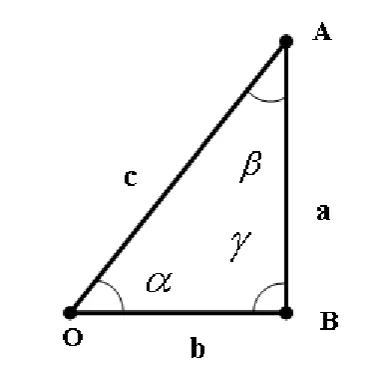
As is well known, the triangle is one of the most important figures in geometry and trigonometry. This figure as a material system can be constructed and studied as follows.
1. The triangle is constructed as is follows. If the sides of the angle are bound up with the rectilinear segment, then the synthesized system (the constructed geometrical figure)
AOB
is calledtriangle (Figure 1).
Figure 1. Geometrical figure "right triangle " as a material system. Points are universal joints.
Three points O, A, B are called vertexes of triangle. The rectilinear segments
a
, b,c
bounded (bordered) by vertexes are called legs of triangle
AOB
.Triangle as a material system does not exist if length of any leg is equal to zero. Existence of interior angles
,
,
of triangle leads to rise of the essential property (feature, parameter) of system: the sum
S
. The problem of value of the sum S is the essence of the problem of Euclid's V-th postulate. Value of S can be determined only by means of experimental investigation of properties of triangle as a material system [4].2. The experimental device for determination of value
S represents the following material design: material triangle
AOB
which has vertexes O,A, B as joints. The joints give opportunity to change the following characteristics of triangle: values of quantities
,
,
of angles andlengths of legs
a
, b,c
of the triangle under the condition thata
0
,b
0
,c
0
. In otherwords, joints give an opportunity of structural (“internal”) movement of triangle (i.e., transitions from some structural states into others). (By definition, the structural movement of the system is the conservation of the basic properties of the system under various internal and external changes).
180
S
and this property of a triangle (as a system)does not depend on properties of elements of a triangle. In other words, it is necessary to show that S is the invariant of the structural movement of a triangle.
The result of the experiment is as follows [4]:
(a) if the quantity
is subject to change, then this change leads to a change quantities
and
;
180
0
;0
180
;0
180
;(b) if
0
, then
180
;(c) if
180
, then
0
;(d) 0
180;(e) area (as a variable) is not the essential feature of triangle;
(f) lengths of legs
a
, b,c
of triangle are not equal to zero. In other words, unlike reasoning of A.M. Legendre, it is not assumed in this experiment that “legs of triangle increase infinitely” (N. Lobachevski).Therefore, it is possible “to conclude from this that approaching of opposite legs to the third side under decrease of two angles is necessarily finished with transmutation of other angle into two right angles” (N. Lobachevski). This result of the experiment signifies that quantity S represents the sum of the adjacent angles
and
. Hence,S
180
. Thus, Euclid’s V-th postulate (or the axiom V in the list of Hilbert’s axioms) is proven. Consequence is as follows: the list of Hilbert’s axioms is incomplete because it does not contain the definition of concept of triangle; therefore, axiom V is not a logical consequence of axioms I-IV. (In other words, the properties of the triangle can be learned only if the triangle has already been constructed (i.e., if the triangle is defined in the list of axioms). Therefore, the property (S
180
) ofthe triangle
AOB
as the system is not a logicalconsequence of the property of the angle
AOB
).Thus, the experimental study of the properties of a triangle as a material system gave me an opportunity to prove Euclid’s V-th postulate. However, I don’t know Who (or what the Essence) led me in this way. What is this Essence?
DISCUSSION
In my opinion, the problem of the creation of Artificial Intelligence (AI) and Artificial General Intelligence (AGI) is a problem of modeling Human Intellect (Human Mind, thought). The scientific problems must be researched within the framework of the correct methodological basis: the unity of formal logic and of rational dialectics. The criterion of truth is practice. And practice is a starting point of any correct theory.
1. As is known, the practical (empirical) facts are as follows:
(a) man enters into the comatose state if his consciousness is completely blocked. This signifies that thinking does not work without consciousness;
(b) man (i.e., the physiological body) dies (i.e., breathing and heart functions are ceased) if his subconsciousness is completely blocked (i.e., if the connection between the subconsciousness and the physiological body is disrupted). This signifies that the subconsciousness of the living man always works. Thus, life and a thinking (thought) cannot exist without the subconsciousness and the physiological body;
(c) man becomes a bio-robot (biological robot, in the narrow sense of the word) if its subconsciousness is not completely blocked. This signifies that a thinking works in a narrow, restricted, limited range. Bio-robots can eat, drink, talk, cry, laugh, work, and carry out simple orders, commands within the framework of the patterns of behavior, which is contained in his consciousness. But bio-robot cannot think critically and create. Thus, the thinking is an essential property (i.e., an essential feature, attribute) of the system “subconsciousness + consciousness”. The creative thinking does not exist without the subconsciousness;
(d) research of hypnotic and meditative states proves the existence of a complex structure of the subconsciousness; the structure of the subconsciousness, probably, cannot be cognized;
condition (mode, regime) of interaction between the subconsciousness and the consciousness. The consciousness in the active state operates in selective mode (regime): the consciousness censors and filters the incoming information (if information comes slowly). The consciousness in the passive state (i.e., in a sleepy or a hypnotic state) does not choose, does not select, does not censor, does not filter the incoming information. In this case, the information coming from the outside is acquired without resistance by the consciousness. This circumstance is used in practice of psychological (particularly, psycholinguistic) programming (coding) of the consciousness of the man;
(f) the psychological (in particular, psycholinguistic) programming (psycholinguistic programming (coding)) of the consciousness of man forms new rules (schemes, instructions) of behavior (actions) of man. The new rules (schemes, instructions) are retained (maintained, conserved) in the consciousness and taken into account by the subconsciousness up to a certain moment until a programmer or subconsciousness does not change the rules. Psychological programming of the consciousness of man is an effective means to stimulate mental activity. However, psychological programming of the consciousness of man is not an effective means to stimulate creative activity;
(g) the means of the increase of effectiveness of activities of the creative people is formation of a powerful incentive, formation of a special environment (surroundings) and of existence conditions. The history of sciences and my experience show that the creative activity of man is highly dependent on the specificity of incentive (stimulus). The comfort (comfortable) conditions of life and the pursuit of comfort (comfortable) conditions of life are not a necessary and sufficient condition for the effectiveness of scientific creativity. The comfort (comfortable) conditions of life give rise to the “corporative science”: the “science” of conservation of comfort (comfortable) conditions of life of the scientist. The comfort (comfortable) conditions of life do not stimulate the search for scientific truth.
2. As is known from the history of sciences, the search for scientific truth – as the aspiration for a vital-essential aim (goal) – is the true sense (content, meaning) of life and of activity of a creative man. The search for scientific truth is possible if and only if the scientific community
raises the truth (but not man!) on the pedestal (podium), if the search for the truth becomes a vital necessity and sense (content, meaning) of the life of a scientist. In this case, the scientific community also gives opportunity to scientists for open criticism of whatever scientific work. The possibility of public discussion and of criticism is an important condition for the existence of sciences, for the development of sciences, and for the increase of effectiveness of activities of the creative scientists. Another important condition is the search for and selection of independent researchers. The independently thinking researchers can go against the current, striving for truth. The scientists of geniuses were and are always the independently thinking researchers. 3. Can a computer think? Can a computer replace the
creative man? To answer these questions, one must compare man (in particular, the creative man) with a computer. In concordance with formal logic, the comparison can be made if man and a computer have common certain aspect. It is clear that the essences of man and a computer are absolutely different. However, the certain manifestations of the essences can be similar and comparable with each other. Obviously, the ability to process information and perform computations is the common aspect of the manifestations of the essences of man and of a computer.
(a) As is known, “a computer is a general-purpose electronic device that must be programmed to carry out a set of arithmetic or logical operations automatically (without human intervention). Since a sequence of operations can be readily changed, the computer can solve more than one kind of problem. The principle of the modern computer was first described by mathematician and pioneering computer scientist Alan Turing, who set out the ide