Cite as: Can Urol Assoc J 2013;7(11-12):463-70. http://dx.doi.org/10.5489/cuaj.1482 Published online December 5, 2013.
Abstract
Introduction: We review the current evidence for the role of
low-dose rate brachytherapy (PB) in patients with low- or intermediate-risk prostate cancer using a systematic review of the literature.
Methods: We searched MEDLINE and EMBASE (from January 1996
to October 2011), the Cochrane Library, relevant guideline web-sites, and websites for meetings specific for genitourinary diseases.
Results: Ten systematic reviews and 55 single-study papers met the
pre-planned study selection criteria. In the end, 36 articles were abstracted and analyzed for this systematic review. There is no evidence for a difference in efficacy between PB and external beam radiation therapy (EBRT), or between PB and radical prostatectomy (RP). During the 6 months to 3 years after treatment, PB was asso-ciated with less urinary incontinence and sexual impotency than RP, and RP was associated with less urinary irritation and rectal morbidity than PB. However, these differences diminished over time. PB conferred less risk of impotency and rectal morbidity in the three years after treatment than EBRT. Iodine-125 and alladium-103 did not differ with respect to biochemical relapse-free survival and patient-reported outcomes.
Conclusions: PB alone is a treatment option with equal efficacy
to EBRT or RP alone in patients with newly diagnosed low- or intermediate-risk prostate cancer who require or choose active treatment.
Introduction
Prostate cancer is a common cause of cancer-related mor-tality in North America and Europe.1,2 In Canada in 2013,
23 600 new prostate cancer cases were predicted, as are approximately 4000 deaths related to prostate cancer.1 In
2001, the Cancer Care Ontario (CCO) Genitourinary Cancer Disease Site Group (DSG) and the Program in Evidence-Based Care (PEBC) developed a guideline on PB for patients
with low-risk prostate cancer (literature search from 1988 to 1999).3 Since studies with stronger quality of evidence
(e.g., randomized controlled trials [RCTs]) on investigating low- and even intermediate-risk patient populations have been published during the last decade, it is necessary to update this systematic review.
Based on the clinical practice guidelines of the Genitourinary Radiation Oncologists of Canada4 and the
National Comprehensive Cancer Network (NCCN),5 prostate
cancer patients are classified into 3 groups: low-risk (defined as having a prostate-specific antigen [PSA] <10 ng/mL and clinical stage T1c-T2a and Gleason score <7), intermediate-risk (PSA ≥10 ng/mL, but <20 ng/mL or clinical stage T2b-T2c or Gleason score =7), and high-risk (PSA ≥20 ng/mL or clinical stage >T2c or Gleason score >7). To date, 3 isotopes have been available for PB in patients with prostate cancer: iodine-125 (I-125), palladium-103 (Pd-103), and cesium-131 (Cs-131), each of which has a different half-life (59.4 days, 17.0 days, and 9.7 days, respectively6). It is unclear which
isotope maximizes clinical outcomes.
Our goal in this updated systematic review is to answer the following 3 questions in patients with newly diagnosed low- or intermediate-risk prostate cancer who are eligible for treatment with PB:
1. What is the efficacy of PB alone for clinical outcomes (specifically: prostate cancer specific mortality [PCSM], overall survival [OS], biochemical relapse-free survival [bRFS], negative biopsy rate, salvage treatment rate, tox-icity, and patient-reported outcomes, including quality of life [QOL]), when compared with EBRT alone, or RP alone?
2. What is the efficacy of PB and EBRT in combination, for the above clinical outcomes, when compared with PB alone, EBRT alone, or RP alone?
3. Among the 3 isotopes used for PB, which one maxi-mizes clinical outcomes?
George Rodrigues, MD, MSc, FRCPC, MSc;
*Xiaomei Yao, MSc;
†D. Andrew Loblaw, MD, MSc, FRCPC;
§Michael Brundage, MD, MSc, FRCPC;
¥Joseph L. Chin, MD, FRCSC
±*London Health Sciences Centre, Department of Oncology, Western University, London, ON; †Program in Evidence-based Care, McMaster University, Hamilton, ON; §Department of Radiation Oncology, University of Toronto, Sunnybrook Health Sciences Centre, Toronto, ON; ¥Division of Cancer Care and Epidemiology, Cancer Research Institute, Queen’s University; ±Division of Urology, London Health Sciences Centre, Division of Surgical Oncology, Schulich School of Medicine and Dentistry, Western University, London, ON
Methods
Literature search strategy
A literature search with a priori defined study selection cri-teria was performed using MEDLINE and EMBASE through the Ovid search engine; also, the Cochrane Clinical Trial Register was searched for the period of January 1, 1996 to October 27, 2011. Alternative terms for brachytherapy including I-125, Pd-103, or Cs-131; alternative terms for prostate cancer were used to search literatures respectively, and then “AND” was used to combine results of these 2.7
The relevant guideline websites (e.g., National Guideline Clearinghouse), websites for meetings specific for gen-itourinary diseases (e.g., American Society for Radiation Oncology), and the Standards and Guidelines Evidence Inventory of Cancer Guidelines8 were checked for existing
relevant systematic reviews and guidelines.
Study selection criteria
Inclusion criteria
1. Systematic reviews, RCTs, and prospective comparative studies with analyzed sample size ≥30 for each com-parative subgroup, or retrospective comcom-parative studies with total sample size ≥500.
2. Papers on studies comparing PB with EBRT or RP alone; PB plus EBRT with PB, EBRT, or RP alone; different doses of PB alone or PB plus EBRT; or any 2 of the 3 isotopes. 3. Papers reporting on at least one of the target clinical
outcomes.
4. Papers published in English.
Exclusion criteria
1. Studies reporting outcomes on mixed risk group popula-tions where >20% of the patients were from the high-risk category or studies in which outcomes were not stratified by risk group.
2. Studies in which treatments were selected according to known risk factors (e.g., patients with PSA <10 ng/mL received PB and patients with PSA ≥10 ng/mL received EBRT).
Synthesizing the evidence
The evidence from included papers was reviewed by 4 clin-ician members of the genitourinary cancer Disease Site Group (DSG), and 1 methodologist from the Program in Evidence-Based Care (PEBC). All data were audited by a second,
independent auditor. Data for any subgroup with less than 30 patients were not used given the large confidence inter-vals implicit in the analysis of small numbers of patients. Significance testing was reported as per the source study.
Assessing quality of the studies
The quality of the RCTs included in this review was assessed using the modified Cochrane Collaboration’s tool.9 The
qual-ity of non-randomized studies was assessed using the modi-fied Newcastle-Ottawa Scale.10
Results
Literature search results
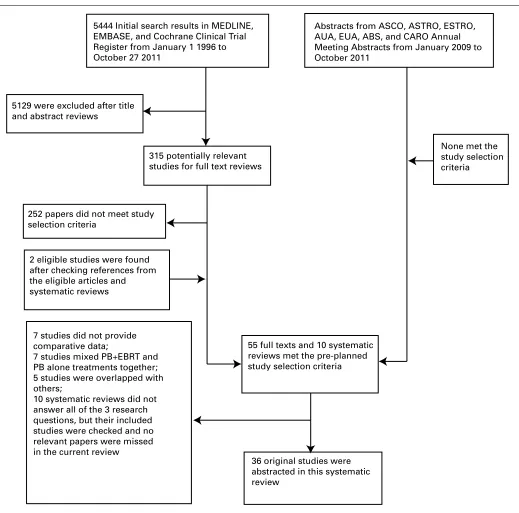
After searching the MEDLINE, EMBASE, and the Cochrane Clinical Trial Register, 5444 citations were identified (Fig. 1). Ultimately, a total of 10 systematic reviews11-20 and 55
unique studies21-75 met the study selection criteria. After
care-ful consideration (Fig. 1), we finally chose 36 articles for this systematic review. Among them, 29 articles related to the first research question,21-23,25-27,29-31,33,34,37,38,41-46,49,51,52,56,61,65,66,72-74 6
related to the second question,35,36,58,63,69,72 and 3 related to
the third research question.36,39,47
We identified the non-RCTs that met our pre-planned study selection criteria; we tallied them and included them for completeness (Table 1, http://journals.sfu.ca/cuaj/index. php/journal/article/view/1482/1457). They were not inter-preted owing to the potential likelihood of significant bias influencing the study findings: studies that did not control for differences in baseline patient characteristics by using multivariate analysis; studies where overall survival (OS)/ prostate cancer specific mortality (PCSM) were <10 years given that the relative 10-year and 15-year prostate-can-cer survival rates are 98% and 91%, respectively, for all prostate cancer patients with any treatment (it is unlikely that between-group differences in survival due to treatment selection would manifest at <10 years);76 studies not
report-ing biochemical relapse-free survival (bRFS) rates ≥5 years (since “benign PSA bounce”77,78 can occur within 5 years
following treatment with PB or EBRT); and studies including unclear proportion of high-risk patients.
Assessment of study quality
Among the 36 articles, 6 reported targeted outcomes from 3 RCTs.36,37,39,47,58,69 Only 1 of the 5 papers39 from the RCTs
pre-planned interim analysis. The randomization method and allocation concealment were clearly reported and by necessity, patients and clinicians were unblinded in both RCTs. The 2009 Giberti and colleagues’ trial was the sixth RCT and demonstrated good quality on the randomization method and allocation concealment;37 outcome assessors
were blinded to patient treatment; the follow-up rate was
87% over 5 years. However, there was no expected effect size or sample size calculation, no intention-to-treat analy-sis, and no information about funding resources. Overall, the quality of evidence from these RCTs was considered to be poor to moderate.
Fourteen articles reported prospective studies and 16 were retrospective studies. The baseline patient
character-5444 Initial search results in MEDLINE, EMBASE, and Cochrane Clinical Trial Register from January 1 1996 to October 27 2011
Abstracts from ASCO, ASTRO, ESTRO, AUA, EUA, ABS, and CARO Annual Meeting Abstracts from January 2009 to October 2011
5129 were excluded after title and abstract reviews
315 potentially relevant studies for full text reviews
252 papers did not meet study selection criteria
2 eligible studies were found after checking references from the eligible articles and systematic reviews
7 studies did not provide comparative data;
7 studies mixed PB+EBRT and PB alone treatments together; 5 studies were overlapped with others;
10 systematic reviews did not answer all of the 3 research questions, but their included studies were checked and no relevant papers were missed in the current review
None met the study selection criteria
55 full texts and 10 systematic reviews met the pre-planned study selection criteria
36 original studies were abstracted in this systematic review
istics or the proportion of different risk patients among the treatment groups were reported as significantly different in 21 studies.21,22,26,27,29,30,33,38,43-46,49,51,52,61,63,66,72-74 There was
no statistical comparison of baseline patient characteristics among intervention groups in 6 studies.23,34,35,42,56,65 Only
the study by Kirschner-Hermann and colleagues reported a blinded assessment of outcome.41 Although the follow-up
rates in most studies were over 80%, only 10 studies had at least 1 group with at least 5 years of median or mean follow-up time.21-23,26,29,43,63,66,72,74 Overall, the study quality
from the non-RCTs was poor to moderate.
Outcomes
Patient characteristics, treatment dose, and treatment effect outcomes are shown in Table 1 (http://journals.sfu.ca/cuaj/ index.php/journal/article/view/1482/1457). Among the eli-gible papers, when PB was used alone, the dose was 140-160 Gy for I-125 or 108-125 Gy for Pd-103; when PB was combined with EBRT, the dose was 41.4-45 Gy EBRT fol-lowed by 100-120 Gy I-125, or 20-50.4 Gy EBRT folfol-lowed by 90-115 Gy Pd-103.
Meta-analyses of the trial results were considered, but were deemed not feasible because patient characteristics, interventions, intervention doses, PSA failure definitions, toxicity assessment criteria, and assessment tools for patient-reported outcomes among the included studies were too heterogeneous.
Outcomes relevant to research question 1: What is
the efficacy of PB alone for clinical outcomes when
compared with EBRT alone, or RP alone?
PCSM, OS, and bRFS
When PB was compared with RP for PCSM or OS, 1 retro-spective study with 41 395 mixed low-risk and intermediate-risk patients reported 10-year survival outcomes.65 In this
study, there was no statistical difference between PB and RP groups, regardless of age (Table 1, http://journals.sfu.ca/ cuaj/index.php/journal/article/view/1482/1457). Four addi-tional studies compared PB with RP for bRFS. One RCT with 200 low-risk patients37 and 1 retrospective study with 927
low-risk patients31 showed no statistical difference between
the 2 groups; 2 retrospective studies showed that PB led to a higher bRFS rate than did RP in 674 intermediate-risk patients66 and in 437 mixed low-, intermediate- and ≤20%
of high-risk patients,26 respectively.
When PB was compared with EBRT, 3 retrospective
stud-ies with 1529 patients showed there were no significant differences between the 2 groups with respect to bRFS.26,31,66
Toxicity
We tallied the studies that reported comparisons of ≥grade 2 toxicities between treatments (Table 2, http://journals.sfu. ca/cuaj/index.php/journal/article/view/1482/1457). With regard to bladder and bowel function, a retrospective study with 729 low-risk patients reported that PB led to more late grade 2 genitourinary and gastrointestinal toxicities, but less impotence than did EBRT. There were no differences for the late grade 3 genitourinary and gastrointestinal toxicities between the 2 groups;74 however, this paper did not give
the time definition of “late toxicity.” For second primary cancers, another retrospective study reported that PB led to fewer second primaries up to 5.3 years compared with EBRT in 58 623 patients (mixed risk categories, but ≤20% of high-risk patients),21 but the EBRT group had more patients ≥65 years old (82% vs. 63%) and more high-risk patients (19.6% vs. 5.4%) than those in the PB group.
Patient-reported outcomes
T h r e e R C T s ( 4 p a p e r s3 6 , 3 7 , 3 9 , 5 8) a n d 1 6 n o n
-RCTs23,25,27,29,33,34,38,41,44-46,49,51,52,61,73 reported data on
patient-reported outcomes using 20 different instruments, but only 10 articles that had clear categories for low-, and/or inter-mediate-, and/or mixed ≤20% of high-risk patients. The data indicated no statistically significant differences at baseline for QOL among intervention groups; also, the data did not adjust for baseline imbalance when reporting QOL out-comes (Table 3, http://journals.sfu.ca/cuaj/index.php/jour-nal/article/view/1482/1457). Given the heterogeneity of the study cohorts and the instruments used, estimates of the magnitude of impact of treatment on patient-reported out-comes could not be compared between studies.
When PB was compared with EBRT, 2 prospective stud-ies with 792 patients showed no difference between the 2 groups for urinary domains. PB led to less sexual and rectal problems than did EBRT in patients with mixed low-, inter-mediate-, and mixed ≤20% of high-risk patients.33,51
When PB was compared with RP, 3 prospective studies with 913 patients in mixed low-, intermediate-, and ≤20% of high-risk showed that urinary incontinence and sexual potency favoured PB, while other urinary problems favoured RP.27,38,51 For rectal morbidity, 1 study favoured RP,27 but the
3 other studies found no difference.33,38,51 In an RCT with
Outcomes relevant to research question 2: What is the
efficacy of PB and EBRT in combination, for the above
clinical outcomes, when compared with PB alone, EBRT
alone, or RP alone?
No study compared the combination of EBRT plus PB with PB, EBRT, or RP alone for treatment benefit outcomes in the target patients in (Table 1, http://journals.sfu.ca/cuaj/index. php/journal/article/view/1482/1457).
One retrospective study of 825 patients investigated gas-trointestinal toxicity between PB plus EBRT and PB alone and found no difference between arms at 8 and 12 months in Table 2 (http://journals.sfu.ca/cuaj/index.php/journal/article/ view/1482/1457).35
For patient-reported outcomes, when PB plus EBRT was compared with PB alone, 1 retrospective study73
demon-strated that PB led to a better urinary function and bother outcomes. There were no statistical differences for sexual, bowel function and bother, or overall QOL between 3 groups in 510 patients with mixed low-, intermediate-, and mixed ≤20% of high-risk in Table 3 (http://journals.sfu.ca/ cuaj/index.php/journal/article/view/1482/1457).
Outcomes relevant to research question 3: Among the
three isotopes used for PB, which one maximizes
clinical outcomes?
In Table 1 (http://journals.sfu.ca/cuaj/index.php/journal/ article/view/1482/1457), 1 RCT with 263 low-risk patients showed no significant difference for bRFS rate between the I-125 and Pd-103 groups (96.8% vs. 99.2%, p = 0.149).47
Up to the search date, there was no evidence to compare the toxicity of different isotopes used for PB in the target patients.
For patient-reported outcomes, when I-125 was compared with Pd-103, 1 RCT with 314 low-risk patients reported that Pd-103 resulted in worse overall QOL than did I-125 at 1 month, and I-125 resulted in worse overall QOL than did Pd-103 at 6 months. However, there was no difference between the 2 groups at 1 and 2 years.39
Ongoing trials
The National Cancer Institute Clinical Trials database was searched on September 12, 2012 and the Radiation Therapy Oncology Group website was searched on March 20, 2012 for potential trials meeting our selection criteria. Six ongoing RCTs were found (the summarized details can be obtained by contacting authors).
Discussion
There are many challenges inherent in conducting an RCT in prostate cancer patients, including the natural history of the disease, strong patient treatment preferences, or concerns regarding receiving non-standard of care approaches.79 For
example, an American College of Surgeons Oncology Group phase III trial (SPIRIT) comparing RP and PB for patients with low-risk prostate cancer opened in 2002, but was closed in 2004 due to poor accrual.29
Due to the relative dearth of RCTs, comparative observa-tional studies were therefore included in this review if they met the a priori selection criteria. Despite the fact that 36 original studies were abstracted in this review, there remains insufficient evidence to answer all 3 research questions with certainty.
Firstly, each of the eligible studies has substantial poten-tial for bias and thus considerable uncertainty regarding its findings. Secondly, it is recognized that bRFS rate is a surro-gate endpoint of treatment efficacy, and few studies reported survival outcomes (PCSM or OS). Thirdly, the studies report-ing bRFS used different definitions for PSA failure, mak-ing between-study comparisons difficult. Most publications before 2006 used the 1996 ASTRO definition (3 consecutive rising PSA values each obtained at least 3 months apart);80
after 2006, most publications followed the 2006 ASTRO definition for failure following PB (PSA should be higher than nadir plus 2 ng/mL) in recognition of the “benign PSA bounce.”81 For RP, definitions for PSA failure included PSA
value ≥0.2 ng/mL, >0.3 ng/mL, or ≥0.4 ng/mL. When PB was compared with RP, using the ASTRO 2006 definition for PSA failure created a bias favouring PB, but adequate follow-up reduced this bias.81 Therefore, only bRFS at ≥5
versus high quality RP were not possible. In addition, as RP and PB are widely performed, the authors of this systematic review wanted to assess the comparative effectiveness of the different procedures (i.e., what the results are across a large spectrum of centres).
Although the quality of evidence from included studies was low-to-moderate in nature within this systematic review, the evidence across the eligible studies consistently sup-ports the conclusion that there is no difference in treatment efficacy between PB, EBRT, and RP in patients with low-, or intermediate-risk prostate cancer.
It is worthy to note that although the 2010 study by Pickles and colleagues is a retrospective study and does not meet the pre-planned study inclusion criteria (i.e., the sample size from a retrospective study should be >500), it is a relevant piece of work that fits within the Canadian context of practice.82 In
total, 108 patients with low-risk and 31 with intermediate-risk prostate cancer in the PB group were matched with patients in the EBRT group. The median followed-up time was 5.5 years. The 5-year bRFS rates in the PB group and the EBRT group were 95% versus 85% (p< 0.001) for all patients, 94% versus 88% (p< 0.001) for low-risk patients, and 100% versus 78% (p= 0.016) for intermediate-risk patients, respectively. At 7 years, the bRFS rate was 95% versus 75% (p< 0.001) for all patients, respectively. Late urinary toxicity was worse in patients treated with PB, and late rectal toxicity was worse in patients treated with EBRT. Thus, this study also supports the conclusion of this systematic review.
After our search for this review, another similar systematic review had been done by Grimm and colleagues.83 They
came to different conclusions and reported that “brachy-therapy provides superior outcome in patients with low-risk disease.” There are several reasons for the difference. Firstly, this Grimm review included single-arm studies. We consid-ered it inappropriate to investigate the treatment effect of one option since without direct comparison between 2 treatment options as many potential confounders can bias the treat-ment results. Secondly, the Grimm 2012 review combined all the comparative studies that met its inclusion criteria in a single analysis. However, for comparative studies (non-RCTs), if the patient characteristics were significantly dif-ferent between 2 treatment groups at baseline, it would be impossible to know whether their final results for treatment effect were real or affected by uncontrolled for the potential confounders at baseline. Actually, many of the 10 systematic reviews that met the pre-planned selection criteria11,19 did
not consider this important point.
Conclusions
To date, consistent evidence exists to support PB alone as a treatment option with equal efficacy to EBRT alone or RP alone for patients with newly diagnosed low- or
intermedi-ate-risk prostate cancer who require or choose active treat-ment; benefits and toxicities must also be balanced. There is insufficient evidence to recommend the use of combination of EBRT plus BT in the target patients. I-125 and Pd-103 are not different for bRFS and QOL in target patients. There is no efficacy evidence for Cs-131. In the absence of large RCTs and faced with small sample sizes in existing non-RCT studies, any possible difference that may exist between the treatment options cannot be conclusively identified. Hence, large sample-size, well-designed, and good-quality RCTs and/or prospective comparative studies are required to investigate novel or targeted approaches in patients with low- or intermediate-risk prostate cancer.
Acknowledgements: The authors would like to thank Harkanwal Randhawa for his contribution toward the data audit, and the Genitourinary Cancer Disease Site Group members in Ontario (Glenn Bauman, Jack Barkin, Rodney Breau, Christina Canil, Charles Catton, Urban Emmenegger, John Hastie, Sébastien Hotte, Himu Lukka, Scott Morgan, Bobby Shayegan, Tom Short, John Srigley, Padraig Warde, Eric Winquist) for their comments on the early draft of this project.
Competing interests: The Program in Evidence-based Care (PEBC) is supported by the Ontario Ministry of Health and Long-Term Care through Cancer Care Ontario. All work produced by the PEBC is editorially independent from its funding source. The lead author, George Rodrigues, declared that he published a commentary on intensity-modulated radiotherapy for prostate cancer (Rodrigues G. Is intensity-modulated radiotherapy for prostate cancer ready for prime-time? Can J Urol 2012;19:6381-2). Dr. Loblaw has consulted with, and has received honorarium from GE Healthcare. The other 3 authors declared none.
This paper has been peer-reviewed.
References
1. Canadian Cancer Society’s Steering Committee on Cancer Statistics. Canadian Cancer Statistics 2013. Toronto, ON: Canadian Cancer Society; 2013. http://www.cancer.ca/Ontario/About%20cancer/ Cancer%20statistics/Stats%20at%20a%20glance/Prostate%20cancer.aspx?sc_lang=en&r=1. Accessed November 14, 2013.
2. Cancer Research UK. UK Cancer Incidence (2010) and Mortality (2010) Summary. http://publications. cancerresearchuk.org/downloads/Product/CS_DT_CASESDEATHS.pdf . Accessed November 14, 2013. 3. Crook J LH, Klotz L, Bestic N, et al. Genitourinary Cancer Disease Site Group of the Cancer Care Ontario Practice Guidelines Initiative. Systematic overview of th e evidence for brachytherapy in clinically localized prostate cancer. Can Med Assoc J 2001;164:975-81.
4. Lukka H. Prostate cancer: risk categories and role of hormones and radiotherapy. Can J Urol 2002;9(Suppl 1):26-9.
5. National Comprehensive Cancer Network (NCCN) Clinical Practice Guideline in Oncology. Prostate Cancer. Version 1; 2012. http://www.nccn.org/professionals/physician_gls/pdf/prostate.pdf. Accessed November 14, 2013.
6. Yang R WJ, Zhang H. Dosimetric study of Cs-131, I-125, and Pd-103 seeds for permanent prostate brachy-therapy. Cancer Biother Radiopharm 2009;24:701-5. http://dx.doi.org/10.1089/cbr.2009.0648 7. Rodrigues G, Yao X, Loblaw A, et al. Genitourinary Cancer Disease Site Group. Low-dose rate brachytherapy
for patients with low- or intermediate-risk prostate cancer. Toronto, ON: Cancer Care Ontario; 2012. Program in Evidence-based Care Evidence-Based Series No.: 3-10 Version 2. https://www.cancercare. on.ca/common/pages/UserFile.aspx?fileId=254196. Accessed November 14, 2013.
9. Higgins JPT, Green S. Cochrane handbook for systematic reviews of interventions. Version 5.1.0. The Collaboration; 2011. www.cochrane-handbook.org. Accessed November 14, 2013.
10. Wells GA Shea B, O’Connell D, et al. The Newcastle-Ottawa Scale (NOS) for assessing the quality of nonrandomised studies in meta-analyses. Ottawa: Ottawa Hospital Research Institute; 2013. http:// www.ohri.ca/programs/clinical_epidemiology/oxford.htm. Accessed November 14, 2013. 11. Bannuru RR, Dvorak T, Obadan N, et al. Comparative evaluation of radiation treatments for clinically
localized prostate cancer: an updated systematic review. Ann Intern Med 2011;155:171-8. http:// dx.doi.org/10.7326/0003-4819-155-3-201108020-00347
12. Bhatnagar V, Stewart ST, Huynh V, et al. Estimating the risk of long-term erectile, urinary and bowel symptoms resulting from prostate cancer treatment. Prostate Cancer Prostatic Dis 2006;9:136-46. http:// dx.doi.org/10.1038/sj.pcan.4500855
13. Katz A. Quality of life for men with prostate cancer. Cancer Nurs 2007;30:302-8. http://dx.doi. org/10.1097/01.NCC.0000281726.87490.f2
14. Koukourakis G KN, Armonis V, Kouloulias V. Brachytherapy for prostate cancer: a systematic review. Adv Urol 2009:327945.
15. Peinemann F, Grouven U, Bartel C, et al. Permanent interstitial low-dose-rate brachytherapy for patients with localised prostate cancer: A systematic review of randomised and nonrandomised controlled clinical trials. Eur Urol 2011;60:881-93. http://dx.doi.org/10.1016/j.eururo.2011.06.044
16. Peinemann F, Grouven U, Hemkens LG, et al. Low-dose rate brachytherapy for men with localized prostate cancer. Cochrane Database Syst Rev 2011:CD008871.
17. Pieters BR, de Back DZ, Koning CCE, et al. Comparison of three radiotherapy modalities on biochemical control and overall survival for the treatment of prostate cancer: a systematic review. Radiother Oncol 2009;93:168-73. http://dx.doi.org/10.1016/j.radonc.2009.08.033
18. Sahgal A, Roach M 3rd. Permanent prostate seed brachytherapy: a current perspective on the evolution of the technique and its application. Nat Clin Pract Urol 2007;4:658-70. http://dx.doi.org/10.1038/ ncpuro0971
19. Wilt TJ, MacDonald R, Rutks I, et al. Systematic review: comparative effectiveness and harms of treatments for clinically localized prostate cancer. Ann Intern Med 2008;148:435-48. http://dx.doi. org/10.7326/0003-4819-148-6-200803180-00209
20. Zhang LL, Ma L, Tian JH, et al. 125I versus 103Pd brachytherapy for low risk prostate cancer: A systematic review. Chin J Cancer 2009;28:872-8. http://dx.doi.org/10.5732/cjc.008.10378
21. Abdel-Wahab M, Reis IM, Hamilton K. Second primary cancer after radiotherapy for prostate cancer--a seer analysis of brachytherapy versus external beam radiotherapy. Int J Radiat Oncol Biol Phys 2008;72:58-68. http://dx.doi.org/10.1016/j.ijrobp.2007.12.043
22. Arvold ND, Chen M-H, Moul JW, et al. Risk of death from prostate cancer after radical prostatectomy or brachytherapy in men with low or intermediate risk disease. J Urol 2011;186:91-6. http://dx.doi. org/10.1016/j.juro.2011.03.003
23. Bacon CG, Giovannucci E, Testa M, et al. The impact of cancer treatment on quality of life outcomes for patients with localized prostate cancer. J Urol 2001;166:1804-10. http://dx.doi.org/10.1016/ S0022-5347(05)65679-0
24. Blasko JC, Grimm PD, Sylsvester JE, et al. The role of external beam radiotherapy with I-125/Pd-103 brachytherapy for prostate carcinoma. Radiother Oncol 2000;57:273-8. http://dx.doi.org/10.1016/ S0167-8140(00)00288-7
25. Borchers H, Kirschner-Hermanns R, Brehmer B, et al. Permanent 125I-seed brachytherapy or radical prostatectomy: A prospective comparison considering oncological and quality of life results. BJU Int 2004;94:805-11. http://dx.doi.org/10.1111/j.1464-410X.2004.05037.x
26. Burdick MJ, Reddy C, Ulchaker J, et al. Comparison of biochemical relapse-free survival between primary Gleason score 3 and primary Gleason score 4 for biopsy Gleason score 7 prostate cancer. Int J Radiat Oncol Biol Phys 2009;73:1439-45. http://dx.doi.org/10.1016/j.ijrobp.2008.07.033
27. Buron C, Le Vu B, Cosset J-M, et al. Brachytherapy versus prostatectomy in localized prostate cancer: results of a French multicenter prospective medico-economic study. Int J Radiat Oncol Biol Phys 2007;67:812-22. http://dx.doi.org/10.1016/j.ijrobp.2006.10.011
28. Colberg JW, Decker RH, Khan AM, et al. Surgery versus implant for early prostate cancer: results from a single institution, 1992-2005. Cancer J 2007;13:229-32. http://dx.doi.org/10.1097/ PPO.0b013e318046f14e
29. Crook JM, Gomez-Iturriaga A, Wallace K, et al. Comparison of health-related quality of life 5 years after SPIRIT: Surgical Prostatectomy Versus Interstitial Radiation Intervention Trial. J Clin Oncol 2011;29:362-8. http://dx.doi.org/10.1200/JCO.2010.31.7305
30. D’Amico AV, Tempany CM, Schultz D, et al. Comparing PSA outcome after radical prostatectomy or magnetic resonance imaging-guided partial prostatic irradiation in select patients with clinically localized adenocarcinoma of the prostate. Urology 2003;62:1063-7. http://dx.doi.org/10.1016/S0090-4295(03)00772-6
31. D’Amico AV, Whittington R, Malkowicz SB, et al. Biochemical outcome after radical prostatectomy, external beam radiation therapy, or interstitial radiation therapy for clinically localized prostate cancer. JAMA 1998;280:969-74. http://dx.doi.org/10.1001/jama.280.11.969
32. Eller LS, Lev EL, Gejerman G, et al. Prospective study of quality of life of patients receiving treatment for prostate cancer. Nurs Res 2006;55:S28-36. http://dx.doi.org/10.1097/00006199-200603001-00006 33. Ferrer M, Suarez JF, Guedea F, et al. Health-related quality of life 2 years after treatment with radical prostatectomy, prostate brachytherapy, or external beam radiotherapy in patients with clinically local-ized prostate cancer. Int J Radiat Oncol Biol Phys 2008;72:421-32. http://dx.doi.org/10.1016/j. ijrobp.2007.12.024
34. Frank SJ, Pisters LL, Davis J, et al. An assessment of quality of life following radical prostatectomy, high dose external beam radiation therapy and brachytherapy iodine implantation as monotherapies for localized prostate cancer. J Urol 2007;177:2151-6. http://dx.doi.org/10.1016/j.juro.2007.01.134 35. Gelblum DY, Potters L. Rectal complications associated with transperineal interstitial brachytherapy for prostate cancer. Int J Radiat Oncol Biol Phys 2000;48:119-24. http://dx.doi.org/10.1016/S0360-3016(00)00632-5
36. Ghaly M, Wallner K, Merrick G, et al. The effect of supplemental beam radiation on prostate brachytherapy-related morbidity: morbidity outcomes from two prospective randomized multicenter trials. Int J Radiat Oncol Biol Phys 2003;55:1288-93. http://dx.doi.org/10.1016/S0360-3016(02)04527-3 37. Giberti C, Chiono L, Gallo F, et al. Radical retropubic prostatectomy versus brachytherapy for low-risk
prostatic cancer: a prospective study. World J Urol 2009;27:607-12. http://dx.doi.org/10.1007/ s00345-009-0418-9
38. Guedea F, Ferrer M, Pera J, et al. Quality of life two years after radical prostatectomy, prostate brachytherapy or external beam radiotherapy for clinically localised prostate cancer: the Catalan Institute of Oncology/Bellvitge Hospital experience. Clin Trans Oncol 2009;11:470-8. http://dx.doi.org/10.1007/s12094-009-0387-x 39. Herstein A, Wallner K, Merrick G, et al. I-125 versus Pd-103 for low-risk prostate cancer: long-term morbidity
outcomes from a prospective randomized multicenter controlled trial. Cancer J 2005;11:385-9. http:// dx.doi.org/10.1097/00130404-200509000-00005
40. Jabbari S, Weinberg VK, Shinohara K, et al. Equivalent biochemical control and improved prostate-specific antigen nadir after permanent prostate seed implant brachytherapy versus high-dose three-dimensional conformal radiotherapy and high-dose conformal proton beam radiotherapy boost. Int J Radiat Oncol Biol Phys 2010;76:36-42. http://dx.doi.org/10.1016/j.ijrobp.2009.01.029
41. Kirschner-Hermanns R, Brehmer B, Borchers H, et al. Do patients with urodynamically proven infravesi-cal obstruction and detrusor overactivity have a higher risk for long-term bothersome symptoms after brachytherapy in comparison to patients treated with radical prostatectomy for localized prostate cancer? Curr Urol 2008;2:135-41. http://dx.doi.org/10.1159/000189654
42. Klein EA, Ciezki J, Kupelian PA, et al. Outcomes for intermediate risk prostate cancer: are there advan-tages for surgery, external radiation, or brachytherapy? Urol Oncol 2009;27:67-71. http://dx.doi. org/10.1016/j.urolonc.2008.04.001
43. Kupelian PA, Potters L, Khuntia D, et al. Radical prostatectomy, external beam radiotherapy <72 Gy, external beam radiotherapy > or =72 Gy, permanent seed implantation, or combined seeds/external beam radiotherapy for stage T1-T2 prostate cancer. Int J Radiat Oncol Biol Phys 2004;58:25-33. http:// dx.doi.org/10.1016/S0360-3016(03)00784-3
44. Lev EL, Eller LS, Gejerman G, et al. Quality of life of men treated for localized prostate cancer: outcomes at 6 and 12 months. Support Care Cancer 2009;17:509-17. http://dx.doi.org/10.1007/s00520-008-0493-2 45. Litwin MS, Sadetsky N, Pasta DJ, et al. Bowel function and bother after treatment for early stage prostate
cancer: a longitudinal quality of life analysis from CaPSURE. J Urol 2004;172:515-9. http://dx.doi. org/10.1097/01.ju.0000129236.56712.e7
46. Malcolm JB, Fabrizio MD, Barone BB, et al. Quality of life after open or robotic prostatectomy, cryoablation or brachytherapy for localized prostate cancer. J Urol 2010;183:1822-8. http://dx.doi.org/10.1016/j. juro.2009.12.102
47. Merrick GS, Butler WM, Wallner KE, et al. Dosimetry of an extracapsular anulus following perma-nent prostate brachytherapy. Am J Clin Oncol 2007;30:228-33. http://dx.doi.org/10.1097/01. coc.0000258110.11024.c4
48. Miller DC, Sanda MG, Dunn RL, et al. Long-term outcomes among localized prostate cancer survivors: health-related quality-of-life changes after radical prostatectomy, external radiation, and brachytherapy. J Clin Oncol 2005;23:2772-80. http://dx.doi.org/10.1200/JCO.2005.07.116
49. Namiki S, Satoh T, Baba S, et al. Quality of life after brachytherapy or radical prostatectomy for localized prostate cancer: a prospective longitudinal study. Urology 2006;68:1230-6. http://dx.doi. org/10.1016/j.urology.2006.08.1093
51. Pardo Y, Guedea F, Aguilo F, et al. Quality-of-life impact of primary treatments for localized prostate cancer in patients without hormonal treatment. J Clin Oncol 2010;28:4687-96. http://dx.doi.org/10.1200/ JCO.2009.25.3245
52. Pinkawa M, Asadpour B, Piroth MD, et al. Health-related quality of life after permanent I-125 brachytherapy and conformal external beam radiotherapy for prostate cancer--a matched-pair comparison. Radiother Oncol 2009;91:225-31. http://dx.doi.org/10.1016/j.radonc.2008.11.005
53. Potters L, Klein EA, Kattan MW, et al. Monotherapy for stage T1-T2 prostate cancer: radical prostatectomy, external beam radiotherapy, or permanent seed implantation. Radiother Oncol 2004;71:29-33. http:// dx.doi.org/10.1016/j.radonc.2003.12.011
54. Sanda MG, Dunn RL, Michalski J, et al. Quality of life and satisfaction with outcome among prostate-cancer survivors. N Engl J Med 2008;358:1250-61. http://dx.doi.org/10.1056/NEJMoa074311 55. Schover LR, Fouladi RT, Warneke CL, et al. Defining sexual outcomes after treatment for localized prostate
carcinoma. Cancer 2002;95:1773-85. http://dx.doi.org/10.1002/cncr.10848
56. Sharkey J, Cantor A, Solc Z, et al. Brachytherapy versus radical prostatectomy in patients with clinically localized prostate cancer. Curr Urol Rep 2002;3:250-7. http://dx.doi.org/10.1007/BF03200421 57. Sharkey J, Cantor A, Solc Z, et al. 103Pd brachytherapy versus radical prostatectomy in patients with
clinically localized prostate cancer: a 12-year experience from a single group practice. Brachytherapy 2005;4:34-44. http://dx.doi.org/10.1016/j.brachy.2004.12.001
58. Sherertz T, Wallner K, Merrick G, et al. Factors predictive of rectal bleeding after 103Pd and supplemen-tal beam radiation for prostate cancer. Brachytherapy 2004;3:130-5. http://dx.doi.org/10.1016/j. brachy.2004.05.005
59. Smith DP, King MT, Egger S, et al. Quality of life three years after diagnosis of localised prostate cancer: population based cohort study. BMJ 2009;339:b4817. http://dx.doi.org/10.1136/bmj.b4817 60. Soderdahl DW, Davis JW, Schellhammer PF, et al. Prospective longitudinal comparative study of
health-related quality of life in patients undergoing invasive treatments for localized prostate cancer. J Endourol 2005;19:318-26. http://dx.doi.org/10.1089/end.2005.19.318
61. Speight JL, Elkin EP, Pasta DJ, et al. Longitudinal assessment of changes in sexual function and bother in patients treated with external beam radiotherapy or brachytherapy, with and without neoadjuvant androgen ablation: data from CaPSURE. Int J Radiat Oncol Biol Phys 2004;60:1066-75. http://dx.doi. org/10.1016/j.ijrobp.2004.05.010
62. Steenland K, Goodman M, Liff J, et al. Quality of life among men with prostate cancer in rural Georgia. Urology 2011;77:927-33. http://dx.doi.org/10.1016/j.urology.2010.12.027
63. Stock RG, Klein TJ, Cesaretti JA, et al. Prognostic significance of 5-year PSA value for predicting pros-tate cancer recurrence after brachytherapy alone and combined with hormonal therapy and/or external beam radiotherapy. Int J Radiat Oncol Biol Phys 2009;74:753-8. http://dx.doi.org/10.1016/j. ijrobp.2008.08.049
64. Talcott JA, Manola J, Clark JA, et al. Time course and predictors of symptoms after primary prostate cancer therapy. J Clin Oncol 2003;21:3979-86. http://dx.doi.org/10.1200/JCO.2003.01.199 65. Tward JD, Lee CM, Pappas LM, et al. Survival of men with clinically localized prostate cancer treated
with prostatectomy, brachytherapy, or no definitive treatment: Impact of age at diagnosis. Cancer 2006;107:2392-400. http://dx.doi.org/10.1002/cncr.22261
66. Vassil AD, Murphy ES, Reddy CA, et al. Five year biochemical recurrence free survival for intermediate risk prostate cancer after radical prostatectomy, external beam radiation therapy or permanent seed implanta-tion. Urology 2010;76:1251-7. http://dx.doi.org/10.1016/j.urology.2010.01.010
67. Wallner K, Merrick G, True L, et al. I-125 versus Pd-103 for low-risk prostate cancer: morbidity out-comes from a prospective randomized multicenter trial. Cancer J 2002;8:67-73. http://dx.doi. org/10.1097/00130404-200201000-00012
68. Wallner K, Merrick G, True L, et al. Iodine-125 vs palladium-103 for low-risk prostate cancer: Preliminary urinary functional outcomes from a prospective randomized multicenter trial. J Brachytherapy Int 2000;16:151-5.
69. Wallner K, Merrick G, True L, et al. 20 Gy versus 44 Gy supplemental beam radiation with Pd-103 prostate brachytherapy: preliminary biochemical outcomes from a prospective randomized multi-center trial. Radiother Oncol 2005;75:307-10. http://dx.doi.org/10.1016/j.radonc.2005.03.019 70. Wallner K, Merrick G, True L, et al. 125I versus 103Pd for low-risk prostate cancer: Preliminary PSA
outcomes from a prospective randomized multicenter trial. Int J Radiat Oncol Biol Phys 2003;57:1297-303. http://dx.doi.org/10.1016/S0360-3016(03)01448-2
71. Wei JT, Dunn RL, Sandler HM, et al. Comprehensive comparison of health-related quality of life after contemporary therapies for localized prostate cancer. J Clin Oncol 2002;20:557-66. http://dx.doi. org/10.1200/JCO.20.2.557
72. Wong WW, Vora SA, Schild SE, et al. Radiation dose escalation for localized prostate cancer: intensity-modulated radiotherapy versus permanent transperineal brachytherapy. Cancer 2009;115:5596-606. http://dx.doi.org/10.1002/cncr.24558
73. Wu AK, Cooperberg MR, Sadetsky N, et al. Health related quality of life in patients treated with multimodal therapy for prostate cancer. J Urol 2008;180:2415-22. http://dx.doi.org/10.1016/j. juro.2008.08.015
74. Zelefsky MJ, Yamada Y, Pei X, et al. Comparison of tumour control and toxicity outcomes of high-dose intensity-modulated radiotherapy and brachytherapy for patients with favorable risk prostate cancer. Urology 2011;77:986-90. http://dx.doi.org/10.1016/j.urology.2010.07.539
75. Zhou EH, Ellis RJ, Cherullo E, et al. Radiotherapy and Survival in Prostate Cancer Patients: A Population-Based Study. Int J Radiat Oncol Biol Phys 2009;73:15-23. http://dx.doi.org/10.1016/j.ijrobp.2008.04.001 76. Survival rates for prostate cancer. American Cancer Society; 2013. http://www.cancer.org/Cancer/ ProstateCancer/OverviewGuide/prostate-cancer-overview-survival-rates. Accessed November 13, 2013. 77. Pickett B, Ten Haken RK, Kurhanewicz J, et al. Time to metabolic atrophy after permanent prostate
seed implantation based on magnetic resonance spectroscopic imaging. Int J Radiat Oncol Biol Phys 2004;59:665-73. http://dx.doi.org/10.1016/j.ijrobp.2003.11.024
78. Thompson A, Keyes M, Pickles T, et al. Evaluating the Phoenix definition of biochemical failure after (125) I prostate brachytherapy: Can PSA kinetics distinguish PSA failures from PSA bounces? Int J Radiat Oncol Biol Phys 2010;78:415-21. http://dx.doi.org/10.1016/j.ijrobp.2009.07.1724
79. Wilt TJ. Can randomized treatment trials in early stage prostate cancer be completed? Clin Oncol 1998;10:141-3. http://dx.doi.org/10.1016/S0936-6555(98)80052-6
80. Consensus statement: guidelines for PSA following radiation therapy. American Society for Therapeutic Radiology and Oncology Consensus Panel. Int J Radiat Oncol Biol Phys 1997;37:1035-41. 81. Roach M 3rd, Hanks G, Thames H Jr, et al. Defining biochemical failure following radiotherapy with
or without hormonal therapy in men with clinically localized prostate cancer: recommendations of the RTOG-ASTRO Phoenix Consensus Conference. Int J Radiat Oncol Biol Phys 2006;65:965-74. http:// dx.doi.org/10.1016/j.ijrobp.2006.04.029
82. Pickles T, Keyes M, Morris WJ. Brachytherapy or conformal external radiotherapy for prostate cancer: a single-institution matched-pair analysis. Int J Radiat Oncol Biol Phys 2010;76:43-9. http://dx.doi. org/10.1016/j.ijrobp.2009.01.081
83. Grimm P, Billiet I, Bostwick D, et al. Comparative analysis of prostate-specific antigen free survival outcomes for patients with low, intermediate and high risk prostate cancer treatment by radical therapy. Results from the Prostate Cancer Results Study Group. BJU Int 2012;109(Suppl 1):22-9. http://dx.doi. org/10.1111/j.1464-410X.2011.10827.x