R E S E A R C H
Open Access
Robustness analysis of global exponential
stability of nonlinear stochastic systems with
respect to neutral terms and time-varying
delays
Zhiying Xu
1, Wei Liu
2, Yan Li
3and Junhao Hu
1**Correspondence: [email protected] 1College of Mathematics and Statistics, South Central University for Nationalities, Wuhan, 430074, P.R. China
Full list of author information is available at the end of the article
Abstract
In this paper, we consider a class of nonlinear stochastic systems with respect to neutral terms and time-varying delays. Given a globally exponentially stable nonlinear stochastic system, the robustness of the global exponential stability of the system subject to a time delay and a neutral term can be derived by a subtle inequality and a transcendental equation. The upper bound of the allowable time delays and the neutral terms contraction coefficient is easy to verify and implement. Finally, an example with a numerical simulation is given to illustrate the presented criteria.
Keywords: robustness analysis; nonlinear stochastic systems; mean square exponential stability; transcendental equation
1 Introduction
In the recent few decades, nonlinear stochastic systems have been widely studied by many authors due to the fact that nonlinear stochastic systems can be applied to population ecology, steam processes, heat exchanges, the distributed networks containing lossless transmission lines, and other engineering systems. Many stochastic systems not only de-pend on present and past states but also involve derivatives with delays. Neutral stochas-tic differential delay equations (NSDDEs) are often used to describe such systems. One of the important issues in the study of NSDDEs is the automatic control, with conse-quent emphasis being placed on the analysis of stability. Kolmanovskii and Nosov [] not only established the existence and uniqueness of the solution of NSDDEs but also investigated the stability and asymptotic stability of NSDDEs. Mao [] studied the expo-nential stability of NSDDEs. Taking the abrupt changes in the structure and parameters of the systems into account, Kolmanovskiiet al.[] considered the moment asymptotic boundedness and moment exponential stability of the solution of NSDDEs with Marko-vian switching. Maoet al.[] investigated the almost surely asymptotic stability of NS-DDEs. Baoet al.[] discussed the stability in distribution of NSDDEs with Markovian switching.
On the other hand, the noise and time delays are often the sources of instability and they may destabilize stable systems if they exceed their limits (see [, ] and []). Shen
and Wang [] studied the noise-induced stabilization of the recurrent neural networks with mixed time-varying delays and Markovian switching parameters. In [], they contin-ued to analysis the robustness of global exponential stability of recurrent neural networks in the presence of time delays and random disturbances. In [–], the authors investi-gated the robustness of global exponential stability of stochastic systems (with Markovian switching) in the presence of time-varying delays or noises. The stability of the systems often also depends on a neutral term. Shen and Wang [] discussed the robustness of global exponential stability of nonlinear systems in the presence of time delays and neu-tral terms.
In this paper, we will consider a class of nonlinear stochastic systems with respect to neutral terms and time-varying delays. By using a subtle inequality, a sufficient condition ensuring robust exponential stability is obtained and the upper bounds of the allowable time delay and the neutral term contraction coefficient for global exponential stability are characterized. We prove theoretically that, for a globally exponentially stable nonlinear stochastic system, if the time delay and neutral term contraction coefficient are smaller than the derived upper bounds, then the perturbed nonlinear stochastic system is guar-anteed to stay globally exponentially stable.
The rest of this paper is organized as follows. Some preliminaries and assumptions are introduced in Section . In Section , the robustness of global exponential stability of non-linear stochastic systems with respect to neutral terms and time-varying delays is analyzed and a corollary for our theorem is derived. In Section , a numerical example is given to illustrate the theoretical result. Finally, concluding remarks are given in Section .
2 Preliminaries and assumptions
Throughout this paper, unless otherwise specified, let (,F,{Ft}t≥,P) be a complete probability space with a filtration{Ft}t≥satisfying the usual conditions (i.e., it is right continuous and F contains allP-null sets). Let w(t) = (w(t), . . . ,wm(t))T, t≥, be an
m-dimension Brownian motion defined on the probability space. Let| · |be the Euclidean norm in Rn. IfAis a vector or matrix, its transpose is denoted byAT. IfAis a matrix,
its trace norm is denoted by|A|=trace(ATA). LetC([–τ¯, ];Rn) denote the family of
continuous functions ϕ from [–τ¯, ] to Rn with the normϕ=sup
–τ¯≤θ≤|ϕ(θ)|. For
p> , denote byLpF([–τ¯, ];Rn) the family of allF
-measurable,C([–τ¯, ];Rn)-valued random variablesξ such thatEξp<∞. Denote by Cb
F([–τ¯, ],Rn) the family of all
F-measurable, bounded, andC([–τ¯, ];Rn)-valued random variables.
In this paper, we will consider a nonlinear neutral type time-varying delay stochastic system of the form
⎧ ⎪ ⎪ ⎨ ⎪ ⎪ ⎩
d[y(t) –G(y(t–τ(t)))]
=f(y(t),y(t–τ(t)),t) dt+g(y(t),y(t–τ(t)),t) dw(t), t>t,
y(t) =ψ(t–t), t–τ¯≤t≤t,
(.)
wheref :Rn×Rn×R
+→Rn,g:Rn×Rn×R+→Rn×m,G:Rn→Rn,t> ,w(t) is an
m-dimension Brownian motion defined on the probability space (,F,{Ft}t≥,P),τ(t) is
a time-varying delay, which satisfiesτ(t) : [t, +∞)→[,τ¯],τ˙(t)≤μ< ,ψ={ψ(s) : –τ¯≤
Assumption . For allu,v,u¯,v¯∈Rnandt∈R+, there exists a constantK
> such that
f(u,u¯,t) –f(v,v¯,t)≤K
|u–v|+|¯u–v¯| .
Moreover, for anyt∈R+,f(, ,t)≡.
Assumption . For allu,v,u¯,v¯∈Rnandt∈R+, there exists a positive constantK
such that
g(u,u¯,t) –g(v,v¯,t)≤K
|u–v|+|¯u–v¯| .
Moreover, for anyt∈R+,g(, ,t)≡.
Assumption . For allu,v∈Rn, there exists a constantk∈(, ) such that
G(u) –G(v)≤k|u–v|.
Moreover,G() = .
It is well known that for any given initial valuetandψ, according to Assumptions .-., system (.) has a unique statey(t;t,ψ) whent≥t–τ¯[]. Besides, system (.) has a trivial statey≡.
In case of no any time delay and neutral term, system (.) has the following form: ⎧
⎨ ⎩
dx(t) =f(x(t),x(t),t) dt+g(x(t),x(t),t) dw(t), t>t,
x(t) =ψ()∈Rn.
(.)
From [], according to Assumptions . and ., for any given initial valuetandψ(), system (.) exists a unique statex(t;t,ψ()). And,x≡ is the trivial state of system (.). With the purpose of analyzing the stability of systems (.) and (.), we give the definition of the global exponential stability of the two systems as follows:
Definition . Letp≥, if for anyt∈R+andψ()∈Rn, there exist positive constants αandβsuch that
Ext;t,ψ() p≤αψ()exp–β(t–t), t≥t,
wherex(t;t,ψ()) is the state of system (.), then the state of system (.) ispth moment globally exponentially stable. The state of system (.) ispth moment globally exponen-tially stable if for anyt∈R+,ψ∈CFb ([–τ, ];Rn), there existα˜> andβ˜> such that
Ey(t;t,ψ)p≤ ˜αψexp–β(˜ t–t), t≥t,
i.e., the Lyapunov exponent
lim sup
t→∞
lnEy(t;t,ψ)p /t < ,
From the above definitions, it is clear that the almost surely global exponential stability of system (.) implies thepth moment global exponential stability of system (.) (see []) but notvice versa. However, if Assumptions .-. hold, we can get the following lemma (see Theorem ., p. in []).
Lemma . Let Assumptions.-.hold.The pth moment global exponential stability of system(.)implies the almost surely global exponential stability.
Meanwhile, in order to obtain our result, we also need another lemma (see Theorem ., p. in []).
Lemma . Let p≥and h:Rn×Rn×[t
,t]→Rn×m,such that E
t t
h(s)pds<∞.
Then
E t
t
h(s) dw(s)
p
≤
p(p– )
p/
(t–t)p– E t
t
h(s)pds.
In particular,for p= ,there is equality.
3 Main results
In this section, we will give the quantitative analysis regarding the effect of time delay and neutral term on global exponential stability of nonlinear stochastic systems. In the following theorem, we will show that if system (.) ispth moment globally exponentially stable, system (.) may remain to bepth moment globally exponentially stable provided that time delayτ¯and contraction coefficientkare sufficiently small.
Theorem . Let Assumptions.-.hold and system(.)be pth moment globally expo-nentially stable,then system(.)is pth moment globally exponentially stable and almost surely globally exponentially stable,ifτ¯<τ˜,τ˜is a unique positive solution of the transcen-dental equation
cp–(k)p
–μ+
– μ
+
p–kp
–μ +
p–c c
+cc pβ(α)
P+p–c
τ¯+ p–kp + –μ
×p–expc
p–+ p– + ccp– + p–αpexp
–pβ(–τ¯) = , (.)
where
c=
ε
p–
Kp+p(p– )p/ K
p
( –ε)p–,
c= p–kpτ¯
–μ+
– μ
+
(τ¯)p–Kp+ τ¯
p(p– )τ¯p/(K)p ¯
c= By (.) and Assumptions .-., we get
Ey(s) –ys–τ(s) p
≤p–EGys–τ(s) –Gys– τ(s) p+ p– s
s–τ¯
By reversing the order of integration, we get
Similarly, we can derive
Whent–τ¯+≤s≤t–τ¯+ , let
From (.), it is easy to see that there exists a unique τ¯ such that τ¯=τmax, whenε∈
(, ).
Choosingγ= –ˆc/, we have
sup
t–τ¯+≤t≤t–τ¯+
Ey(t;t;ψ)p≤exp(–γ )
sup
t–τ¯≤t≤t–τ¯+
Ey(t;t;ψ)p
. (.)
Then, for any positive integerm= , , . . . , by the existence and uniqueness of the state of system (.), whent≥t–τ¯+ (m– ), we have
y(t;t,ψ) =yt;t–τ¯+ (m– ),˜y
t–τ¯+ (m– );t,ψ
. (.)
From (.) and (.)
sup
t–τ¯+m≤t≤t–τ¯+(m+)
Ey(t;t;ψ)
p
= sup
t–τ¯+(m–)+≤t≤t–τ¯+(m–)+
Eyt;t–τ¯+ (m– ),
˜
yt–τ¯+ (m– );t,ψ
p
≤exp(–γ )
sup
t–τ¯+(m–)≤t≤t–τ¯+m
Ey(t;t;ψ)
p
· · ·
≤exp(–γm)
sup
t–τ¯≤t≤t–τ¯+
Ey(t;t;ψ)p
=cexp(–γm), (.)
wherec=supt–τ≤¯ t≤t–τ¯+E|y(t;t;ψ)|p. Thus, for anyt≥t
+, there exists a positive integermsuch thatt–τ¯+m≤t≤t–τ¯+ (m+ ), we have
Ey(t;t;ψ)p
≤cexp(–γt+γt+γ )
=cexp(γ )exp–γ(t–t). (.)
The inequality (.) is also true whent–τ¯≤t≤t–τ¯+. So system (.) ispth moment globally exponentially stable. According to Lemma ., system (.) is also almost surely
globally exponentially stable.
If letp= ,ε=in Theorem ., we obtain the following corollary.
Corollary . Let Assumptions.-.hold and system(.)is pth moment globally ex-ponentially stable,then system(.)is mean square globally exponentially stable and also almost surely globally exponentially stable,ifτ¯<τ˜,τ˜ is a unique positive solution of the transcendental equation
k
–μ+
– μ
+ ˜c+ ˜cα/β+ τ¯
+ –μ
˜
c+ k
+ –μ
where
˜
c= K+ K,
˜
c= kτ¯
–μ+
– μ
+τ¯K+ K τ¯
–μ,
˜
c=
τ¯K+ K τ¯
+ –μ
,
is a step,–τ¯>ln(α)/(β) > .
Remark . Theorem . shows that when system (.) without delays and neutral terms is globally exponentially stable, system (.) induced by time delays and neutral terms can be globally exponentially stable and almost surely globally exponentially stable if the delays are smaller than the given upper bound and the neutral terms are sufficiently small.
Remark . From the proof of Theorem ., we can see that the upper bound of param-eter uncertainty delays is derived through a subtle inequality and a transcendental equa-tion. By using software such as MATLAB or Mathematica, the derived conditions in the theorem can be verified easily.
4 Numerical example
In this section, we give an example with numerical simulation to illustrate our result in the preceding section.
Example . Consider a two-state neutral type delay system
⎧ ⎨ ⎩
d[y(t) –kcosy(t–τ(t))] = –.y(t–τ(t)) dt+ .y(t–τ(t)) dw(t),
d[y(t) –kcosy(t–τ(t))] = –.y(t–τ(t)) dt+ .y(t–τ(t)) dw(t), (.)
whereτ(t) is the time-varying delay andk∈(, ). According to Theorem . in [], the system without time-varying delays and neutral terms
⎧ ⎨ ⎩
dx(t) = –.x(t) dt+ .x(t) dw(t),
dx(t) = –.x(t) dt+ .x(t) dw(t)
(.)
is globally exponentially stable withα= .,β= ..
Let= .,μ= ,k= .,K= .,K= .. By Corollary ., choosingε=, and solving the following transcendental equation:
.. + .τ¯+ (.τ¯+ .)τ¯+ .τ¯(.τ¯+ .) + . ×exp. + τ¯(.τ¯+ .) + .exp(–. +τ¯) = , (.)
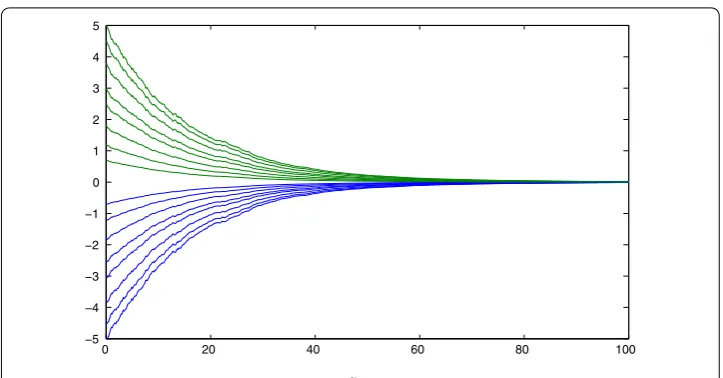
Figure 1 Stable states of the system in (4.1) withτ˜= 0.2390,k= 0.04.
5 Conclusion
This paper studies the robust stability of global exponential stability of nonlinear stochas-tic systems in the presence of time-varying delays and neutral terms. The result shows that a globally exponentially stable nonlinear stochastic system perturbed by both time delays and neutral terms can sustain global exponential stability provided that the delays are, respectively, smaller than the given upper bounds and the neutral terms are sufficiently small.
Competing interests
The authors declare that they have no competing interests.
Authors’ contributions
The authors declare that the study was realized in collaboration with the same responsibility. All of the authors read and approved the final version of the manuscript.
Author details
1College of Mathematics and Statistics, South Central University for Nationalities, Wuhan, 430074, P.R. China.
2Department of Mathematical Sciences, Loughborough University, Loughborough, Leicestershire LE11 3TU, UK.3College of Science, Huazhong Agriculture University, Wuhan, 430070, P.R. China.
Acknowledgements
The authors would like to thank the referee and the associate editor for their very useful comments and suggestions. The authors would also like to thank the financial supports from the National Natural Science Foundation of China (Nos. 61374085, 61304068), Graduate Innovation Fund Projects of the South-Central University for Nationalities under Grant 2014sycxjj124 and Huazhong Agricultural University Scientific & Technological Self-Innovation Foundation under Grant 2662014BQ059.
Received: 21 September 2014 Accepted: 7 January 2015
References
1. Kolmanovskii, V, Nosov, V: Stability and Periodic Modes of Control Systems with Aftereffect. Nauka, Moscow (1981) 2. Mao, X: Stochastic Differential Equations and Applications, 2nd edn. Horwood, Chichester (2007)
3. Kolmanovskii, V, Koroleva, N, Maizenberg, T, Mao, X, Matasov, A: Neutral stochastic differential delay equations with Markovian switching. Stoch. Anal. Appl.21, 839-867 (2003)
4. Mao, X, Shen, Y, Yuan, C: Almost surely asymptotic stability of neutral stochastic differential delay equations with Markovian switching. Stoch. Process. Appl.118, 1385-1406 (2007)
5. Bao, J, Hou, Z, Yuan, C: Stability in distribution of neutral stochastic differential delay equations with Markovian switching. Stat. Probab. Lett.79, 1663-1673 (2009)
6. Liu, Y, Wang, Z, Liu, X: Global exponential stability of generalized recurrent neural networks with discrete and distributed delays. Neural Netw.19, 667-675 (2006)
8. Sipahi, R, Niculescu, S, Abdallah, C, Michiels, W, Gu, K: Stability and stabilization of systems with time delay: limitations and opportunities. IEEE Control Syst. Mag.38, 38-65 (2011)
9. Shen, Y, Wang, J: Noise-induced stabilization of the recurrent neural networks with mixed time-varying delays and Markovian-switching parameters. IEEE Trans. Neural Netw.18, 1857-1862 (2007)
10. Shen, Y, Wang, J: Robustness analysis of global exponential stability of recurrent neural networks in the presence of time delays and random disturbances. IEEE Trans. Neural Netw. Learn. Syst.23, 87-96 (2012)
11. Jiang, F, Yang, H, Shen, Y: On the robustness of global exponential stability for hybrid neural networks with noise and delay perturbations. Neural Comput. Appl.24, 1497-1504 (2014)
12. Zhu, S, Luo, W, Shen, Y: Robustness analysis for connection weight matrices of global exponential stability of stochastic recurrent neural networks. Circuits Syst. Signal Process.33, 2065-2083 (2014)
13. Zhu, S, Shen, Y: Robustness analysis of global exponential stability of neural networks with Markovian switching in the presence of time-varying delays or noises. Neural Comput. Appl.23, 1563-1571 (2013)
14. Luo, W, Zhong, K, Zhu, S, Shen, Y: Further results on robustness analysis of global exponential stability of recurrent neural networks with time delays and random disturbances. Neural Netw.53, 127-133 (2014)