R E S E A R C H
Open Access
Efficient detection and decoding of
q
-ary LDPC
coded signals over partial response channels
Andrea Marinoni, Pietro Savazzi
*and Paolo Gamba
Abstract
In this study, we consider the ways for concatenating the intersymbol interference (ISI) detector with aq-ary low-density parity-check (LDPC) decoder for transmissions over partial response (PR) channels. LDPC codes allow achieving performance close to the channel capacity in additive white Gaussian noise channels, while designing receivers employing these codes for transmissions over channels affected by ISI is still an open issue. Turbo equalization schemes are considered with a novel joint message-passing-based receiver, which is derived from a recently proposed joint algorithm for binary LDPC codes. Simulation results provide performance evaluation of these systems over three different PR channels, together with an analysis of the trade-off between error-rate performance and complexity.
1 Introduction
High data rate modern communication systems are affected by intersymbol interference (ISI) effects, due to frequency selective fading for microwave wireless transmissions or to increased bit density for magnetic recording systems. The ISI channel may efficiently be represented by partial response (PR) discrete models, approximating the frequency selective behavior.
An optimal receiver for PR channels may be realized by a maximum likelihood sequence detector, using the estimated channel impulse response in a Viterbi algo-rithm [1,2]. Bahl–Cocke–Jelinek–Raviv (BCJR) algoalgo-rithm [3] can replace a Viterbi processor if the soft output infor-mation is employed in a concatenated scheme, feeding an outer channel decoder [4]. Recently turbo codes [5] and low-density parity-check (LDPC) [6] codes have been used to achieve bit error rate (BER) values lower than those provided by other typical error-correcting codes, like Reed-Solomon, in applications where ISI has to be very efficiently counteracted.
Specifically, LDPC codes [6] are linear codes character-ized by a sparse parity-check (PC) matrix H, havingM rows and N columns. LDPC can be classified as either regular or irregular depending on their row and column degree-distributions. Regular LDPC codes have a par-ity check matrix in which all rows (and columns) have
*Correspondence: [email protected]
Dipartimento di Ingegneria Industriale e dell’Informazione, University of Pavia, Pavia, Italy
equal weight, while irregular LDPC codes do not exhibit this property. Non-binary (or q-ary) LDPC codes have codewords (and also a PC matrix) whose symbols are elements of the finite field GF(q), with q > 2. These non-binary LDPC codes can allow significantly enhanced performance with respect to the binary case, by increas-ing the finite field dimension [7]. However, the decodincreas-ing complexity isO(Ntq2), whereN is the block length,tis the average column weight, andqis the alphabet size [7,8]. Recent papers reveal thatq-ary LDPC may be applied to magnetic recording channels, allowing reduced complex-ity schemes [9] and robustness to burst errors [10], making theq-ary solution comparable with the binary case.
Historically, considering an LDPC-coded system, the most popular scheme to improve error-correction perfor-mance over channels affected by ISI has been to serially concatenate a soft-output detection algorithm and the binary LDPC decoder. However, a greater performance improvement can be achieved by incorporating the chan-nel detector in the iterative decoder: this implies a turbo concatenation of the two system blocks and several papers in literature call that configuration turbo equalization (TE). Further, in [11-13], an LDPC-coded detection-and-decoding system implemented by a joint algorithm based on the message-passing (MP) algorithm is addressed.
In this article, we extend the joint detection-and-decoding scheme toq-ary LDPC codes. Furthermore, we compare the proposed approach to TE, paying particular attention to the properties of the detector and the decoder
selected for each one. Some preliminary results of this study are presented in [14].
The article is organized as follows. The first sections introduce the system model for the different architectures that are discussed in the article, namely TE, first turbo equalization iteration (FTEI), and the proposed joint MP-based architecture. For the FTEI scheme, no extrinsic information is exchanged, since only the first iteration is performed by doing soft separate detection and decoding. Further, the computational complexity of each receiver scheme considered is discussed in a dedicated section. Finally, simulation results are given, and some remarks about future research development conclude the article.
2 System model
In this section, we analyze the performance of a novel receiver algorithm forq-ary LDPC-coded signals over PR channels, comparing its performance with those obtained by TE and FTEI schemes.
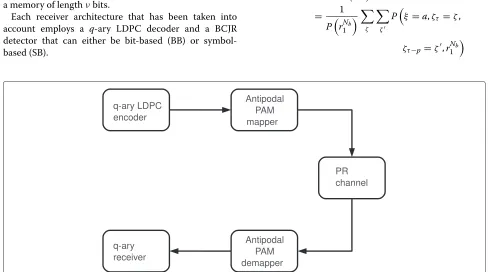
The basic system model is shown in Figure 1. The q -ary LDPC encoder output is a length-N codewordξ = [ξi]i=1,...,N, ξi∈GF(q=2p)∀i=1,. . .,Nsuch that
Hξ=0 (1)
where H = {Hij}i=1,...,M,j=1,...,N, Hij ∈ GF(q = 2p)
is the parity-check matrix. The binary representation of each codeword{ξ}nis transmitted by an antipodal binary pulse-amplitude modulator through a PR channel having a memory of lengthνbits.
Each receiver architecture that has been taken into account employs a q-ary LDPC decoder and a BCJR detector that can either be bit-based (BB) or symbol-based (SB).
2.1 BB detector
The BB detector is represented by the standard BCJR algorithm [3]. The symbol-wisea posterioriprobabilities (APPs) are approximated applying the BCJR algorithm to the PR channel and then multiplying the APPs that form a symbol [15,16]. The symbol-wise APPs are passed to the q-ary LDPC decoder to initialize thea prioriprobabilities.
2.2 SB detector
The SB detector [15,17] modifies the way the probabil-ity functions are updated when compared to the original BCJR algorithm. Hoeher [17] develops a method, called optimal subblock-by-subblock detector, in order to cal-culate the APP of a block of pconsecutive bits. Cheng et al. [15] show that simplifications of the algorithm can be made for the case of the binary-input ISI channels, specifically forp≥ν.
Let a ∈ GF(q = 2p) be an information symbol. It is
possible to map each symbol inGF(q=2p)to a distinct
sequence ofpbits; in other terms, the binary represen-tation ofaisb0p−1 = (bp−1,bp−2,. . .,b1,b0), wherebi ∈ GF(2). Let ζτ be the state at time τ. The a posteriori probability that the information symbolξ equalsa con-ditioned on the length-Nb(= Np) received bit sequence rNb
1 =(r1,r2,. . .,rNb−1,rNb)is
P
ξ =a|rNb 1
= P
ξ =a,rNb 1
PrNb 1
(2)
= 1
PrNb 1
ζ
ζ P
ξ =a,ζτ =ζ,
ζτ−p=ζ,rN1b
Equation (3) is obtained using Bayes’ rule and the prin-ciple of total probability. By applying Bayes’ rule and the Markov property that events after time τ only depend on the current state ζτ and are independent on past observations [15], it is possible to write (3) as follows:
P(ξ=a,ζτ =ζ,ζτ−p=ζ,r1Nb)=P(r
rule and the fact that the symbola prioriprobabilities are state-independent, the branch transition metric can be written as follows: the channel characteristic; in a PR channel with additive white Gaussian noise the probability density function can be calculated as
channel output sequence that corresponds to the input sequencea=b0p−1.
The forward state metricατ(ζ )and the backward state metric βτ(ζ ) can be updated as in the original BCJR algorithm [3].
In the case of binary-input length-νmemory ISI chan-nels, since the states represent subsequences of the input sequence [15], Equation (3) can be expressed as follows:
P
In (6)ζis the state that corresponds to the shift register configuration after an input ofνbits. This simplification is valid whenp ≥ ν. Therefore, for sake of generality, in this article we refer to the SB detecting structure described in [17].
3 Receiver architectures
The next subsections introduce the three detection-and-decoding architectures considered in this article: the FTEI, TE, and Joint MP-based architectures, respectively. In the remainder of this section, we discuss the computa-tional complexity of each proposed scheme.
3.1 TE
When TE and FTEI architectures are considered, a BCJR-based receiver defines thea prioriprobabilities that have to be provided to theq-ary LDPC decoder. These proba-bilities are computed following the BB and SB algorithms, described in the previous section. The decoding proce-dure employs the MP algorithm, which is described in detail in [7,8].
Further, when TE is performed, extrinsic information between the detector and decoder is exchanged in an iter-ative way until an LDPC codeword is found or a maximum number of iterations are performed [4,8,18,19]. It is worth to remind that, in case of LDPC codes, convergence to a codeword is easily detected by the receiver when the parity check equations are satisfied.
On the other hand, if only the FTEI is considered, no extrinsic information is exchanged. In other terms, detec-tion and decoding are performed separately. Analyzing the error-rate performance of the FTEI architecture can provide an interesting insight on the role of the extrinsic information in decoding for BB and SB detections.
Finally, it is interesting to investigate how the error-rate performance of the TE architecture that employs BB detection can be affected by the correlation among the likelihoods input to theq-ary LDPC decoder. Thus, a BB– TE architecture using an interleaver has been analyzed as well. Specifically, the depth of the interleaver has been set to the value of the channel response length. It is worth to note that the correlation among consecutive bits in case of a TE architecture using SB detection should be mitigated by the intrinsic interleaving function provided by theq-ary LDPC code.
3.2 Joint MP-based architecture
In this section, we consider an architecture that employs a joint detection-and-decoding system based on aq-ary MP algorithm.
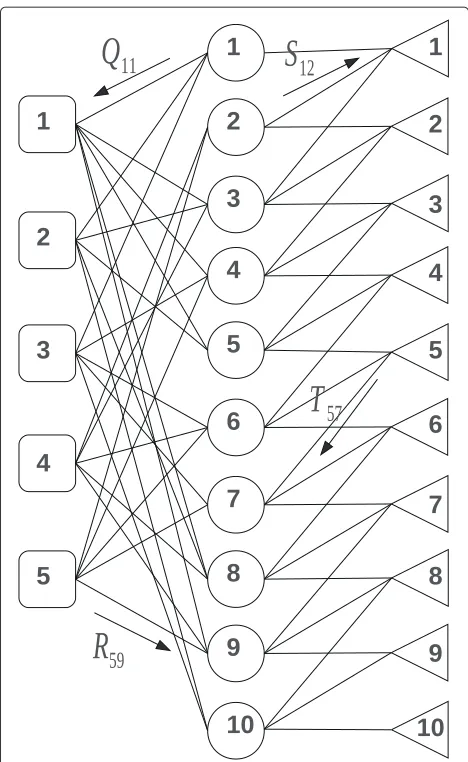
Figure 2A graph that represents channel constraints and the parity check of the LDPC code.Circles represent variable nodes, squares represent parity check nodes, and triangles represent channel nodes. For instance, a 4-ary code over EPR4 channel is shown.
variable (or symbol) nodesξκ, squares to the parity-check nodeszκ and triangles to the channel nodesκ.
A parity check node i and a variable node j are con-nected if the value ofHijis non-zero. A channel nodekis
connected to the variable nodejif the channel response involves bits from the binary representation ofξj.
Following the notation in [7], letN(i)=j:Hij=0
be the set of symbols linked to check nodeiand let the checks linked to symboljbelong toM(j)c=i:Hij=0
. More-over, letL(k)be the set of the channel nodes connected to thekth symbol node and letI(l)be the set of the symbol nodes connected to the channel nodel.
Specifically, the edges between channel nodes and the variable nodes in the tripartite graph can be represented by a square adjacency matrix,= {ij}i,j=1,...,N. Ifijis
not set to zero, an edge in the tripartite graph between
theith channel node and thejth variable node has to be drawn. Thus,L(k)= {l:lk=0}andI(l)= {k:lk=0} The expression of the adjacency matrixdepends on the lengthνof the channel memory and on the alphabet sizeqof the code. For example, the adjacency matrix for a 16-ary LDPC coded transmission over the EPR4 channel (i.e.,ν=3) is as follows
Each element of has its own binary representation depending on the channel responseh(D)and the alphabet sizeq. Specifically, the binary representationijofijis a squarep×pmatrix, wherep=log2q. For example, since the EPR4 channel response ishEPR4(D)=1+D−D2−D3,
each ij related to the matrix in (7) can be written as follows∀i=1,. . .,N: tities,QaijandRaij, for each non-zero element of the parity check matrixH. The first is defined as the probability that jth symbol be a, depending on the information flowing by the whole checks except theith one and by the whole involved channel nodes. On the other hand,Raijis meant to be the probability of checkzibeing satisfied ifξjis equal
toa.
Analogously, let Sakl be the probability that the sym-boll isagiven the information obtained by the channel nodes other than thekth, and by the whole involved check nodes. Further, Tkla is the probability of channel nodek being satisfied if symbollis considered fixed ata. Figure 3 shows these quantities on the tripartite graph. Finally, let X[n] be the value ofXat thenth iteration of the iterative algorithm.
The joint MP algorithm works as follows.
3.2.1 Initialization
The channel inputs are i.i.d., so all state transitions are ini-tially equally likely [13]. Thea prioriprobabilities are then initialized as
fja=P(ξj=a)=
1
4.5 5 5.5 6 6.5 FTEI: BB det, q−ary dec BB joint MP based Architecture TE: SB det, q−ary dec FTEI: SB det, q−ary dec SB joint MP based Architecture TE: BB det with interleaver, q−ary dec
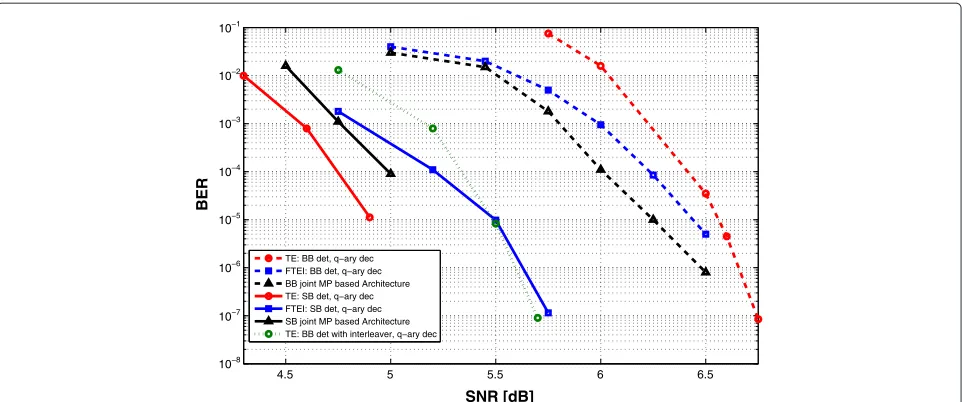
Figure 3BER performance of the architectures discussed in Section 3 on the EPR4 channel: TE, FTEI, and joint MP-based architecture.
3.2.2 Updating Saij
For every iteration of the MP algorithm, the messages Saij that symboljsends to channel node i should be the parent’s belief that it is in statea, according to all other children. Therefore,Saij[n] can be expressed as
Saij[n]=fja
The messagesQaijthat symbol nodejsends to the parity-check nodeishould be the parent’s belief that it is in state a, according to all other children. Thus, Qaij at the nth iteration is updated as follows
Qaij[n]=fja k∈L(j)
Tkja[n−1]
l∈M(j)\i
Ralj[n−1] (12)
3.2.4 Updating Tija
The message that channel nodeisends to symbol nodej should be the probability of channel nodeibeing satisfied ifξjwas in statea. Thus, it is necessary to sum over all the configurationsξ for which the channel constraint is satisfied and thejth symbol is in state aand add up the probability of the configuration, as follows
Tija[n]= P and the symbol nodes that are connected to the channel nodei.
The probabilityP(i|ξ )of the channel constraint being satisfied is either 0 or 1 for any given configurationξ. A channel node is satisfied if the configuration of the vari-able nodes is such that the given varivari-able nodeξjis set to
the given valuea∈GF(q).
Moreover, since the channel nodes are part of a tri-partite graph, their contribution to the detection pro-cess is determined by the information provided by the other nodes in the graph in the previous iterations as well. The channel nodes are only connected to variable nodes. Therefore, the information provided by the previ-ous iterations of the joint scheme comes from the mes-sagesSij. Specifically, this contribution is provided by the
term k∈I(i)\jSξk
ik[n−1] in (13), accordingly to the MP
algorithm [20].
The expressions in (15) are directly derived from the comments and observations in [15] and from the graph connections. In fact, the termβj(ζR)is the backward state
metric, whereas the term αj−1(ζL) is the forward state
metric.θκLandθκRrepresent the possible configurations of the input that lead to the statesζLandζR, respectively.ζL
andζRare linked convoluting the binary representation of
the q-ary symbolξj that has been set toaand the given
channel response. It is worth to note that in case of BB detectionαj−1(ζL),βj(ζR)andγ(aj−1,j)can be obtained by properly multiplying the binary APPs resulting from the binary BCJR algorithm.
EachθκL ∈ L = {θκL}κ=1,...,|L| and eachθκR ∈ R = {θκR}κ=1,...,|R|can be constituted by one or more symbols, depending on the lengthνof the channel memory.
It is easy to notice that the S contributions related to α represent the causal part of the ISI effect, while the S contributions related to β represent the anti-causal part of it. Since the channel constraints for a given PR channel are well defined, it is natural to wonder whether a more efficient way to compute the probability expressed in (13) exists.
Tija can efficiently be calculated by treating the partial sums of a parity check as the states in a Markov chain [8], thereforeTijacan be written as follows
Tija[n]=
In order to better exploit the definition ofFTandBT, let ϕuv(X)be the law that transformsX(living inGF(u)) in its v-ary counterpart. Thus, the terms denoted byFTandBT are defined as follows
The corresponding probabilities are computed as
P
chosen such that the convolution of those values and the
channel response leads the system to the state a.i,jare successive indexes living inI(κ), withj > i for theFT contribution, whilej<ifor theBT part.
3.2.5 Updating Ra ij
The message that check nodei sends to symbol node j should be the probability of check nodeibeing satisfied ifξjwas in statea. As in Section 3.2.4, using the laws of
probabilityRaijcan be expressed as
Raij[n]=Pzi|ξj=a either 0 or 1 for any given configurationξ as in the pre-vious step.Raijcan be efficiently calculated by treating the partial sums of a parity check as the states in a Markov chain [8], thereforeRaijcan be written as follows
Raij[n]=
The corresponding probabilities are computed as
PFκRj=a=
A tentative decoding codewordξ be derived using the following expression:
j=1,...,Nsatisfies (1), then the decoding process
iterates from Section 3.2.2. A failure is declared if the codeword is not found after reaching a fixed maximum number of iterations.
3.3 Computational complexity
In this section, we discuss the computational complexity of each aforementioned receiver architecture.
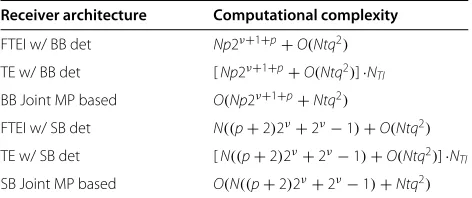
The number of operations required from each system is given by the complexity of the used pair of detector and decoder. Table 1 shows the computational complexity of each receiver for a length-N codeword of a LDPC code overGF(q). Specifically,p = log2qandνrepresents the length of the memory of the considered ISI channel.
Since in this article we are taking into account a classic “flooding” decoding scheme [7], the computational com-plexity of a q-ary LDPC decoder isO(Ntq2), as already stated in this article; t is the average column weight. It is proper to point out that there exist specific decoding schemes, such as those based on layered Belief Propa-gation (BP) algorithm [21], that can lower the aforesaid computational cost.
However, the overall complexity of a given receiver depends on the number of operations required by the detector and the decoder separately and on the way detec-tor and decoder are linked in the architecture that is taken into account.
The systems employing an SB detector typically show lower computational complexities with respect to the corresponding architecture employing an BB detecting scheme. In order to better exploit this point, it is proper to take into account a trellis ofpstages, that correspond to an input sequence ofp bits. In these conditions, the number of paths that have to be set while employing a BB detector isp·2ν+1. On the other hand, an SB detector in
the same conditions needs onlypi=−012χ (ν−i) patterns to work, whereχ (t)=tift≥0,χ (t)=0 otherwise. There-fore, the BB detecting scheme requires a larger number of operations to work than the SB detecting scheme.
The TE without feedback architecture requires a num-ber of operations that is simply the sum of those needed by theq-ary LDPC decoder and the employed detector.
Table 1 Computational complexity of the proposed architectures
Receiver architecture Computational complexity
FTEI w/ BB det Np2ν+1+p+O(Ntq2)
TE w/ BB det [Np2ν+1+p+O(Ntq2)]·N
TI
BB Joint MP based O(Np2ν+1+p+Ntq2)
FTEI w/ SB det N((p+2)2ν+2ν−1)+O(Ntq2)
TE w/ SB det [N((p+2)2ν+2ν−1)+O(Ntq2)]·N
TI
SB Joint MP based O(N((p+2)2ν+2ν−1)+Ntq2)
On the other hand, the TE scheme shows a compu-tational complexity that is proportional to NTI, that is
the number of iterations between detector and decoder. Therefore, the FTEI architecture shows a computational complexityNTItimes lower than that related to the TE.
Finally, the joint MP architecture requires a number of operations that is related to the sum of those neces-sary for the detection and decoding steps. Specifically, the computational complexity of the joint MP-based scheme depends on the convergence rate of the system. That is, the number of operations required by the architecture decreases as the detection-and-decoding scheme finds a codeword within the maximum number of iterations of the MP algorithm.
In other terms, for a given detection scheme and a given q-ary decoder, the joint MP-based architecture shows a computational complexity that is typically lower than that of TE and higher than that required by an FTEI system.
4 Simulation results
For all the considered schemes, a 16-ary LDPC code with coding rateR = 1− MN equal to 8/9 is used. The code-word blocklength is set to 1,152 symbols (that is 4,608 bits) and the average column weight is set to 2.88. The variable-node degree distribution, following the notation intro-duced in [22,23], wasλ2= 0.112 andλ3= 0.8889, where λ(x)=dv
i=2λixi−1, anddvis the maximum symbol-node
degree. Theq-ary LDPC code has been constructed using quasi-regular PC matrices [23] generated by a modified progressive edge-growth algorithm [24] that maximizes the minimum space distance [9,10].
The maximum number of iterations for theq-ary LDPC decoder and for the joint MP algorithm of subsection 3.2 has been set to 25. Moreover, the maximum number of iterations between the detector and the q-ary LDPC decoder for the TE scheme has been set to 10.
We consider three different PR channels having different memory lengthν and channel responsesh(D) as in the following:
hPR4(D)=1+D2
hEPR4(D)=1+D−D2−D3 hEEPR4(D)=1+2D−2D3−D4
(25)
Hence, the channel memory lengthνis set to 2, 3, and 4 for PR4, EPR4, and EEPR4, respectively. As shown above, the PR4 channel used in the simulations is not the stan-dard one: 1 − D2, usually used for magnetic recording channel characterization.
4 4.5 5 5.5 6 10−6
10−5
10−4
10−3 10−2
10−1
SNR [dB]
BER
TE: BB det, q−ary dec FTEI: BB det, q−ary dec BB joint MP based Architecture TE: SB det, q−ary dec FTEI: SB det, q−ary dec SB joint MP based Architecture TE: BB det with interleaver, q−ary dec
Figure 4BER performance on the PR4 channel: TE, FTEI, and joint MP-based architecture.
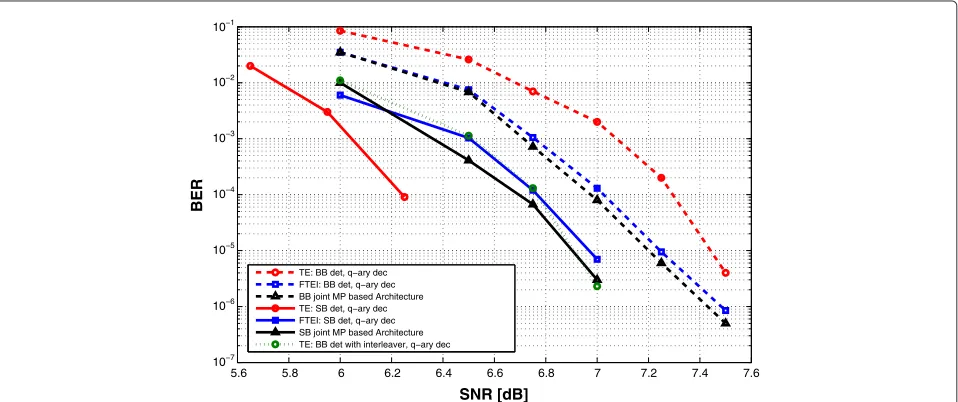
dashed ones represent BB soft metrics. The error-rate per-formance of the BB–TE architecture using an interleaver of depth set to the value of the channel response length ν+1 is shown as a dotted line with a circle marker.
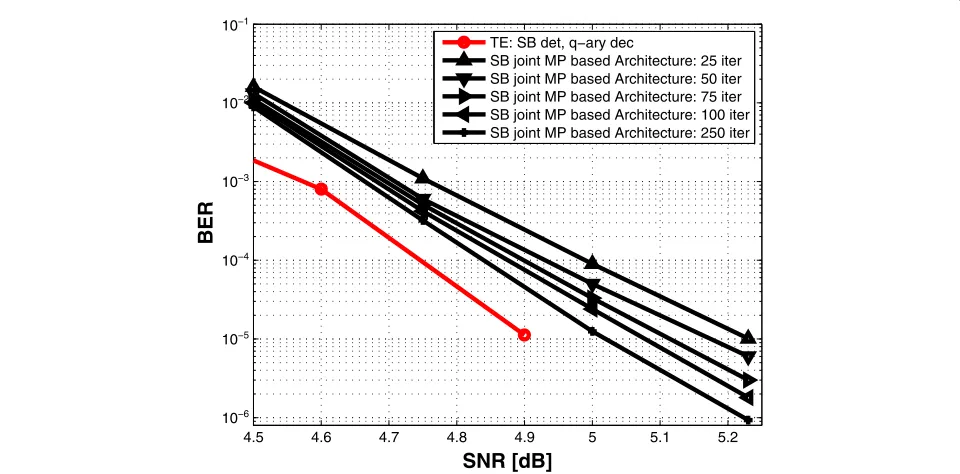
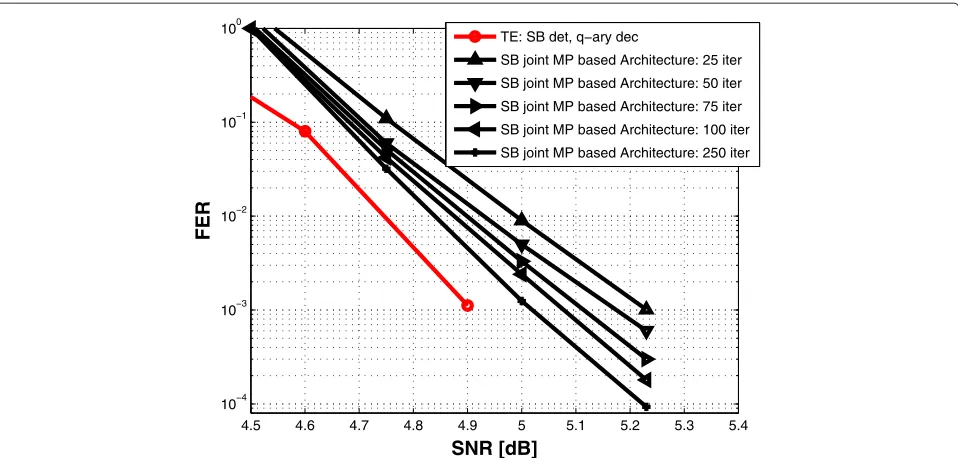
Figures 7 and 8 show how the performance gap between the joint MP and the TE schemes may be reduced, increas-ing the maximum number of allowed iterations for the joint MP algorithm described in Section 3.2.
The systems employing an SB detector largely outper-form the architectures employing a BB one. A reason for this might be that it is possible to include invalid trel-lis paths in the calculation by using the BB detection approach [15]. It has been proved [25] that error prop-agation in turbo decoding is intensified by the feedback
injection. This effect is highlighted in the error floor region, where error resilience of TC is typically weak [4].
Feedbacks inq-ary environments are even more harm-ful in case of MP decoding. In fact, a misleading computa-tion of the input probability distribucomputa-tion affects groups of bits at once [8]. Therefore, a decoder failure occurs faster than in the binary case. Thus, it is hardly surprising that the FTEI employing BB detection shows better error-rate performance than TE employing BB detection, since BB– TE iterates the aforesaid information between detector and decoder.
Specifically, the minimum performance gain of the systems employing an SB detector on their respective BB counterparts goes from about 0.3 to about 0.75 dB
5.6 5.8 6 6.2 6.4 6.6 6.8 7 7.2 7.4 7.6 10−7
10−6
10−5
10−4
10−3
10−2
10−1
SNR [dB]
BER
TE: BB det, q−ary dec FTEI: BB det, q−ary dec BB joint MP based Architecture TE: SB det, q−ary dec FTEI: SB det, q−ary dec SB joint MP based Architecture TE: BB det with interleaver, q−ary dec
Figure 6Performance gap between the TE employing SB detector and the other architectures proposed in Section 3 for the PR channels taken into account.The gap is computed in terms of SNR at BER=10−5;p=log
2qandνis the memory length of the
given PR channel.
in terms of signal-to-noise ratio (SNR), depending on the PR channel that is taken into account. This behav-ior highlights how the rate ν+p1 plays an important role in the error-rate performance of the described algorithms.
On the other hand, the BB–TE architecture that employs a(ν+1)-depth interleaver strongly outperforms the other architectures using BB detection. Specifically,
its error-rate performance can be compared to the those provided by SB FTEI and joint MP-based architectures. Apparently, the aforesaid architecture takes advantage of the low correlation among the likelihoods of consecu-tive bits at the input of the q-ary decoder provided by the interleaver. However, SB–TE architecture still out-performs BB–TE architecture with interleaver on every channel that has been taken into account. It looks like the correlation provided by the PR channels can be well coun-teracted byq-ary decoding as it is fed by SB detection. This effect is consistent with the results obtained in different fields that investigate the role of interleaving in BB or SB synchronization [26,27].
Let us take a deeper look on the error-rate performance of the considered receiver architectures. TE employing SB detection outperforms SB–FTEI and SB joint MP-based architectures as every other architecture employ-ing BB detection as well. Specifically, the gain of SB–TE with respect to the architectures employing a BB detec-tion scheme is greater than 0.55 dB at least. This result furthermore highlights the influence of the computa-tion of the soft input to the q-ary LDPC decoder on the extrinsic information required in the turbo architec-ture. Moreover, the performance gap of SB–TE archi-tecture on every other BB receiver is maximum for
p ν+1 =1.
Indeed, the ratio ν+p1 influences the error-rate perfor-mance of the joint MP-based architecture. In fact, the joint MP-based architecture employing a BB detection out-performs both BB–FTEI and BB–TE without interleaver.
4.5 4.6 4.7 4.8 4.9 5 5.1 5.2
10−6 10−5 10−4 10−3 10−2 10−1
SNR [dB]
BER
TE: SB det, q−ary dec
SB joint MP based Architecture: 25 iter SB joint MP based Architecture: 50 iter SB joint MP based Architecture: 75 iter SB joint MP based Architecture: 100 iter SB joint MP based Architecture: 250 iter
4.5 4.6 4.7 4.8 4.9 5 5.1 5.2 5.3 5.4 10−4
10−3 10−2 10−1 100
SNR [dB]
FER
TE: SB det, q−ary dec
SB joint MP based Architecture: 25 iter
SB joint MP based Architecture: 50 iter
SB joint MP based Architecture: 75 iter
SB joint MP based Architecture: 100 iter
SB joint MP based Architecture: 250 iter
Figure 8Frame error rate performance of the joint MP algorithms versus the turbo detection scheme at different number of maximum iterations, on the EPR4 channel.
However, on the PR4 and EEPR4 channels whereν+p1=1, the gains achieved in BER are very tiny. On the other hand, it looks like the moreν+p1gets larger, the performance gap between the SB–TE and the SB joint MP-based architec-ture becomes lower. This could be due to better match between the channel memory length and theq-ary symbol length in bits, forν+p1≥1.
Finally, a very interesting task is addressed by the behav-ior of SB–FTEI with respect to SB–TE. In fact, SB–TE outperforms by 0.6 dB on SB-FTEI for each PR channel that has been taken into account. This is a result that might require a deeper investigation.
4.1 Convergence analysis
In Figure 9, a convergence analysis using simulations for the joint MP-based architecture is shown. The maximum number of iteration is set equal to 25, while the aver-age number of requested iterations to converge is plotted versus the corresponding SNR. This does not represent a general proof and exhaustively analysis of convergence, but can sufficiently be highlight how such scheme need fewer iterations as the SNR increases. Application of den-sity evolution would need a deeper investigation, since the application to non-binary codes could be very difficult and computationally cumbersome [28,29].
4.5 5 5.5 6 6.5 7
4 6 8 10 12 14 16 18 20 22 24
SNR [dB]
Required iterations
EPR4 PR4 EEPR4
5 Conclusions
The joint MP algorithm for ISI channels has been extended toq-ary LDPC codes and has been compared to TE architectures over some PR channels.
Simulation results for 16-ary LDPC code over three different PR channels showed that the best performance can be achieved by using a turbo equalizer whose detec-tion is symbol-based. Consequently, using such an archi-tecture appears to feature the best performance in an environment affected by ISI where good error-correction capability is desirable.
We observed that in general a symbol-based detec-tion provides better performance with respect to a bit-based one. Furthermore, the proposed extension toq-ary codes of the joint detection algorithm could represent a good trade-off between performance and complexity with respect to TE and FTEI solutions. Simulation results of a TE scheme that employs BB detection and takes advan-tage of an interleaver provide an interesting insight on the role of theq-ary decoding in counteracting the correlation induced by the PR. This effect can be a subject for deeper investigations in future works.
Ongoing research that promises efficiency at the receiver end includes the analysis of different structures for the joint MP-based architecture employing an SB BCJR algorithm, operating on the channel constraints. Future directions for research could focus on the behav-ior of the analyzed schemes over different channels (like the magnetic recording channel) and with differ-ent LDPC codes, having differdiffer-ent codeword length or degree-distribution profile as in [30].
In order to complete the analysis on the efficient receivers over PR channels, a study of the influence of the ratio ν+p1 has to be performed. Further, an investigation on the better detection method that may be addressed by other decoders (such as those based on layered BP algo-rithms [21]). Finally, an optimization of the construction ofq-ary LDPC codes has to be taken into account, starting from the results provided in [31,32], trying to minimize the cycle effects induced in the tripartite graph by the channel nodes. Following this direction, another interest-ing line of research could be the optimization of decodinterest-ing for higher-order modulation over finite-length memory channels, starting from [33,34].
Competing interests
The authors declare that they have no competing interests.
Acknowledgements
The authors would like to thank the anonymous reviewers for their interesting comments and suggestions that helped to improve the article.
Received: 27 July 2012 Accepted: 7 January 2013 Published: 30 January 2013
References
1. GD Forney, Maximum-likelihood sequence estimation of digital sequences in the presence of intersymbol interference. IEEE Trans. Inf. Theory.IT-18(3), 363–378 (1972)
2. G Ungerboeck, Adaptive maximum-likelihood receiver for carrier-modulated data- transmission systems. IEEE Trans. Commun. 22(5), 624–636 (1974)
3. L Bahl, J Cocke, F Jelinek, J Raviv, Optimal decoding of linear codes for minimizing symbol error rate. IEEE Trans. Inf. Theory.IT-20, 284–287 (1974) 4. C Douillard, M Jezequel, C Berrou, A Picart, P Didier, A Glavieux, Iterative
correction of intersymbol interference: turbo equalization. Eur. Trans. Telecommun.6(5), 507–511 (1995)
5. C Berrou, A Glavieux, P Thitimajshima, inProceedings of the IEEE International Conference on Communications (ICC) 1993, vol. 2. Near Shannon limit error-correcting coding and decoding: Turbo codes (Geneve, CH, 1993), pp. 1064–1070
6. RG Gallager,Low-Density Parity-Check Codes. (MIT Press, Cambridge, MA,1963)
7. MC Davey, D MacKay, Low-density parity-check codes over GF(q). IEEE Commun. Lett.2(6), 165–167 (1998)
8. MC Davey, Error-correction using low-density parity-check codes. PhD thesis, University of Cambridge, UK, December 1999
9. H Song, JR Cruz, Reduced-complexity decoding of Q-ary LDPC codes for magnetic recording. IEEE Trans. Magnet.39(2), 1081–1087 (2003) 10. A Marinoni, P Savazzi, S Valle, inProceedings of the 5th International
Symposium on Turbo Codes and Related Topics. Efficient design of non-binary ldpc codes for magnetic recording channels, robust to error bursts (Lausanne, CH, 1–5 September 2008), pp. 288–293
11. BM Kurkoski, PH Siegel, JK Wolf, Joint message-passing decoding of LDPC codes and partial-response channels. IEEE Trans. Inf. Theory.48(6), 1410–1422 (2002)
12. G Colavolpe, G Germi, On the application of factor graphs and the sum product algorithm to ISI channels. IEEE Trans. Commun.53(5), 818–825 (2005)
13. R Radhakrishnan, B Vasic, inProceedings of the IEEE International Conference on Communications. Joint message-passing symbol-decoding of LDPC coded signals over partial-response channels (Dresden, Germany, 14–18 June 2009)
14. A Marinoni, P Savazzi, inProceedings of the IEEE International Conference on Communications (ICC2010). Efficient receivers for q-ary LDPC coded signals over partial response channels (Cape Town, South Africa, 23–27 May 2010) 15. MK Cheng, J Campello, PH Siegel, inProceedings of the IEEE Global
Telecommunications Conference, vol. 2. Soft-decision reed-solomon decoding on partial response channels (Taipei, Taiwan, November 2002), pp. 1026–1030
16. R Koetter, A Vardy, inProceedings of the IEEE International Symposium on Information Theory 2000(ISIT 2000). Algebraic soft-decision decoding of Reed-Solomon codes (Sorrento, Italy, June 2000)
17. P Hoeher, Optimal subblock-by-subblock detection. IEEE Trans. Commun. 43, 714–717 (1995)
18. WE Ryan, LL McPheters, SW McLaughlin, inProceedings of the Conference on Information Sciences and Systems. Combined turbo coding and turbo equalization for PR4-equalized Lorentzian channels, 1998 Conf. on Inf. Sciences and Systems (Princeton University, March 1998)
19. WE Ryan, inProceedings of the IEEE International Conference on Communications. Performance of high rate turbo codes on a PR4-equalized magnetic recording channel (Atlanta, GA, June 1998), pp. 947–951
20. N Wiberg,Code and decoding on general graphs. (Dissertation no. 440, Department of Electronics Engineering, Linkoping University, Linkoping, Sweden, 1996)
21. AI Vila Casado, M Griot, RD Wesel, inProceedings of the IEEE International Conference on Communications (ICC) 2007. Informed dymanic scheduling for belief-propagation decoding of LDPC codes (Glasgow, Scotland, 24–28 June 2007), pp. 932–937
22. M Luby, M Mitzenmacher, A Shokrollahi, D Spielman, V Stemann, in Proceedings of the 29th Annula ACM Symposium on Theory of Computing. Practical loss-resilient codes, 1997, pp. 150–159
24. XY Hu, E Eleftheriou, DM Arnold, Regular and irregular progressive edge-growth Tanner graphs. IEEE Trans. Inf. Theory.51(1), 386–398 (2005) 25. S Benedetto, G Montorsi, Unveiling turbo codes: some results on parallel
concatenated coding schemes. IEEE Trans. Inf. Theory.42, 409–428 (1996) 26. X Jiao, M Armand, inIEEE International Symposium on Information Theory
2011. Interleaved LDPC codes, reduced-complexity inner decoder and an iterative decoder for the Davey-MacKay construction (Saint PeterSburg, Russia, July 31–August 5 2011), pp. 742–746
27. JA Briffa, HG Schaathun, S Wesemeyer, inProceedings of the IEEE International Conference on Communication. An improved decoding algorithm for the Davey-MacKay construction (Cape Town, South Africa, May 2010), pp. 1–5
28. V Rathi, V Urbanke, Density evolution, thresholds and the stability condition for non-binary LDPC codes. IEE Proc. Commun.152(6), 1069–1074 (2005)
29. V Rathi, inProceedings of the IEEE International Symposium on Information Theory (ISIT) 2008. Conditional entropy of non-binary LDPC codes over the BEC (Toronto, CN, 6–11 July 2008)
30. C Poulliat, M Fossorier, D Declercq, Design of regular(2,dc)-LDPC codes
overGF(q)using their binary images. IEEE Trans. Commun.56, 1626–1635 (2008)
31. D Divsalar, S Dolinar, C Jones, K Andrews, Capacity-approaching protograph codes. IEEE J. Sel. Areas Commun.27(6), 876–888 (2009) 32. XY Hu, M Fossorier, E Eleftheriou, inIEEE International Conference on
Communications 2004, vol. 2. On the computation of the minimum distance of low-density parity-check codes (Paris, France, June 2004), pp. 767–771
33. A Marinoni, P Savazzi, RD Wesel, inProceedings of the 6th International Symposium on Turbo Codes & Iterative Information Processing.
Protograph-based q-ary LDPC codes for higher-order modulation (Brest, France, 6–10 September 2010)
34. A Marinoni, P Savazzi, RD Wesel, inIEEE Globecom 2011, Communication Theory Symposium. On q-ary LDPC code design for a low error floor (Houston, TX, USA, 5–9 December 2011)
doi:10.1186/1687-1499-2013-18
Cite this article as:Marinoniet al.:Efficient detection and decoding ofq
-ary LDPC coded signals over partial response channels.EURASIP Journal on
Wireless Communications and Networking20132013:18.
Submit your manuscript to a
journal and benefi t from:
7Convenient online submission 7Rigorous peer review
7Immediate publication on acceptance 7Open access: articles freely available online 7High visibility within the fi eld
7Retaining the copyright to your article