STUDENTS' BEHAVIOUR PROBLEMS: AN ATTEMPT TO
UNDERSTAND THE CAUSES
Othman b. Md.Johan Jabatan Asas Pendidikan
Fakulti Pendidikan UniversitiTeknologi Malaysia
ABSTRACT: A path analysis study was carried out to examine the effects of students ' self-concept and other background variablesof family environment, family socio-economic status and students' intelligence on their behaviour problems.Seven hundred and twenty-three form three students were randomly selected for the study based on their background variables mentioned above.The resultshows that students' academi c and non-academi c self-concept weresignificantl y correlated with their behaviourproblems.The non-academic self-concept was a better predictor of behaviourproblems ascompared to the academic self-concept. However , students' intelligencewas foundto bethe bestpredictorof their behaviour problems among theindependentvariables under study.The role of intelligence and students family environment was also importantas they havean indirecteffecton their behaviourproblem sthroughthe non-academicself-concept.The resultsof the study have important implications on the role of parents, educators and administrators in checkingstudent behaviourproblems.
INTRODUCTION
Educators,school administrators, and parents should not take problems of misbehaviour among students lightly. If these problems are not addressed, there is a tendency that it will be out of control and disrupt learning activities. Various studies (Chug, 1976;Purkey, 1978; Madden,
1988) have shown that there is a positive relationship between students' self-concept and their behaviourproblems.
much in determining other factors associated with such relationship. Many researchers felt that there is a necessity in studying a cause and effect relationship between self-concept and behaviour problems in relation to specific background factors. In this regard, Hansford and Hattie (1982), Shavelson and Bolus (1982) and Eshel and Kurman (1991) suggested that certain background factors such as family environment, family socio-economic status and intelligence could influence one's self-concept. They believed that any cause and effect studies regarding the relationship between self-concept and behaviour problems should take into consideration these background factors, as they are considered vital in the formation of self-concept.
Family members, especially parents are believed to be the principal agent of socialisation for children. As the head of the family, parents are the architects offamily environments and they are always regarded as the best model that the children have. As Bums (1982) put it, children are assumed to intemalise as their world the world of their family members. Thus the nature of the relationship among family members plays an important role in moulding the children's self-concept.
Contrary to the importance of family environment in the formation of one's self-concept, it is always argued that family socio-economic status has no effect on the self-concept of children (Rosenberg, 1978). Studies on the relationship between socio-economic status and self-concept has also been largely ignored (Demo, 1979). Being one of the macro-structural variable, the researcher shares the opinion of Franks and Marolla (1976) that socio-economic status is deemed significant for research aimed at gaining a better understanding of its effect on self-concept.
In stressing the importance of intelligence on behaviour problems, AI-Ghazaly (Hamid, 1990) believed that it is an important tool not only in acquiring knowledge but also in assessing or evaluating oneself. This views is shared by Simon (1978) who believed that one's intelligence will determine his thinking and his behaviour.
RESEARCH HYPOTHESES
In exploring the relationship between students' self-concept and certain background factors and their behaviour problems as well as to see the causal relationship among these variables, the following hypotheses were then proposed:
1. There would be a significant relationship between academic and non-academic self-concept with students' behaviour problems.
2. The non-academic self-concept would be a better predictor of behaviour problems than the academic self-concept.
3. Students' background factors of family environment, socio-economic status and intelligence would serve as better predictors of behaviour problems than their self-concept.
4. Students' family environment, socio-economic status and intelligence would have direct and indirect effects on their self-concept and behaviour problems.
RESEARCH METHODOLOGY
Sample
The sample of the present study consisted of 723 Form III students from 10 secondary schools randomly selected from a total of 23 schools in the district of Johor Bahru, Johor. Four of the schools were located in inner city and the other six were in suburban areas. The students were selected by means of stratified random sampling based on their intelligence, family environment, and parents' socio-economic status.
Collection ofData
The principal technique employed for data gathering was questionnaires. Data for this study was collected in three phases. This was done to satisfy the requirements needed to examine the cause and effect relationships among the variables under study (Pedhazur, 1982).
Instruments
Four sets of instrument were used in this study:
(a) Tennessee Self-Concept Scale:
The Tennessee Self-Concept Scale (TSCS) was used to assess the non-academic self-concept of the students in this study. TSCS consists of self-descriptive statements to which the students respond on a 5-point scale ranging from 'completely true' to 'completely false'. The TSCS consists of eight sub-scales namely Personal, Identity, Self-satisfaction, Behaviour, Physical Self, Moral-Ethical Self, Family Self and Social Self. The scores on the eight subscales were added together to obtain the total score (P score) which was used as a summary measure of the students' self-concept.
The reliability coefficient for the total score is O. 88 and the reliability coefficient for the various subs cales score is in the range of 0.88 - 0.90 (Fitts, 1965). The scale was translated into Bahasa Melayu as it is the medium of instruction in all government secondary schools in Malaysia. The translated version was reported to have a test re-test reliability of 0.87 for the total score (Othman, 1994).
(b) The Academic Self-Concept Scale:
The Academic Self-Concept Scale (ASCS) (Dolan & Enos, 1980) consists of 17 items. It was used to assess students confidence, ability, anxiety, concentration, satisfaction and the feeling of being appreciated in their academic endeavours. The translated version of the scale has a test re-test reliability of 0.86 (Othman, 1994).
(c) The Culture Fair Intelligence Test:
The students' level of intelligence was measured by The Culture Fair Intelligence Test (CFIT) Form - 3A. The test which was developed by Cattell (1973) measures individual intelligence in a manner designed to reduce verbal fluency, cultural climate and educational level. Itis a non-verbal test that requires examinees to perceive relationships in shapes and figures. The test consists of four subtests namely Progressive Series, Classification, Matrices and Conditions. The test has a split half reliability of 0.74 and a test re-test reliability of 0.69 (Cattell, 1973).
(d) The Behaviour Problem Checklist:
disciplinary problems, withdrawal and relationship problems with peer group. It has a test re-test relialibility of 0.95 (Othman, 1994)
RESULTS
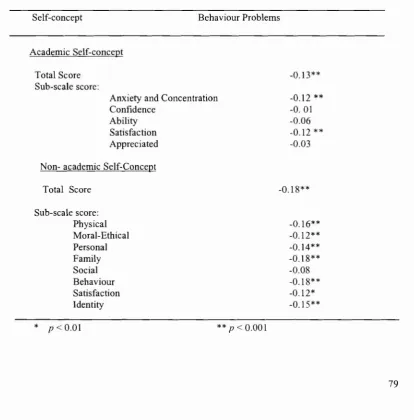
Pearson product moment correlation coefficients were computed between scores on the academic and non-academic self-concept and scores on behaviour problems. The correlation index is presented in Table 1.
TABLE 1: PEARSON CORRELATION INDEX BETWEEN THE ACADEMIC AND NON-ACADEMIC SELF-CONCEPT AND BEHAVIOUR PROBLEMS
Self-concept
Academic Self-concept
Total Score Sub-scale score:
Behaviour Problems
-0.13**
Anxiety and Concentration Confidence
Ability Satisfaction Appreciated
Non- academic Self-Concept
Total Score
Sub-scale score: Physical Moral-Ethical Personal Family Social Behaviour Satisfaction Identity
-0.12 ** -0.01 -0.06 -0.12** -0.03
-0.18**
-0.16** -0.12** -0.14** -0.18** -0.08 -0.18** -0.12* -0.15**
The result indicates that both the academic and non-academic self-concept correlated significantly with students' behaviour problems. Thus, the first hypothesis that the academic and the non-academic self-concept were significantly correlated with students' behaviour problems was accepted. As in other studies (Chiam, 1976; Hanford & Hattie, 1982; Marsh, 1984) the correlation were low and the value of the correlation between the non-academic self-concept and behaviour problems ( r = -0.18) was higher than the value of the correlation between the academic
self-concept and behaviour problems (r= -0.13).
The study also supported the second hypothesis that non-academic self-concept is a better predictor of behaviour problems than the academic self-concept. Table 2 shows that the standardized beta for non-academic self-concept when regressed on behaviour problems is - 0.15 where as the standardized beta for academic self-concept is - 0.07.
TABLE 2: REGRESSION ANALYSIS PREDICTING BEHAVIOUR PROBLEMS FROM STUDENTS ACADEMIC AND NON-ACADEMIC SELF-CONCEPTS
Academic self-concept Non-academic self-concept
Std. Beta
-0.07 -0.15
-1.73 -3.85
p
0.085 0.000
R Squared = 0.190
F Value = 13.516
Adjusted R Squared= 0.034 df= 2, 720 p<0.00
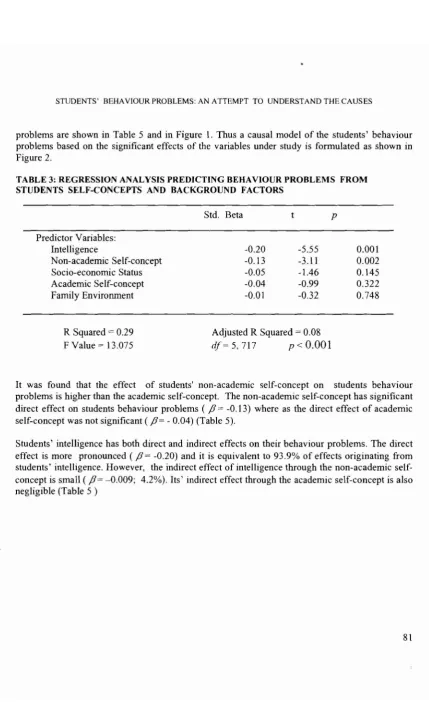
In determining whether students' background variables of intelligence, family environment and parents' socio-economic were better predictors of behaviour problems then the academic and non-academic self-concept, it was found that students' intelligence was the only significant predictor
(13
= -0.20). However, the non-academic self-concept(13
= -0.13) (Table 3) wasthe second best predictor of students behaviour problems after their intelligence. The role of socio-economic status, family environment and the academic self-concept as predictors of students behaviour problems was not significant. Thus the third hypothesis was not accepted.
problems are shown in Table 5 and in Figure 1.Thus a causal model of the students' behaviour problems based on the significant effects of the variables under study is formulated as shown in Figure 2.
TABLE 3: REGRESSION ANALYSIS PREDICTING BEHAVIOUR PROBLEMS FROM STUDENTS SELF-CONCEPTS AND BACKGROUND FACTORS
Predictor Variables: Intelligence
Non-academic Self-concept Socio-economic Status Academic Self-concept Family Environment
Std. Beta
-0.20 -0.13 -0.05 -0.04 -0.01
-5.55 -3.11
-1.46
-0.99 -0.32
p
0.001 0.002 0.145 0.322 0.748
R Squared= 0.29
F Value= 13.075
Adjusted R Squared = 0.08 d(=5, 717 P<
0.001
It was found that the effect of students' non-academic self-concept on students behaviour problems is higher than the academic self-concept. The non-academic self-concept has significant direct effect on students behaviour problems ( jJ= -0.13) where as the direct effect of academic self-concept was not significant (jJ= -0.04) (Table 5).
TABLE 4: STANDARDISED BETA COEFFICIENT(fJ) FOR EACH HIERARC HY OF PATH ANALYSIS ON BEHAVIOUR PROBLEMS
Independent Variables
Family Environment
Socio-economic Status
Intelligence
Non-academic self-concept
Academic Self-concept
Dependent Variables and Beta Values
NASC ASC BP
1* 2* 3*
0.43 0.13 - 0.01
(NS)
0.01 0.03 - O. 05
(NS) (NS) (NS)
0.07 0.09 -0.20
0.32 - 0.13
- 0.04 (NS)
*
Stage of Regression AnalysisNASC Non-Academic self-concept
SAC = Academic Self-concept
BP NS
Behaviour Problems Not Significant
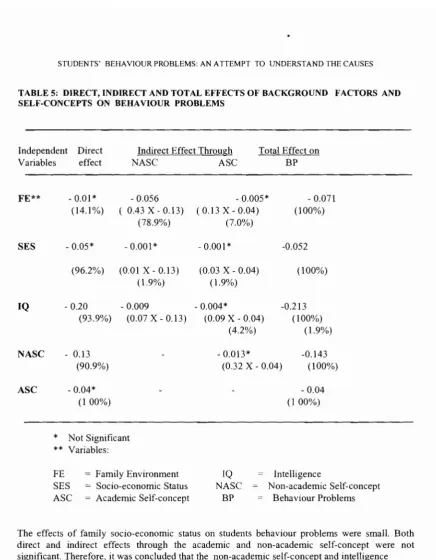
This study also found that students' family environment has an indirect effect on their behaviour
problems through their non-academic self-concept (Table 5). Its' effect (jJ= -0.056)
TABLE5: DIRECT,INDIR ECT ANDTOTALEFFECTSOFBACKGRO UND FACTORS AND SELF-CONCE PTS ON BEHA VIOUR PROBLEMS
Independ ent Direct Indirect Effect Through TotalEffecton
Variables effect NASC ASC BP
FE** -0.0 1* -0.056 -0.005* -0.071 (14.1%) ( 0.43X-0.13) ( 0.13X-0.04) (100%)
(78.9%) (7.0%)
SES - 0.05* -0.00 1* - 0.00 1* -0.052
(96.2%) (0.01X-O.13) (0.03X - 0.04) (100%) (1.9%) (1.9%)
IQ - 0.20 - 0.009 -0.004* -0.213
(93.9% ) (0.07X - 0.13) (0.09 X - 0.04) (100%) (4.2%) ( 1.9%)
NASC - 0.13 - 0.013* -0. 143
(90.9%) (0.32X - 0.04) ( 100%)
ASC - 0.04* -0.04
(100%) (l00%)
*
NotSignificant ** Variables:FE SES ASC
= Family Environment = Socio-economic Status = Academic Self-concept
IQ
NASC BP
= Intelligence
Non-ac adem icSelf-conce pt = BehaviourProblems
have direct effect on students' behaviour problems , where as intelligence and family environment had indirect effect on behaviour problems through the non-academic self-concept. Thus, hypothesis 4 is not accepted.
0.89~
O. 6
FAMILY ENVIRONMENT
SOCIO-ECON STATUS
INTELLIGENCE
0.43
0.09
0.91
NON-ACADEMIC SELF-CONCEPT
O. 2
ACADEMIC SELF-CONCEPT
- .04
\
BEHAVIOUR PROBLEMS) Significant at 0.05 ---'>.Not Significant
FAMILY ENVIRONMEN
T
INTELLIGENCE
NON-ACADEMIC SELF-CONCEPT
BEHAVIOUR PROBLEMS
DISCUSSION
Figure 2: Causal Model for Students Behaviour Problems
The correlation found between the academic and the non-academic self-concept and behaviour problems was low. The correlation between the academic self-concept and behaviour problems was -0.13 and the correlation between the non-academic self-concept and behaviour problems was -0.18. This indicates that the variances explained by the academic and the non-academic self-concept on behaviour problems were small, i.e. 2% and 3% respectively. However, this study also shows that the non-academic self-concept is a better predictor of behaviour problems as compared to the academic self-concept.
The role played by intelligence and family environment on students' behaviour problems shows that background factors are vital in maintaining their good behaviour. It has been shown that students who are good in their studies do not create disciplinary and other behavioural problems in and outside the classroom. Accordingly, students who 'have positive family environments are less susceptible to behaviour problems.
It was also shown in this study that positive family environment will enhance the formation of positive non-academic self-concept which in tum will bring about good behaviour. However, students who are from high socio-economic status are not neccessarily well behaved as there is a tendency that these students lack parental love and guidance. This is particularly true especially when both parents are working and their duty of raising the children is subjected to the whims and fancies of their maids.
CONCLUSION
Any attempt to trace the roots of students' behaviour problems will not be successfull unless a very comprehensive research is undertaken to examine other possible variables. It is therefore suggested that multiple criteria be used to determine the causes of students' behaviour problems. In addition, research of a qualitative and longitudinal nature is necessary to determine the relative contribution of the variables studied.
This study has important implications for parents and teachers. They should playa more effective role in creating environments where self-worth is a valued attribute. Parents should recognise the need for creating a positive family environment as it would help in promoting a higher positive self-concept among their children, and teachers should help their students to develop socio-cultural and personal experiences as well as using their mental abilities in different situational demands. These valuable experiences will enhanced their ability to handle life intelligently as a matured and well-rounded person.
REFERENCES
Bums, R. B. (1982). Self-concept Development and Education. London: Holt, Rinehart & Winston.
Chiam, H. K. (1976). A Study of the Self-concept ofForm 4 Students in anUrban Area and Some of Its Correlates. Unpublished PhD Thesis, University of Malaya.
Chng, C. L. (1976). The Inadequate Home: A Breeding Ground for Delinquents. Jurnal Pendidikan, 4, 60-65.
Demo, D. H. (1979). Social Class and Self-esteem Among Pre-adolescents. Unpublished M.A.
thesis, Virginia Commonwealth University.
Dolan, L. 1.& Enos, M .M. (1980). School Attitude Measure. Glenview: Scott, Foresman Test
Division.
Eshel Y. & Kurman, 1. (1991). Academic Self-concept. Accuracy of Perceived Ability and Academic Attainment. British Journal of Educational Psychology, 61, 187-196.
Fitts,W. H. (1965). Tennessee Self-concept Scale. Nashville. Tennessee: Nashville Mental Hospital Center.
Franks, D. D. & Marolla, 1. A. (1976). Efficacious and social approval as interacting dimensions of self-esteem: A tentative formulation through construct validation.Sociometry,
9: 32-41.
Hamid Fahmy Zarkasyi (1990). Pemikiran Al-Gltazal! Tentang Pendidikan Setapak, Kuala Lumpur: Harian (Zulfadzli) Sdn. Bhd.
Hansford, B. C. & Hattie, 1.A. (1982). The relationship between self and Achievement Iperformance measures. Review of Educational Research, 52,123-142.
Keating, D. (1 978). A Search for Social Intelligence. Journal of Educational Psychology,
70(2),218-223.
Lamed, D. T. & Muller, D. (1979). Development of Self-concept in Grades I thru 9.Journal oj Psychology, 102,143-148.
Madden, L.L. (1988). A Study of Student Self-concept and Selected Variables. Unpublished PhD
Thesis, University of Wyoming.
Othman Md.Johan (1994). Kesan Konsep Kendiri Terhadap Tingkah Laku Murid-Murid. Tesis
PhD yang tidak diterbitkan, Universiti Kebangsaan Malaysia.
Rosenberg, M. (1978). Social Class and Self-esteem Among Children and Adults. American Journal ofSociologv,84(I), 53-77.