ABSTRACT
ZHU, BIWEN. Assessing the Effects of Feedback Type and Modality on Motor Skill Learning and Human Motivation. (Under the direction of Dr. David B. Kaber).
Two types of feedback, including knowledge of results (KR) and knowledge of performance
(KP) are commonly delivered in motor training through various sensory modalities (i.e.,
visual, auditory or kinesthetic). For example, therapists use robots or virtual reality (VR)
displays to deliver multimodal performance feedback to patients in real time. Such feedback
has been found to increase learning and motor skill recovery as compared with traditional
physical training. Similarly, industrial managers use task outcome feedback to sustain
operator work motivation and ensure overall productivity, as well as to reduce learning
periods for new work tasks. However, there is a lack of a design basis for such sensory
feedback systems to optimize motor learning and motivation.
The objective of this study was to investigate the effects of feedback type and
feedback modality on motor skill learning and motivation. To address this, 24 right-handed
participants were recruited for a computer-based psychomotor training task (a Fitts’ task)
using a contemporary (Novint Falcon) haptic interface. During task performance, feedback
was provided on whether a target was acquired (KR), on the process of acquiring a target
(KP), or on both task outcomes and movement processes (combo). KP, KR or combo
feedback were presented to subjects through one of three sensory modalities, including
visual, auditory or haptic. Task performance and motor control data were collected on each
trial as a basis for calculating learning rate and skill retention.
Results showed that KP was superior to KR in terms of comprehensive task
training only a specific aspect of task performance (e.g., accuracy). A combination of KP and
KR through the same modality was not found to produce an additive positive learning effect
for task performance. Instead, such feedback supported to a greater extent skill retention in
terms of jerkiness of control, especially with the haptic modality. With respect to the
feedback modality effect, results revealed enhanced learning effects of haptic or auditory
cues (over visual cues), but only with the existence of multiple information cues.
Results showed that task outcome related feedback (e.g., KR or combo) was better
than process-based feedback (i.e., KP) in terms of sustaining human intrinsic motivation
during the training period. The haptic modality was also found to have stronger motivating
effect than the visual or auditory modalities. In addition to these results, a medium level
motivational state was found to be more helpful for increasing learning rate in terms of
reducing motion path deviations, as compared with low or high motivational states.
The research findings resulted in a set of feedback design guidelines for training
systems to be used in motor rehabilitation or skill development for industrial tasks. Examples
of how to apply these recommendations to existing systems were described. The current
research also developed and validated a novel approach/protocol for studying motor
learning/retention process as based on industrial learning curve theory. This methodology
Assessing the Effects of Feedback Type and Modality on Motor Skill Learning and Human Motivation
by Biwen Zhu
A dissertation submitted to the Graduate Faculty of North Carolina State University
in partial fulfillment of the requirements for the degree of
Doctor of Philosophy
Industrial Engineering
Raleigh, North Carolina
2011
APPROVED BY:
_______________________________ ________________________________
David A. Dickey Yuan-Shin Lee
________________________________ ________________________________
Larry A. Tupler David B. Kaber
ii
BIOGRAPHY
Biwen Zhu obtained his Bachelor’s degree in Industrial Design from Shanghai Jiao Tong
University. Subsequently, he travelled to US to study Human Factors and Ergonomics at NC
State University under the supervision of Dr. David B. Kaber. His research interests include
human robot interaction, ergonomic/usability assessment for consumer products, human
performance modeling and rehabilitation engineering.
iii
ACKNOWLEDGMENTS
I would like first to thank Dr. Kaber for his guidance and continuous support of my study at
NC State. I would also like to thank my committee members for their valuable inputs and
suggestions on my dissertation project. I thank the National Science Foundation for support
for my studies through a grant to the NC State Ergonomics Lab (NO. 0905505) for study of
the design of VR and haptic-based simulations for motor skill rehabilitation in persons
suffering from minor traumatic brain injury. I thank the Ergonomics center of North Carolina
for comparable support of my Ph.D. studies. Finally, and most importantly, I greatly
iv
TABLE OF CONTENTS
LIST OF TABLES ... viii
LIST OF FIGURES ... ix
LIST OF ACRONYMS ... x
CHAPTER 1: INTRODUCTION ... 1
1.1. Motor learning: Definitions and theories ... 2
1.1.1. Definition of motor learning ... 2
1.1.2. Learning and performance variables ... 3
1.1.3. The three‐stage learning process theory ... 4
1.1.4. Measures of motor learning ... 7
1.1.5. Cognitive model of motor control and learning ... 11
1.2. Rehabilitation: A special type of motor learning ... 12
1.2.1. Physical therapy techniques ... 12
1.2.2. Robotic‐based rehabilitation for upper limbs ... 14
1.2.3. VR‐based rehabilitation for upper‐limb movement ... 16
CHAPTER 2: FEEDBACK TYPES, MOTOR LEARING AND MOTIVATION ... 18
2.1. Feedback types and motor learning ... 18
2.1.1. A taxonomy of augmented feedback ... 19
2.1.2. KP and KR in the ergonomics area ... 22
2.1.3. What’s better for motor learning, KP or KR? ... 24
2.1.4. Limitations and weakness of past feedback studies ... 26
2.1.5. Why KP maybe better than KR for skill retention: A HIP perspective ... 29
2.2. Feedback types and human motivation ... 32
2.2.1. Concept of human motivation ... 33
2.2.2. Intrinsic and extrinsic motivations ... 34
2.2.3. The motivating effects of KP and KR ... 36
CHAPTER 3: FEEDBACK MODALITY, MOTOR LEARNING AND MOTIVATION ... 39
3.1. Sensory characteristics and motor learning ... 39
3.1.1. Visual feedback and motor learning ... 41
v
3.1.3. Haptic (force) feedback and motor learning ... 44
3.2. Feedback modality and motor skill learning ... 46
3.3. Feedback modality and motivation ... 48
3.3.1. Feedback modality and human motivation ... 48
3.3.2. Motivational effects of feedback modality and type ... 49
3.4. Human motivation and motor learning ... 50
3.4.1. Physiological arousal as indicators of human motivation ... 50
3.4.2. Relation of motivation and motor learning ... 52
3.4.3. Literature review summary and research goal ... 57
CHAPTER 4: PILOT TEST METHODOLOGY ... 59
4.1. Objectives ... 59
4.2. Participants ... 59
4.3. Equipment and apparatus ... 60
4.4. Experimental Tasks ... 60
4.4.1. How Fitts’ task is related to motor rehabilitation ... 64
4.5. Experimental design and variables ... 65
4.5.1. Independent variables ... 65
4.5.2. Dependent variables... 67
4.5.3. List of specific hypotheses ... 69
4.6. Procedures and subject instruction ... 70
CHAPTER 5: PILOT DATA ANALYSIS AND RESULTS ... 73
5.1. Learning percentage ... 73
5.2. Power analysis on the learning percentage response ... 74
5.3. Absolute retention and power analysis ... 75
5.4. IMI scores and power analysis... 76
5.5. ANOVA modeling on other performance responses ... 78
CHAPTER 6: PILOT EXPERIMENT DISCUSSION ... 81
6.1. Performance plot for individual subject ... 81
6.2. Two aspects of learning measurements ... 82
vi
CHAPTER 7: FULL EXPERIMENT METHODOLOGY ... 87
7.1. Participants ... 87
7.2. Experimental tasks ... 87
7.3. Equipment ... 88
7.4. Experimental design and variables ... 89
7.5. Procedures ... 91
7.6. Expected outcomes and application ... 92
CHAPTER 8: FULL EXPERIMENT RESULTS ... 94
8.1. Descriptive statistics ... 94
8.2. Statistical analysis approach ... 97
8.3. Analysis on intrinsic motivation ... 97
8.4. Analysis on retention scores ... 100
8.4.1. Miss rate ... 100
8.4.2. Fitts’ time ... 101
8.4.3. Cumulative deviation ... 103
8.4.4. Jerkiness ... 105
8.5. Learning percentage score analysis ... 107
8.5.1. Learning percentage calculated with miss rate data ... 107
8.5.2. Learning percentage calculated with Fitts’ time ... 107
8.5.3. Learning percentage calculated with deviation data ... 108
8.5.4. Learning percentage calculated with jerkiness data ... 108
8.6. Additional analysis on the retention score ... 109
8.7. Polynomial Regression analysis ... 110
8.8. Correlation analysis on IMI scale scores and learning percentages ... 113
CHAPTER 9: FULL EXPERIMENT DISCUSSION ...114
9.1. Feedback type and motor skill retention ... 114
9.2. Feedback type and motor skill learning rate ... 115
9.3. Feedback type and motor skill learning ... 116
9.4. Feedback modality and motor skill learning ... 119
vii
9.6. Sensory feedback and motivation ... 122
9.7. Motivation and learning ... 123
9.8. A list of feedback design guidelines ... 124
CHAPTER 10: RESEARCH APPLICATIONS ...126
10.1. Industry assembly training ... 126
10.2. Rehabilitation training ... 128
10.3. Robotic‐assisted surgery training ... 129
CHAPTER 11: CONCLUSIONS ...131
11.1. Research limitations ... 131
11.2. Future work ... 133
APPENDICES ...144
Appendix A ...145
Appendix B...146
Appendix C...148
viii
LIST OF TABLES
Table 1. Examples of KP and KR feedback in the motor science and ergonomics areas 24
Table 2. Hypothesized motivation level for feedback conditions (H4) ... 50
Table 3. Detailed hypothesis ... 52
Table 4. Therblig-based comparison of the Fitts’ task and reaching/pointing task ... 65
Table 5. Descriptive statistics on learning percentage grouped by feedback modality .... 74
Table 6. Descriptive statistics on learning percentage grouped by feedback type ... 74
Table 7. Standardized target miss rate during retention grouped by modality ... 76
Table 8. Standardized target miss rate during retention grouped by feedback type ... 76
Table 9. Descriptive statistics on IMI Z scores grouped by modality (mean and [SD]) .. 77
Table 10. Descriptive statistics on IMI Z scores grouped by type (mean and [SD]) ... 78
Table 11. Greek and Latin codes for feedback type and modality ... 86
Table 12. A sample Graeco-Latin square design ... 86
Table 13. Experimental stimuli design ... 91
Table 14. Unit stimuli comparison across feedback modalities ... 91
Table 15. Descriptive statistics grouped by feedback type or modality ... 95
Table 16. Mixed Model ANOVA results with power calculations for main effects ... 96
Table 17. Quadratic fitting of the retention score by intrinsic motivation ... 110
Table 18. Quadratic fitting of the learning percentage score by intrinsic motivation .... 112
ix
LIST OF FIGURES
Figure 1. Simulated learning curve with three levels of learning percentage ... 9
Figure 2. Learning curve with remission from Hancock and Bayha (1992) ... 10
Figure 3. Taxonomy of augmented feedback ... 20
Figure 4. Human information processing model from Wickens (1999) ... 29
Figure 5. Hypothetical relationship between intrinsic motivation level and learning ... 56
Figure 6. Fitts’ task; left indicates situations of hit; right indicates situations of misses. 62 Figure 7. Set of therbligs and their descriptions from Gilbreth’s (1919) ... 64
Figure 8. Trajectory threshold in the KP conditions ... 66
Figure 9. Calculation of cumulative deviation and jerkiness for one Fitts’ target ... 69
Figure 10. Test environment ... 70
Figure 11. Timeline (sequence of events) for the experiment ... 72
Figure 12. Power analysis from SAS JUMP ... 75
Figure 13. Post-hoc analysis for Fitts’ time across feedback types ... 79
Figure 14. Post-hoc analysis for Fitts’ time across feedback modalities ... 79
Figure 15. Fitts’ time across trials grouped by feedback type and modality ... 79
Figure 16. Plot of cumulative deviation response grouped by feedback types ... 80
Figure 17. Plot of ATMR across trials and conditions for pilot Subject #1 ... 82
Figure 18. Experiment setting with HMD ... 88
Figure 19. Graeco-Latin square designs for the full experiment ... 89
Figure 20. Plot of intrinsic motivation z scores across feedback groups ... 98
Figure 21. Plot of intrinsic motivation z scores across feedback modalities ... 99
Figure 22. Correlation analysis among the subscales of the IMI inventory ... 99
Figure 23. Plot of miss rate in the retention trial grouped by feedback types ... 100
Figure 24. Plot of miss rate in the retention trial across feedback types and modalities 101 Figure 25. Plot of Fitts’ times in retention trials grouped by feedback types ... 102
Figure 26. Plot of Fitts’ times in retention trials grouped by feedback modalities ... 102
Figure 27. Plot of times in retention trials across feedback types and modalities ... 103
Figure 28. Plot of deviation in the retention trial grouped by feedback modalities ... 104
Figure 29. Plot of deviation in the retention trial across feedback types and modalities 104 Figure 30. Plot of jerkiness for the retention trials grouped by feedback modalities ... 105
Figure 31. Plot of jerkiness for the retention trials across feedback types and modalities106 Figure 32. Plot of jerkiness for the retention trials grouped by feedback types ... 106
Figure 33. Plot of miss rate learning percentages grouped by feedback type ... 107
Figure 34. Plot of jerkiness learning percentages grouped by feedback modality ... 109
Figure 35. Plot of TMTs in the retention trial grouped by feedback type ... 110
Figure 36. Plot of transformed learning percentage fit by intrinsic motivation ... 112
Figure 37. Virtual training system for assembly tasks from Gutiérrez et al. (2010) ... 128
Figure 38. Virtual rehabilitation system from Loureiro et al. (2003) ... 129
x
LIST OF ACRONYMS
ANVOA Analysis of variance ATMR Adjusted trial miss rate
CIMT Constraint-Induced Movement Therapy
Dof Degree of freedom
EEG Electroencephalography
EMG Electromyogram
GSR Galvanic skin conductance
HMD Head mounted display
HR Heart rate
HIP Human information processing
ID Index of difficulty
IDE Integrated development environment
IMI Intrinsic Motivation Inventory
KR Knowledge of results
KP Knowledge of performance
LTM Long-term memory
MT Movement time
RMA Rivermead Motor Assessment
ROCF Rey–Osterrieth Complex Figure
SAM Self-Assessment Manikin
SDT Self-determination theory
STSS Short term sensory store
TBI Traumatic Brain Injury
TMT Total movement time
WM Working memory
1
CHAPTER 1: INTRODUCTION
Manual motor skill learning, such as industrial assembly job learning, typically involves
repetitive training of limb movements over time. Two major challenges are associated with
such skill learning. First, training of new skills can be boring and operators may lack interest.
Second, given the fact that operators are paid by the time they spend learning the job (rather
than the number of units produced) before mastering the skill, they lack monetary motivation
to produce more units or to accelerate the learning process. As a consequence, a company has
to pay an additional expense for slow learning and low worker motivation.
This phenomenon appears to be more prominent in the case of motor rehabilitation
training, a special category of motor learning. In one newly developed training therapy
(Taub, Uswatte & Pidikiti, 1999), patients are subjected to concentrated, repetitive training of
an impaired limb for 6 hours per day over 2 to 3 week periods. It is possible that patients feel
a sense of frustration when they fail to complete a required limb movement. This could lead
to temporarily reduced levels of motivation or even permanent termination of the therapy. In
addition, most physical therapies require at least one therapist to work with a patient during
the training process. High training costs can occur if rehabilitation learning is slow.
In order to address these issues, various forms of task feedback have been used in
motor skill training to sustain motivation and support learning. In the physical rehabilitation
area, performance and kinematic feedback are presented to patients using robots or virtual
reality (VR) displays. Similarly, workers in the industrial settings typically receive feedback
when learning tasks via video replay or general comments from a trainer. Such feedback
2
outcomes, whereas the other group focuses more on the state of limb movement during task
performance (see details in Chapter 2). Prior studies have attempted to compare the two
feedback groups with respect to their influence on motor learning and retention (M. Cirstea
& Levin, 2007). However, they failed to control the form or modality of feedback conditions.
Therefore, there is a lack of an empirical basis for feedback design to promote motivation
and learning during motor skill training.
The objective of this research was to compare the utility of various types of sensory
feedback on manual motor learning and human motivation. The results of this study could be
used to redesign current rehabilitation training systems, as well as optimize physical task
training programs in industrial environments.
1.1. Motor learning: Definitions and theories
1.1.1. Definition of motor learning
Schmidt and Lee (2005) defined motor learning as “a set of processes associated with
practice or experience leading to relatively permanent changes in the capability for
movement”. Several key characteristics of motor learning can be revealed from this
definition. First, motor learning is always associated with a set of internal events, occurrences
or processes. Understanding these processes is more critical to training design than simply
observing changes in motor capabilities per se. For example, it would be beneficial to know
what processes are involved when muscle programs are triggered by sensory inputs and are
further retrieved from long term memory. Second, the amount of practice is the most
influential variable in motor learning. Permanent learning usually cannot be achieved through
3
permanent changes in motor behavior. It leads to automaticity and consistency in motor
planning as well as motor control. This also suggests that techniques on measuring learning
are quite different than performance measures, which is the focus of traditional human
factors experiments.
1.1.2. Learning and performance variables
In motor skill learning studies, anticipated learning and performance effects should be clearly
identified. According to Schmidt and Lee (2005), a learning variable facilitates long-term
skill retention whereas a performance variable facilitates more temporary skill acquisition.
Previous studies have found that some task variable manipulations may be good for
temporary performance acquisition, but they may also degrade long-term learning and
retention. For example, Shea and Morgan (1979) asked subjects to learn to respond to
color-coded visual signals and make corresponding movements with one arm to four specific
targets (e.g., red signal on, follow movement Trajectory #1). Subjects were separated into
either a blocked practice condition or random practice condition. In the blocked practice
condition, subjects completed all trials of one movement trajectory before attempting a
second trajectory. In the random practice condition, the movement trajectory was switched
on each trial. Results showed that although random practice led to increased reaction time, as
compared with blocked practice (during the skill acquisition period), it eventually resulted in
better performance in a retention period. In fact, the positive performance effects of the
blocked practice condition were found to almost completely disappear during the retention
period, indicating that block practice was a condition variable facilitating temporary
4
In another similar study by Armstrong (1970), subjects were instructed to make an
elbow movement with a specific spatial-temporal pattern. Average integrated absolute
position error from the template pattern was collected as the main performance measure. The
author separated subjects into three different feedback groups, including: (1) terminal
kinematic feedback on subject movement (after each trial) and template pattern movement
(after a set of 15 trials); (2) concurrent visual kinematic feedback on both subject movement
and the movement of the pattern template; and (3) automatic guidance by a mechanical
device. Results showed that concurrent kinematic feedback and automatic guidance led to
lower errors in the skill acquisition period, whereas terminal kinematic feedback had a
significantly greater learning effect during retention. This study also suggested that the
timing of feedback delivery (concurrent versus terminal) significantly influences learning.
The above review results suggested the processes associated with long-term skill
learning and short-term performance acquisition might not be the same. Therefore, there is a
need for future studies to investigate key characteristics that discriminate a performance
variable from learning variable. It is possible that a learning variable facilitates greater
memory usage and task procedure knowledge formation, whereas a performance variable
may have more of an impact on the flow of human information processing. The present study
focused mainly on motor learning response, and performance data was collected as a basis
for measuring learning.
1.1.3. The three-stage learning process theory
Earlier researchers have agreed that learners appear to pass through distinct stages when they
5
involves two phases: adaptation and facilitation. In the first stage, learners need to acquire the
neuromuscular pattern for task performance, whereas in the second stage, they focus more on
improving the efficiency of the pattern. Other researchers (e.g., Anderson [1982, 2000])
further refined Snoddy’s model and discussed motor learning in terms of three phases of
practice. These include a cognitive phase, associative phase, and autonomous phase.
When the learner is exposed to a new task, considerable cognitive activities are
required before (s)he initiates a movement. For example, (s)he needs to understand what is to
be done, how the performance is to be scored and how to attempt the first few trials. The
success of motor learning in this cognitive stage largely depends on whether or not the
learner can quickly determine an appropriate strategy for the new task. Anderson argued that
most improvements in this first stage are verbal-cognitive in nature; this implies that verbal
instruction and cognitive processing are key components to motor learning in this stage.
Generation of motor patterns was not considered to be critical here.
Once a learner has determined the specific motor patterns for a task, the associative
phase begins in which subtle adjustments are made in how the skill is performed. The learner
concentrates on how to execute particular movement patterns and how to make changes
based on various forms of feedback, rather than determining which pattern should be used.
Performance in this stage improves gradually and movements become more consistent.
In the third phase of motor learning, subject skill becomes largely automatic in the
sense that they can perform the task fairly well without interference from other simultaneous
activities. Task-related mental models are developed and can be processed with minimal
6
Rehabilitation to address specific types of injuries, such as stroke and traumatic brain
injury (TBI), and associated disabilities can also be viewed as a three stage-learning process.
For example, Wolpert and Ghahramani (2000) and Krakauer (2006) argued that physical
rehabilitation is a process of motor relearning that includes: (1) planning and controlling a
series of motor commands, (2) estimating and predicting motor state errors, and (3) forming
task-related internal mental models. The planning stage involves specifying high-level task
goals and associating them with low-level controls (i.e., muscle activation patterns leading to
specific joint rotations and positions). In the biomechanics or movement science areas,
controls are commonly related to both the kinematic (geometry and speed) and dynamic
(force) aspects of a movement. Learning a skill can be viewed as practice-dependent
reduction of control errors detected through sensory feedback. Well-learned movements
become automatic and are later turned into parts of motor programs. Internal mental models
are useful for transforming and applying the particular procedural knowledge to more general
tasks. In short, all the stages of motor learning (i.e., planning, controlling, estimation and
prediction) can be represented and explained in terms of cognitive information processing.
Different types of processing capabilities have been found to be associated with the
three stages of motor leaning (Ackerman, 1990). Ackerman conducted a series of
experiments in which he first asked subjects to perform simple reaction-time tasks (e.g., press
keypad 1 in response to visual cue “#1” on the screen). Due to the trivial nature of the tasks,
subjects determined what to do with no difficulty. Therefore, they were expected to perform
as if starting in the second phase of motor learning. However, beginning from a seventh
7
key designated by a two-letter abbreviation code. The two letters indicated the numeric
keypad row and column, respectively (e.g., UR meant upper row and right column, indicting
the “9” key). This task required considerable cognitive skill, forcing learners back into the
first phase of practice. Finally, the third phase of motor learning was identified when learners
achieved asymptotic performance.
Ackerman collected data on subjects, including general intellectual abilities,
perceptual speed abilities, as well as psychomotor abilities. Results showed that intellectual
abilities (i.e., information processing skills) were highly correlated with performance score
(i.e., reaction time), and were regarded as key learning determinants in the first phase.
However, these abilities were replaced by perceptual speed abilities in the associative
learning stage. Individual differences in psychomotor abilities appeared to be most important
during the autonomous stage of learning. The current proposed study focused on the
“associative stage” of the learning process. Anderson’s research provides a sound theoretical
basis for expecting monotonic performance improvements over test trials during this learning
stage.
1.1.4. Measures of motor learning
Retention tests are the basic and most well known measures of motor learning at the
behavioral level (Schmidt & Lee, 2005). Using this technique, subjects need to perform the
same task after some retention interval and performance data are collected. Any independent
variable manipulated in the training period (e.g., knowledge of results) should be left intact
for the retention tests (Christina, 1997). Christina and Shea (1993) suggested that both
8
retention interval for the immediate retention test should be the same as the inter-trial interval
during the skill training phase of the experiment. The delayed retention interval can range
from as little as 5 minutes to days, depending on the study. If performance level on the
retention test is as proficient as it was immediately after the end of the original learning, this
indicates no memory loss. On the other hand, if performance in retention is poor, we might
conclude that certain learning was lost. However, the performance degradation may also
occur due to factors other than motor memory loss, such as fatigue and low motivation.
Therefore, test conditions for any motor learning studies should be configured (or designed)
to minimize such temporary factors.
Transfer tests are similar to retention tests except that subjects are tested under a new
condition or task after the retention interval. The amount of transfer depends largely on the
similarity of the two tasks and is commonly positive. Negative transfer is also possible in
which the experience of one task in training can cause skill loss in another. This usually
occurs when the two tasks are similar in gross movement structure yet incompatible in skill
requirement (e.g., tennis versus badminton).
Learning curve analysis also provides a structured, mathematical approach to predict
how task performance improves over time (Wright, 1936). It can be used to predict how
much time an operator needs to achieve asymptotic performance during training of new
9
, log log
log
100 ∗ 2 ,
. . ,
The original learning model by Wright (1936) stated that the direct labor man-hours
necessary to complete a unit of production will decrease by a constant percentage each time
the production quantity doubles. For example, if a learning model expects an 80% rate of
learning, then when production doubles, the average unit time declines by 20%. In this sense,
a smaller learning percentage (i.e., K) corresponds to a higher potential (or rate) for future
learning, together with greater progressive improvements with production output (see Figure
1). This model can also be easily adapted to other tasks or scenarios in which the main
performance measure is not “production time”. For example, in a dart shooting context, Yn
would be total number of points one earned within three shots.
10
Wright’s model has also been modified for scenarios when breaks are involved during
the learning (Hancock & Bayha, 1992). The fact is that humans forget some learning during
task breaks and they start from a lower performance level after the break (see Figure 2). The
difference in performance from continuous learning indicates the amount of skill loss (or the
amount of remission, as labeled by Hancock and Bayha). Looking at the dashed curves in
Figure 2, they represent learning curves for each continuous learning cycle without break.
The shape of the curves does not change due to breaks. This suggests that although humans
forget some of the learning during the break, the rate of learning does not change. In the
present study, specific test conditions were applied in each of the learning periods. The slope
of the learning curve was determined to identify differences among test conditions.
Figure 2. Learning curve with remission from Hancock and Bayha (1992)
Recently, learning curve techniques have been used in human factor experiments. For
11
influence human learning of passage typing. They asked subjects to type a passage several
times using each of the alternative keyboard designs. The order of the conditions was
randomly assigned. The learning percentage for each of the keyboard designs was calculated
for each individual. A repeated-measures ANOVA was used for inferential statistics. Results
showed that a “fixed split” keyboard design led to the highest learning percentage (i.e.,
lowest learning rate) compared with other designs. This study was closely related to the
present study and is referenced later.
1.1.5. Cognitive model of motor control and learning
Various computational models of learning have been developed to describe the underlying
mechanisms of motor control in neurologic rehabilitation (Horak, 1991). For example, the
reflex model (Easton, 1972) adopted a “bottom-up” approach, assuming that movement is the
summation of reflexes in response to sensory inputs. This model posited that sensory input
controls motor outputs and is necessary for movement generation. Hierarchical models
(Reed, 1982), on the other hand, take a top-down approach and argue that the central nervous
system controls muscle activation patterns. More modern studies view the movement control
problem as a mix of feedback (reactive) and feedforward (predictive) control
(Carolee-Winstein, Wing & Whitall, 2003). A “feedforward internal model” predicts movement
kinematics and dynamics based on given command inputs; whereas, a “feedback internal
model” transforms the desired movement consequences to specific motor commands.
Considering a reaching and gripping task, one needs to use a feedforward model to estimate
the most efficient reaching trajectory; one also needs a feedback model to adjust the motor
12
inputs (e.g., an object sliding between the fingers). Various empirical studies have proved
that these two mechanisms are fundamental to movement control and learning (see
Carolee-Winstein, et al. [2003] for a review). These models provide a sound theoretical basis for
hypotheses on feedback as an influential factor in motor skill learning and rehabilitation.
1.2. Rehabilitation: A special type of motor learning
Physical rehabilitation is regarded as a special category of motor learning and the study of
rehabilitation has gained wide popularity in recent years. This section reviews several types
of physical rehabilitation techniques, beginning with traditional physical therapies and
making comparison with robotic or VR-based rehabilitation techniques. It is noted that
augmented quantitative feedback is a main feature of newly developed rehabilitation
techniques. However, the design of feedback in such systems lacks an empirical basis. This
represents another motivation for the present research.
1.2.1. Physical therapy techniques
Motor recovery and relearning can be facilitated by active or passive repetitive training of an
affected limb. This type of therapeutic training isolates muscle actions by focusing on
individual movements with the objective of maximizing strength and use of the remaining
motor units. For example, Butefisch et al. (1995) had 27 paraplegic patients perform
repetitive hand and finger flexions and extensions against various loads for 3 weeks. They
found that motor performance (e.g., grip strength and isometric hand extensions) improved
significantly during the training period. Functional motor capacity based on Rivermead
13
measure that assesses the functional motor performance of patients with stroke. It was
developed for both clinical and research use (Collen, Wade, Robb & Bradshaw, 1991).
There is also evidence that task-oriented intervention improves motor recovery
significantly in terms of restoring balance and strengthening lower limb function (Van
Peppen, et al., 2004). Such training protocols focus on facilitating normal movement patterns
and helping patients learn to achieve task goals rather than simply strengthening affected
muscles. However, Higgins et al. (2006) found that an improvement in upper extremity
function was not observed after task-oriented training. They argued, however, that outcome
measures were not sensitive enough to detect small changes occurring at the level of arm
performance. This also suggests that the utility of particular rehabilitation techniques may
vary according to affected limb.
A relatively modern class of rehabilitation techniques, referred to as
Constraint-Induced Movement Therapy (CIMT or CI), has gained a large amount of attention and
showed meaningful gains even for chronic stroke or cerebrovascular accident patients (Taub,
et al., 1999). This technique involves constraining movements of the less-affected limb for
90% of waking hours, while intensively practicing the affected limb for 6 hours per day. This
therapy was designed to help patients in the chronic stage of stroke to overcome “learned
non-use” of the affected limb and to prevent patients in an acute stage from adopting
“compensatory” strategies. In general, this type of training lasts about 2 weeks and its
therapeutic effects can be transferred to real world activities for at least 2 years (Miltner,
14
Neuromuscular stimulation techniques have been found to be helpful for motor and
functional recovery for stroke patients with limited wrist and finger extension capabilities
(Chae, et al., 1998). In one study, 28 patients received electromyogram-triggered surface
neuromuscular stimulation to produce wrist and finger extension exercises for 15 days.
Significantly more gains in motor function were found for the treatment group as compared
with a control group receiving “placebo” stimulation.
In general, the above techniques are helpful for motor skill recovery and relearning to
different degrees. However, these manually assisted protocols are commonly labor intensive
and require a high degree of repetition. Motor relearning can be compromised if task
repetitions are not performed. Moreover, it is not just repetition alone that produces motor
learning (Holden, 2005). Repetition should be combined with incremental success (or
performance knowledge) in a task to sustain patient motivation and attention. In normal
nerve systems, this is normally achieved by intrinsic feedback from the sensory organs (e.g.,
vision). Stroke or brain-injured patients, however, might not be able to take full advantage of
such mechanisms and may require additional augmented feedback (either from
instrumentation or therapists). In the following sections, two additional classes of
rehabilitation techniques are described, including robot assisted therapy and VR-based
therapy, which focus on the three key concepts of motor learning: repetition, feedback and
motivation.
1.2.2. Robotic-based rehabilitation for upper limbs
Several robotic rehabilitation devices for upper limb motor skill recovery have been
15
Van der Loos, 2000), MIT-MANUS (Krebs, Hogan, Aisen & Volpe, 1998), ARM Guide
(Reinkensmeyer, et al., 2000), and Gentle/s (Loureiro, Amirabdollahian, Topping, Driessen
& Harwin, 2003). The majority of these studies have involved assessing the effects of
repetitive robotic training of a patient’s arm, shoulder or elbow movement for about 4–6
months. Data on motor control, muscular-skeletal performance, functional abilities and
independence have been recorded and compared with control groups (e.g., traditional manual
physical training). General evidence was found that robot-aided therapy of upper-extremity
movement improves both short-term and long-term motor functions, but not daily functional
abilities (Kwakkel, Kollen & Krebs, 2008; Prange, Jannink, Groothuis-Oudshoorn, Hermens
& IJzerman, 2006). Instead of re-reviewing clinical evaluation results for each robot training
device, the following discussion focuses on the characteristics of robotic devices and how
they are different from standard training methods.
MIME is a bimanual, mirror-image and patient controlled device for reaching and
tracing tasks (Burgar, et al., 2000). A patient’s hands are attached to two separate robot
end-effectors during the training. The robot can continuously move the paretic limb to the
mirror-image position of the opposite, less affected limb. Such mirror-style training has proved to be
helpful for motor recovery and has a sound neurological basis (Ramachandran & Altschuler,
2009). Moreover, subjects can feel the robot's velocity-sensitive resistance (i.e., force
feedback) when producing a force in the direction of movement. Feedback on fractions of the
movement completed and the remaining time needed to complete a reaching task can also be
presented to patients to sustain motivation. All these features are not easily replicated in
16
MIT-MANUS (Krebs, et al., 1998) is another device that can move, guide or perturb
the movement of a patient’s upper limb using impedance-control. It is a robotic training task
with gaming components including drawing circles, stars, squares, diamonds, and navigating
through windows. Feedback on performance errors can also be directly derived from a
computer screen. These unique components are regarded as key design strategies that could
enhance patient motivation when exercising with MIT-MANUS. Related to this study,
Colombo et al. (2007) developed two rehabilitation robots for spatial object tracking tasks
(one for wrist training and the other for elbow-shoulder training). They suggested that the
design of the rehabilitation task should be “simple” and easy to learn to reduce “start-up”
effort. High quality feedback information about task performance is also considered essential
for sustaining motivation. Quantity of feedback should also be designed to prevent
“information overload”.
1.2.3. VR-based rehabilitation for upper-limb movement
There is also wide range of applications of VR technologies in the field of motor
rehabilitation (e.g., Jack et al., 2001). The key additional feature of VR is that patients
exercise in an immersive virtual environment rather than in the real world. To achieve this
goal, a 3-D stereo display is essential for viewing. Such displays are integrated with
light-shutter glasses, or more expensive head-mounted VR displays (HMD), or can be used as
alternatives to room-sized CAVETM systems. Such additional features make VR technology
an easy and more effective tool for addressing essential human motor learning elements,
including (1) repetitive practice, (2) feedback, and (3) motivation to endure practice.
17
transfer them to the real world (Lintern, Roscoe, Koonce & Segal, 1990; Theasby, 1992). A
contemporary review of VR rehabilitation can be found in Holden (2005).
Gentle/s (Loureiro, et al., 2003) is an appealing robot device for training reaching
tasks for stroke patients, which also integrates a haptic device and VR technology for
presenting various types of sensory feedback. Visual, auditory, haptic and performance cues
are presented to subjects in real time during training. For example, visual cues are used to
present a target object and virtual scene; haptic cues are used when manipulation of objects is
required as part of the training; auditory cues are used to present encouraging words; and
performance cues are used to indicate reaching errors. In addition to this, the system is also
capable of creating different virtual scenes (e.g., an empty room, real room or decorated
room) to represent real reaching scenarios. Objective analytical methods for evaluating a
patient’s reaching performance are also possible during off-line assessment. All these
features are unique and cannot be easily replicated in standard physical training.
In summary, the above reviews suggest that augmented feedback is a unique feature
in robot-aided or VR-aided rehabilitation, and might facilitate enhanced motivation and
additional motor learning as compared with manual physical therapy. However, there are few
feedback design guidelines for these systems. There is also a need to use standardized tasks
for rehabilitation training to support meta-comparisons across studies. In the next Chapter, a
rough taxonomy of augmented feedback is provided to further categorize methods as either
knowledge of results (KR) or knowledge of performance (KP). The learning benefits of the
two general feedback types are compared. Related issues such as feedback delivery, modality
18
CHAPTER 2: FEEDBACK TYPES, MOTOR LEARING AND MOTIVATION
2.1. Feedback types and motor learning
Motor learning feedback can be classified as either “intrinsic” or “augmented” (van Vliet &
Wulf, 2006). Intrinsic feedback refers to human sensory or perceptual information that is
available as a result of movement being performed. For example, a basketball player sees that
he has missed a shot. Augmented feedback (i.e., extrinsic feedback), however, comes from
external sources (e.g., therapies or equipment) and is usually provided in addition to intrinsic
feedback during training. For example, encouragement from a therapist can be viewed as
augmented feedback.
Augmented feedback on task performance is also frequently used by therapists or
coaches during training (McMorris & Hale, 2006). The forms can either be prescriptive
(describing performance errors and ways to correct them; e.g., “you are approaching a foot
too far, reduce the speed a little bit”) or descriptive (describing errors only). Prescriptive
feedback is better for beginners who need to know what’s wrong with their behavior and how
to correct it, whereas experienced performers benefit more from descriptive feedback. Such
feedback is commonly given verbally by the trainer (e.g., motivational encouragement), or
visually through video or demonstration. Moreover, augmented feedback can be delivered
concurrently during training (instant feedback), at the termination of several trials (summary
feedback), or in faded fashion (initially every trial, then after several trials) based on
learning. In some situations, performance feedback is given only if performance falls outside
19
feedback schedules have been extensively studied and are covered in a review by van Vliet
and Wulf (2006).
2.1.1. A taxonomy of augmented feedback
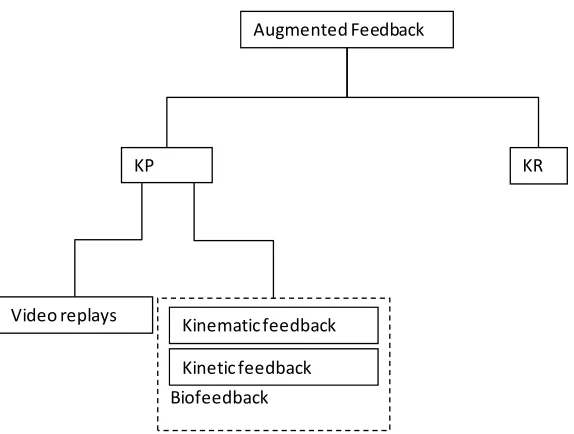
In general, augmented performance feedback can be further separated into knowledge of
performance (KP) or knowledge of results (KR) (Magill, 2004) (Figure 3). KP is information
concerning the nature of the movement pattern or process of which a performer is only
vaguely aware (e.g., gymnist limb position during training), whereas KR is verbal (or
verbalizabled), post-movement information on the outcomes of an action in terms of an
environment goal (e.g., “you were off the target by 3 inches”). The content of KR might
change according to different goals. The content of KP may also change depending on what
aspect of movement (i.e., kinematic or kinetic) is more critical for learning. KR cannot
contain information about the movement itself. Instead, it should contain error–correction
cues (i.e., the amount of error and direction of error) for performers for the next trial.
Depending on the specific training goals, KR can be delivered in terms of a discrete
measurement (i.e., success or failure) or continuous measurement (i.e., smoothness,
deviation, etc.). In many everyday situations, KR tends to be redundant with information
derived from intrinsic feedback through kinesthetic, visual or auditory channels, and this
might compromise further motor learning. For example, Platz and Winter (2001) found that
additional information from KR did not enhance learning since the chosen tasks already had
inherent information about movement outcomes. Therefore, KP is more commonly provided
to athletes or patients during training in natural settings (CJ Winstein, 1991), as knowledge of
20
Figure 3. Taxonomy of augmented feedback
One common way for presenting KP to learners is the use of videotape replays.
Replays can be of a learner’s own performance, or the performances from a domain model or
expert. Such KP is easy to deliver; however, it may contain too much irrelevant information
for the learner. Kernodle and Carlton (1992) found that videotapes with additional directed
viewing cues resulted in greater improvements in throwing performance as compared with a
simple videotape feedback condition. The videotape alone was found to be no better than
simply providing KR. Such results suggest that the content of videotape KP should be
specific to key motor movement joints.
Another type of KP is called kinematic feedback, which involves the presentation of
pure movement information such as position, time, velocity and patterns of coordination to
trainees. They inform the learner of aspects of the movement pattern that may not be directly
observable. However, the benefits of kinematic KP depend on a number of factors, including
the nature of the task goals and the relevance of KP information to the goal. If the uniqueness
KP KR
Video replays
Biofeedback
Kinematic feedback
Kinetic feedback
21
of the kinematic KP is not apparent as compared with less precise KR feedback, its
effectiveness in motor learning might not be so obvious. For example, Swinnen et al. (1993)
asked subjects to practice a discrete, bimanual coordination task. An elbow flexion
movement was made in the left limb, whereas a flexion-extension-flexion movement was
made in the right limb. Subjects were divided into a KR group (a simple outcome about the
coordination performance) or a KP group (a precise representation of the profile of limb
movement). Results showed that learning was equal between the two groups. This might be
due to the kinematic feedback manipulation corresponding to the goal of the task (presented
in terms of KR). The subjects in the KP condition could mentally calculate the KR score by
comparing the profiles for the two limbs, and they attempted similar strategies to the task as
those subjects in the KR group.
Related to kinematic KP, kinetic KP provides information about the forces that are
produced during movements. The forces recorded over time provide a force-time curve that
can be presented to the trainee after each trial. If the task goal is force-related (e.g., to
produce a maximum impulse), such feedback would be understandable for trainees. In other
tasks, directed cues should be provided by the instructors so that trainees can focus on the
most important aspects of the force-time curve.
Both kinematic and kinetic KP are very similar to the concept of biofeedback.
Biofeedback can be defined as the use of equipment to make covert physiological processes
overt (obvious) to patients, and help them to learn self-control of these responses (Huang,
Wolf & He, 2006). Typical information fed back to patients includes electromyogram (EMG;
22
Tuzunalp & Cakci, 1996), pressure or force applied (Lars, 2007; Nichols, 1997), or
electroencephalography (EEG; Thatcher, 2000), etc. This information is commonly presented
in analog, digital or binary forms though visual display. It can also be presented in terms of
auditory pitch (or volume) or mechanical tactile simulations. Traditional biofeedback studies
usually have patients perform a simple movement unrelated to the activities of daily living
(Huang, et al., 2006). As a consequence, the overall effect of traditional biofeedback training
on motor recovery is still inconsistent (Glanz, et al., 1995; Van Dijk, Jannink & Hermens,
2005). Modern perspectives on biofeedback focus more on task-oriented dynamic
biofeedback (Huang, et al., 2005). Such feedback integrates multiple variables that
characterize the task and provide meaningful and easy-to-understand information to patients.
This approach has the advantage of not overwhelming a patient’s perception and cognitive
ability.
2.1.2. KP and KR in the ergonomics area
The concept of KR also appears quite often in ergonomics research. Salvendy (1997) defined
it as outcome related feedback. For example, he mentioned that feedback or reinforcement
that is given to students to tell them how well they performed on the task is a typical form of
KR in educational environments. According to his definition, KR could be either
synchronous or asynchronous with performance. For example, if you asked subjects to
continuously perform 50 trials of a discrete movement task in a block of time, KR in terms of
“hit” or “miss” could be delivered after each individual movement trial (i.e., synchronous
with performance); or a summative outcome of “hit rate” could be delivered at the
23
(1999) suggested that KR offered while a skill is being performed may be less useful than
immediately after skill completion, simply due to divided attention issue. Such characteristics
of KR in the ergonomics area are comparable with the previous definition of KR from the
motor science area.
However, KP has not been defined clearly in human factors research. The reason is
that typical ergonomic experiments are commonly goal related and performance-based. Goal
or outcome related performance feedback (i.e., KR) is usually manipulated as an independent
variable. KP information about a movement process, such as eye tracking data, biofeedback
data, etc. are usually collected as response variables. In the motor learning area, however, we
are not only interested in performance outcomes relative to a goal, but also how the
movement is performed during the process. Knowledge of the process is important for skill
acquisition as well as long-term learning and retention. Therefore, both KP and KR are
commonly investigated and manipulated as independent variables in the motor science field.
In Table 1, some examples of KP (and KR) content are provided for various motor
tasks. Some examples represent real-world tasks (e.g., basketball shooting), whereas others
represent typical psycho motor tasks in ergonomics experiments (e.g., discrete movement or
Fitts’ tasks). As can be seen from the literature, kinematic feedback is the most commonly
manipulated form of KP for all tasks. This might be due to information (e.g., limb position
and the amount of the force applied) being critical to motor skill acquisition and learning.
Such forms of KP can be easily explained by coaches or therapists. Trainees can also
compare their postural information with a domain expert model, which helps facilitate
24
computerized bio-tracking system, and this saves time either for experimental or real-world
training purposes.
Table 1. Examples of KP and KR feedback in the motor science and ergonomics areas
Task Goal KR KP
Shooting a basketball
Shoot the ball into the basket Miss/hit The behavior of the limb during the shooting. Shoot as many baskets as
possible within a certain amount of time.
Hit rate within the time duration
Flight task To maintain a certain altitude
Percentage of time that the plane is above the threshold altitude
Current altitude of the plane
Non corrective linear positioning task
Reach the target position as close as possible
Deviation from the target position
Current position or speed of the lever Fitts task Make as many target hits as
possible within a certain amount of time
The target hit rate Current position of stylus or contact with a target
2.1.3. What’s better for motor learning, KP or KR?
Both KP and KR are valuable for motor recovery and learning. For example, Wallace and
Hagler (1979) found that motor learning was possible when only KR was provided to
subjects, but to a lesser extent when compared with both KP and KR. In another study,
Bilodeau et al. (1959) designed a lever-displacing task, in which KR was given as the amount
and direction of the placement error. Progressive improvement in the KR group was found as
compared with a non-improvement control group with no KR. Performance deterioration was
also found after the withdrawal of KR.
Related to this, a more recent study (C. Cirstea, Ptito & Levin, 2006) recruited 37
chronic stroke patients and investigated how different types of augmented feedback affected
motor recovery in a reaching task. Patients were assigned to either a KR group with
movement precision feedback, a KP group with faded joint motion feedback, or a control
25
evaluated. It was found that kinematic gains in either the KR or KP groups exceeded those
for the control group. In summary, these studies provide a sound empirical basis for feedback
intervention in motor learning.
There is some evidence that the use of KP during repetitive movement practice results
in better motor outcomes and learning as compared with KR. Zubiaur et al. (1999) compared
the two types of feedback in a volleyball learning task. Both KP and KR were delivered at
various points during the testing process. Statistical analysis revealed that KP tended to be
more effective for learning than KR. Kernodle and Carlton (1992) further suggested
augmented KP with additional cues (e.g., attention-focusing cues or error-correcting
transitional information) were more effective for learning as compared with regular KP (or
KR) in a “throwing” activity.
KP was also found to be superior to KR in the rehabilitation learning context. In one
study, chronic stroke patients were randomly assigned to either a KR or KP group in a
pointing task (M. Cirstea & Levin, 2007). Patients were required to complete 75 reaching and
pointing tasks per session for a total of 10 sessions over a 2 week period. KP feedback on
joint motion was delivered 27% of the time, whereas KR feedback on movement precision
was provided 20% of the time. ANOVA results showed that the KP group resulted in both
immediate and long-term increases in joint range as compared with the KR group. The KP
group also achieved better inter-joint coordination and such motor improvements were
26
2.1.4. Limitations and weakness of past feedback studies
Various weaknesses exist in previous studies directly comparing KP with KR. First and most
important, previous studies have failed to control the feedback resolution and
synchronization during the feedback manipulation. For example, Cirstea and Levin (2007)
used concurrent kinematic feedback (i.e., elbow and shoulder movement) as a way to
represent KP. This provided much finer information for trainees as compared with reaching
precision feedback provided as a form of KR (i.e., a number). Subjects receiving kinematic
feedback (i.e., KP) might be able to extract meaningful information on how to correct
reaching movements in follow-on trials. On the other hand, some subjects might feel puzzled
or overwhelmed with such complex information and fail to process it at a high-level of detail.
This means that great individual differences exist in processing feedback information with
various complexities. Therefore, the resulting beneficial effects of KP might be due to the
higher resolution (i.e., detail quality) of the information provided, but not the fundamental
characteristics that differentiate KP from KR (i.e., process vs. product/outcome information).
In Cirstea and Levin’s study, synchronous KP was provided with task performance,
whereas KR was delivered asynchronously with the task. Such study designs might also
cause serious issues in making inferences on experiment results. First, the amount of
feedback cannot be easily controlled if it is delivered in real-time or at the termination of task
performance. For example, if KR is presented asynchronously with task performance, should
the presentation duration be the same length as the task performance duration during which
KP is delivered? Second, feedback provided during a task might influence performance due
27
fully studied. In fact, previous studies have already found that synchronization of feedback
can have different effects on skill acquisition and motor learning (see Armstrong’s, 1970b
paper comparing concurrent KP with terminal KP). Therefore, synchronization of feedback
should be controlled in future motor learning experiments, especially in studies comparing
KP with KR.
Feedback modalities were also not controlled in Cirstea and Levin’s experiment. KP
was presented in a spatial visual format, whereas KR was presented in a verbal format.
Cirstea and Levin failed to provide a literary basis for their choices of feedback modalities.
Their choices might have been based on the fact that kinematic feedback, especially limb
position and joint angle information, could most easily be presented through the visual
modality. Verbal KR was picked to reduce the information load on the visual modality. It is
suspected that these choices were also based on the assumption that feedback modalities have
little or no mediating effects on motor skill acquisition or long-term learning. This also
assumes that human motor adaptation is a multisensory, highly flexible process whose
efficiency does not depend on the effectiveness of a sensory channel for conveying error or
performance signals (Sarlegna, Gauthier, & Blouin, 2007).
Even if the above assumptions were true, there might be additional motivational
effects when training with feedback provided via different sensory modalities. For example,
one feels more motivated when playing video games using force-feedback enabled joysticks.
Such motivational effects might influence motor learning and skill acquisition in the long
28
Some studies have not strictly observed the key differences in characteristics between
KP and KR in defining experimental conditions. For example, in Kernodle and Carlton’s
(1992) study, one condition of information feedback was presented in the form of KP with
error-correcting cues. Their conclusion was that this type of KP can lead to significant gains
in skill acquisition. However, they failed to recognize that KP with error-correcting cues was
not KP at all. Instead, they were actually manipulating a combination of KR and KP, which
was better than KR alone. In general, researchers should not add additional cues to feedback
conditions if their primary goal is to make comparison between KP and KR. KR should be
manipulated to reflect movement outcome, whereas KP should be focused on
process-oriented information (i.e., information on the state of movements).
Consequently, there is a need for research to control these feedback design
parameters and to further study how KP and KR influence motor learning and skill retention.
It was posited earlier that the key differences between the two feedback types are related to
how they direct trainee attention. KR directs trainee attention to the task goal state, whereas
KP directs trainee attention to limb movement state. By comparing the effects of KP and KR
on motor learning, a study actually investigates how human attention resources should be
allocated during skill training to support learning and retention. This kind of research could
also help resolve the basic question of whether motor skill learning is more outcome vs.
process oriented.
In the following section, a model of human information processing (HIP) is reviewed
and discussion is provided on how motor skill learning occurs. The model is used to explain
29
perspectives regarding this research finding (i.e., KP supports more learning than KR) are
also discussed. A set of research hypotheses is described at the end of the section.
2.1.5. Why KP maybe better than KR for skill retention: A HIP perspective
In order to investigate performance and learning effects of different information feedback
types, there is a need to understand the learning process from a human information
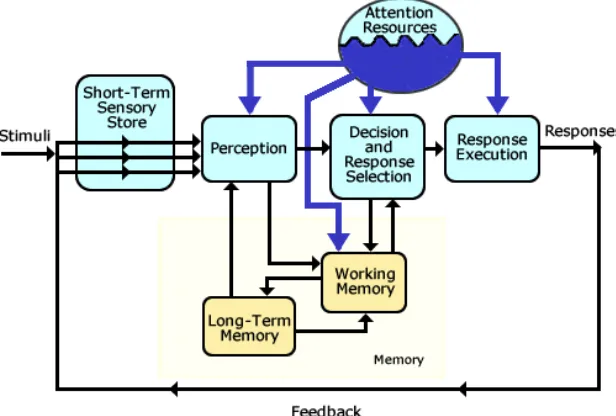
processing (HIP) perspective. Wicken and Hollands (1999) described several critical stages
of information processing involved in human performance or skill acquisition (see Figure 4).
For example, information from various stimulus modalities first enters the short term sensory
store (STSS). The STSS permits environmental information to be preserved temporarily and
dealt with later. However, no attentional resources are allocated in this process and
information stored in the STSS decays quickly. The rate of decay depends on the sensory
modality of the stimuli. In general, iconic stimuli have been found to decay much faster than
echoic or kinesthetic stimuli in the STSS (Wickens & Hollands, 1999).
30
The processor following the STSS is “Perception”. Here, information is perceptually
encoded using attentional resource allocation. At a basic level, perception can be a single
dimension task in terms of detection or miss-detection. At a greater level of complexity, it
might also require recognition of multidimensional cues, which would allow for
identification of the state of the environment, task and system. For both levels of
“perception”, information in the STSS contacts long-term memory (LTM) stores and is
encoded in working memory (WM). More specifically, humans will store the information
from environmental stimuli in WM, encode the information as a set of declarative knowledge
that is related to the task goal, and further make comparisons with operational rules stored in
LTM (e.g., if an object’s shape is round with no corners, it probably is a circle or globe). If
the task is new and no operating rules exist, new procedural knowledge of the task will be
formulated. WM is identified as the key store in HIP affecting skill learning and retention.
This is because perceived information is communicated to the memory store so frequently
that the development of LTM knowledge (i.e., motor programs or motor schemas) for a new
task cannot be achieved without it.
After stimuli are perceptually categorized, a conscious decision is made on what to do
with it. This process includes direct selection of a movement response, or it might include
decisions to store information in WM or LTM for further rehearsal. The last process is to
recall a memory of a motor program and execute the movement. In Wicken’s model, humans
are considered to be closed-loop information processors. Therefore, a feedback loop exists to
modify future control actions based on perception of outcomes of current actions.
31
transformation of the data and demands some time for its operation. This suggests that
human performance is largely dependent on how smooth the information can be transformed
among each processing store, and how much time it would take to finish the entire feedback
loop.
Based on the above discussion, it could be argued that skill performance and skill
learning are related to different aspects of HIP. Human performance mainly depends on the
flow of HIP as a whole, whereas skill learning is more related to the formation of LTMs and
how frequently communications occur among the perceptual process, WM and LTM.
Performance can be facilitated if the flow of information becomes smooth (rapid in speed and
consistent). However, it does not necessarily mean that such skill level can be sustained or
persist after experimental intervention is removed. On the other hand, learning can be
facilitated if subjects form a mental model (or motor program) for the task more quickly and
such model has utility in other tasks that require similar motor skills.
When trainees receive KP feedback during motor skill training, they typically receive
raw information with respect to their movement kinematics or kinetics. When this
information enters the WM store, trainees need to make comparison of input stimuli with the
task goal template. In a reaching task, for example, trainees need to store the current limb
position as well as the target position. They also need to conduct mental calculations on the
deviation between the two in a three-dimensional (3D) space. After that, the calculated
deviation is stored in WM and it is used for decision making and response execution. Such a
process requires many interactions between stimuli input, WM, and LTM, which takes time
32
Trainees receiving KR, on the other hand, can process information much more
quickly withou