AUTOMATIC FINGERPRINT CLASSIFICATION SCHEME USING TEMPLATE MATCHING WITH NEW SET OF
SINGULAR POINT-BASED FEATURES
ALAA AHMED ABBOOD
AUTOMATIC FINGERPRINT CLASSIFICATION SCHEME USING TEMPLATE MATCHING WITH NEW SET OF
SINGULAR POINT-BASED FEATURES
ALAA AHMED ABBOOD
A thesis submitted in fulfilment of the requirements for the award of the degree of
Doctor of Philosophy (Computer Science)
Faculty of Computing Universiti Teknologi Malaysia
To my God, Allah ‘azza wa jalla
ACKNOWLEDGEMENT
Thanks to Allah SWT for everything I was able to achieve and for everything I tried but I was not able to achieve.
I am grateful for several people for making this thesis possible. I would like to begin by expressing my deep appreciation to my supervisor, Professor Dr. Ghazali bin Sulong for his guidance and encouragement. Despite the busy schedule, he has provided me with valuable ideas, advice and comments. I am very fortunate to have him as my adviser. Special thanks to Dr. Sabine U. Peters for valuable comments and suggestions. I would like to thank all my friends for personal support.
ABSTRACT
ABSTRAK
TABLE OF CONTENTS
CHAPTER TITLE PAGE
DECLARATION ii
DEDICATION iii
ACKNOWLEDGEMENT iv
ABSTRACT v
ABSTRAK vi
TABLE OF CONTENTS vii
LIST OF TABLES xi
LIST OF FIGURES xii
LIST OF SYMBOLS xxi
LIST OF ABBREVIATIONS xxiii
LIST OF APPENDICES xxv
1 INTRODUCTION 1
1.1 Overview 1
1.2 Background of Research 2
1.3 Problem Statements 9
1.4 Research Goal 11
1.5 Objectives of the Study 12
1.6 Research Scope 13
1.7 Significance of the Study 13
1.8 Thesis Outline 14
2 LITERATURE REVIEW 16
2.2 Image Pre-processing 17 2.2.1 Fingerprint Image Enhancement 17
2.2.1.1 Normalization 18
2.2.1.2 Histogram Equalization 19
2.2.1.3 Binarization 20
2.2.1.4 Skeletonization 22
2.2.2 Fingerprint Segmentation 25
2.2.2.1 Block-Wise Step Operating on
Gray-Scale Statistical Features 27 2.2.2.2 Bit-Wise Step Operating on
Local Directionality Features 28 2.2.2.3 Bit-Wise Step Operating on
Coherence Features 23
2.3 Feature Extraction 30
2.3.1 Orientation Field Estimation 31
2.3.1.1 Orientation Field Estimation
Using a Gradient Approach 33 2.3.1.2 Model-based Approach for
Orientation Field Estimation 36
2.3.2 Singular Points Detection 37
2.3.2.1 Poincaré Index Methods 37
2.3.2.2 Partitioning-based Methods 40 2.3.2.3 Methods Based on Local
Orientation Field
Characteristics 40
2.4 Fingerprint Classification 42
2.4.1 Model-based Approaches 44
2.4.2 Structure-based Approach 45
2.4.3 Combined Approaches 47
2.4.4 Neural Network Approaches 47
3 METHODOLOGY 50
3.2 Fingerprint Image Enhancement 53
3.2.1 Grey-level Normalization 54
3.2.2 Contrast Enhancement 57
3.2.3 Binarization 60
3.2.4 Skeletonization 63
3.2.5 Proposed Image Fusion 69
3.3 Proposed Segmentation Technique 73
3.3.1 Segmentation Features 74
3.3.1.1 Distribution of Image Mean,
Variance and Coherence 77
3.3.1.2 Relationship between Mean, Variance and Coherence in an
Image 81
3.3.2 Foreground Extraction 85
3.3.3 Filling in the Gaps in a Fingerprint
Image 88
3.4 Orientation Field Estimation 94
3.4.1 Proposed Orientation Field Estimation
using Epicycloid Windows Shape 95
3.4.2 Highlighting the Homogeneous Area in Fingerprint Image based on Region
Growing Technique (RGT). 101
3.5 Singular Point Detection 107
3.5.1 Proposed Singular Point Detection
Method 108
3.6 Classification Process 116
3.6.1 Feature Extraction for Classification 118 3.6.1.1 Symmetric Axis Calculation 119 3.6.1.2 Classification Features 122 3.6.2 Fingerprint Classification Using
Template Matching Technique 130
3.7 Summary 138
4 RESULTS AND DISCUSSION 139
4.1 Introduction 139
4.2 NIST Special Database 14 140
4.3 Performance Measure 143
4.4 Qualitative Evaluation of the Experimental
Results 145
4.4.1 Performance Evaluation of Image
Enhancement 145
4.4.2 Performance Evaluation of Image
Segmentation 153
4.4.3 Performance Measurement of the Current
Orientation Field Estimation Method 159 4.4.4 Performance Evaluation of Singular Point
Detection 165
4.5 Quantitative Evaluation of the Experimental
Results 176
4.6 Performance Measurement of Fingerprint
Classification 178
4.7 Qualitative Evaluation of the Current
Classification Method in Scar Fingerprints 186
4.8 Summary 189
5 CONCLUSIONS AND FURTHER OUTLOOK 191
5.1 Contributions 194
5.2 Further Outlook 197
REFERENCES 198
LIST OF TABLES
TABLE NO TITLE PAGE
2.1 Classification based on singularities (Maltoni and
Cappelli, 2009) 42
2.2 Summary of the related works on the fingerprint
classification 48
3.1 The values of mean, variance and coherence for the
different global mean threshold values 86 4.1 True classes of fingerprints in NIST 14 (f000001 to
f027000 filenames), according to human expert
classification. 141
4.2 Performance Measures 144
4.3 Summary of Miss rates for Core and Delta points 176 4.4 Summary of False alarm rate for Core and Delta
points 177
4.5 A confusion matrix of the experimental results for
LIST OF FIGURES
FIGURE NO TITLE PAGE
1.1 Examples of Galton’s three classes (Maltoni,
2009) 3
1.2 An example of Henry’s five classes (Yager and
Amin, 2004) 3
1.3 Examples of ambiguous fingerprints found in NIST special Database 14: (a) Image with Arch and Tented-arch classification; (b), (c) and (d) Images with Whore and Right Loop classification; (e) Image with Right loop and Tented-arch classification; (f) Image with Left
loop and Tented-arch classification 5
1.4 An example of a scar fingerprint image
(F0002119) found in NIST special Database 14 6 1.5 Examples of problematic fingerprints found in
NIST special Database 14 (a) A dry image (b)
Image containing hand written annotations 7 1.6 Three fingerprints of the same class that have
very different characteristic (large intra-class
variability) (Wang et al., 2007) 7
1.7 Ridge and valley structures and singular points 8 2.1 Quality of fingerprint images: (a) Good, (b)
Low contrast (c) Wet and (d) Over ink 18 2.2 (a) Image before the normalization process (b)
2.3 Otsu’s thresholding: (a) Fingerprint image (b) General histogram of the image, (the X-axis shows the image intensity values; the Y-axis
shows the frequency). 21
2.4 Average Performance Evaluations of Different
Binarization Techniques (Shaikh, 2013) 22 2.5 Shows the 8 neighbours of pixel P(i,j) (Zhang
and Suen., in 1984) 23
2.6 Pixel window of size 3×4 24
2.7 (a) Binary image ( b) Skeleton image 25
2.8 A sample of fingerprint segmentation results: (a) original fingerprint image, (b) background, foreground and noise patches of the segmented
fingerprint image (Saparudin, 2012). 26 2.9 The global and local features of a fingerprint
image (Ozkaya and Sagiroglu, 2010) 31
2.10 Ridge flow direction at pixel and angle θ_xy (i,j) indicating the direction of flow with respect
to the horizontal axis 33
2.11 Orientation image partitioned into homogenous
areas (Cappeli et al., 1999) 40
2.12 An octagon mask for capturing a centre point
(Martino et al., 2007) 41
2.13 Candidate regions for singular points (C. Park et
al., 2006) 42
2.14 Samples after flow-like tracing (Left Loop, Right Loop and Tented Arch) (Wang and Xie.,
2004) 46
3.1 Fingerprint classification process 51
3.2 The proposed enhanced fingerprint image
3.3 Grey-level normalization: (a) Original image (Source NIST Database 14: f0000008) (b)
Normalized image 57
3.4 (a), (b) Normalized image with its histogram before HE, while (c), (d) Enhanced image after
HE with its histogram 59
3.5 A 3x3 window: the centre pixel and its
neighbours 61
3.6 Binarization: (a) Normalized image, (b)
Binarized image 63
3.7 A 3 × 3 pixel mask of the nearest neighbours
mapped around 𝑃𝑖 64
3.8 (a), (b) and (c) Examples of rule 1 65
3.9 Skeletonization: (a - d) Examples of rule 3
effects 66
3.10 Flow diagram of the Skeletonization process 67 3.11 Skeletonization: (a) The input Binarized image
(b) Skeleton image 69
3.12 Summary of the DCT fusion process 71
3.13 (a) Original image (b) Fused image (NIST
F0000008) 73
3.14 Manual subdivision of an image into a 16×16
block (NIST Database 14, F0000008) 77
3.15 Manual identification of the foreground and
background regions 78
3.16 Distribution of local coherence values in an
image 79
3.17 Distribution of local variance in an image 80 3.18 Distribution of local mean values in an image 81 3.19 The relationship between mean, variance and
coherence 82
3.20 The relationship between mean and variance in
3.21 The relationship between coherence and
variance 84
3.22 The relationship between coherence and mean 85 3.23 Segmentation: (a) Enhanced image (b)
Segmented image 88
3.24 A 3x3 blocks mask centred at B_i 88
3.25 Filling in the gaps: (𝑎1 → 𝑎2) and (b1 → b2)
Changes of the block 𝐵𝑖 based on its
neighbours 89
3.26 (a1→ a2) – (d1→ d2): Shows the four conditions
that change block 𝐵𝑖 based on to Rule 1 90 3.27 (a1→ a2) - (d1→ d2) The four conditions that
change block 𝐵𝑖 based on Rule 2 91 3.28 (a1→a2) - (d1→d2): Four conditions that change
block 𝐵𝑖 based on Rule 3 92
3.29 An example of Filling the gaps outcome: (a)
Before the process, (b) After the process 94 3.30 Epicycloid shapes with (a) 𝑘 = 1, (b) 𝑘 = 2, (c)
𝑘 = 3 and, (d) 𝑘 = 4 (Lawrence J. D., (2013) 96 3.31 Epicycloid window shape over 3x3 blocks 96
3.32 The Epicycloid Filter (EF) 97
3.33 Blocks beneath the mask 98
3.34 The orientation field process: (a) Segmented fingerprint image (b) Orientation fingerprint
image 101
3.35 Seed label according to colour 102
3.36 Process of growing for one seed (a) Seed block with its surrounding neighbours (b) Difference in values to seed block (c) Spreading of the
colour 102
3.37 (a) Initial step (b) - (e) Stages of the region
3.38 (a) The distribution of the seed points for region growing in an image (b) The resultant labelled
blocks formed from (a). 104
3.39 (a) Saparuldin’s method (b) The current region
growing method 106
3.40 (a) Fingerprint image with 4 homogenous regions detected using Saparuldin’s method (Saparudin.,2012) (b) Fingerprint image with 4 homogenous regions detected using RGT
method 107
3.41 (a) Traditional labelling of singular points (b)
Sub-classified labelling 108
3.42 New representation of homogenous blocks (a) Original homogenous blocks (b)
Character-based homogenous blocks 109
3.43 String directions in 2×2 block 109
3.44 Top core: (a), (b) Example of Rule 1 from case
1 110
3.45 Bottom Core: (a), (b) Representation of Rule 2
from case 1 111
3.46 Delta: (a), (b) Example of Rule 3 from case 1 111 3.47 Top Core: (a), (b) Example of rule 1 from case 2 112 3.48 Bottom Core: (a)-(h) Examples of combinations
of rule 2 from case 2 113
3.49 Delta: (a)-(h) Example of all the combinations
of rule 3 from condition 2 113
3.50 (a) Orientation field image (b) The detected
singular points 116
3.51 Ridge flow on different classes (a) Right Loop (b) Left Loop (c) Tented-arch (d) Whorl (e)
Arch 118
3.53 Shows the four symmetric axis angles 𝜑
according to colour 120
3.54 Diagram of a symmetric axis calculation, where the numbers inside the blocks (4, 5, 6) represent
the block location surrounding the TC. 120 3.55 Example of a Ridge flow axis calculation: (a)
Original image (b) Fingerprint image with a
symmetric axis 122
3.56 An example of the features of a Right Loop
print 124
3.57 An example of the features of Left Loop print 125 3.58 An example of the features of a Whorl class
print 126
3.59 An example of the features of a Tented-arch
print 127
3.60 An example of the features of an Arch print 128 3.61 Illustrate the process of selecting the optimum
number of image template for each class 131
3.65 Classification process 133
4.1 Representation of the human fingerprint class
distribution. 140
4.2 Fingerprint with a cross-referenced classification or ambiguous fingerprint
(F0000042) 142
4.3 Fingerprint with extraneous objects: (a) Handwritten characters and (b) Other artefacts
common to inked fingerprints 143
4.4 (a) - (e) A comparison between the current enhancement technique and Saparudin’s (2012)
4.5 (a) - (e) Shows the comparison between the current enhancement techniques and Saparudin’s (2012) enhancement technique
using low contrast images 149
4.6 (a)-(c) The effects of the current enhancement
techniques on dry images 151
4.7 (a) - (c) The effects of the current enhancement
techniques on wet images 152
4.8 (a) – (d) Segmentation results of good quality image: Current method versus Saparudin’s
method 153
4.9 (a - c) Segmentation results of dry prints:
Current method versus Saparudin’s method 155 4.10 (a) – (d) Segmentation results of low contrast
image: Current method versus Saparudin’s
method 156
4.11 (a) - (c) Segmentation results of tainted images:
Current method versus Saparudin’s method 158 4.12 (a) – (e) Orientation fields of good quality
images: Current method versus Saparudin’s
method 159
4.13 (a) – (c) Orientation fields of dry quality images: Current method versus Saparudin’s
method 162
4.14 (a) – (c) Orientation fields of low contrast images: Current method versus Saparudin’s
method 163
4.15 (a) – (c) Orientation fields of wet fingerprint images: Current method versus Saparudin’s
method 164
4.16 (a) - (e) Shows detected singular points in good quality images: Current method versus
4.17 (a) - (e) Detected singular points for dry fingerprints: Current method versus Saparudin’s
method 168
4.18 (a) - (e) Detected singular points for wet fingerprints: Current method versus Saparudin’s
method 170
4.19 (a) - (c) Detected singular points for cut fingerprints: Current method versus Saparudin’s
method 172
4.20 (a) - (c) Detected singular points for bruises fingerprints: Current method versus Saparudin’s
method 173
4.21 (a) - (e) Detected singular points for low contrast fingerprint images: Current method
versus Saparudin’s method 174
4.22 Summarized results of the Quantitative Evaluation of the current method in term of Miss Rate and False alarm rate of singular
points. 178
4.23 A comparison in total accuracy between the current method and previous studies on same
dataset 179
4.24 Comparison of the current method with
Saparudin’s one for each individual class 181 4.25 Some examples of correctly classified prints of
various qualities where (a) good, (b), dry, (c)
wet, (d) cut, (e) bruise and (f) low contrast 181 4.26 (a, b) Example on correct classification of the
Tented-arch class 184
4.27 (a), (b): Misclassify fingerprint due to missing
4.28 Scar images (a), (b) Detected as Right Loop class (c), (d) Detected as Arch class (e), (f) Detected as Tented-arch class (g) Detected as
LIST OF ABBREVIATIONS
2D - Two dimensional
A - Arch
AFCS - Automatic Fingerprint Classification System AFIS - Automatic Fingerprint Identification System AHE - Adaptive Histogram Equalization
B - Blue
BC - Bottom Core
CH - Character-based Homogenous blocks
D - Distance
DB14 - NIST Special Database 14 DCT - Discrete Cosine Transform
DP - Delta Point
EF - Epicycloid Filter
FBI - Federal Bureau Investigation FC - False alarm rate of Cores
FD - False alarm rate of Deltas
FVC2002 - Second International Competition for Fingerprint
G - Green
HE - Histogram Equalization HMM - Hidden Markov Model
HR - Homogenous regions
IT - Information Technology
LL - Left Loop
NCIC - National Crime Information Centre
NIST - National Institute of Standards and Technology
P - Purple
PCASYS - Pattern-level Classification Automation System
R - Red
RGT - Region Growing Technique
RL - Right Loop
S - String
SK - Skeletonization
SVM - Support Vector Machine
TA - Tented-arch
TC - Top Core
W - Whorl
LIST OF SYMBOLS
y
S - Vertical Sobel mask operator )
, (i j
Coh - Coherence value of block (i,j) 0
Mg - Desired mean value for determine normalization 0
Vg - Desired variance value for determine normalization Mg - Global mean value of fingerprint image
Mn - Global mean value of normalized fingerprint image Vg - Global variance value of fingerprint image
) , (i j
- Gradient angle of orientation field
) , (m n
Gr - Gradient magnitude of pixel (m,n) )
, (m n
Gx - Gradient of pixel (m,n) in horizontal direction )
, (m n
Gy - Gradient of pixel (m,n) in vertical direction
x
S - Horizontal Sobel mask operator )
, (m n
I - Intensity value of the pixel at the m-th row and n-th column in the fingerprint image
) , (m n
N - Intensity value of the pixel at the m-th row and n-th column in the normalized fingerprint image
) , (i j
Mb - Local mean value of block(i,j)
Nc - Number of cores
Nd - Number of deltas
B
B - Size of block in the fingerprint image H
W - Size of fingerprint image
c - Threshold factor for gradient
th
) , (i j
Vx - Vector gradient x-direction of block (i,j)
) , (i j
Vy - Vector gradient y-direction of block (i,j) ∂ - Threshold of the Binarization process
∆ - Delta
Ci - Exclusive Class Of image I
I - Image
O - Core
LIST OF APPENDICES
APPENDIX TITLE PAGE
A Results of Singular Points Detection Using Current Method
207
CHAPTER 1
INTRODUCTION
1.1 Overview
Biometrics are measurable characteristics based on physiological and behavioural traits that are used in the identification of individuals. The most important type of human biometrics is fingerprints. Fingerprints have been used for personal recognition in forensic applications such as criminal investigation tools and in civilian applications, as well as border access control systems, national identity card validation and authentication processors. The uniqueness and immutability of fingerprint patterns as well as the low cost of associated biometric equipment make fingerprints more desirable than the other types of biometrics (Maltoni and Cappelli, 2009). Fingerprints develop during the fourth or the fifth month after conception. The pattern of a person’s fingerprints remain much the same until his death, or until he gets injured in an accident. Age of a person does not change a person’s fingerprints but injury does. Schaeuble J (1932) and Babler W (1991) had proven that fingerprints of twins sharing similar DNAs are different. Fingerprint biometric identification is low-cost because it involves pattern recognition using IT equipment and does not require laboratory wet tests (such as blood test) Kücken M., and Newell A. C (2004).
the record. Verification process confirms whether the identity of the person with the fingerprint is the valid person. However, the process used in fingerprint identification systems is more complex than the process employed in print verification especially for large databases because fingerprint identification requires the input fingerprints to be compared with all the fingerprints in the database to find a match. While verification uses 1:1 comparison for matching, fingerprints identification requires 1:N comparison to establish if the individual is present in the database (Maltoni et al., 2005).
In fingerprint identification, both matching accuracy and processing time are critical issues. To achieve an efficient identification of a fingerprint, fingerprints in the database are organized into a number of mutually exclusive classes that share certain similar properties. This process is called fingerprint classification. In order to design an automatic system for identification which has better accuracy, pre-processing of the fingerprints have to be carried out to enhance and extract the fingerprint features (Wu et al., 2007).
1.2 Background of Research
The most important part of an Automatic Fingerprint Identification System (AFIS) is the fingerprint classification because it provides an indexing mechanism and facilitates the matching process with the large databases. When a class of a query fingerprint is known, matching the fingerprint only requires that the print is compared with a similar class of prints.
formally recognized system for fingerprint classification. Galton’s classification was introduced as a means of indexing fingerprints in order to facilitate the search for a particular fingerprint within a collection of many prints and proposed three basic fingerprint classes: the Arch, the Loop, and the Whorl shown in Figure 1.1. Galton’s other major contribution was the first study into the uniqueness of fingerprints. In addition to permanence, uniqueness is also necessary for a fingerprint to be a viable method of personal identification.
Figure 1.1 Examples of Galton’s three classes (Maltoni, 2009)
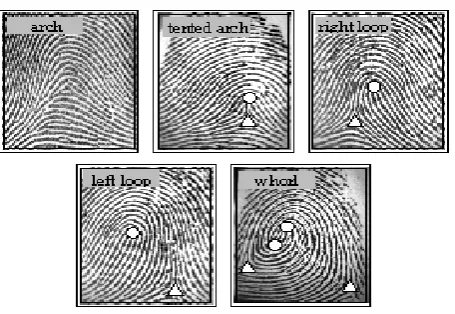
Building on Galton’s work, Edward Henry (1990) subdivided two of the three main classes into more specific sub-classes. Henry distinguished between the Arch, Tented-arch, Left Loop, Right Loop and the Whorl, as shown in Figure 1.2. He also introduced the concept of fingerprint ‘‘Core’’ and ‘‘Delta’’ points and used them as aids for fingerprint classification. Henry’s classification scheme constitutes the basis for most modern classification schemes (Yager and Amin, 2004).
The distribution of the classes in nature is not uniform. The probabilities of the classes are approximately 3.7%, 2.9%, 33.8%, 31.7% 𝑎𝑛𝑑 27.9% for the Arch, Tented-arch, Left Loop, Right Loop, and Whorl, respectively (Jain et al., 1999; Wilson et al., 1994). Left Loop, Right Loop and Whorl are the most common, making up 93.4% of all fingerprints (Yager and Amin, 2004). To develop and test a classification system, it is important to use a suitable dataset with a large enough sample size that is representative of the natural distribution of human fingerprint classes in the population. However, most researchers so far have used the National Institute of Standard and Technology NIST database 4 which provided an insufficient sample size (less than 10,000 prints) for testing and validating their experiments (Jain et al., 1999; Jain et al., 2002; Hou et al. 2008; Wang and Xie 2004.). Thus, the validity of their experimental results is disputable, and the performance of their proposed classification methods implausible. As a result of these limitations, the NIST Special Database 14 was created and became the de facto standard dataset for developing and testing of automatic fingerprint classification systems (Maltoni and Cappelli., 2009).
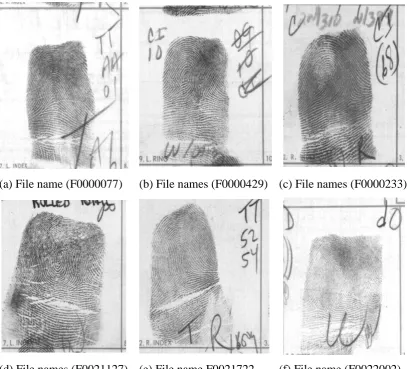
(a) File name (F0000077) (b) File names (F0000429) (c) File names (F0000233)
(d) File names (F0021127) (e) File name F0021722 (f) File name (F0022002)
Figure 1.3 Examples of ambiguous fingerprints found in NIST special Database 14: (a) Image with Arch and Tented-arch classification; (b), (c) and (d) Images with Whore and Right Loop classification; (e) Image with Right loop and Tented-arch classification; (f) Image with Left loop and Tented-arch classification
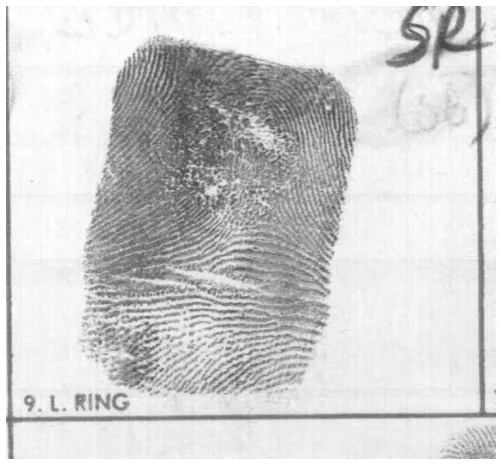
Figure 1.4 An example of a scar fingerprint image (F0002119) found in NIST special Database 14
(a) (b)
Figure 1.5 Examples of problematic fingerprints found in NIST special Database 14 (a) A dry image (b) Image containing hand written annotations
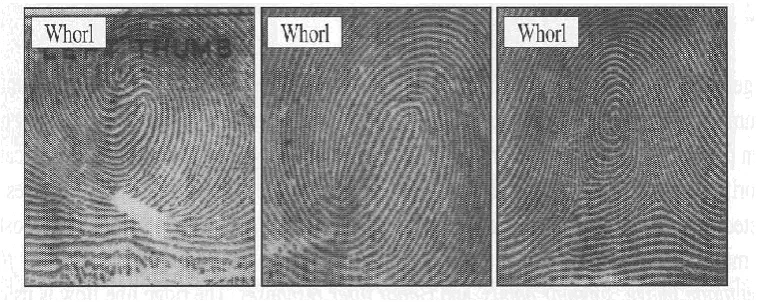
Most classification schemes use five classes. Any significant similarities in the structure and shape of human fingerprints creates difficulty in distinguishing and differentiating orientation patterns of ridge structure within the same class, especially in Whorl cases (see Figure. 1.6). These difficulties and problems are associated with large intra-class variation, where the prints of the same class can have similar characteristics covering a large spread, and are therefore difficult to classify (Wang et al., 2007). This intra-class problem is extremely difficult to deal with even for
human experts.
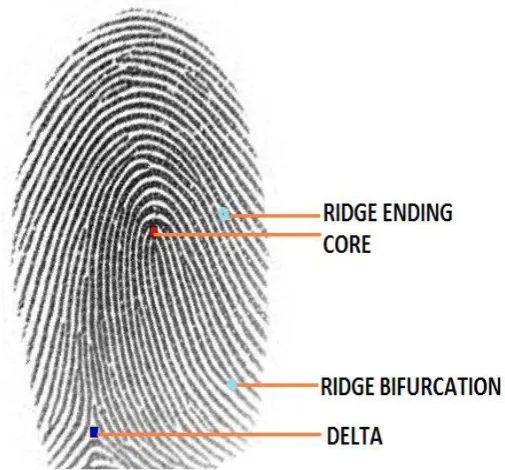
Generally speaking, a fingerprint image contains two features, which are the global feature and the local feature. The global features of the fingerprint image are described by structure shapes (ridges and valleys) and a singular points (core and delta) as shown in Figure 1.7. The local features of the fingerprint consist of minute ridge details. These global features contain global information that is considered valid in the design of automatic fingerprint identification systems (Jain et al., 1999). Therefore, it makes sense to derive these features directly from the fingerprint ridges. Orientation field estimation is a convenient way to represent the global ridge structure of fingerprints. Although orientation field estimation is the best approach to represent ridge structures, there are still many challenges regarding the classification of low quality images.
Figure 1.7 Ridge and valley structures and singular points
This is especially true if the image has poor quality, or if the image contains a high level of noise. This makes the extraction of a singular point in the fingerprint unreliable. Researchers have proposed different methods to locate singular points. The most common and widely used approach is the Poincaré Index (Mandal et al., 2013). However, there are a number of limitations, such as a high sensitivity to noise, and its difficulty capturing low contrast and low quality fingerprint images (Hsieh et al., 2005).
These performance limitations necessitate continued research in this area. In an effort to mitigate the identified challenges, the following research questions guide this study:
1. How to accurately and optimally classify the fingerprint based on five classes?
2. How to improve quality of image having poor quality?
3. How to automatically extract foreground from the background?
4. How to locate and remove the noise to improve the quality of the image? 5. How to estimate the orientation fields of the images having poor quality? 6. How to precisely detect the genuine singular points?
7. How to classify ambiguous fingerprints such as intra- and inter-class variations?
1.3 Problem Statements
Based on the problem background and research questions, the issues to be resolved are:
human expert hand written annotations that further deteriorate the prints. Therefore, it is crucial to make them good by enhancing their quality while still preserving the actual ridge flow.
2. The fingerprints either have non-ridge regions on a background, or they have ridge regions but with foreground containing unwanted hand written comments and references. In the past these images were cropped manually to extract foreground from background manually, which was very labour-intensive. Later, a couple of studies automate the process (Maltoni et al. 2009; Saparudin, 2012). However, their works are far from over. Thus, In order to design a fully automated system, it is necessary to implement a more robust method of segmentation to extract the image’s foreground from the background and also frees from artefacts and unwanted annotations.
3. Ridge patterns in a fingerprint follow a certain field structure. This structure can be represented in the form of orientation field estimation patterns. In previous studies, researchers have used pre-defined angles (for example 0, 45, 90, 135 and 180 degrees) to represent the original ridge shape orientation of fingerprint images ( Ratha et al., 1995; Hsieh et al., 2005; Zhang et al., 2007). However, these pre-defined angles do not
always represent the actual ridge orientation. For that reason, it is necessary to improve the computability of the original ridge orientation and the digital smoothing of the orientation field estimation process.
5. In case of ambiguous prints, more than one class of fingerprints is present that and cannot be easily classified by human experts, let alone by computer. In fact, about 6.63 percent of the 27,000 images in the NIST Special Database 14 are ambiguous. In these cases, it is unclear which fingerprint classes the ambiguous prints should be matched against. Furthermore, these ambiguous prints are also susceptible to inter-class variation, particularly in Arch and Tented-arch cases. Some Tented-arch prints closely resemble the traditional arch shape (i.e. the peak of the Tented-arch is unnoticeable due to defective or deformed vertical shapes). Therefore, it is necessary to come up with solution to this issue (Maltoni and Cappelli, 2009).
6. Large intra-class variation remains a key occurrence that prevents correct classification of the Whorl class, as mentioned by (Maltoni and Cappelli., 2009; Saparudin, 2012).
7. Scars on fingerprints can be caused by accidents, injuries, long exposure to detergents or chemicals, or hard labour. Most scarred prints contain patterns of some parts of the epidermis which have been damaged and consequently distort the original ridge structure of fingerprints. Therefore, many applications reject such images (Maltoni et al., 2009; Saparudin, 2012). Though, the scarred prints percentage found in the NIST Special Database 14 is negligible, it is worth to investigate because in reality there exist a significant number of such prints that require special attentions and specialised tools to correct the damage (Sulong, et al., 2009).
1.4 Research Goal
AFCS will be able to classify most fingerprint images with varied quality. It does so by using pre-processing procedures which execute image enhancement, foreground segmentation, orientation field estimation and singular point detection.
1.5 Objectives of the Study
In order to achieve the above mentioned goal, the following objectives will be fulfilled:
1. Improve the quality of defective images in the fingerprint dataset by using improved reconstructive enhancement techniques.
2. Develop new techniques that identify and detect unwanted objects (hand writing comment and signature) in the fingerprint dataset, and extract the image foreground from the background.
3. Introduce a new orientation field estimation method that utilizes the true angle of the orientation fields in accordance with the natural gradient of a print’s ridge structure.
4. Propose a new singular point detection technique that able to minimize the number of inaccurate Core and Delta points.
1.6 Research Scope
This study is a synthesis of a complete process of automatic fingerprint classification which includes the introduction of an effective fingerprint enhancement, a novel approach to fingerprint segmentation, optimal orientation field estimation, accurate singular point detection, and ultimately, a reliable fingerprint classification method.
This system will be tested using a standard dataset testing platform, employing grey-scale fingerprint images obtained from the NIST special fingerprint database 14. The database contains 54,000 8-bit grey-scale images of rolled fingerprint impressions that were scanned from 27,000 individuals. This study uses the latest work of Saparudin (2012) as a baseline which has already shown results superior to those of Maltoni’s (2009) work. Identical fingerprint samples (f0000001 to f0027000 prints) that were used by Saparudin (2012) will also be used for all tests in this study. In order to confirm the improved performance of this system, scarred prints will also be included.
It is observe that normal practices of the previous works; efficiency is only measured by class assignment’s accuracy without bothering the processing time, this study, therefore, will follow the norm.
1.7 Significance of the Study
employed methods are disputable because the datasets used were from NIST 4 which contains fingerprint patterns that have already been cleaned and any existing noise removed from the background. In industrial and forensic applications the fingerprints that are collected are naturally flawed. That that reason, more rigorous testing using a higher level dataset such as the NIST Special fingerprint database 14 is necessary to confirm that a more elaborate procedure can be used effectively for industrial and forensic purposes. Manual processes are time consuming and tedious and less suitable for a real life applications.
In light of the above mentioned issues, results of this research will contribute to what is currently known about fingerprint classification systems. Nonetheless, the significance of this study is not only limited to knowledge enrichment.
1.8 Thesis Outline
This thesis includes five chapters: The introductory chapter, a review of some of the relevant literatures to date, research methodology, experimental results, and the conclusion. Some of the topics reviewed are enhancement, segmentation, orientation field estimation, singular point detection, and classification of fingerprints.
The methodology chapter describes in detail the proposed automatic fingerprint classification method including fingerprint image enhancement, image segmentation, orientation field estimation, singular point detection, symmetric axis calculation and the template-based classification approach.
REFERENCES
Abdulla, W.H., Saleh, A.O.M. and Morad, A.H., (1988). A Preprocessing Algorithm for Hand-written Character Recognition. Pattern Recognition Letters, vol.7, no.1, pp.13–18.
AlShemmary E., (2012). Classification of Fingerprint Images Using Neural Networks Technique. Journal of Engineering, vol.1, no.3, pp.40-48.
Anon (2013). Improved Method of Image Segmentation and Feature Extraction for Embedded Fingerprint Identification System. Advanced Electronic Systems (ICAES), International Conference on. IEEE, pp.1–5.
Arora, Kumud, and Poonam Garg., (2013). Quality Assessment Based Fingerprint Segmentation. Advances in Computing and Information Technology. Springer Berlin Heidelberg, pp. 569-579.
Assas O., Aijimi A., Boudrah I., Bouamar M., and Benmahammed K., (2013). Comparison of Neuro-fuzzy Networks for Classification Fingerprint Images. Journal of Computer Engineering & Information Technology, pp.1-5.
Awad A. I., and Baba K., (2012). Singular Point Detection for Efficient Fingerprint Classification. International Journal of New Computer Architectures and Their Applications (IJNCAA). 2 (1). pp.1-7.
Awad, A.I., 2013. Fingerprint Local Invariant Feature Extraction on GPU with CUD. Informatica, vol. 37, pp.279–284.
Ayed, Mossaad Ben, Faouzi Bouchhima, and Mohamed Abid., (2012). Automated Fingerprint Recognition using the DECOC Classifier. International Journal of Computer Information Systems and Industrial Management Applications,
Babler W. J., (1991). Embryologic development of epidermal ridges and their configurations. Dermatoglyphics: science in transition. New York: Wiley-Liss, pp. 95-112.
Bahgat, G. A., Khalil, A. H., Abdel Kader, N. S., and Mashali, S. (2013). Fast and Accurate Algorithm for Core Point Detection in Fingerprint Images. Egyptian Informatics Journal, vol.14, no. 1, pp.15-25
Bazen A. M., and Gerez S. H., (2002). Systematic Methods for the Computation of the Directional Fields and Singular Points of Fingerprints. Pattern Analysis and Machine Intelligence, IEEE Transactions. vol.24, no. 7, pp. 905-919.
Bazen A. M., and Gerez, S. H., (2001). Segmentation of Fingerprint Images. In Proc. Workshop on Circuits Systems and Signal Processing, pp. 276-280.
Bian W., Luo, Y., Xu D., and Yu Q. (2014). Fingerprint Ridge Orientation Field Reconstruction using the Best Quadratic Approximation by Orthogonal Polynomials in Two Discrete Variables. Pattern Recognition. Pattern Recognition Journal, vol.47 no.10, pp. 0031–3203.
Bien J., and Tibshirani R., (2011). Prototype selection for interpretable classification. The Annals of Applied Statistics, vol. 5, no.4, pp. 2403-2424.
Blue J. L., Candela G. T., Grother P. J., Chellappa R., and Wilson C. L., (1994). Evaluation of Pattern Classifiers for Fingerprint and OCR Applications. Pattern Recognition, vol. 27 no.4, pp. 485-501.
Bo J., Ping T. H., and Lan X. M., (2008). Fingerprint Singular Point Detection Algorithm by Poincaré index.wseas transactions on systems, vol.7, no.12, pp.1453-1462.
Bowen J. D., (1992). The Home Office automatic fingerprint pattern classification project. In Neural Networks for Image Processing Applications, pp. 1-1.
Cao, K., Pang, L., Liang, J., and Tian, J., (2013). Fingerprint Classification by a Hierarchical Classifier. Pattern Recognition, vol.46 no.12, pp.3186-3197. Cappelli, R., Lumini, A., Maio, D., and Maltoni, D., (1999). Fingerprint
Classification by Directional Image Partitioning. Pattern Analysis and Machine Intelligence, IEEE Transactions on, vol. 21, no. 5, pp. 402-421.
Çavuşoğlu A., and Görgünoğlu S., (2008). A Fast Fingerprint Image Enhancement Algorithm Using a Parabolic Mask. Computers and Electrical Engineering, vol.34, no. 3, pp. 250-256.
Chakravarthy, Meena K., and Nathiya D., (2011). Fingerprint Classification Based on Recursive Neural Network With Support Vector Machine. ICTACT Journal on Soft Computing. Issue 3, pp. 2229 – 6956.
Cheng J., and Tian J., (2004). Fingerprint enhancement with dyadic scale-space. Pattern Recognition Letters,vol. 25 no.11, pp. 1273-1284.
Cho B. H., Kim J. S., Bae J. H., Bae I. G., and Yoo K. Y. (2000). Core-based fingerprint image classification. IEEE Proc. 15th International Conference on Pattern Recognition, vol. 2, pp. 859-862.
Chong M., Tan H. N., Jun L., and Gay R. K., (1997). Geometric framework for fingerprint image classification. Pattern Recognition, vol.30, no. 9, pp. 1475-1488.
De Martino, F.Gentile, F. Esposito, F. Balsi, M. Di Salle, F. Goebel R. and Formisano E., (2007). Classification of fMRI Independent Components Using IC- Fingerprints and Support Vector Machine Classifiers. Neuroimage, vol. 34, no. 1, pp. 177-194.
Dey A., Shaikh S. H., Saeed K., and Chaki N., (2014). Modified Majority Voting Algorithm Towards Creating Reference Image for Binarization. Advanced Computing, Networking and Informatics, Springer International Publishing,
vol. 1, pp.221-227.
El-Feghi I., Tahar A., and Ahmadi M., (2011). Efficient Features Extraction for Fingerprint Classification With Multi Layer Perceptron Neural Network. IEEE Signals, Circuits and Systems (ISSCS), International Symposium. pp.1-4.
Feng W., Xiuyou W., and Lin X. (2009). An Improved Fingerprint Segmentation Algorithm based on Mean and Variance. Intelligent System and Applications (ISA). IEEE International Workshop, 23-24 May 2009.
Fleyeh H., Jomaa D., and Dougherty M., (2010). Segmentation of Low Quality Fingerprint Images. IEEE Proc. Int. Conf. on Multimedia Computing and Information Technology (MCIT), pp. 85-88.
Fu M., Huang J., and Xu J., (2013). A Novel Fingerprint Image Preprocessing Algorithm. Applied Mechanics and Materials, vol 347. pp. 2528-2532.
Gottschlich C., Mihailescu P., and Munk A., (2009). Robust Orientation Field Estimation and Extrapolation Using Semilocal line Sensors. Information Forensics and Security, IEEE Transactions, vol.4 no.4, pp. 802-811.
Gupta P., and Gupta P., (2014). An Efficient Slap Fingerprint Segmentation and Hand Classification Algorithm. Neurocomputing, vol. 142, pp.464-477.
Han N. H., La C. W., and Rhee P. K., (1997). An Efficient Fully Parallel Thinning Algorithm. IEEE Proc. Int. Conf. on Document Analysis and Recognition, pp.137-141.
Han Z., and Lu M., (2012). Improved Pattern-based Fingerprint Image Preprocessing and Binarization Algorithm. Proceedings of the 2nd International Conference on Computer Application and System Modeling, pp.1040–1043.
Hanoon M. F., (2011). Contrast Fingerprint Enhancement Based on Histogram Equalization Followed By Bit Reduction of Vector Quantization. International Journal of Computer Science and Network Security, vol. 11, no. 5, pp.116-123.
Hasan H., and Abdul-Kareem S., (2013). Fingerprint Image Enhancement and Recognition Algorithms: a Survey. Neural Computing and Applications, vol.23, no. 6, pp. 1605-1610.
Hassan M., Ahmad T., Liaqat N., Farooq A., and Ali S. A., (2014). A Review on Human Actions Recognition Using Vision Based Techniques. Journal of Image and Graphics, vol. 2, no. 1, pp.28-32.
Hong L., Wan Y., and Jain A., (1998). Fingerprint Image Enhancement Algorithm and Performance Evaluation. Pattern Analysis and Machine Intelligence, IEEE Transactions, vol. 20, no. 8, pp. 777-789.
Hou Z., Yau W. Y., and Wang Y., (2011). A Review on Fingerprint Orientation Estimation. Security and Communication Networks. vol.4, no. 5, pp.591-599. Hou Z., Yau W. Y., Than N. L., and Tang W., (2008). Complementary Variance
Hsieh C. T., Shyu S. R., and Hu C. S., (2005). An Effective Method of Fingerprint Classification Combined with AFIS. Embedded and Ubiquitous Computing– EUC, Springer Berlin Heidelberg, no.3824, pp. 1107-1122.
Huang C. Y., Liu L. M., and Hung D. C., (2007). Fingerprint Analysis and Singular Point Detection. Pattern Recognition Letters. vol. 28, no. 15, pp.1937-1945. Jain A. K., and Kumar A., (2010). Biometrics of Next Generation: An Overview.
Second Generation Biometrics’ Springer, vol. 12, no. 4, pp. 34-47.
Jain A. K., and Minut S., (2002). Hierarchical Kernel Fitting for Fingerprint Classification and Alignment. IEEE Proc. 16th Int. Conf. on Pattern Recognition, vol. 2, pp. 469-473.
Jain A. K., Hong L., Pankanti S., and Bolle R., (1997). An Identity-authentication System Using Fingerprints. Proceedings of the IEEE. 85 (9). pp. 1365-1388. Jain A. K., Prabhakar S. and Hong L., (1999). A Multichannel Approach to
Fingerprint Classification. Pattern Analysis and Machine Intelligence, IEEE Transactions. vol. 21, no. 4, pp. 348-359.
JI C. L., FENG W., LI M., and YANG J., (2011). Dynamic Threshold with Hole Padding Algorithm for Fingerprint Image Binarization. Computer Simulation, vol. 7, pp. 50-63.
Ji L., and Yi Z., (2008). Fingerprint orientation field estimation using ridge projection. Pattern Recognition, vol.41, no.5, pp.1491-1503.
Jirachaweng S., Hou Z., Yau W. Y., and Areekul V., (2011). Residual Orientation Modeling for Fingerprint Enhancement and Singular Point Detection. Pattern Recognition, vol. 44, no. 2, pp. 431-442.
Jomaa D., (2009). Fingerprint Segmentation. Master Thesis in Computer Engineering, Dalarna University, School of Technology and Business Studies, Computer Engineering 2009.
Karu K., and Jain A. K., (1996). Fingerprint classification. Pattern Recognition, vol. 29, no. 3, pp.389-404.
Karungaru S., Fukuda K., Fukumi M., and Akamatsu N., (2008). Classification of Fingerprint Images into Individual Classes Using Neural Networks. IEEE Proc. 34th Annual Conf. In Industrial Electronics (IECON). 1857-1862 November 2008.
Kawagoe M., and Tojo A., (1984). Fingerprint Pattern Classification. Pattern Recognition, vol. 17, no.3, pp. 295-303.
Khanyile N. P., Tapamo, J. R., and Dube E., (2011). A Comparative Study of Fingerprint Thinning Algorithms. IEEE Proc. 10th Annual Conf on Information Security in South Africa, pp. 15-17.
Kim B. G., Kim H. J., and Park D. J., (2002). New Enhancement Algorithm for Fingerprint Images. IEEE Proc. 16th Int. Conf. on Pattern Recognition, vol. 3, pp. 879-882.
Klimanee C., and Nguyen D. T., (2004). Classification of Fingerprints Using Singular Points and Their Principal Axes. IEEE Proc. Int. on Image Processing 2004 (ICIP'04), vol. 2, pp. 849-852.
Kücken M., and Newell A. C., (2004). A Model for Fingerprint Formation. EPL (Europhysics Letters), vol. 68, no. 1, pp. 141.
Kumar R., Chandra P., and Hanmandlu M., (2011). Fingerprint Singular Point Detection Using Orientation Field Reliability. Advanced Materials Research, 403-408, pp.4499–4506.
Kwon J. S., Gi J. W., and Kang E. K., (2001). An Enhanced Thinning Algorithm Using Parallel Processing. IEEE Proc. Int. on Image Processing, vol. 3, pp. 752-755.
Lawrence J. D. (2013). Book, A catalog of special plane curves. Courier Dover Publications (2013).
Lee S.W. and Li S.Z., (2007). Handbook of Advances in Biometrics. Second Edition. Springer-Verlag London Limited.
Li H., He R., and Liu P., (2013). Segmentation of Fingerprint Images Based on Variance and Gradient Factor. Int. Conf. on Graphic and Image Processing. pp.87684-87684.
Liu M., (2010). Fingerprint classification based on Adaboost learning from singularity features. Pattern Recognition, vol. 43 no.3, pp. 1062-1070.
Liu M., Liu S., and Zhao Q., (2014). Fingerprint Orientation Field Reconstruction by Weighted Discrete Cosine Transform. Information Sciences, pp. 65-77.
Maio D., and Maltoni D., (1996). A Structural Approach to Fingerprint Classification. IEEE Proc. 13 th Int. Conf. on Pattern Recognition, vol. 3, pp. 578-585.
Maltoni D., (2005). A Tutorial on Fingerprint Recognition. Advanced Studies in Biometrics, Springer Berlin Heidelberg, pp. 43-68.
Maltoni D., and Cappelli R. (2009). Advances in Fingerprint Modeling. Image and Vision Computing, vol. 27, no. 3, pp. 258-268.
Maltoni D., Maio D., Jain A.K., and Prabhakar S. (2009). Handbook of Fingerprint Recognition. Second edition. Springer-Verlag London Limited.
Marcialis G. L., and Roli F., (2004). Fingerprint Verification by Fusion of Optical and Capacitive Sensors. Pattern Recognition Letters, vol. 25, no. 11, pp.1315-1322.
Mehtre B. M., and Chatterjee B., (1989). Segmentation of Fingerprint Images a Composite Method. Pattern Recognition, vol. 22, no. 4, pp.381-385.
Mei Y., Hou R., and Wang J., (2013). An Improved Method for Fingerprints’ Singular Points Detection Based on Orientation Field Partition. International Journal of Signal Processing, Image Processing & Pattern Recognition. 6 (1)
pp. 225–234.
Mei Y., Sun H., and Xia D., (2009). A Gradient-based Combined Method for the Computation of Fingerprints’ Orientation Field. Image and Vision Computing, vol. 27, no. 8, pp.1169–1177.
ML I., Radha R., Pushkala K., and Rajendran M., (2013). An Adaptive Approach to Detection of Dermatoglypic Patterns of Blind People Using Fingerprint Classification. International Journal of Emerging Trends & Technology in Computer Science (IJETTCS), vol. 2, no. 3, pp.369-376.
Munshi P., and Mitra S. K., (2012). A Rough-set Based Binarization Technique for Fingerprint Images. IEEE Proc. Int. Conf. in Signal Processing, Computing and Control (ISPCC), pp. 1-6.
Neuhaus M., and Bunke H., (2005). A Graph Matching Based Approach to Fingerprint Classification Using Directional Variance. Audio and Video-Based Biometric Person Authentication Springer Berlin Heidelberg, pp. 191-200.
Nie D., Ma L., Xiao X., and Xiao S., (2006). Optimization based fingerprint direction field estimation. IEEE Proc. 27 th Int. Conf. on Engineering in Medicine and Biology Society. pp. 6265-6268.
Nyongesa H. O., Al-Khayatt S., Mohamed S. M., and Mahmoud M., (2004). Fast Robust Fingerprint Feature Extraction and Classification. Journal of Intelligent and Robotic Systems, vol. 40, no. 1, pp.103-112.
Otsu N., (1979). A Threshold Selection Method from Gray-level Histograms Automatica. IEEE Transactions, vol. 9, no. 1, pp. 23-27.
Park C. H., Lee J. J., Smith M. J., and Park K. H., (2006). Singular Point Detection by Shape Analysis of Directional Fields in Fingerprints. Pattern Recognition, vol. 39, no. 5, pp. 839-855.
Patil S. R., and Suralkar S. R., (2012). Fingerprint Classification Using Artificial Neural Network. International Journal of Emerging Technology and Advanced Engineering, vol. 2, no. 2, pp.513-517.
Qi J., and Xie M., (2008). Segmentation of Fingerprint Images Using the Gradient Vector Field. IEEE Proc. Int. Conf. on Cybernetics and Intelligent Systems. pp. 543-545.
Rajkumar R., and Hemachandran K., (2011). A Review on Image Enhancement of Fingerprint Using Directional Filters. Assam University, Journal of Science and Technology, vol. 7, no. 2, pp.52-57.
Rakesh G., and Rajpreet K., (2008). Skeletonization Algorithm for Numeral Patterns. International Journal of Signal Processing, Image Processing and Pattern
Recognition, vol. 1, no.1, pp. 63-72.
Ratha N. K., Chen S., and Jain A. K., (1995). Adaptive Flow Orientation-based Feature Extraction in Fingerprint Images. Pattern Recognition, vol. 28, no. 11, pp.1657-1672.
Saeed K., Tabędzki M., Rybnik M., and Adamski M., (2010). A Universal Algorithm for Image Skeletonization and a Review of Thinning Techniques. International Journal of Applied Mathematics and Computer Science, vol. 20, no. 2, pp.
317-335.
Shao G., Han C., Guo T., and Hao Y., (2012). An NMF-Based Method for the Fingerprint Orientation Field Estimation. Computer and Information Science, Springer Berlin Heidelberg, pp. 93-104.
Sherlock, B. G., & Monro, D. M. (1993). A Model for Interpreting Fingerprint Topology. Pattern Recognition, vol. 26, no. 7, pp.1047-1055.
Sujan V. A., and Mulqueen M. P., (2002). Fingerprint Identification Using Space Invariant Transforms. Pattern Recognition Letters, vol. 23, no. 5, pp.609-619. Sulong G., Saba T., Rehman A., (2009). A New Scars Removal Technique of
Fingerprint Images. IEEE Proc. Int. on Instrumentation, Communications, Information Technology, and Biomedical Engineering (ICICI-BME). pp.
131-135.
Sundarraj B., (2014). Untapped Fingerprint Matching Using Advanced Features. Middle-East Journal of Scientific Research, vol. 19, no. 6, pp. 826-833.
Surmacz K., and Saeed K., (2011). Robust Algorithm for Fingerprint Identification with a Simple Image Descriptor. Computer Information Systems–Analysis and Technologies, Springer Berlin Heidelberg, pp. 137-144.
Tan T., Zhan Y., Ding L., and Sheng S., (2007). Fingerprint Classification Method Based on Analysis of Singularities and Geometric Framework. Advanced Parallel Processing Technologies, Springer Berlin Heidelberg, pp. 703-712.
Teixeira R. F., and Leite N. J., (2011). Unsupervised Fingerprint Segmentation Based on Multiscale Directional Information. Pattern Recognition, Image Analysis, Computer Vision, and Applications, Springer Berlin Heidelberg, pp.
Thompson D. E. (1999). Design analysis: mathematical modeling of nonlinear systems. Cambridge University Press 1999.
Vizcaya P. R., and Gerhardt L. A. (1996). A nonlinear orientation model for global description of fingerprints. Pattern Recognition, vol. 29, no.7, pp. 1221-1231. Wang S., and Wang Y., (2004). Fingerprint Enhancement in the Singular Point Area.
Signal Processing Letters, IEEE, vol. 11, no. 1, pp.16-19.
Wang X. and Xie M., (2004). Fingerprint Classification: An Approach Based on Singularities and Analysis of Fingerprint Structure. Biometric Authentication, Springer Berlin Heidelberg, pp. 324-329.
Wang Y., and Hu J., (2011). Global Ridge Orientation Modeling for Partial Fingerprint Identification. Pattern Analysis and Machine Intelligence, IEEE Transactions, vol. 33, no. 1, pp. 72-87.
Wang Y., Hu J., and Han F., (2007). Enhanced Gradient-based Algorithm for the Estimation of Fingerprint Orientation Fields. Applied Mathematics and Computation, vol. 185, no. 2, pp.823-833.
Wilson C. L., Candela G. T., and Watson C. I., (1994). Neural Network Fingerprint Classification. Journal of Artificial Neural Networks, vol. 1, no.2, pp. 203-228. Witkin A., Fleischer K., and Barr A. (1987). Energy constraints on parameterized
models. In ACM SIGGRAPH Computer Graphics,vol. 21, no. 4, pp. 225-232. Wu C., Tulyakov S., and Govindaraju V., (2006). Image Quality Measures for
Fingerprint Image Enhancement. Multimedia Content Representation, Classification and Security, Springer Berlin Heidelberg, pp. 215-222.
Wu C., Tulyakov S., and Govindaraju V., (2007). Robust Point-based Feature Fingerprint Fegmentation Algorithm. Advances in Biometrics, Springer Berlin Heidelberg, pp. 1095-1103.
Yager N., and Amin A., (2004). Fingerprint Classification: A Review. Pattern Analysis and Applications, vol. 7, no. 1, pp. 77-93.
Yang Y., Zulong Z., Lin K., and Han F., (2012). A New Method of Singular Points Accurate Localization for Fingerprint. Physics Procedia, pp. 67-74.
Yin J., Zhu E., Yang X., Zhang G., and Hu C., (2007). Two Steps for Fingerprint Segmentation. Image and Vision Computing, vol. 25, no. 9, pp.1391-1403. Yin Y., Yang X., Chen X., and Wang H., (2004). Method Based on Quadric Surface
Model for Fingerprint Image Segmentation. Defense and Security, International Society for Optics and Photonics, pp. 317-324.
Yu C., Xie M., and Qi J., (2008). An Effective Algorithm for Low Quality Fingerprint Segmentation. IEEE Proc. 3rd Int. Conf. on Intelligent System and Knowledge Engineering ISKE, vol. 1, pp. 1081-1085.
Zacharias G. C., and Lal P. S., (2013). Singularity Detection in Fingerprint Image Using Orientation Consistency. IEEE Proc. Int. Multi-Conf. on Automation, Computing, Communication, Control and Compressed Sensing (iMac4s). pp.
150-154.
Zhang Q., and Yan H., (2004). Fingerprint classification based on extraction and analysis of singularities and pseudo ridges. Pattern Recognition, vol. 37, no.11, pp. 2233-2243.
Zhang Q., and Yan H., (2004). Fingerprint Classification Based on Extraction and Analysis of Singularities and Pseudo Ridges. Pattern Recognition, vol 37, no. 11, pp. 2233-2243.
Zhang T. Y., and Ching Y. Suen., (1984) . A fast parallel algorithm for thinning digital patterns. Communications of the ACM, vol. 27, no. 3, pp. 236-239. Zhou J., and Gu J., (2004). A model-based method for the computation of
fingerprints' orientation field. Image Processing, IEEE Transactions on,vol. 13 no. 6, pp. 821-835.