LEARNING AUTOMATA-BASED SOLUTIONS TO TARGET COVERAGE PROBLEM FOR DIRECTIONAL SENSOR NETWORKS
WITH ADJUSTABLE SENSING RANGES
MOHD NORSYARIZAD RAZALI
LEARNING AUTOMATA-BASED SOLUTIONS TO TARGET COVERAGE PROBLEM FOR DIRECTIONAL SENSOR NETWORKS
WITH ADJUSTABLE SENSING RANGES
MOHD NORSYARIZAD RAZALI
A thesis submitted in fulfilment of the requirements for the award of the degree of
Doctor of Philosophy (Mathematics)
Faculty of Science Universiti Teknologi Malaysia
iii
iv
ACKNOWLEDGEMENT
Undertaking this Ph.D has been a truly life-changing experience for me and it would not have been possible to do without the support and guidance that I received from many people.
First and foremost, I would like to express my sincere gratitude to my supervisor, Prof. Dr. Shaharuddin Salleh for the continuous support of my Ph.D study and related research, for his patience, motivation, and immense knowledge. His guidance helped me in all the time of research and writing of this thesis. I could not have imagined having a better supervisor and mentor for my Ph.D study.
v
ABSTRACT
vi
ABSTRAK
vii
TABLE OF CONTENTS
CHAPTER TITLE PAGE
DECLARATION ii
DEDICATION iii
ACKNOWLEDGEMENT iv
ABSTRACT v
ABSTRAK vi
TABLE OF CONTENTS vii
LIST OF TABLES xi
LIST OF FIGURES xii
LIST OF ABBREVIATIONS xiv
LIST OF SYMBOLS xv
LIST OF APPENDICES xvii
1 INTRODUCTION 1
1.1 Problem Background 2
1.2 Problem Statement 5
1.3 Objectives 5
1.4 Research Questions 6
1.5 Scope of the Research 6
1.6 Significance of the Research 7
1.7 Organization of the Thesis 7
2 LITERATURE REVIEW 8
2.1 Introduction 8
2.2 Directional Sensors 9
2.2.1 Video Sensors 9
2.2.2 Infrared Sensors 9
2.2.3 Ultrasound Sensors 10
2.2.4 Prototyping a Directional Sensor
viii
2.3 Directional Sensing 12
2.3.1 Target in Sector (TIS) Test 13
2.4 Limitations and Features of a Directional Sensor
Node 14
2.4.1 Angle of View 14
2.4.2 Working Direction 14
2.4.3 Line of Sight 15
2.5 Principles for Enhancing the Coverage in
Direc-tional Sensor Networks 15
2.5.1 Excessive Deployment 16
2.5.2 Adjusting the Working Directions, Angle
of View, and Sensing Radius 16
2.5.3 Mobile Directional Sensors Deployment 16
2.5.4 Redeployment 17
2.5.5 Hybrid Solution 17
2.6 Target-based Coverage Algorithms in Sensor
Net-works 18
2.7 Theory of Automata 27
2.7.1 Learning Automata 28
2.7.2 Distributed Learning Automata 29 2.7.3 Variable Action Set Learning Automata 30 2.7.4 Learning Automata Applications 31
2.8 Summary 32
3 RESEARCH METHODOLOGY 33
3.1 Introduction 33
3.2 An Overview of the Research Framework 33 3.3 Target Coverage Problem with Adjustable Sensing
Ranges 37
3.3.1 Definition of the Problem 37
3.3.2 Greedy-based Algorithm 1 42
3.3.2.1 Initialization 42
3.3.2.2 Cover Set Formation 44
3.3.2.3 Adjusted Sensor Directions
Contribution 47
3.3.3 Greedy-based Algorithm 2 50
3.3.4 Learning Automata-based Algorithm 54
3.3.4.1 Initialization 56
ix
3.4 Priority-based Target Coverage Problem with
Adjustable Sensing Ranges 64
3.4.1 Definition of the Problem 65
3.4.2 Greedy-based Algorithm 68
3.4.2.1 Initialization 69
3.4.2.2 Cover Set Formation 71
3.4.2.3 Adjusted Sensor Directions
Contribution 74
3.4.3 Learning Automata-based Algorithm 77
3.4.3.1 Initialization 77
3.4.3.2 Cover Set Formation 79
3.5 Summary 84
4 SIMULATION ENVIRONMENT 86
4.1 Introduction 86
4.2 Simulation Model 86
4.2.1 Topology Generation 87
4.2.2 Evaluation Metrics 87
4.3 Simulation Model to the Target Coverage Problem
with Adjustable Sensing Ranges 89
4.4 Simulation Model to the Priority-based Target
Coverage Problem with Adjustable Sensing Ranges 90
4.5 Summary 91
5 RESULTS 92
5.1 Introduction 92
5.2 Performance Evaluation for the Target Coverage
Problem with Adjustable Sensing Ranges 92 5.3 Performance Evaluation for the Priority-based
Target Coverage Problem with Adjustable Sensing
Ranges 100
5.4 Summary 108
6 CONCLUSIONS 109
6.1 Concluding Remarks 109
6.2 Research Contribution 110
6.3 Research Implication 111
x
REFERENCES 113
xi
LIST OF TABLES
TABLE NO. TITLE PAGE
2.1 Related algorithms proposed to solve the target coverage
problem. 26
3.1 The overall research plan 37
3.2 MNLAR Notation 38
3.3 PTCASR Notation 65
4.1 Simulation parameters in solving MNLAR problem. 90 4.2 Simulation parameters in solving PTCASR problem. 91 5.1 Effect of the number of iteration on the network lifetime in
solving target coverage problem. 93
5.2 Effect of the number of sensors on the network lifetime in
solving target coverage problem. 95
5.3 Effect of the number of targets on the network lifetime in
solving target coverage problem. 97
5.4 Effect of the sensing ranges on the network lifetime in solving
target coverage problem. 99
5.5 Effect of the number of iteration on the network lifetime in
solving priority-based target coverage problem. 101 5.6 Effect of the number of sensors on the network lifetime in
solving priority-based target coverage problem. 103 5.7 Effect of the number of targets on the network lifetime in
solving priority-based target coverage problem. 105 5.8 Effect of the sensing ranges on the network lifetime in solving
xii
LIST OF FIGURES
FIGURE NO. TITLE PAGE
1.1 Example network with four directional sensors and three
targets. 3
1.2 Example network with four directional sensors, three targets
and two power levels. 4
2.1 The event-driven surveillance system by directional sensors. 11 2.2 A finite set of orientations for a directional sensor. 12 2.3 Related research in the domain of target coverage problem. 27
3.1 Overview of the research framework 34
3.2 An illustration of target coverage problem. 40
3.3 An example network and its augmented graph. 41
3.4 Cover set formation for greedy-based algorithm 1. 45 3.5 The framework of greedy-based algorithm 1 with each
corresponding actions for solving MNLAR problem. 47 3.6 An example network with three directional sensors, five
targets and two power levels. 48
3.7 Cover set formation for greedy-based algorithm 2. 52 3.8 The framework of greedy-based algorithm 2 with each
corresponding actions for solving MNLAR problem. 53 3.9 Example network with three directional sensors, three targets,
and two power levels. 58
3.10 Cover set formation for learning automata-based algorithm. 62 3.11 The framework of learning automata-based algorithm with
each corresponding actions for solving MNLAR problem. 64
3.12 An example network and its augmented graph. 68
3.13 Cover set formation for greedy-based algorithm. 72 3.14 The framework of greedy-based algorithm with each
corresponding actions for solving PTCASR problem. 74 3.15 Cover set formation for learning automata-based algorithm. 83 3.16 The framework of learning automata-based algorithm with
xiii
5.1 Effect of the number of sensors on the network lifetime in
solving target coverage problem. 96
5.2 Effect of the number of targets on the network lifetime in
solving target coverage problem. 98
5.3 Effect of the sensing range on the network lifetime in solving
target coverage problem. 100
5.4 Effect of the number of sensors on the network lifetime in
solving priority-based target coverage problem. 104 5.5 Effect of the number of targets on the network lifetime in
solving priority-based target coverage problem. 106 5.6 Effect of the sensing range on the network lifetime in solving
xiv
LIST OF ABBREVIATIONS
CCD - Charge-couple device.
CMOS - Complementary metal-oxide-semiconductor.
CP - Covering power.
CW - Covering waste.
DLA - Distributed learning automata. DSN - Directional sensor network.
FoV - Field of view.
IR - Infrared.
LA - Learning automata.
MNLAR - Maximum Network Lifetime with Adjustable Ranges. PIR - Passive infrared.
PTCASR - Priority-based Target Coverage with Adjustable Sensing Ranges.
RAM - Random-access memory.
RL - Residual lifetime.
TIS - Target in sector.
xv
LIST OF SYMBOLS
αi - The action set of automatonAi.
∆t - The value of working time.
∆a - The ratio between battery consumption at levelaand level 1. a - Number of alternative power levels,a≥1.
Ai - Activated automaton.
Ccur - The new cover set or the cover set that is being formed.
Ci - The number of generated sets produced by the i-th generated
topology.
Dcur - The set of directions of available sensors. di,j - j-th direction ofi-th sensor.
di,j, a - Sensor directiondi,jactivated at levela. This pair is also defined as adjusted sensor direction.
g(tm) - The coverage quality required for targettm; the value ofg(m) is
selected between 0 and 1 randomly and uniformly. k - The stage number, initially set to zero.
LF - Maximum network lifetime. li - Lifetime of sensorsi.
Li - The amount of residual lifetime for each sensorsi.
m - Number of targets.
Max CF - The amount of contribution of the selected sensor direction.
n - Number of sensors.
Pselected - The set of targets covered by the adjusted sensor direction
di,j, a
.
S - Set of sensors,{s1, ...,sn}.
xvi
si - A sensor for alli∈ {1, ...,n}.
SOL - The cover sets with their related activation times. T - Set of targets,{t1, ...,tm}.
tc - The critical target.
Tcur - The set of uncovered target. T(d
i,j,a) - The targets covered by sensor directiondi,j when it is set at level
a.
tk - A target for allk∈ {1, ...,m}. Tk - The dynamic threshold at stagek.
u(x) - The coverage quality function where x shows the ratio of the distance between the sensor and target to the sensing range; u(x) =1−x2.
xvii
LIST OF APPENDICES
APPENDIX TITLE PAGE
CHAPTER 1
INTRODUCTION
Wireless sensor nodes are electronic devices that are capable of gathering, storing, and processing environmental information, and they can communicate with other sensor nodes via the wireless communications. A wireless sensor network (WSN) consists of too many wireless sensor nodes distributed in a region of interest. These nodes are typically assumed to have a disk-like sensing range (Yicket al.2008). In the real world, however, sensor nodes may be restricted in their sensing angle where they can sense only a sector of a disk. These sensors are identified as directional sensors (e.g., ultrasound, infrared, and video sensors) and the networks composed of them are labelled as directional sensor networks (DSNs) (Ai and Abouzeid, 2006). Sensor nodes are battery-powered with limited lifetime, which means that they are non-rechargeable or irreplaceable in remote and harsh environments. Because of this, the capability to extend the network lifetime is very important to sensor networks.
2
requirement is in reference to the minimum quality of monitoring that each target requires. The coverage requirement is represented by a value that can be set with regard to the state of the problem (Zorbas and Razafindralambo, 2013). Therefore, one of the most important challenges is to address the priority-based target coverage problem and, simultaneously stretch the network lifetime.
1.1 Problem Background
One major operation of the sensor networks is collating data in inhospitable or remote environments. Since accurate placement of sensors has to depend on the cost and/or risks considerations, under such environments, sensors are normally deployed randomly. To make up for the inaccuracy in such random deployment, more sensors than needed are distributed in the field. Such an over deployment causes DSNs to be more robust as some targets are monitored by multiple sensors redundantly. Instead of having a limitation in their angle of view, each sensor is given with a limited-lifetime battery that cannot be easily recharged or replaced in tough environments. Therefore, the use of power saving mechanisms for lengthening the network lifetime is highly significant to DSNs design. In general, these mechanisms can be divided into two techniques: (i) scheduling sensor nodes activity, and (ii) adjusting the sensing range of sensor nodes (Cardeiet al.2006).
3
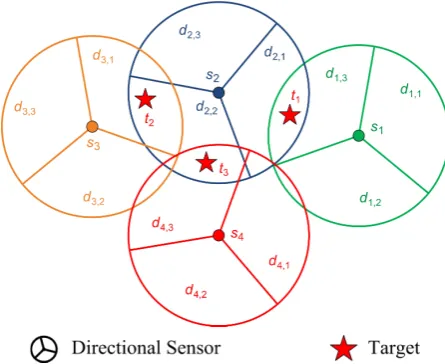
To show the efficiency of scheduling technique, the example network illustrated in Figure 1.1 is considered, in which there are four directional sensors and three targets. Letsn(1≤n≤4) represent the set of directional sensors andtm(1≤m≤3)denotes the set of targets. The figure also highlights that each directional sensor has three directions anddi,j(1≤ j≤3)indicates the directions of sensorsi. In this example, a
single power level is contemplated for each sensor. A target can be monitored when it is within both the sensing region and sensing range of at least one active sensor direction. For example, target t3 is monitored by d2,2 and d4,3, simultaneously. The possible cover sets for all targets are {d1,3, d2,1}, {d2,2, d4,3} and {d2,2, d3,1}. A
cover set is a subset of sensor directions that can monitor the whole targets. Let us say that the battery of each sensor keeps the sensor active for 1 unit of time (classical assumption). By contemplating on one of the abovementioned cover sets, e.g., {d1,3, d2,1} and activating it for the whole battery life of the sensor, all the
targets can be monitored for 1 unit of time. Consequently, the network lifetime can no longer be extended because onlys3 ands4 have residual lifetime and they are not
able to monitor all the targets. On the other hand, by considering three cover sets (i.e., {d1,3, d2,1}, {d2,2, d4,3} and {d2,2, d3,1}) and activating each of them for 0.5 units
of time, the network lifetime would be equals 1.5 units of time. Conclusively, this strategy (i.e., scheduling technique) outperforms the previous one as it can extend the network lifetime.
4
Another technique that can be used to extend the network lifetime is adjusting the sensing range of sensor nodes. This technique is used in the networks in which the sensors have various sensing ranges and helps a sensor save its energy whenever it is to monitor the targets in its vicinity. This is because the power requirement is a non-decreasing function of the distance between the sensor and the farthest target it monitors (Rossiet al., 2012). The technique of adjusting sensing ranges (i.e., sensors have multiple power levels) can potentially increase the network lifetime. This is explained by the fact that it increases the number of feasible cover sets that may be included in the solution.
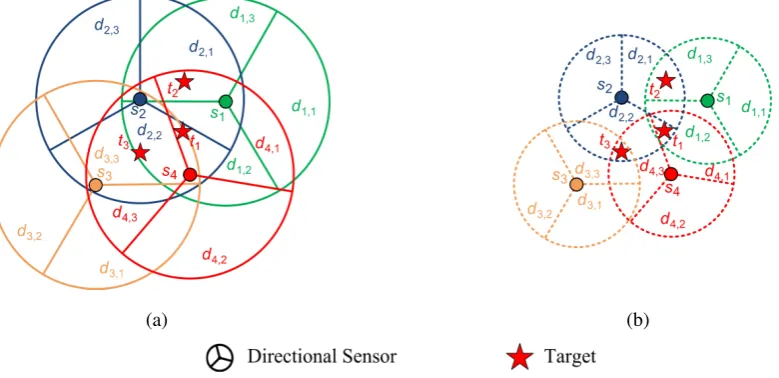
The efficiency of technique of adjusting sensing range is illustrated through the example network displayed in Figure 1.2 where there are four directional sensors, three targets, and two power levels. Figures 1.2(a) and 1.2(b) illustrate the sensing ranges of each directional sensor when set at level 1 and 2, respectively. In this study, (di,j, a) refers to sensor direction di,j when activated at level a. The batteries are
expected to be able to keep sensors active for 1 unit of time at power level 1 and 0.5 units at power level 2. If power level 1 is considered, there will be a single feasible cover set (i.e., (d1,2, 1),(d2,1, 1),(d4,3, 1)) and the total network lifetime equals 1.
Meanwhile, by considering power level 2, there will be a wider set of cover sets and a network lifetime of 1.5 can be achieved (consider, for example,{(d1,3, 2),(d2,2, 2)},
{(d3,3,2),(d4,1, 2)}, and{(d2,1, 2),(d4,3, 2)}are activated for 0.5 units of time each).
As a matter of fact, if the sensor directions and their sensing range are used in a suitable manner, the network lifetime can be considerably extended.
(a) (b)
5
1.2 Problem Statement
The problem addressed in this study is explained as follows:
One significant problem linked with directional sensor networks is target coverage, which primarily operate based on simultaneously observing a group of events (targets) occurring in a set area, and at the same time maximizing the network lifetime. Directional sensors cannot sense a circular region completely as there are limitations to its sensing angle. Additionally, they have limited energy resource and may cause difficulty in recharging the battery. In typical situations, it is assumed that sensors have a single power level. However, in some applications it may have multiple power levels that determine different sensing ranges and power consumptions. Due to these constraints, effectively managing the energy consumption of the sensors is highly important and the solution proposed for WSNs cannot be applied to DSNs. In real applications, each target may associated with a different priority reflecting its importance in the application and the quality of monitoring is depends on the distance between the directional sensors and targets. Thus, it is crucial to design a new technique to satisfy the coverage quality requirements of all targets, hence maximizing the network lifetime.
1.3 Objectives
The objectives of this research are outlined as follows:
(i) To provide a better energy efficient techniques with multiple power levels of sensors for solving the target coverage problem in DSNs.
(ii) To design a new heuristical algorithm for solving target coverage problem in DSNs with adjustable sensing ranges.
6
1.4 Research Questions
The general research question is:
How to organize sensor directions into several cover sets in such a way that each cover set can satisfy the different coverage quality requirements of all the targets and, simultaneously maximize the network lifetime?
Among the problems to be addressed are:
(i) How to adjust the working direction of each sensor using learning automata (LA)?
(ii) How to schedule the adjusted working direction using LA?
(iii) How to manage the critical targets in order to maximize the network lifetime? (iv) How to select the efficient sensing nodes to satisfy the coverage quality
requirements of all the targets?
1.5 Scope of the Research
Following are the scope covered in this study.
(i) The problem domain is lies on target coverage (i.e., k-coverage) and priority-based target coverage in directional sensor networks, in cases where sensors are assumed to have multiple power levels (i.e., adjustable sensing ranges), and each target is associated with a different priority reflecting its important in the application.
7
(iii) All sensors are assumed to be homogeneous with respect to their angle of view and initial energy, and randomly deployed close to the targets with known locations, as to satisfy their coverage quality requirements.
1.6 Significance of the Research
This research introduces a solution to the target coverage problem in DSNs, where the sensors have multiple power levels (i.e. the sensing ranges are adjustable). The work can be significant because it recommends and develops several algorithms that can function as a benchmark for newly designed algorithms and it provides a criterion for other researchers to evaluate their algorithms with a near-optimal solution. Additionally, some efficient techniques are designed to manage the critical sensors; the issue not adequately covered in DSNs. These techniques can contribute to a longer lifetime of the total network. Considering both directional sensors and adjustable sensing ranges requirements together with managing the critical sensors, this thesis presents the target coverage problem more realisticly and practicably.
1.7 Organization of the Thesis
REFERENCES
Ai, J. and Abouzeid, A. A. (2006). Coverage by directional sensors in randomly deployed wireless sensor networks.Journal of Combinatorial Optimization. 11(1), 21–41.
Akyildiz, I. F., Melodia, T. and Chowdhury, K. R. (2007). A Survey on Wireless Multimedia Sensor Networks.Computer Netw. 51(4), 921–960.
Akyildiz, I. F., Melodia, T. and Chowdhury, K. R. (2008). Multimedia Sensor Networks : Applications and Testbeds. Proceedings of the IEEE. 96(10), 1588– 1605.
Beigy, H. and Meybodi, M. R. (2010). Automata in Each Cell and Its Applications. Trial. 40(1), 54–65.
Cai, Y., Lou, W. and Li, M. (2007). Cover Set Problem in Directional Sensor Networks. InFuture Generation Communication and Networking (FGCN 2007), vol. 1. IEEE. Cai, Y., Lou, W., Li, M. and Li, X. Y. (2009). Energy efficient target-oriented scheduling in directional sensor networks. In IEEE Transactions on Computers, vol. 58. IEEE.
Cardei, I. and Cardei, M. (2008). Energy-efficient connected-coverage in wireless sensor networks.International Journal of Sensor Networks. 3(3), 201–210.
Cardei, M. and Du, D. Z. (2005). Improving wireless sensor network lifetime through power aware organization.Wireless Networks. 11(3), 333–340.
Cardei, M., Wu, J. and Lu, M. (2006). Improving network lifetime using sensors with adjustable sensing ranges. International Journal of Sensor Networks. 1(1/2), 41. ISSN 1748-1279.
Cardei, M., Wu, J., Lu, M. and Pervaiz, M. O. (2005). Maximum network lifetime in wireless sensor networks with adjustable sensing ranges. In2005 IEEE International Conference on Wireless and Mobile Computing, Networking and Communications, WiMob’2005, vol. 3. IEEE.
114
ranges.European Journal of Operational Research. 220(1), 58–66.
Chen, U. R., Chiou, B. S., Chen, J. M. and Lin, W. (2008). An adjustable target coverage method in directional sensor networks. InProceedings of the 3rd IEEE Asia-Pacific Services Computing Conference, APSCC 2008. IEEE.
Cheng, W., Li, S., Liao, X., Changxiang, S. and Chen, H. (2007). Maximal coverage scheduling in randomly deployed directional sensor networks. In Proceedings of the International Conference on Parallel Processing Workshops. IEEE.
Dhawan, A., Aung, A. and Prasad, S. K. (2010). Distributed scheduling of a network of adjustable range sensors for coverage problems. InCommunications in Computer and Information Science. (pp. 123–132). vol. 54. Springer.
Esnaashari, M. and Meybodi, M. (2010). A learning automata based scheduling solution to the dynamic point coverage problem in wireless sensor networks. Computer Networks. 54(14), 2410–2438.
Ghosh, A. and Das, S. K. (2008). Coverage and connectivity issues in wireless sensor networks : A survey.Pervasive and Mobile Computing. 4(3), 303–334.
Gil, J. M. and Han, Y. H. (2011). A Target Coverage Scheduling Scheme Based on Genetic Algorithms in Directional Sensor Networks.Sensors. 11(2), 1888–1906. Gil, J. M., Kim, C. M. and Han, Y. H. (2010). Two scheduling schemes for extending
the lifetime of directional sensor networks. In Communications in Computer and Information Science. (pp. 411–420). vol. 78 CCIS. Springer.
Granmo, O. C. and John Oommen, B. (2011). Learning automata-based solutions to the optimal web polling problem modelled as a nonlinear fractional knapsack problem.Engineering Applications of Artificial Intelligence. 24(7), 1238–1251. Guvensan, M. A. and Yavuz, A. G. (2011a). A Hybrid Solution For Coverage
Enhancement In Directional Sensor Networks. InProc. of Intl. Conf. on Wireless and Mobile Communications (ICWMC 2011), Luxembourg (June 2011). c.
Guvensan, M. A. and Yavuz, A. G. (2011b). On coverage issues in directional sensor networks: A survey.Ad Hoc Networks. 9(7), 1238–1255.
Guvensan, M. A. and Yavuz, A. G. (2013). Hybrid movement strategy in self-orienting directional sensor networks.Ad Hoc Networks. 11(3), 1075–1090.
Hochbaum, D. S. and Maass, W. (1984). Approximation Schemes for Covering and Packing Problems in Robotics and VLSI.Stacs. 32(1), 55–62.
115
and Lecture Notes in Bioinformatics). (pp. 201–213). vol. 7129 LNCS. Springer.
Jaggi, N. and Abouzeid, A. A. (2006). Energy-efficient connected coverage in wireless sensor networks. InThe Forth Asia International Mobile Computing Conf. Citeseer, 77–86.
Jamali, M. (2006). Learning to Solve Stochastic Shortest Path Problems. Rapport Technique, Sharif University of Technology. 14(05), 1–9.
Jarray, F. (2013). A Lagrangean-based heuristics for the target covering problem in wireless sensor network.Applied Mathematical Modelling. 37(10-11), 6780–6785. Kandoth, C. and Chellappan, S. (2009). Angular mobility assisted coverage in
directional sensor networks. In NBiS 2009 - 12th International Conference on Network-Based Information Systems. IEEE.
Kim, Y. H., Han, Y. H., Jeong, Y. S. and Park, D. S. (2013). Lifetime maximization considering target coverage and connectivity in directional image/video sensor networks.Journal of Supercomputing. 65(1), 365–382.
Lai, C.-C., Ting, C.-K. and Ko, R.-S. (2007). An effective genetic algorithm to improve wireless sensor network lifetime for large-scale surveillance applications. InEvolutionary Computation, 2007. CEC 2007. IEEE Congress on. IEEE.
Li, J., Wang, R. C., Huang, H. P. and Sun, L. J. (2009). Voronoi based area coverage optimization for directional sensor networks. In 2nd International Symposium on Electronic Commerce and Security, ISECS 2009, vol. 1. IEEE.
Liang, C. K., He, M. C. and Tsai, C. H. (2010). Movement assisted sensor deployment in directional sensor networks. InProceedings - 2010 6th International Conference on Mobile Ad-hoc and Sensor Networks, MSN 2010. IEEE.
Ma, H. and Liu, Y. (2005). On Coverage Problems of Directional Sensor Networks. In Mobile Ad-hoc and Sensor Networks. (pp. 721–731). vol. 3794. Springer.
Ma, H., Zhang, X. and Ming, A. (2009). A coverage-enhancing method for 3D directional sensor networks. InProceedings - IEEE INFOCOM. IEEE.
Mohamadi, H., Ismail, A. S. and Salleh, S. (2013a). Solving Target Coverage Problem Using Cover Sets in Wireless Sensor Networks Based on Learning Automata. Wireless Personal Communications. 75(1), 447–463.
Mohamadi, H., Ismail, A. S. and Salleh, S. (2013b). Utilizing distributed learning automata to solve the connected target coverage problem in directional sensor networks.Sensors and Actuators, A: Physical. 198, 21–30.
116
Supercomputing. 66(3), 1533–1552.
Mohamadi, H., Salleh, S. and Razali, M. N. (2014). Heuristic methods to maximize network lifetime in directional sensor networks with adjustable sensing ranges. Journal of Network and Computer Applications. 46, 26–35.
Mohamadi, H., Salleh, S., Razali, M. N. and Marouf, S. (2015). A new learning automata-based approach for maximizing network lifetime in wireless sensor networks with adjustable sensing ranges.Neurocomputing. 153, 11–19.
Mostafaei, H. and Meybodi, M. R. (2012). Maximizing Lifetime of Target Coverage in Wireless Sensor Networks Using Learning Automata. Wireless Personal Communications. 71(2), 1461–1477.
Narendra, K. S. and Thathachar, M. A. L. (1980). On the Behavior of a Learning Automation in a Changing Environment with Application to Telephone Traffic Routing.Ieee. SMC-10(5), 262–269.
Narendra, K. S. and Thathachar, M. A. L. (1989). Learning Automata: An Introduction. Courier Corporation.
Nurcan, T. and Wenye, W. (2008). Self orienting wireless multimedia sensor networks for occlusion free viewpoints.Elsevier, Computer networks. 52(13), 2558–2567. Osais, Y., St-Hilaire, M. and Yu, F. R. (2008). The Minimum Cost Sensor Placement
Problem for Directional Wireless Sensor Networks. In2008 IEEE 68th Vehicular Technology Conference. IEEE.
Rogalski, A. (2011). Infrared Physics & Technology Recent progress in infrared detector technologies.Infrared Physics and Technology. 54(3), 136–154.
Rossi, A., Singh, A. and Sevaux, M. (2012). An exact approach for maximizing the lifetime of sensor networks with adjustable sensing ranges. Computers and Operations Research. 39(12), 3166–3176.
Salleh, S. and Abas, Z. A. (2016). Simulation for Applied Graph Theory Using Visual C++. CRC Press.
Singh, A. and Rossi, A. (2013). A genetic algorithm based exact approach for lifetime maximization of directional sensor networks.Ad Hoc Networks. 11(3), 1006–1021. Soro, S. and Heinzelman, W. R. (2009). A Survey of Visual Sensor Networks.Adv. in
MM. 2009(3), 689–726.
117
Tao, D., Ma, H. and Liu, L. (2006). Coverage-Enhancing Algorithm for Directional Sensor Networks. InMobile Ad-hoc and Sensor Networks. (pp. 256–267). vol. 4325. Springer.
Thathachar, M. A. L. and Harita, B. R. (1987). Learning automata with changing number of actions. Systems, Man and Cybernetics, IEEE Transactions on. 17(6), 1095–1100.
Thathachar, M. A. L. and Sastry, P. S. (1987). A Hierarchical System of Learning Automata That Can Learn the Globally Optimal Path.Information Sciences. 42(2), 143–166.
Ting, C.-K. and Liao, C.-C. (2010). A Memetic Algorithm for Extending Wireless Sensor Network Lifetime.Inf. Sci. 180(24), 4818–4833.
Torkestani, J. A. (2011). A new approach to the job scheduling problem in computational grids.Cluster Computing. 15(3), 201–210.
Torkestani, J. A. (2012). An adaptive backbone formation algorithm for wireless sensor networks.Computer Communications. 35(11), 1333–1344.
Torkestani, J. A. (2013a). An energy-efficient topology construction algorithm for wireless sensor networks.Computer Networks. 57(7), 1714–1725.
Torkestani, J. A. (2013b). Energy-efficient backbone formation in wireless sensor networks.Computers and Electrical Engineering. 39(6), 1800–1811.
Torkestani, J. A. (2013c). LAAP: A learning automata-based adaptive polling scheme for clustered wireless Ad-hoc networks.Wireless Personal Communications. 69(2), 841–855.
Torkestani, J. A. and Meybodi, M. R. (2009). An intelligent backbone formation algorithm for wireless ad hoc networks based on distributed learning automata. Computer Networks. 54(5), 826–843.
Torkestani, J. A. and Meybodi, M. R. (2010a). Clustering the wireless Ad Hoc networks: A distributed learning automata approach. J. Parallel Distrib. Comput. 70(4), 394–405.
Torkestani, J. A. and Meybodi, M. R. (2010b). Mobility-based multicast routing algorithm for wireless mobile Ad-hoc networks: A learning automata approach. Computer Communications. 33(6), 721–735.
Torkestani, J. A. and Meybodi, M. R. (2011). A cellular learning automata-based algorithm for solving the vertex coloring problem.Expert Systems with Applications. 38(8), 9237–9247.
118
algorithm for solving the minimum spanning tree problem in stochastic graphs.The Journal of Supercomputing. 59(2), 1035–1054.
Torkestani, J. A. and Meybodi, M. R. (2012b). Finding minimum weight connected dominating set in stochastic graph based on learning automata. Information Sciences. 200, 57–77.
Tseng, Y. C., Wang, Y. C., Cheng, K. Y. and Hsieh, Y. Y. (2007). iMouse: An integrated mobile surveillance and wireless sensor system. InComputer, vol. 40. ACM. Wang, J., Niu, C. and Shen, R. (2009). Priority-based target coverage in directional
sensor networks using a genetic algorithm. Computers and Mathematics with Applications. 57(11-12), 1915–1922.
Wang, Y. C., Chen, Y. F. and Tseng, Y. C. (2012). Using rotatable and directional (R&D) sensors to achieve temporal coverage of objects and its surveillance application.IEEE Transactions on Mobile Computing. 11(8), 1358–1371.
Wen, J., Jiang, J., Dou, W. and Fang, L. (2008). Coverage optimizing and node scheduling in directional wireless sensor networks. In 2008 International Conference on Wireless Communications, Networking and Mobile Computing, WiCOM 2008. IEEE.
Wu, J. and Yang, S. (2004). Coverage issue in sensor networks with adjustable ranges. In Workshops on Mobile and Wireless Networking/High Performance Scientific, Engineering Computing/Network Design and Architecture/Optical Networks Control and Management/Ad Hoc and Sensor Networks/Compile and Run Time Techniques for Parallel Computing ICPP 2. IEEE.
Xingyu, P. (2006). Redeployment problem for wireless sensor networks. In Communication Technology, 2006. ICCT’. IEEE, 1–4.
Yang, H., Li, D. and Chen, H. (2010). Coverage quality based target-oriented scheduling in directional sensor networks. In IEEE International Conference on Communications. IEEE.
Yang, Y. and Cardei, M. (2007). Movement-assisted sensor redeployment scheme for network lifetime increase. InProceedings of the 10th ACM Symposium on Modeling, analysis, and simulation of wireless and mobile systems - MSWiM ’07. ACM.
Yick, J., Mukherjee, B. and Ghosal, D. (2008). Wireless sensor network survey. Elseiver Computer Networks. 52(12), 2292–2330.
119
Zhao, J. and Zeng, J.-C. (2009). An Electrostatic Field-Based Coverage-Enhancing Algorithm for Wireless Multimedia Sensor Networks. In 2009 5th International Conference on Wireless Communications, Networking and Mobile Computing. IEEE.
Zhao, Q. and Gurusamy, M. (2008). Lifetime maximization for connected target coverage in wireless sensor networks. IEEE/ACM Transactions on Networking. 16(6), 1378–1391.
Zhou, Z., Das, S. R. and Gupta, H. (2009). Variable radii connected sensor cover in sensor networks.ACM Transactions on Sensor Networks. 5(1), 1–36.
Zhu, C., Zheng, C., Shu, L. and Han, G. (2012). A survey on coverage and connectivity issues in wireless sensor networks.Journal of Network and Computer Applications. 35(2), 619–632.
Zorbas, D. and Douligeris, C. (2011). Connected coverage in WSNs based on critical targets.Computer Networks. 55(6), 1412–1425.
Zorbas, D., Glynos, D., Kotzanikolaou, P. and Douligeris, C. (2010). Solving coverage problems in wireless sensor networks using cover sets. Ad Hoc Networks. 8(4), 400–415.