Mobile Learning Application Website for Educators
Nuur Rauthoh Bt Md SukriEducational Technology, Universiti Teknologi Malaysia, Malaysia
Dr. Norazrena Bt Abu Samah [email protected]
Educational Technology, Universiti Teknologi Malaysia, Malaysia
Abstract
PDA’s, mobile phone and smart phone are the example of personal mobile devices that is has the ability to provide educational content. Followed by the transactional distance theory is relevant to the template design in mobile learning application for education through a website. The idea suggested that the transactional distance includes the psychological rather than geographical distance among the educators and students which it is link to the balance of the dialogue, structure (course design), and autonomy of learner (Moore & Kearsley, 2005). This study addresses the suitable design patterns layout for mobile learning application based on the student preferences in the terms of navigation menu, learning contents view, searching method and sorting method, enhance a mobile learning application model and test. The objective of this research was to help the educators creating the mobile learning application through a website. The study of design patterns for mobile learning application template is, by analyze the student preferences with quantitative method survey. Generic design templates for mobile learning application will be develop with the ADDIE model concepts. A working prototype system website will be develop after the findings of the design patterns based on the preferences of students in UTMs' postgraduate master student will be discussed and evaluated.
Keywords: template design in mobile application, design patterns layout, prototype system,
transactional distance theory, ADDIE model
1.0 Introduction
According to Boyinbode et al. (2010) mobile learning enables the users to access at anytime and anywhere; whereas, in the process of study mobile learning is as a medium portable for the learner (Shelly Kinash, 2011). Smart phones, tablet, PCs, notebook and mobile phone is an example of tools for mobile learning (Woukeu et al., 2005), (Wain Yee Au et al., 2011). According to (Vavoula, 2005) research study, the considerable learning occurs outside the lectures class as people structure their activities to enable outcomes and educational process, but in the (O’Malley et al., 2003) defines mobile learning take over when the learner is not in fixed location or when the learners takes advantage of learning opportunities offered by mobile learning.
that the extent of psychological separation between the students and educators (Shearer, 2007).
This research was carried out to create the template design of mobile learning application website for educators. The important of the, template layout design that is suitable for the IPTA students are should be identified. In the pedagogical perspective, the mobile learning will give the advantage of making the learning process more collaborative and interactive. According to Savill-Smith and Kent (2003), the main key for using mobile computers for process learning are it will help students’ in encourage a sense of responsibility, motivation, help organizational skills, help both independent and collaborative learning, even as a reference tools, help in tracking student progress and assessment. However, collaborative learning occurs only if the technology is designed with fit the appropriate fit context of use (Lorna Uden, 2007).
Mobile learning application for education should have suitable effective design layout but it still has several challenge that posed by the elements of mobile context of use (York and Pendharkar, 2004). The educators teach designing of successful mobile learning application must requires the appropriate context that is suitable with the course subject that. Based on the Naismith et al. (2005) mobile devices are especially well suited with context-aware applications because it was available in different contexts so it is possible for us to draw all the contexts to develop the learning activity. The template layout design of the mobile learning application must be appropriate and suitable with the students because based on the Preece et al. (1994), context is discipline with the design concerned, evaluation and implementation of interactive computing systems for the human use and it results of the study of major phenomena surrounding them.
Mobile learning application design needs the users choices based on their preferences. So, the best design layout should be in the design layout in the mobile learning application is based on the users. The term of users in the education is students because; the students use the mobile learning application as a medium for referring. According to Cooper and Reiman (2003), personas and scenarios are a lightweight method for capturing and recording the requirements of a system from end user’s viewpoint. This persona describes that an end user in some detail; job function, the background and the situation of the organization whereas scenarios are textual descriptions of how a persona interacts with the system another personas when using a system. This scenario is independent to any technology and it will represent either current practice or improved practice (as-is or to-be).
Therefore, it is important to develop guidelines or framework for designing suitable template design layout in the mobile learning application. This paper aims to provide a generic framework for template mobile learning application design for educations. In this paper the several important design issues, the preface of emerging technologies and the theory approaches that appear to develop the suitable template mobile learning application design website for the educators in education. In the next section, this paper was introduced some related review on the design for mobile learning application. Secondly, the generic framework for template mobile learning application design is proposed. This research also highlighted some of the important criteria issues and present useful design guidelines in the framework. Last but not least, this research was concluded by the preliminary study of this research.
2.0 Literature Review
(Preece et al. 1994), whereas according to Dey, Abowd or Wood (1990) defines context as any information to be used characterize the situation of an entity. However, the design session outcomes were been analyzed using the changing of circumstances or different user needs (Tarasewich, 2003). Tarasewich has developed a three-category context model environment portage with the properties of objects in the environment physical aspects. Participants include the status of user (s) or other participants in the environment. Next, activities cover user (s), participants or environmental activities. This model is included interaction or relationships among environment, activities and participants. According to Sharples et al. (2007; in press) mobile learning as the private and public processes of coming to know through exploration and conversation across multiple contexts between in interactive technologies and people proposed by a characterization of mobile learning. In their analysis, the conception of learning as a tool-mediated socio-cultural activity (Engestrom, 1996, to identify how knowledge is constructed through an activity in a society.so, this researcher argue that understanding how mobile learning can be integrated with conventional education, as the conversation and context are been constructed. So, based on the researches states that, the template layout design in mobile learning application should function well as the change of context and the content should be presented on screen should be appear and it is easy to users by the use of multimedia content layout design.
According to the Gong and Tarasewich, (2004); Jones, Buchanan and Thimbleby, (2002); Kärkkäinen and Laarni, (2002) were states that the issues of navigation structure, learning and content view, searching method and sorting method naming for small screens. The guidelines in that researches state suggested that for example, navigation structures can facilitate users to finish their task within the lower interaction; menu of choices should be clear to easily interpret the labels; avoided the long list of choices on screen in order to minimize cognitive load of users and the navigation site should be consistent.
Another issue in mobile learning application for education is student preferences, it is important in the template design layout especially the objective for develop mobile learning application website for educators use in the process of teaching and learning. In this research mobile learning application should provide the students with suitable content presentation and data entry methods based on the students' preferences. In this paper, the template design mobile learning application through a website should be develop to make the educators easily put all the information for the process of teaching and learning. In this paper, the research proposes design guidelines from the existing research into two main aspects. Firstly, the data analysis based on the literature review towards design context mobile learning application for the consideration aspects. Second, in this research students preferences and characteristics will be integrate into the template design mobile learning application before the website will be develop to the educators. Last but not least, the lecturers and students acceptance and feedback will be analyzed.
3.0 A Framework Of Mobile Learning Application Website For Educators
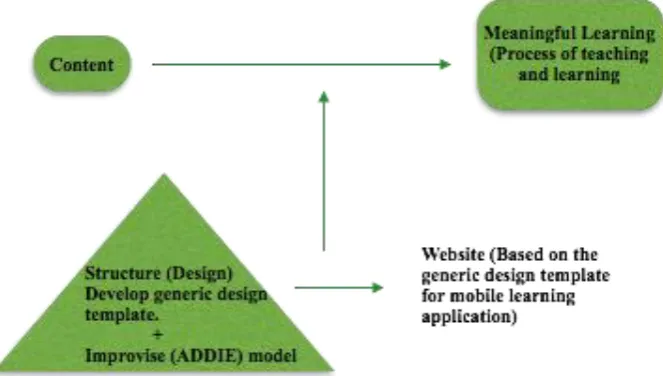
Built upon the past literature view and research, the generic framework based on the theory transactional distance was be proposed for the mobile learning application website for educators because of the process of teaching and learning is in anytime and anywhere.
Figure 1: The theoretical framework
4.0 Architectural Design
Firstly, the data analysis survey tests to the students’ preferences to the layout. The major selection preferences of the student towards the design pattern layout should be in the mobile learning application. The development of website of the template design pattern layout based on the student preferences. The architecture of the Mobile Learning Application Website: (a) the educators will asses the website and put all the data information. (b) Internet network connects to the 'mobile learning'. This architecture is based on the socket connection between mobile phones and the Internet Server. (c) The students will install the application that already be publish by their educators. Last but not least, the students can refer the application without connecting to the Internet because it was already is installed in the mobile hand phone. See Figure 2.
Figure 2: Architecture of Mobile Learning Application Website a) Educators access the
website (put all the information notes). Educators publish the
mobile apps through website.
b) Internet Server c) Students install the
Students Preference based in the design pattern terms of:
1)Navigation menu
2)Learning content views
3)Searching method
4)Sorting method
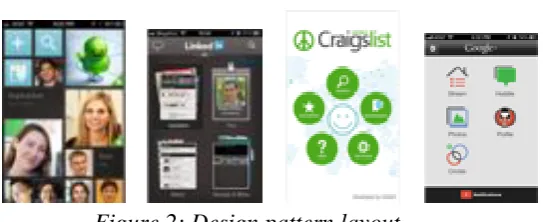
Figure 2: Design pattern layout
Students have different preferences on how the information should be presented on mobile learning application. They would like to obtain their knowledge information displayed in their preferred format. The major prefer of students like to the format of template design, the suitable the format of template design to those students. For example, in terms navigation menu there are several example how the students move through the views of mobile learning application such as Springboard, List (Vertical, Infinite), Tabs, Gallery (Grid), Dashboard, Metaphor, Page Carousel, Image Carousel, Expanding Lists and Infinite Area (Dominick Pacholczyk, 2014). For preferred formats, some students may prefer to view Tabs format because it is clearly differentiate the selected tab from the others. It is use easy to recognize icons or icons with the labels. However, other students may prefer use Expanding Lists because it works best for progressively disclosing more details or option for an object in the mobile learning application.
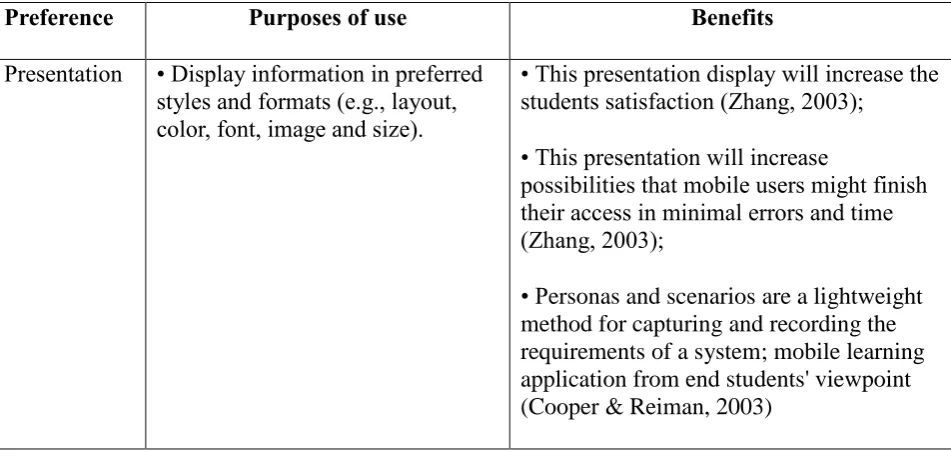
Preference Purposes of use Benefits
Presentation • Display information in preferred styles and formats (e.g., layout, color, font, image and size).
• This presentation display will increase the students satisfaction (Zhang, 2003);
• This presentation will increase
possibilities that mobile users might finish their access in minimal errors and time (Zhang, 2003);
• Personas and scenarios are a lightweight method for capturing and recording the requirements of a system; mobile learning application from end students' viewpoint (Cooper & Reiman, 2003)
Table 1: Students preferences – purpose of benefits and use
5.0 Design Methodology
The analysis of complex interactions between computer-based technology and people is the proper followed a methodology of socio-cognitive engineering (Sharples, M., Jeffery, and du Boulay, G.H 2002). This methodology has been applied to the design of human centred technologies. The knowledge of potential users was draws by socio-cognitive engineering and was involves in the design process, but it is critical of the reliability of user reports to give account of cognitive processes and social interactions, strategies of working and styles, patterns of communication and language so it will portrays of human knowledge and activity that can inform design system. However in the concept of design methodology by (Berri et.,al 2005) have proposed and architecture that employs ontologies, which are rule-based and are driven by a learner profile and search agent that searches distributed learning object.
According to Dimakopoulus et al., (2008), states that similar middleware base architecture for contextual lifelong learning, but in the Benlamri et .al (2008), the context-aware mobile learning architecture using content ontologies, context and learner. This review of Design Methodology clearly highlighted that the importance of context-awareness as well as in mobile web service and ontologies utility whereas personal contextual learning and any general constraints such as budget available and time for system design.
6.0 Context
could be hardly taken into account during the process of design.
Mobile learning application has the biggest advantage and it is universal information access, more context-aware mobile learning applications are emerging. In this research it is not examination of how template of context-aware of mobile learning application could be design but it is suggestions based on the existing application and the problems that might occur in mobile learning application. According to Schulmeister (2006), the main advantage of multimedia to enhance the learning is how to overcoming of existing limits in the learning experience. So, this researcher states that mobile context aware Learning Management System allows providing more efficient; situation optimized learning material and methods and personalized.
7.0 Conclusion
The purpose of this research is to develop the mobile learning application website for educators. This is because; nowadays the mobile learning is become trendy due to the rapid growth of the technology and information, so the learning methods are evolving. According to Geddes (2004), suggested that all knowledge and skill using mobile technologies is regardless time or place it will cause the changing of human behaviour. The idea to design mobile learning application template based on the students' preferences because students as a users in the mobile learning application. So, the preferences of the students towards the suitable layout design in the mobile learning application is important to make sure the students are
comfortable and can easily asses the information. In addition, based on the proposed theoretical framework and findings from previous literature, this research provides some generic template layout design guidelines based on the students preferences. Based on the literature view from the previous studies towards the mobile learning application the study of the mobile learning application Website is important in education. According to Berri et al., (2005) suggested that design and architecture, which are rule-based and driven by learner profile and search agent that searches distributed learning object.
References
Adipat, B., & Zhang, D. (2005). Interface design for mobile applications. Proceedings of the Eleventh Americas Conference on Information Systems (AMCIS 2005): A Conference on a
Human Scale, 1–11. Retrieved from
http://aisel.aisnet.org/cgi/viewcontent.cgi?article=2024&context=amcis2005
Arai, K., & Tolle, H. (2011). Module Based Content Adaptation of Composite E-Learning Content for Delivering to Mobile Learners. Internation Journal of Computer Theory and Engineering, 3(3), 382–387.
Bazargan, K., Kastner, R., & Sarrafzadeh, M. (2000). Fast Template Placement for Recon gurable Computing Systems, XX, 100–112.
Benson, R., & Samarawickrema, G. (2009). Addressing the context of e‐learning: using transactional distance theory to inform design. Distance Education, 30(1), 5–21. http://doi.org/10.1080/01587910902845972
Brown, E., Cristea, a., Stewart, C., & Brailsford, T. (2005). Patterns in authoring of adaptive educational hyper- media : a taxonomy of learning styles. Journal of Educational Technology & Society, 8(3), 77–90.
Collaborative Filtering for Academic Orientation . Case Study of the Spanish Secondary School 1. Computer, 15(14), 2786–2807.
Castellano, E. J., & Martínez, L. (2009b). A Web-Decision Support System based on
Collaborative Filtering for Academic Orientation . Case Study of the Spanish Secondary School 1. Computer, 15(14), 2786–2807.
Conference, I. I. (2005). IADIS International Conference Mobile Learning 2005 (Vol. 1). Contero, M., Naya, F., & Company, P. (2005). Visualization Skills in Engineering, (October),
24–31. http://doi.org/10.4018/978-1-4666-0243-4.ch011
Davidsson, M., Isaías, P. P., Sánchez, I. A., Bryfczynski, S., Pargas, R. P., & Cooper, M. M. (2012). IADIS International Conference Mobile Learning 2012 CONFERENCE PROGRAM.
Gedik, N., Hanci-Karademirci, A., Kursun, E., & Cagiltay, K. (2012). Key instructional design issues in a cellular phone-based mobile learning project. Computers & Education, 58(4), 1149–1159. http://doi.org/10.1016/j.compedu.2011.12.002 Hussin, S., Radzi Manap, M., Amir, Z., & Krish, P. (2012). Mobile Learning Readiness
among Malaysian Students at Higher Learning Institutes. Asian Social Science, 8(12), 276–283. http://doi.org/10.5539/ass.v8n12p276
Jick, T. D. (1979). Mixing Qualitative and Quantitative Methods : Triangulation in Action Mixing Qualitative and Quantitative Methods : Triangulation in Action *. Qualitative Methodology, 24(4), 602–611.
Keskin, N. O., & Metcalf, D. (2011). the Current Perspectives , Theories and Practices of Mobile. Turkish Online Journal of Educational Technology, 10(2), 202–208.
Klamma, R., Chatti, M. A., Duval, E., Hummel, H., Hvannberg, E. T., Kravcik, M., … Scott, P. (2007). Social Software for Life-long Learning. Educational Technology & Society, 10, 72–83. Retrieved from
http://citeseerx.ist.psu.edu/viewdoc/download?doi=10.1.1.119.9967&rep=rep1&type=pd f#page=77
Koole, M., Letkeman McQuilkin, J., & Ally, M. (2010). Mobile learning in distance education: Utility or futility, 1–12. Retrieved from
http://auspace.athabascau.ca:8080/dspace/handle/2149/2673\npapers2://publication/uuid /653FEFD5-9A20-472B-B80B-98CF8068C198
Kukulska-Hulme, A., Sharples, M., Milrad, M., Inmaculada Arnedillo-Sánchez, & Vavoula, G. (2009). Innovation in Mobile Learning : A European Perspec- tive. International Journal of Mobile and Blended Learning, 1(1), 13–35.
http://doi.org/10.4018/jmbl.2009010102
Laouris, Y., & Eteokleous, N. (2005). We Need an Educationally Relevant Definition of Mobile. Proc mLearn, (June), 1–13. Retrieved from
http://citeseerx.ist.psu.edu/viewdoc/download?doi=10.1.1.106.9650&rep=rep1&am p;type=pdf
Moldovan, A.-N., & Muntean, C. H. (2011). Towards Personalised and Adaptive Multimedia in M-learning Systems. World Conference on E-Learning in Corporate, Government, Healthcare, and Higher Education, 2011(1), 782–791. Retrieved from
http://www.editlib.org/p/38807/
Moore, M. (1993). Theory of transactional distance. Theoretical Principles of Distance Education.
Mykota, D. B. (2015). The Influence of Learner Characteristics on Social Presence. Procedia - Social and Behavioral Sciences, 176, 627–632.
http://doi.org/10.1016/j.sbspro.2015.01.520
Naismith, L., Lonsdale, P., Vavoula, G., & Sharples, M. (2004). Literature Review in Mobile Technologies and Learning Literature Review in Mobile Technologies and Learning. Educational Technology, 11, 1–25. Retrieved from
http://citeseerx.ist.psu.edu/viewdoc/download?doi=10.1.1.136.2203&rep=rep1&am p;type=pdf
Omar, W. M., & Taleb-Bendiab, a. (2006). E-health support services based on
service-oriented architecture. IT Professional, 8(2), 35–42. http://doi.org/10.1109/MITP.2006.32
Park, Y., & Tech, V. (2011). A Pedagogical Framework for Mobile Learning : Categorizing Educational Applications of Mobile Technologies into Four Types. International Review of Research in Open and Distance Learning, 12(2), 78–102.
http://doi.org/10.3394/0380-1330(2006)32
Parsons, D., & Ryu, H. (2006). A Framework for Assessing the Quality of Mobile Learning. Proceeding of the International Conference for Process Improvement, Reseacrh and Education, 17–27. http://doi.org/10.1080/00221340802463979
Savill-smith, C. (2004). Mobile learning anytime everywhere. Mobile Learning Anytime Everywhere: A Book of Papers from MLEARN 2004, 242.
Seong, D. S. K. (2006). Usability guidelines for designing mobile learning portals.
Proceedings of the 3rd International Conference on Mobile Technology, Applications & Systems - Mobility ’06, 25. http://doi.org/10.1145/1292331.1292359
Sharples, M., Corlett, D., & Westmancott, O. (2002). The design and implementation of a mobile learning resource. Personal and Ubiquitous Computing, 6(3), 220–234. http://doi.org/10.1007/s007790200021
Sharples, M., & Others. (2007). Big issues in mobile learning: Report of a workshop by the kaleidoscope network of excellence mobile learning initiative. University of Nottingham, 1–37. Retrieved from
http://scholar.google.com/scholar?hl=en&btnG=Search&q=intitle:Big+Issues+in+Mobil e+Learning+Report+of+a+workshop+by+the+Kaleidoscope+Network+of+Excellence#0 \nhttp://hal.archives-ouvertes.fr/docs/00/19/02/54/PDF/Sharples_Big_Issues.pdf
Sharples, M., Taylor, J., & Vavoula, G. (2005). Towards a Theory of Mobile Learning. Proceedings of mLearn, 1(1), 1–9. http://doi.org/citeulike-article-id:6652555
Sirat, M. Bin. (2010). Strategic planning directions of Malaysia’s higher education: university autonomy in the midst of political uncertainties. Higher Education, 59(4), 461–473. http://doi.org/10.1007/s10734-009-9259-0
Uden, L. (2007). Activity theory for designing mobile learning. International Journal of Mobile Learning and Organisation, 1(1), 81.
http://doi.org/10.1504/IJMLO.2007.011190
Wilson, S., Johnson, M., & Sharples, P. (2007). Personal Learning Environments : challenging the dominant design of educational systems . Je-LKS - Journal of E-Learning and Knowledge Society, 3(2), 27–38.
http://doi.org/10.1080/10494820701772652
Wu, W. H., Jim Wu, Y. C., Chen, C. Y., Kao, H. Y., Lin, C. H., & Huang, S. H. (2012). Review of trends from mobile learning studies: A meta-analysis. Computers and Education, 59(2), 817–827. http://doi.org/10.1016/j.compedu.2012.03.016
Yee, K. Y., Tiong, A. W., Tsai, F. S., & Kanagasabai, R. (2009). OntoMobiLe: A Generic Ontology-centric Service-Oriented Architecture for Mobile Learning. Mdm: 2009 10th International Conference on Mobile Data Management, (October), 631–636.