Adsorption of comb copolymers on weakly attractive solid surfaces
A. Strioloa兲
Department of Chemical Engineering, Vanderbilt University, Nashville, Tennessee 37235
A. Jayaraman, J. Genzer, and C. K. Hall
Department of Chemical and Biomolecular Engineering, North Carolina State University, Raleigh, North Carolina 27605
共Received 9 March 2005; accepted 12 June 2005; published online 17 August 2005兲
In this work continuum and lattice Monte Carlo simulation methods are used to study the adsorption of linear and comb polymers on flat surfaces. Selected polymer segments, located at the tips of the side chains in comb polymers or equally spaced along the linear polymers, are attracted to each other and to the surface via square-well potentials. The rest of the polymer segments are modeled as tangent hard spheres in the continuum model and as self-avoiding random walks in the lattice model. Results are presented in terms of segment-density profiles, distribution functions, and radii of gyration of the adsorbed polymers. At infinite dilution the presence of short side chains promotes the adsorption of polymers favoring both a decrease in the depletion-layer thickness and a spreading of the polymer molecule on the surface. The presence of long side chains favors the adsorption of polymers on the surface, but does not permit the spreading of the polymers. At finite concentration linear polymers and comb polymers with long side chains readily adsorb on the solid surface, while comb polymers with short side chains are unlikely to adsorb. The simple models of comb copolymers with short side chains used here show properties similar to those of associating polymers and of globular proteins in aqueous solutions, and can be used as a first approximation to investigate the mechanism of adsorption of proteins onto hydrophobic surfaces. ©2005 American Institute of Physics.关DOI: 10.1063/1.1993557兴
I. INTRODUCTION
Polymers adsorbed onto solid surfaces are frequently en-countered in nature and in technological applications. Poly-mer adsorption is used to stabilize or flocculate colloidal suspensions 共paints, coatings, inks, etc.兲,1,2 to improve the performance of membranes for protein fractionation,3,4to in-crease the circulation half-life of liposomes in the blood stream,5 and to engineer biocompatible materials.6 The ad-sorption of biopolymers共e.g., proteins兲at solid surfaces is of relevance in a wide range of applications including industrial biocatalysis and stabilization of therapeutic proteins.7,8
At dilute conditions the behavior of a polymer chain near a surface is determined primarily by polymer-surface interactions and solvent quality.9 When polymer-surface in-teractions are favorable for adsorption, the conformational statistics of polymer chains in the vicinity of the solid sur-face is determined by a competition between the energetic advantage of segmental adsorption and the associated en-tropic penalty. The enen-tropic penalty arises because adsorp-tion reduces both the translaadsorp-tional freedom and the number of available conformations for the polymer chain. Due to the presence of hydrophilic and hydrophobic residues, the ad-sorption of proteins and associating polymers on a surface is more complicated than the adsorption of homopolymers. When proteins are dissolved in a bulk aqueous solution the
hydrophobic residues are preferentially located in the interior of the macromolecules while hydrophilic residues are ex-posed to the aqueous environment. When adsorbed on a sur-face, proteins often undergo conformational changes in an attempt to lower the global free energy.10
Mean-field theories are useful for understanding polymer adsorption. Fang and Szleifer11,12 developed a molecular theory to study the thermodynamics and the kinetics of the adsorption of proteins of different sizes and charges on a solid surface. Carignano and Szleifer13showed that by graft-ing charged polymers on an attractive surface it is possible to prevent primary protein adsorption 共the adsorption of pro-teins directly onto the attractive solid surface兲, and to pro-mote secondary adsorption 共the adsorption of proteins onto the layers of grafted polymers, but not onto the solid sur-face兲. Scanning-probe microscopy has been used to visualize macromolecules adsorbed onto solid surfaces.14 For ex-ample, Bauerle et al.15 and Prokhorova et al.16 observed monolayers with long-range order when oligo共thiophenes兲or comblike polymers adsorb on graphite, while Sheikoet al.17
reported first-order rod-globule phase transitions in adsorbed polymer films. Molecular simulations provide a bridge be-tween mean-field theories and experimental data.18 For ex-ample, Zajac and Chakrabarti19 and Striolo and Prausnitz20 reported Monte Carlo simulations for the adsorption of linear homopolymers, branched homopolymers, and copolymers on solid surfaces.
In this work we use Monte Carlo simulations to study the adsorption of linear and comb polymers on solid
a兲Present address: University of Oklahoma, School of Chemical Biological
and Materials Engineering, Norman OK 73019. Electronic mail: [email protected]
surfaces. We use a continuum model to study the adsorption of polymers from infinitely dilute solutions. We complement these studies with a lattice model to investigate the adsorp-tion of polymers from finite-concentration solutions. Polymer-segment-segment and segment-surface interactions are modeled using hard-sphere potentials. Selected polymer segments, equally spaced along the linear polymers or lo-cated at the tips of the side chains in comb polymers, are attracted to each other and to the surface; these are modeled using square-well potentials. Polymers are considered ad-sorbed when the density of polymer segments near the sur-face is larger than that in the bulk. In order to investigate the characteristics of the polymer architecture that lead to maxi-mum adsorption, we vary the lengths of the side chains关zero
共linear polymer兲, one, three, five, eight, and ten segments兴 and the lengths of the backbone共69, 99, and 129 segments兲 in the different simulation runs. To understand why one cer-tain polymer architecture favors adsorption, we compare the conformations of adsorbed polymers to those of polymers in bulk solutions.
We chose the comb polymer architecture to crudely rep-resent proteins. Secondary and tertiary structures of globular proteins in aqueous solutions are primarily due to hydrogen bonds, hydrophobic interactions between side groups of the amino acids 共for example, phenylalanine and tryptophan contain aromatic rings兲, disulfide bridges between cysteine residues, and salt bridges between charged side groups.21The strongly associating sites are located at a short distance from the protein backbone. We mimic the protein architecture by using comb polymers with short side chains where the tips of the side chains attract each other. This representation is crude, and certainly does not allow us to model secondary protein structures such as ␣ helices or  sheets, but it is sufficient to understand if the architecture of proteins has any impact on their thermodynamic behavior共e.g., adsorption on hydrophobic surfaces兲.
At infinite dilution, our results show that linear polymers do not adsorb readily on a surface because of large entropic penalties. Comb polymers with short side chains readily ad-sorb on a solid surface and undergo conformational changes. These polymers assume globular conformations in the bulk and spread upon adsorption. Comb polymers with long side chains adsorb on a surface but maintain a globular confor-mation. Interestingly, the behavior of comb polymers with short side chains resembles that of proteins which are globu-lar in bulk aqueous solutions and spread on top of hydropho-bic surfaces. At finite concentration our results show that linear polymer and comb polymers with long side chains readily adsorb on the solid surface. Linear polymers adsorb and spread on the surface, and entangle with each other. Ad-sorbed comb polymers do not entangle with each other, but maintain globular conformations. The typical conformation of adsorbed comb polymers is characterized by few attractive segments in contact with the surface, and others at some short distance from it.
The remainder of this paper is organized as follows: in Sec. II we describe the simulation details for the infinitely dilute continuum model and the finite-concentration lattice model. In Sec. III we discuss the results obtained from the
infinitely dilute continuum simulations and the finite-concentration lattice simulations. In Sec. IV we provide a brief summary of our conclusions.
II. MODEL AND SIMULATION DETAILS
A. Infinitely dilute continuum model
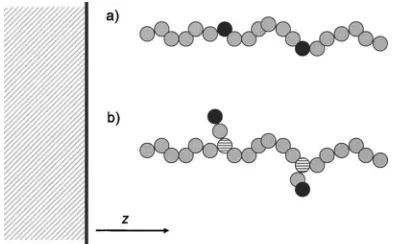
We use continuum Monte Carlo simulations to study the adsorption of comb and linear polymers on a flat solid sur-face when the system is at infinitely dilute conditions. We treat comb and linear polymers as sequences of freely jointed tangent spheres. We use the ensemble-growth algorithm, de-scribed below, to grow an equilibrated ensemble of systems composed of one polymer near the attractive surface. In Fig. 1 we show a schematic representation of the polymer archi-tecture of one linear polymer关Fig. 1共a兲兴and one comb poly-mer 关Fig. 1共b兲兴. The shaded region on the left side of the figure represents the attractive solid surface modeled as a flat wall located at z= 0. Thezcoordinate indicates the distance from the attractive surface. Polymer segments are allowed only in the region of positivez. In this work all distances are measured in terms of diameter of polymer segment,, which is considered as the unit length. The linear polymer shown in Fig. 1共a兲is composed of 20 segments. Two of the segments are attractive and they are separated from each other by six nonattractive segments. The comb polymer shown in Fig. 1共b兲 is composed of a backbone of length 20 segments and two side chains, each of length two segments, separated from each other by six nonattractive segments. The length of the side chains does not account for the branching segment
关striped bead in Fig. 1共b兲兴which is part of the backbone. The attractive segments 共black beads兲 are either equally spaced along the linear polymer关Fig. 1共a兲兴or located at the tips of the side chains关Fig. 1共b兲兴; these are attracted to each other and to the solid surface. The other segments 共gray and striped beads兲 are nonattractive. The conformational details
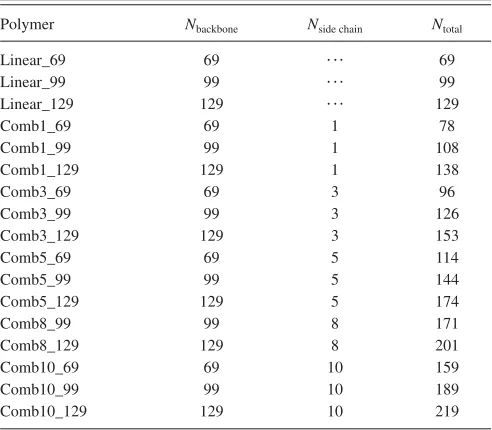
共number of segments in the backbone, Nbackbone, number of segments in each side chain, Nside chain, and total number of segments in the polymer,Ntotal兲for all the polymers consid-ered are given in Table I. All comb and linear polymers con-tain nine attractive segments at the tips of the nine side chains 共except for linear polymers in which the attractive
segments are embedded in the backbone兲. We consider poly-mers with backbones of lengths 69, 99, and 129 segments
共Nbackbone兲 and side chains of lengths one, three, five, eight, and ten segments共Nside chain兲. For the three values ofNbackbone the corresponding lengths on the backbone that separates two consecutive side chains are 6, 9, and 12 segments, respec-tively.
To describe segment-segment interactions we choose simple potentials. We recognize that, as a first approxima-tion, specific interactions between the side groups of the amino acids are primarily responsible for the structure of proteins. Thus we assign attractive square-well potentials to describe interactions between attractive segments, and hard-sphere potentials to describe all other interactions. Algebra-ically, for effective interactions between segmentsiandjwe use square-well potentialsij,
ij=
冦
⬁ 0⬍dij⬍1
− for 1艋dij艋1.5
0 1.5⬍d.
冧
共1兲
In Eq.共1兲dis the center-to-center distance between polymer segments and is the well depth. The well depth is non-zero only for the attractive polymer segments. All other in-teractions are hard-sphere inin-teractions. The strength of the specific attractions depends, among other things, on the type of amino acid. For the sake of simplicity we conduct simu-lations for ranging between 2 and 4kT.
The segment-surface interactions are represented by square-well potentials,
i=
冦
⬁ 0⬍zi⬍0.5
− for 0.5艋zi艋
0 ⬍z.
冧
共2兲
In Eq.共2兲,zrepresents the distance of the polymer segment
i from the attractive wall, represents the depth of the segment-surface attractive interaction, and represents the width of the attractive well. The segment-surface well depth
is attractive only for those polymer segments that attract each other via the square-well potential of Eq.共1兲. For all the other segments, the surface is effectively a hard wall. We consider three values for 共0.75, 1, or 1.5兲. As increases, the segment-surface interaction becomes longer ranged.
To obtain an equilibrated ensemble of systems each composed of one polymer near the surface we implement the ensemble-growth algorithm.22–24The algorithm builds simul-taneously, step by step, an ensemble of Mc systems, each composed of one polymer near the surface. The first polymer segment of each of the Mc polymer-surface systems is in-serted randomly at a distance between 0.5 and 30 from the attractive surface. For each of the Mc members of the en-semble five possible positions for the second polymer seg-ment are randomly chosen around the first segseg-ment. Out of the total 5Mcpossibilities, Mc polymer-surface systems are randomly chosen according to Boltzmann probability. The systems are stored as the new members of the ensemble. The remaining 4Mc replicas are erased from the memory. This procedure guarantees that energetically favorable polymer-surface systems are more likely to be chosen as members of the new ensemble than energetically unfavorable systems. The correct implementation of the algorithm requires some less-favorable polymer-surface systems to be statistically present in the ensemble at all times. This is achieved only for large values of Mc. In the next step the third segments are attached to the second segment using the same procedure that is adopted to attach the second segments to the first segment. The procedure is repeated untilMcpolymer-surface replicas of fully grown polymers are obtained. The same algorithm is also used to obtain bulk polymer systems, where we neglect the presence of the surface for the purpose of comparison to our polymer-surface systems. Further details on the algorithm can be found in Ref. 24. For both polymer-surface systems and bulk polymer systems the quantities of interest 共segment-density profiles, axial distribution func-tions, and radii of gyration兲are computed and averaged over the Mcpolymer-surface systems that comprise the final en-semble. For polymer-surface systems, each ensemble con-tainsMc= 40 000 replicas and the results are averaged over at least 50 independent ensembles. When the surface is strongly attractive, the simulation data are rather noisy; up to 150 independent ensembles are required to obtain reliable results. For bulk polymer systems, each ensemble contains Mc = 30 000 replicas and the results are averaged over at least three independent ensembles. The independent ensembles are obtained by repeating the simulations with a different seed for the random number generator. To assess the repro-ducibility of our results we compute the average of the dif-ferent runs, the standard deviation from the average, and the percentage of the standard deviation with respect to the
av-TABLE I. Structural characteristics of the model polymers simulated in this work.Nbackboneis the number of segments in the backbone,Nside chainis the number of segments in the side chain共all of the same length within a single polymer兲, andNtotalis the total number of segments in the polymer. All polymers except the linear ones have nine side chains. In all polymers the total number of segments attracted to each other and to the surface is 9.
Polymer Nbackbone Nside chain Ntotal
Linear_69 69 ¯ 69
Linear_99 99 ¯ 99
Linear_129 129 ¯ 129
Comb1_69 69 1 78
Comb1_99 99 1 108
Comb1_129 129 1 138
Comb3_69 69 3 96
Comb3_99 99 3 126
Comb3_129 129 3 153
Comb5_69 69 5 114
Comb5_99 99 5 144
Comb5_129 129 5 174
Comb8_99 99 8 171
Comb8_129 129 8 201
Comb10_69 69 10 159
Comb10_99 99 10 189
erage. This percentage of the standard deviation with respect to the average is referred to as “percentage error” in our results.
B. Finite-concentration lattice model
Protein solutions are seldom at infinitely dilute concen-trations. However, the ensemble-growth algorithm requires too much memory for the investigation of systems at finite concentration. We employ a lattice model to study adsorption of polymer systems at finite concentration. Lattice Monte Carlo simulation is computationally fast and yet provides a good description of the large scale conformational features of polymer chains. We perform the simulations on a cubic lat-tice in the canonical共NVT兲ensemble, i.e., the total number of segments in the simulation box 共N兲, the volume of the simulation box共V兲, and the temperature of the system共T兲are maintained constant. The simulation box has periodic bound-ary conditions in the x and y directions. In the z direction there is an impenetrable surface atz=h+ 1 and an adsorbing surface atz= 0, whereh is the height of the simulation box. The simulation box dimensions in the x,y, andzdirections are 30, 30, and 50, respectively. The polymers are modeled as self-avoiding walks on the cubic lattice. Polymer seg-ments located at the tips of side chains in comb polymers or equally spaced in linear polymers are attracted to each other and to the surface by a square-well attraction of 2kT. This value of the potential is strong enough to induce the poly-mers to adsorb at the attractive surface, yet weak enough to allow them to desorb. The rest of the polymer segments in-teract with each other and with the surface via athermal po-tentials 共= 0kT兲. The polymer-segment-segment interaction potential is short ranged and only affects nonbonded nearest neighbors. The segment-surface interaction potential is at-tractive only when the polymer segments occupy lattice sites on the plane共z= 1兲 adjacent to the adsorbing surface共z= 0兲. We vary the lengths of the side chains关zero共linear polymer兲, one, three, five, eight, and ten segments兴while we maintain
Nbackbone= 99 in the different simulation runs.
The initial configuration of the copolymer chains is ob-tained by first growing the backbone and then adding the side chains to the branch points. The backbone is grown by first placing thehead segments of the chains at random lo-cations on the lattice. The second segments are placed on sites adjacent to the head segment on each chain, one by one. The third segments are placed on sites next to the second segment, one at a time, and this procedure is repeated until the backbones are grown to the desired length. During this process, if there is no vacant lattice site for adding a segment to one end of one chain, the segment is added to the other end of the chain. If adding the segment to either end fails
共because there is no vacant site兲, then the chains are moved in the box 共using translation, kink jump, and crankshaft moves兲until a vacancy next to the chain in question is cre-ated. Once the backbone is grown completely, the side chains are added to the backbones in a similar fashion. Attempted Monte Carlo moves comprise the usual assortment of local chain moves 共end moves, kink jump, and crankshaft moves兲25in addition to translation moves. The type of move,
chain, and segment number along the chain is chosen ran-domly. In one Monte Carlo 共MC兲 step we make Npolymers
⫻Ntotalmoves, whereNpolymersis the number of polymers in the simulation box and Ntotal is the number of segments in each polymer. The moves are accepted or rejected according to the Metropolis algorithm.26 The simulation comprises three stages: initialization, equilibration, and production. In the initialization stage we let the system go through 100 000 MC steps, moving the chains in the simulation box while polymer-segment-segment and segment-surface attractive in-teractions are switched off. This stage is required to avoid any bias due to the nature of the initial configuration. In the equilibration stage we let the system go through 2⫻106MC steps while the segment-segment and polymer-segment-surface attractive interactions are switched on. In the production stage the data for the quantities of interest
共e.g., segment-density profiles兲are collected.
III. RESULTS AND DISCUSSION
A. Infinitely dilute continuum model
1. Effect of varyingand
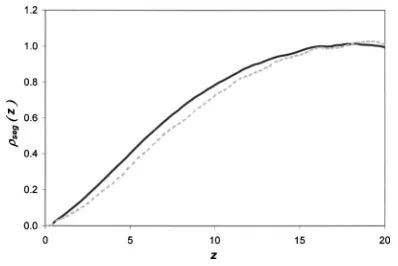
In Fig. 2 we report the segment-density profile as a func-tion of the distance z from the adsorbing surface for 99-segment-long linear polymers 共black solid line兲, and comb polymers with 99-segment-long backbones and 10-segment-long side chains 共gray dashed line兲 when = 2kT and = 0.75. The segment-density profile at a distancez from the surface is obtained as the ratio of the average density of polymer segments found at distance zand the average den-sity of polymer segments in the bulk 共equal to the average polymer-segment density obtained at distances between 18 and 20 from the surface兲. The segment-density profiles of the comb polymers with side chains of lengths one, three, and five segments are not shown in Fig. 2 for clarity. Our results indicate that the segment density near the surface is less than that in the bulk and that it approaches zero as z→0. The region near a solid surface where the segment density is less than that in the bulk is known as the depletion layer.27,28It is possible, even at inifinitely dilute concentrations, to define the depletion-layer thickness, ␦,20,29according to
␦=
冕
0⬁
冉
1 − seg共z兲seg共bulk兲
冊
dz. 共3兲
In Eq.共3兲seg共z兲is the segment-density profile at a distance
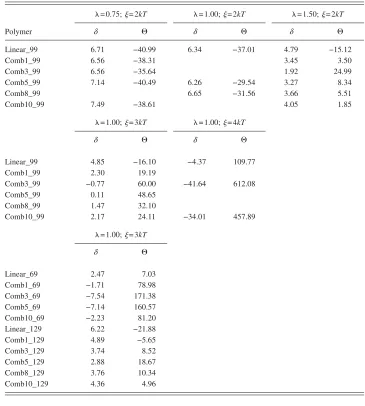
z from the attractive surface and seg共bulk兲 is the segment-density profile in the bulk, i.e., at distance z far from the surface. At infinitely dilute conditions the depletion layer cannot be defined when irreversible adsorption occurs共e.g., when polymer-surface attraction is large兲. The quantity␦ is positive when a depletion layer is observed and negative when the polymer segments are preferentially adsorbed on the surface. To characterize the properties of polymers that are preferentially adsorbed on the surface, for which ␦ as-sumes physically confusing negative values, we introduce a dimensionless parameter⌰defined as
⌰= 100
冉
0.5 − ␦Rxyz
冊
. 共4兲
In Eq.共4兲Rxyzis the radius of gyration of the polymer in the bulk. The parameter ⌰ is positive when polymer segments
accumulate close to the surface and negative when the deple-tion layer is larger than half the radius of gyradeple-tion. Values of ⌰larger than 50 indicate the absence of a depletion layer. In Table II we report values for ␦ and ⌰obtained for the dif-ferent polymer-surface systems considered in the infinitely dilute continuum model. Results shown in Table II suggest that the polymer architecture has a small influence on the depletion-layer thickness when= 0.75 and= 2kT共see Fig. 2兲, and when= 1.00 and= 2kT. At thisthe entropic loss due to adsorption prevails over the enthalpic gain and the surface is effectively repulsive leading to a depletion layer. Our results indicate that ␦ is large for linear polymers, de-creases for comb polymers with one- or three-segment-long side chains, and then increases as the length of side chain increases. Correspondingly,⌰, negative for linear polymers, increases, reaches a maximum for comb polymers with three-segment-long side chains, and then decreases as the length of the side chains increases.
To assess the effect of adsorption on the statistical prop-erties of the polymers, we compute the three- and the two-dimensional 共parallel to the surface兲radii of gyration of the
TABLE II. Width of the depletion layer␦and parameter⌰关see Eqs.共3兲and共4兲for definition兴obtained from the simulation of polymer adsorption in the infinitely dilute continuum model. The acronyms used to identify the polymer architectures correspond to those in Table I.
= 0.75;= 2kT = 1.00;= 2kT = 1.50;= 2kT
Polymer ␦ ⌰ ␦ ⌰ ␦ ⌰
Linear_99 6.71 −40.99 6.34 −37.01 4.79 −15.12
Comb1_99 6.56 −38.31 3.45 3.50
Comb3_99 6.56 −35.64 1.92 24.99
Comb5_99 7.14 −40.49 6.26 −29.54 3.27 8.34
Comb8_99 6.65 −31.56 3.66 5.51
Comb10_99 7.49 −38.61 4.05 1.85
= 1.00;= 3kT = 1.00;= 4kT
␦ ⌰ ␦ ⌰
Linear_99 4.85 −16.10 −4.37 109.77
Comb1_99 2.30 19.19
Comb3_99 −0.77 60.00 −41.64 612.08
Comb5_99 0.11 48.65
Comb8_99 1.47 32.10
Comb10_99 2.17 24.11 −34.01 457.89
= 1.00;= 3kT
␦ ⌰
Linear_69 2.47 7.03
Comb1_69 −1.71 78.98
Comb3_69 −7.54 171.38 Comb5_69 −7.14 160.57 Comb10_69 −2.23 81.20 Linear_129 6.22 −21.88
Comb1_129 4.89 −5.65
Comb3_129 3.74 8.52
Comb5_129 2.88 18.67
Comb8_129 3.76 10.34
polymers as a function of the distance of the center of mass from the attractive surface. The radii of gyration are obtained as
Rxyz2 共zCM兲=
冓
1N
兺
i=1N
关共xi−xCM兲2+共yi−yCM兲2
+共zi−zCM兲2兴
冔
, 共5兲Rxy 2共z
CM兲=
冓
1N
兺
i=1 N关共xi−xCM兲2+共yi−yCM兲2兴
冔
. 共6兲In Eqs.共5兲and共6兲Nis the total number of segments in the polymer; xCM, yCM, zCM are the coordinates of the polymer center of mass; xi, yi, zi are the coordinates of theith seg-ment; and angular brackets denote ensemble averages. For the sake of brevity, we report the radii of gyration results obtained for the polymers considered in Fig. 2 in the Appen-dix. Our results 共see Appendix, Fig. 9兲 indicate that as the polymer center of mass approaches the attractive surface,
Rxyz2 关Fig. 9共a兲兴 slightly decreases and Rxy2 increases 关Fig. 9共b兲兴. The increase in Rxy2 is a clear indication of the ten-dency for the adsorbed polymers to spread on the surface. When the center of mass is located at z⬍5 the polymers appear to collapse, but it should be noted that only a few polymers are located at these distances from the surface.
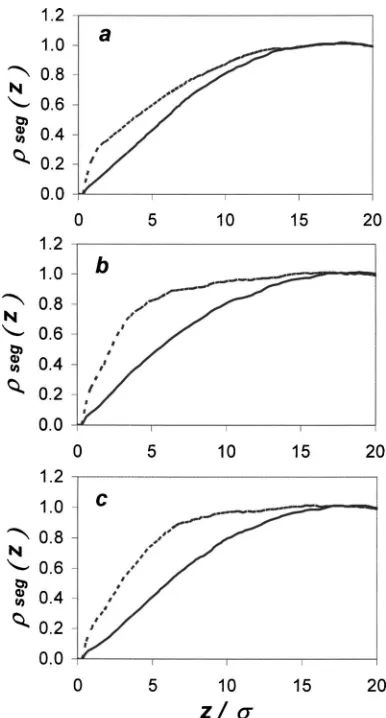
In order to understand if the entropic loss upon adsorp-tion is the limiting factor that effectively repels the polymer segments from the surface, we repeat the simulations dis-cussed above for larger values of . As increases, the en-tropic loss upon adsorption should decrease because ad-sorbed polymers can assume several different conformations while maintaining the same surface-polymer favorable en-ergy. In Fig. 3 we present results for the segment-density profiles for linear 关Fig. 3共a兲兴, comb polymers with five-segment-long side chains 关Fig. 3共b兲兴, and comb polymers with eight-segment-long side chains 关Fig. 3共c兲兴 when = 2kT and equals 1.0 共black solid lines兲 and 1.5 共black dotted lines兲. Asincreases the density of polymer segments near the surface increases, the depletion layer thickness de-creases, and the parameter ⌰ increases 共see Table II兲. The effect is particularly evident for the comb polymer with five-segment-long side chains 关Fig. 3共b兲兴. The results shown in Fig. 3 lead us to conclude that the entropy loss limits the adsorption of polymers at solid surfaces and that adsorption increases when the entropy loss due to adsorption is some-how reduced.
To test the relative importance of enthalpic and entropic driving forces for polymer adsorption, we fix = 1 and we simulate the adsorption of comb polymers at solid surfaces varying between 2, 3, and 4kT. In addition to the density profile of the polymer segments we also compute the density profile of the centers of mass of the polymers,com共z兲, which is defined as
com共z兲=
P共z兲
P共bulk兲. 共7兲
In Eq.共7兲P共z兲is the density of the centers of mass of poly-mers located at a separation z from the surface. From the values ofcom共z兲we can understand if one polymer is effec-tively attracted to or repelled from the surface. When
com共z兲⬎1 the polymers whose center of mass is located at distance z are effectively attracted to the surface. When
com共z兲⬍1 the polymers are effectively repelled.
In Fig. 4 we report results for segment-density profiles
关Fig. 4共a兲兴, density profiles of the centers of mass关Fig. 4共b兲兴, and radii of gyration as a function of the distance between the center of mass of the polymer and the surface关Figs. 4共c兲 and 4共d兲兴for linear polymers共black solid line兲, comb poly-mers with three-segment-long side chains共gray dashed line兲, and comb polymers with ten-segment-long side chains共black dotted line兲 when = 4kT and = 1. For all polymers
Nbackbone= 99. The segment-density profiles shown in Fig.
4共a兲indicate that when we consider large attractive polymer-segment-surface interactions the depletion layer disappears, leading to large positive values of the parameter⌰共see Table II for = 4kT and = 1兲. This significant accumulation of
polymer segments is also manifested in an effective surface-polymer attraction at distances larger than three to four as indicated by the density profiles of the centers of mass of the polymers关Fig. 4共b兲兴. Results for the radii of gyration关Figs. 4共c兲 and 4共d兲兴 suggest that the adsorbed polymers readily spread on the surface. Comparing the results obtained upon increasingwhile keepingconstant共Fig. 3兲to the results obtained upon increasing while maintaining constant
共Fig. 4兲, we note that polymer adsorption increases more significantly when increases than when increases. By realizing that an increase incorresponds to an increase in the enthalpy of adsorption and that an increase in corre-sponds to a decrease in the entropy loss upon adsorption, we conclude that enthalpy is the driving force for adsorption to occur. The entropy loss limits polymer adsorption, but this limitation can be overcome by appropriate increases in the polymer-segment-surface attractive interaction.
On weakly adsorbing surfaces we observe similar re-sults, but less pronounced共for the sake of brevity the results are reported in Appendix, Fig. 10兲. Our results lead us to conclude that short side chains promote the adsorption of polymers on solid surfaces.
For the set of polymer-surface interaction parameters = 3kT and = 1 we investigate the effect of polymer length on the behavior of the polymers near an attractive surface. We change the number of polymer segments in the polymer backbone, while maintaining the total number of attractive segments per polymer molecule constant. Results for the segment-density profiles near the attractive surface for poly-mers with Nbackbone= 69 or 129 segments confirm that the presence of short side chains promotes the adhesion of poly-mers to an attractive surface 共results not shown graphically
for brevity, but reported in Table II兲. In addition, we find that the length of the side chains that maximizes polymer adsorp-tion increases as Nbackbone increases. Comb polymers with
Nbackbone= 69 maximize the parameter ⌰ when Nside chain= 3 while comb polymers with Nbackbone= 129 maximize the pa-rameter⌰whenNside chain= 5共see Table II兲.
2. Adsorption mechanism
To visualize the molecular mechanism of polymer ad-sorption, we show selected snapshots for adsorbed polymers when = 4kTand= 1 in Fig. 5. All the polymers shown in Fig. 5 关linear polymers 共left panel兲, comb polymers with three-segment-long side chains 共central panel兲, and comb polymers with ten-segment-long side chains 共right panel兲兴 have Nbackbone= 99. We represent the attractive surface with the black dotted lines, the attractive polymer segments with
FIG. 4. Segment-density profiles共a兲, density profiles of centers of mass of polymers共b兲, three- and two-dimensional radii of gyrations squared关共c兲and共d兲, respectively兴for linear polymers 共black solid lines兲, comb polymers with three-segment-long side chains共gray dashed lines兲, and comb polymers with ten-segment-long side chains共black dotted lines兲near an attractive surface when= 1.0 and= 4kT. For all polymersNbackbone= 99.
FIG. 5. Representative snapshots for polymers adsorbed on a solid surface when= 1.0 and= 4kT. Polymers considered haveNbackbone= 99 and are either linear 共left panels兲, comb polymers with three-segment-long side chains共center panels兲, or comb polymers with ten-segment-long side chains
black spheres, and the nonattractive polymer segments with gray spheres. The snapshots indicate that upon adsorption the comb polymers project their side chains towards the surface and maintain their backbones within the bulk solution to maximize both the entropy and the enthalpy of adsorption. For linear polymers the adsorbed conformations become en-tropically disadvantageous. For comb polymers with long side chains, because of the limited number of attractive seg-ments, enthalpically favorable polymer-segment-surface con-tacts can be established when the majority of the polymer segments on the backbone remain far from the surface to maximize the system entropy. Because of these two limiting behaviors, there is a competition between the tendency of the polymers to remain in the bulk solution and to adsorb onto the surface. Our results indicate that optimum conditions for adsorption are obtained when the polymers have short side chains共three segments whenNbackbone= 99兲.
3. Bulk versus adsorbed configurations
Our results at infinitely dilute concentrations suggest that adsorption of a polymer on a surface is promoted when it has short side chains. To better appreciate the change in confor-mation that these polymers experience when they are ad-sorbed on a surface from the bulk, we further study the bulk properties of a comb polymer with Nbackbone= 99 and
Nside chain= 3 at varying polymer-segment-segment interac-tion. The surface is not considered in these calculations. The strengths of the square-well potential parameter in Eq.共1兲 are equal to 1, 2, 3, 4, and 5kT. Large values of indicate low temperatures, at which polymer-segment-segment attrac-tive interactions become significant.
In Fig. 6 we report results for the density of polymer segments, ⌫, as a function of the distance from the polymer center of mass at infinitely dilute concentrations showing the total segment density共gray dashed lines兲, the density of the attractive segments共black solid lines兲, and the density of the
nonattractive segments 共black dotted lines兲. We report the radius of gyration for the bulk polymers considered in Fig. 6 in the Appendix, Table III. Results shown in Table III indi-cate that as increases, the radius of gyration of the poly-mers decreases. We note that when = 1kT the segment-density profiles decay smoothly as the distance from the center of mass increases, but when = 4 or 5kT they decay irregularly and abruptly, suggesting that at these conditions the polymers collapse into well-defined globular conforma-tions. In particular, when = 5kT the polymer radius of gy-ration squared collapses to one-half of the value observed when = 1kT 共see Table III兲. This result is quite surprising when we notice that the number of attractive segments共black solid lines in Fig. 6兲is less than 10% of the total segments in the polymer共gray dashed lines in Fig. 6兲. However, contrary to our expectations, the attractive segments共black solid lines兲 do not agglomerate near the center of mass of the polymer when = 4 or 5kT but rather accumulate at some distance from it. In fact, at= 4kTand at= 5kT the black solid line has a maximum at a distance equal to three to four from the polymer center of mass 共see arrows in Fig. 6兲, and not near the center of mass as observed, for example, for = 1kT. Further studies are necessary to determine if the poly-mers considered here have first-order disorder-to-order tran-sitions as a function of temperature共or兲.30,31
The results shown in Fig. 6, as well as simulation snap-shots 共not shown for brevity兲, indicate that the majority of the attractive segments are buried within the globular bulk conformation of the polymers at each value of considered, even though they are not accumulated at the center of mass. For example, when = 4kT and = 5kT the total segment density 共gray dashed lines in Fig. 6兲is nonzero at distances larger than those at which the density of the attractive seg-ments共black solid lines in Fig. 6兲equals zero. This confor-mation is similar to that of aqueous globular proteins in which the hydrophobic residues are preferentially buried within the hydrophobic interior of the protein.32 This sug-gests that our model can be used as a first approximation to study the adsorption of complex macromolecules on attrac-tive surfaces. It should, however, be noted that our simple model cannot capture the formation of secondary protein structures that can only be described by complicated models such as those discussed by Smith and Hall,33 and Leonhard
et al.34
B. Finite-concentration lattice model
1. Single chain
In order to facilitate the comparison between results ob-tained using the infinitely dilute continuum algorithm and the finite-concentration lattice model, we perform lattice model simulations of a system containing only one polymer mol-ecule共Npolymers= 1兲. The backbone of the polymer is 99 seg-ment long. The packing fraction of the polymer segseg-ments for the systems considered ranges from 0.0022 for linear poly-mers to 0.0042 for comb polypoly-mers with ten-segment-long side chains. For the sake of brevity, the segment-density pro-files for the single polymer chain, together with calculation
details, are shown in the Appendix, Fig. 11. While the results differ from those obtained with the infinitely dilute con-tinuum model共see Appendix for details兲, we observe that the presence of short side chains promotes polymer adsorption on the surface. This observation ensures that the choice of parameters in the finite-concentration lattice model is such that it can qualitatively reproduce the systems simulated in the infinitely dilute continuum model.
Analogous to the parameter⌰discussed in the infinitely dilute continuum model, we calculate the polymer-segment-surface excess,Z*, defined as35
Z*=
冕
0 ⬁冉
共z兲共bulk兲− 1
冊
dz. 共8兲 In Eq.共8兲共z兲is the segment density at a distancezfrom the attractive surface and 共bulk兲 is the segment density in the bulk far from the surface. The limits of the integral in Eq.共8兲 run fromz= 0 toz→⬁because共z兲→共bulk兲asz→⬁. Be-cause we have a finite simulation box we cannot calculate the surface excess as z→⬁. Instead in this finite-concentration lattice model we conduct the integration fromz= 0 共location of the attractive surface兲 to z= 25 共far from both the attractive surface at z= 0 and the hard surface at z
= 50兲 and therefore 共bulk兲 is set equal to 共25兲. Positive values of the parameterZ*indicate an accumulation of poly-mer segments on the surface and therefore the parameterZ* is analogous to the parameter⌰defined in the infinitely di-lute continuum model 关see Eq. 共4兲兴. Negative values of the parameter Z* are interpreted as a depletion layer near the surface since algebraically the parameter Z* is the negative of the width of the depletion layer␦关see Eq.共3兲兴. The inset in Fig. 11共a兲shows the average values ofZ*obtained for the different architectures of the polymers in the finite-concentration lattice model when a single polymer is dis-solved within the simulation box. Our results indicate thatZ* is negative for linear polymers 共indicating the presence of a depletion layer兲, increases and reaches a maximum for comb polymers with one-segment-long side chains, and then de-creases as the length of the side chains inde-creases. When the side chains are five segments or longer, the density profiles, within statistical uncertainties, do not change significantly and are similar to those obtained for linear polymers. These results are in qualitative agreement with the results obtained in the infinitely dilute continuum model where, as the length of the side chains increases, the parameter ⌰ increases, reaches a maximum, and then decreases关inset in Fig. 10共a兲兴. The difference between the two models is that in the finite-concentration lattice model the comb polymer with one-segment-long side chains has the highest Z* while in the infinitely dilute case the comb polymer with three-segment-long side chains has the highest Z*.
2. Multiple chains
ranges from 0.044 for linear polymers to 0.084 for comb polymers with ten-segment-long side chains. While the poly-mer number density 共ratio of number of polymers to the volume of the simulation box兲remains constant as the length of the side chains increases, the packing fraction of the mer segments increases, and the systems with comb poly-mers with ten-segment-long side chains are almost twice as packed as those with linear polymers.
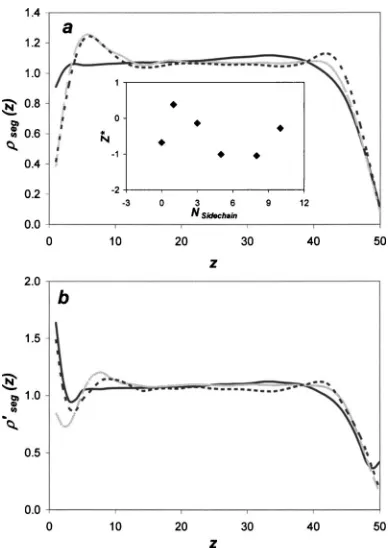
Results obtained for a system containing 20 polymers
共Npolymers= 20兲are displayed in Fig. 7. In Fig. 7共a兲we show the total segment-density profiles for linear 共black solid lines兲, comb polymers with three-segment-long side chains
共gray solid lines兲, and comb polymers with ten-segment-long side chains共black dotted lines兲. The inset in Fig. 7共a兲shows the parameterZ*as a function of the length of the side chains in the polymers. Our results indicate that Z* is negative for linear polymers, increases for comb polymers with one-segment-long side chains and three-one-segment-long side chains, decreases for comb polymers with five-segment-long side chains and eight-segment-long side chains, and in-creases for ten-segment-long side chains. This observation is qualitatively similar to the results obtained for a single poly-mer with the finite-concentration lattice model 关Fig. 11共a兲兴 where the comb polymer with one-segment-long side chain has the highest value ofZ*. The notable difference between single chain and multiple chains in the finite-concentration lattice model is that in the multiple-chain case the comb polymer with ten-segment-long side chains has a higher
value ofZ*than the comb polymers with five-segment- and eight-segment-long side chains. This could be due to both the change in conformations of the chains as the concentration in the simulation box increases and the increased packing frac-tion of polymer segments. This will be discussed later in this section.
In Fig. 7共b兲 we report the density profile of attractive segments for linear polymers 共black solid line兲, comb poly-mers with five-segment-long side chains 共gray dashed line兲, and comb polymers with ten-segment-long side chains共black dotted lines兲. The density profile of the attractive segments at a distance zfrom the surface is obtained as the ratio of the average density of attractive polymer segments found at that distance and the average density of attractive polymer seg-ments in the box共equal to the number of attractive segments in the simulation box divided by the box volume兲. Our re-sults indicate that the number of attractive segments in con-tact with the surface is the highest for the linear polymer, decreases as the length of the side chain increases, reaches a minimum for the five-segment-long side chain, and increases for comb polymers with ten-segment-long side chains. These results are in conflict with those obtained for a single poly-mer using the finite-concentration lattice model 关Fig. 11共b兲兴 where the number of attractive segments near the surface is highest for comb polymers with three-segment-long side chains and lowest for comb polymers with ten-segment-long side chains. This difference can be attributed to conforma-tional changes of the polymers near the attractive surface upon increasing the polymer concentration.
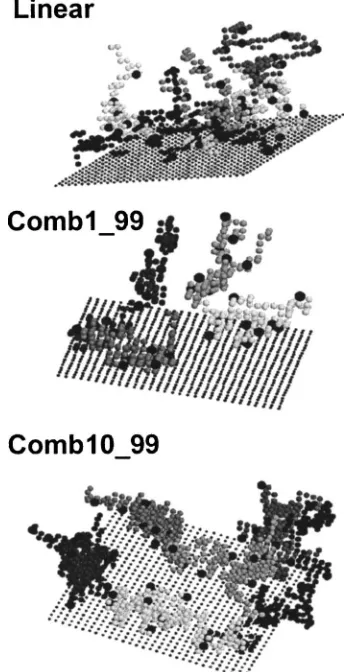
To better understand the conformations of polymers ad-sorbed on a surface from a finite-concentration solution we show simulation snapshots 共see Fig. 8兲 of linear polymers
共top panel兲, comb polymers with one-segment-long side chains共middle panel兲, and comb polymers with ten-segment-long side chains 共bottom panel兲. For clarity the snapshots show only a few adsorbed chains in each system. The attrac-tive segments in the polymers are represented with large black spheres. The nonattractive segments are represented with spheres of different shades of gray so that the chains can be distinguished from each other. When linear polymers adsorb on a surface 共top panel兲, they interpenetrate each other. In addition, we can see in the snapshots that each individual adsorbed chain spreads on the surface forming “trains” and “loops.” Similar conformations are also ob-served at infinitely dilute concentrations in the continuum model共see Fig. 5, left panels兲. However, visual inspection of the snapshot shown in Fig. 8共top兲indicates that linear poly-mers establish a larger number of contacts with the surface in the finite-concentration 共lattice model兲 than at infinitely di-lute concentrations. This qualitative observation is supported by results obtained for the density of attractive segments shown in Fig. 7共b兲.
Comb polymers with one-segment-long side chains
共middle panel兲 from individual globules and adsorb on the surface separately with no evidence of entanglement. Some of the comb polymers with ten-segment-long side chains
共bottom panel兲 stay in individual coils and others interpen-etrate during adsorption. As mentioned earlier, the packing fraction of the polymer segments increases as the length of
FIG. 7. Total segment density,seg共z兲,共a兲and segment density of attractive segments,seg⬘ 共z兲,共b兲for a system containing 20 polymers as a function of distance from the surface,z, for linear polymers共black solid lines兲, comb polymers with three-segment-long side chain关gray dashed lines, only共a兲兴, comb polymers with five-segment-long side chain关gray dashed lines, only
the side chains increases, and this could explain why comb polymers with ten-segment-long side chains in some cases interpenetrate while comb polymers with one-segment-long side chains do not. In addition, we expect that polymer-polymer interactions play a significant role in determining the conformation of adsorbed polymers at finite concentra-tion. In the literature it has been observed that at dilute bulk concentrations linear polymers interpenetrate, whereas branched polymers repel each other.36 Therefore it is ex-pected that linear polymers will adsorb and interpenetrate each other while comb polymers will adsorb as single glob-ules without interpenetrations.
With the aid of the simulation snapshots we can ratio-nalize the differences observed in the results at low concen-tration 共one polymer in the simulation box兲 and moderate concentrations 共20 polymers in the simulation box兲. At low concentration polymers adsorb on an attractive surface for enthalpic reasons. The favorable polymer-surface interac-tions cause linear polymers and comb polymers with short side chains to adsorb and spread on the surface共see Fig. 5兲. When the polymer concentration increases, the enthalpic gain due to polymer-segment-surface interactions can also be achieved by favorable segment-segment associations
between different polymer chains near the surface. In the case of linear polymers the association between a few poly-mer chains drives some of the adsorbing linear polypoly-mers to entangle and interpenetrate共see Fig. 8, top panel兲. The linear polymers that do not establish favorable segment-surface in-teractions or favorable association with other polymers re-main as globules in the bulk. This explains why the linear polymers have a lower value of Z* but a higher number of attractive segments adsorbed at the surface at moderate con-centration as compared to low concon-centration.
At moderate concentrations comb polymers with short side chains associate, preferentially in the bulk. Those poly-mers that do not associate in the bulk adsorb on the surface as individual globules 共see Fig. 8, middle panel兲. This ex-plains why comb polymers with short side chains 共one seg-ment long and three-segseg-ment long兲 have lower number of attractive segments on the surface at moderate concentration as compared to low concentration.
Comb polymers with long side chains共10 segment long兲 adsorb on a surface readily at infinitely dilute concentrations as they do not suffer a large loss in entropy 共see Fig. 5兲. However, our results at dilute concentrations in the lattice model 共Fig. 11兲 show that these polymers do not adsorb on the attractive surface for the set of interaction parameters chosen here. At moderate concentration in the lattice model, as the packing fraction increases, even comb polymers with ten-segment-long side chains adsorb 共see Fig. 7兲. Interest-ingly, adsorbed conformations of the comb polymers with ten-segment-long side chains are similar to the conforma-tions far from the surface. Many of the polymers adopt globular configurations in which some attractive segments are in contact with the attracting surface and others are in contact with other polymer chains共see Fig. 8 bottom panel兲. The visual observation of the snapshots shows that the con-formation of the polymers does not change upon adsorption. Therefore we conclude that for comb polymers with ten-segment-long side chains the adsorption is predominantly driven by the large packing fraction in the simulation box. This system is indeed the most crowded among those studied here, and it is likely that the confined polymers try to occupy the largest possible volume in an attempt to maximize the entropy of the system.
IV. SUMMARY AND CONCLUSIONS
We have presented a combination of molecular-simulation studies of the adsorption of linear and comb poly-mers on weakly attractive surfaces. The length of the back-bone in the comb polymers is equal to the length of the linear polymers. The molecular weight of the polymers is increased by increasing the length of the side chains in the comb poly-mers. The majority of the segments comprising a polymer molecule interact with each other and with the surface via hard-sphere potentials. Selected polymer segments, located at the tips of the side chains in comb polymers or equally spaced along linear polymers, interact with each other and with the surface via attractive square-well potentials. This
architecture is chosen to crudely represent proteins, in which associating interactions between amino acids are primarily responsible for the secondary and tertiary structures. In our simplistic representation, proteins are represented as comb polymers with short side chains. We are interested in under-standing if this simple representation of protein architecture determines the thermodynamic properties of proteins 共e.g., adsorption on hydrophobic surfaces兲. We investigate the ef-fect of the length of the side chains on the properties of the adsorbed polymers.
At infinitely dilute concentrations short side chains pro-mote adsorption because they allow the polymer molecules to maximize the enthalpic gain due to the adsorption of at-tracted segments, and minimize the entropic penalty faced during adsorption. We note that, among the polymers consid-ered here, comb polymers with short side chains resemble aqueous proteins more closely than the other polymer archi-tectures do. Our results suggest that the architecture of pro-teins is responsible for the tendency of propro-teins to adsorb and degenerate on top of hydrophobic surfaces. Our results seem to suggest that this architecture is optimal for the synthesis of polymers that are required for adsorption on solid surfaces and formation of brushes. Interestingly, this polymer archi-tecture共comb polymers with short side chains兲has been used by Augusteet al.5 to coat liposomes with polymer brushes. We find that long side chains do not promote the spreading of polymers on the attractive surface because the free energy of adsorption is minimized when the attractive segments are in contact with the surface 共maximizing the enthalpy gain due to adsorption兲 and the nonattractive segments are far from the surface 共maximizing the entropy of the system兲. Snapshots of the molecular configurations taken during the simulation show that comb polymers undergo a significant conformational change upon adsorption. When comb poly-mers are dissolved in bulk solutions at low temperatures, the attractive segments preferentially form clusters near the cen-ter of mass of the polymer, but when the comb polymers are adsorbed onto an attractive surface the attracted segments are preferentially in contact with the attractive surface while the backbone remains in solution. This conformational change resembles that observed when aqueous proteins are adsorbed onto hydrophobic surfaces. Further, by varying the width and depth of polymer-segment-surface square-well potentials we demonstrate that the driving force for adsorption to occur is the enthalpic gain, while the entropic loss constitutes an ob-stacle to adsorption that can be overcome by either favorable polymer architectures or by increased surface-polymer at-traction. The results obtained at infinitely dilute concentra-tions are in agreement with the results obtained at low con-centration using a lattice model where the comb polymer with short side chains promoted the adsorption of polymers onto an attractive surface. However, in the lattice model at low concentration the comb polymer with ten-segment-long side chains did not adsorb on the attractive surface. For this specific polymer architecture the set of interaction param-eters chosen in the lattice model is probably such that the enthalpic gain due to adsorption does not compensate for the entropic loss, and consequently the polymer does not adsorb.
At moderate concentration the enthalpic gain due to polymer-segment-surface interactions is achieved by favor-able segment-segment associations between different poly-mer chains near the surface. Linear polypoly-mers adsorb on an attractive surface and they form “trains” in which several attractive segments are in contact with the surface. Linear polymers are flexible and they easily interpenetrate each other. Our simulation snapshots suggest that by interpenetrat-ing each other the linear polymers minimize the free energy of the system by establishing contacts between attractive segments belonging to different polymers 共thus minimizing the system enthalpy兲and by allowing several possible con-formations 共thus maximizing the system entropy兲. In con-trast, comb polymers repel each other, and rarely interpen-etrate. At moderate concentration comb polymers with short side chains form globules in which the attractive segments are often located at the exterior. This configuration promotes the formation of contacts between attractive segments be-longing to different polymers, or between attractive segments and the attractive surface, in an attempt to lower the global free energy. As a consequence, we observe that adsorbed polymers have a few attractive segments in contact with the surface and a few others projected towards the center of the simulation box. This behavior is in contrast with our results at infinitely dilute concentrations 共continuum model兲 or at low concentrations共lattice model兲where the majority of the attractive segments is found in contact with the attractive surface and the polymer backbone is projected towards the center of the simulation box. We attribute the difference to the absence of the possibility of establishing contacts be-tween attractive segments belonging to different polymers at dilute or infinitely dilute concentrations. Comb polymers with ten-segment-long side chains at moderate concentra-tions adsorb on the attractive surface, even though they do not adsorb at low concentration共lattice model兲. The confor-mation of comb polymers with long side chains does not change appreciably when the concentration increases. Fur-thermore the conformations of adsorbed chains are not dif-ferent from that of the chains in the bulk. In a typical con-formation, the attractive segments are preferentially located on the exterior of a globule of polymer segments. Our results indicate that these globules adsorb on the attractive surface at large packing fraction. Since the conformations of the poly-mers do not change appreciably upon adsorption we specu-late that at the conditions considered here adsorption occurs only because of steric effects.
ACKNOWLEDGMENTS
APPENDIX
1. Infinitely dilute continuum model: Statistical conformations of polymers near surfaces
Results shown in Fig. 9.
2. Infinitely dilute continuum model: Polymers adsorbed on weakly attractive surfaces
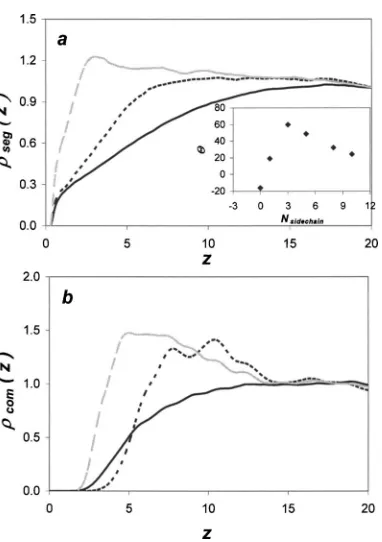
To investigate the effect of polymer architecture on ad-sorption when polymers are weakly adsorbed on a surface, we simulate the adsorption of comb polymers on solid sur-faces when= 3kTand= 1. We report the segment-density profile关Fig. 10共a兲兴and the density profiles of the centers of mass of the polymers关Fig. 10共b兲兴for various polymer archi-tectures. At these conditions linear polymers 共black solid lines兲 are effectively repelled from the surface and a wide depletion layer is observed 共see Table II for = 3kT and = 1兲. As the length of the side chains increases the parameter ⌰increases, becomes positive, reaches a maximum, and then decreases 关see inset in Fig. 10共a兲兴. The maximum in ⌰ is obtained when the side chains are three segment long. In agreement with results discussed earlier共see Fig. 2兲, the re-sults shown in Fig. 10 lead us to conclude that short side chains promote the adsorption of polymers on solid surfaces.
3. Infinitely dilute continuum model: Polymer radius of gyration in bulk
Results shown in Table III.
4. Finite-concentration lattice model: Single chain
The total segment-density profile at a distancezfrom the surface 关Fig. 11共a兲兴 is obtained as the ratio of the average density of polymer segments found at distance z and the average density of polymer segments in the box关equal to the ratio of the total number of segments in the simulation box
共Npolymers⫻Ntotal兲 and the volume of the simulation box兴. Only the results for linear polymer共black solid lines兲, comb polymer with three-segment-long side chains 共gray dashed lines兲, and comb polymer with ten-segment-long side chains
共black dotted lines兲are shown for clarity. The total segment density of the linear polymer共black solid line兲and the comb polymer with ten-segment-long side chains 共black dotted line兲is low adjacent to the attractive surface共z= 0兲and then gradually increases aszapproaches the center of the simula-tion box, which is in qualitative agreement with results ob-tained with the continuum model共see Fig. 10兲. However, in
TABLE III. Radius of gyration,具Rxyz2典. for comb polymers withNbackbone = 99 and 3-segment-long side chains as a function of the polymer-segment-segment interaction potential parameter关see Eq.共1兲兴.
/kT 具Rxyz2典
1 61.7± 0.2
2 62.2± 0.8
3 56.4± 0.8
4 40.6± 3.2
5 31.6± 1.9
FIG. 9. Three-关Rxyz2 ,共a兲兴and two-dimensional关Rxy2,共b兲兴radii of gyration
squared as a function of the center-of-mass distance from the attractive surface for linear polymers共black solid line兲and comb polymers with ten-segment-long side chains共gray dashed line兲when= 2kTand= 0.75. For both polymersNbackbone= 99. The percentage error in these data is below 5%.
the lattice model关Fig. 11共a兲兴the total segment density near the surface is larger for the linear polymer共black solid line兲 than for the comb polymer with ten-segment-long side chains 共black dotted line兲. This result disagrees with the re-sults obtained in the continuum model where the total seg-ment density near the attractive surface is the least for the linear polymer. This difference can be explained with the density profile for the attractive segments关Fig. 11共b兲兴. While several attractive segments of the linear polymer adsorb on the surface, the attractive segments of the comb polymer with ten-segment-long side chains rarely adsorb. We specu-late that in the case of the linear polymer the entropy loss due to adsorption is lower in the lattice model than in the continuum model while in the case of the comb polymer with ten-segment-long side chains the set of interaction pa-rameters chosen for our simulations favors the formation of globules that do not adsorb on the attractive surface.
The total segment density of the comb polymer with three-segment-long side chains near the surface关Fig. 11共a兲兴 is higher than those of the linear polymer and the comb polymer with ten-segment-long side chains. This qualita-tively agrees with the results in Fig. 6共a兲 where the comb polymer with three-segment-long side chains has the highest total segment density near the surface. The results in Fig. 11共a兲 indicate that the density profile is close to 1 at z= 1, adjacent to the attractive surface, increases to 2.5 atz= 3 – 4, and then decreases to 1 as z approaches the center of the simulation box. Similar features are observed in the con-tinuum model 关see Fig. 10共a兲兴, however, the total segment density adjacent to the surface is lower and the peak located
at z= 3 – 5 is weaker in the continuum model than in the lattice model. These differences can be explained with the density profile for the attractive segments shown in Fig. 11共b兲. The attractive segments of the comb polymer with three-segment-long side chains accumulate on the surface. This could be a consequence of the shorter range of the segment-surface attractive interaction in the lattice model as compared to that used in the continuum model.
In Fig. 11共b兲we plot the density profile of the attractive segments for a single polymer within the simulation box. Our results indicate that when a linear polymer is dissolved within the simulation box关black solid line in Fig. 11共b兲兴the attractive segments are distributed fairly uniformly across the simulation box. The attractive segment density is largest ad-jacent to the attractive surface 共indicating polymer adsorp-tion兲, decreases to a minimum at short separations from the attractive surface, and then reaches a plateau共within compu-tational uncertainties兲in the center of the simulation box. A similar behavior is observed for a comb polymer with three-segment-long side chains 关gray dashed line in Fig. 11共b兲兴. The minimum in the density profile of the attractive seg-ments observed at z= 4 – 5 for the linear polymer or at z
= 8 – 9 for the comb polymer with three-segment-long side chains indicates that the attractive segments prefer being ad-sorbed on the surface or being around the center of the simu-lation box, but they do not like to be at intermediate separa-tions. This is probably a consequence of the fact that the global free energy is minimized when the attractive segments are adsorbed at the surface or are present in the bulk where the number of possible polymer configurations is maximized. A different behavior is observed for a comb polymer with long side chains关Nside chain= 10 in Fig. 11共b兲, black dot-ted line兴. In that case the attractive segment density is low close to the attractive surface共z= 0兲 and to the hard surface
共z= 50兲and reaches a maximum in the center of the simula-tion box. These features are in partial agreement with the configurations of linear and comb polymers adsorbed on at-tractive solid surfaces in the infinitely dilute continuum model 共Fig. 5兲. The models agree in that they both predict that linear polymer and comb polymers with short side chains readily adsorb and spread on attractive surfaces lead-ing to high densities of attractive segments close to the at-tractive surface. The models disagree in the following way. The infinitely dilute continuum model predicts that comb polymers with long side chains project their attractive seg-ments towards the attractive surface but withhold their back-bone from it 共Fig. 5, right panels兲. The finite-concentration lattice model predicts that the attractive segments of the comb polymers with ten-segment-long side chains are not adsorbed on the attractive surface 关see also values forZ* in the inset of Fig. 11共a兲兴. This could be because they maintain globular conformations, even when close to the attractive surface.
1P. C. Hiemenz and R. Rajagopalan, Principles of Colloid and Surface Chemistry, 3rd ed.共Marcel Dekker, New York, 1987兲.
2J.-F. Le Meins and J.-F. Tassin, Colloid Polym. Sci. 281, 283共2003兲. 3U. Reichert, T. Linden, G. Belfort, M.-R. Kula, and J. Thömmes, J.
Membr. Sci. 199, 161共2003兲.
4J. F. Hester and A. M. Mayes, J. Membr. Sci. 202, 119共2002兲. FIG. 11. Total segment densityseg共z兲 共a兲and segment density of attractive
5D. T. Auguste, R. K. Prud’homme, P. L. Ahl, P. Meers, and J. Kohn, Biochim. Biophys. Acta 1616, 184共2003兲.
6I. Norde, inSurface and Interfacial Aspects of Biomedical Applications, edited by J. D. Andrade共Plenum, New York, 1995兲.
7M. A. C. Stuart, G. J. Fleer, J. Lyklema, W. Norde, and J. Scheutjens, Adv. Colloid Interface Sci. 34, 477共1991兲.
8A. A. Mungikar and D. Forciniti, ChemPhysChem 3, 993共2002兲. 9A. K. Chakraborty and M. Tirrell, MRS Bull. 21, 28共1996兲.
10L. G. Cascão Pereira, A. Hickel, C. J. Radke, and H. W. Blanch, Bio-technol. Bioeng. 78, 595共2002兲.
11F. Fang and I. Szleifer, Biophys. J. 80, 2568共2001兲. 12F. Fang and I. Szleifer, J. Chem. Phys. 119, 1053共2003兲. 13M. A. Carignano and I. Szleifer, Mol. Phys. 100, 2993共2002兲. 14S. S. Sheiko and M. Möller, Chem. Rev.共Washington, D.C.兲 101, 4099
共2001兲.
15P. Bauerle, T. Fisher, B. Bidlingmeier, A. Stabel, and J. P. Rabe, Angew. Chem., Int. Ed. Engl. 34, 303共1995兲.
16S. A. Prokhorova, S. S. Sheiko, A. Mourranet al., Langmuir 16, 6862 共2000兲.
17S. S. Sheiko, S. A. Prokhorova, K. L. Beers, K. Matyjaszewski, I. I.
Potemkin, A. R. Khokhlov, and M. Möller, Macromolecules 34, 8354
共2001兲.
18I. I. Potemkin, A. R. Khokhlov, S. Prokhorova, S. S. Sheiko, M. Möller, K. L. Beers, and K. Matyjaszewski, Macromolecules 37, 3918共2004兲. 19R. Zajac and A. Chakrabarti, J. Chem. Phys. 107, 8637共1997兲.
20A. Striolo and J. M. Prausnitz, J. Chem. Phys. 114, 8565共2001兲. 21T. E. Creighton,Proteins: Structures and Molecular Properties, 2nd ed.
edited by共W. H. Freeman, New York, 1993兲. 22T. Garel and H. Orland, J. Phys. A 23L621共1990兲. 23P. Q. Higgs and H. Orland, J. Chem. Phys. 95, 4506共1991兲.
24A. Striolo, D. Bratko, J. M. Prausnitz, N. Elvassore, and A. Bertucco,
Fluid Phase Equilib. 183–184, 341共2001兲.
25P. H. Verdier and W. H. Stockmayer, J. Chem. Phys. 36, 227共1962兲. 26N. Metropolis, A. W. Rosenbluth, M. N. Rosenbluth, A. N. Teller, and E.
Teller, J. Chem. Phys. 21, 1087共1953兲.
27S. Asakura and F. Oosawa, J. Chem. Phys. 22, 1255共1954兲.
28A. Striolo, C. M. Colina, K. E. Gubbins, N. Elvassore, and L. Lue, Mol. Simul. 30, 437共2004兲.
29J. J. de Pablo, H. C. Ottinger, and Y. Rabin, AIChE J. 38, 273共1992兲. 30Y. Zhou, C. K. Hall, and M. Karplus, Phys. Rev. Lett. 77, 2822共1996兲. 31Y. Zhou, M. Karplus, J. M. Wichert, and C. K. Hall, J. Chem. Phys.107,
10691共1997兲.
32S. Damodaran, Interfaces, Protein Films, and Foams共Academic, San Diego, 1990兲.
33A. V. Smith and C. K. Hall, Proteins 44, 344共2001兲.
34K. Leonhard, J. M. Prausnitz, and C. J. Radke, Phys. Chem. Chem. Phys.
5, 5291共2003兲.
35R. A. L. Jones and R. W. Richards,Polymers at Surfaces and Interfaces 共Cambridge University Press, London, 1999兲.