THE EFFECTIVENESS OF RFID IN REDUCING INWARD GATE CONGESTION IN JOHOR PORT.
MUHAMAD HAIRI BIN MAAROF
A dissertation submitted in partial fulfilment of the requirements for the award of the degree of
Master of Science (Transport Planning)
Faculty of Built Environment Universiti Teknologi Malaysia
I dedicate this dissertation to my parents Hj Maarof Bin Hj Abas and Hjh Hamidah Bt Hj Mohamad, my brother and sisters, my family and close friends. Without their patience, understanding, support, and most of all love, the completion of this work
ACKNOWLEDGEMENT
First of all, thanks to Allah S.W.T for giving me the strength, health and ability to complete this study.
ABSTRACT
ABSTRAK
Kajian ini memberi focus dan penekanan terhadap aplikasi teknologi Rfid yang membenarkan pergerakkan bahan-bahan dan barangan di pintu keluar.
TABLE OF CONTENT
ACKNOWLEDGEMENT vi
ABSTRACT vii
ABSTRAK viii
TABLE OF CONTENTS ix
LIST OF TABLES xii
LIST OF FIGURES xiii
LIST OF SYMBOLS xiv
GLOSSARY OF TERMS xv
LIST OF APPENDICES xvi
1 INTRODUCTION 17
1.1 Background of Problem 21
1.2 Problem Statement 22
1.3 Research Questions 26
1.4 Research Objectives 27
1.5 Research Hypothesis 27
1.6 Theoretical Framework 28
1.7 Scope of Research 28
1.8 Research Assumptions 29
1.9 Assumption of Research 29
1.10 Significance of Research 29
1.11 Research Design 30
1.12 Thesis Outlines 30
1.13 Chapter Summary 31
2 LITERATURE REVIEW 32
2.1 Radio Frequency Identification 32
2.2 Congestion 34
2.4 Operational Management & Operational Efficiency 37 2.5 Chapter Summary 38
3 RESEARCH METHODOLOGY 39
3.1 Introduction 39
3.2 Study Variables 39
3.3 Data Sources 40
3.3.1 Sampling Design 40
3.3.2 Target Population 41
3.4 Reliability and Validity 41
3.4.1 Reliability 41
3.4.2 Data Reliability (Acquisition) 41
3.4.3 Data Reliability (Analysis) 42
3.4.4 Validity 43 3.4.5 Data Validity (Data Errors) 43 3.4.6 Data Validity (Correlation with Purpose) 44
3.5 Analytical Techniques 45
3.6 Chapter Summary 46
4 DATA COLLECTION AND ANALYSIS 47
4.1 Manpower Reduction Analysis 48
4.2 Relation of Man Power Reduction & Operational Management 52 4.3 Analysis of Time Reduction 53
4.4 Relation of Reduced Operational Time With Operational Management 55
4.5 Process Steps Reduction Analysis 56
4.6 Relation of Reduced Procedural Steps With Operational Management 58
5 RESULTS AND FINDINGS 60
5.1 Hypothesis 60
6 CONCLUSIONS AND SUGGESTIONS 64
6.1 RFID Implementation. 64
6.1.1 Security 65
6.1.2 Tracking & Transportation 65
6.1.3Limitation 66 6.2 Research Enhancements,Suggestions & Limitations 66
6.2.1 Limitations 66
6.2.2 Suggestions 67
6.2.3 Enhancement of This Research 67
6.3 Chapter Summary 67
LIST OF TABLES
TABLE NO. TITLE PAGE
Table 3-1 Mapping of Hypothesis to Study Variables 40 Table 3-2 Data and Hypothesis Correlation Table 44
Table 4-1 Manpower Reduction Analysis 49
Table 4-3 Analysis of Time Reduction 53
` LIST OF FIGURES
FIGURE NO. TITLE PAGE
Figure 1-1 Pre-Advise Screen 23
Figure 1-2 Conrtainer Truck Queue at Terminal Gate In 24
Figure 1-3 Terminal Gate In 24
Figure 1-4 Yard Crane Operation Off-Loading Container From Truck 25
Figure 4-1 Before Implementing RFID 50
LIST OF SYMBOLS
f - Min tasks per day
g - 22 working days
x - Min process time before RFID
GLOSSARY OF TERMS
RFID - Radio Frequency Identification
ISO - International Organization for Standardization MIC - Ministry of Internal Affairs and Communication
LIST OF APPENDICES
APPENDIX TITLE PAGE
CHAPTER 1
INTRODUCTION
The roots of radio frequency identification technology can be traced back to world war 2. The Germans, Japanese, Americans and British were all using radar, which has been discovered in 1935 by Scottish physicist Sir Robert Alexander Watson Watt to warn of approaching planes while they were still miles away. Here the problem occurs where there was no way to identify which planes belonged to the enemy and which were a country’s own pilot returning from a mission. The Germans discovered that if pilots rolled their planes as they returned to base it would change the radio signal reflected back. This crude method alerted the radar crew on the ground that these were German planes and not Allied aircraft. Watson Watt developed the first active identify friend or foe (IFF) system. They put a transmitter on each British plane. When it received signals from radar station on the ground, it began broadcasting a signal back that identified the craft as friendly. RFID works on this same basic concept. A signal is sent to a transponder which makes up and either reflects back a signal (passive system) or broadcast a signal (active system).
Advance in radar and RF communications systems continue through the 1950’s and 1960’s. Scientist and academics in the United States. Europe and Japan did research and presented papers explaining how RF energy could be identify objects remotely. Companies began commercializing anti-theft systems that used radio waves to determine whether an item had been paid for or not. Electronic article
The bit is either on or off. If someone pays for the item the bit is turned off and a person can leave the store. But if the person doesn’t pay and tries to walk out of the store, readers at the door detect the tag and sound an alarm.
Radio-frequency identification (RFID) is a technology that uses radio transfer waves to transfer data and a data collection technology that uses electronic tags for storing data. The electronic tags also known as an electronic label, transponder or code plate is made up of an RFID chip attached to an antenna. Transmitting in the kilohertz, megahertz and gigahertz ranges, tags may be battery powered or derive their power from the RF waves coming from the reader. Like bar codes, RFID tags identify items. However, unlike bar codes, which must be close proximity and line sight to the scanner for reading, RFID tags do not require line of sight and can be embedded within packages. Depended on the type of tag and application, they can be read at a varying range distances. In addition tagged cartons rolling on a conveyer belt can be read many times faster than bar coded boxes.
There also several specific industries that have set guidelines including the Financial Services Technology Consortium(FSTC) has set a standard for tracking IT assets with RFID, the Computer Technology Industry Association CompTIA has set a standard for certifying RFID engineers and the International Airlines Transport Association IATA set tagging guidelines for luggage in airports.
RFID tags can be either passive, active or Semi tags. Passive tags have no power source but use the electromagnetic waves from the reader to energize the chip and transmit back (backscatter) their data. Passive tags can cost less than a quarter and be read up to approximately 10 feet from the reader’s antenna. Active tags have a battery that can transmit up to 300 feet indoors and more than a thousand feet outdoors. Used for tracking trailers in yards and containers on the loading dock, active tags cost several dollars and may periodically transmit a signal for readers to pick up or may lie dormant until they sense the reader signals. Semi passive tags, also called semi active tags, combine passive backscattering with a battery that allows the device to beep, blink or perform some operation. For example a semi passive tag on refrigerated cartons can include a sensor that when interrogated, reports the temperature range during shipment.
1.1 Background of Problem
Congestion at Johor Port become more crucial, the Johor Port Shipping and forwarding Associations wants the transport ministry to come up with the solutions to reduce congestions at Johor Port. Despite having raised the issue with the port operator on several occasions they want a long term solution and not something which is done on an ad hoc basis or as and when the situation arises. The problem had been going on for years and if the port operator could not solve the issue and need relevant authorities to involve solving it and closely monitoring will all parties concerned for the benefits of the country’s logistic sector. Johor Port is not transparent and responsible and as a service provider they had a duty to explain to port users on the problem.
What is obvious is that there is a variety of problem that arises from the delays currently happening in Johor Port. Primarily this incursion in time as well as the delays happening increases costs as well hinders company productivity which relates directly to profit. Financially speaking, delay in managing a product would be increased primarily in re-moving these materials, storing these materials as well as additional charges incurred due to the change in re-scheduling vessels to transport these materials.
1.2 Problem Statement
Various short-term mitigation was plan to incremental improvements to the situations and this will continue as an ongoing practice but still doom to solve the problem. The establishment of Tanjung Pelepas Port Sdn Bhd was been said to be the long term solution envisaged by the government at that time. Where they are two specialized ports. Port Tanjung Pelepas function is handle containers and Johor Port to handle conventional cargo.MMC corp has 70% equity interest in PTP and wholly owns Johor Port. In 2009, MMC had proposed to move Johor Port’s container operations in Pasir Gudang to PTP. This would turn Johor Port into a non containerised port while PTP would focus on its forte of handling containerised cargo but the plan was turned down by the government. Johor Port Berhad are now operating at 80% to 90% capacity and with the bunching of vessel arrivals, the situations had become more worst.
In end of 2009 Johor Port Berhad has decide to improve their gates system operation by implementing RFID technology to its operations. The purpose of implementing the technology of RFID is to reduce congestion and indirectly to eliminate the congestion problem. By implementing RFID technology in operations, the cost has tremendously increased, but still they can’t prove the effectiveness and the efficiency of the RFID technology. Therefore this dissertation uses the approach of evaluating the effectiveness and efficiency of RFID technology in gates system operations at Johor Port berhad.
The basic processes that make up the conventional gates operations are as follows :-
1. Container Pre-advise.
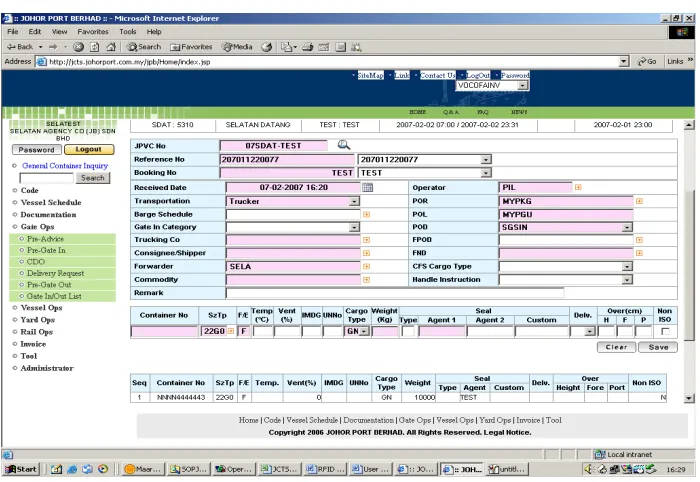
not to miss the loading. The information for cargo and the container must be at all time accurate in accordance to the intended shipment so has not to miss match with the vessel loading plan. Do refer Figure 1-1.
.
Figure 1-1 Pre-Advise Screen
2. Truck arrival at gate in.
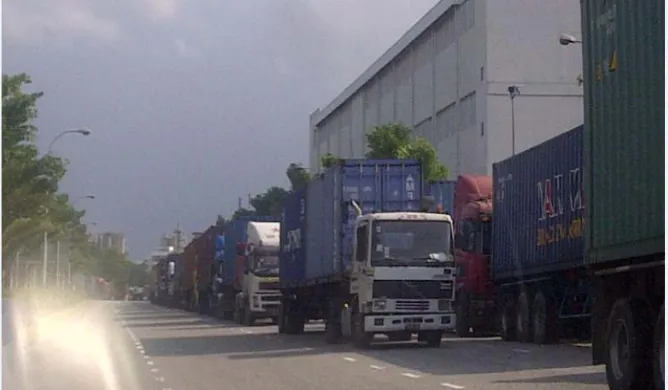
Figure 1-2 Container Trucks Queue At Terminal Gate In
3. Gate-in process & physical inspection.
Once the truck is position in the gate-house, container is being physically inspected on the container details such as container number size, conditions, vessel name, port of discharge, container seal number matching with pre-advised.and at same time to weigh the container to ascertain container weight. To ensure the container cargo is safe before entry to yard, the gate keeper will inspect the container seal in good condition and not being tempered or broken. If everything goes well this gate-in information verification and container physical inspection will only take 2 to 3 minute. In some instances some containers have to be rejected due to container condition and overweight or miss-matched physical data with the system. Do refer figure 1-3.
4. Gate confirmation.
Upon passing the gate-in physical inspection, the container is given a yard location to stack or position the container in the yard. The Gate Clerk is also conveying container planned location to the driver for him to proceed to location for off-loading the container. The container location is also being updated in the computer system to alert the yard Crane Operator. Containers with same vessel for loading will be located in one or two group locations depending on the total number of containers to be loaded.
5. Stacking container.
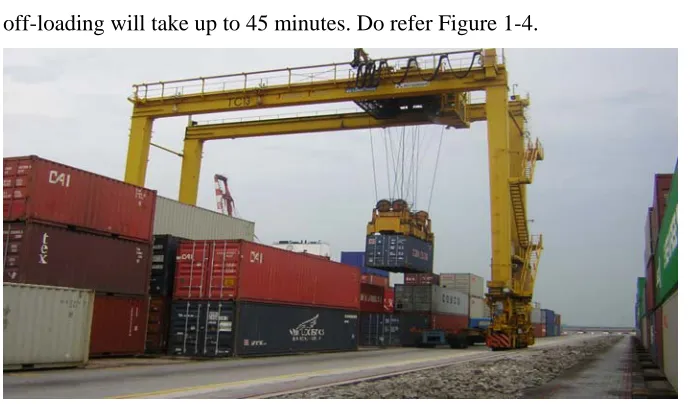
The truck driver proceeds to the yard location and engage with the yard crane to off-load the container. The yard Crane Operator will check his order list to check the container number and location to ensure he is picking-up the right container for the right stacking. In normal condition the process of lifting and stacking containers will take less than 5 minutes. But during peak period where bunching of truck arrivals going to same yard crane , the off-loading will take up to 45 minutes. Do refer Figure 1-4.
6. Empty truck leaves the port.
Once the container is safely off-loaded from the truck to the yard , the drive will proceed the terminal gate-out to complete the delivery cycle for sending export container from the customer’s premise to port. By this time container arrival and stacking data are being updated accordingly and real-time display on the web site for customer to view the whole processes log.
1.3 Research Questions
This dissertation will primarily focus on efficiency and how it can and has been increased due to the implementation of the RFID system. So the research questions would as follows:-
1. How is operational efficiency defined? 2. What is RFID?
3. How is RFID implemented in Johor Port?
4. How has the implementation of RFID help increase operational efficiency of Johor Port?
5. How does implementing RFID help decrease congestion happening in Johor Port?
6. What are the suggestions which can be implemented in order to further increase the efficiency of Johor Port?
Port effectiveness and efficient become an important element and criteria in operations. Effectiveness and efficient can be a valuable assets for a port to attract investors and to attracts more customer and directly improve their daily operations.
1.4 Research Objectives
A general characteristic of a rail network should facilitate the passengers in the first place to travel from one destination to other destination. But with the experts planner, the implementation of the infrastructure is not just facilitating and transferring passenger from origin to destination, it is also as a part of the responsibility to ensure that the infrastructures are sustain in a long term, adapt to any new urban development and definitely reliable of transferring people from the origin to the destination. So, the goals of this dissertation are:
1. To evaluate the network complexity of light rail services in the study area using the β-indicator and directness of services to measure the competency.
2. To compare the existing network with the other service provider by measuring the network complexity for each system.
3. To measure the Directness of Services for each proposals for the purpose of measuring the flexibility level and convenience of the network itself to the users.
1.5 Research Hypotheses
1.6 Theoretical Framework
This study will help to determine three main things which is also the main characters of evaluating efficiency. Firstly, the reduced time in operational processes. With the RFID inserted firmly into the processing method now, less time is being utilized which helps with decreasing congestion happening in Johor Port as well as eliminating problems of delays. The second is the lesser man-power being utilized in the processing which helps decreases the overall operational cost of handling the containers. Finally is the difference in steps that need to be taken before and after the RFID system was implemented. Where a process which might have taken 10 procedural steps before the RFID implementation took less after RFID was introduced into the system. Finally in which areas can more changes be made in order to further increase efficiency of the port operations. The importance of Johor Port is undeniable to the customers utilizing its services. In which case, implementation of RFID and how it decreases congestion, manpower as well as reducing the steps required is vital to the not only the operational efficiency of the port but also all the companies who are using Johor Port as the main medium for moving and transporting their containers.
1.7 Scope of Research
My research will be subject of only these few elements.
1. The change in manpower required before and after RFID is implemented 2. The amount of time required to process containers before and after RFID is
implemented
3. The steps taken to process these containers before and after RFID is implemented.
1.8 Research Assumptions
To proceed with the research objectives some assumption has been made. There are :-
1. Location of the destination for collection and delivery will not be the same each day for a truck.
2. Cost, time and accuracy will not be the same for each destination for collection and delivery.
3. The overall outcome will prove that the MITS system is effective or wasn’t.
1.9 Assumption of Research
To outline the areas affected by RFID primarily decrease of processing time and congestion, decrease of manpower and manpower costs, and decrease operational steps taken after utilizing RFID, and finally identifying the key areas where RFID has yet to be implemented and can affect change as well. The differences of processing time and operational processes that occurs currently in Johor Port due to the implementation of RFID
1.10 Significance of Research
1. The study will describe the before and after data available which will prove the changes that has happened in Johor Port operational procedures and how this can be translated to enhance operational efficiency.
2. This study will look at the decreased time operational processes, decreases the requirement of manpower, decreases overall congestion and finally decreases the processing steps required when processing these containers
1.11 Research Design
The design of this research is highlight the difference in time required in processing with customer containers, the decreased manpower required in processing these containers and finally the decreased amount of steps in processing these containers and how that can be translated into key areas used to evaluate operational efficiency of the port as a whole.
1.12 Thesis Outlines
Chapter 1 – Introduction
1.13 Chapter Summary
REFERENCES
Nagurney,A and Qiang,Q (2007). A network efficiency measure with application to
critical infrastructure networks. United States: Isenberg School of Management, University of Massachusetts.
Dimitriou,H.T and Adegboyega,B.G (1992). The Urban Trasnport Planning
Process: Its Revolution and Application to Third World Cities. New York: Routledge.
Hilling, D. (1996). Transport & Developing Countries. London: Routledge.
Smeed, R. (1964). The Traffic Problem in Town: A Review of Possible Long Term Solutions. Town Planning Review , 133 -159.
Vaughan, R. (1987). Urban Spatial Traffic Patterns. London: Pion Limited.
Vuchic, V. R. (2005). Urban Transit: Operations, Planning and Economics. New Jersey: John Wiley & Sons, INC.
Yi,W and Chao,Y (2009). Evolution Characteristics Analysis of Urban Rail Transit Network in Shanghai. International Conference on Transportation
Engineering 2009 (pp. 3076- 3081). Shanghai, China: ASCE. Li,F (2011). International City Traffic Congestion Based Analysis and
Countermeasures Research.Hebei Province, China. Ye,F (2008). Research on Supply Chain Inventory Optimization and
Benefit Coordination with Controllable Lead Time. Guangzhou, P.R.China.