Jurnal Teknologi Maklumat & Multimedia 2(2005): 81-103
Standards and Tools in Production and
Maintenance of System Documentation
SHAHIDA SULAIMAN, NORBIK BASHAH IDRIS & SHAMSUL SAHIB UDDIN
ABSTRACT
Implementation of a standard in a software development or maintenance process will provide guidelines on how to conduct the activities in the phases of software life cycle including the documentation to be produced. In addition, the use of Computer-Aided Software Engineering tools or workbenches can automate parts of documenting activities. Despite the importance of standard and tools to be utilised, they are still not widely used. Thus, software engineers still confront with the problems related to documentation particularly system documentation. This paper presents the result of a survey in Malaysia with the main goal to study software engineers' current practice in production and maintenance of documentation based on characteristic, behavior, belief and attitude. Finally, we highlight on what kind of tools should be introduced, why it is introduced and when or how it should be introduced to support the practice.
ABSTRAK
INTRODUCTION
System documentation (SD) is an important source of software understanding. Having system documentation, a system is easy to maintain. According to Hoffer et al. (1999), SD is detailed information about a system's design specification, its internal workings and functionality. In this study SD includes analysis and design documents. SD should be produced and continuously updated to evolve together with its software. However, most available SD is almost always out-dated or even non-exist at all. On the other hand, a thick set of documentation might be useless too, if such documents do not serve the information required by software engineers particularly during software maintenance. As a result, software maintainers still need to study the source codes to accomplish their tasks.
In order to produce a tool that can serve software maintainers' needs in documentation automation, we believe that the current practice of documentation should be studied. Hence we conducted a survey towards 50 software engineers in Malaysia with the main goal to study their current practice in production and maintenance of SD during software development and maintenance based on four types of data elements: characteristic, behavior, belief and attitude (Kendall and Kendall 1998). We also highlight the questions that argue on what kind of tools should be introduced, why it is introduced and when or how it should be introduced. We would like to emphasise the word "should" instead of "can" because for an instance; what a tool is claimed "can" do is sometimes not actually what a tool "should" do to serve the users' needs. In the following sections we will discuss the background, survey, analysis, findings and finally our conclusion.
BACKGROUND
Programmers spend 40 percent to 60 percent of their time reading the code and attempting to comprehend its logic (Pigoski 1997). Without the assistance of documentation, the percentage may be higher and directly lead to costly software maintenance process. Furthermore, problems in software maintenance are related to how much information is available from the documents especially with respect to the architecture and design of a system. A study stated that documentation being absent, out-of-date or at best insufficient as the third major cause of maintenance problems (van Vliet 2000). While a survey found that the lack of documentation of applications was in the second ranking of the three biggest problems related to software maintenance process (Sousa and Moreira 1998). We highlight the problems related to standard and tools in the following paragraphs.
Life Cycle (SOLC). Such fully integrated CASE tools will normally produce a self-generated documentation that will be useful to maintainers. Nonetheless most organisations do not use CASE tools to support all phases of SOLC. "These reasons range from a lack of vision for applying CASE to all aspects of the SOLC to the belief that CASE technology will fail to meet an organisation's unique system development needs" (Hoffer et al. 1999). Hence, software developers might just use a particular CASE tool to draw diagrams that capture user requirements in the analysis and design phase of SOLC but do not use code generators or Reverse Engineering (RE) utility provided. Therefore, there is a lack of integration between the so and the source codes. In addition, RE workbenches can re-document legacy systems by parsing source codes of the subject system and visualise the artifacts in its graph editor. Nevertheless, RE tools are still not widely used for some fundamental difficulties: documents generated are too general or too detail, lack of data needed by maintainers, and RE tools are inflexible (Canfora et al. 1991).
On the other hand, if CASE tools are not used at all, software engineers may need to read through all the source codes again and transform them into graphical notation. "This can be a tedious job, which requires considerable concentration. It is all too easy for concentration to collapse, for even a very short period and miss some vital piece of information" (Lincoln 1993). Besides, during initial development, documentation often comes off badly because of deadlines and other time constraints (van Vliet 2000). Programmers also dislike documenting system as this is seen as a rather boring task compared to the excitements of creation in design and implementation (Macro 1990).
Implementation of a standard such as those from DoD (us Department of Defense) and IEEE (Institute of Electrical and Electronics Engineering) in a software development or maintenance process is a good practice because the standard will provide guidelines on how to conduct the activities in the phases of software life cycle including the documentation to be produced. Some of the standards provide the brief outlines on the contents of specified documentation such as IEEE Std 1016-1998 that recommends practice for Software Design Descriptions but some standards just describe the documentation to be produced in general for instance DoD-Std- 2167 A. However, most organisations in Malaysia do not apply any formal software development methodology (Yahya et al. 2002). Indirectly it shows they probably do not apply any documentation standards to be the guidelines in producing or maintaining so. Therefore documents or so available are of different formats.
Nevertheless, only the documentation for the first maintenance could be reliable. The link between a program and its associated documentation are sometimes lost during the maintenance process and this may be the consequence of poor configuration management or due to adopting a "quick fix" approach to maintenance (Sommerville 1997).
A number of surveys were conducted to study the problems in software maintenance (Sousa and Moreira 1998; van Vliet 2000) and some surveys such as by Sim et al. (1998) were conducted to study the features required by software engineers in tools for software understanding. However, there is no research has been done to study the role of standards and tools in the current practice. Thus, our study will cover these issues.
THE SURVEY
The survey managed to derive the responses from 50 software engineers from various industries and levels in Malaysia who are involved in software development or maintenance project. Maximum of two software engineers from the same company were allowed to answer the questionnaire. A pilot study of the survey was conducted to 5 software engineers and the questionnaire was refined. The survey was conducted bye-mailing some software engineers who had liaison with the researchers. The questionnaire file was attached to the e-mail and then forwarded to other software engineers. In addition; some identified respondents were personally contacted and distributed with the printed questionnaire by the researchers. This method made the response rate higher and saved cost compared to the method of contacting all organisations in a telephone directory.
The questionnaire was formulated based on the literature review and discussions with some software engineers. It consisted of 35 questions (only 3 of them were open-ended questions) distributed into 3 sections: Section A: Professional Background (AI - A14), Section B: System Documentation and Standard (Bl - B16), and Section C: CASE tools (Cl - C5). Some of closed questions provided "Others" as another option of answers in order to allow respondent to provide the answer that never thought of. Some answers were provided with "No Opinion" option to avoid the feeling of being forced to agree with the answers provided. The questionnaire was quite comprehensive, hence in following analysis and findings we only focus on the issues related to the role of standards and tools in documentation production and maintenance.
THE ANALYSIS
without any response were considered missing except for certain filtered questions, which required respondents to skip irrelevant questions.
CHARACTERISTIC
For this element, the survey identified properties of software engineers and so. The respondents were from diverse job positions i.e. from technical to management (see element Crl in Table 1). The data shows 16 respondents were programmers or senior programmers (32%) and 14 respondents (28%) were system analysts. While in management level, the cumulative frequency was 13 respondents (26%). The distribution between the technical and management people surveyed was almost 2 to 1. The respondents were from wide range of industry (element Cr2 in Table 1) with most of them were from software industry (32%), followed by telecommunication (20%), government service (16%) and software consultancy (12%). Other category contributed 20% of those surveyed. In term of experience (refer element Cr3 in Table 1), most respondents had involved in software development or maintenance for 1 to 5 years.
Regarding the usefulness of existing so provided to software maintainers (Table 2, element Cr5), 38 respondents (76%) cited that it was always useful. On the other hand, 7 of them (14%) viewed so provided was not always useful and theyalmost "strongly agreed" with the reasons out-of-date with the mean 4.67, almost "agreed" with the reason unreliable (4.17) and incomplete (3.83), "agreed" with the reason misleading (4.00), almost "normal" opinion towards low quality (3.20) and "normal" opinion towards unorganised (3.00). When asked whether parts of so produced by CASE tools were always useful (see Table 2, element Cr6), 21 respondents (84%) with CASE tools experience said it was always useful. While only 4 respondents (16%) said that it was not always useful with the "strongly agree" reason (5.00), lack the data needed.
BEHAVIOR
Behavior element investigates on "what organisational members do" during software development or maintenance in relation with documentation. From the response on the number of projects, on average, the respondents are involved in 3 maintenance projects and 2 development projects yearly. Meanwhile, on average, a set of so was produced or modified for both maintenance project and development project per year. Thus, 2 maintenance projects and 1 development project were usually not provided with so yearly.
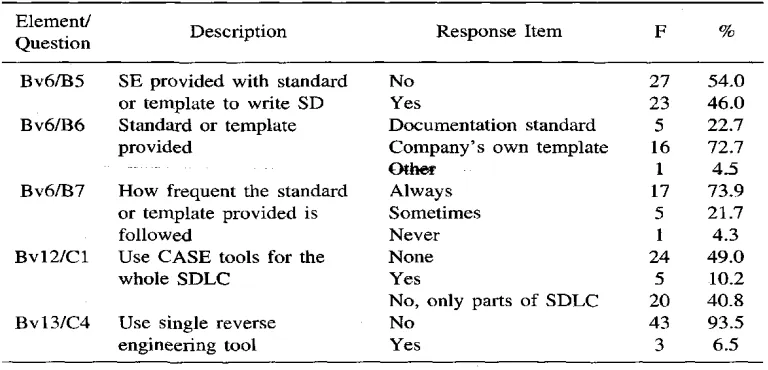
company's own template. Most ofthem (17 respondents, 73.9%) claimed that they "always" followed the standard or template provided, 5 respondents (21.7%) cited "sometimes" and 1 respondent (4.3%) cited "never". Regarding the use of CASE tools (element Bv12), 24 respondents (49%) did not use CASE tools, while 20 respondents (40.8%) used CASE tools partially and only 5 respondents (10.2%) used CASE tools for the whole SOLC. Referring to experience in using RE tools (element Bv13), only 3 respondents (6.5%) had ever used the tools compared to 43 respondents (93.5%) without such experience at all.
Regarding the software packages used to produce or maintain so, the responses are ranked by the mean values and the usages are compared, as in Table 4. Based on the table, it reveals that the respondents who used CASE tools for tb& whole SOLC used most of the software packages; both word processor and spreadsheet (3.00) and graphical tools (2.33), compared to the other two groups. For the other two groups ("None" and "No, only part of SOLC"), both mostly used word processors (2.81 and 2.79 respectively). The former group used spreadsheet application more (2.08) than the latter group (1.50), but used less graphical tool (1.62) compared with the latter group (2.09).
with documentation standard produced and modified more SD (1.40 for development and 1.00 for maintenance projects) and faced less maintenance projects without SD (1.60) as compared to the former group. In addition, those with companies' own template, produced and maintained the most number of SD yearly (2.38 for both development and maintenance projects) and the least number of maintenance projects not provided with SD (1.08). We do not discuss on the "other" group.
The number of SD produced for new software development (see Table 6) is the highest (1.71) among software engineers who did not use CASE tools at all followed by those partially used CASE tools (1.16) and fully used CASE tools (1.00). On the other hand, the highest number of SD produced or modified in software maintenance project contributed by software engineers who partially used CASE tools (1.63) followed by those with no CASE tools (1.29) and with CASE tools (0.50). Regarding the number of maintenance project was not provided with SD, this phenomenon mostly occurred among software engineers partially used CASE tools (2.61), while those fully used CASE tools had the mean value 1.50 compared to only 0.95 of those without CASE tools.
ATTITUDE
investigate whether it is true that software engineers prefer graphical to textual software representation in order to understand the software, and what features are in favour that should be incorporated into a document generator tool.
The analysis result is shown in Figure 1. The figure illustrates the difference in the need of textual description versus graphical representation, in which the mean of graphical representation of system is higher compared to that of textual description. The mean of textual description of system architecture or system and subsystem is 3.18 while 3.83 for the graphical representation. The mean of textual description of modules or programs and their relationships is 3.20 but 3.83 for the graphical representation. Meanwhile, the mean of textual description of data flow is also lower (3.15) if compared to that of data flow graph (3.72). The mean for textual description of procedures or methods or functions is 3.27 whilst the mean for program versus file cross-reference table is 3.14. The most needed features among all are graphical system-subsystem flow and graphical representation of components' relationships, which share the same mean value (3.83).
For other features like search utility, documentation layout generation, applicatioiiIiiwide range of language, interactive browsers, and link between source code and graphical representation; their means are 3.20, 2.93, 2.98, 2.93 and 3.29 respectively. All the features have the means within the range of 2.00 (Less Required) to 4.00 (Required) which indicate that all features are basically necessary to have but not the most demanded in the respondents' point of view.
T-test was used to study the significance of difference in means. The null hypothesis is "there is no significant difference between the means of textual and graphical software visualisation". Table 7 reveals that all the three pairs are able to reject the null hypothesis (less than 0.025).
BELIEF
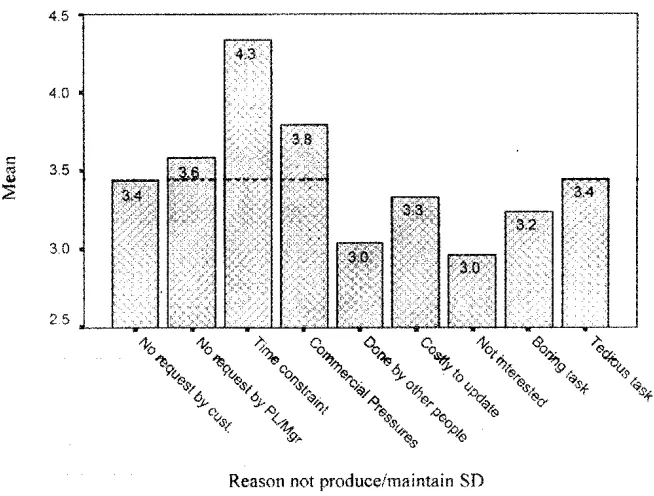
Figure 2 illustrates the reasons for not producing SD. The top three reasons were time constraints (4.30), commercial pressures (3.80) and SD not requested by project leader or software manager (3.60). The other reasons were because SD was not requested by customer and it was a tedious task, which share the same mean value (3.40), costly to keep updated (3.30), a boring task (3.20), done by other people and not interested, both with the same mean (3.00). These mean values were based on Likert scale: I = Strongly Disagree, 2 = Disagree, 3 = Normal, 4 = Agree and 5 = Strongly Agree.
THE FINDINGS
Software engineers confront with more maintenance projects without SD compared to development projects with the ratio of 2: 1. Despite their perspectives on the importance of SD and standards to be followed (see Table 8), both software development and maintenance projects suffer from non-existence of SD. On the other hand, software engineers tend to appreciate existence of MY kinds of SD. This is because majority of them cited that SD provided for existing software maintenance or parts of SD produced by CASE tools were always considered useful to them regardless of their quality (see Table 2).
Software is always developed or maintained within a specified schedule and must be installed at customers' site as planned. This provides time constraints and causes commercial pressures to software engineers. They tend to emphasise more on producing the software and forget about the documentation. The third and fourth ranked reasons were: not requested by their superiors and customers respectively. Most customers are not aware of the need to have documents as a complementary product to a software system. Since customers do not request documentation, project leaders or software managers do the same to their software engineers although they believe in the importance of so to be produced or maintained together with the software system. Sharing the fourth ranked reason previously mentioned was the reason why software engineers did not produce or maintain so as it was a tedious task.
Technically, documenting activities are tedious particularly when we need to ensure the link between source codes and documents is always updated. In addition, software engineers with stronger belief towards the importance of so, tend to have more concrete reasons ("commercial pressures" and "tedious tasks") besides the foremost reason "time constraints" (Table 9). For this group of software engineers, they were almost "normal" towards the reasons "not requested by project leader or software manager" and "not requested by customer". Thus, it reveals that these software engineers have better perspectives towards documentation, and do not simply neglect production of documentation or give a weak reason such as "Although I know I should do, I don't do because I'm not requested to do".
Single or integrated CASE tools that cover the whole SOLC (like Oracle Designer and Developer, Rational Rose integrated with Visual Basic) should be able to lighten software engineers' work hence eliminate the problems related to so. Most development tool suite or package's latest version like Visual Basic and Borland JBuilder provide the utility to document components of a software system in the development environment itself. As a result, the use of CASE tools (fully or partially) can make software engineers assume the data they feed into a CASE tool during software development can be referred as an alternative to documentation especially if they employ rapid application development or extreme programming in their software development or maintenance. This is supported by the fact that most of them (21 of 25 software engineers with full or partial CASE tools experience) found the parts of documents provided by CASE tools were useful (Table 2).
with those without CASE tools. In this case, the use of CASE tools does not seem to be able to solve problems in SO as always expected. Besides the use of CASE tools, software engineers used software packages like word processor, spreadsheet application and graphical tool to produce or maintain documents (Table 4). We expected those without CASE tools or partially used CASE tools, used software packages the most. But our study shows that the two groups used less software packages if compared to the group with CASE tools for the whole SOLC. Based on previous discussion on the use of CASE tools, software engineers without CASE tools or partially use it tend to produce less so, hence they also use less software packages to document software system.
Software engineers believed in the importance of so particularly to provide guidelines and also the enforcement of standard or template while writing so (Table 8). Despite the belief, more than half of software engineers were not provided with standard or template by their companies (Table 3). Only 5 software engineers were provided with documentation standard while 16 software engineers were provided with company's own documentation template. When enforced to follow the standard or template in writing SD, most software engineers tended to "always" follow them and only some software engineers "sometimes" followed them (Table 3). In addition, software engineers with documentation standard or template tended to produce or maintain more so compared to those without it (Table 5). Consequently, the former group of software engineers faced less maintenance project without so compared to the latter.
RE or document generator tools should have the features required by software engineers otherwise the data served by the tools might not be useful. The study discovered that graphical representation was preferred more than textual representation, and the difference in the three types of features identified in the study (system-subsystem architecture, data flow graph and call graph - see Figure 1) was significant (Table 7) for each feature compared to its textual counterpart.
WHAT, WHY, WHEN AND HOW TOOLS "SHOULD" SUPPORT THE PRACTICE
From the findings we summarise what, why, when and how tools "should" support (not "can" support) the practice in production and maintenance of SD.
a) What tools should support?
Both documentation and enforcing a standard while wntmg it are important. Thus, a tool that can, visualise the software artifacts particularly with features specified by software engineers in this study, and some features highlighted in our previous work (Sulaiman et al. 2002) into a standardised documentation template should be introduced. The toot should focus on production of documents related to the analysis and design of a system, which are crucial to software maintainers.
b) Why tools should support?
From the reasons for not producing or maintaining SD, in our study, it shows that tools should support documentation because software engineers frequently face time constraints and commercial pressures in their projects. The tools should also attempt to make documenting activities interesting, easy and fun in order to eliminate problems related to negative perspectives
towards documenting activity. .
c) When tools should support?
d) How tools should support?
If document generator tool is introduced early in the development stage, the tool will be able to capture the knowledge from software developers regarding the clustering of the components in the software. Subsequently, the written source codes can be parsed during reverse engineering process, and the captured software artifacts can be visualised or viewed and also printed into a standardised document template, configured and archived into softcopy for future use. If the tool is used only when software is on a maintenance stage, software engineers need to study the existing software components to suggest how to cluster them before other steps can be taken. This may eliminate the weaknesses in the current tools studied by Sulaiman and Idris (2002).
The dotted lines show the phases when the documentation environment should intercept. At these levels, source codes are in the most reliable and updated condition where there is no more changes and software is released. In the documentation environment, the shaded rectangle represents a document generator which is developed using an enhanced approach of software visualisation (as discussed in a previous work by Sulaiman and Idris 2002). Prior to generating a document, a user is required to feed in the name of programs and clustering information of the programs specified. The existing parser will parse the source codes and then the software artifacts will be retained in a software repository. The document generator will extract related information from the repository including the clustering details that are tagged with the parsed software components and generate the documents to be viewed and printed based on the document template or queries specified by the user.
CONCLUSION
The study implies that both standards and tools play very significant roles in order to improve the current practice in production and maintenance of documentation particularly system documentation. Despite software engineers' belief on the importance of SD, they still do not produce SD during software development or maintain SD during software maintenance for the top two reasons: time constraints and commercial pressures. Besides, the use of software packages, CASE tools or workbenches like RE, does not provide total solution to the problems related to SD. However the use of both standards and tools in an organisation tends to increase the number of SD produced or maintained. Although an organisation does not employ any documentation standard, software managers should at least provide a documentation template and then they can slowly enforce a suitable standard in their documentationrelated activities.
On the contrary, a tool may be useless if it cannot satisfy users' needs. Thus we emphasise on what, why, when and how tools should support the practice based on our study, to provide a guidance to CASE tools developers. In a nutshell, we believe the documentation practice can be improved by using a document generator tool integrated with a RE technology in a standardised documentation environment to assist software engineers in documenting critical information during development and the following maintenance processes, that is after an implementation phase in which source codes are at the most updated level. Nevertheless, the functionalities of such tools are still not widely understood and utilised by software engineers in Malaysia. Hence we should increase the awareness of the need for the effective tools to improve their current practice in production and maintenance
REFERENCES
Canfora, G., Cimitile, A. and Carlini, U. 1991. A logic-based approach to reverse engineering tools production. IEEE Transactions on Software Engineering Hoffer, J. A., George, J. F. and Valacich, J. S. 1999. Modem systems analysis and
design.2ndEd. Reading, USA: Addison Wesley.
Kendall, K. E. and Kendall, J. E. 1998.System analysis and design.4thEd. London: Prentice Hall.
Lincoln, A. D. 1993. Computer-aided documentation for software maintenance.lEE Colloquium on Issues in Computer Support for Documentation and Manuals 169(7): 1-3.
Macro, A. 1990. Software engineering concepts and management. Hertfordshire, UK:
Prentice Hall.
Pigoski, T. M. 1997. Practical software maintenance: best practices for managing your software investment.Indianapolis, USA: John Wiley.
Sim, S. E., Clarke, C. L. A. and Holt, R. C. 1998. Archetypal source code searches: a survey of software developers and maintainers. Proceedings of the Sixth International Workshop on Program Comprehension, 24-26 June. Ischia, Italy, 180-187.
Sommerville, I. 1997.Software engineering.England: Addison Wesley.
Sousa, M. 1. C. and Moreira, H. M. 1998. A survey on the software maintenance process. Proceedings of the International Conference on Software Maintenance,16-20 November. Washington, USA, 265-274.
Sulaiman, S. and Idris, N. B. 2002. An enhanced approach of software visualization in reverse engineering environment. Proceedings of the National Conference on Computer Graphic and Multimedia (CoGRAMM'02), 7-9 October. Melaka,
Malaysia, 459-464.
Sulaiman, S., Idris, N. B. and Sahibuddin, S. 2002. A comparative study of reverse engineering tools for software maintenance. Proceedings of the 2nd World Engineering Congress,23-25 July. Sarawak, Malaysia, 478-483.
van Vliet, H. 2000.Software engineering principles and practice.2ndEd. New York, USA: John Wiley.
Yahya, Y., Mohd. Yusof, M., Yusof, M. and Omar, N. 2002. The use of information system development methodology in Malaysia.International Journal of Information Technology2: 15-34.
Shahida Sulaiman
Pusat Pengajian Sains Komputer Universiti Sains Malaysia
Norbik Bashah Idris, Shamsul Sahibuddin
Centre for Advanced Software Engineering (CASE) Universiti Teknologi Malaysia City Campus Jalan Semarak
54100 Kuala Lumpur
Malaysia e-mail:[email protected]@case.utm.my