CONCEPTUAL CHANGES IN
SCIENTIFIC ARGUMENTATION
THROUGH GUIDED GROUP
SETTINGS
Lee Ling Heng, Johari Surif, Cher Hau Seng
INTRODUCTION
The main goal of scientific argumentation is to foster students’ understanding of scientific concepts (von Aufschnaiters et al., 2008; Nussbaum, 2011; Sadler, 2004; Zohar and Nemet, 2002) and to eliminate alternative frameworks (Cross et al., 2008). The involvement of students in argumentative activities also enhances their scientific reasoning skills (Osborne et al., 2004).
construction tasks will be more effective if students engaged in peer argumentation.
According to Nussbaum and Sinatra (2003), while constructing a scientific argument, individuals need to consider both sides of the argument, explain aspects of the problem that are anomalous to their existing conceptions, and confront with the discrepancies between their points of views. These actions will allow students to engage in the process of deep thinking about the alternative concepts, and subsequently rebut the
alternative frameworks and change their conception.
Furthermore, by considering the three levels of scientific representation, students will form a better understanding of the concepts (Beall et al., 1994; Bucat and Mocerino, 2009; Johnstone, 1991), which assists the process of conceptual change. As stated by Bucat and Mocerino (2009), the sub microscopic level should be knitted into the observable macroscopic and symbolic levels of representation to enhance the understanding of chemistry concepts. However, are our students able to link all the three levels of representation in order to achieve conceptual change? Thus, this study examines conceptual changes in scientific argumentation through guided group settings.
METHODOLOGY
arguments constructed in the answers were assessed based on their accuracy and the three levels of representation in chemistry. If the argument consisted of alternative framework in any of the argumentation elements, that argument will be considered as non-scientific. On the other hand, any argument with the correct concepts and without any alternative framework will be classified as scientific argument. Thirty two (32) students who have constructed different arguments were then selected by using purposive sampling to go through a guided group argumentation. Guided by a researcher (McNeil et al., 2006), each group consisted of two students who mastered the scientific concepts and two students with alternative frameworks (Webb, 1985). According to Osborne et al. (2004), the characteristic of this combination is essential to create cognitive conflict among group members, which will trigger scientific argumentation. In groups, students were guided and encouraged to explain their arguments constructed, and to relate them to the three levels of representation. The argumentation processes were also recorded, transcribed and analyzed. Students were then asked to answer the OSAT 2 and the arguments constructed were re-assessed to compare the mastery of scientific argumentation before and after the guided group argumentation.
RESULTS AND DISCUSSION
Mastery of Scientific Argumentation
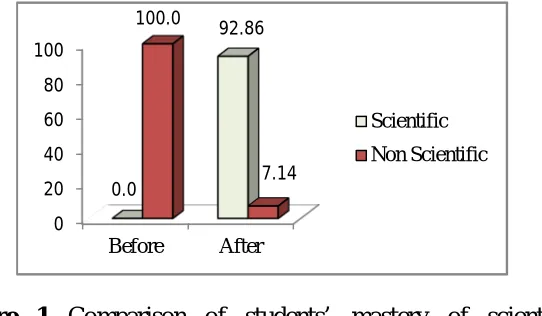
argumentation especially in guided group setting promotes conceptual change (Aydeniz et al., 2012; Nussbaum and Sinatra, 2003; Nussbaum, 2011).
Figure 1 Comparison of students’ mastery of scientific argumentation before and after guided group argumentation
Construction of Scientific Arguments at Macroscopic, Sub microscopic and Symbolic Level
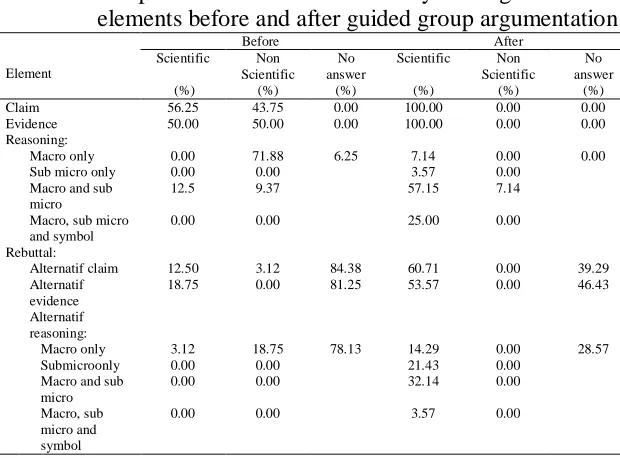
Table 1 shows that all students involved in guided group argumentation could construct claim and evidence with correct scientific concepts. The element of reasoning constructed is mostly at macroscopic and sub microscopic level (57.15%). Furthermore, the arguments constructed did consist of the element rebuttal although the percentage is lower that other elements. The results suggest that guided group argumentation not only changed students’ alternative frameworks to appropriate concepts, it also improved the quality of the arguments that are constructed (Aydeniz et al, 2012; Nussbaum, 2011). These findings corroborate with Cross et al. (2008) that involved in scientific argumentation help students to reflect on their existing ideas and eventually eliminate the alternative frameworks that exist. Content analysis also shows that the scientific arguments
0 20 40 60 80 100
Before After 0.0
92.86 100.0
7.14
Scientific
constructed were accurate in terms of the scientific concepts and complex in terms of the argumentation structure. Moreover, there are also arguments which showed the link between the three levels of representation. This suggests that students possessed deep and holistic scientific knowledge in the concepts being studied (Beall et al., 1994; Bucat and Mocerino, 2009).
Table 1 Comparison of students’ mastery of argumentation elements before and after guided group argumentation
Element
Before After
Scientific (%) Non Scientific (%) No answer (%) Scientific (%) Non Scientific (%) No answer (%) Claim 56.25 43.75 0.00 100.00 0.00 0.00 Evidence 50.00 50.00 0.00 100.00 0.00 0.00 Reasoning:
Macro only 0.00 71.88 6.25 7.14 0.00 0.00 Sub micro only 0.00 0.00 3.57 0.00
Macro and sub micro
12.5 9.37 57.15 7.14
Macro, sub micro and symbol
0.00 0.00 25.00 0.00
Rebuttal:
Alternatif claim 12.50 3.12 84.38 60.71 0.00 39.29 Alternatif
evidence
18.75 0.00 81.25 53.57 0.00 46.43
Alternatif reasoning:
Macro only 3.12 18.75 78.13 14.29 0.00 28.57 Submicroonly 0.00 0.00 21.43 0.00
Macro and sub micro
0.00 0.00 32.14 0.00
Macro, sub micro and symbol
0.00 0.00 3.57 0.00
is driven by the efforts of students to construct evidence, reasoning and rebuttal at the macroscopic, sub microscopic and symbolic levels. Hence, it requires in-depth explanation of the thinking process that occurs in students’ scientific argumentation scheme.
Conceptual Change in Scientific Argumentation Scheme
Figure 2 shows the conceptual change in scientific argumentation scheme of students involved in guided group argumentation.
Figure 2 Conceptual change in scientific argumentation scheme
Based on Figure 2, students involved in comparing and evaluating the two alternative concepts at the macroscopic, sub microscopic and symbolic levels which led to cognitive conflicts. Through the process of deep thinking, students aware of their alternative frameworks and replaced it with appropriate scientific concepts. This conceptual change enables students to understand the scientific concepts completely and subsequently enhance their mastery of related concepts. These findings are in line with several studies which reported that argumentation in
1.Construct claims with supporting evidence / explanation (Constructing initial claim)
6.Present condition and criteria for the claim to be valid (Presenting additional information) 2.Support claim
with reasoning at macro, sub micro and symbolic levels (Deep thinking)
4.Evaluate alternative claim at three levels of representation (Deep thinking) 3.Consider alternative claim with explanations (Challenges alternative claim)
7.Restructuring claim with reasoning at three levels of representation
(Changing alternative framework to scientific concept)
group setting can be used as a tool for conceptual change (Asterhan et al., 2009; Aydeniz et al., 2012; Nussbaum, 2011; von Aufschnaiters et al., 2008) and to eliminate alternative frameworks (Cross et al., 2008).
CONCLUSION
This study showed that conceptual changes occur when students
construct scientific arguments that link between the
macroscopic, sub microscopic, and symbolic levels of representations. While constructing arguments in a group setting, students tended to elaborate their pre-existing ideas in a social context, thus providing opportunities to their peers to evaluate the rationality and accuracy of the ideas, as well as to provide feedback (Aydeniz et al., 2012). The study also showed that the process of deep thinking about the two alternative concepts at the three levels of representation helped with conceptual changes. It was observed that students tend to restructure and accommodate these conceptions to discover and accept the alternative conception, if it is intelligible, plausible and fruitful (Posner et al., 1982). Hence, the teaching and learning of science need to focus on group argumentation and incorporate the linkage between the macroscopic, sub microscopic, and symbolic representations (Tsai, 1999; Wu, 2003) to promote meaningful learning and to ensure students’ understanding of scientific concepts (Jaber and BouJaoude, 2012).
REFERENCES
Amigues, R. 1988. Peer interaction in solving physics problems: Sociocognitive confrontation and metacognitive aspects.
Journal of Experimental Child Psychology, 45(1): 141-158.
explanation in conceptual change: Indications from
protocol analyses of peer-to-peer dialog. Cognitive
Science, 33: 374-400.
Aydeniz, M., Pabuccu, A., Cetin, P. S. and Kaya, E. 2012. Argumentation and students’ conceptual understanding
of properties and behaviors of gases. International
Journal of Science and Mathematics Education, 19: 1303-1324.
Beall, H., Trimbur, J., and Weininger, S. J. 1994. Mastery
insight and the teaching of chemistry. Journal of Science
Education and Technology, 3(2): 99-105.
Bucat, B., and Mocerino, M. 2009. Learning at the sub-micro level: Structural representations. In J. K. Gilbert and D.
Treagust (Eds.), Multiple representations in chemical
education (pp.11-29). Dordrecht, the Netherlands: Springer.
Cross, D., Taasoobshirazi, D., Hendricks, S. and Hickey, D. T.
2008. Argumentation: A strategy for improving
achievement and revealing scientific identities.
International Journal of Science Education, 30(6): 837–
861.
Dindar A. C. and Geban, O. 2011. Development of a three-tier test to assess high school students’ understanding of acids
and bases. Procedia Social and Behavioral Sciences,15:
600-604.
Erduran, S. 2007. Methodological foundations in the study of argumentation in science classrooms. In S. Erduran and
M. P. Jiménez-Aleixandre (Eds.), Argumentation in
science education: Perspectives from classroom-based research (pp. 47-70). Dordrecht, the Netherlands: Springer.
Jaber, L. Z., and BouJaoude, S. 2012. A macro-micro-symbolic teaching to promote relational understanding of chemical
reactions. International Journal of Science Education,
34(7), 973-998.
are seldom what they seem. Journal of Computer Assisted Learning, 7(2): 75-83.
Kendeou, P. and Broeck, P.V. 2007. The effects of prior knowledge and text structure on comprehension
processes during reading of scientific texts. Memory and
Cognition, 35(7): 1567.
Mason, L. 1996. An analysis of children’s construction of new knowledge through their use of reasoning and arguing in
classroom discussions. Qualitative Studies in Education,
9(4): 411-433.
McNeill, K. L., Lizotte, D. J., Krajcik, J. and Marx, R. W. 2006.
Supporting students’ construction of scientific
explanations by fading scaffolds in instructional materials. The Journal of the Learning Sciences, 15(2): 153–191.
Nussbaum, E. M and Sinatra, G. M. 2003. Argument and
conceptual engagement. Contemporary Educational
Psychology, 28(3): 384-395.
Nussbaum, E. M. 2011. Argumentation, dialogue theory, and probability modeling: Alternative frameworks for
argumentation research in education. Educational
Psychologist, 46(2): 84-106.
Osborne, J., Erduran, S. and Simon, S. 2004. Enhancing the
quality of argumentation in school science. Journal of
Research in Science Teaching, 41(10): 994-1020.
Posner, G. J., Strike, K. A., Hewson, P. W. and Gertzog, W. A. 1982. Accommodation of a scientific conception: Toward
a theory of conceptual change. Science Education, 66:
221-227.
Sadler, T. D. 2004. Informal reasoning regarding socio scientific
issues: A critical review of research. Journal of Research
in Science Teaching, 41(5): 513-536.
Schwarz, B. B., Neuman, Y., and Biezuner, S. 2000. Two wrongs may make a right…if they argue together!
Cognition & Instruction, 18: 461-494.
misconceptions about microscopic views of phase
change: A study of an analogy activity. Journal of
Science Education and Technology, 8 (1): 83-91.
von Aufschnaiter, C, Erduran, S., Osborne, J and Simon, S. 2008. Arguing to learn and learning to argue: Case studies of how students’ argumentation relates to their
scientific knowledge. Journal of Research in Science
Teaching, 45(1): 101-131.
Webb, N. M. 1985. Verbal interaction and learning in
peer-directed groups. Theory into Practice, 24 (1): 32-39.
Wu, H. K. 2003. Linking the microscopic view of chemistry to real-life experiences: Inter textuality in a high-school
science classroom. Science Education, 87: 868-891.
Zohar, A. and Nemet, F. 2002. Fostering students' knowledge and argumentation skills through dilemmas in human
genetics. Journal of Research in Science Teaching, 39(1):