Students’ Difficulties In Multivariable Calculus Through
Mathematical Thinking Approach
Hamidreza Kashefi ¹, Zaleha Ismail ² & Yudariah Mohammad Yusof ² 1
Fakulti Pendidikan, Universiti Teknologi Malaysia 81310 Johor, Malaysia
ABSTRACT: The purpose of this study is to identify students’ difficulties in Multivariable Calculus through mathematical thinking approach at Universiti Teknologi Malaysia (UTM). The data collection for this study was collected from a Multivariable Calculus class in Faculty of Electrical Engineering during semester I 2009-2010. Data collection was carried out through written assessments and structured questionnaires. The data analysis reveals that students’ common difficulties are: students’ met-before (previous experience), selecting appropriate representation of the three worlds of mathematical thinking, the transition from one world to another world of mathematical thinking, lack of understanding two different symbolic for a concept, and poor prior knowledge or lack of it. The findings show that the sketching in 3-dimensions is the greatest difficulty for majority of students in this method.
Keywords: Mathematical Thinking; Basic Calculus; Multivariable Calculus; Students’ difficulties.
1.0 INTRODUCTION
The applications of calculus in many fields show calculus still playing its central role from the discovery it over three centuries ago until the recent decade (Tall, 1997). Nowadays, calculus is one of the most important courses for undergraduate students in many fields that is offered as pre-requisite course to other advanced mathematics courses (Kashefi et al., 2010a). However, for most undergraduate students calculus has always been one of the most difficult courses to study in their field of study (Kashefi et al., 2010b). Some difficulties that students encounter in the calculus are (Tall & Schwarzenberger, 1978, Tall, 1993; Roselainy, 2009):
the particular events in past experiences of students,
poring ability in algebraic manipulation – or lack of it,
having difficulties in specific concepts,
selecting and using appropriate representations,
translating real-world problems into calculus formulations,
absorbing complex new ideas in a limited time,
students’ beliefs and learning styles. poring ability in basic skills and algebraic manipulation – or lack of it,
recalling of knowledge fact,
the quite entrenching of students in their learning behavior and styles,
coordinating multiple procedures,
answering non-routine questions.
Some researchers at Universiti Teknologi Malaysia (UTM) try to support students to overcome their difficulties in the learning of Multivariable Calculus by promoting mathematical thinking in face-to-face classroom. Mathematical thinking is the main goal of mathematics education (Kardage, 2008) and can play an important role as a way of learning and teaching mathematics (Stacey, 2006). According to Tall (2004), there are three significantly different worlds of mathematical thinking as: conceptual-embodied, proceptual-symbolic, and axiomatic-formal. In this study, we explain how researchers try to help students to overcome their difficulties in calculus by promoting mathematical thinking. Then, we identify how much these methods are capable to support students’ ability to overcome their difficulties and which difficulties still exist.
2.0 MULTIVARIABLE CALCULUS THROUGH MATHEMATICAL THINKING APPROACH
Mathematical thinking is a dynamic process which expands our understanding with highly complex activities, such as abstracting, specializing, conjecturing, generalizing, reasoning, convincing, deducting, and inducting (Mason, Burton & Stacey, 1982; Tall, 1991; Yudariah & Roselainy, 2004). There is quite an extensive study on mathematical thinking such as works by Mason, Burton & Stacey (1982), Dubinsky (1991), Schoenfeld (1992), Yudariah & Tall (1999), Gray & Tall (2001), Tall (2004). In the earlier study (Yudariah & Roselainy, 2004; Roselainy, Yudariah & Mason, 2007; Roselainy, Sabariah & Yudariah, 2007; and Sabariah, Yudariah & Roselainy, 2008), in developing the mathematical pedagogy for classroom practice, they adopted the theoretical foundation of Tall (1995) and Gray et al. (1999) and used framework from Mason, Burton & Stacey (1982) and Watson & Mason (1998).
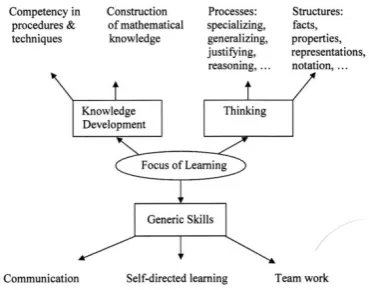
Figure 1: Focus of Mathematical Learning
Roselainy, Sabariah & Yudariah (2007) had developed and implemented their model of active learning in the teaching of Multivariable Calculus at UTM. They considered the following aspects in the implementation of active learning in Multivariable Calculus classroom (Roselainy, Sabariah & Yudariah, 2007; and Sabariah, Yudariah & Roselainy, 2008).
classroom tasks- by categorizing book as Illustrations, Structured Examples and Reflection with Prompts and Questions.
classroom activities- by working in pairs, small group, quick feedback, students’ own examples, assignments, discuss and share, reading and writing.
encouraging communication- by designing prompts and questions to initiate mathematical communication.
supporting self-directed learning- by creating structured questions to strengthen the students’ understanding of mathematical concepts and techniques.
identifying types of assessment- by incorporating both summative and formative types.
In other words, they had provided and promoted a learning environment where the mathematical powers are used specifically and explicitly, towards supporting students (i) to become more aware of the mathematics structures being learned, (ii) to recognize and use their mathematical thinking powers, and (iii) to modify their mathematical learning behavior (Yudariah & Roselainy, 2004; Roselainy, Sabariah & Yudariah, 2007; and Sabariah, Yudariah & Roselainy, 2008). Figure 2 below gives a summary of their model for active learning (Roselainy, Sabariah & Yudariah, 2007; and Sabariah, Yudariah & Roselainy, 2008).
3.0 METHOD
This study is part of a project concerned with the students’ obstacles in face-to-face Multivariable Calculus classroom through Roselainy and her colleagues’ method at UTM in the semester I 2009-2010. The Multivariable Calculus is offered at UTM as three credits for first-year undergraduate students. The pre-requisite for this course is Basic Calculus and it focuses on engineering mathematics consisting of the following topics: functions of several variables, partial derivatives, multiple integrals, vector functions, and vector calculus.
The sample of this study consists upon 53 first year undergraduate students in Faculty of Electrical Engineering. The Engineering mathematics for Independent Learners by Yudariah, Sabariah & Roselainy (2009) was the name of the book that was introduced as textbook and covered all topics of this course. In this book, the authors based on their method try to increase the students’ understanding and abilities by organizing the contents in the specified manner. Focus of Attention, Prompts and Questions, Reflections, and Review Exercise are some important contents of this book that are designed based on their method. Additionally, the mathematics in this book is presented so as to expose its mathematical structures, thinking process (activities) and themes (Yudariah, Sabariah & Roselainy, 2009).
Data for the study has been collected through structured questionnaires and written assessments such as quiz, tests and final exam. For the purpose of this study, all problems of written assessment were covered all five chapters. The most important goal of quiz was to identify students’ difficulties in finding the domain and range of the functions of two variables that were taught in Week 1. The students had to find the domain and range function:
( ) √ and sketch the graph of domain.
The Test I was conducted at the end of week 3 and covered some concepts of Chapter 1. The test was used to understand how much this method influences the students’ understanding to solve non-routine or some problems that are slightly beyond students’ experiences. To achieve these goals the following examples of the textbook have been chosen that were discussed in the classroom by students.
Sketch the graph of the following functions (a). f (x, y) = 9 – x2 – y2.
(b). (Yudariah et al. 2009, P 43).
We changed the variables x and y to y and z for the function of part (a) and we changed the constant numbers in part (b) too. By adding two more questions and the problem was changed as the following:
For the following functions, 1. Find and sketch the domain 2. Determine the range
3. Sketch the graph of the functions (a). f (y, z) = 9 – y2 – z2.
(b). Find and sketch the domain of .
reasons of their responses especially their difficulties in the solving of the problems were asked.
4.0 FINDINGS
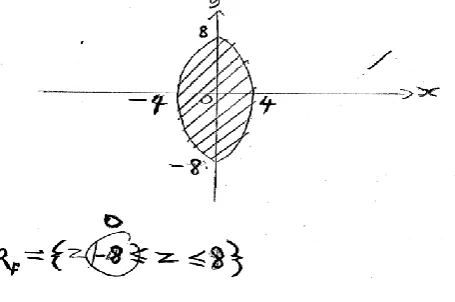
Students’ responses to written assessments showed differences in their difficulties based on mathematical thinking approach. In solving quiz problem, some students had difficulties in finding of the range of f. One student found the range of the function as the following, although the domain of f was sketched correctly.
Figure 3: A student’s attempt at finding the range
This difficulty can be related to students’ met-before for finding the range based on the graph of function; however, this student used the graph of the domain incorrectly. The answer of this student to a question of the structured questionnaire confirmed the reason of this difficulty. See the following figure.
Figure 4: A students’s answor to a question from questionaire about finding the range
Figure 5: A student’s attempt at finding the domain of f Part (a)
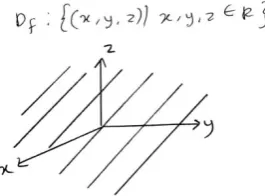
In solving part (b), most students showed difficulty in finding the domain of the function. The majority of the students found it as: Df = {(x, y, z) x, y, z R} that is shown in
the following student’s response.
Figure 6: A student’s attempt at finding the domain of f Part (b)
This difficulty can be related to lack of understanding on two different symbolic presentation of two-variable function as z = f (x, y) and f(x, y, z) = 0; therefore, they thought f(x, y, z) = 0 is a three-variable function. Some students by selecting an appropriate world (the symbolic world) to sketch the traces in the coordinate planes could sketch the graph correctly (transition from the symbolic world to the embodiment world). See a student’s response below.
Figure 7: A student’s attempt at sketching the graph of Part (b)
sphere by the cylinder . In Figure 8, you can see a students’ attemp to sketch the graph for solving this problem.
Figure 8: A student’s attempt at sketching the graph
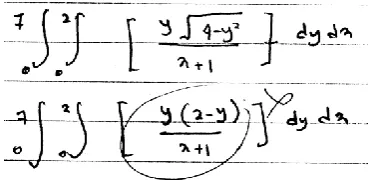
Poor prior knowledge or even lack of it was another students’ difficulty that student showed in all assessments. Students’ responds to assessments showed they had not enough prior knowledge and background for solving the problems. For instance, in the following students’ responds a student found the multiply of to x as or in the second students’ respond you can see how a student simplify √ as .
Figure 9: A student’s mistake in algebraic manipulation
Figure 10: A student’s mistake in simplifying
5.0 CONCLUSION
when encounter with non-routine problems. Analysis of the results of this study show that some students’ obstacles in learning of functions of two variables based on mathematical thinking approach are:
students’ met-before,
selecting appropriate representation of the three worlds of mathematical thinking,
the transition of one world to other world of mathematical thinking,
the lack of understanding two different symbolic,
the poor prior knowledge – or lack of it.
It was found that the most important students’ difficulty is sketching in 3-dimansions. The findings of the study confirmed the results of the study that sketching in 3-dimenssion is the most important students’ difficulties from students and lecturers point of view (Kashefi, Zaleha & Yudariah, 2010a). It seems Roselainy and her colleagues’ method still cannot enough support students’ sketching in Multivariable Calculus (Kashefi et al., 2010b).
In some, findings of this study confirmed the results of other researches about students’ difficulties in Basic Calculus and Multivariable Calculus. The results obtained from this study are expected will be useful in designing activities and tools to teach Multivariable Calculus, and their use will support students to overcome their obstacles in this course.
REFERENCES
Dubinsky, E. (1991). Reflective Abstraction in Advanced Mathematical Thinking. In D. O.Tall (ed.) Advanced Mathematical Thinking, Kluwer: Dordrecht, 95–123.
Gray, E. M., & Tall, D. O. (2001). Duality, Ambiguity and Flexibility in Successful Mathematical Thinking, Proceedings of PME 15, Assisi, 2, p72-79.
Gray, E., Pinto, M., Pitta, D., & Tall, D. O. (1999). Knowledge Construction and Diverging Thinking in Elementary and Advanced Mathematics. Educational Studies in Mathematics, 38 (1-3), 111-113.
Karadag, Z. (2008). Improving online mathematical thinking. 11th International Congress on Mathematical Education. Monterrey, Nuevo Leon, Mexico.
Kashefi, H., Zaleha Ismail., & Yudariah Mohd. Yusof.(2009). “ Promoting Mathematical Thinking in Engineering Mathematics through Blended E-learning”, Proceedings of the Education Postgraduate Research Seminar, November 18-19, Johor Bahru, Malaysia.
Kashefi, H., Zaleha Ismail., & Yudariah Mohd. Yusof. (2010a). Engineering Mathematics Obstacles and Improvement: A Comparative study of Students and Lecturers
Approaches through Creative Problem Solving. In CD Proceedings of the 3rd Regional Conference on Engineering Education & Research in Higher Education, Kuching, 7-9 Jun.
Proceedings of the 3rd Regional Conference on Engineering Education & Research in Higher Education, Kuching, 7-9 Jun.
Mason, J., Burton, L., & Stacey, K. (1982). Thinking Mathematically. Addison-Wesley Publishing Company, Inc, Wokingham, England.
Roselainy Abd. Rahman. (2009). Changing My Own and My Students Attitudes Towards Calculus Through Working on Mathematical Thinking, Unpublished PhD Thesis, Open University,UK.
Roselainy Abd. Rahman., Sabariah Baharun., & Yudariah Mohd. Yusof. (2007). Enhancing Thinking through Active Learning in Engineering Mathematics. In CD Proceedings of Fourth Regional Conf. on Engineering Educ., Johor Bahru, 3–5 Dec.
Roselainy Abd. Rahman., Yudariah Mohd. Yusof., & Mason, J. H. (2007).Translating Learning Theories into Practise in Enhancing Students” Mathematical Learning at University.Proceding of the Third International Conference on Research and Education on Mathematics.
Sabariah Baharun., Yudariah Mohd. Yusof., & Roselainy Abd. Rahman. (2008). Facilitating Thinking and Communication in Mathematics. Paper presented at ICME11th, Mexico, 6 – 13 July.
Schoenfeld, A. H. (1992). Learning to think mathematically: problem solving, metacognition, and sense-makingin mathematics. In D. Grouws, (ed.). Handbook for Research on Mathematics Teaching and Learning. New York: MacMillan. pp. 334-370.
Schwarzenberger, R. L. E. (1980). ‘Why calculus cannot be made easy’. Mathematical Gazette, 64, 158–166.
Stacey, K. (2006). What is mathematical thinking and why is it important? Progress report of the APEC project: Collaborative Studies on Innovations for Teaching and Learning Mathematics in Different Cultures (II) – Lesson Study focusing on Mathematical Thinking. CRICED, University of Tsukuba.
Tall, D. O. (1991). Advanced Mathematical Thinking, Kluwer, Dordrecht.
Tall, D. O. (1992). Current difficulties in the teaching of mathematical analysis at university: an essay review of Victor Bryant Yet another introduction to analysis, Zentralblatt für Didaktik der Mathematik, 92/2, 37-42.
Tall, D. O. (1993). Students’ difficulties in Calculus, Plenary Address, Proceedings of Working Group 3 on Students’ obstacles in Calculus, ICME-7, Québec, Canada, 13-28.
Tall, D. O. (1995). Mathematical Growth in Elementary and Advanced Mathematical Thinking, plenary address. In L. Meira & D. Carraher, (Eds.), Proceedings of PME 19, Recife, Brazil, I, 61-75.
Tall, D. O. (2004). Thinking Through Three Worlds of Mathematics. Proceedings of the 28th Conference of the International Group for the Psychology of Mathematics Education, Bergen, Norway, 4, 281–288.
Tall, D. O., & Schwarzenberger, R. L. E. (1978). Conflicts in the learning of real numbers and limits, Mathematics Teaching, 82, 44-49.
Watson, A., & Mason, J. (1998). Questions and Prompts for Mathematical Thinking. AMT, Derby.
Yudariah Mohd. Yusof., & Tall, D. O. (1999). Changing Attitudes to University Mathematics through Problem-solving, Educational Studies in Mathematics, 37, 67-82.
Yudariah Mohd. Yusof., & Roselainy Abd. Rahman. (2004). Teaching Engineering Students to Think Mathematically. Paper presented at the Conference on Engineering Education, Kuala Lumpur, 14-15 December.