AT&T
D E F I N I T Y
® Communications SystemGeneric 1 and Generic 3
and System 75
NOTICE
While reasonable efforts were made to ensure that the information in this document was complete and accurate at the time of printing, AT&T can assume no
responsibility for any errors. Changes or corrections to the information contained in this document may be incorporated into future issues.
TO ORDER COPIES OF THIS DOCUMENT
Contact: AT&T Customer Information Center 2855 North Franklin Road
P.O. Box 19901
Indianapolis, Indiana 46219 1-800-432-6600,
In Canada: 1 800-255-1242
Contents
Your 7401 Plus Voice Terminal 1
What the Features Do 3
How to Use the Feature Directory 5
How to Use the Features 6
Key Words
Handset Tones
6 6
Special Instructions 6
Troubleshooting 7
Quick Reference Lists 7
Abbreviated Dialing (AD) 8
Answering or Placing a Second Call 9
Automatic Callback 10
Call Forwarding All Calls 11
Call Park 11
Call Pickup 12
Conference 13
Drop 13
Hold 13
Last Number Dialed 14
Leave Word Calling 14
Message 15
Priority Calling 15
Select Ring 16
Send All Calls 16
Transfer 17
Voice Message Retrieval 17
Tones and Their Meanings 1 9
Ringing Tones 1 9
Handset Tones 1 9
Troubleshooting 2 0
System 75 Version Notes 2 1
Key Words to Know 2 2
Your 7401 Plus Voice Terminal
The 7401 Plus voice terminal has an innovative design to make it easy to use the many features of the AT&T DEFINITY®
Communications System or System 75. Familiarize yourself with your voice terminal, shown in Figure 1 and explained below.
Figure 1. 7401 Plus Voice Terminal
Starting at the top of Figure 1 and continuing clockwise:
Handset
Feature Directory
Speakerphone/headset jack (on back of voice terminal)
Line jack
(on back of voice terminal) Dial pad
For placing and receiving calls (also known as the receiver). In most cases, you must lift the handset (go off-hook)
before you can use a feature.
A quick reference list of 12 voice features available on your voice terminal, including each feature name and its corresponding 2-button dial code.
This jack is used for connecting an external speakerphone (such as an S101A or S201A
Speakerphone) or a headset adapter (such as a 500A Headset Adapter) to your voice terminal. The jack is labeled
This jack is used for connecting a line cord to your voice terminal. The jack is labeled "LINE."
Feature/call activity light
Handset jack (on back of voice terminal)
Message light
Ringer volume control (on back of voice terminal)
A green light which goes on steadily when you press [ Feature ]. Also, it flutters when you have an incoming call or when you put a call on hold, and flutters intermittently when you use the Select Ring feature.
This jack is for connecting a handset to your voice terminal. The jack is labeled
A red light which lights steadily when a message has been left for you.
What the Features Do
Below is a listing of many commonly used features and a description of how to use them.
Note: You will have the Conference, Drop, Hold, Message, Select Ring, and Transfer features. In addition, you may have many of the other features listed here; your System Manager can advise you.
Abbreviated Dialing (AD) Allows you to store selected telephone numbers for quick and easy dialing. Each number can be a complete or partial telephone number, an extension number, or a feature or trunk code. Abbreviated Dialing offers 4 possible types of lists– personal, group, system, and enhanced, and you can have a total of 3 out of the 4 lists. Numbers on a personal list are programmable by you; numbers on all other lists are programmable only by the System Manager. Use as a timesaver for dialing frequently called, lengthy, or emergency numbers.
Answering or Placing a Second Call Allows you to answer or place a second call when you are already on a call. Use to avoid missing important calls or to make another call to get information you need for your current call. Note: Incoming second calls may be limited to priority calls depending on how your system is administered; see your System Manager.
Automatic Callback Sends you a special 3-burst ring indicating that a previously busy or unanswered extension you dialed is now available. Use to avoid constant redialing when you wish to speak to someone who is frequently busy on the telephone or in and out of the office. Note: Can be used only for extensions, not outside numbers.
Call Forwarding All Calls Temporarily forwards all your calls to another extension or to an outside number, depending on your system. Use when you will be away from your voice terminal and you want your calls to be forwarded to a telephone number of your choice.
Call Park Puts a call on hold at your voice terminal, for retrieval at any extension. Use when you need to go elsewhere to get information during a call, or whenever you wish to complete a call from a different location. Also, if the call received is for someone else, use it to hold the call until the called party can answer it from the nearest available voice terminal.
Conference Allows you to conference up to 6 parties on a call (including yourself) so that you can conduct a 6-way discussion. Use to set up time-saving conferences, or to spontaneously include an additional party important to a conversation. Note: If you have both an active call and a call on hold, you must terminate one of the calls before you can use Conference.
Drop Drops the last party from a conference call. Use when you want to remain connected to the other parties.
Hold Puts a call on hold until you can return to it. While a call is on hold, you can answer an incoming call or leave your voice terminal to perform another task. Use when you have a call that you don’t wish to drop, but which you have to interrupt briefly to do something else.
Last Number Dialed Automatically redials the last extension or outside number you dialed. Use to save time in redialing a busy or unanswered number.
Leave Word Calling Leaves a message for another extension to call you back. The called party will be able to dial message service (for example, attendant, AUDIX, covering user, etc.) to retrieve a short, standard message which gives your name and extension, the date and time you called, and the number of times you called. Use whenever you wish to have someone call you back; it will help cut down on repeated call attempts.
Message Your Message light goes on when a caller has left a message for you. You can then follow your System Manager’s local message retrieval procedures to get your message.
Priority Calling Allows you to call an extension with a distinctive 3-burst ring to indicate that your call requires immediate attention. Use when you have important or timely information for someone.
Select Ring Allows you to choose your own personalized ring pattern for your voice terminal from among 8 available patterns. Use to help distinguish you incoming calls from those of other nearby voice terminals.
Send All Calls Sends all your calls to the extension of a person designated by your System Manager to answer them when you cannot (perhaps a secretary or
receptionist). Use when you will be away from your desk for awhile, or when you do not wish to be interrupted by telephone calls.
Transfer Transfers a call from your voice terminal to another extension or outside number. Use when your caller needs to speak further with someone else. Note: Calls from an outside number to your voice terminal can be transferred only to an
How to Use the Feature Directory
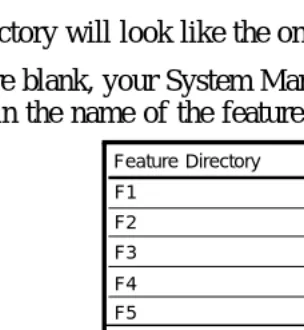
The Feature Directory, shown in Figure 2, provides a convenient quick reference list for 12 features which can be accessed by first pressing [ Feature ] and then pressing the corresponding entry number (1-9 and 0) or character (# and *) on the dial pad. For example, to put a call on hold, you would press [ Feature ], then [ # ]. And to set up a conference you would begin by pressing [ Feature ], then [ 8 ]. The green light next to [ Feature ] goes on steadily when the button is pressed to let you know that your dial pad is now in the feature selection state.
Your Feature Directory will look like the one shown in Figure 2:
If entries F1-F7 are blank, your System Manager may assign features to them, and you can write or type in the name of the features assigned.
Feature Directory
F1
F2
F3
F4
F5
F6
F7
F8 Conference (F8, dial party, F8)
F9 Transfer (F9, dial party, F9)
F0 Drop (Disconnect last party)
F# Hold (Press switchhook to return)
F* Select Ring (Press Feature to store)
Press Feature button, then dial pad button
The last 5 features on the Feature Directory are fixed:
Figure 2. Assignable Feature Directory
F8 Conference F9 Transfer F 0 D r o p F # H o l d F* Select Ring
Note: You are not limited to the 12 features shown on your directory. All other features available with your DEFINITY®
How to Use the Features
The procedures which follow give short, step-by-step instructions for using each feature. For your convenience, features are listed alphabetically.
Key Words
You will see these two terms used regularly in the procedures:
entry number A number from 1-9 and 0, corresponding to the first 10 entries on the Feature Directory. Each of these numbers is dialed in conjunction with [ Feature ] to access an assigned feature.
flash the switchhook To press and then release the button under the handset (receiver). This button is the switchhook.
Note: If you are using optional adjunct equipment, such as a speakerphone, connected to your voice terminal, you can also "flash the switchhook" by turning the adjunct
equipment off and then back on.
For a list of other glossary terms, see the chapter titled Key Words to Know.
Handset Tones
The tone that appears in brackets after a step, such as [dial tone], indicates what you should hear from your handset after successfully performing that step.
For a list of tones and their meanings, see the section titled Tones and Their Meanings. For a list of glossary terms, see the section titled Key Words to Know.
Special Instructions
The first time you use these procedures, you will need to customize them for yourself by obtaining the following information from you System Manager:
● To the right of each feature name is a box. For each feature that you have on
● To operate a feature, you must have the handset off-hook (removed from the
cradle of the voice terminal) unless otherwise noted. Any feature not listed on your Feature Directory can be activated or canceled by dialing a 1-, 2-, or 3-digit feature code. In the blanks provided within the procedures, write in the assigned code numbers.
As you operate the features assigned to your voice terminal, keep in mind the following general rules.
● Follow carefully all the steps listed in the procedure for the particular feature you
are using.
● If you receive an intercept tone (high-pitched, alternating high and low tone)
while attempting to operate any feature, you have taken too much time to complete a procedural step or have made a dialing error. Hang up, get dial tone, and begin again at Step 1.
● Step 1 in most procedures gives you two options. Follow the first option if the
named feature is listed on your directory; follow the second option (in gray type) if it is not.
● System 75 is available in more than one version. Some features, such as
Abbreviated Dialing, Call Forwarding All Calls, Last Number Dialed, and
Priority Calling operate slightly differently with Version 1, and possibly Version 2, than they do with later versions. If you are using Version 1 or 2 of the System 75 software, you should check the section titled Troubleshooting later in this guide before you use you use any of these 4 features.
Troubleshooting
Later in this guide you will find a short section on troubleshooting. Use the procedures listed here for problems that you may have in using your voice terminal.
Quick Reference Lists
Abbreviated Dialing (AD)
To program/reprogram an AD entry on your Feature Directory
Note: AD entry must first be assigned to your directory by your System Manager. 1 2 3 4 5 6 7
On a separate sheet of paper, jot down the outside numbers, extensions, and/or feature codes you want to store as AD entries
Note: Each AD entry will hold one complete phone number or feature code.
Pick up handset [dial tone]
Dial Program code
[dial tone] Press [ Feature ], then the entry number for the AD entry you wish to program [dial tone]
● For example, to store a number in AD entry F3,
press [ Feature ], then [ 3 ]
Dial outside number, extension, or feature code you want to store (up to 24 digits)
Note: If you are storing an outside number, be sure to include a trunk code, if applicable.
Press [ # ] [confirmation tone] then [dial tone] Hang up
● Be sure to write the name of the AD party
(or feature) on your Feature Directory
To place an AD call from 1 Press [ Feature ], then the entry number for the AD your Feature Directory entry you wish to call [ringback tone]
● For example, to call the number stored as AD
entry F3, press [ Feature ], then [ 3 ]
To program or reprogram a personal list item
1 2 3 4 5 6
On a separate sheet of paper, jot down the outside numbers, extensions, and/or feature codes you want to store as items on your personal list(s) (see example to the left)
Note: Each phone number or feature code is stored as a separate item.
Pick up handset [dial tone]
Dial Program code
Dial Personal List number (1, 2, or 3)
Dial list item (1, 2, 3...)
[dial tone]
Dial outside number, extension, or feature code you want to store (up to 24 digits)
7
8
Press [ # ] [confirmation tone] then [dial tone] Note: Repeat Steps 5-7 if you want to program additional items on the same list. Hang up and begin again at Step 1 if you want to program items on another personal list.
Hang up
● Record the personal list item on the Abbreviated
Dialing list in the back of this booklet.
To place a call from a list 1 (personal, system, group, or enhanced)
2
Dial appropriate List code:
● List 1
● List 2 [dial tone]
● List 3
or Press [ Feature ], then the appropriate entry number (if you have a list code programmed as a Feature Directory entry)
Dial desired list item (1, 2, 3...) [ringback tone] Note: Keep your own personal lists in the back of this booklet; system, group, and enhanced lists are available from your System Manager.
Answering or Placing a Second Call
✔
To end first call and 1 Ask first caller to hang up, then flash the switchhook answer second call ● Second call is connected
Note: Depending on how your system is
administered, the incoming call may be limited to priority calls. Check with your System Manager.
To put first call on hold 1 Press [ Feature ], then [ # ] and answer second call
● First call is put on hold
2 Flash the switchhook
To return to first call 1 Complete second call or put it on hold 2 Flash the switchhook
● First call is reconnected
Note: By repeatedly using hold, you can toggle back and forth between calls.
To put first call on hold 1 Press [ Feature ], then [ 9 ] [dial tone] and place a second call ● First call is put on hold
Note: Pressing [ Feature ], and [ 9 ] instead of [ # ] gives you the dial tone needed to place the second call. 2 Dial second call
To put second call on 1 Press [ Feature ], then [ # ] hold and return to first ● Second call is put on hold
call
2 Flash the switchhook
● First call is reconnected
Automatic Callback
To automatically place 1 another call to an
extension that was busy, did not answer, or 2 returned a call waiting
ringback tone
Note: You can do this only if Automatic Callback is assigned to your Feature Directory.
3
Press [ Feature ], then the Automatic Callback entry number (during call attempt) [confirmation tone] Hang up
● You will get a 3-burst priority ring when the
extension you attempted to call becomes available Note: After you activate Automatic Callback, the system monitors the called extension. That extension becomes available after the called party completes a call.
Lift handset when you hear priority ring
● A call is automatically placed to the extension,
which receives regular ringing
To cancel Automatic Callback
1 Press [ Feature ], then the Automatic Callback entry
number again [dial tone]
Call Forwarding All Calls
To temporarily redirect all 1 Press [ Feature ], then the Call Forward entry number calls to an extension or or Dial Call Forward code
outside number of your [dial tone]
choice
2 Dial extension or number where calls will be sent [confirmation tone] Note: Some voice terminals have restrictions
on where calls can be forwarded (see your System Manager).
3 Hang up
Note: You may hear a ring-ping tone from your voice terminal as each call is forwarded.
To cancel Call 1 Press [ Feature ], then the Call Forward Forwarding entry number again
or Dial Call Forward Cancel code
[confirmation tone]
● Your calls will now ring at your own voice
terminal
Call Park
To park a call at your 1 Press [ Feature ], then [ 9 ] [dial tone] extension (for retrieval at
2 Press [ Feature ], then the Call Park entry number any extension)
or Dial Call Park code
To return to a call parked 1 Press [ Feature ], then the Call Park entry number
at your extension [confirmation tone]
or Dial Answer Back code
[dial tone] 2 Dial your own extension number
[confirmation tone]
● You are reconnected to call
To retrieve a call parked 1 at another extension
2
Dial Answer Back code
[dial tone] Dial extension where call is parked
[confirmation tone]
● You are connected to call
Note: If you receive intercept tone, parked call has been disconnected or retrieved by someone else.
Call Pickup
To answer a call placed to a member of your pickup group when your voice
1 Press [ Feature ], then the Call Pickup entry number or Dial Call Pickup code
terminal is idle ● You are connected to ringing call
To pick up a call when you are already active on another call
Note: Depending on how your system is
administered, you may not be able to do this procedure on your voice terminal. See your System Manager for more details.
1 Press [ Feature ], then [ # ]
● Present call is put on hold ● Call activity light flutters
2 Press [ Feature ], then the Call Pickup entry number or Dial Call Pickup code
● You are connected to ringing call
Conference
✔
To add another party to a 1 call (for a total of up to 6 parties)
2
3
Press [ Feature ], then [ 8 ] [dial tone]
● Present call is put on hold
Dial number of new party and wait for answer
Note: You can privately discuss the call with the new party at this time; if no answer or busy, flash the switchhook to return to held call.
Press [ Feature ], then [ 8 ] again
● All parties now connected
● Repeat Steps 1-3 for additional conference
connections
To drop a party 1 Ask party to hang up
● You remain connected to other parties
D r o p
✔
To drop last party from conference call
1 Press [ Feature ], then [ 0 ]
● You remain connected to other parties
Note: Parties other than last one added must hang up to be released from conference call.
Hold
✔
To put a call on hold while you answer another call or perform some other task
1 Press [ Feature ], then [ # ]
● Call activity light flutters; you may hang up
Last Number Dialed
To automatically redial 1 the last number you
dialed
Press [ Feature ], then the Last Dialed entry number or Dial Last Number Dialed code
Note: The redialed number can be an outside number (up to 24 digits), an extension, or a trunk or feature code.
Leave Word Calling
To leave a message after 1 Press [ Feature ], then the Leave Word Calling
dialing an extension entry number [confirmation tone] (when your call is not
Message light goes on at called voice terminal answered, you hear ●
coverage or busy tone, or you have been put on hold)
Note: You can do this only if Leave Word Calling is assigned to your Feature Directory.
To leave a message 1 Press [ Feature ], then the Leave Word Calling without ringing an entry number
extension or Dial Leave Word Calling code
[dial tone] 2 Dial extension [confirmation tone]
● Message light goes on at called voice terminal
To cancel a Leave Word 1 Calling message
Note: You cannot cancel a message left for an
AUDIX subscriber. 2
Press [ Feature ], then the Leave Word Calling Cancel entry number
or Dial Leave Word Calling Cancel
code [dial tone]
Message
✔
To retrieve a message 1 See your System Manager for instructions regarding when your Message light your local message retrieval procedures
is on
Priority Calling
To place a priority call 1 Press [ Feature ], then the Priority Calling (3-burst ring) entry number
or Dial Priority Calling code
[dial tone] 2 Dial the extension
To change a regular call 1 Press [ Feature ], then the Priority Calling into a priority call (when entry number
you hear a busy or call Wait for called party to answer waiting ringback tone) 2
Note: You can do this only if Priority Calling is
● If you still receive a busy tone or call waiting
ringback tone, wait a few minutes and try again assigned to your Feature
Select Ring
To select a personalized 1 Press [ Feature ], then [ * ] (leave handset on cradle) ring pattern ● Green light flutters intermittently
● Voice terminal plays current ring pattern
2 Adjust the ringer volume with the sliding ringer control on back of voice terminal if desired 3 Press [ * ] again to hear the next ring pattern
Note: There are 8 different patterns; cycle repeats after the last pattern.
4 Press [ Feature ] when you hear the desired ring pattern
● Your new ring is set; selection process ends
Note: If you receive a call, go off-hook, or lose power during selection, the process is interrupted and you must start again.
Send All Calls
To send all calls (except 1 Press [ Feature ], then the Send All Calls entry number
priority calls) immediately [dial tone]
to coverage
or Dial Send All Calls code
[confirmation tone] Note: When a call comes to your extension,
call activity light will flutter and you may hear a ring-ping tone indicating that the call has been sent to coverage.
To cancel Send All Calls 1 Press [ Feature ], then the Send All Calls
entry number again [dial tone] or Dial Send All Calls Cancel code
Transfer
✔
To send present call to 1 another extension or
outside number
2
3
4
Press [ Feature ], then [ 9 ] [dial tone]
● Present call placed on hold
Dial number that call is to be transferred to
[ringback tone]
● Remain on line and announce call; if number
dialed is busy or unanswered, return to held call by flashing the switchhook
Press [ Feature ], then [ 9 ] again
● Call sent to dialed extension or number
Note: Only calls from another extension can be sent to an outside number; you cannot transfer a call from an outside number to another outside number. Hang up
Voice Message Retrieval
To retrieve your voice 1 Dial the Voice Message Retrieval code
messages when your [dial tone]
Message light is on 2 Press [
# ] [dial prompting]
Note: If calling from someone else’s extension, do not press [ # ]; instead, dial your own extension number and your security code, if required.
3 Move through the messages with these dial pad buttons:
To retrieve voice 1 messages for a co-worker
2
3
4
Dial Voice Message Retrieval
Coverage code [dial tone]
Dial co-worker’s extension [voice prompting] Note: If you receive an intercept tone, see your System Manager for further instructions.
Move through the messages with dial pad buttons previously listed
Tones and Their Meanings
Ringing tones are produced by an incoming call. Handset tones are those which you hear through the handset (receiver).
Ringing Tones
● ● ● ●
1 ring — A call from another extension.
2 rings — A call from outside or from the attendant.
3 rings — A priority call from another extension, or from an Automatic Callback call you placed.
ring-ping (half ring) — A call redirected from your voice terminal to another because Send All Calls or Call Forwarding All Calls is active.
Handset Tones
busy tone — A low-pitched tone repeated 60 times a minute; indicates the number dialed is in use.
call waiting tone — One, two, or three beeps of high-pitched tone, not repeated; indicates an incoming call is waiting to be answered. Number of beeps designates the source: 1 for an internal call, 2 for an outside or attendant call, 3 for a priority call.
● ●
● ● ● ● ● ● ●
call waiting ringback tone — A ringback tone with a lower-pitched signal at the end; indicates that the extension called is busy, but the called party has been given a call waiting tone.
confirmation tone — Three short bursts of tone; indicates a feature activation or cancellation has been accepted.
coverage tone — One short burst of tone; indicates your call will be sent to another extension to be answered by a covering user.
dial tone – A continuous tone; indicates dialing can begin.
intercept/time-out tone — An alternating high and low tone; indicates a dialing error, a denial of the service requested, or a failure to dial within a preset interval (usually 10 seconds) after lifting the handset or dialing the previous digit.
recall dial tone — Three short bursts of tone followed by a steady dial tone; indicates the feature request has been accepted and dialing can begin.
Troubleshooting
Problem
A feature doesn’t work as noted in the book.
There are no Feature Codes (such as Call Forward code or Send All Calls code) written in the appropriate blanks in this guide.
Solution
1 Reread the procedure and try again.
2 For many features you must lift the handset before you can use the feature.
3 Check with your System Manager to be sure this feature is administered on your voice terminal.
4 You may have an older version of the System 75 software so that some features may have slight differences from the procedures described in this guide. Check the section below on "Version Notes" for ways in which these features work differently.
See your System Manager for a list of Feature Codes for features assigned to your voice terminal. Then, write the codes in this guide.
Problem
There’s no dial tone.
Solution
1 Check with your System Manager to be sure your voice terminal is administered correctly.
2 Make sure that the handset and line cords at your voice terminal are securely connected at both ends.
3 Find a working voice terminal of the same type as your own. Unplug this voice terminal from its modular wall jack. Plug your voice terminal into that jack and check if it gets dial tone.
Problem
The telephone doesn’t ring.
The lights do not go on next to the buttons.
Solution
1 2
3
4
1
2
Set the ringer volume to a higher level.
Place a test call from another extension to your extension.
Check the line cord to make certain that it is securely connected at both ends.
If there is still a problem, see your System Manager.
Check the line cord to make certain that it is securely connected at both ends.
If there is still a problem, see your System Manager.
System 75 Version Notes
If you have Version 1 or 2 of System 75, some features may work a little differently than noted in this guide. The following list explains the slight differences in these features.
Note: If you are uncertain what version of the System 75 software your business is using, check with your System Manager.
Feature System 75 Version Changes in Feature Operation
Abbreviated If you are using You can store up to 16 Dialing Version 1 digits rather than 24 digits.
If you are using You cannot use an Version 1 or 2 Enhanced List.
Call Forwarding If you are using You cannot forward All Calls Version 1 or 2 someone else’s calls.
Key Words to Know
activate To begin or turn on the operation of a feature.
attendant The person who handles incoming and outgoing calls at the main console.
AUDIX Audio Information Exchange, an optional voice mail and message service which provides coverage for calls to you by recording callers’ messages and reporting Leave Word Calling messages.
coverage Automatic redirection of calls from an unanswered voice terminal to another voice terminal. Redirection could be to the extension of a receptionist, secretary, co-worker, AUDIX, or message center. A person who provides coverage is a covering user.
DEFINITY Communications System Generic 1 and Generic 3 The AT&T switch to which you may be connected. (Your voice terminal may be connected to System 75 instead.) DEFINITY Generic 1, Generic 3, and System 75 are communications systems which transmit and receive voice and data signals for all communications equipment in your network.
dial pad The 12 pushbuttons you use to dial a number and access features.
enhanced list One of the 4 types of Abbreviated Dialing lists; programmable only by the System Manager (and available only with System 75 Version 3, DEFINITY Generic 1 and Generic 3). Contains telephone numbers useful to all system members, and stores each of those numbers as a 1-, 2-, or 3-digit list item.
entry One of 12 spaces on the Feature Directory. At least 5 of these entries will already have features assigned to them; the remainder will be assigned features by your System Manager.
entry number A number from 1-9 and 0, corresponding to the first 10 entries on the Feature Directory. Each number is dialed in conjunction with [ Feature ] to access an assigned feature.
extension A dialing number of 1 to 5 digits assigned to each voice terminal connected to your DEFINITY Generic 1, Generic 3, or your System 75.
feature A special function or service, such as Conference, Hold, Send All Calls, etc. Feature/call activity light The green light to the left of [ Feature ]. It goes on steadily when you use [ Feature ], flutters when you receive an incoming call or put a call on hold, and flutters intermittently when you use Select Ring.
feature code A dial code of 1, 2, or 3 digits, which you use to activate or cancel the operation of a feature not listed on your Feature Directory.
group list One of the 4 types of Abbreviated Dialing lists; programmable only by the System Manager. Contains telephone numbers useful to members of a specific group, and stores each of those numbers as a 2-digit list item.
handset The handheld part of the voice terminal which you pick up, talk into, and listen from. Also known as the receiver.
party A person who places or answers a call.
personal list One of the 4 types of Abbreviated Dialing lists; programmable by the System Manager or by you, the user. Contains telephone numbers of your choice, and stores each of them as a single-digit list item.
personal list item One of the 10 available slots on an Abbreviated Dialing
personal list. The first nine personal list items are given digits 1 to 9, with 0 for the tenth item.
pickup group A group of up to 25 voice terminal users who can answer calls for each other through the Call Pickup feature. Group members are determined by the System Manager and are usually located in the same work area or perform similar job functions.
priority call An important or urgent call which sends a special 3-burst ring. program/reprogram To use your dial pad to assign a telephone number to an AD entry on your Feature Directory or to a personal list item for Abbreviated Dialing. public network The communications system that can be accessed by all telephone customers for local or long distance calling.
retrieve To collect telephone messages with the Message or Voice Message Retrieval features. (Also, with Call Park, to resume a call from an extension other than the one where the call was first placed or received.)
ringer The device that produces the electronic ringing sound in your voice terminal. stored number A telephone number which has been programmed and stored as a
1-, 2-, or 3-digit list item for use with Abbreviated Dialing. It can be a complete or partial telephone number, an extension number, or a feature or trunk code. Once programmed, a number can be accessed by first dialing the list, then the list item digit(s) under which it is stored. (Alternatively, if Abbreviated Dialing is on your Feature Directory, a number can be accessed by simply pressing [ Feature ], then dialing the appropriate entry number.)
switch The device that makes connections for all voice and data calls for a network, and which contains software for features. Also known as a system, switching system, or PBX (private branch exchange). Your switch is either an AT&T DEFINITY Communications System Generic 1, Generic 3 or System 75. System 75 The AT&T switch to which you may be connected. (Your voice
switchhook The button under the handset in the cradle of the voice terminal. system list One of the 4 types of Abbreviated Dialing lists; programmable only by the System Manager. Contains telephone numbers helpful to all system users, and stores each of those numbers as a 2-digit list item.
System Manager The person responsible for specifying and managing the operation of features for all the voice and data equipment in your network.
trunk A telecommunications channel between your switch and the public network. Trunks of the same kind connecting to the same end points are assigned to the same trunk group.
trunk code A dial code of 1, 2, or 3 digits which you dial to access a trunk group to place an outside call.
Quick Reference Lists
Feature Codes
Feature Code
ABBREVIATED DIALING
List 1
List 2
List 3
Program
Feature Code
CALL PICKUP
LAST NUMBER DIALED
LEAVE WORD CALLING
cancel