Abstract
RUDOLPH, ADAM J. An Algorithm for Determining the Optimal Resource Allocation in Stochastic Activity Networks. (Under the direction of Professor Salah E. Elmaghraby).
The problem we investigate deals with the optimal assignment of resources to the
activities of a stochastic project network. We seek to minimize the expected cost of the
project, which we take as the sum of resource utilization costs and lateness costs, if the
project is completed after a specified due date. These costs are both functions of the resource
allocations to the activities with opposite responses to changes in allocation. We assume that
the work content required by the activities follows an exponential distribution. An
immediate result of this assumption is that the duration of the activities also follows an
exponential distribution based on the degree of resource allocation. We construct a
continuous time Markov chain (CTMC) model for the activity network and use the Phase
Type (PHtype) distribution to evaluate the project completion time.
Absence of an analytically tractable means of evaluating the sensitivity of the project
cost to variation in the resource allocation to an individual activity led us to develop a
derivative descent algorithm for the optimization of the expected cost of the project. We
approximate the value of the derivative at a particular allocation by evaluating the differential
cost of a slightly modified allocation. These quasiderivatives led to the selection of an
activity to which we optimize resource allocation. We use Fibonacci search over the interval
of permissible allocations to the activity to seek the minimum expected cost. This iterative
process of activity selection followed by changing the resource allocation is repeated until
the expected cost is not significantly decreased. Finally, through extensive experimentation
with a variety of projects of different structure and size, we show that this algorithm yields
An Algorithm for Determining the Optimal Resource Allocation in Stochastic Activity Networks
by
Adam J. Rudolph
A thesis submitted to the Graduate Faculty of North Carolina State University
In partial fulfillment of the Requirements for the Degree of
Master of Science
Operations Research
Raleigh, North Carolina May 2008
APPROVED BY:
__________________________________ Dr. Subhashis Ghosal
__________________________________ Dr. Julie Ivy
__________________________________ Dr. Salah E. Elmaghraby
Biography
Adam Rudolph was born on December 5 of 1983 in Louisville, Kentucky, however
most of his childhood was spent in Lafayette, Indiana. He enrolled at Purdue University in
West Lafayette, Indiana in August of 2002 where he studied Industrial Engineering and was
introduced to the field of Operations Research. While at Purdue, Adam had the opportunity
to pursue internships with H.B. Maynard and Co., Caterpillar Inc., and GE Healthcare. He
graduated from Purdue in May of 2006.
Adam moved to Raleigh, North Carolina and enrolled at North Carolina State
University in August of 2006 to pursue a graduate education in Operations Research. He will
Acknowledgements
I would like to express my thanks to Dr. Salah E. Elmaghraby, Dr. Julie Ivy, and Dr.
Subhashis Ghosal for their hard work and dedication as my advisory committee. Through
their time and help they have assisted me greatly in the completion of my thesis. I would
also like to thank our department secretary Barbara Walls for her assistance with the many
administrative details throughout my time at NCSU.
I must also thank Dr. Demeulemeester of Katholieke Universiteit Leuven for his
provision of the RanGen and RanGen2 network generators.
Personally, I must thank my family, Ed and Sheila Rudolph and Sara and Jerod
Patterson for their prayers and support throughout my formal education, graduate and
otherwise.
There are so many others I could mention for countless simple acts of support that
have made the completion of this graduate degree possible. Thank you to my many teachers,
friends, and family who have been there for me throughout my life and especially thanks to
Table of Contents
List of Tables ... vi
List of Figures ... vii
Introduction...1
Literature Review ...3
2.1 Project Scheduling and PERT networks ...3
2.2 Continuous Time Markov Chains...7
2.3 Relevant Recent Studies:...8
Problem Statement ...10
3.1 Introductory Assumptions ...10
3.2 Continuous Time Markov Chains...14
3.3 PhaseType Distributions ...18
3.4 The Cost Function...21
Description of Algorithm...22
4.1 Cost Computation ...22
4.2 Selecting Candidate Activities...25
4.3 Improving Computational Efficiency ...27
4.4 Optimizing The Allocation to a Single Variable ...28
4.5 Stopping Criteria...31
4.6 An Illustrative Example ...32
Results ...35
5.2 Network Structure Considerations...39
Conclusions and Future Research ...44
6.1 Conclusions ...44
6.2 Directions for Future Research...46
Bibliography ...51
Appendix A: Test Network Generation...54
List of Tables
Table 1: State Space of the CTMC...16
Table 2: Example Derivative Approximation...33
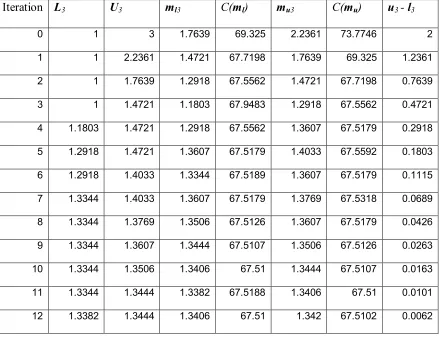
Table 3: Fibonacci Search Procedure Example ...34
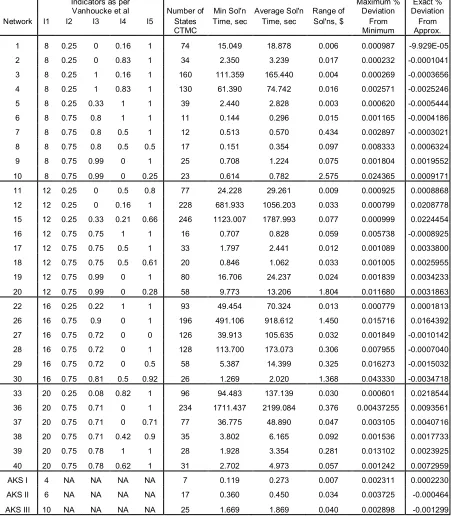
Table 4: Test Results ...36
Table 5: Example Network Test Results ...43
Table 6: State Space of the AoN Example Network...57
List of Figures
Figure 1: An Example 3Activity Network ...10
Figure 2: The State Space of the Project of Figure 1: ...17
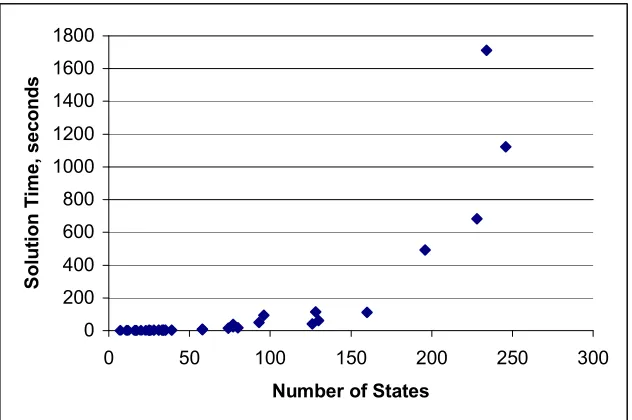
Figure 3: Solution Time vs Number of States in CTMC...38
Figure 4: Example Network 2...41
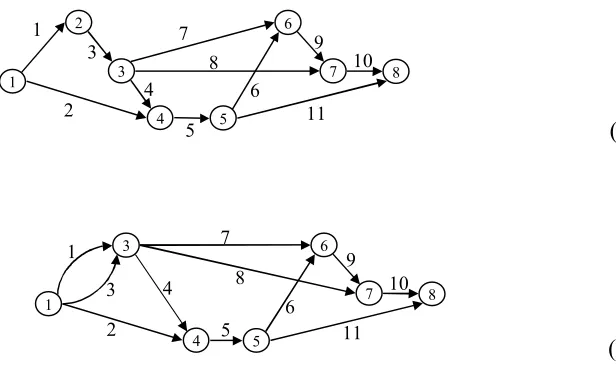
Figure 5: Example Network 2 with Reduced Complexity ...41
Figure 6: Example Network 2 with Further Complexity Reduction...42
Figure 7: SeriesParallel Network...42
Chapter 1
Introduction
In many modern business, engineering, and industrial environments, reliable project
scheduling tools are invaluable. Predictions of project completion dates and project costs
strongly impact many business decisions. In turn, these decisions can impact the course of
the coming weeks, and often years, for modern companies. As a result, it is important to
have accurate predictions of project costs and completion times for management to make the
best, most informed decisions.
Much of the literature pertaining to project scheduling problems ignores the simple
fact that activity durations within a project framework are not known with certainty. This
fact can strongly impact the validity of project planning tools in real life applications.
Further, many project scheduling problems deal with ordering the various tasks of the project
in such a way to meet some predefined objective. In reality, often a project manager has
several resources at his or her disposal that can be used to complete a multitude of project
tasks that can be undertaken at a particular point in time. Keeping this in mind, we seek to
develop a model and create an algorithm that will find the optimal way to assign resources to
the various stochastic activities of a project to minimize an economic objective function.
In the next chapter we discuss the literature that is available pertaining to project
scheduling. We review several papers regarding classical project scheduling problems and
Markov Chain representations of projects. We then discuss in more depth a few papers that
are closely related to the research at hand. In Chapter 3 we formally state the problem under
arrive at a formal statement of our economic objective function. Chapter 4 contains a
complete description of the optimizing algorithm. We pay special attention to a few
simplifying assumptions that lighten the computational burden required and include
illustrative examples to aid comprehension. In Chapter 5 we present the key results of our
research as obtained from testing our algorithm on a set of test networks and discuss the
computational burdens imposed by certain network structures. We conclude by discussing
several possible extensions to the work presented in this thesis. In Appendix A, we briefly
describe the methodology employed in the generation of test networks. Finally, in Appendix
B we list the scripts used in MATLAB to optimize resource allocation to the activities of
these test project networks. These scripts are detailed at length to assist in verifying our
results and to provide a basis for extension to future research in any of the directions
Chapter 2
Literature Review
This review is categorized into three sections. First we briefly survey the literature within the
realm of project scheduling and activity networks in both deterministic and stochastic
settings. Second, we summarize the relevant concepts in continuous time Markov chains,
Markov PERT Networks and the advantages afforded by their application. Finally, we
discuss several recent research projects that have studied problems similar to our own.
2.1 Project Scheduling and PERT networks
A great deal of research has been done pertaining to project scheduling since the
field’s inception. Classically, CPM (“critical path method”) and PERT (“program evaluation
and review technique”) models have been the industry standard for some time both for their
effectiveness and for their simplicity. In the traditional sense, however, neither model takes
resource constraints into account as they opt to deal more with precedence relationships and
time considerations. More recently, much effort has been spent researching the Resource
Constrained Project Scheduling Problem (RCPSP) which we look into briefly before
discussing the stochastic case.
The objective of the RCPSP studies is to schedule activities in such a manner to meet
resource availability and precedence constraints in order to optimize an objective function
unimodal and multimodal cases. The unimodal case involves preset durations and resource
requirements for each activity, whereas the multimodal case allows activities to be processed
in a number of different “modes” requiring different resource levels and completion times.
Resource constraints can be classified as renewable or nonrenewable. Renewable resource
constraints put limits on the amount of a particular resource that can be utilized at a particular
time in the project. Nonrenewable resource constraints limit the amount of a particular
resource that can be utilized in total throughout the project’s life. Chapters 7 through 9 of
Demeulemeester and Herroelen [2002] provide an excellent review of RCPSP problems and
related optimization techniques.
The multimodal RCPSP is closely related to the problem at hand. These problems are
often referred to as TimeCost Tradeoff problems (TCTP). At its core, the TCTP assumes
that the duration of an activity is a function of the resources assigned to its completion.
Further, both rely heavily on the concept of “work content”. Normally, greater resource
allocation will demand a greater expense, thus we have a tradeoff between the time to
complete a project and its cost (a function of the resources assigned). When the task duration
is a linear function of the assigned resources we have the Linear Time Cost Tradeoff (LTCT)
problem. Notably, Fulkerson [1961] studied this problem under the objective of minimizing
project cost subject to completion before a due date. He then solved the problem through the
clever use of primaldual concepts in linear programming and developed an approach to
compute the complete cost curve of the project as a function of the project’s due dates.
If the resource’s allocation is limited to distinct values we have the Discrete Time
Cost Tradeoff (DTCT) problem. Hindelang and Muth [1979] developed a dynamic
corresponding AoA project graph is seriesparallel. In the case where the graph is not series
parallel De et al [1997] provide an update to the DP algorithm of Hindelang and Muth. In
the same article, they show that the DTCT problem is, in general, strongly NPHard by
reduction from 3SAT.
Deckro et al [1994] discuss the nonlinear case of the TCTP. They deviate from the
traditional approach to the problem which would involve piecewise linearization and suggest
a true nonlinear program. Presenting a quadratic program they suggest solution using
commercially available software. The authors also investigate some extensions to the model
including a goalprogramming formulation.
When elements of the project are not known deterministically, analysis of the project
network becomes much more difficult. The dearth of literature on the topic is perhaps good
evidence of this fact. Even so, several studies have been performed both in the single and
multiple mode fields.
GolenkoGinzburg and Gonik [1997] investigate the RCPSP when faced with
stochastic activity times. They use Beta, Normal, and Uniform distributions for activity
times and determine a heuristically achieved best solution to the problem of minimizing the
project's expected completion time. They schedule start times for tasks and proceed
heuristically. The authors face the problem of deciding between “entering variables” (the
activities to be initiated at a particular state of the project) by first using simulation to
determine the probability that the activity is on the critical path and then solve a 01
Knapsack Problem.
In another paper, Stork [2001] takes an indepth look at the RCPSP in the stochastic
briefly discusses the Linear TimeCost Tradeoff problem and shows it is NPhard when
AND/OR constraints are present. He further investigates branchandbound, forbidden set,
and priority based procedures for optimization in their relationship to the “robustness” of a
solution.
Valls et al. [1998] study the RCPSP with some activities facing stochastic
interruptions and processing times. They deal with the concept of Stochastic Programming
versus Robust Optimization and state the burdens to computation imposed by multiple stages
Stochastic Programming. Optimizing the weighted tardiness of either each activity or the
total project, the authors propose and validate a metaheuristic solution that blends Tabu
Search and Scatter Search techniques.
Wollmer [1985] studies a version of the LTCT problem with an additional stochastic
parameter. He deals with the problem where activity durations have a component that is a
linear function of the allocation plus a random element. The author first seeks to find the
minimum required investment subject to an expected project completion time and then solves
the dual problem of finding the minimum expected completion time subject to a budget
constraint. The author utilizes a cutting plane technique for his solutions.
Gutjahr et al. [2000] consider scheduling problems similar to our own. However, in
their approach activities can have one of two possible distributions depending on whether or
not a project is crashed. In this vein, our problem may be considered one in which projects
can be "crashed" to varying degrees (i.e. depending on the allocation of resource to task).
They are also under the discrete time assumptions but depending on the degree of
discretization this assumption is overcome. Further, they define an “HSBranchandBound”
success using this approach as opposed to Total Enumeration, or pure Stochastic Branchand
Bound. They suggest using different heuristics in different applications.
2.2 Continuous Time Markov Chains
In this thesis, we assume that the work content of any task is an exponentially
distributed random variable. As a direct result of this assumption, activity durations are also
exponential random variables since the duration is derived from the work content via the
relation Y = W/x, in which W is the (random) work content and x is the resource allocation.
Further, when we assume independence of activity times with respect to one another we have
a Markov PERT Network (MPN). Under this assumption the analysis of project networks is
greatly aided by the use of Continuous Time Markov Chain (CTMC) theory. A good
introduction to Continuous Time Markov Chains is provided in Ross [2002].
The term Markov PERT Network originated with Kulkarni and Adlakha [1986] and
refers to stochastic activity networks where activity times follow an exponential distribution.
Kulkarni and Adlakha [1986] describe Markov PERT Networks in great detail. Further, they
provide a method for analysis involving uniformly directed cutsets (UDC’s) that allows one
to transform the PERT network into a Continuous Time Markov Chain. An exposition of
this process will be provided with appropriate definitions in section 3.2 below. The authors
then develop recursive formulas for obtaining the moments of the completion time of a MPN.
Though the use of these formulas is beneficial in certain applications (such as in bounding
the completion time of the project), we instead favor the use of the Phasetype (PHtype)
project completion time but also in its distribution based on the project parameters. We will
develop the key concepts regarding this distribution in section 3.3.
2.3 Relevant Recent Studies:
A few studies have been conducted recently that are in a similar vein to the research
considered here. However, they differ from our study in the objective, the optimization
methodology, or the constraining set.
Tereso, Araújo, and Elmaghraby [2004] investigate optimal resource allocation under
stochastic conditions. They optimize the same objective with which we are faced and relax
the assumption that work content follows an exponential distribution. They solve the
problem using a Dynamic Programming algorithm that is extremely taxing computationally.
Their approach optimizes the allocation to resources along a single path through the network
from start to finish while holding the allocations to other activities constant. Their solution
necessitates enumerating the optimal path for all possible values of allocations to other
variables. In conclusion they suggest treating only exponential distributions which gives rise
to the research presented in this thesis.
Morgan [2006] derives a fast method for optimizing resource allocation in a single
stage stochastic activity network. He justifies optimizing a single stage by suggesting that a
project manager’s strategy should change once the state of the project changes as evidenced
by the completion of an activity. Morgan uses Sample Path Optimization and appeals to
Geometric Programming to solve the single stage problem. Repeatedly applying the single
amenable to random sampling. Morgan’s approach also allows for absolute bounds on the
resources to be applied.
Ramachandra [2006] studies the problem of optimal resource allocation in a Markov
PERT Network with respect to an economic objective. His objective function is comprised
of the expected cost of the resources and the cost of expected tardiness. Though the cost of
expected tardiness is a major simplifying assumption when compared to the expected cost of
tardiness, the author goes on to show that his approach to solution delivers an excellent
approximation of the optimal solution. The author first describes a “Policy Iterationlike”
approach to solution and then shows a SimulationcumOptimization approach to the
problem. He uses Monte Carlo and Latin Hypercube Sampling approaches and shows the
latter to have advantages with respect to variance minimization. The author further admits
that any aggregate bounds on resource allocation would need to be applied in the search
technique.
Finally, Azaron et al. [2007] use control theory to study resource allocation in
Markov PERT Networks. The authors explain that the resource allocation costs and project
tardiness costs are in conflict and therefore decide to model the problem as a multiple
objective stochastic program. Ultimately the authors describe Goal Attainment and Goal
Programming methodologies to solve the problem and provide computational results for a
few examples. The authors state that their solution allows for activity times to be taken from
any distribution as a generalized Erlang distribution. They also arrive at the conclusion that
an optimal solution to the control problem cannot be found and so they resort to the
discretization of time, modeling the problem with difference (rather than differential)
Chapter 3
Problem Statement
3.1 Introductory Assumptions
We begin with a set ofn activities that define the project. The project can be
expressed as a graphG = (N, A) where either the nodes or the arcs signify the activities in a
project. For this problem statement, we will consider the arcs to be representative of the
activities and the nodes to be representative of “events” in the progression of the project (the
activity on arc (AoA) mode of representation). The work on a task cannot commence until
all its predecessors are completed. This is symbolized in the nodes of the project graph,
wherein the arcs into a node are predecessors to the arcs out of the node. Further, we
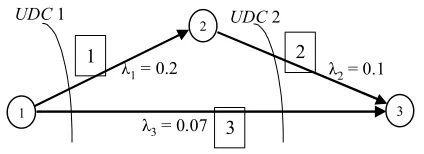
consider the project completed only when all tasks therein are completed. Figure 1, below,
provides a simple example. Activity 2 cannot begin until activity 1 is completed. Also, we
consider the project completed only when all three activities have been completed; i.e. Node
3 is realized.
2
3 1
3
1 2
λ 3 = 0.07
λ 2 = 0.1 λ 1 = 0.2
UDC1 UDC2
We are given for each activity j its work content, Wj, representing the amount of work
(effort, energy) to be done on the activity. We assume that Wj is known in probabilistic
terms (nondeterministic). It is important to note that we consider the source of uncertainty
to be internal to the project. External uncertainty, such as that due to machine failure or
weather, is beyond the scope of this research. In general, work content is measured in some
convenient unit depending on the activity and the resource; such as “workerhours” or
“computerseconds”, etc. Consequently, only when the resource level is specified can we
estimate the time to complete the activity. This relationship depends on three entities: work
content, resource level, and activity duration. If a simple hyperbolic relationship is assumed
then the activity duration is equal to the work content divided by the resource level, as we
shall show in equation (2). For instance, if the activity requires 36 workerhours and 3
workers are assigned to it, it shall consume 12 hours to accomplish. However, if 4 workers
are assigned to it, it shall require only 9 hours, etc. We are also given a due date for the
project, Ts, which is specified by the project “owner” and is known with certainty.
We let xj represent the allocation of the resource to activityj. It is important to note
that the value ofxj is our decision variable while Wj is a random variable; thus we seek to
find the best values of the xj variables that optimize the objective function. We consider only
one resource of unlimited availability, although in application the particular resource may
vary from activity to activity within a project; i.e. one activity may require electricians as a
resource while another may require bricklayers but no activity requires more than one
(critical) resource at a time. This could be accommodated in the proposed model by
replicating the activity arc in parallel for each resource required for the represented activity
Costs incurred in the execution of the project are of two forms: resource costs and
lateness costs. We assume a constant marginal cost for the resource,cR, and also assume that
this cost is constant across all activities. The latter assumption is made for ease of
computation although it could be relaxed easily in the algorithm detailed in the next section.
We are also given a cost of lateness for the project,cL per unit time of delay. In our
application, we normalize these costs by dividing through bycR. Again, this assumption
serves to simplify the computations; in any application more realistic costs would be known
and could be used (such as piecewise linear and convex costs). If we let ¡ denote the time
of project completion, a random variable, the cost of lateness is defined as cL (max{0,¡ –
Ts}). Finally, we seek to find an allocation vector,X, minimizing the sum of the expected
value of these two costs.
The first major assumption we make is the distribution function of each activity’s
work content,Wj. Because of its tractability and ease of use, we assume that Wj follows an
exponential distribution with parameter λj:
Wj ~ exp(λj), "j ÎA (1)
As we will show, this assumption will greatly decrease our computational burden because of
the exponential distribution’s memoryless property. Further, we assume that the resource
allocation, xj, is bounded from below bylj and from above byuj:
0< lj£ xj £uj < ¥ " Î, j A
Note that this assumption does not conflict with the earlier assumption of unlimited resource
availability – it only constrains the resource allocation to any individual activity. We assume
parallel at a given time. Given our assumptions of exponential work content and bounded
resource allocations we let Yj denote the duration of activityj:
j j
j
W x
Y = (2)
As Wj is exponentially distributed and xj is a decision variable, it can be easily
demonstrated that Yj also follows an exponential distribution with parameter xjλj. Note that
this definition necessitates our bounding ofxj; without bounds onxj, the duration of activityj
will not necessarily take on a meaningful value. While the assumption that the duration of an
activity takes on an exponential distribution may seem unreasonable, such a choice can be
justified on three grounds.
First, the memoryless property of the exponential distribution aids greatly in
computation and, as we will show in section 3.2, lends well to the use of continuous time
Markov chain (CTMC) theory for its analysis. Second, and perhaps more importantly, the
exponential distribution is the limit of the class of distributions known as “new better than
used in expectation” (NBUE) distributions, to which all proposed distributions of activity
durations known to us belong. That is to say, if a task has not completed after ttime units,
the expectation that the task will take 1/xjλj additional units provides an upper bound on the
expected time the task should take in actuality. Thus this assumption ensures that we provide
an upper bound on the expected project duration and cost. Lastly, using the exponential
distribution and modeling the project as a CTMC can be considered the fundamental
“building block” which serves other potential work content distributions. This is due to the
fact that any continuous distribution can be approximated to any desired degree of accuracy
each “phase” is exponentially distributed – and we are back to the CTMC model based on
these exponential distributions.
Finally, we assume that the cost of resource allocation to activityj is quadratic in the
allocation over the duration of the activity. This reflects the added cost of employing
additional resources. It also could be considered representative of the law of diminishing
marginal returns. It also has the added advantage of resulting in a linear funcdtion of the
allocationxj. Thus the cost of resource allocation to activityj is defined as:
2
R R
j j j j j
C =c x Y = c x W . (3)
Therefore, the expected cost due to resource allocation to all the project activities is given by:
[ ] R
a R
a a
C c
ε
A
x
l
Î
æ ö
= × ç ÷
è ø
å
. (4)
In order to properly evaluate the portion of the project cost due to lateness we must
first establish the distribution of the project completion time. To do so, we will first apply
the principles established by Kulkarni and Adlakha [1986] to develop a continuous time
Markov chain representative of the project network. Next we present the known results from
the PhaseType Distributions in order to evaluate the density function of the project
distribution.
3.2 Continuous Time Markov Chains
Kulkarni and Adlakha [1986] developed a methodology for transforming a project
network with exponentially distributed activity completion times into a CTMC. We will now
We begin with a graphG = (N, A) representing the project in the AoA mode of
representation as previously stated. Without loss of generality, we assume that the project
begins at time zero and will end at a randomly distributed later time, ¡, once all of the
activities have been completed. At a particular time, t, between 0 and ¡, each activity in A
can be in one of three states:
Active: An activity is active if it is in process at time t.
Dormant: An activity is dormant if it is completed but at least one other activity
ending at the same node is stillactive at time t.
Idle: An activity is idle if it is neither active nor dormant. This includes all
activities that are yettobeinitiated and those that are completed along
with all other activities ending at the same node.
Clearly, a project is completed when it has no active ordormant activities. Since
each activity is in one of these three states Kulkarni and Adlakha [1986] define the following
sets for any time t ≥ 0:
Y(t) = {a ÎA: ais active at time t},
Z(t) = {a ÎA: ais dormant at time t}, and the state of the project
is given by:
X(t) = (Y(t),Z(t)).
The set of idle activities is the complement of the set X(t) inA. Before proceeding further we
must define a cutset. Given a project graphG = (N, A) in AoA representation, let B be a
proper, nonempty subset of the set of nodes, N, and B be its complement inN. Further, we
define ( , )B B ={jÎA i: ÎB i, 'Î B} where i and i' denote the start and end nodes of activity
denotes the start node of a project (node 1) and n denotes the terminal node of the project, n
= |N|. Further, the cutset is a uniformly directed cutset (UDC) if no arcs extend from B into
B, symbolically, ( , )B B = Æ . The project in Figure 1 has 2 UDC’s, both of which are
labeled.
As stated by Kulkarni and Adlakha [1986], {X(t),t≥ 0} is a representation of the
state of the project which forms a continuous time Markov chain (CTMC) with a single
absorbing state when mutual independence of the activities is assumed. This stems from the
fact that X(t) forms a 2partition of a UDC for all times t. If we define S as the set of all
admissible 2partitions ofUDCs inG, then clearlyX(t)ÎS. Whent ≥ ¡, the setsY(t) and Z(t)
are both empty, thus X(t) = (Æ,Æ) and S =SÈ Æ Æ( , forms the state space for the CTMC. )
Generally, S is the set of all possible combinations ofactive and dormant activities of the
project that can occur according to the precedence constraints, extended by the empty set,
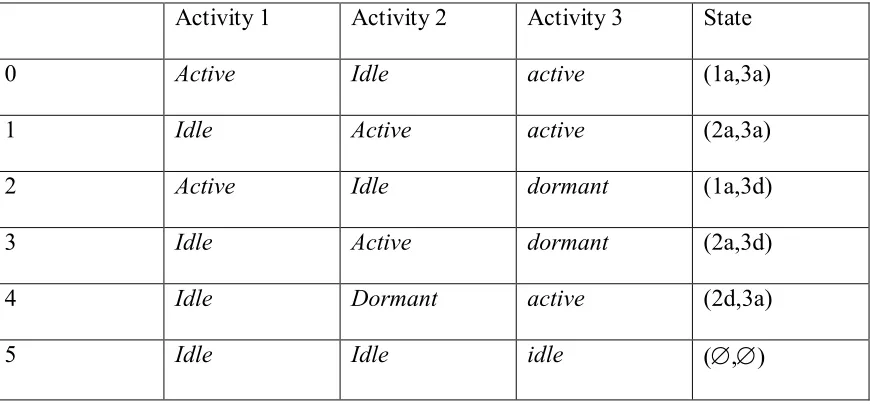
(Æ,Æ). For the project in Figure 1, S contains 6 states, which are enumerated in Table 1. A
graphical representation of the CTMC is given in Figure 2:
Table 1: State Space of the CTMC
Activity 1 Activity 2 Activity 3 State
0 Active Idle active (1a,3a)
1 Idle Active active (2a,3a)
2 Active Idle dormant (1a,3d)
3 Idle Active dormant (2a,3d)
4 Idle Dormant active (2d,3a)
5
3 4
2 1
0
(1a,3a)
Æ
(2a,3d) (2d,3a) (2a,3a)
(1a,3d) λ 2
λ 3 λ 1
λ 3
λ 2 λ 3
Project start
Project end
Figure 2: The State Space of the Project of Figure 1:
Graphical Representation of the six states of the CTMC
A few observations made by Kulkarni and Adlakha [1986] are worthy of note due to
their importance and relevance to our research.
· Transitions in the CTMC correspond to the completion of activities in the project and
their associated rates correspond to the parameters of the completion time
distribution. This directly implies that in our research, the transition rates within the
CTMC are random variables of rates {xjλj}.
· The state (Æ,Æ) corresponds to the completion of the project. With no activities left
to initiate or complete, no transitions are possible from this state and so (Æ,Æ) is the
single absorbing state of the CTMC.
· Since each activity is completed exactly once, each state of the CTMC may be visited
only once. Thus, the states ofS are transient and the states of S can be numbered so
that the rate transition matrix is uppertriangular: |S | = m and
· The number of states in {X(t), t≥ 0} is finite for projects with a finite number of
activities. Therefore, {X(t),t ≥ 0} will be completed in finite time with
probability 1.
· Finally, if | A | = a, the number of states in the CTMC follows:
a £ |S | £ 2 a (5)
with the lower bound occurring when all activities of the project are in series and the
upper bound occurring when all activities are in parallel.
3.3 PhaseType Distributions
In order to establish the expected cost of lateness, we must first describe the
distribution of time until the project’s completion. Employing the CTMC interpretation of
the model previously described the project can be considered completed when the Markov
process reaches its absorbing state. When an absorbing CTMC has a single absorbing state
the distribution of time until absorption can be described by the phasetype (PHtype)
distribution. The phasetype distribution gets its name from the path taken by the project
from initiation to completion, which can be viewed as a series of stages, or “phases,” each
having an exponential distribution.
The parameters of the phasetype distribution are a probability vector, (a,am+1), and
the CTMC’s rate generator matrix:
0 ( ) ( 1)
(1 ) 0(1 1)
m m m
m
T T Q
0
´ ´
´ ´
é ù
= ê ú
ë û
Here, the T matrix is representative of the transient states of the matrix, withTii < 0 for 1 ≤i
≤ m and Tij³ 0 for i≠ j. Additionally:
T 0 +Te =0, (7)
where e represents a column vector of dimension (1xm) and 0 is a vector of zeros of
equivalent dimension; i.e. the rows of the matrixQ sum to 0. As an example, the Q matrix
for the project in Figure 1:
0.27 0.20 0.07 0 0 0
0 0.17 0 0.07 0.10 0
0 0 0.2 0.20 0 0
0 0 0 0.1 0 0.10
0 0 0 0 0.07 0.07
0 0 0 0 0 0
Q
-
é ù
ê - ú
ê ú
-
ê ú
= ê ú
-
ê ú
ê - ú
ê ú
ë û
The vectora is an initial probability vector, also called the “counting probability” ofQ. This
vector represents the probability that the Markov process begins in a given state. As such,
we have:
a ∙e +am+1 =1. (8)
For our purposes, we assume the project begins with no activities completed; i.e. the project
is in the first state with probability 1. Thus we have a =[1 0(1xm)].
In general, the PHtype distribution, hereby referred to as F(∙), can be represented by
(a,T). A necessary and sufficient condition for the states of the CTMC represented byT to
be transient is that the matrixT is nonsingular. As a result, T k® 0 as k ® µ. When given
an initial probability vector (a,am+1), the cumulative distribution function of the time to
absorption in state m+1is given by:
The evaluation ofe Tt has been studied in depth. Traditionally, it is given by the
Taylor series:
1 ! 0 ( ) T
i T
¥
=
=
å
t i
ι
e t , (10)
however, it can by calculated in a myriad of other ways as demonstrated by Moler and van
Loan [2003].
A few observations about the PHtype distribution are now necessary for our
research:
· The functionF(∙) has a jump of height am+1 at t = 0. This is equivalent to the
probability that the process begins in the absorbing state. For our research, this is
somewhat irrelevant because we assume the project starts with no activities
completed. In practice, this assumption could be relaxed in the interest of managerial
flexibility; i.e. after a certain amount of time, the manager could reoptimize his or
her resource allocation according to the progress of the project at that time.
· The probability density function (pdf) f(∙) is given by:
0 ( ) ( ) t .
t
f t d F t e T
d α T
= = × × (11)
· The expected value and variance of the PHtype distribution, respectively, are given
by:
–a ∙T 1 ∙e and 2a∙T 2 ∙e (12)
and, in general, the noncentral moments fi ofF(∙) are given by:
3.4 The Cost Function
The PHtype distribution can be used to formally state the cost function over which
we seek to optimize. As of the moment, we have in hand the expected cost of resource
allocation, given by (4) above; it remains to derive the portion pertaining to the expected cost
of lateness.
First, as previously stated, the cost of lateness is defined byCL(¡ ) = cL (max{0,¡ –
Ts}). With the distribution of¡ following the PHtype distribution we must use integration
to calculate the expected cost of lateness: 0 0 0 0 [ ] ( ) ( ) ( ) ( ) s L L t L t s T
C C t f t dt
C t e dt
tT e dt
ε
T T α T α T ¥ ¥ ¥ = × = × × × = × × ×
ò
ò
ò
(14)
It is important here to remember that the entries of the matrixT, as well as T 0 , are determined
by the completion times of the activities in A. Under our assumptions these completion times
are functions of the resource allocations to the activities in the project. Thus, the expected
cost of lateness is also a function of the vector X. In total, we seek to find the optimal
resource allocationX to minimize the expected project cost:
0
[ ( )] L ( )
s a t s T a a
C c tT eT dt
A
x
X α T
l
e
¥ Î æ ö = ç ÷ + × × × × è øå
ò
(15)
subject to the bounds on resource allocation as well as the precedence constraints expressed
as nodes inG. Here, the value cR has dropped out of the equation as it has been set equal to 1
Chapter 4
Description of Algorithm
In order to solve the problem at hand, we focus our research on a modified derivative descent
algorithm. We first compute an approximation to the partial derivative of the expected cost
with respect to the allocation to each of the activities and then choose to modify the
allocation to the activity that has the greatest negative derivative. Next we use line search
techniques to find the minimum expected cost allocation to the chosen activity while holding
the other allocations constant. The algorithm iterates using these two steps until a specified
stopping criterion is met. In order to execute any of these steps, we first must be able to
compute the expected cost at a particular allocation.
4.1 Cost Computation
As previously described, the expected cost of the project (given in (15) and repeated
here for convenience) contains two terms:
0
[ ( )] L ( )
s
a t
s T a
a
C c tT eT dt
A
x
X α T
l
e
¥Î
æ ö
= ç ÷ + × × × ×
è ø
å
ò
The first term relates exclusively to the level of resource allocation. Since the work content
distribution parameter, λi, is given for each activity the expected cost of resource allocation
can be computed directly. The second term, which relates to the lateness of the project with
respect to a given due date,Ts, cannot be computed directly for the following reason. Due to
summation to approximate the expected cost of lateness. Applying a summation requires
assuming time takes on discrete values. Azaron et al. [2007] arrive at the same conclusion
through the use of control theory. They take the approach of dividing the “time interval”
(that is, the interval of time to project completion) into K portions of lengthΔt and solve a
system of difference equations. However, we choose to depart from this approach since the
“time interval” is not known. For example, a trivial project involving only a single activity
will have a significantly shorter “time interval” when allocating 3 units of the resource than
when allocating just 1 unit. Instead, we set the length ofΔt and take the sum of lateness costs
until the probability that the project takes longer thanm∙Δt time units is sufficiently small,
sayplim. Since the expectation of cost involves computing the probability that the project
completes within a certain time interval, this method of calculation requires no additional
computational steps.
We, therefore, take a midpoint Riemann sum of the product to approximate the value
of the integral. For suitably small values ofΔt this method provides an excellent
approximation. The downside, however, is that while decreasing Δt to increase the precision
of the approximation we also increase the computational burden. We settle this tradeoff by
letting Δt equal a fraction of the standard deviation of the project completion time provided it
is greater than a lower bound, lΔt, as this helps to normalize the computational time for each
instance in which the expected project cost is computed.
The computational burden required by the cost calculation derives from the
calculation of the probability that a project completes in a specified window of time. Recall
calculation of the expected cost, much can be gained if we let R = e T . Equation (9) then
becomes:
F(t) = 1 –a ∙Rt ∙e fort ³ 0. (16)
This computation requires computing R t rather thane Tt .
The algorithm for computing the cost then proceeds as follows:
Step 1: Initialization: Let t =Ts, let Δt = max{z·σtn, lΔt} where tn denotes the project
completion time and z is a predefined fraction, let CP = 0, let p0 denote the probability
that the project completes before time Ts, i.e. let p0 = F(Ts), let Rmat= R t , and let U =
R Δt .
Step 2: Calculate the probability, p, that tn falls in the interval of [t,t+Δt]:
p1 = F(t + Δt) = 1 –a∙Rmat ∙U ∙e (17)
p = p1 p0 (18)
Step 3: Let CP = CP + cL ∙ p∙ ((2t +Δt)/2 Ts). Ifp1 exceeds 1plim then go to Step 4.
Otherwise let p0 =p1, let t = t+ Δt, let Rmat = Rmat ∙U, and repeat from Step 2.
Step 4: Add the expected cost of resource usage to the expected lateness cost, CP, using (4)
and stop. CP now equals the expected total project cost.
In the algorithm, we use U and Rmat in order to eliminate the need to calculate the power of
an exponential in each step. Instead, we calculate these quantities once (from knowledge of
the Wj’s and the resource allocation) and can then rely on matrix multiplication, which is
significantly less burdensome computationally than matrix exponentiation.
With an effective way to calculate the total expected project cost in hand, we can now
4.2 Selecting Candidate Activities
In general, our algorithm optimizes the project cost by changing the allocation to one
activity atatime. We now need to explain the procedure to select activities that are the best
candidates for optimization. The best candidates in our procedure are those that could lead to
the greatest decrease in expected project cost.
The two terms of the project cost behave diametrically opposite in their response to
changing resource allocations. The project resource cost increases linearly with respect to an
increase in resource allocation to any activity. On the other hand, increased resource
allocation to the activities tends to shorten their expected duration and so the expected
lateness cost would decrease with respect to such a change in allocation. A decrease in
overall cost, therefore, could be obtained from either a decrease or an increase in resource
allocation.
An important observation is that the expected project cost is a convex function with
respect to the allocation to a single activity. This fact is a result of the two convex
components of cost. The expected cost of lateness decreases convexly due to the exponential
distributions on which it is based. Further, since the resource costs are linear (hence convex)
in the resource allocation, the sum of the two costs is convex. Thus, repeatedly optimizing
allocations to single activities oneatatime will descend monotonically to reach the optimal
solution.
Since no analytical expression is known for the partial derivative of the cost function
with respect to the allocation to any activityaj, we must rely on approximations to proceed.
Such an approximation would enable us to select the activities to which a change in
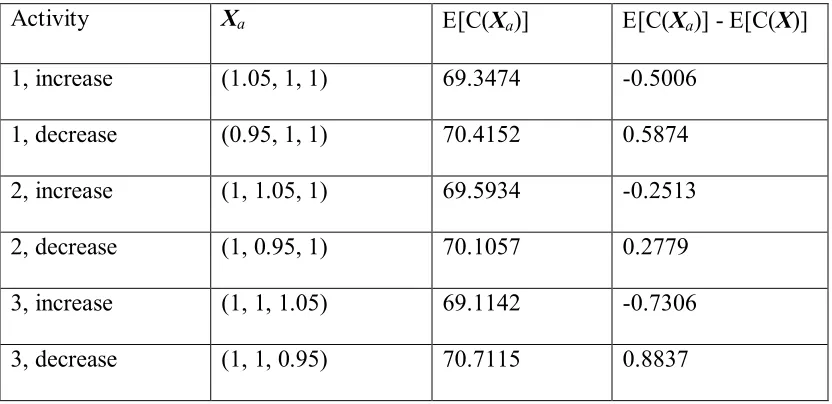
associated with a small change in allocation, d, to a particular activity we can approximate
the derivative of the cost function by first taking the difference between this cost and the cost
of the initial resource allocation and then dividing by the magnitude ofd. Since a decrease in
cost can occur via an increase or a decrease in allocation, and thanks to the convexity of the
cost function, the best candidate allocations are those with the steepest derivatives causing a
decrease in cost. Further, ifd is constant across all activities, we can simply find the change
in allocation reflecting the greatest decrease in cost, as we are not concerned with the actual
value of the derivatives, but rather their magnitudes with respect to one another.
Letting X+a = X+d∙ea, where ea is a vector of dimension |A| with zeros everywhere
except in positiona, denote the allocationX with the value of the ath allocation increased by
the amount d, further we allow Xa = X – d∙ea to denote the allocation with the ath allocation
decreased. We calculate E[C(X+a)] and E[C(Xa)] for each activity. Withe[C(X)] in hand,
we find E[C(X+a)] –E[C(X)] and E[C(Xa)] –E[C(X)] for each activity, a, and use this as a
surrogate for the value of the derivatives of the cost function with respect to the allocation to
a. We select the activity corresponding to the greatest decrease in cost as the candidate
activity. If the decrease in cost comes fromX+a the allocation to activitya must be increased.
Likewise, if this comes fromXa we must decrease the allocation to activitya. Since we are
dealing with minimization of the cost function, for certain network structures both increasing
and decreasing the allocation can cause an increase in cost. Thus it is important to check
both an increase and decrease in allocation rather than assuming that an increase in cost in
4.3 Improving Computational Efficiency
As with computing the cost function, approximating its derivative can be
computationally burdensome, considering that we must calculate E[C(X+a)] and E[C(Xa)] for
each activity. We let Q(X+a) represent the matrix Q with the allocation to activitya increased
by the value d. Note that increasing the allocation to a single activity may correspond to
increasing the value of several entries in the originalQ matrix, as well as the decreasing their
corresponding elements along the main diagonal. Changing the allocation to activityi byd
implies that we must change the values in the Q matrix bydli. This change can be viewed
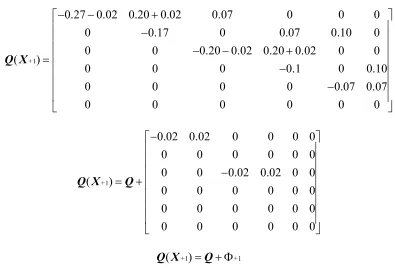
as matrix addition. These facts are best illustrated with an example from the project in
Figure 1, where we change the allocation to activity 1 (li = 0.2) withd= 0.1:
1
0.27 0.02 0.20 0.02 0.07 0 0 0
0 0.17 0 0.07 0.10 0
0 0 0.20 0.02 0.20 0.02 0 0
( )
0 0 0 0.1 0 0.10
0 0 0 0 0.07 0.07
0 0 0 0 0 0
Q X - - + é ù ê - ú ê ú - - + ê ú = ê ú - ê ú ê - ú ê ú ë û + 1
0.02 0.02 0 0 0 0
0 0 0 0 0 0
0 0 0.02 0.02 0 0
( )
0 0 0 0 0 0
0 0 0 0 0 0
0 0 0 0 0 0
Q X Q
- é ù ê ú ê ú - ê ú = + ê ú ê ú ê ú ê ú ë û + 1 1 ( )
Q X+ =Q+ F +
where, F+a represents the matrix corresponding to the increase in allocation to activitya.
Recall from elementary matrix algebra that e A+B = e A ∙e B whenA and B are
commutative: A∙B = B∙A. Unfortunately for our purposes, Q ∙Fa¹ Fa ∙Q. However, the
sparse nature of the Fa matrix implies that these two terms are approximately equal. Further,
eFa is nearly equal to the identity matrix, I. With these facts in mind, we can use e Q+Fa = e Q ∙
eFa or rather the transient matrices e T+fa = e T ∙efa , where fa denotes the transient portion of
Fa, for use as an approximation in the density function of the completion time distribution.
This approximation provides a good indicator of the derivative of the cost function with
respect to direction (as in whether increasing the allocation leads to an increase or a decrease
in cost) as well as the magnitude of the change in cost. We will validate this approximation
in the next section by comparing the expected costs returned by the algorithm when using the
approximation and the exact determinations of the cost derivatives. Note that this analysis
can be applied to the computation ofE[C(Xa)].
The key advantage this approximation provides is that it eliminates the need to
calculate the matrix exponential for the evaluation of the derivative at each iteration. Since
Fa does not depend on the current allocation, the efa matrices can be computed once at the
beginning of the algorithm and stored for use throughout the optimization process. Since e T
is needed for calculating the cost at each iteration this matrix is in hand as well. Thus, e T ∙efa
is computed and passed to the cost calculation algorithm as the matrix, R.
4.4 Optimizing The Allocation to a Single Variable
With a candidate variable in hand, we now seek to optimize the allocation of
stated, the expected project cost is a convex function with respect to the allocation to a single
activity. Any convex optimization procedure could therefore be applicable here. However,
due to the difficulty involved in finding exact analytical expressions for the partial
derivatives of the cost function, we opt to use Fibonacci search as our method of determining
the optimal allocation to the selected activity. Note that this “optimal” allocation is “locally
optimal” in a sense as it depends upon the allocation to the other activities.
At its core, Fibonacci search, often referred to as “golden mean” search, finds the
optimal point in a range of feasible values by repetitively shrinking the range, stopping when
the range is sufficiently small to suggest a single optimal point. Fibonacci search makes use
of the socalled “golden ratio," which Wilde [1964] shows is the most computationally
efficient method of finding the optimal value of a variable when searching along a line.
Given a lower bound, l, and an upper bound, u, on the range, two new points are calculated
within the range: ml andmu where ml < mu. We define r as the inverse of the “golden ratio”
and use r to give values for ml and mu:
2
0.618 1 5
r = »
+ (19)
ml =l∙ (r) +u∙ (1 – r) (20)
mu = l∙ (1 – r) + u∙ (r). (21)
For our purposes, these points represent different resource allocations. If activityj was
selected as the candidate activity and its cost decreases with increased allocation we let l be
the current allocation and let u be uj for activityj while keeping the allocations to the other
activities unchanged. If its cost decreases with decreased allocation, we define the upper
bound as the current allocation and let lj be the lower bound on the allocation to activityj.
with lower and upper bounds defined at 1 and 3 respectively. If activity 1 is selected as the
candidate activity and its cost decreases with increased allocation we let l= X (the current
allocation) and u = (3, 2, 2). Conversely, if the cost increases with increased allocation, let l
=(1, 2, 2) and u =X. Values forml and mu are then defined by (20) and (21) respectively.
With these four values in hand (l, u,ml, and mu), we recursively redefine the bounds
on the range to hone our search to the minimum expected cost allocation. Optimization
proceeds by first calculating the expected costs of allocations ml andmu. The convexity of
the expected cost function allows us to conclude that the minimum falls between the greater
of the two values and the opposite absolute bound; i.e. ifE[C(ml)] <E[C(mu)] then the
optimal value must lie betweenl and mu, otherwise E[C(ml)] >E[C(mu)] and the optimal
value must lie betweenml and u. If the two expected costs are equal, either bound can be
used. Using these values we redefine the bounds on optimization using the absolute bound
nearer ml ormu corresponding the lower cost and redefine the opposite bound as ml ormu
corresponding the greater expected cost. The two points within the range are then redefined;
however, the use of the “golden ratio” permits calculation of only one of these points. The
ml ormu corresponding to the lower expected cost will take the value of the opposite
midpoint in the next iteration, as the use of equation (20) or (21) will yield this value.
Further, only one new expected cost must be calculated in each iteration. As an example,
suppose E[C(ml)] <E[C(mu)]. In the next iteration, l will remain unchanged, u will take the
previous value ofmu,mu will take the previous value ofml, and a new ml can be calculated
using (20). These concepts are illustrated numerically in Section4.6 below.
In each iteration, we shrink the search range by the ratio r as defined in (19),
interval exists betweenl and