LOCALIZING NON-IDEAL IRISES VIA CHAN-VESE MODEL AND VARIATIONAL LEVEL SET OF ACTIVE CONTOURS WITHTOUT
RE-INITIALIZATION
QADIR KAMAL MOHAMMED ALI
A dissertation submitted in partial fulfillment of the requirements for the award of the degree of
Master of Science (Computer Science)
Faculty of Computing Universiti Teknologi Malaysia
iv
ACKNOWLEDGEMENT
First and foremost, I would like to express heartfelt gratitude to my supervisor Prof. Dr. Ghazali Bin Sulong for his constant support during my study at UTM. He inspired me greatly to work in this project. His willingness to motivate me contributed tremendously to our project. I have learned a lot from him and I am fortunate to have him as my mentor and supervisor
Besides, I would like to thank the authority of Universiti Teknologi Malaysia (UTM) for providing me with a good environment and facilities such as computer laboratory to complete this project with software which I need during process.
To my dearest wife Zuzan, my son Event and my siblings whose inspirational words and prayers gave me the strength to carry on. God have answered all your prayers, thank you all.
ABSTRACT
vi
ABSTRAK
TABLE OF CONTENTS
CHAPTER TITLE PAGE
1 INTRODUCTION
1.1 Overview 1
1.1.1 Why Iris? 3
1.1.2 Iris Recognition 3
1.2 Problem Background 4
1.3 Problem Statement 7
1.4 Research Question 8
1.5 Dissertation Aim 8
1.6 Objectives of Study 8
1.7 Research Scope 9
1.8 Research Framework 9
1.9 Research Organization 10
2 LITERATURE REVIEW
2.1 Introduction 11
DECLARATION ii
DEDICATION iii
ACKNOWLEDGMENT iv
ABSTRACT v
ABSTRAK vi
TABLE OF CONTENTS vii
LIST OF TABLES x
viii
2.2 Comparison of Different Biometrics 12
2.3 Iris Anatomy 16
2.3.1 Iris Structure 16
2.3.2 Iris Pigmentation 17
2.4 Eye Image Acquisitions 18
2.5 Eye Image Pre-processing 19
2.6 Iris Localization 19
2.6.1 Integro Differential Operator 20 2.6.2 Circular Hough Transform 22
2.6.3 Active Contour Methods 26
2.6.4 Directional Ray Detection Method 34 2.6.5 Image Processing Algorithms 35
2.7 Summary 40
3 RESEACH METHODOLOGY
3.1 Introduction 41
3.2 Detecting and Localizing the Inner Boundary
Using Chan-Vese Model 43 3.3 Detecting and Localizing the Outer Boundary
Using Level Set Formulation of Active
Contours Without Re-initialization 46
3.4 Summary 48
4 EXPERIMENTAL RESULT AND DISCUSSION
4.1 Introduction 50
4.2 Data Set 50
4.3 Detection of the Inner Boundary and
Localization of the Pupil Region 51 4.4 Detection of the Outer Boundary and
Localization of the Iris Region 55 4.5 Experimental Result and Discussion 61
4.6 Summary 63
5 CONCLUSION AND FUTURE WORK
5.2 Summary of Work 65
5.3 Dissertation Contribution 65
5.4 Future Work 66
x
LIST OF TABLES
TABLE NO. TITLE PAGE
2.1 Summary of the Iris Localization Techniques with their Localization Accuracies 2.2 Summary of the Iris Localization Methods Employed
by Different Authors 4.1 Experimental Result of the Iris Localization Stages
4.2 Comparision of Experimental Result 34
LIST OF FIGURES
FIGURE NO. TITLE PAGE
1.1 Different types of biometrics 2
1.2 Basic block daigram of biomtric system 2
1.3 Daugman’s model for iris recognition scheme 4
1.4 Research framework 9
1.5 Organization of dissertation 10
2.1 Various types of biometric 15
2.2 A sample of the human eye 17
2.3 Graph showing proper capture of images 18
2.4 (a) Eye image (020_2_1 from the CASIA repository). (b) Matching edge map. (c) Edge map with only horizontal inclines. (d) Edge map with only vertical inclines. 24
2.5 Various types of active contour methods 27
2.6 (a) Iris image from CASIA. (b) Halting operation K. (c) Altered halting operation K′ 31
2.7 (a) Original contour of Iris image from CASIA user 5. (b) Embedding function Ψ (The dimension of the iris image match with the X and Y axis and various level sets are signified by the Z axis). (c), (d) Contour after the 400th iterations and its matching embedding operations. (f) Final contour after 600 iterations. 32
3.1 The research design of iris localization 42
3.2 Image representing a single object of intensity Uinternal, separated by the contour C0 from its background of intensity Uexternal. 43
3.3 The signed distance function (SDF) 44 3.4 Image representing a single object (R) with its
xii
initial LSF as positive constant c0 outside of
R, zero 0 on the boundary of R, and negative
constant -c0 inside of R. 47 4.1 An example of CASIA-Iris-V3-Interval 51 4.2 Preprocessing for detection of the inner boundary.
(a) Original iris image. (b) Gaussian filtered (σ =
1.0) 52
4.3 Evolution of the Chan-Vese active contour model during Pupil localization. (a) Input Image with (σ=1.0). (b) Initial Contour. (c) After 2 iterations. (d) After 3 iterations. (e) Final contour after
10 iterations. (f) Extracted pupil 53 4.4 Pupil localization process without using Gaussian
filter. (a) Original image. (b) Initial Contour. (c) Final contour after 10 iterations. (d) Bad Localized
pupil 54
4.5 Evolution of the Level set without Re-initialization during Iris localization. (a) Input image with (σ = 3.5). (b) Initial contour. (c) After 300 iterations.
(d) Final contour after 500 iterations 55 4.6 Iris localization process without using Gaussian
filter. (a) Original image. (b) Unsuccessful iris
localized after 500 iterations 56 4.7 Iris Localization process. (a) Original iris image.
(b) Final iris localization 57
4.8 Good Iris Localization process. (a) Detected inner boundary after 6 iterations. (b) Extracted Pupil region. (c) Detected outer boundary after 350
iterations. (d) Iris Localization 58 4.9 Poor Pupil Localization. (a) Poor detected pupil.
(b) Bad extracted pupil 59 4.10 Poor Pupil Localization. (a) Poor detected pupil.
(b) Bad extracted pupil 59 4.11 Poor Iris Localization. (a) Original image.
(b) Bad detected iris 60 4.12 Poor Iris Localization. (a) Original image. (b) Bad
detected iris 60
4.13 Bad Iris Localization process. (a) Poor iris
CHAPTER 1
INTRODUCTION
1.1 Overview
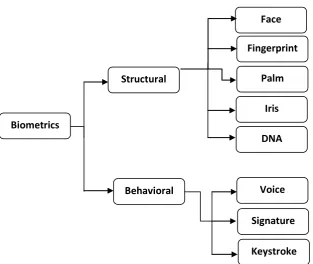
In the past centuries, body characteristics have used by humans such as face, voice, and so on to distinguish or know each other. Nowadays, security technology and the authentication of individuals are very vital and necessary for many different secure areas in our lives. Various kinds of Biometric technologies have been used in many countries in the world to identify the identity of the individuals in their various secure areas; for instance, passport control, resident buildings, some vital rooms in the buildings, International Airports, ATMs, and so on.
2
Figure 1.1 Different Types of Biometrics.
Data computing sensors
Figure 1.2 Basic Block Diagram of a Biometric System.
Biometrics
Structural
Behavioral
Face
Fingerprint
Palm
Iris
DNA
Voice
Signature
Keystroke
Biometric Templates Features
Extraction
Generate Template
Comparison
Database
1.1.1 Why Iris?
There are many various types of biometrics and each one has its own strong points and weak points. To pick the right one to be highly fit for the special case, we picked Iris pattern because of its unique traits that two eyes are not the same even twins have different eyes as well as left and right irises for an individual. Moreover, Iris pattern has stability throughout the lifetime, because internal organ of the eye is protected by the cornea and aqueous humor (Daugman, 2003). Irises do not change even with age, expression, makeup, and pose. For all of the above reasons Iris pattern is measuring as the most secure and convenient biometric.
1.1.2 Iris Recognition
4
In addition, all phases are important in iris recognition system but iris localization is one of the most critical and difficult phase (Shamsi et al., 2009), because of any mistake made in this phase will result to inexact extraction of pattern which will be stored in the database and will lead to an unsuccessful system implementation (Nkole, 2012).
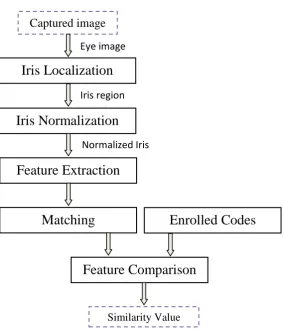
Figure 1.3 Daugman’s Model for Iris Recognition Scheme.
1.2 Problem Background
There are five phases in Iris recognition system (according to Daugman Model for Iris recognition): Image Acquisition, Iris Localization, Iris Normalization, Feature Extraction, and Matching.
Iris Localization
Captured imageSimilarity Value
Iris Normalization
Feature Extraction
Matching
Enrolled Codes
Feature Comparison
Eye imageIris region
The iris images are collecting during the first phase (Birgale and Kokare, 2009). Generally, this phase carried several flaws and factors such as: blind person, hurry process, light intensity, distance between the iris camera and the eye, obscured by eyeglasses, eyelashes and eyelids. In spite of several iris image databases are available and most studies have used them; for examples, UBIRIS, MMU, UPOL, BATH, ICE, and WVU, but their iris images have different kind of noises and low resolution, because good quality of images require too much cost and large memory (Proenca and Alexandre, 2007).
The second phase is one of the most significant and difficult in the Iris recognition scheme is called Iris localization, because it defines two boundaries; the inner (pupil/iris) boundary and the outer (iris/sclera) boundary of the iris region in an eye image (Soltany et al., 2012). In the most cases, the outer (iris/sclera) boundary has low contrast signal in infrared light which makes the sclera often as dark as the iris, because inside the sclera consists of a lot of blood and hemoglobin in blood absorbs strongly in the near infrared spectrum (Daugman, 2006). There are several issues in Iris Localization phase that should be resolved; for examples, an off-axis gaze, blur, low quality and contrast, specular reflection, shadow, bright spot,
unfocused image (Shamsi, 2011; He et al., 2009).
Integro-Differential Operator (IDO) used by Daugman to detect and find both inner and outer circles of the iris in (Daugman, 1993), but fourteen years later; after using Active Contour algorithm based on Discrete Fourier Series in (Daugman, 2007) he discovered that the inner (pupil) and outer (limbic) boundary were not circular shape absolutely. The 2D Gabor Wavelet also used by Daugman in (Daugman, 1993); to eliminate noises of the iris in an eye image that composed of eyelids and eyelashes, but ten years later in (Daugman, 2002); he discovered that the all useless information (noises) were not taken away entirely.
6
many other authors and researchers used this methods; for instance, (Kong and Zhang, 2003), (Tisse et al., 2002), (Ma et al., 2002), and (Nkole, 2012) used Circular Hough Transform to localize irises as well. But using Hough Transform method has several weak points and the most important are: First, since the circular Hough transform uses threshold values for edge detection, critical edge points can be removed which can result in failure to detect circles. Also, the Hough transform algorithm is computationally time-consuming which makes it non-ideal for real time applications, and too many parameters need it (Wildes, 1997).
The Canny Edge Detection and Hough Circle Detection were used to localize the inner and outer boundaries by (Masek, 2003) for preprocessing, while (Shamsi, 2011) based on the assumption that since the pupil is black and that it is the center of the iris, and then used average square shrinking approach to localized the center of the pupil.
All the above algorithms try to find circle shapes to detect the pupillary (inner) and limbic (outer) boundaries, but active contour models assume that actually both boundaries are near-circular contour rather than perfect circle (Arvacheh and Tizhoosh, 2006). Later, (Daugman, 2007) proposed active contours model as an excellent approach to describe both pupil/iris (inner) boundary and iris/sclera (outer) boundary.
using the circular pupil/iris (inner) boundary estimate as an initial contour (Hilal et al., 2012).
Mostafa et al. also proposed Chan-Vese method. In the first step, they also applied Circular Hough Transform then they used a numerically stable Direct Least Square-based elliptical fitting model to approximate the iris/sclera boundary. In the second step, they applied a modified Chan-Vese method to approximation exact pupillary and limbic boundaries. Hence, using both Hough Transform and Chan-Vese methods on one image at the same time occupies large memory space thereby resulting to a slow processing time (Mostafa et al., 2012).
Li et al. presented a new Variational Level Set of Active Contours without Re-initialization method to detect one or more desire objects in medical and real images especially those their boundaries are weak and strong noise (Li et al., 2005).
1.3 Problem Statement
Though, we can get iris in the captured image of eye, but simultaneously it
contains other useless information around the iris region such as: pupil, eyelashes,
eyelids, and sclera. So, localization stage is very important to demarcate iris region.
Although, most localization methods showed that inner (pupil/iris) and outer
(iris/sclera) boundaries of the iris are perfect circles, but in fact, they have
near-circular shape in the most cases. As a result, we applied Chan-Vese model and
Variational Level Set of Active Contours without Re-initialization in this thesis.
There are several different kinds of noise to make iris recognition scheme
poor performance; for instance, bright spot, eyelashes, and the lower and upper
eyelids. In this dissertation, we intend to come up with an approach to overcome the
8
1.4 Research Question
The research question is:
How to localize the inner boundary and outer boundary of an eye image?
In view of the above question, the following issues have to be solved.
I. How to detect the inner boundary?
II. How to localize the pupil region?
III. How to localize of the iris?
1.5 Dissertation Aim
The main aim of this dissertation is to accurately localize iris in an eye image
by enhancing the algorithms Chan-Vese model to localize pupillary boundary (inner
– the black portion of the eye) as in (Hilal et al., 2012), and Level Set of Active
Contours without Re-initialization to detect limbic boundary (outer – the white
portion of the eye) depends on (Li et al., 2005).
1.6 Objectives of Study
To obtain the aims above, we have to do the following:
I. To reduce the eye image noise and the effect of eyelashes and eyelids.
II. To detect the boundary between pupil and iris and demarcate the pupil
region from the eye image.
1.7 Research Scope
We focused on Iris Localization phase which involves detecting the iris and
pupil in an eye image, and demarcating its inner (iris/pupil) and outer (iris/sclera) boundaries. Moreover, the main issue of this research is about noncircular both boundaries in the iris images due to camera position and off-angle gaze. The next issues are about blur images and occlusion due to eyelids and eyelashes decrease the iris localization accuracy. To ensure the performance of the proposed methods, the algorithms are tested and implemented on 404 non-ideal iris images from
CASIA-iris-interval Version 3.
1.8 Research Framework
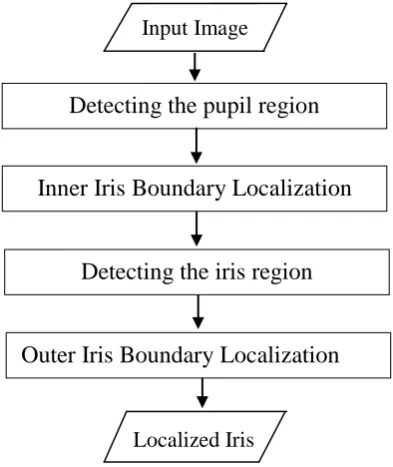
Our work is Iris Localization process that consists of: detecting of the pupil region, inner iris boundary localization, and outer iris boundary localization. Figure 1.4 shows the follow of data in Iris localization process.
Figure 1.4 Research Frameworks. Localized Iris
Detecting the pupil region
Inner Iris Boundary Localization
Detecting the iris region
10
1.9 Dissertation Organization
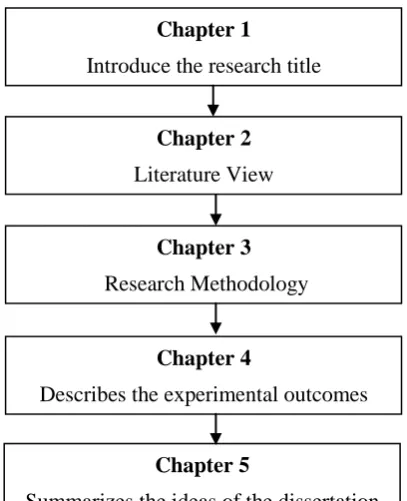
This research is arranged in chapters, Chapter one introduces the research title, explains the problem background highlights statement of problem, pin-point the research aim, establishes the objective of the study, discusses the scope of the research, hence the framework of the research and ended with the dissertation organization. The chapter two provides a detailed review of related literatures in Iris Localization while chapter three describes the methodology applied in the thesis.
Furthermore, chapter four describes the experimental outcome of how to detect inner boundary and localize pupil region using Chan-Vese model, and how to localize the iris region using Variational Level Set of Active Contours without Re-initialization. Finally, chapter five summaries the ideas of the dissertation, highlights the contributions and future works.
Figure 1.5 Organization of Dissertation. Chapter 1
Introduce the research title
Chapter 2 Literature View
Chapter 3 Research Methodology
Chapter 4
Describes the experimental outcomes
Chapter 5
REFERENCES
America, U. S. O. (2008). Biometric Technology Manual. Security. Washington DC, Published by the National Biometric Security Project (NBSP). 1.
Angle, S., Bhagtani, R., and Chheda, H. (2005). Biometrics: A further echelon of security. In UAE International Conference on Biological and Medical Physics, 2005.
Arvacheh, E. M., and Tizhoosh, H. R. (2006). Iris segmentation: Detecting pupil,
limbus and eyelids. IEEE International Conference onImage Processing,
2453-2456.
Babich, A. (2012). Biometric authentication. Types of biometric identifiers. Bachelor of Science. University of Applied Sciences.
Basit, A., Javed, M., and Anjum, M. (2005). Efficient iris recognition method for human identification. World Academy of Science, Engineering and Technology, 4, 24-26.
Birgale, L. V., and Kokare, M. (2009, March). Iris recognition using discrete wavelet
transform. In 2009 International Conference on Digital Image Processing,
147-151.
Boles, W., and Boashash, B. (1998). A human identification technique using images of the iris and wavelet transform. IEEE Transactions on Signal Processing,
46, 1185-1188.
Bowyer, K. W., Hollingsworth, K., and Flynn, P. J. (2008). Image understanding for iris biometrics: A survey. Computer Vision and Image Understanding, 110, 281-307.
69
Caselles, V., Catte, F., Coll, T., and Dibos, F. (1993). A geometric model for active contours in image processing. Numerische mathematik, 66, 1-31.
Chan, T. F., and Vese, L. A. (2001). Active contours without edges. IEEE Transactions on Image Processing, 10, 266-277.
Chin, S., Jin, A., and Ling, D. (2006). High security iris verification system based on random secret integration. Computer Vision and Image Understanding, 102, 169-177.
Daugman, J. (2007). New methods in iris recognition. Systems, Man, and Cybernetics, Part B: IEEE Transactions on Cybernetics, 37, 1167-1175. Daugman, J. (2003). Demodulation by complex-valued wavelets for stochastic
pattern recognition. International Journal of Wavelets, Multiresolution and Information Processing, 1, 1-17.
Daugman, J. (2004). How iris recognition works. IEEE Transactions on Circuits and Systems for Video Technology, 14, 21-30.
Daugman, J. (2006). Probing the uniqueness and randomness of IrisCodes: Results from 200 billion iris pair comparisons. Proceedings of the IEEE, 94, 1927-1935.
Daugman, J. G. (1993). High confidence visual recognition of persons by a test of statistical independence. IEEE Transactions on Pattern Analysis and Machine Intelligence, 15, 1148-1161.
Daugman, J. G. (2002). How iris recognition works. In: Proceedings of International Conference on Image Processing, 1, (pp. 1-33-6), Piscataway, NJ.
Dorairaj, V., Schmid, N. A., and Fahmy, G. (2005). Performance evaluation of non-ideal iris based recognition system implementing global ICA encoding. ICIP 2005. IEEE International Conference on Image Processing, 2005. IEEE, III-285-8.
Drahanský, M. (2005). Biometric security systems fingerprint recognition technology. Publishing the Technical University in Brno VUTIUM, ISBN 80-214-2969-0.
Fancourt, C., Bogoni, L., Hanna, K., Guo, Y., Wildes, R., Takahashi, N., and Jain, U. (2005). Iris recognition at a distance. Audio-and Video-Based Biometric Person Authentication. Springer, 187-200.
He and Shi, P. F. (2005). A novel iris segmentation method for hand-held capture device. Advances in Biometrics, 479-485.
He, Z., Tan, T., Sun, Z., and Qiu, X. (2009). Toward accurate and fast iris segmentation for iris biometrics. IEEE Transactions on Pattern Analysis and Machine Intelligence, 31, 1670-1684.
Hilal, A., Daya, B., and Beauseroy, P. (2012). Hough Transform and Active Contour for Enhanced Iris Segmentation. International Journal of Computer Science Issues, 9(2), 1694-0814.
Horst, J. (2006). Iris Recognition: A General Overview. Journal of Student Research, 19-24.
Ibiyemi, T., and Ogunsakin, J. (2012). Bi-Modal Biometric Authentication by Face Recognition and Signature Verification. International Journal of Computer Applications, 42, 17-21.
Itai, Y., Kim, H., Ishikawa, S., Yamamoto, A., and Nakamura, K. (2007). A segmentation method of lung areas by using snakes and automatic detection of abnormal shadow on the areas. International Journal of Innovative Computing, Information, and Control, 3, 277-284.
Jain, A. K., Flynn, P., and Ross, A. A. (2010). Handbook of biometrics, Springer Publishing Company, Incorporated.
Jain, A. K., and Kumar, A. (2010). Biometrics of next generation: An overview. Springer Berlin, Germany.
Jain, A. K., Ross, A., and Prabhakar, S. (2004). An introduction to biometric recognition. IEEE Transactions on Circuits and Systems for Video Technology, 14, 4-20.
Jillela, R., Ross, A., Boddeti, N., Vijaya Kumar, B., Hu, X., Plemmons, R., and
Pauca, P. (2012). An Evaluation of Iris Segmentation Algorithms in
Challenging Periocular Images. Handbook of Iris Recognition, Springer,
Heidelberg.
Kang, B., and Park, K. (2005). A study on iris image restoration. Audio-and Video-Based Biometric Person Authentication. Springer, 251-262.
Kass, M., Witkin, A., and Terzopoulos, D. (1988). Snakes: Active contour models.
71
Kong, W. K., and Zhang, D. (2003). Detecting eyelash and reflection for accurate iris segmentation. International Journal of Pattern Recognition and Artificial Intelligence, 17, 1025-1034.
Li, C., Xu, C., Gui, C., and Fox, M. D. (2005). Level set evolution without re-initialization: A new variational formulation. CVPR 2005. IEEE Computer Society Conference on Computer Vision and Pattern Recognition. IEEE, 430-436.
Li, C., Xu, C., Gui, C., and Fox, M. D. (2010). Distance regularized level set evolution and its application to image segmentation. IEEE Transactions on Image Processing, 19, 3243-3254.
Li, D., Babcock, J., and Parkhurst, D. J. (2006). OpenEyes: a low-cost head-mounted eye-tracking solution. Proceedings of the 2006 symposium on Eye tracking research and applications. ACM, 95-100.
Lili, P., and Mei, X. (2005). The algorithm of iris image processing. In Fourth IEEE Workshop on Automatic Identification Technologies, October 2005 of Conference., 134-138.
Liu, X. (2006). Optimizations in iris recognition. Doctor of Philosophy, University of Notre Dame.
Liu, Y., Yuan, S., Zhu, X., and Cui, Q. (2003). A practical iris acquisition system and a fast edges locating algorithm in iris recognition. In IEEE Instrumentation and Measurement Technology Conference, 2003 of Conference., 1, 166-168. Loutfi, A., and Coradeschi, S. (2008). Odor recognition for intelligent systems.
Intelligent Systems, IEEE, 23(1), 41-48.
Ma, L., Tan, T., Wang, Y., and Zhang, D. (2003). Personal identification based on iris texture analysis. IEEE Transactions on Pattern Analysis and Machine Intelligence, 25, 1519-1533.
Ma, L., Tan, T., Wang, Y., and Zhang, D. (2004). Efficient iris recognition by characterizing key local variations. IEEE Transactions on Image Processing,
13, 739-750.
Ma, L., Wang, Y., and Tan, T. (2002). Iris recognition using circular symmetric
filters. In 2002, Proceedings. 16th International Conference on Pattern
Mahlouji, M., and Noruzi, A. (2012). Human iris segmentation for iris recognition in
unconstrained environments. IJCSI International Journal of Computer
Science Issues, 9(3).
Malladi, R., Sethian, J. A., and Vemuri, B. C. (1995). Shape modeling with front propagation: A level set approach. IEEE Transactions on Pattern Analysis and Machine Intelligence, 17, 158-175.
Masek, L. (2003). Recognition of Human Iris Patterns for Biometric Identification. Bachelor of Engineering, The University of Western Australia.
Matey, J. R., Broussard, R., and Kennell, L. (2010). Iris image segmentation and suboptimal images. Image and Vision Computing, 28, 215-222.
Merloti, P. E. (2004). Experiments on Human Iris Recognition using Error Backpropagation Artificial Neural Network. Prepared for Neural Network Class (CS533) of Spring Semester. San Diego State University.
Mitchell, H. B. (2010). Image Fusion: Theories, Techniques and Applications. Springer, Scientific Publishing Services Pvt. Ltd., Chennai, India.
Monaco, M. K. (2007). Color Space Analysis for Iris Recognition. Master of Science, West Virginia University.
Mostafa, E., Mansour, M., and Saad, H. 2012. Noncooperative Iris Segmentation.
International Journal of Computer Science, 9, 1.
Mumford, D., and Shah, J. (2006). Optimal approximations by piecewise smooth functions and associated variational problems. Communications on pure and applied mathematics, 42, 577-685.
Nkole, I. U. (2012). An Enhanced Iris Segmentation Algorithm using Circle Hough Transform. Master of Science, Universiti Teknologi Malaysia.
Osher, S., and Sethian, J. A. (1988). Fronts propagating with curvature-dependent speed: algorithms based on Hamilton-Jacobi formulations. Journal of computational physics, 79, 12-49.
Peters, T. H. (2009). Effects of Segmentation Routine and Acquisition Environment on Iris Recognition. Doctor of Philosophy, University of Notre Dame.
73
Puhan, N. B., Sudha, N., and Sivaraman Kaushalram, A. (2011). Efficient segmentation technique for noisy frontal view iris images using Fourier spectral density. Signal, Image and Video Processing, 5, 105-119.
Rani, E., and Shanmugalakshmi, R. (2012). An Efficient Palmprint Recognition System Based on Extensive Feature Sets. European Journal of Scientific Research, 71, 520-537.
Rekik, A., Zribi, M., Hamida, A. B., and Benjelloun, M. (2007). Review of satellite image segmentation for an optimal fusion system based on the edge and region approaches. Inernational Journal Computer Science and Network Security, 7(10), 242-250.
Roberts, C. (2007). Biometric attack vectors and defenses. Computers and
Security, 26(1), 14-25.
Rudrapal, D., Das, S., Debbarma, S., Kar, N., and Debbarma, N. (2012). Voice Recognition and Authentication as a Proficient Biometric Tool and Its Application in Online Exam for PH People. International Journal of Computer Applications, 39.
Ryan, W. J., Woodard, D. L., Duchowski, A. T., and Birchfield, S. T. (2008). Adapting starburst for elliptical iris segmentation. BTAS 2008. 2nd IEEE International Conference on Biometrics: Theory, Applications and Systems, 2008. IEEE, 1-7.
Sahmoud, S. A. (2011). Enhancing Iris Recognition. Master of Science, Islamic University.
Shamsi, M. (2011). Ellipse Gamma Spectrum Iris Recognition based on Average Square Shrinking Segmentation and Trapezium Normalisation. Doctor of Philosophy, Universiti Teknologi Malaysia.
Shamsi, M., Saad, P. B., Ibrahim, S. B., and Kenari, A. R. (2009). Fast algorithm for iris localization using Daugman circular integro differential operator. SOCPAR'09. International Conference of Soft Computing and Pattern Recognition, 2009. IEEE, 393-398.
Soltany, M., Zadeh, S. T., and Pourreza, H. R. (2012). Daugman’s Algorithm Enhancement for Iris Localization. Advanced Materials Research, 403, 3959-3964.
Sun, C., Zhou, C., Liang, Y., and Liu, X. (2006). Study and improvement of iris location algorithm. ADVANCES IN BIOMETRICS, Lecture Notes in Computer Science. Springer. 3832, 436-442.
Sun, S., and Zhao, L. (2012). Bovine iris segmentation using region-based active contour model. International Journal of Innovative Computing, Information and Control, 8, 9.
Sung , H., Lim, J., Park, J. h. and Lee, Y. (2004). Iris recognition using collarette boundary localization. 17th International Conference on Pattern Recognition (ICPR'04), 2004 of Conference., 4, 857–860.
Tian, Q. C., Pan, Q., Cheng, Y. M., and Gao, Q. X. (2004). Fast algorithm and application of hough transform in iris segmentation. International Conference on Machine Learning and Cybernetics, August 2004 of Conference., 7, 3977– 3980.
Tisse, C., Martin, L., Torres, L., and Robert, M. (2002). Person identification
technique using human iris recognition. Proceedings of Vision Interface,
294-299.
Uchida, C. D. (2004). Safe Kids, Safe Schools: Evaluating the Use of Iris Recognition Technology in New Egypt, NJ. Washington, DC: US Department of Justice.
Verma, P., Dubey, M., Verma, P., and Basu, S. (2012). Daughman's algorithm
method for iris recognition-a biometric approach. International Journal of
Emerging Technology and Advanced Engineering, 2(6), 177-185.
Wang, L., Li, C., Sun, Q., Xia, D., and Kao, C. Y. (2009). Active contours driven by local and global intensity fitting energy with application to brain MR image segmentation. Computerized Medical Imaging and Graphics, 33, 520.
Wildes, R., Asmuth, J., Green, G., and Hsu, S. (2004). A system for automated iris recognition. Second IEEE Workshop on Applications of Computer Vision, 121- 128.
Wildes, R. P. (1997). Iris recognition: an emerging biometric technology.
75
Xu, C., Yezzi, A., and Prince, J. L. (2000). On the relationship between parametric and geometric active contours. Conference Record of the Thirty-Fourth Asilomar Conference on Signals, Systems and Computers, 2000. IEEE, 483-489.
Xu, X. W. (2013). An Efficient Iris Segmentation Method for Non-Ideal Iris Images.
Advanced Materials Research, 658, 597-601.
Yahya, A. E., and Nordin, M. J. (2008). A new technique for iris localization in iris recognition systems. Information Technology Journal, 7(6), 924-929.
Yahya, A. E., and Nordin, M. J. (2010). Accurate Iris Segmentation Method for Non-Cooperative Iris Recognition System. Journal of Computer Science, 6, 492-497.