MAGNETIC-FIELD-INDUCED LIQUID PHASE CATALYSIS OVER ELECTRICALLY CONDUCTING SURFACE CONTAINING TITANIUM
DIOXIDE
AMELIA BINTI BOON HOO
MAGNETIC-FIELD-INDUCED LIQUID PHASE CATALYSIS OVER ELECTRICALLY CONDUCTING SURFACE CONTAINING TITANIUM
DIOXIDE
AMELIA BINTI BOON HOO
A thesis submitted in fulfillment of the requirement for the award of the degree of
Master of Science (Chemistry)
Faculty of Science Universiti Teknologi Malaysia
For the LORD almighty
Glory be Yours forever…
Rom 11: 36
My beloved DAD, MUM, Brothers - Augustine and Arnold,
Aunties, Uncles, cousins - Step and Phing,
My family in Christ (especially Jael), and
some of my ex-course mates……
ACKNOWLEDGMENTS
I greatly appreciate the continuous advices, inspiration, support and guidance from my research supervisor, Associate Professor Dr. Hadi Nur as my supervisor for this Master’s Project, not only for his invaluable academic guidance, but for his enthusiasm, patience, sincerity and kindness as well. Thanks for his contribution in the progress of doing this research. Without his help, the process of completing this research will not be so successful.
Special thanks are extended to Associate Professor Dr Zainab Ramli and Dr. Lee Siew Ling from the Faculty of Science for giving their information, advice, concern and guidance throughout the duration of this study.
Besides, I would like to thank Lim Kheng Wei and Wan Faizal Wan Ahmad from Ibnu Sina Institute for Fundamental Science Studies for helping me in handling certain instrument and with the help of getting some needed chemicals and apparatus. I would also like to thank PSZ for providing books, journals and the internet services for me to search related and useful materials.
I am indebted to my family for their all-out support especially my parents and aunties for their spiritual and financial support. Besides, I want to give my gratitude for my sisters in Christ and friends for their friendship, supports, suggestions and help.
ABSTRACT
ABSTRAK
CONTENTS
CHAPTER TITLE PAGE
DECLARATION DEDICATION
ACKNOWLEDGEMENTS ABSTRACT
ABSTRAK
TABLE OF CONTENTS LIST OF ABBREVIATIONS LIST OF TABLES
LIST OF FIGURES LIST OF APPENDICES
ii iii iv v vi vii xiii xvi xvii xx
1 INTRODUCTION
1.1 Research Background and Problem Statement 1.2 Development of New Heterogeneous Catalysts
System
1.3 Objective of Study 1.4 Scope of Study
1
2 6 6
2 LITERATURE REVIEW
2.1 Introduction to Catalysis
2.1.1 Catalysts and Reaction Energetic 2.1.2 Importance of Catalysis
2.1.3 Type of Catalysts
2.1.3.1 Homogeneous Catalysis 2.1.3.2 Heterogeneous Catalysis
2.2 Electric-field-induced Chemistry
2.3 Existence of the Magnetic Field by the Flow of Electric Current
2.4 Adsorption and Desorption in Catalytic Cycles 2.4.1 Physisorption and Chemisorption 2.4.2 Application of Adsorption in Industries 2.4.3 Adsorption in Electrochemistry
2.5 Carbon Conductive Grease 2.5.1 Carbon Black
2.5.2 Polydimethylsiloxane 2.6 Polypyrrole
2.7 Titanium Dioxide
2.7.1 Titanium Dioxide as Photocatalyst 2.8 Oxidation of Alcohols
2.8.1 Oxidation of Benzhydrol 2.9 Dye Adsorption
2.9.1 Dyes
2.9.2 Dye Classification
2.9.3 Dye Removal Techniques 2.9.4 Methylene Blue
12 12 15 16 17 18 18 19 19 20 22 23 25 26 28 28 28 29 31
3 METHODOLOGY
3.1 Chemicals and Apparatus 3.1.1 Chemicals 3.1.2 Apparatus
3.1.3 Instrumental Analysis
3.1.3.1 X-ray Diffractometry (XRD) 3.1.3.2 Fourier Transform Infrared
(FTIR) Spectroscopy
3.1.3.3 Field Emission Scanning Electron Microscopy (FESEM)
3.1.3.5 Gas Chromatography (GC) 3.2 Models of Integrated Catalytic System for Magnetic-field-induced Catalytic Reaction
3.2.1 Polypyrrole Film Impregnated with Titanium Dioxide Electrochemically 3.2.1.1 Preparation of Polypyrrole Film
Impregnated with Titanium Dioxide Electrochemically 3.2.1.2 The Study of Polypyrrole Film
Impregnated with Titanium Dioxide Electrochemically as Catalytic System in Epoxidizing 1-Octene
3.2.2 Modified Polypyrrole Film Impregnated with Titanium Dioxide Electrochemically by using Octadecyltrichlorosilane
3.2.2.1 Preparation of Modified Polypyrrole Film Impregnated with Titanium Dioxide
Electrochemically by using Octadecyltrichlorosilane 3.2.2.2 The Study of Removal of
Methylene Blue Enhanced by Generated Magnetic field using Modified Polypyrrole Film Impregnated with Titanium Dioxide Electrochemically 3.2.3 Immobilized PPy/TiO2 Mixture onto
Conducting Carbon Grease
3.2.3.1 Determination of the Relationship between the Electric Current flowing through Bronze Foil and the Magnetic Field generated by It
3.2.3.2 Preparation of Polypyrrole Loaded with Titania in various Proportions
3.2.3.3 Experimental Setup for
Immobilized PPy/TiO2 Mixture
onto Conducting Carbon Grease as New Design Catalytic System 3.2.3.4 The Study of Immobilized
PPy/TiO2 Mixture onto
Conducting Carbon Grease as Catalytic System in Organic Media
3.2.3.5 The Study of Immobilized PPy/TiO2 Mixture onto
Conducting Carbon Grease as Catalytic System in Aqueous Medium
3.2.3.6 The Study of Immobilized PPy/TiO2 Mixture onto
Conducting Carbon Grease as Catalytic System in Dye Adsorption Process 3.3 Characterization
3.3.1 Fourier Transform Infrared (FTIR) Spectroscopy
3.3.2 Ultraviolet-Visible (UV-Vis) Spectroscopy
3.3.3 Field Emission Scanning Electron Microscopy (FESEM)
3.3.4 X-ray Diffractometry (XRD) 3.3.5 Gas Chromatography (GC)
4 RESULTS AND DISCUSSION
4.1 Models of Integrated Catalytic System for Magnetic-field-induced Catalytic Reaction 4.1.1 Polypyrrole Film Impregnated with
Titanium Dioxide Electrochemically as Catalytic System in Epoxidazing 1-Octene 4.1.2 The Removal of Methylene Blue
Enhanced by Generated Magnetic Field using Modified Polypyrrole Film Impregnated with Titanium Dioxide Electrochemically
4.1.3 Immobilized PPy/TiO2 Mixture onto
Conducting Carbon Grease as Catalytic System
4.1.3.1 Determination of the Relationship between the Electric Current flowing through Bronze Foil and the Magnetic Field generated by It
4.1.3.2 Immobilized PPy/TiO2 Mixture
onto Conducting Carbon Grease as Catalytic System in Organic Media
4.1.3.3 Immobilized PPy/TiO2 Mixture
onto Conducting Carbon Grease as Catalytic System in Aqueous Medium
4.2 Adsorption of Dyes Process under the influences of Generated Magnetic Field by using
Immobilized PPy/TiO2 Mixture onto Conducting
Carbon Grease as Catalytic Model System
62
64
66
69
69
71
72
4.3 Oxidation of Benzhydrol with Aqueous Hydrogen Peroxide under Generated Magnetic Field by using Immobilized PPy/TiO2 Mixture onto
Conducting Carbon Grease as Catalytic Model System
4.4 The Location of the Most Active Oxidation Site
76 82
5 CONCLUSIONS AND RECOMMENDATIONS
5.1 Conclusions 5.2 Recommendations
85 86
REFERENCES 88
LIST OF ABBREVIATIONS
PPy - Polypyrrole
Ti - Titanium
TiO2 - Titanium dioxide
OTS - Octadecyltrichlorosilane
Ti(SO4)2 - Titanium (IV) sulfate
DC - Direct current
XRD - X-ray diffractometry
FTIR - Fourier transform infrared spectroscopy
IR - Infrared
FESEM - Field emission scanning electron microscope
UV-Vis - Ultraviolet-visible spectroscopy
UV/Vis/Nir - Ultra violet– visible-near infrared
GC - Gas chromatography
FID - Flame ionization detector
EDX - Energy dispersive X-ray spectroscopy
tr - Retention time
PDMS - Polydimethylsiloxane
CB - Conduction band
VB - Valence band
h+ - Positively charged hole
e-cb - Negatively charged electrons (e-) in the conduction band
h+vb - Positively charged hole (h+) in the valence band
H2O - Water
H+ - Proton
·OH - Hydroxyl radical
(C6H5)2C=O - Benzophenone
(C6H5)2CHOH - Benzhydrol
TON - Turnover number
SrTiO3 - Strontium titanate
Fe2O3 - Iron (III) oxide
CdS - Cadmium sulfide
WO3 - Tungsten (VI) oxide
ZnS - Zinc sulfide
FeTiO3 - Iron titanium oxide
ZrO2 - Zirconium oxide
V2O5 - Vanadium oxide
Nb2O5 - Niobium oxide
SnO2 - Stannic oxide
Eg - Energy gap
[O] - Oxidizing agent
RCH2OH - Primary alcohol
RCH=O - Aldehydes
RCOOH - Carboxylic acids
R2C=O - Ketones
PCC - Pyridinium chlorochromate
DDQ - Dichlorodicynoquinone
-N=N- - Azo
-C=O - Carbonyl
-C=C- - Carbon-carbon double bonds
-NO2 - Nitro functional groups
–CH=N- - Carbon-nitrogen functional groups
C=S - Carbon-sulfur functional groups
-NO - Nitroso functional groups
RNA - Ribonucleic acid
DNA - Deoxyribonucleic acid
E0 - Ground state energy
E1 - First excited state energy
KBr - Potassium bromide
ε - Molar absoptivities
T - Transmittance
A - Absorbance
He - Helium
I0 - Intensity of reference beam
I - Intensity of sample beam
Aq - Aqueous
BW - Magnetic field generated by wire
BE - Earth magnetic field
LIST OF TABLES
TABLE NO. TITLE PAGE
3.1
4.1
4.2
4.3
4.4
4.5
4.6
Polypyrrole loaded with titanium dioxide in various proportions
Three models of integrated catalytic system to demonstrate the effect of generated magnetic field in liquid phase reaction
The value of the distance, r and its corresponding electric current when the magnetometer was pointing to angle θ = 10° achieved by the bronze foil
Adsorption of methylene blue at different temperature
Adsorption of methylene blue in the absence of catalyst system for 75 minutes
Oxidation of benzhydrol to benzophenone when magnetic field is applied
Oxidation of benzhydrol to benzophenone without the application of external magnetic field in the catalytic system
51
63
70
74
75
78
LIST OF FIGURES
FIGURE NO. TITLE PAGE
1.1 1.2 1.3 1.4 2.1 2.2 2.3 2.4 2.5 2.6 2.7 2.8 2.9 3.1 3.2
The conceptual model for the desired heterogeneous catalytic system
The model of the polypyrrole and titanium dioxide
The chemical structure of polypyrrole polymer chain
Schematic representation of the research question and statement of the problem
Potential energy diagram of the effect of a catalyst in a hypothetical exothermic chemical reaction
The circular field lines of the magnetic field formed around the wire.
Diagram of calculating the total magnetic field.
Diagram of adsorption and desorption process
The structure of polydimethylsiloxane with [SiO(CH3)2] as
the repeating monomer units
Mechanism of pyrrole polymerization
Structure of polarons and bipolarons in polypyrrole
Possible reaction pathway for generated electron-hole pairs in titanium dioxide
Structure of methylene blue
Methodology of this study in flow chart
The principle of XRD
3.3 3.4 3.5 3.6 3.7 3.8 3.9 3.10 3.11 3.12 3.13 3.14 3.15 4.1 4.2
The characteristic regions for common infrared stretching and bending vibrations
Field emission scanning electron microscopy (FESEM) principle
The principle of ultraviolet-visible (UV-Vis) spectroscopy
The basic components of a gas chromatography
Experimental set-up for polypyrrole film synthesis
Schematic diagram of the basic experimental set-up for the removal of dye enhanced by generated magnetic field
Setup of the apparatus for measuring the value of the generated magnetic field by bronze foil
The orientation of the bronze foil, bar magnet and the needle pointer of the magnetometer
Eleven series of the PPy/TiO2 mixture with the weight (g)
ratio of PPy/TiO2 mixture at: (i) 1.0:0; (ii) 0.9:0.1; (iii)
0.8:0.2; (iv) 0.7:0.3; (v) 0.6:0.4; (vi) 0.5:0.5; (vii) 0.4:0.6; (viii) 0.3:0.7; (ix) 0.2:0.8; (x) 0.1:0.9; and (xi) 0:1.0
Five examples of bronze foils of attached PPy/TiO2 mixture
with the weight (g) ratio at: (i) 0:1.0; (ii) 0.1:0.9; (iii) 0.5:0.5; (iv) 0.9:0.1; and (v) 1.0:0
Diagram of experimental setup for this new design catalytic system
Schematic diagram of the basic experimental set-up used in oxidizing benzhydrol to benzophenone reaction
Experimental set-up used in the adsorption process of methylene blue under magnetic field
Bubbles was rising on the surface of the polypyrrole film loaded with titanium oxide once they were immersed in aqueous hydrogen peroxide
4.3
4.4
4.5
The removal efficiency of methylene blue solution at room temperature after 3 hours of reaction under two different experimental conditions: (i) without magnetic field effects, (ii) under magnetic field. The application of electric field was 2.0 V and 5.0 A
The model of methylene blue developed by ChemOffice 6.0 software
The adsorption of methylene blue towards PPy-TiO2-OTS
pellet under the influence of generated magnetic field
67
68
69
4.6
The graph of
versus distance showed by bronze foil 70
4.7 4.8 4.9 4.10 4.11 4.12 4.13
Concentration of adsorbed methylene blue on the surface of catalyst system containing titanium dioxide
Model mechanism for the adsorption of cationic dye particles towards polypyrrole in a magnetic-field-induced system
The model of benzhydrol developed by ChemOffice 6.0 software
The yield of benzophenone on the the oxidation of benzohydrol by aqueous hydrogen peroxide. All reactions were carried out at 70 oC for 20 min. The bronze foil which was used in this catalytic system produced magnetic field at 13 X 10-6 T. (a) The FESEM photographs, (b) EDX mapping, (c) elemental Ti count image and (d) arrangement of TiO2 on the surface of catalyst system.
The turnover number per Ti in the oxidation of benzohydrol by aqueous hydrogen peroxide. Reaction conditions are the same as given in Figure 4.11
The schematic representation of the catalyst system induced by generated magnetic field
Proposed model of an effective region for catalytic oxidation reaction induced by generated magnetic field
LIST OF APPENDICES
APPENDIX TITLE PAGE
A
B
C
D
X-ray diffractogram of titanium dioxide sample
FTIR spectra of PPy/TiO2 mixture samples in
various proportions. Composition of titanium dioxide and poplypyrrole is given at the individual curves
Oxidation of benzhydrol to benzophenone under the influence of magnetic field
Oxidation of benzhydrol to benzophenone without the influence of magnetic field
98
99
100
CHAPTER I
INTRODUCTION
1.1 Research Background and Problem Statement
In the 21st century, industrial catalyst technologies affect nearly all areas particularly chemical and petroleum industries since the vast majority of industrial processes and the synthesis of new materials are based on catalytic reactions [1]. Moreover, catalysts are utilized as a critical component of emerging technologies for improving the quality of life and also for environmental protection and alternative energy sources.
Basically, catalysts are classified into three subdisciplines according to their structure, composition, area of application, or state of aggregation. The three subdisciplines of catalysts classes are homogeneous catalysis, biocatalysis and heterogeneous catalysis. At present, heterogeneous catalytic reaction system is of fundamental importance in the chemical industry and in other technologically relevant applications since most of the catalytic chemical reactions are heterogeneous and adsorption [2-9].
catalytic reactions [13-17]. The development of new electrocatalysis holds a place on most ―top ten‖ lists for catalysis where electrocatalysis at nanoparticle surface is a
modern, authoritative treatise that provides comprehensive coverage at recent advances in nanoscale catalytic and electrocatalytic reactivity [7]. In recent years, magnetic field effect has been applied on chemical reactions like photocatalytic reaction [18, 19]. However, there is no report on the effect of magnetic field generated by external electric field in heterogeneous catalytic system.
Indeed, it has been a challenge to prepare catalysts with high activity and design catalytic systems with high efficiency in organic chemistry, organometallic chemistry, inorganic chemistry and catalytic chemistry. However, many fundamental atomic-scale and nanoscale understanding of catalysis has been developed. The success of both scientists and engineers that involve in these experiments to control catalytic chemistry had resulted in deeper insights into catalysis and allowed the design of new catalysts and catalytic processes that approach the ultimate goal in the studies of catalysts. Moreover, the breakthrough in computational chemistry, measurement techniques and imaging had further provided new fundamental knowledge for the catalysis research community.
As this study intends to design a new heterogeneous catalytic system to enhance the heterogeneous catalytic system by applying electric field to generate magnetic field on the catalyst system, more emphasis will be given to the set-up of the new heterogeneous catalytic system and the relevant heterogeneous catalytic reactions.
1.2 Development of New Heterogeneous Catalyst System
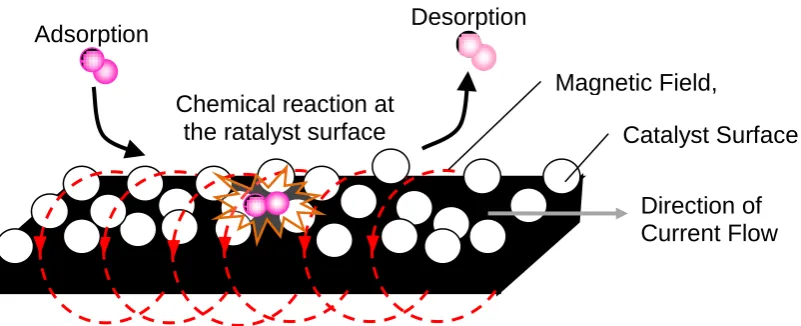
Therefore, the ultimate goal of this study is to design a new heterogeneous catalytic system to improve the efficiency of adsorption and desorption in catalytic cycle processes. This can be done by applying electric field to generate magnetic field on the surface of catalyst. Figure 1.1 shows the proposed design of the desired heterogeneous catalytic system.
Figure 1.1 : The conceptual model for the desired heterogeneous catalytic system
One suggests that external electric field does bring forth changes in the chemisorption and catalytic properties of semiconductors [13-17]. Hence, this new catalytic system design is basically based on the idea that the surface properties of the catalyst can be controlled by the presence of magnetic field. Moreover, magnetic field will be generated on a conductor when an electric field is switched on. As a result, the different physicochemical processes occur and this can stimulate adsorption and catalytic reactions on the surface of the catalyst [13-17]. In other words, when there is an application of an electric field which bring forth the magnetic field effects, the efficiency of adsorption and desorption (interaction between the catalyst and reactant) in catalytic cycle processes can be controlled.
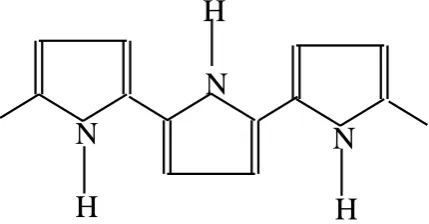
Figure 1.2 shows the model of a new integrated catalytic system using polypyrrole and titanium dioxide as conducting and catalytic active site, respectively. Polypyrrole is a conducting polymer and act as ―solid‖ solvent to control the amount of titanium dioxide in catalytic system. Polypyrrole is one of the conducting polymers with "back bone" of alternating double and single bonds, along which electrons can flow [20]. Polypyrrole with extending π-conjugated electron systems
Adsorption Desorption
Chemical reaction at
the ratalyst surface Catalyst Surface
have been extensively studied due to its good electrical conductivity and thermal stability, redox properties, environmental stability and easy preparation by both electrochemical and chemical approaches in various organic solvents and aqueous solution [17, 21]. It is also efficient electron donor and good hole transporter upon visible light excitation [22].
On the other hand, titanium dioxide was used to provide active sites for reaction to occur because it is resistant to photo-corrosion and has high oxidative power [23]. Due to its electrical conductive properties, it would be of great interest to study the adsorption and desorption behaviour of polypyrrole- titanium dioxide mixture under magnetic field.
Figure 1.2 : The model of the polypyrrole and titanium dioxide
Figure 1.3 : The chemical structure of polypyrrole polymer chain
By applying these concepts into the new integrated catalytic system, this model will be introduced with the expectation of combining the effects of adsorption ability of polypyrrole and the reactivity of titanium dioxide to enhance the overall catalytic activity.
N
H
N
H
H
N
Active site (titania)
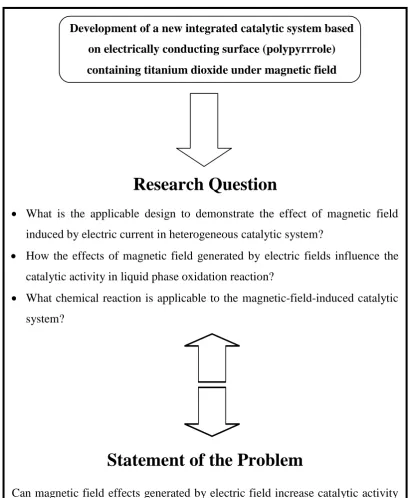
The effect of magnetic field on catalytic activity was investigated through several chemical reactions and adsorption experiments. In this study, epoxidation of alkane, oxidation of alcohol and also adsorption of dye were used to demonstrate the effect of magnetic field on the catalytic activity. The research questions and statement of the problem are shown in Figure 1.4.
Figure 1.4 : Schematic representation of the research question and statement of the problem
Research Question
What is the applicable design to demonstrate the effect of magnetic field
induced by electric current in heterogeneous catalytic system?
How the effects of magnetic field generated by electric fields influence the
catalytic activity in liquid phase oxidation reaction?
What chemical reaction is applicable to the magnetic-field-induced catalytic system?
Statement of the Problem
Can magnetic field effects generated by electric field increase catalytic activity in liquid phase reaction over solid catalyst?
1.3 Objective of Study
Main objectives of this study are:
(a) To develop a new magnetic-field-induced catalytic system based on electrically conducting surface containing titanium dioxide.
(b) To study the influence of magnetic field effects generated by external electric field on the catalytic activity in liquid phase catalysis over electrically conducting surface containing titanium dioxide.
1.4 Scope of Study
REFERENCES
1. Karakhanov, E. A., Maksimov, A. L. and Runova, E. A. (2005). Design of Supramolecular Metal Complex Catalytic Systems for Organic and Petrochemical Synthesis. Russ. Chem. Rev. 74 (1), 97 – 111.
2. Ikeda, S., Nur, H. and Ohtani, B. (2001). Phase-Boundary Catalysis of Alkene Epoxidation with Aqueous Hydrogen Peroxide using Amphiphilic Zeolite Particles Loaded with Titanium Oxide. J. Catal. 204, 402-408.
3. Ikeda, S., Nur, H., Sawadaishi, T., Ijiro, K., Shimomura, M. and Ohtani, B. (2001). Direct Observation of Bimoodal Amphiphilic Surface Structures of Zeolite Particles for a Novel Liquid-liquid Phase Boundary Catalysis. J. Langmuir. 17(26), 7976-7979.
4. Nur, H., Manan, A. F. N. A., Lim, K.W., Muhid, M. N. M. H. and Hamdan, H. (2005). Simultaneous Adsorption of a Mixture of Paraquat and Dye by NaY Zeolite Covered with Alkylsilane. J. Hazard. Mater. B117, 35-40.
5. Ikeda, S., Nur, H. and Ohtani, B. (2004). Phase Boundary Catalysts for Acid-catalyzed Reactions: The Role of Bimoodal Amphiphilic Structure and Location of Active Sites. J. Braz. Chem. Soc. 15(5), 719-724.
7. Wieckowski, A., Savinova, E. R. and Vayenas, C. G. (Eds.) (2003). Catalysis and Electrocatalysis at Nanoparticle Surfaces. New York: Marcel Dekker, Inc.
8. Tada, M. and Iwasawa, Y. (2003). Approaches to Design of Active Structures by attaching and Molecular Imprinting of Metal Complexes on Oxide Surfaces. J. Mol. Catal. A: Chem. 204–205, 27–53.
9. Pineda, M. (2008). Fluctuations in Heterogeneous Catalysis: CO Oxidation as a Case Study. Doctor Philosophy, Leibniz University Hannover, Germany.
10. Disselkamp, R.S., Judd, K. M., Hart, T. R., Peden, C. H. F., Posakony, G. J. and Bond, L. J. (2004). A Comparison between Conventional and Ultrasound-mediated Heterogeneous Catalysis: Hydrogenation of 3-buten-1-ol Aqueous S3-buten-1-olutions. J. Catal. 221, 347–353.
11. Hanh, H. D., Dong, N. T., Okitsu, K., Nishimura, R. and Maeda Y. (2009). Biodiesel Production through Transesterification of Triolein with various Alcohols in an Ultrasonic Field. Renewable Energy. 34, 766–768.
12. Suslick, K. S. (1994). The Chemistry of Ultrasound. Chicago: Encyclopaedia Britannica.
13. Mikheeva, Ε. Ρ. (1989). The Influence of Electric Fields on the Chemisorption and Catalytic Properties of Semiconductor Catalysts. Russ. Chem. Rev.58 (6), 881-907.
14. Pacchioni, G., Lomas, J. R. and Illas, F. (1997). Electric Field Effects in Heterogeneous Catalysis. J. Mol. Catal. A: Chem. 119, 263-273.
16. Yusuf, N., Zakari, B.Y. and Muhammad, F. (2008). Investigation into the Effect of Electric Field on the Absorption of Carbon Dioxide in a Polar Solvent (Water). J. Appl. Sci. Res. 4(6), 754-759.
17. Linford, R.G. (1990). Electrochemical Science and Technology of Polymers (Volume 2). England: Elsevier Science Publishers Ltd.
18. Wakasa, M., Ishii, N. and Okano, M. (2006). Magnetic Field Effect on Photocatalytic Decomposition Reaction of Tert-butanol with Platinized TiO2
Particles. C. R. Chimie. 9, 836–840.
19. Zhang, W., Wang, X. and Fu, X. (2003). Magnetic Field Effect on Photocatalytic Degradation of Benzene over Pt/TiO2. Chem. Commun. 2196-2197.
20. Johan, H. (2003). Conducting Polymers Containing In-Chain Metal Centres Electropolymerisation and Charge Transport. Doctor Philosophy, Uppsala University, Sweden.
21. Michael, E.G. (1994). Electroactive Polymer Electrochemistry (Part 1, Fundamentals). New York: Trans Plenum Press.
22. Liang, H. C. and Li, X. Z. (2009). Visible-Induced Photocatalytic Reactivity of Polymer–Sensitized Titania Nanotube Films. Appl. Catal. B: Environ. 86, 8–17.
23. Valentin, C. D., Finazzi, E., Pacchioni, G., Selloni, A., Livraghi, S., Paganini, M. C. and Giamello, E. (2007). N-doped TiO2: Theory and Experiment.
Chem. Phys. 339, 44–56.
25. Chorkendorff, I. and Niemantsverdriet, J. W. (2003). Concepts of Modern Catalysis and Kinetics. (2nd ed.) Weinheim: Wiley-VCH.
26. Walker, J. (2008). Fundamentals of Physics. (8th ed.). Honoken, N.J.: John Wiley & Sons, Inc.
27. Oldham, K. B. and Myland, J. C. (1994). Fundamentals of Electrohcemical Science. California: Academic Press, Inc.
28. Dwyer, D.J. and Hoffmann, F.M. (Eds.) (1992). Surface Science of Catalysis: In Situ Probes and Reaction Kinetics. Washington: American Chemical Society.
29. Farah Hannah binti Anuar (2007). Adsorption of Dyes on Polypyrrole under Applied Electric Potential. Degree of Bachelor, Universiti Teknologi Malaysia, Skudai.
30. Robin, J. J. (2008). The Comparative Study of Methylene Blue Removal by Graphite and Polypyrrole Loaded with Titanium Oxide Assisted by Electric Field and Ultraviolet Irradiation. Degree of Bachelor, Universiti Teknologi Malaysia, Skudai.
31. Ramaswamy, V., Jagtap, N.B., Vijayanand, S., Bhange, D.S. and Awati, P.S. (2008). Photocatalytic Decomposition of Methylene Blue on Nanocrystalline Titania prepared by different Methods. Mat. Res. Bull. 43, 1145–1152.
32. Rocher, V., Siaugue, Jean-Michel., Cabuil, V. and Bee, A. (2008). Removal of Organic Dyes by Magnetic Alginate Beads. Water Res. 42, 1290–1298.
33. Thomas, J. M. and Thomas W. J. (1997). Principles and Practice of Heterogeneous Catalysis.New York: VCH Publishers, Inc.
35. Gileadi, E. (Ed.) (1967). Electrosorption. New York: Trans Plenum Press.
36. Przyluski, J. (1991). Conducting Polymers–Electrochemistry. Liechtenstein: Sci-Tech Publication Ltd.
37. Przyluski, J. and Roth, S. (Eds.) (1993). Conducting Polymers-Transport Phenomena. Switzerland: Trans Tech Publication Ltd.
38. Wade, J. (2005). An Investigation of TiO2-ZnFe2O4 Nanocomposites for Visible Light Photocatalysis. Degree of Master, University of South Florida, Tampa.
39. Linsebigler, A. L., Lu, G. Q. and Yates, J. T. (1995). Photocatalysis on TiO2
Surfaces: Principles, Mechanisms, and Selected Results. Chem. Rev. 95, 735-758.
40. Jiang, Z. P., Wang, H. Y. and Cao, C.C. (2004). Photocatalysis enhancement by electric field: TiO2 thin film for degradation of dye X-3B. Chemosphere. 56, 503–508.
41. Hasnah Mohd Sirat, Farediah Ahmad, Zakaria Bahari and Muhammad Sum Idris. (2002). Kimia Organik Kumpulan Berfungsi. Skudai: Unit Penerbitan Akademik Universiti Teknologi Malaysia.
42. Hein, M. and Best, L. R. (1980). College Chemistry: An Introduction to Inorganic, Organic, and Biochemistry. (2nd ed.) California: Wadsworth, Inc.
44. Mardani, H. R. and Golchoubian, H. (2006). Effective Oxidation of Benzylic and Aliphatic Alcohols with Hydrogen Peroxide Catalyzed by a Manganese (III) Schiff-base Complex under Solvent-free Conditions. Tetrahedron Lett. 47, 2349–2352.
45. Kalena, G. P., Jadhav, S. M. and Banerji A. (2000). DDQ/PbO2: A Novel Oxidation System for Hindered Electron Rich Benzhydrols. Molecules. 5, 240-244.
46. Shali, N. B. and Sugunan, S. (2007). Photoinduced Oxidation of Benzhydrol over Lanthana Modified Sol-gel Titania. J. Sol-Gel Sci. Tech. 42, 101–105.
47. Eren, Z. and Acar, F. N. (2006). Adsorption of Reactive Black 5 from an Aqueous Solution: Equilibrium and Kinetic Studies. Desalination. 194, 1-10.
48. Kannan, N. and Murugavel, S. (2007). Column Studies on the Removal of Dyes Rhodamine-B, Congo Red and Acid Violet by Adsorption on various Adsorbents. Kannan et al. EJEAFChe. 6(3),1860-1868.
49. Voudrias, E., Fytianos, K. and Bozani, E. (2002). Sorption- Desorption Isotherms of Dyes from Aqueous Solutions and Wastewaters with different Sorbent Materials. Global Nest. 4(1), 75-83.
50. Van der Zee, F. P. (2002). Anaerobic Azo Dye Reduction. Doctor Philosophy, Wageningen University, Wageningen.
51. Yeddou, N. and Bensmaili, A. (2005). Kinetic Models for the Sorption of Dye from Aqueous Solution by Clay-wood Sawdust Mixture. Desalination. 185, 499-508.
53. Shabudeen, P. S. S., Venckatesh, R. and Pattabhi, S. (2006). Preparation and Utilization of Kapok Hull Carbon for the Removal of Rhodamine-B from Aqueous Solution. J. Chem. 3(11), 83-96.
54. Bunting, R. K., Swarat, K., Finello, D. and Yan, D. (1997). Synthesis and Characterization of a Conducting Polymer. J. Chem. Edu. 74(4), 421-422.
55. Hamdaoui, O. and Chiha, M. (2007). Removal of Methylene Blue from Aqueous Solutions by Wheat Bran. Acta Chim. Slov. 54, 407–418.
56. Brundle, C. R., Jr. Evans, C. A. and Wilson, S. (Eds.) (1992). Encyclopedia of Materials Characterization Surface, Interfaces, Thin Films. Boston: Butterworth-Heinemann.
57. Mabbs, F.E. and Machin, D.J. (1973). Magnetism and Transition Metal Complexes. London: Chapman and Hall Ltd.
58. Christian, G.D. (2003). Analytical Chemistry. (6th ed.) N.J.: John Wiley and Sons, Inc.
59. Urias, K. R. (2002). Experimental Studies in Temperature Programmed Gas Chromatography. Degree of Master, Virginia Polytechnic Institute and State University, Blacksburg.
60. McNair, H. M. and Miller, J. M. (1997). Basic Gas Chromatography. New York: John Wiley & Sons, Inc.
61. Mori, M., Shibata, M., Kyuno,E. and Ito, S. (1956). Reaction of Hydrogen Peroxide with Titanium (IV) at Different pH Values. Bull. Chem. Soc. Jpn.
29(8), 904-907.
63. Ogino, C., Dadjour, M. F., Iida, Y. and Shimizu, N. (2008). Decolorization of methylene blue in aqueous suspensions of titanium peroxide. J. Hazard. Mater. 551-556.
64. Rothenberg, G. (2008). Catalysis: Concepts and Green Applications.
Weinheim: WILEY-VCH Verlag GmbH & Co. KGaA.
65. Yang, H. H., Guo, L. J., Yan, W. and Liu, H. T. (2006). A Novel Composite Photocatalyst for Water Splitting Hydrogen Production. J. of Power Sources. 159, 1305–1309.
66. Doushita, K. and Kawahara, T. (2001). Evaluation of Photocatalytic Activity by Dye Decomposition. J. Sol-Gel Sci. Tech. 22, 91–98.
67. Herrmann, J.-M. (1999). Heterogeneous Photocatalysis: Fundamentals and Applications to the Removal of various Types of Aqueous Pollutants. Catal. Today. 53, 115–129.
68. An, T.C., Li, G. Y., Xiong, Y., Zhu, X. H., Xing, H. T. and Liu, G. G. (2001). Photoelectrochemical Degradation of Methylene Blue with Nano TiO2 under
high Potential Bias. Mater. Phys. Mech. 4, 101-106.
69. Chorkendorff, I. and Niemantsverdriet, J. W. (2003). Concepts of Modern Catalysis and Kinetics. (2nd ed.) Weinheim: Wiley-VCH.
70. Wolszczak, M., Kroh, J. and Abdel-Hamid, M. M. (1995). Some Aspects of the Radiation Processing of Conducting Polymers. Radiat. Phys. Chem.
45(1), 71-78.
72. Cabala, R., Skarda, J. and Potje-Kamloth, K. (2000). Spectroscopic Investigation of Thermal Treatment of Doped Polypyrrole. Phys. Chem. 2, 3283-3291.
73. Kominami, H., Kato, J.-I., Takada, Y., Doushi, Y., Ohtani, B., Nishimoto, S.-I., Inoue, M., Inui, T. and Kera, Y. (1997). Novel Synthesis of Microcrystalline Titanium (IV) Oxide having high Thermal Stability and Ultra-high Photocatalytic Activity: Thermal Decomposition of Titanium(IV) Alkoxide in Organic Solvents. Catal. Lett. 46, 235-240.
74. Hughes, E. (2002). Hughes Electrical and Electronic Technology. (8th ed.) Harlow: Pearson Education Ltd.
75. Chhatwal, G. R. and Mehra, H. (1974). Adsorption and Phase Rule. (2nd ed.) Meerut: GOEL Publishing House.
76. Jailakshmi, K., Rai, K. M. L. and Byrappa, K. (2008). Synthesis of Benzhydrol Derivatives by Metal Imidozalen Catalysed Electrophilic Addition of Aromatic Aldehyde to Hydrocarbons under Solvothermal Condition. J. Mat. Sci. 43, 2254–2257.
77. Guilherme, M. R., Silva, R., Girotto, E. M., Rubira, A.F. and Muniz, E.C. (2003). Hydrogels based on PAAm Network with PNIPAAm Included: Hydrophilic–hydrophobic Transition Measured by the Partition of Orange II and Methylene Blue in Water. Polym. 44, 4213–4219.
78. Grujić-Brojčin, M., Šćepanović, M. J., Dohčević-Mitrović, Z. D., Hinić, I., Matović, B., Stanišić, G. and Popović, Z. V. (2005). Infrared Study of Laser
Synthesized Anatase TiO2 Nanopowders. J. Phys. D: Appl. Phys. 38, 1415–
1420.
80. Basolo, F. and Johnson, R.C. (1964). Coordination Chemistry the Chemistry of Metal Complex. California: W.A. Benjamin, Inc.
81. Ibhadon, A. O., Greenway, G. M., Yue, Y., Falaras, P. and Tsoukleris, D. (2008). The Photocatalytic Activity and Kinetics of the Degradation of an Anionic Azo-dye in a UV Irradiated Porous Titania Foam. Appl. Catal., B. 84(3-4), 351-5.
82. Zheng, C., Hofstetter, H. and Hofstetter, O. (2008). Charge Density and Computational Study of Benzhydrol and Benzhydrol-d10. J. Mol. Struct. 875,
173–182.