International Journal in Management and Social Science (Impact Factor- 4.358) A STRUCTURAL EQUATION MODELLING OF CONSUMERS’ ONLINE PURCHASE INTENTION
Ms. Urvashi *
Dr. Dharamveer**
*Research Scholar & Assistant Professor, Maharishi Markandeshwar University,
** Assistant Professor, Maharishi Markandeshwar University
INTRODUCTION
Online Shopping refers to the shopping behavior of consumers in an online store or a website used for online purchasing purpose (Monsuwe et al 2004).It saves time and offer convenience(Alba at al 1997), saves travel costs(Umair at al), offers a price cheaper than brick and mortar store(Foley and Sutton,1998; O’Conner & O’Keefe,1997)Internet usage currently is no longer restricted to a networking media, but it also functions as marketing and transaction medium for some people. Research indicates the development of of the commercial trade that is carried out through the internet has amazingly changed the retail vista in the World economy since 1990 (Chen & chang,2003). Owing to mushrooming of countless of internet shop portals, the competition has also increased manifold. While shopping on the internet you have to take care of various deals offered by various websites on a day to day basis.
Various theories and approaches have been put forth to address this problem. Davis(1989) proposed the Technology Acceptance model to explain the user’s behavioral intention to use a technological innovation.TAM is based on the theory of reasoned action (TRA), a psychological theory that seeks to explain behavior(Fishbein & Ajzen,1975), and involves two variables-
International Journal in Management and Social Science (Impact Factor- 4.358) LITERATURE REVIEW
Online Shopping is increasingly becoming attractive with penetration of internet in the modern times (Jalan Margonda Raya,2012).There are many factors that researchers have identified as determinants of consumers purchase intention.
Technology Acceptance Model (TAM)
A research model has been employed to investigate the technology acceptance factors that influence the adoption of online shopping. The TAM (Davis, 1989), with its basis in the TRA (Ajzen, 1991; Fishbein & Ajzen, 1975) has emerged as a powerful model in investigating the acceptance and use of information technology (Davis, 1989; Keil, et al., 1995; Mitchell & Greatorex, 1993; Roger, 1995). The choice for using TAM as a research model to explain consumers’ online shopping adoption is attributed to its consistent capability to explain a substantial portion of variances between behavioural intention and actual behaviours derived mainly from research into the purchase of technology related products (Bobbit & Dabholkar, 2001; Goldsmith, 2002; Grabner-Krauter & Kaluscha, 2003; Hanque, et al., 2006; King & He, 2006).
The TAM postulates that the perceptions or beliefs about the innovation are instrumental in the development of attitudes that will eventually result in system utilization behaviour (Davis, 1989). It also posits that the actual system use is determined by each user’s behavioural intention to use, which is in turn influenced by each user’s attitudes towards use. Finally, the attitude is directly affected by the usefulness and ease of use of the system. Although this model was originally conceived to model the adoption of information systems in the workplace (Davis, 1989), scholars in the area of consumer behaviour have identified two specific dimensions which are relevant to online shopping: perceived ease of use and perceived usefulness (Gefen, et al., 2003; Huang, 2008).
Perceived Ease of Use (PEOU)
International Journal in Management and Social Science (Impact Factor- 4.358)
Internet to shop online (Bisdee, 2007; Yulihasri & Daud, 2011). This is consistent with the work of Childers et al. (2001) which argued that online retailers which are able to provide online shopping sites which are clear and understandable, with less mental effort requirement, and allow consumers to shop the way they want to shop results in ease of use perceptions in consumer minds with favourable attitudinal attachment to online retailers which are able to do so.
Perceived Usefulness (PU)
PU is another major determinant of attitude toward use in the TAM model (Davis, et al., 1989). PU is defined as the degree to which the user believes that the technology will enhance the performance of an activity (Davis,1989). According to McCloskey (2004), the ability to improve shopping performance, shopping productivity, and most importantly, accomplishing shopping goals, were concluded as valid determinants as to what makes consumers’ shopping activity a success. This is in line with the findings of Barkhi et al. (2008) as their study suggests that consumers will develop favorable attitudes toward products and/or services that they believe to provide sufficient benefits or attributes toward a solution and negative attitudes toward those that are inadequate.
Given this scenario, Kim et al. (2003) argued that online shopping sites which provide functions which aid consumers in making better shopping decisions will be perceived as useful. The same logic was observed in the work of Bisdee (2007) as online shopping sites which are able to provide useful services to consumers and services which are not available through traditional shopping (e.g. comparison between products at a glance) will be perceived as useful by consumers, and thus leads to the development of favourable attitudes toward online shopping. This notion is supported by Childers et al. (2001) whereby their findings suggest that consumers which had favourable attitudes toward online shopping were found to perceive online retailers as being useful as online retailers were able to enhance their shopping productivity, effectiveness and ability.
Perceived Risk
Perceived risk was developed from psychology by Bauer (1967) and since then has been widely discussed in consumer behavior literature and regarded as one of the basic concepts. Risk is related to consumers' perception of the insecurity and the significance of participating in an activity (Dowling & Staelin, 1994). Consumers evaluate product purchases based on both the long-term consequences of the purchase and the immediate benefits, which influence their purchase intention (e.g., Grewal, Gotlieb, & Marmorstein, 1994; Sweeney, Soutar, & Johnson, 1999).
International Journal in Management and Social Science (Impact Factor- 4.358)
Cox (1967) considered that perceived risks lies in the notion that consumer behavior is a goal-oriented activity, and purchase of the product is associated with this goal; its acceptable expectation level is measured by the degree of achievement to this goal. However, the consumers may not be aware of any risk component so that their behavior may be affected sub-consciously and this may influence some direct actions.
Perceived risk related to shopping includes (i) financial risk, which is related to the potential monetary loss and perception of insecurity regarding online credit card usage (Forsythe, Liu, Shannon, & Gardner, 2006; Lim, 2003); (ii) performance risk, which is related to the possibility that a purchased product fails to provide the desired benefits or does not function properly (Crespo, del Bosque, & de los Salmones Sanchez, 2009; Grewal et al., 1994; Lim, 2003); (iii) physical risk, which is related to the possibility of physical injury and damaged health caused by a purchase (Hassan, Kunz, Pearson, & Mohamed, 2006; Lim, 2003); (iv) social risk, which is related to a consumer's concern about how other people perceive their shopping behavior and about the potential loss of social status (Crespo et al., 2009; Lim, 2003)
RESEARCH METHODOLOGY
Objective of the study:
The purpose of the study is to explore the influence of various factors on consumers’ intention to buy online.
Research Design and Framework
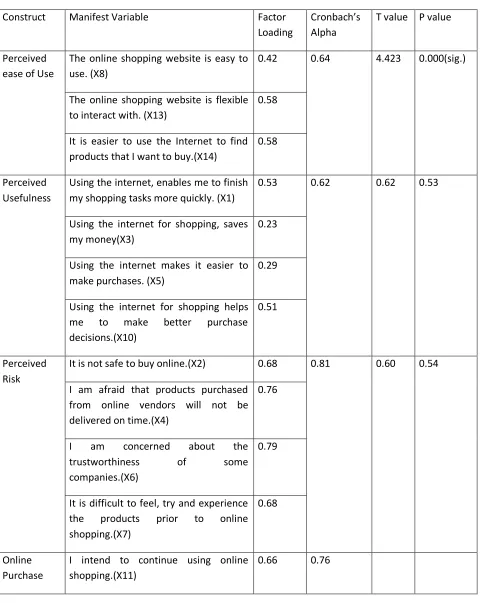
This study focused on exploring the influence of perceived ease of use, perceived usefulness and perceived risk on consumers online purchase intention. The current research is descriptive in nature. Data was collected by questionnaire from 120 respondents and after shifting out the invalid ones, 100 questionnaires were used for the study. The questionnaire comprised of 15 questions regarding perceived ease of use, perceived usefulness and perceived risk. According to the above mentioned research goals and literature review, the framework of the study is shown in Fig 1
International Journal in Management and Social Science (Impact Factor- 4.358) Table 1: Questionnaire Items, Reliability and validity
Construct Manifest Variable Factor
Loading
Cronbach’s Alpha
T value P value
Perceived ease of Use
The online shopping website is easy to use. (X8)
0.42 0.64 4.423 0.000(sig.)
The online shopping website is flexible to interact with. (X13)
0.58
It is easier to use the Internet to find products that I want to buy.(X14)
0.58
Perceived Usefulness
Using the internet, enables me to finish my shopping tasks more quickly. (X1)
0.53 0.62 0.62 0.53
Using the internet for shopping, saves my money(X3)
0.23
Using the internet makes it easier to make purchases. (X5)
0.29
Using the internet for shopping helps me to make better purchase decisions.(X10)
0.51
Perceived Risk
It is not safe to buy online.(X2) 0.68 0.81 0.60 0.54 I am afraid that products purchased
from online vendors will not be delivered on time.(X4)
0.76
I am concerned about the
trustworthiness of some
companies.(X6)
0.79
It is difficult to feel, try and experience the products prior to online shopping.(X7)
0.68
Online Purchase
I intend to continue using online shopping.(X11)
International Journal in Management and Social Science (Impact Factor- 4.358)
Intention My intention is to continue using online shopping rather than traditional shopping.(X12)
0.70
I intend to purchase products about internet to get experience about online shopping. (X15)
0.62
If I could, I would like to continue shopping online as much as possible in the future.(X9)
0.63
Hypothesis
According to previous review and discussion, three main research hypothesis are proposed: Hypothesis 1: Perceived ease of use affects consumers’ online purchase intention.
Hypothesis 2: Perceived usefulness affects consumers’ online purchase intention. Hypothesis 3: Perceived risk affects consumers’ online purchase intention.
ANALYSIS AND RESULTS:
Data was analyzed through Structural Equation Modeling which includes measurement model and path analysis. It is an effective way to find the causal relationships between constructs and their underlying measurement suitability and AMOS Software with maximum likelihood estimation was used to implement SEM. The actual results are stated below:
Reliability and Internal Consistency
International Journal in Management and Social Science (Impact Factor- 4.358) Structural Model: Path Analysis
Overall model fit
Overall fit indexes are reported in table 2, which shows that the model was reasonably consistent with the data, with all the fit indexes better than recommended values. Figure 2 indicates the path loadings
Criteria CMIN AGFI NFI CFI RMSEA
Actual value 1.625 0.85 0.81 0.88 0.059
Regression Results
Standardized Regression Weights: (Group number 1 - Default model) Estimate
INTENTION <--- EASY .777 INTENTION <--- USEFULNESS .168 INTENTION <--- RISK -.101 Correlations:
(Group number 1 - Default model)
Estimate EASY <--> USEFULNESS -.137 USEFULNESS <--> RISK .061
International Journal in Management and Social Science (Impact Factor- 4.358)
Fig.2 : Path coefficients for SEM Model FINDINGS
Based on the test results, the following conclusions were drawn:
1)For the SEM Modeling with the constructs, perceived ease of use was the most important and perceived usefulness was next and perceived risk was the least important construct. Therefore, convenience and comfort have much influence on consumers purchase intention.
2)Hypothesis 1 stated that perceived ease of use affects online purchase intention proved valid. P value is less than 0.05, so H1 is strongly supported. This means that consumers wants easiness and comfort while shopping online.
3)Hypothesis 2 stated that perceived ease of use affects online purchase intention proved invalid. P value is more than 0.05, so H2 is not supported. This means that perceived usefulness did not affect much on online shopping intention.
International Journal in Management and Social Science (Impact Factor- 4.358) CONCLUSION
This paper has examined the influence of various factors on purchase intention by the use of Structural Equation Modelling. .It may be concluded that perceived ease of use is the most important factor and perceived risk is the least important and affects purchase intention negatively. The results highlighted the imortance of TAM Model towards consumers' online purchase intention. This study provided managerial implications for online shopping retailers and marketers to serve and pull consumers to shop online. REFERENCES
1)Ajzen, I. (1991). The theory of planned behaviour. Organizational Behaviour and Human Decision Process, 50(2), 179-211
2)Bauer, R.A (1967), “Consumer Behavior as Risk taking,” in Risk Taking and Information Handling in Consumer Behavior, edited by D. Cox, Harvard University Press, Cambridge, Mass.
3)Barkhi, R., Belanger, F., & Hicks, J. (2008). A model of determinants of purchasing from virtual stores. Journal of Organizational Computing and Electronic Commerce, 18(3), 177-196.
4)Bisdee, D. (2007). Consumer Attitudes Review. Office of Fair Trading, June, 1-147
5)Buton-Jones, A., & Hubona, G. S. (2005). Individual differences and usage behaviour: revisiting a technology acceptance model assumption. The DATA BASE for Advances in Information Systems, 36(2), 58-77
6)Cox, Donald F.,(1967), “Introduction” in Donald F. Cox(Ed), Risk-Taking and Information-Handling in Consumer Behavior, Boston, 1967
7)Davis, F. D. (1989). Perceived usefulness, perceived ease of use, and user acceptance of information technology. MIS Quarterly, 13(3), 318-340.
8)Dowling, G.R., and Staelin, R. (1994), “A Model of Perceived Risk and Intended Risk-handling Activity,” Journal of Consumer Research, 21(1), 119-134.
9)Fishbein, M., & Ajzen, I. (1975). Belief, attitude, intention and behaviour: an introduction to theory and research, Addison-Wesley, California
10)Grabner-Krauter, S., & Kaluscha, E. A. (2003). Empirical research in on-line trust: a review and critical assessment. International Journal of Human-Computer Studies, 58(6), 783-812.
International Journal in Management and Social Science (Impact Factor- 4.358)
12)Kim, J., & Forsythe, S. (2010). Factors affecting adoption of product virtualization technology for online consumer electronics shopping. International Journal of Retailing and Distribution Management, 38(3), 190-204.
13)Kim, S., Williams, R., & Lee, Y. (2003). Attitude toward online shopping and retail website quality: acomparison of US and Korean consumers. Journal of International Consumer Marketing, 16(1), 189-203.
14)King, W. R., & He, J. (2006). A meta-analysis of the technology acceptance model. Information and Management, 43(6), 740-755.
15)McCloskey, D. (2004). Evaluating electronic commerce acceptance with the technology acceptance model. Journal of Computer Information Systems, 44(22), 49- 57
16)Mitchell, V. W., & Greatorex, M. (1993). Risk perception and reduction in the purchase of consumer services. The Service Industries Journal, 13(4), 179-200.
17)Selamat, Z., Jaffar, N., & Ong, B. H. (2009). Technology acceptance in Malaysian banking industry. European Journal of Economics, Finance and Administrative Sciences, 1(17), 143-155.
18)Teo, T. S. H. (2001). Demographic and motivation variables associated with Internet usage activities. Internet Research, 11(2), 125-137.
19) Venkatesh, V. (2000), “Veterminants of perceived ease of use: integrating control, intrinsic motivation, and emotion into the technology acceptance model”, Information Systems Research, Vol. 4 No. 4, pp. 342-65
20)Wolfinbarger, M. and Gilly, M.C. (2001), “Shopping online for freedom, control, and fun”, California Management Review, Vol. 43 No. 2, pp. 34-55.