University of South Carolina
Scholar Commons
Theses and Dissertations
2015
The Liberal Commercial Peace, Regional
Considerations: International Relations of
Southeast Asia, Latin America, and the European
Union Countries
Chienwu Hsueh
University of South Carolina
Follow this and additional works at:https://scholarcommons.sc.edu/etd
Part of thePolitical Science Commons
This Open Access Dissertation is brought to you by Scholar Commons. It has been accepted for inclusion in Theses and Dissertations by an authorized administrator of Scholar Commons. For more information, please [email protected].
Recommended Citation
T
HEL
IBERALC
OMMERCIALP
EACE,
R
EGIONALC
ONSIDERATIONS:
I
NTERNATIONALR
ELATIONS OFS
OUTHEASTA
SIA,
L
ATINA
MERICA,
AND THEE
UROPEANU
NIONC
OUNTRIESby
Chienwu Hsueh
Bachelor of Arts
National Chengchi University, Taiwan, 2004
Master of Arts
National Chengchi University, Taiwan, 2007
Submitted in Partial Fulfillment of the Requirements
For the Degree of Doctor of Philosophy in
Political Science
College of Arts & Sciences
University of South Carolina
2015
Accepted by:
Timothy M. Peterson, Major Professor
John Fuh-Sheng Hsieh, Committee Member
Harvey Starr, Committee Member
Gerald McDermott, Committee Member
© Copyright by Chienwu Hsueh, 2015 All Rights Reserved.
D
EDICATIONTo my father, Tiencheng Hsueh (薛天成); my mother, Shumei Ku (古淑媚); my
uncle, Tunglo Liu (劉銅鑼); my aunt, Hsin Tung (董信); and, my wife, Tingchia Wang
(王廷嘉).
And, to my senior and good friend, Tsungmu Wu (吳宗穆).
A
CKNOWLEDGEMENTSThank the chair of my dissertation, Dr. Timothy M. Peterson, who helps me a lot
along the whole research process. Tim, you are the best dissertation chair a graduate
student could ever found!
Thank my dissertation committee members: Dr. John Fuh-Sheng Hsieh, Dr.
Harvey Starr, and Dr. Gerald McDermott. What I learned from Dr. Hsieh’s CP classes
and Dr. Starr’s IR classes would definitely help me through my future academic career.
Thank Dr. Kirk A. Randazzo for teaching me the concept of EITM, Dr. Lee D.
Walker for teaching me the concept of quality-quantity methods, and Dr. Tobias Heinrich
for teaching me the concept of causal inference.
Thank my good classmates and my juniors and seniors in the doctoral program of
Department of Political Science: Yue Hu, Jikuo Lu, Intae Yoo, Juri Kim, Soonkun Oh,
Anikin Evgeny, Mariam Dekanozishvili, Elena Grynberg-Bekier, Laura Elder, Clay
Fuller, Douglas Paige, Rebecca Reid, Gretchen Keneson, TJ Kimel, Jamie Gray, Paige
Price, Paul White, Jim Heenehan, Adam Cox, and Judit Trunkos.
Thank the great help and care from my dear Taiwanese seniors and friends during
these four and half years: Wenchen Wang, Yuehe Cheng, Chintser Huang, Yuehching Ma,
Liting Yang, David Chao, Jenny Chao, Michael Chen, Bob Chen, Weitien Li, Chonghan
Wu, Ifan Chen, Chiayin Wei, Yitzu Lin, Shuwun Zeng, Juiheng Tseng, Shrhan Wu,
Kuolun Yen, Yuhsiu Lin, and Chuanfa Tang.
Thank Dr. John Fuh-Sheng Hsieh and Juoyen Hsieh, who take a good care of us
just like our father and mother in South Carolina.
A
BSTRACTMost of the large-N empirical studies on the liberal commercial peace theory
demonstrate that, in general, trade has a robust pacifying effect in reducing the
probability of dyadical militarized interstate disputes. However, why trade’s pacifying
effect varies across time and space remains a puzzle that previous research has not yet
solved. The liberal commercial peace literature suggests the following questions are in
need of answers: Why does trade promote peace mainly in inter-region dyads but not in
intra-region dyads? What are the preconditions that make trade’s pacifying effect work or
not work? In this research, I argue that there are two critical preconditions for trade’s
pacifying effect to work: first, the benefits of trade must be substantively important, and
second, important social actors who have stakes on trade must be able to influence the
leaders when they are making foreign policy decisions. These two preconditions can be
measured by countries’ degree of democracy and degree of development. Therefore,
regionally, the pacifying effect of trade is stronger in regions where the countries are
more democratic and more developed, and it gets weaker in regions where the countries
are less democratic and less developed; temporally, because countries’ degree of
democracy and degree of development vary from time to time, the pacifying effect of
trade changes over time accordingly. I then extend this overarching framework to
investigate the role of trade in the regional peace of Southeast Asia, Latin America, and
the European Union countries, arguing that the variations of the regional peace can be
predicted by looking at how trade affects the most important political issues in each of the
regions. By finding out more nuanced preconditions, this research advances our
knowledge toward the liberal commercial peace theory in the contemporary international
relations research.
T
ABLE OFC
ONTENTSDEDICATION ... iii
ACKNOWLEDGEMENTS ... iv
ABSTRACT ... vi
LIST OF TABLES ... ix
LIST OF FIGURES ... xi
CHAPTER 1:INTRODUCTION ...1
CHAPTER 2:THE LIBERAL COMMERCIAL PEACE,REGIONAL CONSIDERATIONS ...15
CHAPTER 3:ASEAN AND SOUTHEAST ASIAN PEACE: NATIONAL BUILDING,ECONOMIC PERFORMANCE, AND ASEAN’S SECURITY MANAGEMENT ...73
CHAPTER 4:LATIN AMERICAN PEACE:HEGEMONIC STABILITY DURING THE COLD WAR AND CAPITALIST PEACE AFTER THE COLD WAR ...112
CHAPTER 5:THE EMBEDDED LIBERALISM AND THE INTERNATIONAL RELATIONS BETWEEN THE EUROPEAN UNION COUNTRIES ...147
CHAPTER 6:CONCLUSION ...186
REFERENCES ...192
L
IST OFT
ABLESTable 1.1 Plan of the dissertation ...13
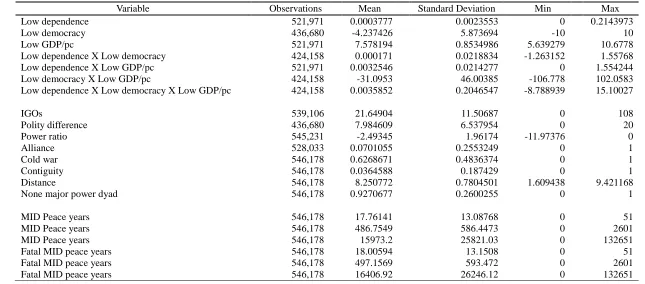
Table 2.1 Summary of all the variables used ...43
Table 2.2 The number of fatal MIDs
between all dyads, 1950~2001 ...47
Table 2.3 The number of fatal MIDs occurred
between inter-region dyads, 1950~2001 ...48
Table 2.4 The number of fatal MIDs occurred
between inter-region dyads, 1950~2001 ...49
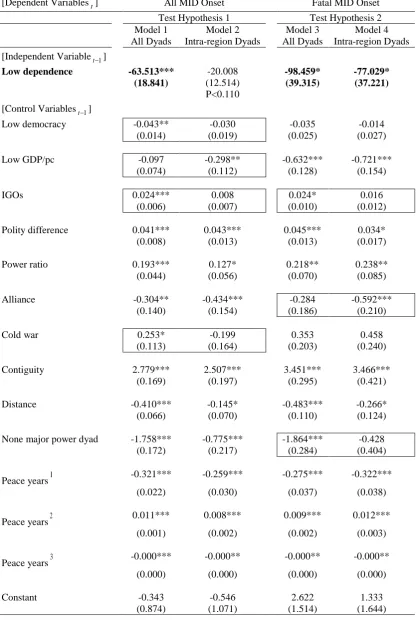
Table 2.5 Liberal commercial peace, global and regional, 1950~2001 ...51
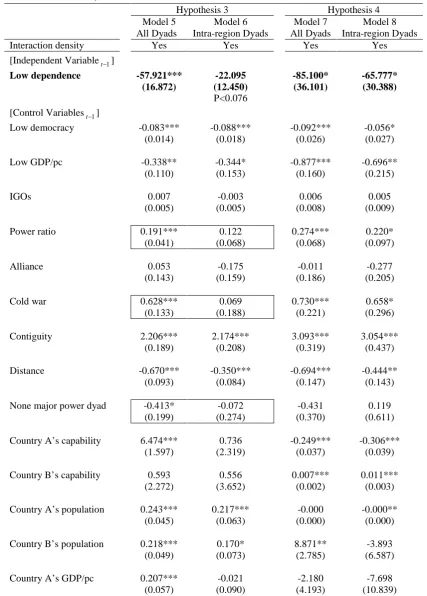
Table 2.6 Liberal commercial peace, global and regional,
with interaction density,1950~2001 ...54
Table 2.7 Three-way interaction of liberal commercial peace, global and regional,
1950~2001 ...56
Table 3.1 MID onset between JntELP countries before and after JntELP, 1950~2001 ....79
Table 3.2 Monadic MID onset analysis of countries
who adopt economic liberalization policy, 1950~2001 ...81
Table 3.3 Background of Southeast Asian countries in their early years
after independence ...87
Table 3.4 ASEAN and dyadic MID onset in Southeast Asia ...97
Table 3.5 ASEAN and dyadic force and fatal MID onset in Southeast Asia ...101
Table 3.6 Robustness checks of dyadic MID onset in Southeast Asia, 1980~2001 ... 106
Table 4.1 The highest average dependences of Country A on Country B
in Latin America from 1950 to 2001 ... 121
Table 4.2 Determinants on force MID onset between Latin American countries ... 141
Table 4.3 Substantive effects of the independent variables ... 144
Table 5.1 The influences of interdependence and social expenditure
on the number of international conflicts ... 167
Table 5.2 GEE negative binomial models of different levels of international conflicts between the European Union countries, 1990~2004 ... 176
Table 5.3 Substantive effects of variables that are statistically significant
on each of the three dependent variables ... 179
Table 5.4 Robustness checks models of All conflict
between the European Union countries, 1990~2004 ... 182
L
IST OFF
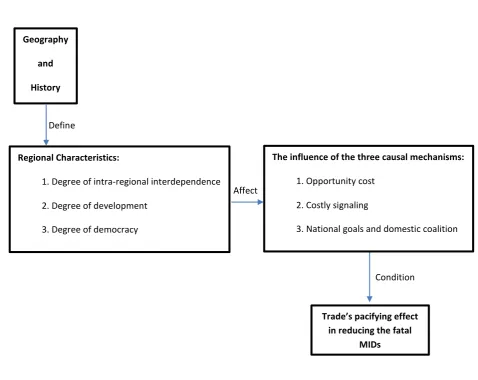
IGURESFigure 2.1 A unified theoretical framework of the liberal commercial peace effect
between the intra-region dyads ...38
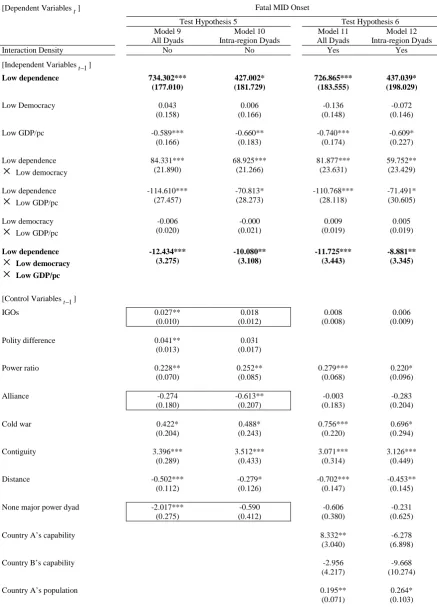
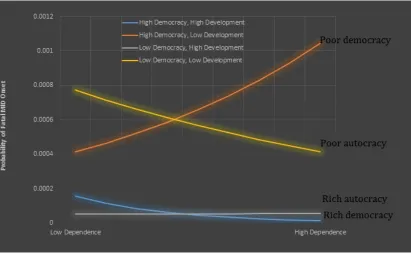
Figure 2.2 Predicted probability of fatal MID onset, using Low dependence (denoting as Dependence in the plot) ...63
Figure 2.3 Predicted probability of fatal MID onset, using Low democracy (denoting as Democracy in the plot) ...64
Figure 2.4 Predicted probability of fatal MID onset, using Low GDP/pc (denoting as GDP/pc in the plot) ...65
Figure 3.1 Low growth rate and predicted probability of MID onset at t+1 with 95% confidence interval in different time periods ...104
Figure 4.1 Different political regimes and MID onsets in Latin America (1950~2001, non-directed dyads) ...120
Figure 4.2 The mean number of MID onsets per year and the mean number of shared IGO memberships of each dyad in Latin America, 1950~2001 ...123
Figure 4.3 The game-theoretical model ...130
Figure 5.1 Predicted mean number of Low-level conflict per dyad-year ...180
Figure 5.2 Predicted mean number of High-level conflict per dyad-year ...180
Figure 5.3 Predicted mean number of All conflict per dyad-year ...180
CHAPTER 1
Introduction
1 The unsolved puzzles
The topic of the dissertation is “The Liberal Commercial Peace, Regional
Considerations: International Relations of Southeast Asia, Latin America, and the
European Union Countries.” The goal of this dissertation is twofold. First, I construct a
theory to explain several puzzles remaining unsolved in literature about trade’s unstable
pacifying effect (Chapter 2). Second, I propose a theoretical framework which links
leaders’ political survival with the role that trade plays in each of the regions in
investigation to explain the regional peace in Southeast Asia (Chapter 3), Latin America
(Chapter 4), and the European Union countries (Chapter 5). Although the four main
empirical chapters of the dissertation are disjointed, they share a similar framework
which addresses how regions become peaceful and how to explain the within-region
variation of the regional international relations in the viewpoint of trade.
I begin with defining what the so-called “liberal commercial peace” is. The
simplest definition of the liberal commercial peace is that: trade promotes peace.
Although there are contradicting findings in literature regarding whether trade leads to
peace or conflict,1 generally speaking, most of the large-N research confirms that,
dyadically, with the increase of trade in proportion to both sides’ gross domestic product
1 Refer to Barbieri (2002), Mansfield and Pollins (2003), and Crescenzi (2005) to see a more complete literature review about the relationship between trade and conflict.
1
(GDP), the probability that they engage in militarized conflict will decrease (Oneal &
Russett, 1997, 2001; Hegre, Oneal, & Russett, 2010).
As for why trade should have a pacifying effect, scholars of the liberal
commercial peace theory point out three main causal mechanisms to link trade with the
reduction of conflict occurrence (Kastner, 2005). The constraint arguments state that as
interdependence increases, the cost of military conflict also increases due to the loss of
valuable assets and trade flows. The informational arguments claim that interdependence
enables states to signal more efficiently their true level of resolve through threatening to
use costly economic sanctions, therefore reducing the likelihood of dangerous
miscalculations about each other’s resolves. The transformative arguments posit that
interdependence can reduce the probability of conflict by reshaping the underlying states’
interests and preferences, either through changing the states’ core international objectives
or through changing the balance of domestic political coalitions. According to these three
causal mechanisms along with the findings of most of the large-N empirical research, the
pacifying effect of trade should be a stable and universal one that works around the world.
However, several findings have put trade’s pacifying effect into doubt. First,
Barbieri (1996, 2002) demonstrates that trade leads to conflict rather than reduces it,2
and Pevehouse (2004) demonstrates that trade actually makes conflict more likely to
happen, while it simultaneously restrains the number of conflict from going rampant.
Second, many demonstrate that trade’s pacifying effect varies across time and space, that
is, during some periods and in some countries trade leads to peace, while during another
periods and in another countries trade leads to conflict (Beck, Katz, & Tucker, 1998;
2 Although Xiang, Xu, and Keteku (2007) have demonstrated that Barbieri’s research committed an omitted variable bias – not controlling for states’ power.
2
Zorn, 2001). Third, if trade does have a pacifying effect, why except for the European
Union countries (Ripsman, 2005), when it comes to regional peace, are there few scholars
attribute it to trade? For example, the Middle East, Latin America, the West Africa, and
Southeast Asia are known to gradually become a peaceful region since the end of the
World War II (Kacowicz, 1995, 1998; Acharya, 2001; Miller, 2005). However, trade is
seldom been mentioned as the main reason that stabilizes the regions. Lastly, Goldsmith
(2006) demonstrates that if we separate the world into five regions according to the
classification of the Correlates of War database – the West, Latin America, Africa, the
Middle East, and Asia, we will find that trade actually increases the probability of
militarized conflict in all of them, even including the West. If trade does have a pacifying
effect, how could we explain these empirical puzzles?
2 The argument in short
To solve these puzzles, this dissertation is composed of four independent articles
as each of the empirical chapters. The first article (Chapter 2) serves as the overarching
theory, in which I propose a set of unified preconditions that explain the regional
variations of trade’s pacifying effect around the world. In short, I argue that trade’s
pacifying effect is a conditional one, which is simultaneously mediated by countries’
degree of democracy and degree of development. The facts that trade’s pacifying effect is
the most evident in the European Union countries and that it is not as evident in any other
region around the world strongly suggest that trade would lead to peace only in
“developed” “democracies.” Therefore, I posit that for the liberal commercial peace to
work, dyadically, both countries must reach a domestic consensus on the benefits of trade
so that both the leaders and the people in both countries would take trade into
consideration when dealing with international affairs. Only when all the important
domestic political actors have a stable preference for the benefits of trade do “the three
causal mechanisms of the liberal commercial peace” work in reducing the probability of
militarized conflict. This is because “development” and “democracy” together suggest
that the benefits of trade is substantively important and that people who have stake on
trade could have the power to influence the leaders when they are making foreign policy
decisions. These are the critical preconditions that make the three causal mechanisms
work. Thus, all the four puzzles remaining in literature can be explained by my theory:
First, because countries’ degree of democracy and degree of development change from
time to time, as a consequence, the pacifying effect of trade varies accordingly as well.
Second, due to proximity, countries in the same region tend to have similar degree of
democracy and development resulting from shared geography and history, and countries
in different regions tend to have different degree of democracy and development.
Therefore, trade’s pacifying effect varies from region to region. Thus my argument
solves the four puzzles.
Aside from the first article (Chapter 2), the following three articles (Chapter 3~5)
extend the findings in Chapter 2 to investigate how trade and economic concerns relate to
regional peace in three different regions, respectively. In Chapter 2 I demonstrate that,
higher degree of democracy and higher degree of development are the critical
preconditions that make trade’s pacifying effect work. Then, what is the role of trade in
regions where the countries are less democratic and less developed and where the “old”
liberal commercial peace theory would predict a pacifying effect?
I select two regions that matches this requirement – Southeast Asian and Latin
America. Theoretically, trade should have an evident pacifying effect in these two
regions.3 However, empirical findings in literature demonstrate that trade is never the
main reason that contributes to the regional peace. In Southeast Asia, the security
management of the Association of Southeast Asian Nations (ASEAN) has been argued to
be the most important factor that maintain the regional peace based on a process of
consensus building. In Latin America, the hegemonic stability effect managed by the
United States is a well-known but controversial phenomenon. I propose a theoretical
framework to explain the role of trade in these regional peace. I link trade with regional
peace by looking at what the main domestic political issues are among countries in these
two regions, because the main controversies in the domestic political arena also represent
the leaders’ ruling foundation. To make sure their political survival is unthreatened,
leaders must satisfy the demand of their winning coalition (Putnam, 1988; Bueno de
Mesquita, Smith, Siverson, & Morrow, 2003). Therefore, to understand the role of trade
in the regional peace, we should look at how trade may affect the balance of the key
domestic political coalitions the leaders rely upon. In the Southeast Asian countries,
keeping a good economic performance is the key for leaders to maintain their ruling
legitimacy due to their special historical background; in the Latin American countries, the
domestic threat of coup d’état, the international threat of their enduring rivalries, and
their relationship with the United States are the critical concerns for leaders to survive.
Thus, I argue, we can predict the regional international relations by looking at how trade
3 I will further elaborate the reasons why trade should have an evident pacifying effect in these two regions in the next section.
5
may affect the political coalitions that the leaders must rely upon in order to keep
incumbent.
Then, in Chapter 5, I extend this theoretical framework to investigate the
international relations between the European Union countries. The European Union
countries are the richest, the most democratic, and the most integrated region in the world
where militarized conflict has been disappeared since 1986 and trade’s pacifying effect is
the most prominent. I demonstrate that this theoretical framework is still useful to
understand how trade affects the international relations between countries that are the
least-likely ones to have conflict by looking at the balance between their domestic
internationalizing and backlashing coalitions.
In the next section, I will explain the theoretical reasons why I select these three
regions to be investigated. By solving these four puzzles and proposing this theoretical
framework, this research not only finds out more nuanced preconditions of the liberal
commercial peace effect, but also enriches our knowledge toward how regions become
peaceful and what the influence of trade is on regional peace.
3 Case selection
In this research I dig out how the regional characteristics affect the effectiveness
of the liberal commercial peace effect by comparing three different regions around the
world – Southeast Asia, Latin America, and the European Union countries. I select these
three regions for investigation for four theoretical reasons. First, these three regions are
known to have very peaceful international relations by many studies (Mitrany, 1948;
Haas, 1964; Deutsch, Burrell, Kann, & Lee, 1957; Deutsch, 1961; Kacowicz 1995;
Acharya 2001; Kivimäki 2001; Ray 2002; Buzan and Wæver 2003; Ripsman 2005;
Miller 2005; Solingen 2007; Tønnesson 2009; Kivimäki 2011), therefore, they are the
most suitable regional cases to be tested to see whether the liberal commercial peace
effect has contributed to the formation of the regional peace in terms of the reduction of
militarized conflict.
Second, based on the concern of research design, these three regions are the most-
likely cases that may enjoy the liberal commercial peace. The European Union countries
have long been recognized as the most successful case of peace through interdependence
and international integration, and their experiences to achieve peace are also the origin
where scholars build the liberal commercial peace theory from. For the Southeast Asian
countries, after decolonization since the end of World War II, state building and national
prosperity have been their most important goals, and the establishment of ASEAN is
meant to promote regional stability to attract badly needed foreign direct investment to
stimulate economic development (Haftel, 2010; Tang, 2012). Thus, theoretically, the
liberal commercial peace effect should be very prominent in the region as well. Lastly,
Latin America is the most economically open region in the world during the 1990s when
almost all of the countries adopted the Washington consensus of structure reform
(Williamson, 1990). Therefore, theoretically, it should be the region with the most salient
liberal commercial peace effect. In sum, based on the logic of the most-likely case study
design (Eckstein, 1975; McKeown, 1999), these three regions should be the most likely
ones to embody the liberal commercial peace effect. Thus investigating the regional
variations of trade’s pacifying effect across these three regions should give us the most
leverage to find out the preconditions of the liberal commercial peace.
Third, all the three regions have important regional intergovernmental
organizations (IGOs) to facilitate their intensive interaction between member states.
Although the degree of regional integration varies across these three regions, the
Association of Southeast Asian Nations (ASEAN), the Organization of American States
(OAS), and the European Union (EU) have long been recognized to play an important
role in promoting regional integration and conflict resolution in these three regions. In
addition, the functionalists (Mitrany, 1948; Haas, 1958, 1964; Abbott & Snidal, 1998)
and the liberals (Keohane, 1984; Oye, 1986; Russett, Oneal, & Davis, 1998; Oneal &
Russett, 2001) all highlight the contribution of international organizations in conflict
resolution and international coordination, whether in security issues or in trade issues.
Therefore, due to the development of the three important IGOs, these three regions
should be the most- likely ones to enjoy liberal commercial peace than any other regions.
Fourth, many scholars find that weak or failed states radically change the
adaptability of international relations theories (Weiss & Kessler, 1991; Job, 1992; Ayoob,
1999; Miller, 2005) which implicitly assume that every state is the same unity with
similar functions (Waltz, 1979). For example, the international security dilemma
emphasized by mainstream international relations theories is not the main focus of this
kind of states; instead, internal security dilemma is what they pay attention to due to their
lack of legitimacy, functioning coercive capacity, and a capable bureaucracy (Kelly, 2007,
pp. 216–217). Unlike other regions which are full of weak states, in lack of populations,
or geographically isolated, such as some regions in Africa, Middle East, and the Oceania
countries, the three regions under investigation in this research (Southeast Asia, Latin
America, and the European Union countries) are regions composed of modern national
states with sufficient state capability to function as normal national states, thus they
should be suitable for the liberal commercial peace theory to apply.
For these four reasons above, I contend that investigating these three regions are
proper to explore how the regional characteristics condition the liberal commercial peace
effect. In the next section, I will summarize the content of the dissertation and point out
how this research could make up the deficiency in literature as the contribution.
4 Organization of investigation
The topic of chapter 2 is “The Liberal Commercial Peace, Regional
Considerations.” As an overarching theory of the whole dissertation, I argue that trade’s
pacifying effect is simultaneously conditioned on the degree of democracy and the degree
of development, and that it embodies not in reducing all levels of conflict, but in reducing
the conflicts that would cause fatality. I use data concerning the onset of militarized
interstate dispute (MID) 3.10 (Ghosn, Palmer, & Bremer, 2004) from the Correlates of
War dataset to test my argument. The finding of this chapter also bridges the long debate
between the democratic peace theories and the capitalist peace theories by demonstrating
that both the degree of democracy and the degree of development are independent and
mutually reinforcing (rather than mutually exclusive) moderators of trade’s pacifying
effect.
The topic of chapter 3 is “ASEAN and Southeast Asian Peace: National Building,
Economic Growth, and ASEAN’s Conflict Management.” In this chapter I plan to solve
an unsolved debate in the literature, that is, whether ASEAN’s security management in
the region keeps the peace. I argue that the pacifying effect of ASEAN should be
understood as a conditional one, which hinges on Southeast Asian countries’ economic
performance. For decades, national building and economic growth are the main goals of
the Southeast Asian countries as well as their leaders’ ruling foundation. When the
leaders are not able to maintain good economic performance, they tend to emphasize the
national building issues, such as territorial disputes, to keep their ruling legitimacy, thus
compromising ASEAN’s security management. Empirical analysis of the onset of
militarized interstate disputes from 1950 to 2001 confirms my argument. My finding also
contributes to the long debate about whether we need non-Western international relations
theories to understand the international relations of the Asia-Pacific countries.
The topic of chapter 4 is “Latin American Peace: Hegemonic Stability during the
Cold War and Capitalist Peace after the Cold War.” In this chapter I plan to solve an
unsolved debate in the literature, that is, what the role the United States was in the
formation of the regional peace. Generally speaking, there are three competing models
about it: the hegemonic stability argument emphasizes that it is the United States’ peace
keeping that stabilizes the region, the whirlpool model argues that the United States is
only involved when its interests are compromised and it disengages soon after the events
are solved, and the radical argument contends that the United States is actually the one
who provokes conflicts in the region. I argue that Latin American peace should attributes
to the United States’ hegemonic stability effect; however, this does not mean that the
United States has sufficient policy tools to constrain the conflictual behavior of all the
Latin American countries. In countries that have higher degree of economic dependence
on the United States, the United States has enough influence and economic leverage on
the former to constrain the former from using force. Instead, in countries that have lower
degree of economic dependence on the United States, the United States does not have
sufficient policy leverage on the latter. As a consequence, the hegemonic stability effect
of the United States’ security management becomes less evident in these countries.
Therefore, the hegemonic stability effect of the United States’ leadership in the region is
a conditional one, which hinges on whether the United States has enough economic
leverage to influence a certain Latin American country’s conflictual behavior. Besides,
my argument also implies that after the end of the Cold War the regional peace should
follow a “capitalist peace” trajectory when the region had lost its strategic value of
geopolitics to the United States.
The topic of chapter 5 is “Embedded Liberalism and International Relations
between the European Union Countries.” In this chapter I want to highlight a
phenomenon that is not well-explained by relative literature. That is, how to explain the
variation of conflict and cooperation between the European Union countries after the
Cold War. The European Union countries are the richest, the most democratic, and the
most integrated countries in the world without any single militarized interstate conflict
since 1986, so previous research has trouble measuring the cooperation and conflict
among them since there is no variation in the popularly-used datasets. By applying Gary
King and Will Lowe’s “10 Million International Dyadic Events (IDE)” dataset (King &
Lowe, 2003),4 I am able to investigate the international relations between the European
Union countries. I argue that due to the logic of the embedded liberalism – the
relationship between market opening and governments’ welfare spending, among the
European Union countries, their degree of interdependence and degree of domestic
4 King, Gary; Lowe, Will, 2003, "10 Million International Dyadic Events",
http://hdl.handle.net/1902.1/FYXLAWZRIA UNF:3:dSE0bsQK2o6xXlxeaDEhcg== IQSS Dataverse Network [Distributor] V5 [Version].
11
compensation jointly will determine the number of their international conflicts. Among
the EU countries, all things being equal, countries whose degree of interdependence and
domestic compensation are both at a high level will have the least number of conflicts
with their trade partners; countries whose degree of interdependence and domestic
compensation are both at a low level will have few conflicts with their trade partners;
countries who have low degree of interdependence and high degree of domestic
compensation will have a few conflicts with their trade partners; and countries who have
high degree of interdependence and low degree of domestic compensation will have the
most number of conflicts with their trade partners.
Table 1.1 summarizes the plan of the previous three chapters. Among the three
most-likely regions that may embody trade’s pacifying effect, according to the literature
about the regional peace,5 only in in the European Union countries does trade have a
meaningful contribution to regional peace. In the other two regions – Southeast Asia and
Latin America, the pacifying effect of trade is not considered to help much in stabilizing
the regions. According to literature, in Southeast Asia, regional peace is largely
maintained by ASEAN’s security management through a way of consensus building; in
Latin America, the hegemonic stability effect in terms of the United States’ security
management is known as one of the main reasons that stabilize the region. However, the
role of ASEAN and the United States in regional security does not go without challenge.
Both ASEAN’s ability of security management in Southeast Asia and the United States’
ability of security management in Latin America vary case by case from time to time, and
the literature has not yet offered a satisfying explanation. Even in the European Union
5 More detailed discussion regarding the literature about each regional peace will be presented in each of the chapters.
12
13
Table 1.1 Plan of the dissertation
Regions How regions became peaceful Explaining the within-region variations Dissertation Chapter
Southeast Asia Security community Economic growth rate Chapter 3
Latin America American hegemony The United States’ economic leverage Chapter 4
countries where interdependence has known as the main reason that promotes the
regional peace, how to account for the variation of the international relations among the
richest, the most democratic, and the most integrated countries remains an untouched part
in literature. My arguments in each of the three chapters supplement the missing part of
the literature and enrich our knowledge toward the regional peace by offering a
theoretical viewpoint through the influence of trade on the domestic coalitions that the
leaders must rely upon in order to keep incumbent.
Lastly, Chapter 6 is the conclusion, in which I discuss how my findings could
contribute to our understanding toward how the rise of China may affect the international
security in contemporary international system, the most important event of international
relations in our time. Will a large-scale conflict between China and the United States or
between China and other East Asian countries become unavoidable with the rise of China
as the realists claimed? Or will the increased interdependence between China and the
United States or between China and other East Asian countries largely reduce the
probability of a large-scale conflict as the liberals claimed? My theory offers some
answers to this critical question by specifying more nuanced preconditions and their
influence on China’s rising and international security.
Overall, by investigating the regional variances of the liberal commercial peace
effect, this research not only solves the puzzles of the global-regional and the temporal
discrepancies regarding trade’s pacifying effect, but also advances our understanding
about the liberal commercial peace theory in terms of the Lakatosian criteria (Lakatos,
1978) by finding out more nuanced preconditions and theoretical implications.
CHAPTER 2
The Liberal Commercial Peace, Regional Considerations
1 Introduction
Although there is a large literature about whether trade brings peace or conflict,
most studies have reached a conclusion explicitly or implicitly stating that, overall,
commercial ties have a net pacifying effect (Oneal & Russett, 1999; Maoz, 2009; Hegre,
Oneal, & Russett, 2010; Choi, 2010); while, at the same time, the literature also points
out that this liberal commercial peace effect may vary across time and space. For example,
the Western European countries after World War II are the ideal type of the liberal
commercial peace model, where trade interdependence “spilled over” (Haas, 1958, 1964)
to political and social domains and so facilitated regional integration and a
well-functioned security community (Deutsch, 1961; Deutsch, Burrell, Kann, & Lee, 1957);
Adler and Barnett 1998; Bellamy 2004). However, these spill-over and integration effects
of the liberal commercial peace in other regions of the world are not as evident as in
Western Europe. For instance, although most of the countries in Southeast Asia and Latin
America have welcomed market liberalization policies for decades, the liberal
commercial peace effect has never been deemed as the main reason to explain the
regional peace in these regions (Kacowicz, 1995; Acharya, 2001; Ray, 2002; Miller, 2005;
Johnston, 2012). Accordingly, there are several questions in need of answers. Why does
the liberal commercial peace appear to operate in the Western Europe but not in other
regions? How do we account for the regional variation of the liberal commercial peace
effect? Is there a universal theory of the liberal commercial peace? If the pacifying effect
of trade is actually mediated by specific regional preconditions, what are they? Could we
have a general theory to guide us about how to find out the regional preconditions that
make the liberal commercial peace work? The goal of this research is to answer these
questions by investigating the relationship between regionally-distinguished
characteristics and the liberal commercial peace.
The liberal commercial peace theory holds the view that interdependence,
specifically trade, should have a strong pacifying effect that can constrain both states
from engaging in militarized interstate conflict, and that this pacifying effect should
increase with the increase of interdependence. However, while the large-N research
stably confirms the liberal commercial peace effect between the global dyads, empirical
evidences between the intra-region dyads do not always support it. To explain the
different effectiveness of the liberal commercial peace across different regions, I make
two arguments in this research. First, I argue that looking at all levels of conflict is not
proper to understand the liberal commercial peace effect, especially between the
intra-region dyads. Because trade is demonstrated as also a measurement of interaction
between both sides, countries that trade more intensively are also those who are most
likely to have disputes due to their intensive interaction. Therefore, the pacifying effect of
trade should embody in the reduction of high-level conflicts (those that cause fatality),
not the low-level ones (those that do not cause fatality). Because countries in the same
region tend to have more intensive interaction than countries between different regions,
therefore they tend to have more conflicts simply due to intensive interaction. As a
consequence, to test the effectiveness of the liberal commercial peace effect between the
intra-region dyads, we should look at only the high-level conflicts instead of looking at
all the recorded conflicts indifferently.
Second, I argue that there are three regionally-distinguished characteristics that
not only differentiate one region from all the others but also affect the three causal
mechanisms of the liberal commercial peace, therefore making the effectiveness of the
liberal commercial peace vary across regions. Besides, these three factors also help point
out what conditions the pacifying effect of trade, that is, why in some regions trade
reduces the probability of conflict and in others vice versa. These three
regionally-distinguished characteristics, I argue, are their differing degree of intra-regional
interdependence, degree of development, and degree of democracy. These three factors
are universal ones that explain the regional variation of the liberal commercial peace
effect. Thus, my theory proposes a generalizable framework that bridges the contradicting
findings at the global level and the regional level.6
To access my argument, the structure of the research is as follows. In the next
section, I first elaborate on what remains a puzzle in the literature about the liberal
commercial peace phenomenon, that is, how to explain the regional variations of the
liberal commercial peace effect, which is the question I want to answer in this research.
Then, in the third section I construct my theory to solve this question, arguing that my
theory can explain what conditions the liberal commercial peace effect both at the global
level and at the regional level. I test my theory with statistical models using data from
1950 to 2001 in the fourth section, in which the empirical results show robust support for
6 In this research I use “at the global level,” “global dyads,” and “inter-region dyads” interchangeably to describe all the dyadic country combinations around the world, and use “at the regional level,” “regional dyads,” and “intra-region dyads” interchangeably to describe only the intra-region dyadic country combinations.
17
my theory. Overall, by bringing the regional concerns back in, this research largely
enriches the liberal commercial peace theory not only in finding out more nuanced
preconditions but also in extending more theoretical implications.
2 The Puzzle: Regional variations of the liberal commercial peace effect
As Kastner (2005) had reviewed, there are at least three arguments commonly
used to link economic interdependence with a reduced likelihood of military conflict in
liberal commercial peace literature as causal mechanisms: the constraint arguments, the
informational arguments, and the transformative arguments. The constraint arguments
state that as interdependence increases, the cost of military conflict also increases due to
the loss of valuable assets and trade flows (Papayoanou, 1996; Oneal & Russett, 2001b;
Gelpi & Grieco, 2003; Smith, 2014). The informational arguments claim that
interdependence enables states to signal more efficiently their true level of resolve
through threatening to use costly economic sanctions, therefore reducing the likelihood of
dangerous miscalculations about each other’s resolves (Fearon, 1995; Gartzke, 1999;
Morrow, 1999, 2003; Gartzke, Li, & Boehmer, 2001; Powell, 2002; Gartzke & Li, 2003;
Gartzke, 2003; Stein, 2003). The transformative arguments posit that interdependence can
reduce the probability of conflict by reshaping the underlying states’ interests and
preferences, either through changing the states’ core international objectives or through
changing the balance of domestic political coalitions (Mitrany, 1948, 1966; Haas, 1958,
1964; Deutsch et al., 1957; Deutsch, 1961; Adler & Barnett, 1998a; Solingen, 2001, 2003,
2007; Simmons, 2003). Although the pacifying effect of the liberal commercial peace is
not always a positive one, since in a dyadic level of analysis peace may result from the
fact that the target state is successfully coerced by the sender state so that there is no overt
conflict; however, by and large, as a final phenomenon, trade does reduce the probability
of conflict.
According to these three causal mechanisms of the liberal commercial peace
theory, the pacifying effect of trade should be universal and ubiquitous across the whole
world since these three causal mechanisms, no matter one, two, or all of them, should be
found in any pair of countries with sufficient economic ties. However, two empirical
evidences have put the liberal commercial peace effect into doubt. First, although the
liberal commercial peace effect has been empirically supported as very prominent in
many studies (Oneal & Russett, 1999, 2001a; Maoz, 2009; Hegre et al., 2010), it is
interesting that when it comes to the regional peace, few scholars attribute it to
interdependence. For example, regional security research seldom confirms the
contribution of the liberal commercial peace effect outside the Western European
countries, especially the long peace in Southeast Asia, Latin America, and the Middle
East (Lake & Morgan, 1997; Acharya, 2001; Lemke, 2002; Ray, 2002; Buzan & Wæver,
2003; Miller, 2005; Goldsmith, 2007). Second, in statistical models, the liberal
commercial peace effect usually does not hold in regional subsamples. For instance, by
dividing the world into five different regions – the West, the Middle East, Africa, Asia,
and Latin America, Goldsmith (2006) finds that at odds with the liberal commercial
peace literature, interdependence is actually positive with the probability of the onset of
dyadic militarized interstate dispute (MID) in all the five regions, even including the
West. As a result, the pacifying effect of interdependence demonstrated in most of the
literature may be very likely resulting from the inter-regional commercial peace rather
than the intra-regional one. In other words, intra-regional trade leads to conflict rather
than reduces it, and inter-regional trade vice versa. Although it should be quite reasonable
that countries tend to have more trade and conflict with neighboring ones than with those
who are far away, this still arouses an inquiry of why the liberal commercial peace effect
does not work, especially at the regional level. If trade only reduces the probability of
conflict between pairs of countries between different regions but not between those in the
same region, the substantive effect of the liberal commercial peace may be trivial and
over-emphasized by the liberals since it cannot promote peace for countries that interact
the most frequently.
Does the fact above result from some specific outlier states in each region that
nullify the liberal commercial peace effect? Or does it result from the regional-specific
characteristics that affect all the states in the region? In the monadic level of analysis, it is
easier to understand why the liberal commercial peace effect does not work in certain
countries because not all countries have the same characteristics. Since the goal of a
scientific theory is to predict the central tendency, it is not surprising if we have some
states as outliers against the prediction of the liberal commercial theory due to omitted
variable bias such as other special preconditions. However, at the regional level of
analysis, if the outliers are at the regional level, which means that most of the states in the
region are outliers, a revision or a reconsideration of the liberal commercial theory may
be a necessity. This can be done by two different ways. First, it is possible that the liberal
commercial peace theory is not a universally generalizable one because it is derived only
from the experience of the modern European countries after 1816, especially after the end
of World War II, so that it may not well account for the international relations in other
regions. Therefore, we need new theories (adding new causal mechanisms) to explain the
relationship between trade and conflict. Another way is to accept the three main causal
mechanisms of the liberal commercial peace theory, but reconsider the regional
preconditions that mediate the effectiveness of them, which, I argue, may be a more
informative way since we have abundant literature of liberal commercial peace research
and regional studies that help. In the next two sections, I will demonstrate why paying
attention to the regional level of analysis is more helpful than looking at the monadic
level of each outlier state, bringing the regional factors back in to enrich our
understanding of the liberal commercial peace theory as well as the regional peace across
the world.
3 Bridging the global-regional gap of the liberal commercial peace effect
How do we account for the regional variation of the liberal commercial peace
effect? Is there a universal theory of the liberal commercial peace? If the pacifying effect
of trade is actually mediated by specific regional preconditions, what are they? Could we
have a general theory to guide us about how to find out the regional preconditions that
make the liberal commercial peace work? In this section, I make two arguments to bridge
the gap between the general liberal commercial peace theory and its regional variances.
First, I argue that looking at all kinds of MIDs to conceptualize conflict is not a proper
way to investigate the liberal commercial peace effect. Because the pacifying effect of
trade works not in the reduction of all kinds of conflicts, but in the reduction of conflicts
that would cause fatality. Second, I argue that there are two universal factors that
condition the liberal commercial peace effect – countries’ degree of democracy and
development. As a consequence, the regional variances of the liberal commercial peace
effect around the world are due to the regional variation of these two factors. By making
these two arguments, I offer a unified theory to explain the global-regional differences of
the liberal commercial peace effect, instead of pointing out ad hoc explanations for every
specific region around the world.
3.1 Why using all recorded MIDs is not proper for investigating the liberal commercial
peace effect at the regional level
There are many debates about whether using all the recorded conflict events is
proper to test the liberal commercial peace theory, especially regarding the most popular
militarized interstate dispute (MID) data of the Correlates of War dataset (Barbieri, 2003;
Pevehouse, 2003; Reuveny, 2003). Generally speaking, there are mainly two kinds of
concerns about it: The first one is the concern of data quality, and the second one the
concern of theory.
The first concern regards data quality. Not all levels of MIDs that happened will
be recorded due to information availability, especially the low-level MIDs that happened
in the third world countries where there is a lack of media coverage. Moreover, high-level
MIDs tend to be recorded more correctly because they arouse more attention and give
more information, especially those involved with casualties.
MID includes a series of events that are defined as “a set of interactions between
or among states involving threats to use military force, displays of military force, or
actual uses of military force” (Gochman & Maoz, 1984, p. 586). Among these three
categories, there are conflict events with casualties and without casualties. Thus, displays
of military force that involved with casualties may actually be more severe and arouse
more attention than actual uses of military force that caused no fatality. Therefore, many
researchers promote the claim that looking at the MIDs that caused fatality is more proper.
For example, Toset, Gleditsch, and Hegre (2000, p. 984) insist that the use of fatality
MIDs helps avoid both coding irregularities and “attention bias” on low-level disputes.
Souva and Prins (2006) also echo Toset et al. (2000) that “fatal MIDs offer greater
temporal and spatial consistency in the historical recording of these events. Plus, they
avoid very low-hostility disputes that may not reach the attention of policymakers”
(Souva & Prins, 2006, p. 191). Given the fact that MIDs are very rare events,7 a slightly
difference of the coding methods may result in a huge bias in a large-N research. For data
quality concern, looking at only the MIDs that caused fatality gives us a more consistent
measurement than taking all the MIDs into concern.
The second concern regards theory. Not all theories that predict the reduction of
conflict have the causal mechanisms that cover all levels of conflict, and it is misleading
to give all levels of conflict the same weight, either, simply by looking at the frequency
of all levels of conflict.
The three causal mechanisms of the liberal commercial peace theory – the
constraint argument, the informational argument, and the transformative argument –
implicitly assume that trade’s pacifying effect should embody in the reduction of
conflicts which are important enough to trigger the three causal mechanisms to work. In
other words, low-level conflicts may not be salient enough to make trade be taken into
consideration by leaders or any other influential social actors. In this situation, the three
causal mechanisms may not work in low-level conflicts even though both sides have
7 For example, there are only 1,289 MIDs (2.28%) in the total 56,647 politically relevant (involving at least one major power, contingency, or separated by less than 400 miles of water) non-directed dyad-year observations in the sample period from 1950 to 2001. Among the total 1,289 MIDs, there are only 945 MIDs (1.67%) that involved the actual use of force, and only 439 MIDs (0.77%) that caused fatality. Given MIDs are such rare events, the estimated outcomes will be sensitive to the coding rules, which may change the number of MIDs in a large-N research.
23
significant trade. In addition, the degree of trade is also a measurement of the degree of
interaction between both sides. It should not be surprising at all that countries who
interact more often tend to have more conflictual issues simply due to their intensive
interaction. For example, by using the COPDAB and the WEIS data,8 Pevehouse (2004)
demonstrates that measurements of trade are also the measurements of the density of
bilateral interaction. As a result, trade tends to make the presence of small amounts of
conflict more likely due to intensive interaction, but simultaneously restrain the number
of conflicts from going rampant due to the liberal commercial peace effect. Moreover, by
using the MID data, Hegre (2009) also demonstrates that when investigating the
trade-conflict relationship, it is imperative to control for interaction density between both
countries due to the same reason.9
In the other situations, some low-level MIDs are actually caused by trade issues or
geological reasons, such as the fishery disputes and the natural resource disputes between
countries who share the same fishing ground or mineral vein. Those countries may well
have a very closed economic interdependence relationship due to proximity, just like the
U.S.-Canada fishery disputes or the China-Japan territorial disputes on the small islands
8 Refer to Azar (1980) about the COPDAB data, and Goldstein (1992) about the WEIS data. As for the comparison across the COPDAB, WEIS, and MID datasets, refer to Vincent (1983), Pevehouse (2003), and Reuveny (2003).
9 Besides, Beck, Katz, and Tucker (1998) find that although trade may not inhibit conflict, it does appear to shorten the spells of conflict, and Zorn (2001) finds that high levels of interdependence generally lower the probability of conflict, but in the short term trade increases the chance of conflict. Pevehouse (2004) and Hegre’s (2009) explanations here also offer a good causal mechanism to account for Beck et al. (1998) and Zorn’s (2001) findings that the pacifying effect of trade tends to be mixed if we do not differentiate the density of interaction between both sides.
24
in the East China Sea (Downs & Saunders, 1998; Hickey, 2014).10 Thus leaders in
countries that have more intensive commercial interactions may also use militarized
measures such as the demonstration of force to show their concern about the issues and to
tell their people they did do something, but at the same time they do not really want to
cause fatality since this will very likely destroy their current cooperative relationship.
Therefore, this kind of conflicts that happens from time to time do not necessary mean
that the liberal commercial peace effect does or does not work. Due to these reasons
above, I argue that when using the MID data to test the liberal commercial peace effect, it
is more proper to use MIDs that caused causality rather than to use all kinds of MIDs.
Many “cheap MIDs” which involved only the low-level conflicts such as “threat to use
force without casualties,” “display of force without casualties,” or even “actual uses of
military force but without casualties” may not arouse attentions that are sufficient enough
for the liberal commercial peace effect to work. Therefore, trade may play no role in
these kind of cheap MID events. But this is not equal to saying that trade does have or
does not have a pacifying/conflictual effect. Looking at fatal MIDs instead of all kinds of
MIDs can help avoid conflicts that very likely have nothing to do with the liberal
commercial peace effect, and thus is a more proper measurement of the conflicts that the
liberal commercial peace effect should have prevented (or should have prevented but
failed).11
10 For example, according to the MID 3.1 data, from 1950 to 2001, there are 6 MIDs happened between the United States and Canada and also 6 MIDs happened between China and Japan. However, none of the above caused fatality.
11 A good example is the 1995-1996 Taiwan Strait Crisis, which is a series of missile tests conducted by China in the waters surrounding Taiwan including the Taiwan Strait from July 21, 1995 to March 23, 1996. The first set of missiles fired in mid-to-late 1995 by China were allegedly intended to send a strong signal to Taiwan’s president Tenghui Lee, who had been seen as moving Taiwan’s foreign policy away from the
25
In sum, if we use at all kinds of MIDs as the dependent variable to conceptualize
international conflict, the liberal commercial peace effect will be significant only at the
global level, not the regional level. This is because countries in the same region tend to
have higher degree of interdependence due to proximity and more MIDs due to intensive
interaction, and because the liberal commercial peace effect works not in reducing the
occurrence of all kinds of MIDs, but in reducing the occurrence of the fatal ones. For
these reasons, using only the MIDs that caused fatality to conceptualize international
conflict is more proper to investigate the liberal commercial peace effect, and this effect
should work both at the global level and at the regional level.
Due to the two main concerns above – the data quality concern and the theory
concern, I posit that the liberal commercial peace effect is more prominent between
global dyads than between intra-region dyads if we use all levels of MIDs to measure the
reduction of conflict. Because the degree of trade is also a measurement of the degree of
interaction, with the increase of interaction comes with more chances for both sides to
have disputes. Countries in the same region tend to interact more intensively thus have
more issues to dispute. As a consequence, trade does not have a significant pacifying
effect if we look at all levels of MIDs in which many of them have nothing to do with
trade or actually are triggered by trade. Instead, among countries in the same region who
have substantive trade relations, although they tend to have more issues to dispute, it is
One-China policy. The second set of missiles were fired in early 1996, allegedly intending to intimidate the Taiwanese electorate in the run-up to the 1996 presidential election. This crisis was coded as a MID that involved actual use of force without fatality in the COW MID 3.1 dataset, which is a MID that happened in spite of the high degree of interdependence between both sides and had no negative effect on bilateral trade later on. The trade flows between both sides still kept increasing very quickly after the missile crisis (Kastner 2007; 2009). This case shows that not all MIDs are relevant to the liberal commercial peace effect, even those in which force is actually used by one or both sides.
26
not their real interest to cause fatality to each other since doing so will compromise their
interests for cooperation in the future. As a consequence, trade’s pacifying effect
embodies in reducing the probability of fatal MID, and this phenomenon should be
evident both between global dyads and between intra-region dyads.
Based on these reasons, my argument proposes two hypotheses to be tested:
Hypothesis 1: If we look at all levels of MIDs, higher trade is associated with
lower conflict occurrence only when including all dyads, not when limiting the analysis
to intra-region dyads.
Hypothesis 2: If we look at only the MIDs that caused fatality (the fatal MIDs),
higher trade is associated with lower conflict occurrence not only when including all
dyads, but also when limiting the analysis to intra-region dyads.
Furthermore, as a theoretical implication of my argument, there are two more
phenomena that should also be observed if my argument is robust enough. First, since the
pacifying effect of trade between intra-region dyads is expected to be not statistically
significant if we use all levels of MIDs to conceptualize it (due to the fact that
intra-region dyads interact more intensively and so have more disputed issues), it should be
statistically significant once the degree of bilateral interaction is put into control. And,
second, since the pacifying effect of trade mainly embodies in reducing the conflict that
may cause fatality despite how many disputed issues there are between both sides, this
effect should still be statistically significant even though the degree of bilateral
interaction is put into control. Thus, my theory proposes another two hypotheses to be
tested:
Hypothesis 3: If we look at all levels of MIDs, higher trade is associated with
lower conflict occurrence whether including all dyads or limiting the analysis to
intra-region dyads, once the degree of bilateral interaction is put into control.
Hypothesis 4: If we look at only the MIDs that caused fatality (the fatal MIDs),
higher trade is associated with lower conflict occurrence not only when including all
dyads but also when limiting the analysis to intra-region dyads, whether the degree of
bilateral interaction is controlled or not.
3.2 Universal and regional preconditions of the liberal commercial peace effect
3.2.1 Why the intra-region dyads are different from the inter-region dyads
Just like the methodological debate between the quantitative school and the
qualitative school (King, Keohane, & Verba, 1994; Brady & Collier, 2010), large-N
empirical research of international relations theories is typically regarded by
non-quantitative scholars as too general to be useful when applied to explain the details of
each specific event or the regional differences, especially the latter. Scholars who focus
on the regional level of analysis make many arguments to justify the necessity of the
regional level variables against traditional IR theories which typically assume
universalism (Thompson, 1973; Lake & Morgan, 1997; Lemke, 2002; Buzan & Wæver,
2003; Hoogensen, 2005).12 Among the many pro-regional-centered arguments, all of
them would agree with the claim that traditional international relations theories insist too
much on parsimony, therefore it is too abstract and distant to capture real world regional
dynamics (Hentz & Bas, 2003). A good example is Shambaugh’s (2004) critique of
Mearsheimer’s (2001) offensive realism that, “(i)t is a classic example of an international
12 Refer to Kelly's (2007) review article about these arguments that emphasize the necessity of the regional level of analysis in the research of international relations.
28
relations theorist, who is not well grounded in regional area studies, deductively applying
a theory to a situation rather than inductively generating theory from evidence”
(Shambaugh, 2004, p. 94). At the cost of parsimony, bringing regional variables back into
concern can enrich our understanding of the regional variance of general international
relations theories. In terms of statistics, failing to take regional characteristics into
concern when building international relations theory is equal to committing an “omitted
variable bias” (King et al., 1994, p. 170). As Johnston (2012) has noted:
“it is clear that whether because of geographic characteristics, cultural
traits, the density of social network linkages, variation in the loss of
strength gradient, or limits on other pathways for the diffusion of
similarities, there is considerable variation across regions in the
conduct of their international relations……Even important large-N
work suggests regional variation matters for overall findings”
(Johnston, 2012, p. 58).
Therefore, I posit that the variation of the effectiveness of the liberal commercial peace
across different regions is due to some regionally different “omitted variables” that
influence the three main causal mechanisms of the liberal commercial peace but are
neglected by general international relations theorists.
Since regional omitted variables may bias statistical results, using regional
dummy variables to roughly capsule all the possibly neglected omitted variables of each
region is the most popular way to fix the statistical models. For example, Goldsmith
(2006) argues that the regional omitted variables are very difficult or impossible to be
reduced to “discrete causally independent variables because regions comprise very
complex sets of path-dependent interactions” (Goldsmith, 2006, p. 536). Therefore, he
proposes two arguments to justify why for some purposes we should understand
international relations based on “regions” and we should not further disaggregate
“regions” into state level of analysis:
“I suggest that regions imply: (1) more similar internal political and
socioeconomic characteristics, both institutions and political culture;
and (2) increased frequency of shared interactions and even shared
perceptions, often leading to similar expectations and patterns of
interaction embodied in regional norms or institutions. These are based
not only on proximity, but on regional identity as well (and so apply
even within the subset of contiguous but inter-Intra-region Dyads…)”
(Goldsmith, 2006, pp. 536–537).
For these reasons, which mainly result from the path-dependence phenomenon
(Pierson, 2000; Mahoney, 2003; Mahoney & Rueschemeyer, 2003), Goldsmith (2006)
argues that “using regions as a manifest indicator for what appear to be complex
interactions between numerous unmeasured latent factors is reasonable empirically and
theoretically” (Goldsmith, 2006, p. 538). Because the regional independent variables are
too complicated and entangled to be further specifically identified, as Goldsmith’s
argument, using regional dummy variables is the simplest way to take regional
characteristics into concern.
Although using regional dummy variables may to some degree alleviate the
omitted variable bias problem in large-N research, it does not help if we want to further
dig out what the regional factors are that make a difference. In other words, using
regional dummy variables does not advance our knowledge about what causes the
regional variations of the liberal commercial peace. Do these regional variations result
from different regionally specific variables in each of the regions respectively? Or are
they caused by some universal variables that vary in each of the regions respectively?
Using regional dummy variables to model the liberal commercial peace does not enable
us to answer these questions.
Echoing Goldsmith’s argument, I argue that it is the different regional
characteristics that cause the variation of the effectiveness of the liberal commercial
peace across regions. But different from Goldsmith, I neither plan to stop here only by
arguing that there are regional differences of the liberal commercial peace nor make a
strong assumption that there must be some regionally-specific variables that are neglected
by large-N research. Instead, according to the suggestions of literature, I try to look for
the universal factors that vary across different regions rather than look for ad hoc
regionally-specific reasons that condition trade’s pacifying effect. Besides, I also try to
design a general analytical framework based on literature that can guide us to find out
how to make the liberal commercial peace effect work in different regions. In other words,
I neither simply treat regional characteristics as an unmodelable or inseparable set of
many entangled independent variables nor directly use regional dummy variables to catch
all these regional characteristics as Goldsmith did in his research. Instead, according to
literature, I enumerate the specific factors that differentiate one region from the others
and construct an overarching theory to explain the regional variations of the liberal
commercial peace effect. As such, the contribution of this research is to advance a
theoretical progress of the liberal commercial peace theory.