WHAT IS FINANCIAL STABILITY? Meenakshi
Research Scholar, Department of Economics
Kurukshetra University, Kurukshetra
ABSTRACT
The increased focus on financial stability issues the definition of “financial stability” has generated a fair
amount of debate among academics, market participants and policy makers. Within this context, we will
try to the search for a useful definition of financial stability by first reviewing the existing literature on
the subject before proceeding to discuss the definition of financial stability we analyze the principles and
assumptions underlying the chosen definition as well as the implications for different work in the area of
financial stability.
Keywords; Financial Stability, Financial Instability, Systemic Risk.
INTORDUCTION
The global financial crisis has changed the way policy makers’ view and approach the issue of financial
stability. The crisis has shown that even with price and macroeconomic stability, financial instability is a
distinct possibility. Financial stability, therefore, needs to be pursued as an explicit policy variable. The
emerging paradigm, post-crisis, is aimed at a more holistic approach to financial sector regulation with
focus on systemic interconnectedness among various financial sector entities, apart from micro
prudential surveillance of individual institutions and use of macro prudential instruments to address the
systemic risks. Many countries are in the process of redefining the regulatory objectives and mandates
of various regulators. The nature and intensity of the impact of the global crisis on India was very
different from those in some of the developed economies. The financial sector remained resilent and
functioning, despite some volatility. There was no material stress on the balance sheets of banks and
non-banking financial companies on account of toxic financial instruments. There were no solvency
issues with any of the financial institutions requiring direct financial support from the Government.
Though the direct impact of the crisis on India was relatively muted, the knock-on effects on the Indian
economic and financial system were discernible, indicative of India’s rapid and growing integration into
the global economy. The economy experienced a significant slowdown in 2008-09 in comparison with
the robust growth performance in the preceding five years. Widening credit spreads and higher liquidity
international financial market during Q3 2008 and Q1 2009. The Indian rupee also weakened
significantly and the equity markets experienced sharp corrections However, quick and aggressive policy
responses both by the Government and the Reserve Bank in the post-Lehman scenario mitigated the
adverse impact of the global financial crisis. A number of conventional and unconventional measures
were swiftly taken to improve domestic and foreign exchange liquidity and to contain excessive
volatility. The domestic markets returned to normalcy much ahead of the global markets with a
significant reduction in risk and a rebound in market activity. There was also an early recovery in
economic growth.
The immediate challenge for the Indian economy and the financial sector is to reclaim the pre-crisis
configuration with minimal efficiency loss. The process of exiting from an accommodative fiscal and
monetary stance will be a test of the resilience of the system. In the above backdrop, the stability of
banking sector means that the banks should remain well capitalized in terms of regulatory capital
adequacy ratios, with higher core capital and sustainable financial leverage, and this contributes to
financial stability. Stress tests for credit and market risk should reveal banks’ ability to withstand
unexpected levels of stress. The balance sheets of households and corporate should suggest that the
financial system is not exposed to the risk of large leverages. The financial infrastructure should be
robust and markets well functioning.
WHAT IS FINANCIAL STABILITY?
In recent years, financial stability issues have been receiving priority attention from policy makers
around the world. One main catalyst for this trend was the East Asian financial crisis of the late 1990s.
Following that turmoil, the World Bank and the International Monetary Fund (IMF) introduced the
Financial Sector Assessment Program (FSAP) in 1999, aimed at assessing regularly the strengths and
weaknesses of financial systems in their member countries.
In addition, several international forums devoted to financial stability issues have emerged or become
more active, including bodies such as the Financial Stability Forum, Basle Committee on Banking
Supervision, Financial Stability Institute, Committee on the Global Financial System, Committee on
Payment and Settlement Systems, International Association of Insurance Supervisors, International
Association of Deposit Insurers. There is also the Counterparty Risk Management Policy Group, a private
sector organization devoted to fostering financial stability.
Well aware of the fiscal, economic and social costs of financial crises, many of these bodies have
devoted large amounts of time and energy to developing various International Standards and Codes,
which are essentially compilations of best practices in different areas related to the objective of
fostering financial stability. A substantial portion of these efforts has been directed towards reinforcing
different aspects of financial sector infrastructure (e.g. legal framework, financial supervision,
accounting, auditing and financial reporting).
At the country level, many central banks and regulatory authorities have also taken financial stability
more seriously, establishing Financial Stability Departments and introducing the regular publication of
Financial Stability Reports, focused on assessing potential risks to financial stability.
Despite this increased focus on financial stability issues, it is notable that a widely accepted definition of
“financial stability” does not exist and the concept has generated a fair amount of debate among
academics, market participants and policy makers. Within this context, we will try to the search for a
useful definition of financial stability by first reviewing the existing literature on the subject before
proceeding to discuss the definition of financial stability we analyze the principles and assumptions
underlying the chosen definition as well as the implications for different work in the area of financial
stability.
DEFINITIONS OF FINANCIAL INSTABILITY
Mishkin (1999) states that“financial instability occurs when shocks to the financial system interfere with information flow so that the financial system can no longer do its job of channeling funds to those with
productive investment opportunities”. This definition emphasizes the intermediation role of the financial
system in providing credit to the real sector and stresses the central role of asymmetric information in
causing financial instability (Mishkin, 1997 and Mishkin, 2000). Mishkin suggests that financial stability
arises when shocks cause disruptions to the flow of information. However, since information failures
pervade all financial transactions (even without shocks), it is better to interpret this definition in terms
of shocks acting to aggravate existing information asymmetry up to the point where normal financial
Davis (2001) defines systemic risk and financial instability as “a heightened risk of a financial crisis”. A financial crisis is then described as “a major collapse of the financial system, entailing inability to provide
payments services or to allocate credit to productive investment opportunities”. Davis further pointed
out that financial crises would have major adverse effects on economic activity and fostering financial
stability is tantamount to managing systemic risk. Although he contends that episodes of asset price
volatility should be excluded from this definition, it is acknowledged that systemic risk may be
manifested in the form of the failure of market liquidity and a breakdown of market infrastructure.
Finally, this definition also emphasizes the role of the financial system in supporting the real sector
through the provision of credit and payment services.
Ferguson (2003) described financial instability as “a situation characterized by …three basic criteria: i) some important set of financial asset prices seem to have diverged sharply from fundamentals; and/or ii)
market functioning and credit availability, domestically and perhaps internationally, have been
significantly distorted; with the result that, iii) aggregate spending deviates (or is likely to deviate)
significantly, either above or below, from the economy’s ability to produce”. This definition has a couple
of interesting features. First, unlike Davis (2001), Ferguson incorporates the distortion of asset prices
into his definition of financial instability. Second, there is explicit coverage of the ultimate impact of
financial instability on the macro economy, in terms of the impact on aggregate spending.
Chant (2003) argues that financial stability could best be understood by considering its absence, i.e. financial instability. He defined financial instability as “…conditions in financial markets that harm or
threaten to harm an economy’s performance through their impact on the working of the financial
system”. He pointed out that the term “financial instability” encapsulates several different kinds of such
instability, ranging from banking crises to stock market crashes. Hence, different forms of instability
affect different parts of the financial system and may also differ in their consequences. Further, Chant
proposed that financial instability should be distinguished from other forms of instability such as
macroeconomic instability. The primary difference is that financial instability has its immediate source in
financial markets (broadly defined) while macroeconomic instability is often due to aggregate demand
or supply shocks. Finally, Chant points out that financial market are characterized by constant changes in
prices and conditions, all of which would not qualify as financial instability. He therefore proposes that
financial instability should be viewed in terms of the potential impact of changes in financial conditions
Allen and Wood (2006) referred to financial instability as “episodes in which a large number of parties, whether they are households, companies or (individual) governments, experience financial crises which
are not warranted by their previous behaviour and where these crises collectively have seriously adverse
macro‐economic effects”. Financial stability is then described as “a state of affairs in which an episode of
financial instability is unlikely to occur….” Allen and Wood include the non‐financial sector in this
definition, explaining that financial institutions are not the only entities which experience financial
stress. Although it has some validity, this viewpoint results in a rather broad definition of financial
stability, as it incorporates institutions which the central bank cannot expect to influence directly to
promote financial stability. In addition, Allen and Wood do not consider episodes of asset price bubbles
as financial instability and they introduced the concept of “innocent bystander”, suggesting that
households and companies suffer unduly in a financial crisis, “even though they have learned how to
behave in such a way that they are not afflicted by financial crises”. This concept of “innocent
bystander” is somewhat simplistic, as many cases of financial distress have involved households and
businesses behaving imprudently. While some “innocent” households and businesses will suffer from
the adverse effects of financial crises (even though they have strong balance sheets), many more will be
culpable as we have seen in past episodes of financial crises.
DEFINITIONS OF FINANCIAL STABILITY
Crockett (1997) expresses financial stability as requiring “that the key institutions in the financial system are stable, in that there is a high degree of confidence that they continue to meet their contractual
obligations without interruption or outside assistance; and that the key markets are stable, in that
participants can confidently transact in them at prices that reflect the fundamental forces and do not
vary substantially over short periods when there have been no changes in the fundamentals”. Implicitly,
this definition takes account of the condition of financial intermediaries and markets, but not financial
infrastructure. Also, in contrast to some other writers (e.g. Davis 2001 and Allen and Wood, 2006), the
statement considers periods of asset price volatility as evidence of instability. Finally, it contends that
financial stability exists if the financial system can continue to function normally without “outside
assistance”. Hence, it excludes situations where financial instability is only avoided through the
provision of financial or other kinds of support to financial institutions by the regulatory or political
authorities.
real output”. He went on to say that “such disruptions might have their origins in difficulties facing
financial institutions or in disturbances in financial markets”. Again, there is emphasis on the impact of
financial instability on the real economy and recognition is also given to disruptions in financial markets
(in addition to cases of distress in financial intermediaries).
According to Foot (2003), “…we have financial stability where there is: (a) monetary stability; (b) employment levels close to the economy’s natural rate; (c) confidence in the operation of the generality
of key financial institutions and markets in the economy; and (d) where there are no relative price
movements of either real or financial assets within the economy that will undermine (a) or (b)”. This is
one of the few definitions which mention monetary stability as an essential part of financial stability.
Foot’s definition is notable in interpreting the linkage with the real sector in terms of proximity to the
natural rate of employment levels. It also highlights the importance of “confidence” in the operation of
the financial system, a position similar to the arguments of Large (2003) who described financial stability
mainly in terms of maintaining confidence in the financial system.
Padoa‐Schioppa (2002) contends that “…financial stability is a condition where the financial system is able to withstand shocks without giving way to cumulative processes, which impair the allocation of
savings to investment opportunities and the processing of payments in the economy”. The emphasis here
is on the shock‐absorbing capacity or resilience of the financial system, so that it can continue to carry
out its essential functions of resource allocation and provision of payments services. The reference to
payments services here is important because like disruptions to the intermediation function,
disturbances to the payments system have the capacity to inflict adverse effects on the level of
economic activity (Davis, 2001).
Schinasi (2004) offers the following definition: “A financial system is in a range of stability whenever it is capable of facilitating (rather than impeding) the performance of an economy and of dissipating
financial imbalances that arise endogenously or as a result of significant adverse and unanticipated
events”. This statement is unique in viewing financial stability as a continuum, rather than a single, static
condition . This implies that financial systems operate within a corridor, with stability and instability at
opposite ends. Movements towards the “unstable” end of the corridor could then be due to an
accumulation of imbalances (or vulnerabilities) within the financial system or because of exogenous
shocks. Like some writers cited earlier, Schinasi points out that instability should refer to cases where
As many central banks established financial stability departments and began publishing Financial
Stability Reports, they have also adopted specific definitions in order to provide some guidance to their
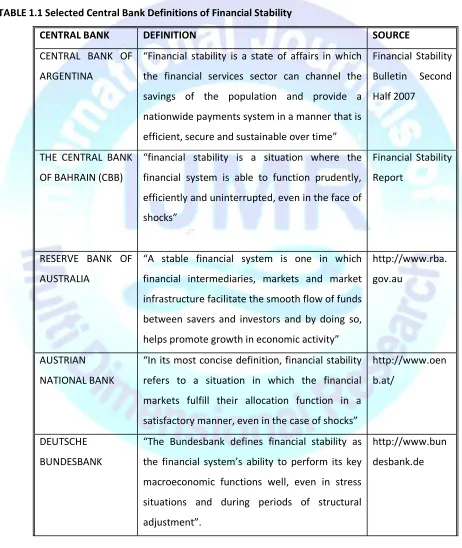
objective of safeguarding financial stability. Table 1.1 below displays some of these definitions from
selected central banks around the world.
TABLE 1.1 Selected Central Bank Definitions of Financial Stability
CENTRAL BANK DEFINITION SOURCE
CENTRAL BANK OF
ARGENTINA
“Financial stability is a state of affairs in which
the financial services sector can channel the
savings of the population and provide a
nationwide payments system in a manner that is
efficient, secure and sustainable over time”
Financial Stability
Bulletin Second
Half 2007
THE CENTRAL BANK
OF BAHRAIN (CBB)
“financial stability is a situation where the
financial system is able to function prudently,
efficiently and uninterrupted, even in the face of
shocks”
Financial Stability
Report
RESERVE BANK OF
AUSTRALIA
“A stable financial system is one in which
financial intermediaries, markets and market
infrastructure facilitate the smooth flow of funds
between savers and investors and by doing so,
helps promote growth in economic activity”
http://www.rba.
gov.au
AUSTRIAN
NATIONAL BANK
“In its most concise definition, financial stability
refers to a situation in which the financial
markets fulfill their allocation function in a
satisfactory manner, even in the case of shocks”
http://www.oen
b.at/
DEUTSCHE
BUNDESBANK
“The Bundesbank defines financial stability as
the financial system’s ability to perform its key
macroeconomic functions well, even in stress
situations and during periods of structural
adjustment”.
http://www.bun
CZECH NATIONAL
BANK
‘’The CNB defines financial stability as a situation
where the financial system operates with no
serious failures or undesirable impacts on the
present and future development of the
economy as a whole, while showing a high
degree of resilience to shocks‘
Financial Stability
Report
EUROPEAN
CENTRAL BANK
“Financial stability can be defined as a condition
in which the financial system—comprising of
financial intermediaries, markets and market
infrastructures—is capable of withstanding
shocks and the unraveling of financial
imbalances, thereby mitigating the likelihood of
disruptions in the financial intermediation
process which are severe enough to significantly
impair the allocation of savings to profitable
investment opportunities”
Financial Stability
Review
BANK OF FINLAND “The financial system is stable and reliable when
it is able to smoothly conduct its core tasks—
including the intermediation of financing,
transmission of payments, pricing of financial
instruments and allocation of risks. In addition,
the risk‐bearing capacity of major financial
institutions and infrastructure must be sufficient
to withstand even severe disruptions in the
environment”
Financial Stability
Report
NORGES BANK
(CENTRAL BANK OF
NORWAY)
“Financial stability implies that the financial
system is robust to disturbances in the economy
and can channel capital, execute payments and
redistribute risk in a satisfactory manner”
Financial Stability
BANK OF JAPAN “Financial system stabilityʺ refers to a state in
which the financial system functions properly,
and participants, such as firms and individuals,
have confidence in the system”
http://www.boj.
or.jp
RESERVE BANK OF
SOUTH AFRICA
“Financial stability can be described as the
absence of the macroeconomic costs of
disturbances in the system of financial exchange
between households, businesses and
financial‐service firms”
http://www.rese
rvebank.co.za/
CENTRAL BANK OF
SRI LANKA
“Financial system stability means a safe and
secure financial system which is able to
withstand external and internal shocks”.
http://www.cbsl.
gov.lk
SWISS NATIONAL
BANK
“A stable financial system can be defined as a
system whose individual components – financial
intermediaries and the financial market
infrastructure – fulfill their respective functions
and prove resistant to potential shocks.”
http://www.snb.
ch/
CENTRAL BANK OF
ICELAND
“Financial stability means that the financial
system is equipped to withstand shocks to the
economy and financial markets, to mediate
credit and payments and to redistribute risks
appropriately”.
Financial Stability
Report
An examination of these definitions indicates a gradual convergence of views on financial stability, at
least among the central bankers charged with its attainment:
Many central bank definitions attempt to define financial stability (rather than instability).
Many of them place emphasis on the key functions of the financial system (e.g. provision of credit and
payment services).
There is emphasis on shocks that disrupt the functioning of the financial system and by extension, on
Many of them highlight the importance of confidence in the financial system.
Financial system is also a cumulative process.
COMMONALITIES AND DIFFERENCES IN DEFINITIONS
Our review of the academic literature has revealed the wide diversity in definitions of financial stability
(and instability). Nonetheless, some common elements could be identified.
First, there is frequent reference to the functions of the financial system including its role in channeling
savings into productive investment (e.g. Mishkin, 1999; Davis, 2001; Padoa‐Schioppa, 2002) or its central
role in the payments system (Davis, 2001; Padoa‐Schioppa, 2002). Second, there is recognition that
instability often arise from unforeseen shocks impacting the financial system (e.g. Mishkin, 1999;
Padoa‐Schioppa, 2002; Schinasi, 2004). Third, many definitions recognize explicitly, the possible impact
of financial instability on the economy at large (e.g. Lager, 1999; Ferguson, 2002; Foot, 2003; Chant,
2003; Schinasi, 2004; Allen and Wood, 2006). Lastly, there is reference to financial stability as entailing
confidence in the financial system (e.g. Crockett, 1997; Foot, 2003; Large, 2003)
Aside from the aforementioned division between those defining financial stability and those defining
instability, there are additional differences in the definitions we have reviewed. For instance, Mishkin
(1999) is unique in emphasizing the role of asymmetric information in financial crises while Schinasi
(2004) stands out in its view of financial stability as a continuum. Foot (2003) also explicitly incorporates
monetary stability into his definition of financial stability.
SHOULD WE HAVE A SINGLE, WIDELY‐ACCEPTED DEFINITION?
The brief survey of definitions suggests that a widely accepted definition of financial stability is still far
away (if it will ever be found!). Is this likely to have any implications for the conceptual and operational
development of this topic? We are of the view that the practical impact would be minimal. While a
definition would help in the continued development of an analytical framework or for determining the
operational parameters for financial stability work, the absence of a single, widely‐accepted definition
would not necessarily prevent the development of such frameworks. As shown above, central banks are
increasingly settling on individual definitions which should provide sufficient guidance to operational
work at the country level. In addition, central bank definitions show certain commonalities, raising the
probability of identifying common grounds among policy makers.
On a more general note, it is worth noting that the discipline of economics itself is replete with concepts
mathematical methods, despite the fact that no widely‐accepted definition exists. Commenting on the
definition of econometrics, Kennedy (1995, p.1) writes: “Strange as it may seem, there does not exist a
generally accepted answer to this question. Responses vary from the silly “Econometrics is what
econometricians do” to the staid “Econometrics is the study of the application of statistical methods to
the analysis of economic phenomena”, with sufficient disagreements to warrant an entire journal article
devoted to this question”. More tellingly, “economics” has no single, widely‐accepted definition, despite
the popularity of Lionel Robbins’ definition among many students (and teachers) of introductory
economics.
The lack of financial stability could be seen along a range of possibilities, including:
♦ Financial fragility, where vulnerabilities are evident but the financial system is somehow managing to
carry out its functions
♦ Financial instability, where vulnerabilities are beginning to impede the delivery of financial services
♦ Financial crisis, where the normal functions of the system cease. This is the most serious form of
instability (see Chant, 2003).
In determining whether the financial system is stable or not, we should consider four key issues: What is the current financial condition and performance of the different components of the financial
system?
What is the current financial condition of the non‐financial sector (households and business
enterprises)?
What are the vulnerabilities in the balance sheets of both the financial and non‐financial sectors?
How are these vulnerabilities being managed and how resilient are the financial and non‐financial
sectors to shocks?
CONCLUSION
Finally, it should be acknowledged that it is impossible to establish a foolproof framework for financial
stability. Financial markets will always experience volatility and individual financial institutions will fail
now and again. Hence, the goal of financial stability is not to prevent the failure of individual financial
institutions. The goal of financial stability is to ensure that such failures do not result in a significant
REFERENCES
1. Ahnert T. & Georg C.P. (2012): “Financial Linkages, Transparency, and Systemic Risk”.
2. Alawode A.A. & Sadek M.A. (2008): “What is financial stability?” Financial stability paper series,
published by Central Bank of Bahrain.
3. Allen F and Gale D (2007), “Understanding Financial Crises”, Oxford University Press, 2007.
4. Allen F. & Carletti E. (2011): “Systemic Risk and Macro prudential Regulation”. International Research
Journal of Finance and Economics.
5. Berg Andrew and Catherine Patillo (1999), “Are Currency Crises Predictable? A Test”, IMF Staff Papers,
Volume 46, No. 2, June 1999.
6. Bussiere Matthieu and Fratzscher Marcel (2002), “Towards a new early warning system of financial
crises”, Working Paper Series 145, European Central Bank.
7. Caprio Gerard and Daniela Klingibiel (2003), “Episodes of Systemic and Borderline Financial Crises”
World Bank, January 2003.
8. International Monetary Fund (IMF) (1998), “Financial Crises: Characteristics and Indicators of
Vulnerability”, World Economic Outlook, Chapter IV, 74-97,
9. Kaminsky Graciela (1999), “Currency and Banking Crises: The Early Warnings of Distress”, IMF Working
Paper, 99/178, 1-38
10. Kaminsky G., Lizondo Saul and Carmen M. Reinhart (1998), “Leading Indicators of Currency Crises”, IMF
Staff Papers, Volume 45, no.1, March 1998.
11. Kaufman G.G. and Scott K.E. (2003): “What Is Systemic Risk, and Do Bank Regulators Retard or
Contribute to It?”, The Independent Review, Chicago.
12. Laeven, Luc and Fabian Valencia (2008), “Systemic Banking Crises: a New Database”, 1-78, IMF Working
Paper No. 08/224
13. Nelson W.A. & Perli R. (2005): “Selected Indicators of Financial Stability”. Federal Reserve Board,
Washington.
14. Ocampo J.A. (2005), “A Broad view of Macroeconomic Stability”, DESA Working Paper , October 2005.
http://www.un.org/esa/desa/papers
15. Pierre R.A. and Luiz A. Pereira da Silva(2011), “Macroeconomic Stability, Financial Stability, and