4163
Energy Efficient Cluster Head Selection In Adhoc
On Demand Multipath Distance Vector Routing
Protocol
Dr. M. Sundar Rajan, Dr. J. R. Arunkumar Dr. R. Anusuya
Abstract: Wireless Sensor Networks (WSNs) bringing in new applications and needs non-conventional standard for protocol design due to various challenges. While selecting a protocol for WSN formulating an energy efficient protocol is the biggest challenge. On-Demand routing protocols operates on the idea of generating routes as and when needed between a source and destination node pair in a network topology. Traditi onal AOMDV Protocol provides multiple routes but did not consider energy constraint. To overcome this challenge clustering based AOMDV protocol is proposed. Energy based multipath routing LEACH by introducing the clustering mechanism is tried. But in LEACH Protocol cluster head selection mechanism is random and not dependent on the size of the cluster. A new strategy is proposed which selects the cluster head based on residual energy. It selects the cluster head for Clustering induced AOMDV based on Midpoint K Means Algorithm by identifying the centroids of the cluster. The proposed methodology outperforms other traditional protocol algorithms such as LEACH and Energy Efficient Clustering Formation in terms of various parameters such as Energy Consumption distribution of cluster head in addition to providing multipath.
Index Terms: AOMDV, Cluster Head, LEACH, MPK (Midpoint K Means Algorithm), K Means Algorithm, Residual Energy.
—————————— ——————————
1
INTRODUCTION
OW-A-DAYS, Wireless Communication technology is one of the important technologies for making sure the normal operation of a Wireless Sensor Network (WSN). It has been extensively analyzed for conventional wireless networks in the last couple of decades and important advancements have been achieved in various aspects of wireless communication. Wireless Sensor Network (WSN) defined as a group of spatially dispersed and dedicated sensors for supervising and storing the physical conditions of the environment and structuring the gathered data at a central location. WSNs will monitor and measure and store environmental conditions like temperature, sound, pollution levels, humidity, wind speed and direction, pressure, etc. WSNs were initially formulated with a view in mind to facilitate military operations but its application has since been stretched to health, traffic, and many other consumer and industrial areas because of their cost effectiveness. Wireless Sensor Network (WSN) is a self-structured adaptive network composed of infinite sensor nodes which can gather the data information, store the data, process the data information and transmit mutual data information. Typically, a wireless sensor network contains hundreds and thousands of senor nodes. A wireless sensor node contains various parts each part functioning individually and in collaboration with other parts. The sensor node equipment consists of a sensing device such as transducer, a communication part which refers a radio transceiver along with an antenna, a processing part which is nothing but a microcontroller, an interfacing electronic circuit for giving input to the microcontroller and an energy source, usually a battery. The size of the sensor nodes is very small which ranges from the size of a shoe box to as small as the size of a grain of dust. The individual sensor nodes in wireless sensor network is fundamentally resource constrained. They have very limited
processing speed, low storage capacity and reduced communication bandwidth very minimum power. These sensor nodes interact with each other by using radio signals. Its node power is very limited.
The modern research has found a variety of applications and systems with broadly varying needs and characteristics in Wireless Sensor Networks (WSNs). The research has resulted in discovery of many application specific routing protocols which is very be energy-efficient. As a result, it has become extremely difficult to discuss the design constraints requirements regarding hardware and software support. Formulating Deployment of effective system in a multidisciplinary research such as WSNs has become arduous task. WSN can be differentiated from traditional wireless communication networks, for example, cellular systems and Mobile Ad Hoc Networks (MANET) and have specific characteristics such as densely installation of node, higher unreliability of sensor nodes, and severe energy, computation, and storage constraints, which shows many new challenges in the growth and applications of WSNs. The properties that are preferred in Ad hoc Routing protocols are,1. Distributed operation, 2. Loop free, 3. Demand based operation,4. Unidirectional link support 5. Security,6. Power conservation,7. Multiple routes: 8. Quality of Service Support. The main responsibility of the routing protocol is to determine the scientific and correct forwarding path for the data transmission using the minimum amount of energy. The routing protocol of WSN concentrates on energy-first, data-centric and application-dependent. In this paper, cluster routing protocol in the wireless sensor network is analyzed and explore the advantages and disadvantages of LEACH protocol, indicating the constraint. The focus is at the problems existing in the original LEACH protocol, the cluster head election, the special node processing and inter cluster routing problem were overcome respectively by utilizing novel mechanism of selecting the cluster head selection using determining the midpoint, and then an enhanced LEACH protocol was proposed.
PROBLEM
STATEMENT
Energy consumption in routing protocol is one of the major N
________________________
Dr. M. Sundar Rajan is with the Department of Electrical and Computer Engineering, Arbaminch Institute of Technology, Arbaminch University, Ethiopia.
Dr. J. R. Arunkumar is with the Department of Computer Science and Information Technology, Arbaminch Institute of Technology, Arbaminch University, Ethiopia.
concerns in the design of wireless sensor networks. On demand Routing Protocol is preferred to reduce the energy consumption. There are various problems in AODV extensions,1. The selection of the alternate routes performed without comparison of performances. 2. The existing protocols are not effective to compute more disjoint paths between source and destination pairs. 3. Packet delivery may take more time, if it gets destroy while transaction because of single path. 4. For resending the packet again energy is wasted. To overcome from this problem proposed method of Clustering based Modified AOMDV is used. Again, selection of cluster head is the biggest challenge. Hence a mechanism of selecting the cluster head using finding the midpoint of the cluster using Midpoint K Means Algorithm in cluster based modified AOMDV is formulated. The rest of this paper is organized as follows; Section II Survey of various researches done by the various scholars in the area of Energy Efficient Routing in Wireless Sensor Networks Section III explain the proposed method Evaluation Results of the proposed technique are described in Section IV. Finally, Section V concludes.
2
L
ITERATURES
URVEYSangeetha and Mohammed (2013) [1] analyzed the various design issues, Characteristics and Challenges in Routing Protocols in Wireless Sensor Networks. In this paper they discussed the design issues in routing protocols for WSNs by considering its various dimensions and metrics such as QoS requirement, path redundancy, energy etc. Abdullah et al (2017) [2] formulated a configurable routing protocol for improving Lifetime and Coverage Area in Wireless Sensor Networks. This paper consists of three main components. Fuzzy C-Means is utilized for network clustering, a cluster head rotation mechanism and a sleep scheduling algorithm based on a modified version of Particle Swarm Optimization. The proposed solution encompasses, FCM for clustering the network, then utilizing a straightforward cluster head rotation mechanism in each round and scheduling sleep slots with the modified PSO, which improves both energy- balance and network coverage. Khadije and Fatemeh (2017) [3] proposed an improved Routing in Wireless Sensor Networks using Harmony Search Algorithm. This paper is concentrated to enhance the objective function for energy efficiency in the harmony search algorithm to develop a balance between the network energy consumption and path length control. Therefore, it is needed to select the initial energy of each node randomly from a certain range as the path energy utilization should be a small value to select a route which takes into consideration of the residual energy. A path should be selected to develop a balance between the network energy utilization and the reduced residual energy D. Naga Ravikiran and C.G. Dethe [4] (2018) proposed improvements in Routing Algorithms to enhance lifetime of wireless sensor networks. First, the analysis is started with Low Energy Adaptive Cluster Hierarchy (LEACH)which is a clustering mechanism that picks a CH based on the probability model. Then, work explains a Fuzzy logic system-initiated CH selection algorithm for LEACH. In this study ABC optimization algorithm is utilized for choosing the fuzzy rule. Vinesh Kumari et al (2017) [5] proposed energy efficient routing protocol in wireless sensor networks. The motivation of research in this paper is to cover the hierarchical routing protocol to enable the improvement in lifetime of LEACH protocol and MODLEACH protocol that is
based on current protocol theories and overcome the challenges of these theories. The simulation result observes the comparison of Enhanced Protocols with existing routing protocols, LEACH and MODLEACH based on different parameters. Different tests are conducted to analyze with LEACH and MODLEACH. Mohamed Benaddy et al. (2017) [6] formulated a multipath routing algorithm for WSN for reliability data transmission, considering distance and energy consumption constraints. The first steep of their proposed algorithm is to provide to each node in the network a weight. Then the nodes will send the acquired weights to their neighbors. After the construction phase every node in the network has its weight and sorted weights of its neighbors. A source node can now send the data to its neighbors with the highest weight in the sorted weights list. The neighbors around the source node will obtain the data packet and resend it to its neighbors with high weights.Jyoti et al (2014) [7] proposed a new leach-based protocol for energy optimization in wireless sensor networks. This paper formulated a new routing method based on hierarchical routing protocol LEACH where clusters are refreshed periodically depending on residual energy and distance. Reclustering spreads the workload among different nodes and in turn improves the network lifetime by rotating the cluster head. The sensor nodes will be in active state only during its transmission slot. Otherwards it remains in sleep state to save energy. Payal and Anu Chaudhary (2017) [8] compared the LEACH Protocol and Pegasis Protocol based on their Lifetime of Wireless Sensor Networks. They have discussed LEACH and PEGASIS out of various available hierarchical protocols. Hierarchal protocol utilizes the data aggregation clustering. Data aggregation is a method to minimize the duplicity of data transmissionZhang et al (2017) [9] presented A heterogeneous ring domain communication topology with equal area in each ring in an attempt to find the solutions the energy balance problem in original IPv6 routing protocol for reduced power and lossy networks (RPL). A new clustering algorithm and event-driven cluster head rotation strategy are also developed depending on this topology. The clustering
information announcement message and clustering
4165
energy. LEACH Distance-M is designed for mobile wireless sensor networks where the option of cluster heads is depending on the upper threshold distance, lower threshold distance, balance energy, and least mobility. Hassan et al., [2017] (11) formulated energy Efficient in Wireless Sensor networks Using Cluster-Based Approach Routing. In this paper, the motivation is mainly stressing the analysis of the energy-efficient using hierarchical cluster-based approach namely LEACH (Low Energy Adaptive Clustering Hierarchy Protocol), for designing a new method to enhance the life time of network sensor. Their method is depending to enhancing the algorithm LEACH protocol, exactly to reduce the distance between BS and cluster head and reduced number of dead nods far than BS. Their strategy contains identifying the specific cluster heads of the nodes that are away from BS at half the topology of the network. Their Objectives is to eliminate the death of the nodes which are at distant from the base station and give luck to the node placed at the half of the topology and base station so that they will be converted into CHs. Their strategy is to conserve energy consumption when transmitting data to the Base Station (BS). Suparna et al. (2016) [12], formulated a novel cluster head selection algorithm for energy efficient routing in wireless sensor networks to enhance the life time of Wireless Sensor Networks. Here the cluster head is chosen based on the residual energy, distance from the node from the base station, selection frequency of node cluster-head and how much recently it is chosen as cluster heads etc. Along with this, the developed solution can also identify malicious nodes in the network and can protect them from becoming cluster heads. The results depict that proposed solution achieves good performance in terms of prolongation of network lifetime, uniform selection of nodes as cluster head that eliminates the probability of a single node from exhausting away its power by its repetitive choice as a cluster head. Puneet and Vidushi (2013) [13] formulated a cluster head mechanism in Wireless Sensor Network under Fuzzy Environment. In this paper, they utilized a fuzzy decision-making approach for the choice of cluster heads. Fuzzy multiple attribute decision-making (MADM) strategy is utilized to choose CHs using three criteria encompassing residual energy, number of neighbors, and the distance from the base station of the nodes.
3
PROPOSED
METHODOLOGY
3.1 Need for Clustering in WSN:
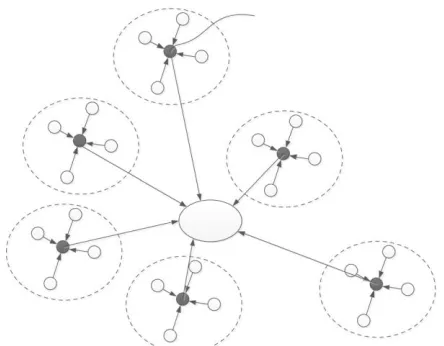
WSN base station always requires to produce a grouped value to the end users and the grouping of the data to be transmitted can also support in minimizing the transmission overhead and the energy consumption. To support the grouping of data in the network the nodes can be divided into small groups called the Clusters. Clustering can be explained as the partition of the nodes in the groups on the basis of some mechanism. Clustering has been utilized to enhance network lifetime, a primary metric for analyzing the performance of a sensor network. Clustering is done to acquire the energy efficiency and the scalability of the network. Formation of the cluster also includes the providing the role to the node on the basis of their perimeters. The coordinator of the cluster which is accountable for the processing, aggregation and transmission of the data to the base station is called the Cluster Head (CH) or the leader, whereas the other nodes which are accountable for sensing
and transmitting the gathered data to the CH are called the Member Nodes. [14]
Fig. 1 Process of Clustering in Wireless Sensor Network 3.2 AOMDV (Ad-hoc on Demand Multipath Distance
Vector Protocol):
AOMDV exploits several characteristics of AODV.
It is depending on the concept of on the distance vector and utilizes hop-by-hop routing strategy. Moreover, AOMDV also determines routes on requirement using a route identification procedure. The main difference is in the number of routes identified in each route discovery. In AOMDV, RREQ broadcasting from the source towards the destination presents multiple reverse paths both at intermediate nodes as well as the destination. Multiple RREPs tracks these reverse paths back to identify multiple forward paths to the destination at the source and intermediate nodes. Note that AOMDV also gives intermediate nodes with alternate paths as they are found to be valuable in minimizing the route discovery frequency. The core of the AOMDV protocol is in ensuring that multiple paths discovered are loop-free and disjoint, and in effectively determining such paths using a flood-based route discovery. [16] Traditional AOMDV does not take into consideration of the energy for selecting the paths [15]. Reliable data transmission has been an upcoming worry in ad hoc on-demand multipath distance vector AOMDV routing since the nodes are subjected to link failures and breaking up of route breaks in highly dynamic ad hoc networks because of the choice of multiple routes between any source and destination pair depending on minimal hop count. [17]
3.3 A clustering WSN routing protocol depending on node energy and multipath
probability forms, thus minimizing the number of data transmission; multipath parallel transmission is found out by link resource and hop number, and the data to be sent is distributed to pre-selected disjoint paths; more usual is the last one development of the single path, when the path discovery is observed, the multi hop path is picked, and one of the best performance is used as the current path, and if the path fails, the data is sent from the alternative path. [18] Many researchers utilize repetitive or network coding to implement multi-path routing protocols to assure reliability and real-time. AOMDV protocol can minimize the number of reinventions of routing, but will result to other serious implications, thus, when using multipath routing, required to be considered not only the number of hops in the path, the energy of nodes, but also the distance between nodes. When the current path fails, the backup path is utilized and new paths are produced on demand to replace the failure paths, thus managing the number of backup paths unaltered. In this paper, it is tried to implement an energy based multipath routing algorithm (LEACH, multiple disjoint paths are produced from the routing topology of inter cluster nodes. In data transmission, the current optimal path is dynamically picked by taking into consideration of the path energy utilization, the route hops and the path residual energy. There are N number of nodes and m number of completely disjoint routing from source node S to sink node (BS) .For the m routing (P1, P2, ・ ・ ・ Pm), position and energy of each node, the high priority path must have few hops, least transmission distance and large path residual energy. Nodes energy utilization parameter on the routing path is:
{
(1)
Total transmit and receive energy utilization parameters Ei of article i path is:
∑
( ) (2)
The Node Ni balance energy parameters aw after the completion of the data retransmission is:
( )
(
)
(3)
Defines the energy remaining for path i is:
( ) ( )
( )
∏ ( ) ( )
(4)
If the energy of one node is nearer to the critical state, the energy utilization parameter converges quickly, and the reliability and relative balance of the energy transmission of the path can be assured. Incorporating the total energy utilization and hops of the path, the routing energy priority parameter is explained as:
( )
( )
(5)
Out of them, defines the hop number of S → D, and
explains the residual energy of path i, and defines the energy consumption of path i. Substituting formulas (3.2) we can achieve the energy priority parameter of path i:
( )
∏ ( )
∑
( )
(6)
3.4 A Clustering WSN routing protocol based on node energy and multipath
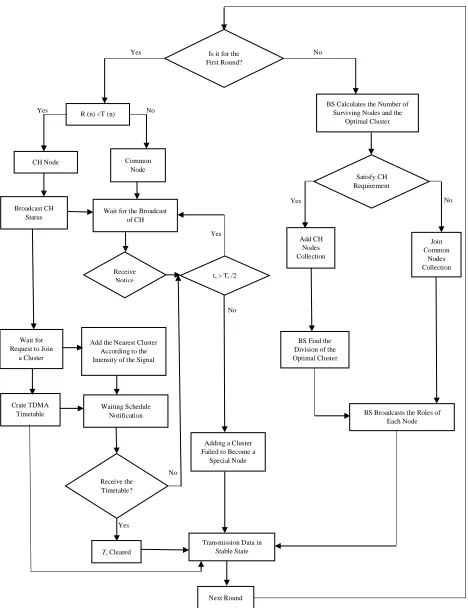
Based on the constraints present in the original protocol, in this research, the enhanced protocol is formulated whose process is shown in Figure.3. After finishing the first round, the next CH is picked by the BS in relevant with the residual energy, the distance from the BS, the number of times to be picked and the number of nearby nodes; and set other CH nodes and more scientific and admissible multi hop inter cluster routing. The first round selection mainly follows the strategy of the original protocol, and define wait time is𝑡, each round timing 𝑡 ( ) is the residual energy of node 𝑛 𝑑 ( ) is the distance of node 𝑛 to BS; 𝑁( ) is the total
amount of nodes that belongs to the same cluster on this node; and if node 𝑛 is in the to cluster 𝑐. Therefore, the evaluation function 𝑓(𝑛 𝑐) of CH is explained as followed
{
𝑓(𝑛 𝑐) (𝑛) 𝑛{ 𝑐 ( )} { 𝑐 ( )} 𝑛{ 𝑐 ( )} { 𝑐 ( )} 𝑛{ 𝑐 ( )}
𝑓 (𝑛 𝑐)
Otherwise
(7)
𝑓(𝑛 ) 𝑛{𝑑 𝑐} 𝑑 (𝑛)
(8)
{
𝑓(𝑛 𝑐) 𝑁(𝑛) 𝑛{𝑁 𝑐 ( )} {𝑁 𝑐 ( )} 𝑛{ 𝑐 ( )} { 𝑐 ( )} 𝑛{𝑁 𝑐 ( )}
𝑓 (𝑛 𝑐) Otherwise
(9)
{
𝑓(𝑛 𝑐) 𝑓 (𝑛 𝑐) 𝑓(𝑛 𝑐) 𝑓 (𝑛 𝑐) 𝑛
𝑓(𝑛 𝑐) Otherwise
(10)
In the Formula (3.7)– (3.10), 𝑓 𝑓 and 𝑓 are utilized to calculate the energy condition of the remaining nodes, the distance to the BS and the total amount of adjacent nodes
respectively. , and are weight index whose
4167
Fig 2 Flowchart for Cluster based Modified AOMDV 3.5 The main issues of the LEACH protocol
First, in practical applications, the segmenting of clusters is extremely uneven. Some clusters are too huge, while others have only one node, which cause in a large waste of node
energy. Second, the communication between cluster nodes and BS is single path point to point transmission. If the CH is at distance from the BS, it requires a huge transmission power. In the stable phase, if a CH has suddenly failed Is it for the
First Round?
R (n) <T (n)
CH Node Common
Node
Broadcast CH
Status Wait for the Broadcast of CH
Receive
Notice ts > Tr /2
BS Calculates the Number of Surviving Nodes and the
Optimal Cluster
Satisfy CH Requirement
Join Common
Nodes Collection Add CH
Nodes Collection
Add the Nearest Cluster According to the Intensity of the Signal
Waiting Schedule Notification Wait for
Request to Join a Cluster
Crate TDMA Timetable
Receive the Timetable?
Ts Cleared
Adding a Cluster Failed to Become a
Special Node
BS Find the Division of the Optimal Cluster
BS Broadcasts the Roles of Each Node
Transmission Data in Stable State
Next Round Yes
Yes
Yes Yes
Yes
No
No
No No
because of unexpected circumstances, the original LEACH protocol has no spare CH node, and then the ordinary nodes in the cluster will still interact in accordance with the original provided time until the end of the round, causing a great amount of energy waste. When the proportion is 5%, the system effectiveness is the highest. In fact, the ratio finds the number of CH nodes depending on the number of initial nodes, and there are more alterations in the structure resulted by the appending of new nodes and the failure of existing nodes in actual function. In WSN, the cluster heads are accountable for gathering the data from the members of the cluster and fusing them, and then transmitting them to the BS Station (Base), also known as the SINK. Therefore, the energy of cluster head nodes is mainly utilized in the following sections: energy will be consumed on receiving the data received by members of (N/r) clusters, energy utilization of data fusion processing, and energy utilization of transmitting the fused data to the base station. The choice of cluster head node in LEACH [16] has some deficiencies such as,1. some very huge clusters and very tiny clusters may prevail in the network at the same time.2. Irrelevant cluster head picking while the nodes have different energy.3. Cluster member nodes exhausted of energy after cluster head was failed.4. The algorithm does not consider the position of nodes. omits residual energy, geographic location and other information, which may simply result in cluster head node will rapidly fade. The Cluster head gathers and groups the information from sensors in its own cluster and sends the information to the BS. By rotating the cluster-head randomly, energy consumption is estimated to be uniformly distributed. However, LEACH possibly picks too many cluster heads at a time or randomly chooses the cluster heads far away from the BS without taking into consideration of residual energy. As a consequence, some cluster heads will exhaust their energy early thus minimizing the lifespan of WSN. In every step of the cluster formation, network requires to adopt the two steps to choose cluster head and transmit the aggregated data. (i) Set-Up Phase, which is decomposed in to Advertisement, Cluster Set-Up & Schedule Creation phases. (ii) Steady-State Phase, which achieves data transmission using Time Division Multiple Access (TDMA).[19]
3.6 Leach K-means algorithm
In Low Energy Adaptive Clustering Hierarchy (LEACH), a hierarchical protocol all most all nodes send the data to cluster heads. This section explains the original k-means clustering algorithm. The provided group of data with fixed k number of values into disjoint clusters is formulated. This strategy functions in a two individual sections. The first step is to assign k centroids forever cluster. The second step is to the provided data set is placed with a location to the closest centroid. Euclidean distance is generally taken into consideration to find out the distance between data points and the centroids. The first step is stopped after all the points are encompassed in clusters, and an early aggregation is made and to the new centroids are evaluated again, as the addition of new points may result in a alteration in the cluster centroids. Once k new centroids are found, a loop is produced to generated a new relationship between the same data points and the nearest new centroid. As a consequence of this loop, the k centroids may alter their location in a step by step manner with fixed centroids location leads in coverage demand. The k means algorithm is a famous strategy for
automatically categorizing vector-based data. [20]
3.7 Cluster Head Selection for Modified AOMDV based on Node Energy and multipath using midpoint K Means Algorithm.
To generate the initial centroids effective mid-point algorithm is utilized. The Midpoint Leach K-means (MPLK-means) algorithm provides a strategy to present the initial centroids. It also generates best clusters using k-mean method, in comparison with random choice of initial centroids. In formulated algorithm, if the input data set consists of the negative value characteristics, then all the characteristics are changed to positive space by subtracting every data point characteristic with the lease characteristic value in the data set. This modification is needed since the algorithm the measures distance from origin to each data point. Then for different data points similar Euclidean distance will be achieved to eliminate wrong choice of initial centroids. The next stage is to measure the distance of each point from the origin. The original data points are arranged into k equal sets. The point is evaluated in all over the process. All the mid-points are considered as the initial centroids.
A. Selection of Cluster Head
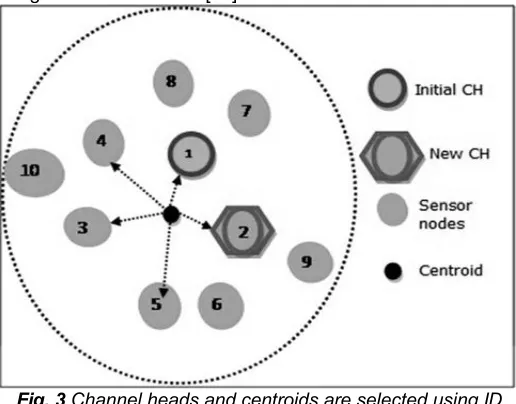
The midpoint algorithm which has been utilized for initial CH opting considers that the data points contain only positive values. Fig. 2 shows an example of a particular cluster of ten nodes where initial CHs have been selected through the midpoint algorithm. Here the centroid of preferred number of clusters retained is cluster is a virtual node locating at the center position of the cluster. In this figure, initial CH is explained by marked sensor node. To manage the link of the network, residual energy of the CH is monitored every round. If the energy of the CH is lease than the threshold energy, the node contains the next ID number is selected as a new CH as in [10]. The newly chosen CH intimates to nodes about the alteration of the CH. Balance node joins the closest cluster channel head and the centroid of every cluster is evaluated. ID number is assigned to every node in which least number is assigned to closest one. [21]
Fig. 3 Channel heads and centroids are selected using ID number
B. Calculation of Residual Energy Between Nodes
4169
is defined as follows:
--- (11)
Where, Ecurrent denotes the volume of residual energy and Emax is the highest volume of the energy of a node when it is fully charged. Since residual energy finds its place in the numerator, nodes with largest residual energy is chosen as CH.
C. Distance Between Node and Bs
Nodes that are nearer to the BS have more probability to be selected as CH. SP2 is explained by below equation as a parameter for the neares node to BS, for achieving high score than other nodes is most required to become a cluster head.
--- (12)
where, dbs the distance from every node to BS.
D. The Distance Between Node and Its Neighboring Nodes
SP3 is explained by Eq. (13) as a parameter for the node that is nearer to its adjacent nodes to achieve more score than others are required to be selection qualification as a cluster head.
∑
--- (13)
where, disi represents the distance between the node and its
ith neighbor. dis
max represents the distance between the node
and its farthest neighboring node and N is the number of neighboring nodes. Because the total distance is the numerator and N _ dismax is the denominator in Eq. (13),
multiplied by a negative number, the smaller the total distance between a node and its neighbors is, the lower the SP3 is achieved.
E. Number of Neighboring Nodes
A threshold for the number of cluster members should be formed so that number of adjacent nodes nearer to the threshold It is must to set that will have the higher probability to be picked as CH.SP4 is explained by Eq. (14).
( )
--- (14)
SP4 will be equal to 1 if the number of the node’s adjacent nodes counting is equal to the optimal number of adjacent nodes threshold), and less than 1 if counting is either larger or smaller than the threshold. The threshold is given in the equation
𝑡 𝑒 𝑑
--- (15)
where, counting represents the number of adjacent nodes of
every node and threshold refers for the optimal number of adjacent nodes for every node. CH selection is formulated for modified AOMDV as per the midpoint algorithm sensor nodes are gathered into closest channel heads and the operation is performed by following condition if (Residual energy of cluster head ≥ Ethreshold) and (SP1) and (SP2) and (SP3) and (SP4) then The node will retained as cluster head else determine ID number of all sensor nodes in that clusterThe node I the next order of ID number is picked as a new CH. Then the picked channel heads broadcast nodes about the alterations till the cluster heads are not altered any more. After then sensor nodes transmits data packet to their channel heads and evaluates the distance between elected CH by meeting the following condition
if (dbs < dthreshold) then
Cluster head directly linked to the BS otherwirs
picks the nearest neighbor cluster head whose dbs is less than the dthreshold to interact to BS
\IV EXPERIMENTAL RESULTS
Parameter Selection for Simulation
Following table shows the enlist of parameter needed for the simulation. Table 1 is summarized with Simulation parameters.
TABLE1
PARAMETERS FOR CLUSTERING
Parameter Value
Number of sensor nodes (N) 100 Network size 100x100 m2
Base station (0,0)
Number of clusters (Kopt) 4,5 Initial energy of node 1J
Data packet 3200 bits
Eelec 50 nJ/bit
0.0013 pJ/bit/m’
10 pJ/bit/m
2
Energy for data aggregation (EDA) 5 nJ/bit/signal
dBS 85_100 m
dCH dBS/2
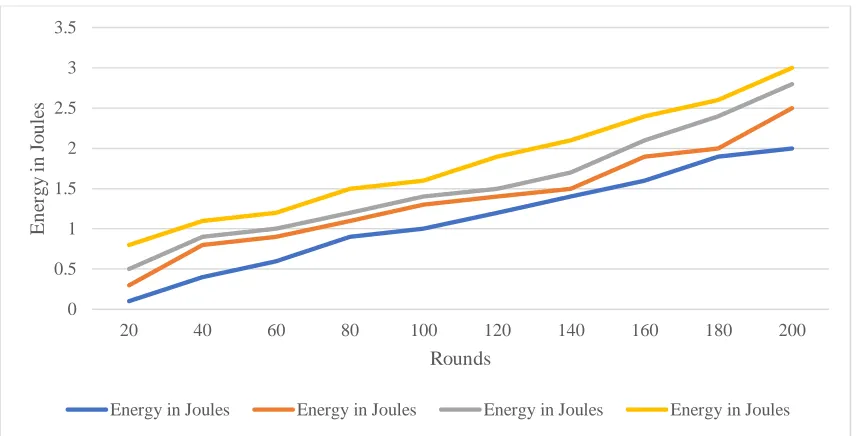
Fig.4 Residual Energy Parameter in Reducing Energy Consumption
Fig. 5 Comparison of Energy Consumption by Nodes
Fig. 4 and 5 depicts the observed energy consumption of the protocols in different rounds. It is clear from above graph that proposed protocol MPK (Mid-Point K-means) applied to modified AOMDV for the selection of outperforms EECF (Energy Efficient Cluster Formation) [22] Modified AOMDV and LEACH (Low Energy Adaptive Clustering Hierarchy) in terms of energy consumption and network lifetime.
0 0.2 0.4 0.6 0.8 1
1000 2000 3000 4000 5000 6000 7000 8000 9000 10000
A
v
er
a
ge
E
n
er
gy
i
n
J
o
ul
es
Time
Aveage Remaining Energy Aveage Remaining Energy
Aveage Remaining Energy Aveage Remaining Energy
0 0.5 1 1.5 2 2.5 3 3.5
20 40 60 80 100 120 140 160 180 200
E
n
er
gy
i
n
J
o
ul
es
Rounds
4171
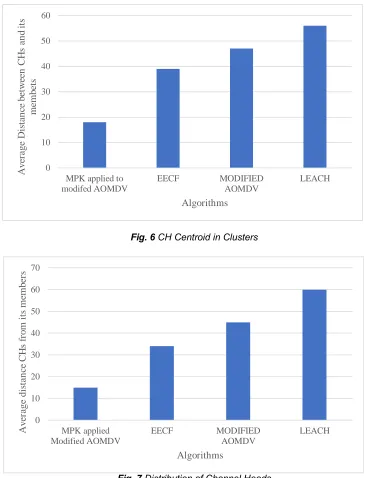
Fig. 6 CH Centroid in Clusters
Fig. 7 Distribution of Channel Heads
Fig. 5 and 6 Presents the selected CHs of proposed protocol MPK (Mid-Point K-means) strategy applied to Modified AOMDV for choosing the cluster are well distributed across the network due to cluster formation proposed protocol performs superior than EECF (Energy Efficient Cluster Formation) and Modified AOMDV LEACH (Low Energy Adaptive Clustering Hierarchy).
V CONCLUSION
AODV is a reactive protocol that identifies routes on a requirement basis using a route identification mechanism and AODV is single path routing protocol. Link Failures occurs in AODV. AOMDV is a multipath routing protocol that can be utilized to identify node-disjoint or link disjoint routes. AOMDV has large number of message overheads during route identification due to maximized flooding. Because of these overheads it consumes more energy. To overcome this clustering is introduced in AOMDV by considering node
energy. Cluster head selection is done by random manner. For Selecting the Cluster head in the clustering induced AOMDV midpoint K means algorithm is proposed. The proposed algorithm performs well in comparison with LEACH and EECF in parameters such as Energy Consumption by nodes, Residual Energy and distribution of Cluster heads.
REFERENCES
[1] Sangeeta Vhatkar, Mohammad Atique, ―Design Issues, Characteristics and Challenges in Routing Protocols for Wireless Sensor Networks‖ International Journal of Computer Applications (0975 – 8887) International Conference and Workshop on Emerging Trends in Technology 2013.
[2] Abdullah Alshahrani, Nader M. Namazi, Majed Abdouli, Ahmed S. Alghamdi, ―A Configurable Routing Protocol for Improving Lifetime and Coverage Area in Wireless Sensor Networks‖ Journal of Wireless Sensor Network, 2017, 9, pp 311-332, Scientific Research Publishing.
0 10 20 30 40 50 60
MPK applied to modifed AOMDV
EECF MODIFIED
AOMDV
LEACH
A
v
er
a
ge
D
is
ta
n
ce
b
et
w
ee
n
CH
s
a
n
d
it
s
m
em
b
et
s
Algorithms
0 10 20 30 40 50 60 70
MPK applied Modified AOMDV
EECF MODIFIED
AOMDV
LEACH
A
v
er
a
ge
di
st
a
n
ce
CH
s
fr
o
m
i
ts
m
em
b
er
s
[3] Khadije Rahimkhani, Fatemeh Forouzesh, ―Improved Routing in Wireless Sensor Networks Using Harmony Search Algorithm‖, Journal of Wireless Sensor Network, 2017, 9, pp 333-353, Scientific Research Publishing.
[4] D. Naga Ravikiran and C.G. Dethe, ―Improvements in Routing Algorithms to Enhance the Lifetime of Wireless Sensor Networks‖ International Journal of Computer Networks & Communications (IJCNC) Vol.10, No.2, March 2018.
[5] Vinesh Kumari, Hakam Singh, Pratibha Sharma, ―Energy Efficient Routing Protocols in Wireless Sensor Network‖ 2017 | Volume 5, Issue 2 | ISSN: 2321-9939, International Journal of Engineering Development and Research (IJEDR).
[6] Mohamed Benaddy*, Brhim El Habil, Othmane El Meslouhi, Salah-ddine. Krit, ―A Multipath Routing Algorithm for Wireless Sensor Networks Under Distance and Energy Consumption Constraints for Reliable Data Transmission ―International Journal of Sensors and Sensor Networks 2017; 5(5-1):32-35. [7] Jyoti Singh, Bhanu Pratap Singh, Subhadra Shaw, ―A New
LEACH-based Routing Protocol for Energy Optimization in Wireless Sensor Network‖ 2014 5th International Conference on Computer and Communication Technology IEEE Conference.
[8] Payal Jain, Dr. Anu Chaudhary, ―The Comparison between Leach Protocol and Pegasis Protocol based on Lifetime of Wireless Sensor Networks‖ International Journal of Computer Science and Mobile Computing, Vol. 6, Issue. 12, December 2017, pg.15 – 19.
[9] Wenbo Zhang, Ling Li, Guangjie Han, and Lincong Zhang ―E2HRC: An Energy-Efficient Heterogeneous Ring Clustering Routing Protocol for Wireless Sensor Networks‖ Special Section on Future Networks: Architectures, Protocols, and Applications, 2017, IEEE ACCESS.
[10]Padmavati Khandnor, Trilok Aseri, ―Threshold distance-based cluster routing protocols for static and mobile wireless sensor networks‖ Turkish Journal of Electrical Engineering & Computer Science (2017) 25 pp 1448 – 1459.
[11]Hassan Oudani, Salahddine Krit, Mustapha Kabrane, Kaoutar Bandaoud, Mohamed Elaskri, Khaoula Karimi, Hicham Elbousty, Lahoucine Elmaimouni, ―Energy Efficient in Wireless Sensor Networks Using Cluster-Based Approach Routing‖ International Journal of Sensors and Sensor Networks 2017;5(5-1): pages6 -12.
[12]Suparna Biswas, Jayita Saha, Tanumoy Nag Chandreyee Chowdhury Sarmistha Neogy, ―A Novel Cluster Head Selection Algorithm for Energy-Efficient Routing in Wireless Sensor Network‖, 2016 IEEE 6th International Conference on Advanced Computing (IACC).
[13]Puneet Azad and Vidushi Sharma, ―Cluster Head Selection in Wireless Sensor Networks under Fuzzy Environment‖ A Journal of ISRN Sensor Networks Volume 2013, Hindawi Publishing Corporation.
[14]Shilpa Mahajan, Pushpender Kumar Dhiman, ―Clustering in Wireless Sensor Networks: A Review‖, International Journal of Advanced Research in Computer Science, Volume 7, No. 3, May-June 2019.
[15]May Cho Aye and Aye Moe Aung, ―Energy Efficient Multipath Routing for Mobile Ad Hoc Networks‖ International Journal of Information Technology, Modeling and Computing (IJITMC) Vol. 2, No.3, August 2019.
[16]Mahesh K. Marina1 and Samir R. Das, ―Ad hoc on-demand multipath distance vector routing‖ International Journal of Wireless Communications and Mobile Computing 2006; 6:969– 988 Published online in Wiley Inter Science.
[17]P. Periyasamy and E. Karthikeyan,‖ Link reliable energy efficient AOMDV routing protocol for mobile ad hoc networks ―International Journal of Ad Hoc and Ubiquitous Computing Volume 26 Issue 2, January 2019 pp 92 -103.
[18]Zhong-xun Wang,Min Zhang,Xinglong, Gao Wenqi Wang · Xiaolin Li, ―A clustering WSN routing protocol based on node energy and Multipath‖ A Journal of Cluster Computing,2017, Springer Publication.
[19]Muhammd Arshad, Mohammad Y Aalsalem, Farhan A Siddiqui ―Enegy Efficient Cluster Head Selection in Mobile Wireless Sensor Networks‖ Journal of Engineering Science and Technology, Vol. 9, No. 6 (2014) pp 728 – 746.
[20]Park, G.Y., Kim, H., Jeong, H.W. and Youn, H.Y., 2013, March. A novel cluster head selection method based on K-means algorithm for energy efficient wireless sensor network. In Advanced Information.
[21]M.Sundar Rajan, J.R Arunkumar and Dr.R.Anusuya, Midpoint Leach K-means (MPLK-means) Algorithm for Cluster Head Election in Wireless Sensor Network, Conference.