In two volumes
Volume II
Thesis submitted for the degree of Doctor of Philosophy
in the School of Slavonic and East European Studies, University of London
September, 1996
Chapter 5 Discussion
The discussion which follows refers not only to the survey and dictionary data contained in the summary tables appearing in Chapter 4, but also to the full survey data found in
Appendix C. Translations are given for lexemes and phrases; Ryan & Norman (1995), and Wade (1992:419-21 for preposition + noun phrases) have been drawn on particularly heavily.
Lexemes are discussed in the order in which they appear in the tables in Chapter 3. Nouns are thus grouped according to the stress pattern traditionally assigned to them;
preposition + noun phrases are sorted by preposition, and • ordered alphabetically within this grouping; prefixed and non-prefixed verbs are sorted by root; and adjectives are grouped according to which forms show variation, and, within
this, alphabetically. For nouns and verbs, the stress pattern assigned to the lexeme in question by the majority of
speakers, that is, the pattern currently prevailing for the lexeme, is given immediately after the entry heading, eg
cynbk m, 'judge', 2.2; if younger or older speakers in the survey gave a pattern differing from the overall pattern, this information is included in brackets, eg moBoponA f,
'frying-pan', 4g (35+: 4g or 5g).
412
a) Nouns
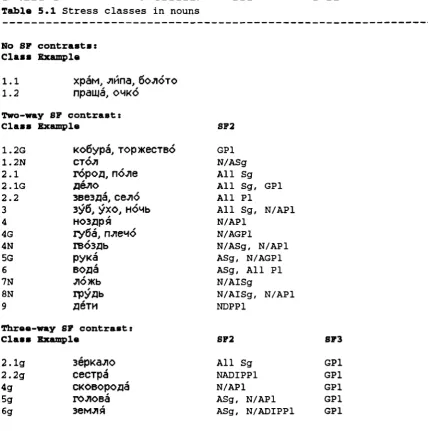
For the sake of clarity, two tables from Chapter 3 are repeated here. The first table lists all the classes and their variants; the SF which has the stress on the earliest syllable is arbitrarily called SF2; word-forms not listed have SF1:
Table 5.1 Stress classes in nouns
No SF contrasts: Class Example
1.1 xpam, nina, 6o,16T0 1.2 npaaa, ok4K6
Two-way SF contrast:
Class Example SF2
1.2G Ko6ykropmmoTB6 GP1
1.2N CTOA N/ASg
2.1 rOpon,n6Ae All Sg
2.1G 7:16-Ao All Sg, GP1
2.2 3se3/16, ce,n6 All P1
3 396, 9X0, H611b All Sg, N/AP1
4 Homp A N/AP1
4G ry6a, rme446 N/AGP1
4N 1B6341, N/ASg, N/AP1
5G pyK6 ASg, N/AGP1
6 B046 ASg, All P1
7N ,n6)Kb N/AISg
8N 17;?Ab N/AISg, N/AP1
9 AeTH NDPP1
Three-way SF contrast:
Class Example SF2 SF3
2.1g ApKaAo All Sg GP1
2.2g CeCTpS NADIPP1 GP1
4g mosopoai N/AP1 GP1
5g PDA0136 ASg, N/AP1 GP1
6g 3WAAA ASg, N/ADIPP1 GP1
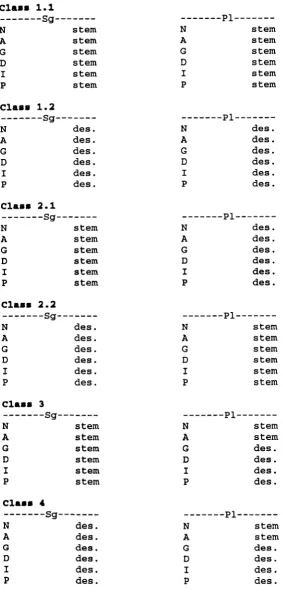
The morphemic stress of the classes is given below. Words of certain declensions will have a zero-desinence in
Table 5.2 Morphemic stress of noun classes
Class 1.1
Sg P1
N stem N stem
A stem A stem
G stem G stem
D stem D stem
I stem I stem
P stem P stem
Class 1.2
Sg P1
N des. N des.
A des. A des.
G des. G des.
D des. D des.
I des. I des.
P des. P des.
Class 2.1
Sg P1
N stem N des.
A stem A des.
G stem G des.
D stem D des.
I stem I des.
P stem P des.
Class 2.2
Sg P1
N des. N stem
A des. A stem
G des. G stem
D des. D stem
I des. I stem
P des. P stem
Class 3
Sg P1
N stem N stem
A stem A stem
G stem G des.
D stem D des.
I stem I des.
P stem P des.
Class 4
Sg P1
N des. N stem
A des. A stem
G des. G des.
D des. D des.
I des. I des.
P1 Class 5
Sg
N des. N stem
A stem A stem
G des. G des.
D des. D des.
I des. I des.
P des. P des.
Class 6
Sg P1
N des. N stem
A stem A stem
G des. G stem
D des. D stem
I des. I stem
P des. P stem
Class 7
Sg P1
N des. N des.
A des. A des.
G des. G des.
D des. D des.
I stem I des.
P des. P des.
Class 8
Sg P1
N des. N stem
A des. A stem
G des. G des.
D des. D des.
I stem I des.
P des. P des.
Class 9
Sg P1
N - N stem
A - A(=G) des.
G - G des.
D - D stem
I - I des.
P _ P stem
Case-forms may be separated into direct and indirect forms. The direct case-forms of inanimate nouns are the NSg
and ASg (or N/ASg) and N/AP1; the remaining case-forms are
indirect. For animate nouns, the A/GP1 (and A/GSg for
masculines) is considered indirect. In the analysis of the survey data, any one of the oblique Sg case-forms is taken as representative of the other oblique Sg forms (except the ISg of class 7 and 8 nouns and the LSg of third declension
the GP1 is taken as representative of the other oblique P1 forms (except for class 9 nouns).
Forms which do not fit the expected patterns of Sg-Pl or direct-oblique stress contrast may be considered anomalous. Certain forms (often the GP1) may have a unique, 'anomalous' SF, found only in this particular form. Forms are also
considered anomalous if they show irregularity in other respects, such as their morphological shape, rather than their stress. Tendencies in the development of mobile stress patterns often concern these anomalous forms; this is
discussed in greater detail in the section entitled
Conclusions, which follows the discussion below (p.488). Many of the nouns investigated in the present study are also discussed in Kip. It should be noted, however, that Kip. consciously ignores GP1 forms, because of the appearance of fleeting vowels, which, in his opinion, are 'haufig sekundar'
and which 'ziemlich regellos auftreten i (p.189).
Kip.'s codes, and the equivalent patterns in this study, are as follows:
Table 5.3 Kiparsky's codes and equivalent patterns in this study
Nouns in -a/-A
Kip. Pattern
1.1
/I 1.2
III 5
6
A 2.2
4
Nouns with monosyllabic stems, and nouns ending in a consonant:
Kip. Pattern
1.1
II 3
III 2.1
IV 1.2
i) Class 4
Discussion of data
Sg P1
N des. N stem
A des. A stem
G des. G des.
D des. D des.
I
des.
I des.P des. P des.
Class 4 nouns contrast a stem-initial stressed SF in the direct P1 word-form (N/AP1), with a desinence-stressed SF in the oblique P1 word-forms (GDIPP1) and all the Sg forms.
Class 4G nouns follow the same pattern, but have a zero-desinence in the GP1, and consequently stem-final stress and
the same SF as the direct Pl; this grouping of N/AP1 and GP1 in terms of their SFs may be considered anomalous, since it does not uphold the direct-oblique division.
Class 4g nouns follow the same pattern, but have a different SF for the stem-final stressed zero-desinence GP1, owing to their polysyllabic stems or the appearance of a
fleeting vowel.
Nouns of class 4N have a zero-desinence in the N/ASg, and thus stem-stress and the same SF as the direct Pl.
cKambA, f, 'bench', 1.2
The survey data shows that desinence-stress is clearly preferred for the entire P1 (falling, by necessity,
stem-finally in the zero-desinence GP1), bringing the stress of the P1 into line with the stress of the Sg; only two older informants gave stem-stress for the direct P1 and one older informant stem-stress for the oblique Pl.
This is borne out by the dictionary data: sources agree on desinence-stress for the entire Pl, whilst Zal. and Red. list, and A&O and OS permit, stem-stressed variants for the direct P1 also; only Zal. lists and OS permits stem-stressed oblique P1 forms. SU, the most modern source, lists
mambA thus no longer contrasts direct P1 cases with all other forms by stress, but has generalised fixed desinence-stress for all forms (pattern 1.2); this process is complete for almost all speakers.
Kip. (p.197) considers that pattern 1.2 may in fact be original; his sources give 1.2 as normative, and 2.2
(desinence-stress in the Sg, stem-stress in the Pl) as
permissible. The survey demonstrates that earlier patterns of 2.2 or 4 have thus given way to 1.2.
cyAbA, m, 'judge', 2.2
Dictionaries indicate no variation in the stem-stress of the direct Pl, but variation in the GP1 (where a fleeting vowel appears before the jot) and other oblique P1 forms. The
survey thus tested the GP1 and DP1, finding stem-stress to be universal for the DP1, and stem-initial stress given by 67% of informants for the GP1. Older speakers were slightly over-represented amongst those giving stem-final stress (on the fleeting vowel) for the GP1.
Only one source gives stem-final stress as the only possible stress for the GP1, and whilst the oldest source
(A&O) prohibits stem-initial stress, the newest source allows only this variant. The older stem-final stressed GP1 would thus seem to be gradually giving way to a more modern, stem-initial stressed form. All sources except OS give stem-stress as either the only or a possible stress for the rest of the oblique P1 forms, with only OS and Red. mentioning desinence-stress. The latter two sources thus do not reflect modern usage.
Nesset marks stem-final stress as optional for the GP1. In morphophonemic treatments such as that of Stankiewicz (see 1986:331) cyAIDA is grouped with nouns such as cembii for which GP1 stem-final stress is obligatory, and pymb8 and CBlitibil, for which it is a variant; the apparently anomalous stem-final
stress of the GP1 is explained as the realisation of a stressed zero morpheme occurring stem-finally in the
is brought into question, however, by the common occurrence of a stem-initial stressed GP1 form, as demonstrated by the survey.
Shapiro (1986:195) states that this noun has moved into our class 2.2, and that this is representative of a tendency amongst similar nouns which formerly had an anomalous GP1
form (eg cecT136,cBmHb4). This point of view is compatible with
the findings of the survey.
The survey shows that stem-(initial) stress is unanimous for oblique P1 forms except the GP1, and commoner, especially among younger speakers, for the GP1, than stem-final stress
(cyneA ). CyAbsi would seem, as suggested by Shapiro, to be
moving towards pattern 2.2, with a simple Sg-Pl contrast of stress. The anomalous form of the GP1, with its fleeting vowel, may account for its reluctance to join the stress of the rest of the P1 (cf Tesniere 1937:262).
Kip. (p.227) gives pattern 1.2 (fixed desinential-stress) as original. Pattern 4 is a later development, subsequently replaced by pattern 2.2, preferred in his twentieth-century sources. This agrees with the survey findings.
nt, plurale tantum, 'diamonds (suit in cards)', 2.2 The survey indicates that stem-stress is preferred for the GP1, with only eight
informants
giving desinence-stress, of which six were older speakers. All informants gave the PP1stem-stress.
Source data (except from SU) seem to confirm this. Whilst the two oldest sources (Red. and A&O) prohibit
A process of levelling to fixed stem(-initial) stress (pattern 2.2) seems to be taking place for this lexeme, and to be already complete for the oblique P1 cases except the GP1, where it may be prevented by the anomalous form with its
fleeting vowel.
nelibm plurale tantum, 'money', 4
Sources give stem-stress without variation for the N/AP1 and the GP1, but variation for the other oblique P1 word-forms. The survey indicates that desinence-stress for these other oblique forms is preferred, with twice as many informants giving this. All but one of the informants who gave stem-stress, however, were under 35; this is thus the younger variant.
Source data confirms that desinence-stress is preferred, and marks stem-stress as obsolescent; the survey indicates that stem-stress has been lost for older speakers, but is developing again for younger speakers. The stem-initial stress of the GP1 is highly anomalous, grouping as it does the N/AP1 with the GP1, despite the fleeting vowel; Nesset, accordingly, places it in a special category with cammub.The
younger tendency to generalise stem-stress for all the Pl, however, is evidence of a gradual removal of this anomaly. Kip. (p.205) discusses AeHbra 'old Russian coin; (P1)
money'. He believes the original stress to be pattern 1.1 (fixed stem-stress). Pattern 4 or 2.2 mobility is a later development; the survey indicates that the modern preference is for pattern 4, with a younger trend towards 2.2.
ApOemm, plurale tantum, 'wood-sledge', 2.2
Icriówm (4, or luiewA, 1.2), plurale tantum, 'tongs'
K.716w, P1 KJ1eLWI, m, 'tick', 1.2
In the meaning 'tongs', sources give stem-stress as normative for the N/AP1, although desinence-stress is permitted by OS and Red., listed beside stem-stress by Zal., and the only version given by A&O. Desinence-stress is undisputed for the oblique cases. The modern pattern thus appears to be like pattern 4 in the Pl. Fixed desinence-stress in the Sg and P1
(pattern 1.2) is the only possible stress in the meaning 'tick', and this is confirmed by Kip.(p.20).
The test sentence in the survey failed to distinguish the two possible meanings; two informants stated explicitly that stress depended on meaning. Source information alone therefore leads us to conclude that it is possible that the semantic differentiation is maintained in the N/AP1 by a contrast of stress, with '<mew meaning 'tongs', and Kmewli
meaning 'ticks'; however, this contrast is not present in the oblique cases. The distinction is certainly current for at least two of the informants.
Orpythi, plurale tantum, 'bran', 4
The survey indicates that fixed desinence-stress is strongly preferred for all oblique cases; sources list only desinence-stressed variants, apart from A&O, the oldest source, which already prohibits stem-stress for the GP1. Pattern 4, that of contrast between direct and oblique cases, would thus seem to be relatively stable.
nOmow, plurale tantum, 'harness; braces', 4 (GP1 nOmomeil )
only, unattested in dictionaries; two further informants
failed to give a reading. The preferred pattern is thus stem-stress in the N/AP1 and GP1, and desinence-stem-stress for the other oblique cases, although it may be that this anomalous pattern causes many speakers to question the stem-stress of the GP1 .
n6xopoHm, plurale tantum, 'funeral', 4g
All informants gave stem-final stress for the GP1 (which may be interpreted as theoretical desinence-stress), and all but
two gave desinence-stress for the PPl. Sources admit the existence, but prohibit the use, of stem-stressed variants for the oblique Pl, but it appears from the survey that these have very little currency. The pattern 4-type direct versus oblique contrast is thus stable, and the contrasting SF of the GP1, owing to its zero-desinence, not subject to
variation.
penw, plurale tantum, 'labour, delivery', 1.1
Stem-stressed variants were preferred for oblique plural forms both by younger speakers and by most older speakers, just two giving desinence-stress for the GP1, and one for the PPl. Sources concur with this, only the two oldest sources
(Red., A&O) recognising the existence of a desinence-stressed variant, for the GP1 only (poA619), a form which is prohibited by A&O. Fixed stem-stress (pattern 1.1) would thus seem to be
firmly established for this noun, in place of older pattern 3
(if stem-stress is assumed for a theoretical Sg) or 4 (if desinence-stress is assumed).
Kip. (p.90-91) indicates, for the meaning 'labour,
6.710)(6, f, 'flea', 2.2
All but one informant gave stem-stress for the PPl. Stem-stress is listed as a variant by OS and Zal., but prohibited by A&O; all sources, however, list desinence-stress, although
this is clearly very rare in practice. It seems likely that
6Aoxa has moved to pattern 2.2 (stem-stress throughout the Pl,
contrasting with desinence-stress throughout the Sg), the contrast of SFs (including that of the GP1) thus underlining the number contrast.
Kip. (p.203) considers fixed desinence-stress (pattern 1.2) to be original, with pattern 4 mobility a later
development; the survey demonstrates, however, that this has now been replaced by pattern 2.2.
Boma, f, 'wave', 4 (-35: 2.2)
Survey results indicate that the stress of the PP1 is fluid,
with a narrow majority of informants preferring desinence-stress. The age-split shows that among younger speaker stem-stress was narrowly preferred, whilst older speakers clearly favoured desinence-stress. The younger version thus appears to be stem-stress, which gives a nice contrast of desinence-stress throughout the Sg with stem-desinence-stress throughout the Pl, ie pattern 2.2.
Loy-Aar'
Dictionaries generally list both variant ; SU, however,
Li /°C the most modern dictionary, gives only desinence-stress, and
is therefore conservative. A&O, the oldest dictionary, marks
stem-stress as permissible, confirming that this is a newer
variant.
A transition towards the number opposition being
supported by an SF contrast seems to be occurring at present; however, the older pattern 4 (direct versus oblique contrast in the plural) although undermined by the zero-desinence of the GP1, still holds sway.
variation perhaps as early as the sixteenth century. Pattern 4 and pattern 2.2 mobility are later developments.
Boil-iá 'wool' occurs dialectally as a singulare tantum noun with either fixed desinence-stress or fixed stem-stress.
rpsula, f, 'bed (horticultural); bank, range (eg of hills, clouds)', 2.2
SU, OS and Zal. recognise a difference in meaning and
concomitant difference in stress, assigning rpsna 'bed' stem-stress throughout the P1 (pattern 2.2), and rimai 'bank,
range' desinence-stress throughout the P1 (pattern 1.2; OS, Zal.) or desinence-stress in the oblique P1 and stem-stress in the direct P1 (pattern 4; SU). A&O does not recognise a meaning differentiation, and indicates a direct-oblique contrast in the P1 (pattern 4). Red. lists both
direct-oblique contrast and fixed stem-stress variants in the Pl. It should be noted that the GP1 is always stem-stressed in
reality, owing to its zero-desinence.
The survey tested direct and oblique P1 forms for both meanings. Stem-stress for all forms was preferred in both meanings, more clearly so for younger speakers, but with
significant variation throughout. In particular, informants showed greater inconsistency in the meaning 'bank, range', especially for the PP1 in this meaning, which was fairly equally split between stem- and desinence-stress.
It would seem, therefore, that stem-stress is being generalised for the P1 in both meanings of the word (pattern 2.2), re-affirming the number opposition, and eliminating the special position of the GP1 with its zero-desinence. Sources disagree in their data, but all fail to notice the occurrence of a desinence-stressed N/AP1 variant in the meaning 'bed', and those that recognise a meaning distinction fail to reflect the still preferred stem-stressed oblique forms in the meaning 'bank, range'. The situation is thus more fluid than dictionaries imply.
=ma,
f, 'trough', 4 (35+: 1.2 or 4)
Desinence-s tress is given by all sources for all forms except
the N/AP1. Stem-stressed N/AP1 718wmis given by all sources,
OS also listing
Aemm,and Zal. permitting fixed
desinence-stress (pattern 1.2) throughout the Pl.
The word is rare, and eight informants were unable to
provide a reading. All three variants listed in dictionaries
were attested, with a slight majority (46%) in favour of
amm,thus maintaining a direct P1 versus all other word-forms
contrast of stress (pattern 4), but eliminating the
e>8
development; a smaller but still significant group (31%)
generalised desinence-stress for both Sg and P1 (1.2). With
both patterns, the GP1 with its zero-desinence is anomalous,
either agreeing with the N/AP1, or contrasting its SF with
that of all other forms.
Kip. (p.205) believes the original stress to be pattern
5 mobility or pattern 1.2 (fixed desinence-stress); pattern
4mobility is a later development. The high level of
unfamiliarity of this word makes it difficult to draw
conclusions about its position in modern Russian; the survey
shows that patterns 4 or 1.2 are the most common, amidst much
variation.
we.ne3S,
f,
tonsil', 2.2 (GP1 )s(eA63)
Stem-initial stress for the N/AP1 is undisputed in dictionary
sources, with desinence-stress for the oblique Pl. In
addition, OS and A&O recognise the existence, but do not
recommend, stem-initial stress for the oblique P1 forms,
although this is specifically prohibited for the GP1 by A&O.
Several informants were unable to provide readings, with
two commenting that they did not understand the sentence
containing the DP1 word-form
(iTonomoraer)icesne3am`thisaids
the tonsils'); this was probably due either to the
unfamiliarity of the word, or confusion with
wene3o,nt,unattested in dictionaries, and one giving an unattested GP1 form; moreover, several informants suggested and then
rejected variants. This indicates the unfamiliarity of the word.
Of those providing readings, the great majority gave the desinence-stressed GP1 form we.7183, the form given or
recommended by sources; two younger and one older speaker, however, gave stem-initial stress. Just over half, and the majority of younger speakers, gave stem-stress for the DP1, although this is not recommended by sources; another large group followed the sources' recommendation of desinence-stress.
This seems to indicate that stem-stress is being
generalised for the Pl, in contrast to desinence-stress in the Sg; this represents a movement towards pattern 2.2. The GP1 has held out against this, however, perhaps owing to its different SF (we.7163), which is upheld by most speakers; the
rarity of the word may also permit its anomalous stress pattern.
Kip. (p.205) believes the original stress to be pattern 5 mobility; pattern 4 mobility is a later development. The survey demonstrates further movement towards pattern 2.2, with an anomalous GP1 form.
f, 'swelling from hernia', 4
Several informants were unfamiliar with this word, or considered it obsolete. The majority of those giving a reading assigned stem-stress to the N/AP1, and a narrow
majority, particularly of older speakers, favoured desinence-stress for the PPl. SU and A&O list only desinence-desinence-stress for all Pl, whilst other sources list stem-stressed variants
throughout.
It would seem that the modern trend is towards stem-stress throughout the P1 (pattern 2.2), which would
regularise the SF of the GP1 with its zero-desinence.
the zero-desinence GPI sharing a SF with the N/AP1. This creates an anomalous pattern of SF distinctions.
Kip. (pp.205-6) believes the original stress to be
pattern 1.1 (fixed stem-stress); patterns 4, 2.2 and 1.2 are later developments. The survey indicates a modern trend
towards pattern 2.2.
Komi& f, 'shock, stook (of corn)', 2.2g, GP1 KOnem (35+: 2.2g,
GP1 Kon6m; -35: 4, with anomalous GP1 KOneH)
A very narrow majority of informants favoured stem-stressed variants throughout the P1 (pattern 2.2); in the GP1, another
large group, composed particularly of older speakers, gave the theoretically desinence-stressed variant WIleH, and a desinence-stressed PP1 variant was given by just under half the informants (pattern 4). Sources give desinence-stress for oblique forms (pattern 4), although OS and Zal. also give stem-stressed variants.
It appears that the lexeme is moving towards fixed stem-stress in the Pl, contrasting with desinence-stem-stress in the Sg (pattern 2.2); many older speakers maintain the theoretically desinence-stressed e> 6 GP1, and some, old and young alike,
maintain desinence-stress in the other oblique P1 forms. Kip. (p.205-6) believes that the original stress is likely to have been pattern 1.2 (fixed desinence-stress); pattern 4 is a later development, with pattern 2.2 a very recent development.
KowmA, f, 'large piece of felt', 2.2
A misprint in the survey means that no results are available for the N/AP1. Many informants were unfamiliar with the word, which was correctly printed in the sentence in which it
appeared in the PP1; 75% of those responding gave stem-stress for this form. Sources list stem-stress for the direct Pl, and desinence-stress for the oblique Pl, although OS
recognise stem-stress for the oblique P1 as well. The latter two sources also acknowledge the existence of a GP1 variant with an unstressed fleeting vowel, KOwemi.
Two processes are possible: the creation of a desinence-stressed N/AP1, giving desinence-stress throughout the Sg and Pl, but an anomalous GP1 form with zero-desinence; or the appearance of stem-stressed DIPP1 forms, regularising the SF of the GP1 and forming a Sg-Pl contrast of stress (pattern 2.2). The survey evidence suggests that the latter is more likely, as far as the stress of this unfamiliar word is known at all.
Kip. (p.206) finds no evidence for the expected 1.2 (fixed desinence-stress); present variation is between patterns 2.2 and 4. The survey points towards pattern 2.2.
memS, f, 'boundary-strip', 1.2G
The survey clearly shows that desinence-stress is preferred for all P1 word-forms (pattern 1.2), eliminating the direct-oblique contrast and any Sg-Pl contrast. All but one
informant gave desinence-stress for the oblique Pl, whilst four retained the older stem-stress of N/AP1 (pattern 4).
OS and Zal. recognise this trend towards desinence-stress in the N/AP1; the same two sources also recognise the existence of stem-stress for the oblique P1 forms, indicating a variant with a 2.2 pattern, arising from the levelling of stem-stress in the Pl.
The trend towards fixed desinence-stress throughout the Sg and P1 (pattern 1.2) leaves the zero-desinence GP1 with an anomalous SF; OS, however, notes the existence of a
'regularised' desinence-stressed GP1 mexceA
66xa, f, 'shaft or handle of plough; obzha (historical measure of arable land and unit for tax assessment)', 1.1
The stem-stress of the N/AP1 word-form is undisputed. SU
indicates fixed stem-stress throughout the Sg and Pl, whilst OS, Zal. and Red. also give desinence-stressed variants.
This word was unfamiliar to fourteen of the twenty-one informants. Those who did give readings showed a preference for stem-stressed variants (NSg, ASg, GP1 and PP1 were
tested), and often consistency of stress within the Sg forms and the P1 forms; figures are too low, however, for firm conclusions to be drawn. The word is rarely used and its stress unfamiliar to most speakers; stem-stress would appear often to be generalised across all forms (pattern 1.1).
Kip. states only that this word is obsolete (p.232).
npocEmpa, f, 'communion bread', 2.2 (N/AP1 np6cBmpw, GDIPP1
npocBilp- )
The desinence-stress of the Sg, and stem-stress of N/AP1 is undisputed; more recent sources give desinence-stress
(realised as stem-final stress for the zero-desinence GP1) for the oblique P1 forms (pattern 4), whilst older A&O prefers, and Red. recognises stem-initial stress for the entire P1 (pattern 2.2).
Informants agreed unanimously with the more recent
sources for the GP1. The SF of this form, however, according to survey evidence, has been extended to the other oblique P1 cases; all informants who responded gave npocaiipax, although this is unattested in dictionaries. The pattern represents a variation on pattern 2.2, the Sg having desinential-stress,
the direct P1 initial stress, and the oblique P1 stem-final stress; in terms of SF contrasts, there are thus three distinct SFs, whilst in terms of which morphemes are
Kip. (p.207) believes pattern 5 mobility to be original, both for npocempa and its synonym npocepok pattern 4 is a
later development for npootopa (for which no variation is recorded in modern sources) and 4 and 2.2 later developments for npocampa. The survey shows that a variation on pattern 2.2 has developed for this noun.
npocrb1H4 , f, ' sheet , 4 ( GP1 npocrbmeil)
The stem-stress of the N/AP1 is undisputed. Some sources recognise the existence of 'incorrect' stem-stressed NSg forms ngoticTbirth and nOcTIAIR (OS), a stem-stressed GP1 form which is prohibited (SU, A&O) or not recommended (OS), and a stem-stressed PP1 form which is prohibited (A&O) or not
recommended (OS). None of these forms was attested in the survey, except for one occurrence of the stem-stressed GP1
npOcTbnib. All except Red. give npocnimb as the GP1, although OS and Zal. also give moommek the form given by most
informants.
The survey shows that desinence-stress is maintained throughout all Sg and P1 word-forms, except the N/AP1, with the GP1 given the ending 411 and thus the same SF as the Sg and the rest of the oblique Pl. Pattern 4 is thus undisputed, and the SF of the GP1 is regularised, bringing it into line with the rest of the oblique Pl.
cepbra,
f, 'earring', 4Stem-stress in the N/AP1 and the theoretically desinence-stressed GP1 form
am6r
are undisputed. All sources give desinence-stress for the remaining oblique P1 forms, as did 64% of informants for the DP1, this variant being especially common amongst older speakers. Zal. gives stem-stressedoblique forms also, which are permitted by OS, and a stem-stressed DP1 was given by the remaining 36% of informants.
contrast is still upheld by the majority of speakers,
especially older informants. The undisputed GP1 am6r may be resistant to change owing to its anomalous SF with
characteristic e > 6 development.
Kip. (p.208) considers pattern 4 mobility to be a later development for this noun, replacing a probable (but
unattested) original pattern 1.2 (fixed desinence-stress). The survey demonstrates that pattern 2.2 is developing, with an anomalous GP1.
cmpai, f, 'stack, rick', 1.2G (-35: 2.2)
A fixed desinencestressed masculine variant of this noun
-odipm - also exists. All sources give desinence-stressed forms for all the Pl, as well as a stem-stressed form for the
N/AP1; OS and Zal. also recognise stem-stressed oblique P1 forms.
Younger speakers were more or less evenly split between stem- and desinence-stressed direct and oblique P1 forms; older speakers, on the other hand, clearly preferred desinence-stressed forms throughout. It may be that the existence of the desinence-stressed masculine variant odipij promotes desinence-stressed P1 variants, which would thus agree in terms of their stress with the Sg forms, creating a pattern of fixed desinence-stress throughout (pattern 1.2). Alternatively, the narrow majority of younger speakers giving
stem-stressed variants throughout the P1 suggests the
development of a Sg-Pl opposition (pattern 2.2); this would remove the problem presented by the SF of the zero-desinence GP1 form cia:ip74, which otherwise contrasts with all other
forms.
Kip. (p.208) considers class 4 mobility for ckmpila to be
mon, f, 'clamp, staple', 2.2
Stem-stress is undisputed for the N/AP1; all sources give desinence-stress for the oblique Pl, whilst OS and Zal. also give stem-stress, prohibited by A&O. The survey indicates that stem-stress is clearly preferred for the oblique P1 forms, however, pointing to a levelling of stress in the Pl, and a contrast of stress between Sg and P1 forms (pattern 2.2). In this way, the zero-desinence GP1 ma is no longer anomalous in terms of its SF, now having the same SF not only as the N/AP1, but as the rest of the Pl.
Kip. (p.208) believes that cognates in South Slavonic languages attest an original pattern of fixed stem-stress
(class 1.1); later sources give pattern 4. The survey demonstrates that pattern 2.2 is developing.
mosoponS, f, 'frying-pan', 4g (35+: 4g or 5g)
Sources give desinence-stress for the Sg, with OS and Zal. noting an obsolescent stem-stressed ASg. A small majority of
(particularly younger) informants preferred desinence-stress, but nine of the twenty-one informants retained stem-stress.
Sources unanimously give stem-stress for the N/AP1, theoretical desinence-stress (falling stem-finally owing to the zero-desinence) for the GP1, and desinence-stress for the other oblique P1 forms. This is upheld by the survey results, although two informants gave a stem-initial stressed GP1, and
five informants (four older and one younger) gave a
stem-stressed DP1, a form prohibited or not recommended by the two most modern dictionaries.
It would seem that the modern pattern is one of fixed desinence-stress in the Sg and the oblique Pl, contrasting with stem-stress in the direct P1 (pattern 4); interestingly, some older speakers have generalised stem-stress in the P1 to include oblique forms except for the GP1. The distinct SF of the GP1 is generally maintained; this may be taken as
Kip. (p.208) gives original pattern 5, pattern 4. The survey demonstrates that the
in the modern language, with the GP1 having the zero-desinence. One informant preferred
cKosopOnoK for the GP1, from the diminutive this diminutive form appears to be far more
later replaced by latter is upheld a third SF due to the form
form mosop6ma;
current in the spoken language than the non-diminutive form.
cAeni, f, 'beam', 2.2
All but one informant gave stem-stress for the PP1, implying fixed stem-stress throughout the Pl; this stress is also noted by two of the more modern sources, OS and Zal. All
sources list the more traditional desinence-stress for the oblique Pl, chosen only by one older informant in the survey.
The movement towards a Sg-Pl opposition (pattern 2.2) would therefore seem to be almost complete; the GP1 now has the same SF as the rest of the Pl.
Kip. (p.208) is unable to identify the original pattern
of stress; pattern 4 mobility has latterly been established. The survey indicates that this has been abandoned in favour of pattern 2.2.
cAo6o,a, f, 'sloboda, settlement with non-serf population; (obsolete) suburb', 4g
The survey shows the almost complete stability of the stem-final stressed zero-desinence GP1 cAo66n, attested in all
sources. Three-quarters of informants gave desinence-stress for the PP1, the variant listed by all sources, but three speakers gave stem-initial stress, not recommended by OS, and two gave stem-final stress (like the GP1), not attested in the dictionaries.
The pattern 4 direct-oblique contrast seems to be upheld in the Pl, therefore, with the GP1's anomalous SF also
the N/AP1 (pattern 2.2), or towards the stem-final stress of the GP1 (a variant on 2.2, eg cemtp); however, this is seen only in a few speakers.
Kip. (p.208-9) gives 1.2 (fixed desinence-stress) as probably the oldest pattern; pattern 5 is given by Vostokov
(1831), however, and pattern 4 mobility is established in more recent sources.
cTpoO, f, 'stanza, strophe', 4G
Desinential-stress is given by three-quarters of informants for the oblique P1 forms, but the remaining speakers (four younger, but only one older speaker) give stem-stress. Most
sources allow both variants, although the oldest (A&O) prohibits stem-stress. Stem-stress throughout the Pl,
regularising the SF of the GP1, would thus appear to be the more modern variant, contrasting with desinence-stress in the
Sg (pattern 2.2); however, the older pattern 4G is still maintained by the majority of speakers.
Kip. (p.209) gives fixed desinential stress (pattern 1.2) as original; this was later replaced by patterns 4 and, finally, pattern 2.2. The survey confirms movement towards pattern 2.2.
cyAb65, f, 'fate', 2.2
Desinential-stress is found in the Sg, whilst older N/A stem-stress and GDIPP1 desinence-stem-stress (pattern 4) competes with newer stem-stress in all the P1 forms (pattern 2.2).
Stem-stress throughout the P1 is recommended by sources, although the older desinence-stressed GP1 form cy74615 is also given, marked as obsolescent or obsolete, by all but the most modern
source, and other desinence-stressed forms are given
decreed', and KaKiirvo1cyAb66mti? 'fancy meeting you here!; how did you/he/etc get here?'.
Red. states that this noun is moving from fixed
desinential-stress in the Sg and P1 (pattern 1.2) towards desinence-stress in the Sg contrasting with stem-stress in the P1 (pattern 2.2). If this is indeed so, pattern 4, with stem stress in the N/AP1 and desinence-stress in the GP1
(theoretical) and in the other oblique P1 forms, represents an intermediary stage.
Kip.(p.227) gives pattern 1.2 as original; patterns 2.2 and 4 are recorded by his twentieth-century sources.
rpon6, f, 'path', 2.2
A large majority of informants gave stem-stress for the
oblique P1 forms, pointing to a regularisation of stem-stress in the Pl, contrasting with desinence-stress in the Sg, and regularising the SF of the GP1 (pattern 2.2). Dictionary evidence backs this up, with older sources giving only desinence-stress, but newer sources marking this as obsolescent.
Kip. (p.209) gives pattern 5 as original; patterns 2.2 and (more rarely) 1.2 developed later, and current sources indicate pattern 4. The survey demonstrates that pattern 2.2 is general.
werhi, f, 'splinter, chip (of wood)', 2.2 (35+: 4G) The P1 occurs predominantly as N/AP1 in the phrases
pa36P1rtilpa3HecrilBwenbi 'to smash to pieces'; elsewhere it is generally replaced by the diminutive wenKm.
especially by younger speakers; sources give desinence-stress, with OS listing the desinence-stressed variant.
It appears that the rare oblique P1 forms tend towards stem-stress, bringing them into line with the direct P1 form, and the SF of the GP1; pattern 4G is thus been replaced, for younger speakers, by pattern 2.2.
Kip. (p.209) is unable to establish the original stress. Vostokov (1831) gives pattern 5; in the twentieth century this has been abandoned in favour of pattern 4. The survey indicates that the current tendency is towards pattern 2.2.
sOp, mt, 'thief', 3
This animate noun follows pattern 3, with stem-stress in the Sg and NP1, and desinence-stress in the oblique Pl, including the A/GP1. However, a desinence-stressed variant (prohibited by OS and A&O) exists for the Sg forms (except zero-desinence NSg); such a stress, as found in the desinence-stressed GSg variant in the proverb 13613 y 1300 Ily6kiwy yKpaa 'one thief has
outwitted another, ie both parties are guilty' (see Zhukov 1993:73), indicates movement in the direction of pattern 4. A&O also prohibits a desinential-stressed NP1, an observation which would point towards a levelling of the whole of the P1
to desinence-stress, either creating a Sg-Pl opposition (pattern 2.1) or, more likely, fixed desinence-stress throughout (pattern 1.2).
Kip. (p.18) gives pattern 3 as original and normative, although an 'emotive' A/GSg form with desinence-stress is possible, in the phrase AepwAeopa! 'stop thief!'; this, he
believes, has spread to the rest of the paradigm, giving a non-normative, colloquial pattern 1.2 (fixed desinential-stress) (pp.68, 97). This pattern is also found dialectally
rpOnb, m, 'milk-agaric (type of mushroom, Agaricus or
Lactarius
piperatus)', 4NSome 38% of informants gave stem-stress 4,9321 q in the GSg, a
variant attested by OS, implying levelling to the SF of the N/ASg, and pattern 3 overall. The remaining informants gave the desinence-stress given as standard by all sources. The N/AP1 has undisputed stem-stress, and the oblique P1 forms have desinence-stress.
Kip. states that evidence from the oldest sources is inconclusive (p.82-83), but traces a probable development from pattern 3 to pattern 4. The survey demonstrated that pattern 3 still has currency, or perhaps has redeveloped, for a sizable proportion of speakers.
17;mb, m, 'goose', 3
Sources indicate pattern 3 for this animate noun, with stem-stress in the Sg and NP1, and desinence-stem-stress in the oblique Pl, including the A/GP1 r),(AA. However, a desinence-stressed variant exists for the forms of the Sg (apart from zero-desinence NSg), permitted by OS, but prohibited by A&O, the earlier of the two sources; this would indicate movement in the direction of pattern 4. In the set-phrase KAlccryrcsisonS
'like water off a duck's back', the standard stem-stress is preserved.
Kip. (p.83) supposes a development from an original pattern 3 towards pattern 4.
KOHb, m, 'horse, steed', 4W
Sources give desinence-stress for the oblique P1 of this animate noun, with A&O prohibiting stem-stress; this is upheld by the survey, which showed almost unanimous
The survey demonstrates that the direct-oblique contrast is upheld for the P1 forms, following pattern 4, although the AP1 and the GP1 are identical, since the noun is animate.
Kip. (p.83) indicates that pattern 4 is only recorded in the twentieth century; earlier sources are inconclusive and usage varied in the eighteenth and nineteenth centuries. The most likely original pattern would seem to be 1.2 (fixed desinence-stress).
srrosab,m, 'coal; charcoal'
The situation is complicated by a possible semantic
differentiation. In the meaning 'coal', Zal. gives a pattern of fixed stem- or fixed desinence-stress (with anomalous N/ASg "tro,nb) throughout the paradigm. OS gives fixed
stem-stress throughout with desinence-stem-stressed oblique Sg variants (the P1 in this meaning is restricted to specialist use). In the meaning 'charcoal', Zal. and OS give pattern 3 mobility or fixed stem-stress throughout. This semantic
differentiation is not indicated by the other sources; SU indicates pattern 4, Red. allows fixed stem- or desinence-stress throughout, and A&O recommends pattern 3 and permits pattern 4.
Zal. notes an obsolete poetic N/ASg form yrJib. The
collective P1 frOsAbfi (fixed stem-stress) is given by some
sources (marked 'popular' in A&O) with the meaning 'pieces of burnt wood left in a hearth or the remains of a bonfire', and A&O gives the set-phrase CliaTbK6KHafroobsx 'to be on
tenterhooks, to be on thorns'; Ryan & Norman (1995) also record the variant cpmerbxaKmayroA4x, with desinence-stress
and lacking the jot.
The noun thus appears to show great variation, with the emerging pattern 4 allowed as a variant in the oldest source
(A&O), and already given as the only variant in the newest source (SU). There may be a further distinction by stress of the meanings 'charcoal' and 'coal' (in forms other than the N/ASg jav.nb), although sources differ as to the details of
Kip. (p. 83) gives fixed stem-stress (pattern 1.1) as original; the noun has moved through pattern 3, given by Vostokov (1831), to the twentieth-century variation between pattern 1.1 and pattern 4.
JIOKOTb, m, I elbow' , 3
This noun follows pattern 3, with stem-stress in the Sg and N/AP1, and desinence-stress in the oblique P1 including the GP1. A desinence-stressed variant exists for the oblique Sg forms, warned against by both OS and A&O; this implies that this lexeme may be moving towards class 4.
Kip. (pp.101, 102, 170) gives pattern 3 for this
noun,
with a tendency towards pattern 4 in the colloquial language.TaBp6, nt, 'brand (for cattle, horses)', 2.2
Stem-stress is listed universally for the N/AP1, with variation in the oblique cases, desinence-stress being
preferred by the majority of sources. This is a rather rare word, especially in the Pl, and three informants gave no
reading. Of those who gave readings, 78% assigned stem-stress to the DP1, and the remainder, including all the older
speakers, gave desinence-stress for this form.
The survey indicates that stem-stress is being
generalised for the entire Pl, contrasting with desinence-stress for the entire Sg, creating pattern 2.2. The GP1 Taw
thus no longer anomalously shares a SF with the N/AP1, as would be the case with pattern 4.
KpbuibuO, nt, 'porch', 4g (GP1 Kpunea)
Three informants expressed dissatisfaction with the use of this word in the P1 at all, although the rarity of P1 forms is not indicated in the sources consulted. Most informants gave desinence-stress for the PP1, and stem-final stress,
falling on the fleeting vowel, for the GP1 (theoretical
desinence-stress); this indicates pattern 4. These forms are attested in all dictionaries, whilst OS also recognises stressed variants. Three younger informants gave a
stem-stressed variant for the PP1, and two speakers indicated stem-initial stress for the GP1, pointing to a possible levelling in the direction of stem(-initial) stress
throughout the P1 (pattern 2.2); this process does not yet have the support of the majority, however, and the GP1 may be resistant owing to its characteristic SF with its fleeting vowel forming the second syllable of the dissyllabic stem. Kip. (p.241) believes pattern 3 to be original, with current variation between patterns 1.2 and 4. There are only a few neuter nouns following pattern 3, and many show a
tendency towards pattern 1.2 (pp.240-41) or are singularia tantum nouns. The dissatisfaction of some informants with this noun being used in the P1 at all (a phenomenon not noted by Kip.) would therefore fit the general pattern which he
identifies.
caxelib, 1.1 (or ca)Kehb, 3), f, 'sazhen (Russian linear measure, = 213cm)'
This word is relatively unfamiliar, referring to an obsolete unit of measurement. A&O, Red., OS and Zal. indicate two distinct variants for the lexeme: cawerib, with fixed
stem-final stress is the recommended form in A&O, although caxemb,
following pattern 3, is also allowed, with competing GP1 forms ca*em and caxteHeil. Red., Zal. and OS (by implication) allow both fixed stem-initial stress throughout and pattern 3
(desinence-stress in the oblique P1 forms); SU allows only
the N/ASg. Sources agree on a stem-initial stressed variant in the set-phrase Kocasic6)KeHbBnsneLiax 'very broad-shouldered'.
In the Pl, then, a variant exists which is like AeHbni,
with stem-initial stress for the N/AP1, a GP1 variant câxcem
(et neHer ), and desinence-stress in the rest of the oblique Pl. However, unlike aHbni, Sg forms with stem-initial stress also exist for this variant.
Of the two possible variants, cawerib, with fixed stem-final stress is generally preferred, which indicates a
tendency to level the stress throughout the paradigm (pattern 1.1). Where a pattern of 'marginal' mobile stress (movement from a stem-initial syllable to a desinence) is allowed, it follows pattern 3, with two competing forms for the GP1: câmeH
groups itself with the N/ASg, and has an unexpectedly hard stem-final phoneme; GP1 ca)KemetI groups itself less anomalously with the rest of the oblique Pl.
It is likely that, as the word become ever less
familiar, the variant with fixed stem-final stress (pattern 1.1) will win ground over the variant with mobile stress. The set-phrase may retain the alternative stress as a relic form.
Kip. (p.99) gives camem, pattern 1.1, as original, with later variation between this and cbrcemb, pattern 3.
Summary
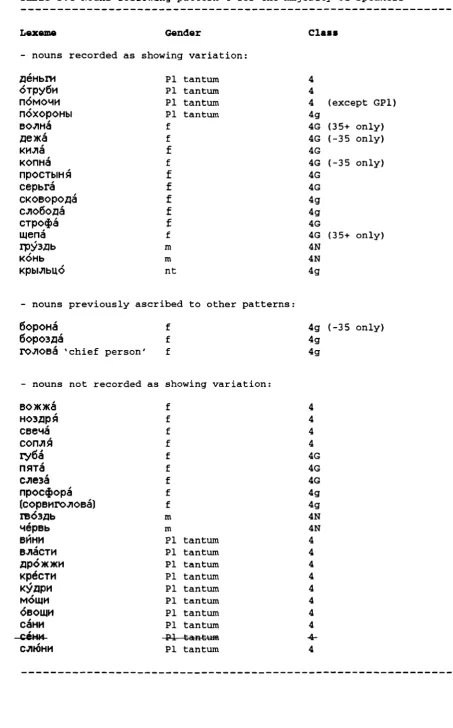
The nouns in the table below followed pattern 4 for the
majority of informants. Some nouns have been added which have previously been ascribed to other patterns; they are
discussed further below. Nouns belonging to pattern 4 for which no variation is recorded, and which were therefore not
Table 5.4 Nouns following pattern 4 for the majority of speakers
Lexeme Gender Class
- nouns recorded as showing variation:
,BeHbril P1 tantum 4
OTpy6m P1 tantum 4
nOmo Lim P1 tantum 4 (except GP1)
nOxopomi P1 tantum 4g
BOAHA f 4G (35+ only)
Pe)Ka f 40 (-35 only)
101.716 f 40
KOP11-6 f 4G (-35 only)
npocTimmA f 40
cepbra f 4G
moBopona f 4g
cAo6ona f 4g
crpo0
f
4Gwena f 40 (35+ only)
ppOolb in 4N
KOHb in 4N
Kpbu1tat6 nt 4g
- nouns previously ascribed to other patterns:
60p0Fla f 4g (-35 only)
60p0346 f 4g
roAomi 'chief person' f 4g
- nouns not recorded as showing variation:
B0)10Ka f 4
H0340 f 4
cBem6 f 4
corkali f 4
ry66 f 40
nwra f 4G
cAelfi f 4G
npoccbopi f 4g
(copsiiroAomi) f 4g
n.B.63m, m6pEtb in m 4N 4N
BAHH P1 tantum 4
BAACTH P1 tantum 4
nOmotcm P1 tantum 4
pecTm P1 tantum 4
Kj'ApH P1 tantum 4
mOwm P1 tantum 4
613011B1 P1 tantum 4
CSHH P1 tantum 4
—cimm- P1 tantum A,
Variation is found for the GP1 of the following nouns, either in sources or in the survey; this demonstrates the key position of the GP1 form either as the model for analogical
change, or as the case typically resistant to such change:
Table 5.5 Nouns showing variation in the GP1
cy4bA 66Hbi
ApOBHm 6Tpy6pi nOrnom n6xopolibi p6jabl
xe.ne36 Korm6 Kowme
Me )Ká npocBmpi npocTbniii
cKoBopona
cylab6a
KóHb +110.71b Kpb1.71bRO Ca)KeHb
For nouns in -a/-s, Kip. believes that pattern 2.2 dates only from the mid-nineteenth century (agreeing with Hingley 1952, although Nicholson indicates that the emergence of
fixed stem-stress in the P1 for such nouns certainly occurred earlier, see Nicholson 1968:97-8), and that pattern 4 does not predate the seventeenth or eighteenth century (Kip., p.210).
Table 5.6 Tendencies in nouns in -a/-s and pluralia tantum nouns previously ascribed to pattern 4
- stable pattern 4:
61-py611 n6xopoHN
n6momm (anomaly in GP1)
npocTmHA (new GP1)
moBopon6
- moving towards 1.2:
CKahlb
flex&
- moving towards 2.2 (desinence-stress in Sg, where the Sg exists):
cynbA 696Him
AeHbrM
711:06amm 67=8
BOAH6
'A RM (all meanings)
weAeli (third SF in GP1)
KMA6
Konma Kourda
maxi
npocampi (third SF in oblique Pl)
cepbra (third SF in GP1)
cKmpai cKo6a cAeni cAo6oAS cTpocIA cyx0,66 3pona wena
- moving towards 1.1:
66xca
- possible semantic differentiation (patterns attached to specific meanings in brackets):
KAeWM 'tongs' (4); 'tick' (1.2)
Most nouns not ending in -a/-si placed by some writers in
pattern 4 are subject to a high level of variation; the only
exception to this would seem to be K6mb,which is stable in
pattern 4. Kip. holds that monosyllabic nouns following
pattern 4 (such as
K6Hb)are recent developments of pattern 3
nouns and not of pattern 1.2 nouns, as had earlier been
thought (see Kip., p.82). In other words, desinence-stress
has developed for the Sg, whilst the direct-oblique contrast
has been maintained in the Pl.
The following tendencies were noted in the survey:
Table 5.7 Tendencies in other nouns ascribed to pattern 4
- stable pattern 4:
K6Hb
- variation between 4 and 3:
rpOrib
l*b
.716KOTb B6p
- variation between 4, 3 and 1.1:
l'.0.11b 'coal; charcoal' (possible semantic differentiation)
CaNCOHb/C&KeHb
- moving towards 2.2:
TaBp6 Kpb1.11bU6
- moving towards 1.1: p6Abi
- moving towards 1.2:
ii) Class 5
piscussion of data
Sg P1
N des. N stem
A stem A stem
G des. G des.
D des. D des.
I des. I des.
P des. P des.
Class 5 nouns contrast a stem-initial stressed SF in the direct P1 (N/AP1) and ASg, with a desinence-stressed SF in
the oblique P1 (GDIPP1) word-forms, and remaining Sg forms. The pattern is thus the same as pattern 4, but with a stem-stressed ASg.
All members of this class are feminine nouns in -a/-s and thus in fact bear the code 5G or 5g. Nouns in class 50 have a zero-desinence GP1, with theoretical desinence-stress, by necessity stressing the stem-final syllable; this gives
the GP1 the same SF as the N/AP1.
Nouns in class 5g also have theoretical
desinence-stress, falling, by necessity, on the stem-final syllable in the GP1; since they have polysyllabic stems, the SF of the GP1 is unique to this form.
60snomá, f, 'excrescence, gall (on trees); (fig., dialectal) tumour, swelling; sapwood'
This rare noun follows pattern 5 without variation according to SU and Red., but Zal. lists a desinence-stressed variant for the ASg, thus placing the noun in class 4. It is possible that the stress of the ASg is being levelled to that of the rest of the Sg, and the noun is thus joining class 4.
6opoilS, f, `beard', 5g
No variation is recorded for the stem-stressed ASg and N/AP1. The survey demonstrates that stem-final stress (theoretical desinence-stress) is universal for the zero-desinence GP1; one speaker also offered the alternative stem-initial
stressed variant
6.
6roni, not recommended by OS and prohibited by A&O. There is more variation in the PP1, with youngerspeakers almost all giving desinence-stress, but older
speakers equally split between stem-initial and desinential stress; stem-initial stress is recognised but not recommended by OS.
The traditional pattern thus seems to be upheld, with one SF for the ASg and N/AP1, one for the GP1 owing to its zero-desinence, and a third for the other oblique P1 forms; older speakers may have the same SF for the N/AP1 and oblique P1 forms (with stem-initial stress) except the GP1. Many
older speakers thus give this word an anomalous pattern, indicating that it has undergone a period of instability in the past, tending towards a levelling of stem-initial stress in the P1 (except the GP1), to contrast with desinence-stress in the Sg (except the ASg).
Kip. (p.199) states that a pattern of class 5 mobility is original; this pattern is upheld in the modern language.
6opo3n6, f, 'furrow', 4g (35+: 4g or 5q)
Informants were split on the stress of the ASg, with just one more younger speaker assigning this form desinence-stress, bringing it into line with the rest of the Sg, than choosing stem-stress. Most sources recognise both variants as equally acceptable.
stem-initial stress, as is found in the N/AP1, although only OS recognises this variant, not recommending it. One younger informant gave, and another informant gave and then rejected, the stem-final stressed variant 601363nax, indicating a
possible levelling of this SF to the SF of the GP1. There is thus some indication that a process of
levelling to the stress of the N/AP1 may be taking place in the Pl, although the GP1 is thus anomalous.
Kip. (p.203) considers fixed desinence-stress (pattern 1.2) to be original, with pattern 4 a later development. The ASg stem-stress of pattern 5 would thus represent a variant which developed at some later stage, but has recently been
abandoned in favour of pattern 4.
6opoHa, f, 'harrow', 5g (-35: 4g)
The ASg shows evidence of instability, with a majority of younger speakers choosing desinence-stress, and a majority of older speakers choosing stem-stress; only more modern sources recognise desinence-stress. A process of levelling of the stress of the ASg to that of the rest of the Sg would thus seem to be taking place, transferring the noun from pattern 5 to pattern 4.
Most informants follow the sources' recommendation of desinence-stress in the oblique P1 (stem-final by necessity in the zero-desinence GP1). Two younger speakers, however, gave stem-initial stress in the GP1 66poH, which is noticed but not recommended by OS, indicating levelling to the stress
of the N/AP1; two other informants gave stem-stress for the PP1, which would indicate the same process.
Kip. (p.199) indicates that class 5 mobility is
romoBa, f, 'head (body-part)', 5g; 'head (chief person)', 4g
Sources recommend a semantic differentiation by stress in the ASg, with the traditional stem-stress indicating 'head (body-part)' (pattern 5g), and desinence-stress, that is, fixed desinence-stress throughout the Sg, indicating 'head (chief person)' (pattern 4g), as in ropoxicK6iiro.noBâ, A/GSg mpoimKODD
roAce9 'mayor'. This distinction by stress does not apply to other cases of the Sg or the Pl, except in the use of the AP1 or GP1 form for the direct object, dependent on the animacy or inanimacy of the noun.
Only one informant failed to observe the distinction in the ASg, generalising stem-stress, although two others first suggested stem-stress, then rejected it in favour of the recommended desinence-stress in the animate meaning.
Kip. (p.199) has class 5 mobility as original; movement to fixed desinence-stress in the Sg (pattern 4), semantically restricted today, is evidenced from the sixteenth century onwards.
ropa , f, ' mountain ' , 5G
Stem-stress is undisputed for the ASg and N/AP1, the noun following pattern 5. A&O, the oldest source, prohibits stem-stress for the oblique Pl, although one younger informant in the survey gave stem-stress for PPl. Generally, however, the traditional pattern is not subject to variation.
Kip. (p.199) gives pattern 5 as original. The survey indicates that this is upheld.
nocxa, f, 'board', 6g
All informants gave stem-stress for the ASg, although a desinence-stressed variant is recognised by three sources. Desinence-stress is the only variant possible in the proverb
three times)', where it appears that stress has been altered to create the rhyme with Tom:f.
Only one informant upheld desinence-stress in the PP1, however, with all others giving stem-stress, a variant recognised by OS and Zal., but prohibited by A&O. This
indicates levelling within the P1 to the stress of the N/AP1 (creating pattern 6), a process which seems to have
incorporated even the GP1 acoK,despite its characteristic fleeting vowel; 83% of informants gave this variant rather than older Aoc6K.
Kip. (p.199) has class 5 mobility as original. The survey indicates that pattern 6 is now general.
KpOxa, f, 'crumb; small child', 1.1
Older sources indicate a semantic differentiation by stress, with xpox6 with fixed desinence-stress (pattern 1.2) used in the primary meaning 'crumb (eg of bread)', and Kpcbca with
fixed stem-stress (pattern 1.1) having the secondary meaning 'small child'. Pattern 1.1 was found universally, however, for both meanings of the word, suggesting levelling in the Sg and DIPP1 to the stress and hence SF of the ASg, N/AP1 and zero-desinence GP1 of an original pattern 5G.
Kip. (p.200) gives pattern 5 mobility as original (with no mention of a semantic differentiation by stress), although he states that some recent sources normalise fixed desinence-stress (class 1.2). The survey demonstrates that the pattern 1.1 is now general, and that the semantic distinction is unlikely to be upheld.
nozoca, f, 'stripe; strip', 5g (-35: 6g, but GP1 noA6c for -35
as for 35+)
All informants gave stem-stress for the ASg, although most sources also recognise the existence of desinence-stress in
some speakers, and this is the preferred form in A&O. All but one (younger) informant gave stem-final stress to the
desinence GP1 noz6c, rather than the stem-initial stressed ri6.710c prohibited by some sources. The IP1, representative of the other oblique P1 forms, showed more evidence of
variation, however, with a slight majority of speakers
overall giving desinence-stress, as is traditional (pattern 4 or 5), but a slight majority of younger speakers gave stem-initial stress, indicating levelling to the stress of the N/AP1 (creating pattern 6, but with an anomalous GP1, as in mmevito ).
Whilst levelling is not occurring in the Sg, therefore, despite dictionary indications there is evidence that it is found in the Pl. This is a movement towards a straight Sg-Pl opposition of stress, but the ASg and GP1 remain anomalous.
Kip. (p.206-7) believes pattern 5 mobility to be
original. Pattern 4 is first found in the early nineteenth century, and, he states, currently preferred. The survey indicates that the modern pattern is either 5, or, for younger speakers, 6, with an anomalous GP1.
nopS, f, 'time, season', 5G
The stem-stress of the ASg is stable, with no informants choosing the desinence-stressed variant no0 warned against by A&O. Stem-stress is undisputed for the N/AP1 nOrmof this noun.
Kip. (p.200) is uncertain as to original stress, but identifies pattern 5 from the nineteenth century. The survey indicates that this pattern is not subject to variation.
The existence of the fixed stem-stressed noun nOpa
'pore' should be noted.
cpe.a, f, 'Wednesday' 6; 'surroundings, milieu' 2.2
Semantic differentiation occurs in the ASg, with stem-stress in the meaning 'Wednesday', and desinence-stress in the
In the meaning 'surroundings', sources state that stem-stress is fixed in the P1 (pattern 2.2), although two
informants gave desinence-stress, and there was some
objection to its use in the P1 at all; BTaK6ricpene, or BTaKrix
ycz6BmRx were suggested as better alternatives to the test sentence's B -mob< cpenax.
Stem-stress was also preferred, by 81% of informants, for the oblique P1 in the meaning 'Wednesday', with only three older speakers giving desinence-stress. The older pattern 5 would seem, therefore, to have been largely replaced by fixed stem-stress in the P1 in both meanings.
Kip. (p.200) has class 5 mobility as original in the meaning 'Wednesday' and records no variation in stress for
this meaning. The meaning 'surroundings' also has pattern 5 mobility as original, although it is recorded in his modern sources as pattern 4 or 2.2.
The present survey indicates that pattern 6 has
developed for the meaning 'Wednesday', and pattern 2.2 for the meaning 'surroundings'.
creHa , f, `wall', 6
Stem-stress in the ASg and N/AP1 is not disputed for this noun. Some 76% of informants, and the majority of younger informants, generalise stem-stress for all forms of the P1
(pattern 6), with the older desinence-stress for the oblique forms (theoretical in the GP1) upheld by just 24% of speakers
(pattern 5).
Kip. (p.200-201) gives pattern 5 as original, noticing a
movement towards pattern 6 (fixed stem-stress in Pl) as early as Lermontov.
mopona, f, 'harrow'
Zal. alone lists variation for this rare noun, marked as
dialectal by Nesset (1994:165). Zal. gives a stem-stressed as well as a desinence-stressed ASg variant. The noun is perhaps moving from pattern 5 into pattern 4, with a levelling of the stress in the Sg
accompanying
the increasing unfamiliarity of all the forms of the lexeme.This noun is also given the botanical meaning 'chive' in Dal' (1880-82, s.v.); the stress of the ASg is not mentioned. Macura (1990) gives this meaning also, implying
desinence-stress in the ASg, although not stating this explicitly. The form mopOna appears with this meaning in SU, with fixed stem-final stress; a misprint must be ruled out. With this meaning the noun is likely to be used only in the Sg .
cTopoHe, f, 'side', 5g
Stem-stress for the ASg and N/AP1 and desinence-stress for the oblique P1 except the GP1 are undisputed. The situation in the other forms is complex. Variation occurs in particular collocations involving the GSg, however, for which desinence-stress is expected; in these contexts there may be
interference from the stem-stressed N/AP1. After a numeral strictly requiring the GSg, A&O prohibits stem-stress; one younger speaker gave this variant, perhaps interpreting cTopolim as N/AP1 after 711316, thus stressed cT6poHbi. There is
also variation in contexts
involving
the word 66e; OS andZal. recognise and A&O prohibits desinence-stress in the phrase no 66e c-ropow, where there may be confusion as to whether the word-form is GSg or N/AP1 (the old N/A dual
inflection was -t).SU indicates that stem-stress is required in the phrase 66e no1oi3 613 t aro e c c-r6poHbi, where the form of the
participle indicates that cr6poHbi is N/AP1, with the expected, regular stress. Newer sources allow or recommend stem-stress in the set-phrase Ha ece Lierbipe crOpoHbi 'wherever he wants to go', whilst A&O prohibits this; the use of
Kip. (p.201) has pattern 5 mobility as original.
The survey indicates that this is upheld, with variation for the GSg occurring in certain contexts.
cipoKa, f, 'line', 2.2
The stem-stress of the N/AP1 form is not subject to
variation. The older stem-stressed ASg is preserved in the set-phrase siesckoe..70KoecTpOKy 'one mustn't be too fussy, one
must make allowances', where it is also important for the imperfect rhyme. Outside of this context, the great majority of informants, including all the younger speakers, give
cTpoKs'‘, thus levelling the stress in the Sg. Sources appear to
confirm that this process is taking place over time, with only the oldest mentioning the stem-stressed ASg variant
cTp6Ky. For the IP1, representing the oblique P1 forms,
stem-stress was chosen by 67% of informants, with the remainder preserving the desinence-stress given as standard by most sources. The stress of the P1 would also thus seem to be in the process of being levelled to that of the N/AP1 and the zero-desinence GP1 (which may be the key case, as the model for analogical change), creating an overall pattern of
desinence stress in the Sg contrasting with stem-stress in the P1 (pattern 2.2).
Kip. (p.209) is unable to suggest the original stress; Vostokov (1831) gives pattern 5, which was later abandoned in favour of pattern 4; a desinence-stressed ASg appears in some sources as early as the eighteenth century.
The survey indicates that the modern pattern is 2.2.
wel<6, f, 'cheek', 5G
The stem-stress of the N/AP1 and the desinence-stress of the DIPP1 do not appear to be subject to variation. OS and Zal. list a desinence-stressed variant beside the generally
accepted stem-stressed variant for the ASg, but this
informants. The tendency to level the stress of the Sg is thus weak, and not found at all among younger speakers.
Kip. (p.201) believes that pattern 5 is most likely to be original.
The survey indicates that this pattern is upheld in the modern language.
Zunimaly
Kip. considers pattern 5 to be the original pattern of mobile stress for nouns in -a/-41 (p.189), but states that this
pattern has minimal
%Anziehungskraft'
or 'attractiveness' (Kip., p.201). The following nouns display pattern 5 mobility for the majority of informants; the one noun which is not recorded as showing variation has been added to the end of the table:Table 5.8 Nouns following pattern 5 for the majority of speakers
LeXeMil Gender Class
- nouns recorded as showing variation:
6oponi f 5g
60p03.7145 f 5g (35+ only)
60130H6 f 5g (35+ only)
DOA0136 (body-part) f 5g
nomoca f 5g (35+ only)
cropolia f 5g
ropi f 50
nopa f 5G
weKS f 50
- not recorded as showing variation:
The following tendencies were identified from the survey data:
Table 5.9 Tendencies in nouns previously ascribed to pattern 5
- stable pattern 5: POAOBS (body-part) nopà
nopa
croporia (variation in GSg)
- moving towards pattern 1.1: KpOxa
- moving towards pattern 6: AocKA
nosnoca (anomalous GPI) cpeai 'Wednesday' CTBFIS
- moving towards pattern 2.2: cpena 'surroundings' cTpoith
- moving towards pattern 4: 6opo346
6opolla
DDAOBS 'chief person'
- variation in the GP1: 6opoai
6opo3m6 6opom6 AocKa nozoca
- variation in the ASg: 6opo346
60p0HS
TOAOBS (chief person) CTp0Ka
- possible semantic differentiation by stress:
romoB6 (body-part) (5); (chief person) (4) cpeni 'Wednesday' (6); 'surroundings' (2.2)
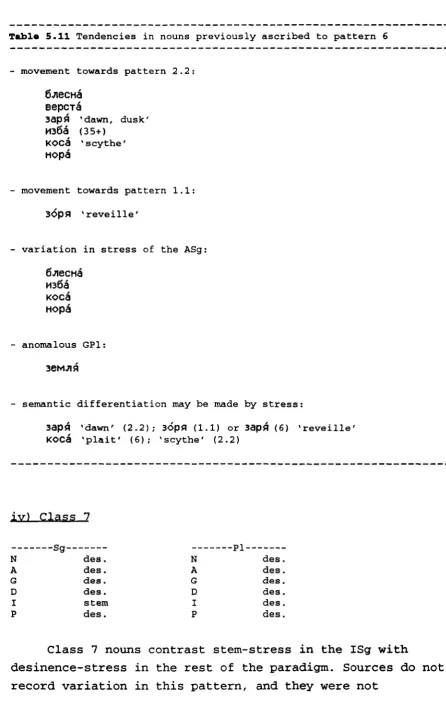
iii) Class 6
Discussion of data
Sg P1
N des. N stem
A stem A stem
G des. G stem
D des. D stem
I des. I stem
P des. P stem
Class 6 nouns contrast desinence-stress in the Sg with stem-initial stress in the Pl; the pattern is interrupted, however, by stem-initial stress in the ASg. Pattern 6 is
thus as pattern 2, but with stem-initial stress in the ASg. If a fleeting vowel appears in the GP1 and the stress falls on the stem-final syllable, a new SF is created and the noun is classed as 6g.
6.71ecHA, f, 'spoon-bait', 2.2
The ASg was given desinence-stress, the only form listed in the three most modern sources, by all but one (older)
informant, who gave the non-standard form 6,716cHy; A&O warns
against 6,716cmy. Modern sources record no variation for other
forms; desinence-stress is given for the remaining Sg forms and stem-stress for all the P1 forms. A&O, the oldest source, warns against stem-stressed variants for all Sg forms (giving pattern 1.1), but informants universally gave
desinence-stressed NSg 6,necm6 rather than stem-stressed 6,7160-ia.