To appear in Proceedings of the 16th Annual Joint Conference on Artificial Intelligence (IJCAI-99, Stockholm, Sweden), 1999.
S
ARD
S
RN
: A Neural Network Shift-Reduce Parser
Marshall R. Mayberry, III and Risto Miikkulainen
Department of Computer Sciences
The University of Texas
Austin, TX 78712, U.S.A
(
m
artym,[email protected])
Abstract
Simple Recurrent Networks (SRNs) have been widely used in natural language tasks. SARDSRN
extends the SRNby explicitly representing the in-put sequence in a SARDNETself-organizing map. The distributed SRNcomponent leads to good gen-eralization and robust cognitive properties, whereas the SARDNET map provides exact representations of the sentence constituents. This combination al-lows SARDSRN to learn to parse sentences with more complicated structure than can the SRNalone, and suggests that the approach could scale up to re-alistic natural language.
1
Introduction
The subsymbolic approach (i.e. neural networks with dis-tributed representations) to processing language is attractive for several reasons. First, it is inherently robust: the dis-tributed representations display graceful degradation of per-formance in the presence of noise, damage, and incomplete or conflicting input [Miikkulainen, 1993; St. John and McClel-land, 1990]. Second, because computation in these networks is constraint-based, the subsymbolic approach naturally com-bines syntactic, semantic, and thematic constraints on the in-terpretation of linguistic data [McClelland and Kawamoto, 1986]. Third, subsymbolic systems can be lesioned in var-ious ways and the resulting behavior is often strikingly similar to human impairments [Miikkulainen, 1993; 1996; Plaut, 1991]. These properties of subsymbolic systems have attracted many researchers in the hope of accounting for in-teresting cognitive phenomena, such as role-binding and lex-ical errors resulting from memory interference and overload-ing, aphasic and dyslexic impairments resulting from phys-ical damage, and biases, defaults and expectations emerg-ing from trainemerg-ing history [Miikkulainen, 1997; 1996; 1993; Plaut and Shallice, 1992].
Since its introduction in 1990, the simple recurrent network (SRN) [Elman, 1990] has become a mainstay in connectionist natural language processing tasks such as lexical disambigua-tion, prepositional phrase attachment, active-passive transfor-mation, anaphora resolution, and translation [Allen, 1987; Chalmers, 1990; Munro et al., 1991; Touretzky, 1991]. This paper describes an extension to the standard SRN, which
utilizes SARDNET [James and Miikkulainen, 1995], a
self-organizing map algorithm designed to represent sequences. SARDNET permits the sequence information to remain ex-plicit, yet distributed in the sense that similar sequences result in similar patterns on the map. SARDSRN, the combination of the SRNand SARDNET, effectively solves the fundamen-tal memory accuracy limitations of the SRN, and allows the processing of sentences of realistic length.
This paper shows how SARDSRNimproves upon the per-formance of the SRN in a nontrivial syntactic shift-reduce parsing task. The results show that SARDSRN outperforms the SRNin this task by providing an effective solution to the memory problem. SARDSRNtherefore forms a solid founda-tion for building a subsymbolic parser of realistic language.
2
The Task: Shift-Reduce Parsing
The task taken up in this study, shift-reduce (SR) parsing, is one of the simplest approaches to sentence processing that nevertheless has the potential to handle a substantial subset of English [Tomita, 1986]. Its basic formulation is based on the pushdown automata for parsing context-free grammars, but it can be extended to context-sensitive grammars as well. The parser consists of two data structures: the input buffer stores the sequence of words remaining to be read, and the partial parse results are kept on the stack (figure 1). Ini-tially the stack is empty and the entire sentence is in the in-put buffer. At each step, the parser has to decide whether to shift a word from the buffer to the stack, or to reduce one or more of the top elements of the stack into a new element representing their combination. For example, if the top two elements are currently NP and VP, the parser reduces them into S, corresponding to the grammar rule S!NP VP (step
17 in figure 1). The process stops when the elements in the stack have been reduced to S, and no more words remain in the input. The reduce actions performed by the parser in this process constitute the parse result, such as the syntactic parse tree (line 18 in figure 1).
Stack Input Buffer Action the boy who liked the girl chased the cat . 1 Shift the boy who liked the girl chased the cat . 2 Shift the boy who liked the girl chased the cat . 3 Reduce NP[the,boy] who liked the girl chased the cat . 4 Shift NP[the,boy] who liked the girl chased the cat . 5 Shift NP[the,boy] who liked the girl chased the cat . 6 Shift NP[the,boy] who liked the girl chased the cat . 7 Shift NP[the,boy] who liked the girl chased the cat . 8 Reduce NP[the,boy] who liked NP[the,girl] chased the cat . 9 Reduce NP[the,boy] who VP[liked,NP[the,girl]] chased the cat . 10 Reduce NP[the,boy] RC[who,VP[liked,NP[the,girl]]] chased the cat . 11 Reduce NP[NP[the,boy],RC[who,VP[liked,NP[the,girl]]]] chased the cat . 12 Shift NP[NP[the,boy],RC[who,VP[liked,NP[the,girl]]]] chased the cat . 13 Shift
NP[NP[the,boy],RC[who,VP[liked,NP[the,girl]]]] chased the cat . 14 Shift
NP[NP[the,boy],RC[who,VP[liked,NP[the,girl]]]] chased the cat . 15 Reduce
NP[NP[the,boy],RC[who,VP[liked,NP[the,girl]]]] chased NP[the,cat] . 16 Reduce
NP[NP[the,boy],RC[who,VP[liked,NP[the,girl]]]] VP[chased,NP[the,cat]] . 17 Reduce
S[NP[NP[the,boy],RC[who,VP[liked,NP[the,girl]]]],VP[chased,NP[the,cat]]] 18 Stop
Figure 1:Shift-Reduce Parsing a Sentence. Each step in the parse is represented by a line from top to bottom. The current stack is at left,
the input buffer in the middle, and the parsing decision in the current situation at right. At each step, the parser either shifts a word onto the stack, or reduces the top elements of the stack into a higher-level representation, such as the boy!NP[the,boy] (step 3). (Phrase labels such
as “NP” and “RC” are only used in this figure to make the process clear.)
The general SR model can be implemented in many ways. A set of symbolic shift-reduce rules can be written by hand or learned from input examples [Hermjacob and Mooney, 1997; Simmons and Yu, 1991; Zelle and Mooney, 1996]. It is also possible to train a neural network to make parsing decisions based on the current stack and the input buffer. If trained properly, the neural network can generalize well to new sen-tences [Simmons and Yu, 1992]. Whatever correlations there exist between the word representations and the appropriate shift/reduce decisions, the network will learn to utilize them.
Another important extension is to implement the stack as a neural network. This way the parser can have access to the entire stack at once, and interesting cognitive phenomena in processing complex sentences can be modeled. The SPEC
system [Miikkulainen, 1996] was a first step in this direction. The stack was represented as a compressed distributed rep-resentation, formed by a RAAM(Recursive Auto-Associative Memory) auto-encoding network [Pollack, 1990]. The result-ing system was able to parse complex relative clause struc-tures. When the stack representation was artificially lesioned by adding noise, the parser exhibited very plausible cogni-tive performance. Shallow center embeddings were easier to process, as were sentences with strong semantic constraints in the role bindings. When the parser made errors, it usu-ally switched the roles of two words in the sentence, which is what people also do in similar situations. A symbolic rep-resentation of the stack would make modeling such behavior very difficult.
The SPECarchitecture, however, was not a complete im-plementation of SR parsing; it was designed specifically for embedded relative clauses. For general parsing, the stack needs to be encoded with neural networks to make it possi-ble to parse more varied linguistic structures. We believe that the generalization and robustness of subsymbolic neural net-works will result in powerful, cognitively valid performance. However, the main problem of limited memory accuracy of the SRN parsing network must first be solved. An architec-ture that will do that, SARDSRN, will be described next.
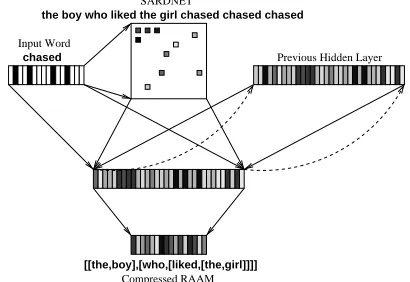
Previous Hidden Layer
Compressed RAAM Input Word
SARDNET
chased
[[the,boy],[who,[liked,[the,girl]]]] the boy who liked the girl chased chased chased
Figure 2:The SARDSRNNetwork. This snapshot shows the
net-work during step 11 of figure 1. The representation for the current input word, chased, is shown at top left. Each word is input to the SARDNETmap, which builds a representation for the sequence word by word. At each step, the previous activation of the hidden layer is copied (as indicated by the dotted line) to the Previous Hidden Layer assembly. This activation, together with the current input word and the current SARDNETpattern, is propagated to the hidden layer of the SRNnetwork. As output, the network generates the compressed RAAMrepresentation of the top element in the shift-reduce stack at this state of the parse (in this case, line 12 in figure 1). SARD -NETis a map of word representations, and is trained through the Self-Organizing Map (SOM) algorithm [Kohonen, 1995; 1990]. All other connections are trained through backpropagation.
3
The S
ARDS
RNparser architecture
3.1
Simple Recurrent Network
The SRN architecture can be used to implement a shift-reduce parser in the following way: the network is trained to step through the parse (such as that in figure 1), generat-ing a compressed distributed representation of the top element of the stack at each step (formed by a RAAM network: sec-tion 4.1). The network reads the sequence of words one word at a time, and each time either shifts the word onto the stack (by passing it through the network, e.g. step 1), or performs one or more reduce operations (by generating a sequence of compressed representations corresponding to the top element of the stack: e.g. steps 8-11). After the whole sequence is input, the final stack representation is decoded into a parse result such as a parse tree. Such an architecture is powerful for two reasons: (1) During the parse, the network does not have to guess what is coming up later in the sentence, as it would if it always had to shoot for the final parse result; its only task is to build a representation of the current stack in its hidden layer and the top element in its output. (2) Instead of having to generate a large number of different stack states at the output, it only needs to output representations for a rela-tively small number of common substructures. Both of these features make learning and generalization easier.
A well-known problem with the SRN model is its low memory accuracy. It is difficult for it to remember items that occurred several steps earlier in the input sequence, es-pecially if the network is not required to produce them in the output layer during the intervening steps [Stolcke, 1990; Miikkulainen, 1996]. The intervening items are superim-posed in the hidden layer, obscuring the traces of earlier items. Nor has simply increasing the size of the hidden layer or lowering the learning rate been found to offer much ad-vantage. As a result, parsing with an SRNhas been limited to relatively simple sentences with shallow structure.
3.2
S
ARDN
ETThe solution described in this paper is to use an explicit rep-resentation of the input sequence as additional input to the hidden layer. This representation provides more accurate in-formation about the sequence, such as the relative ordering of the incoming words, and it can be combined with the hid-den layer representation to generate accurate output that re-tains all the advantages of distributed representations. The se-quence representation must be explicit enough to allow such cleanup, but it must also be compact and generalize well to new sequences.
The SARDNET (Sequential Activation Retention and Decay Network) [James and Miikkulainen, 1995] self-organizing map for sequences has exactly these properties. SARDNET is based on the Self-Organizing Map neural net-work [Kohonen, 1990; 1995], and organized to represent the space of all possible word representations. As in a con-ventional self-organizing map network, each input word is mapped onto a particular map node called the maximally-responding unit, or winner. The weights of the winning unit and all the nodes in its neighborhood are updated according to the standard adaptation rule to better approximate the current input. The size of the neighborhood is set at the beginning of the training and reduced as the map becomes more organized. In SARDNET, the sentence is represented as a distributed
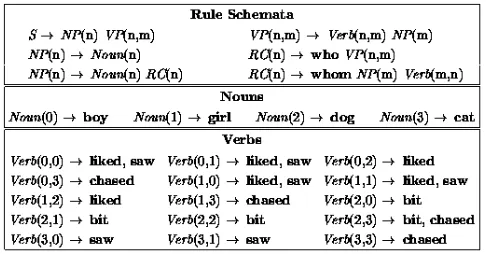
Figure 3:Grammar. This phrase structure grammar generates
sen-tences with subject- and object-extracted relative clauses. The rule schemata with noun and verb restrictions ensure agreement between subject and object depending on the verb in the clause. Lexicon items are given in bold face.
activation pattern on the map (figure 2). For each word, the maximally responding unit is activated to a maximum value of 1.0, and the activations of units representing previous words are decayed according to a specified decay rate (e.g. 0.9). Once a unit is activated, it is removed from competition and cannot represent later words in the sequence. Each unit may then represent different words depending on the context, which allows for an efficient representation of sequences, and also generalizes well to new sequences.
In the SARDSRN architecture, SARDNET is used to di-rectly handle the memory limitation of the SRN. A SARD -NET representation of the input sentence is formed at the same time as the SRN hidden layer representation, and used together with the previous hidden layer representation and the next word as input to the hidden layer (figure 2). This archi-tecture allows the SRN to perform its task with significantly less memory degradation. The sequence information remains accessible in SARDNET, and the SRNis able to focus on
cap-turing correlations relating to sentence constituent structure during parsing.
4
Experiments
the 10000000 who 01010000
whom 01100000 . 11111111
boy 00101000 dog 00100010
girl 00100100 cat 00100001 chased 00011000 saw 00010010 liked 00010100 bit 00010001
Figure 4:Lexicon. Each word representation is put together from
a part-of-speech identifier (first four components) and a unique ID tag (last four). This encoding is then repeated eight times to form a 64-unit word representation. Such redundancy makes it easier to identify the word.
The approach taken in this paper is the same as in SPEC
(section 2), as well as in other connectionist parsing sys-tems [Miikkulainen, 1996; Berg, 1992; Sharkey and Sharkey, 1992]. Compressed representations of all the partial syntactic parse trees using RAAMare built up through auto-association of the constituents. This training is performed beforehand separately from the parsing task. Once formed, the com-pressed representations can be decoded into their constituents using just the decoder portion of the RAAMarchitecture.
In shift-reduce parsing, the input buffer after each “Re-duce” action is unchanged; rather, the reduction occurs on the stack. Therefore, if we want to perform the reductions one step at a time, the current word must be maintained in the input buffer until the next “Shift” action. Accordingly, the input to the network consists of the sequence of words that make up the sentence with the input word repeated for each reduce action, and the target consists of representations of the top element of the stack (as shown in figure 1).
Word representations were hand-coded to provide basic part-of-speech information together with a unique ID tag that identified the word within the syntactic category (figure 4). The basic encoding of eight units was repeated eight times to fill out a 64-unit representation. The 64-unit representation length was needed to encode all of the partial parse results formed by RAAM, and redundancy in the lexical items facili-tate learning.
Four data sets of 20%, 40%, 60%, and 80% of the 436 sen-tences generated by the grammar were randomly selected to train both parsers, and each parser was trained on each dataset four times. Training on all thirty-two runs was stopped when the error on a 22-sentence (5%) validation set began to level off. The same validation set was used for all the simulations and was randomly drawn from a pool of sentences that did not appear in any of the training sets. Testing was then per-formed on the remaining sentences that were neither in the training set nor in the validation set.
The SRNnetwork architecture consisted of a 64-unit input layer, 200-unit hidden and context layers, and 64-unit output and target layers. SARDSRN added a 144-unit feature map (SARDNET) to the SRNsetup. A learning rate of 0.2 was used to train both networks, while the learning and decay rates for the SARDNETfeature map input in SARDSRNwere set to 0.5 and 0.9, respectively. The neighborhood was set at 6 initially and gradually reduced to 0. These parameters were found experimentally to result in the best general performance for both parsers.
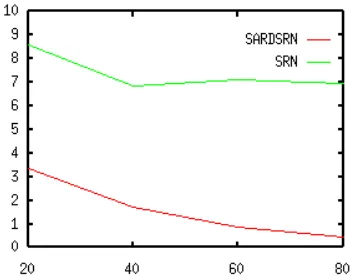
Figure 5: Results. Averages over four simulation runs using the
stricter average mismatches per sentence measure on the test data. The SRN’s performance in all 16 runs bottomed out at a much higher error than SARDSRN, while still unable to parse all of the train-ing sentences. SARDSRN, on the other hand, did learn to parse the training sentences, and showed very good generalization to the test sentences. These differences are statistically significant with
p<0:0005.
4.2
Results
The average mismatches performance measure reports the av-erage number of leaf representations per sentence that are not correctly identified from the lexicon by nearest match in Euclidean distance. As an example, if the target is [who,[liked,[the,girl]]]], (step 11 of figure 1), but the out-put is [who,[saw,[the,girl]]]], then a mismatch would occur at the leaf labelled saw once the RAAM representation was decoded. Average mismatches provide a measure of the cor-rectness of the information in the RAAMrepresentation. It is a much stricter measure of the utility of the network than the standard mean squared error and was, therefore, used in our experiments.
Training took about four days on a 200 MHz Pentium Pro workstation, with SARDSRN taking about 1.5 times as long per epoch as the SRNalone. The validation error in the SRN
runs quickly leveled off, and continued training did nothing to improve it. On the other hand, the SARDSRN simulation runs were still showing slight improvements when they were cut off. Figure 5 plots these performance measures averaged over the four simulation runs against the test sentences.
4.3
Example Parse
Adding SARDNET to the SRN architecture made it possible for the network to learn the parsing task. This can be shown clearly by contrasting the performances of SARDSRNand the SRN on a typical sentence, such as the one in figure 1. Nei-ther SARDSRNnor SRNhad any trouble with the shift targets. Not surprisingly, early in training the networks would master all the shift targets in the sentence before they would get any of the reductions correct. The first reduction ([the,boy] in our example) also poses no problem for either network. Nor, in general, does the second, [the,girl], because the constituent information is still fresh in memory. However, the ability of the SRNto generate the later reductions accurately degrades rapidly because the information about earlier constituents is smothered by the later steps of the parse. Interestingly, the structural information survives much longer. For example, instead of [who,[liked,[the,girl]]]], the SRN might produce [who,[bit,[the,dog]]]]. The structure of this representation is correct; what is lost are the particular instantiations of the parse tree. This is where SARDNETmakes a difference. The lost constituent information remains accessible in the feature map. As a result, SARDSRN is able to capture each con-stituent even through the final reductions.
5
Discussion
These results demonstrate a practicable solution to the mem-ory degradation problem of simple recurrent networks. The SRNdoes not have to maintain specific information about the sequence constituents, and can instead focus on what it is best at: capturing structure. The explicit and concise representa-tion of the entire sequence on SARDNETalso enables SARD -SRNto handle long-term dependencies better than a moving-window architecture such as NARX[Mayberry and
Miikku-lainen, in press]. Although the sentences used in these ex-periments are still relatively uncomplicated, they do exhibit enough structure to suggest that much more complex sen-tences could be tackled with SARDSRN.
The operation of SARDSRN on the shift-reduce parsing task is a nice demonstration of holistic computation. The network is able to learn how to generate each RAAM parse representation during the course of sentence processing with-out ever having to decompose and recompose the constituent representations. Partial parse results can be built up incre-mentally into increasingly complicated structures, which sug-gests that training could be performed incrementally. Such a training scheme is especially attractive given that training in general is still relatively costly.
An extension of the SARDSRN idea, currently being in-vestigated by our group, is an architecture where SARDNET
is combined with a RAAM network. RAAM, although hav-ing many desirable properties for a purely connectionist ap-proach to parsing, has long been a bottleneck during training. Its operation is very similar to the SRN, and it suffers from the same memory accuracy problem: with deep structures the superimposition of higher-level representations gradually obscure the traces of low-level items, and the decoding be-comes inaccurate. This degradation makes it difficult to use RAAM to encode/decode parse results of realistic language.
Preliminary results indicate that the explicit representation of a compressed structure formed on a SARDNET feature map, coupled with the distributed representations of the RAAM, yields an architecture able to encode richer linguistic struc-ture.. This approach should readily lend itself to encoding the feature-value matrices used in the lexicalist, constraint-based grammar formalisms of contemporary linguistics theory, such as HPSG [Pollard and Sag, 1994], needed to handle realistic
natural language.
The SARDSRN idea is not just a way to improve the per-formance of subsymbolic networks; it is an explicit imple-mentation of the idea that humans can keep track of identities of elements, not just their statistical properties [Miikkulai-nen, 1993]. The subsymbolic networks are very good with statistical associations, but cannot distinguish between repre-sentations that have similar statistical properties. People can; whether they use a map-like representation is an open ques-tion, but we believe the SARDNET representation suggests a way to capture a lot of the resulting behavior. It is useful for building powerful subsymbolic language understanding sys-tems, but it is also a plausible cognitive approach.
6
Conclusion
We have described an extension of the SRN called SARD -SRNthat combines the subsymbolic distributed properties of the SRNwith the localist properties of SARDNET. The dis-tributed component leads to good generalization and robust cognitive properties, whereas the map provides exact repre-sentations of the sentence constituents. The results in this pa-per demonstrate a practicable solution to the memory degra-dation problem of SRNs. With SARDNET keeping track of the sequence constituents, the SRNis able to learn the struc-ture representation necessary to perform shift-reduce pars-ing. This combination allows SARDSRN to learn to parse longer and more complex sentences than the SRNalone. The representative properties of SARDNETalso promise to allow RAAMto encode the more complicated structures used in lin-guistics theory.
Acknowledgments
This research was supported in part by the Texas Higher Ed-ucation Coordinating Board under grant ARP-444.
SARDSRN demo:h ttp://www.cs.utexas.edu/users/nn/pages/-research/nlp.html.
References
[Allen, 1987] Robert B. Allen. Several studies on natural language and back-propagation. In Proceedings of the IEEE First International Conference on Neural Networks (San Diego, CA), volume II, pages 335–341, Piscataway, NJ, 1987. IEEE.
[Chalmers, 1990] David J. Chalmers. Syntactic transforma-tions on distributed representatransforma-tions. Connection Science, 2:53–62, 1990.
[Elman, 1990] Jeffrey L. Elman. Finding structure in time. Cognitive Science, 14:179–211, 1990.
[Elman, 1991] Jeffrey L. Elman. Distributed representa-tions, simple recurrent networks, and grammatical struc-ture. Machine Learning, 7:195–225, 1991.
[Hermjacob and Mooney, 1997] Ulf Hermjacob and Ray-mond J. Mooney. Learning parse and translation decisions from examples with rich context. In Proceedings of the 35th Annual Meeting of the ACL, 1997.
[James and Miikkulainen, 1995] Daniel L. James and Risto Miikkulainen. SARDNET: A self-organizing feature map for sequences. In G. Tesauro, D. S. Touretzky, and T. K. Leen, editors, Advances in Neural Information Processing Systems 7, pages 577–584, Cambridge, MA, 1995. MIT Press.
[Kohonen, 1990] Teuvo Kohonen. The self-organizing map. Proceedings of the IEEE, 78:1464–1480, 1990.
[Kohonen, 1995] Teuvo Kohonen. Self-Organizing Maps. Springer, Berlin; New York, 1995.
[Mayberry and Miikkulainen, in press] Marshall R. May-berry, III and Risto Miikkulainen. Combining maps and distributed representations for shift-reduce parsing. In Ste-fan Wermter and Ron Sun, editors, Hybrid Neural Sym-bolic Integration. Springer, Berlin; New York, in press. [McClelland and Kawamoto, 1986] James L. McClelland
and Alan H. Kawamoto. Mechanisms of sentence process-ing: Assigning roles to constituents. In James L. McClel-land and David E. Rumelhart, editors, Parallel Distributed Processing: Explorations in the Microstructure of Cog-nition, Volume 2: Psychological and Biological Models, pages 272–325. MIT Press, Cambridge, MA, 1986.
[Miikkulainen, 1993] Risto Miikkulainen. Subsymbolic Nat-ural Language Processing: An Integrated Model of Scripts, Lexicon, and Memory. MIT Press, Cambridge, MA, 1993.
[Miikkulainen, 1996] Risto Miikkulainen. Subsymbolic case-role analysis of sentences with embedded clauses. Cognitive Science, 20:47–73, 1996.
[Miikkulainen, 1997] Risto Miikkulainen. Dyslexic and category-specific impairments in a self-organizing feature map model of the lexicon. Brain and Language, 59:334– 366, 1997.
[Munro et al., 1991] Paul Munro, Cynthia Cosic, and Mary Tabasko. A network for encoding, decoding and translat-ing locative prepositions. Connection Science, 3:225–240, 1991.
[Plaut and Shallice, 1992] David C. Plaut and Tim Shal-lice. Perseverative and semantic influences on visual ob-ject naming errors in optic aphasia: A connectionist ac-count. Technical Report PDP.CNS.92.1, Parallel Dis-tributed Processing and Cognitive Neuroscience,
Depart-ment of Psychology, Carnegie Mellon University, Pitts-burgh, PA, 1992.
[Plaut, 1991] David C. Plaut. Connectionist Neuropsychol-ogy: The Breakdown and Recovery of Behavior in Le-sioned Attractor Networks. PhD thesis, Computer Science Department, Carnegie Mellon University, Pittsburgh, PA, 1991. Technical Report CMU-CS-91-185.
[Pollack, 1990] Jordan B. Pollack. Recursive distributed rep-resentations. Artificial Intelligence, 46:77–105, 1990.
[Pollard and Sag, 1994] Carl Pollard and Ivan A. Sag. Head-Driven Phrase Structure Grammar. University of Chicago Press, Chicago, IL, 1994.
[Sharkey and Sharkey, 1992] Noel E. Sharkey and Amanda J. C. Sharkey. A modular design for connectionist pars-ing. In Marc F. J. Drossaers and Anton Nijholt, editors, Twente Workshop on Language Technology 3: Connec-tionism and Natural Language Processing, pages 87–96, Enschede, the Netherlands, 1992. Department of Com-puter Science, University of Twente.
[Simmons and Yu, 1991] Robert F. Simmons and Yeong-Ho Yu. The acquisition and application of context sensitive grammar for English. In Proceedings of the 29th Annual Meeting of the ACL, Morristown, NJ, 1991. Association for Computational Linguistics.
[Simmons and Yu, 1992] Robert F. Simmons and Yeong-Ho Yu. The acquisition and use of context dependent gram-mars for English. Computational Linguistics, 18:391–418, 1992.
[St. John and McClelland, 1990] Mark F. St. John and James L. McClelland. Learning and applying contextual constraints in sentence comprehension. Artificial Intelli-gence, 46:217–258, 1990.
[Stolcke, 1990] Andreas Stolcke. Learning feature-based se-mantics with simple recurrent networks. Technical Re-port TR-90-015, International Computer Science Institute, Berkeley, CA, 1990.
[Tomita, 1986] M. Tomita. Efficient Parsing for Natural Language. Kluwer, Dordrecht; Boston, 1986.
[Touretzky, 1991] David S. Touretzky. Connectionism and compositional semantics. In John A. Barnden and Jor-dan B. Pollack, editors, High-Level Connectionist Mod-els, volume 1 of Advances in Connectionist and Neural Computation Theory, Barnden, J. A., series editor, pages 17–31. Ablex, Norwood, NJ, 1991.