Privacy-Preserving Distributed Machine
Learning based on Secret Sharing
Ye Dong1,2, Xiaojun Chen1( ), and Liyan Shen1,2 1
Institute of Information Engineering,Chinese Academy of Sciences,Beijing,China
2
School of Cyber Security, University of Chinese Academy of Sciences,Beijing,China
{dongye,chenxiaojun,shenliyan}@iie.ac.cn
Abstract. Machine Learning has been widely applied in practice, such as disease diagnosis, target detection. Commonly, a good model relies on massive training data collected from different sources. However, the collected data might expose sensitive information. To solve the problem, researchers have proposed many excellent methods that combine machine learning with privacy protection technologies, such as secure multiparty computation(MPC), homomorphic encryption(HE), and differential pri-vacy. In the meanwhile, some other researchers proposed distributed ma-chine learning which allows the clients to store their data locally but train a model collaboratively. The first kind of methods focuses on security, but the performance and accuracy remain to be improved, while the second provides higher accuracy and better performance but weaker se-curity, for instance, the adversary can launch membership attacks from the gradients’ updates in plaintext.
In this paper, we join secret sharing to distributed machine learning to achieve reliable performance, accuracy, and high-level security. Next, we design, implement, and evaluate a practical system to jointly learn an accurate model under semi-honest and servers-only malicious adversary security, respectively. And the experiments show our protocols achieve the best overall performance as well.
Keywords: Secret Sharing· Distributed Machine Learning · Privacy-Preserving.
1
Introduction
Recent advances in machine learning have produced exciting achievements both in academia and industry, the machine learning systems are approaching or even surpassing human-level accuracy in speech, image and text recognition. That thanks to algorithmic breakthroughs and hardware developments, which help our systems process massive amounts of data.
promising solution by allowing different institutions to train various models based on their joint data without revealing any sensitive information beyond the outcome.
The state-of-the-art solutions for privacy-preserving machine learning based on MPC, i.e. [23,27,29], are many orders of magnitude slower than training on plaintext. The main source of inefficiency is that the bulk of computation in the training phase takes place within a secure manner such as garbled circuits or HE. It is well-known that computing complex function, especially non-linear function, in secure form is very expensive.
To improve the efficiency, we design our protocols based on distributed ma-chine learning and instead of joining the secure computation technologies to these expensive computations in our protocols, we join secret sharing to the gra-dients’ sharing phase which only consists of simple arithmetics, i.e. addition. In this way, we can improve efficiency greatly while still meet the security require-ments. Finally, each client can learn no information beyond the trained model, and the parameter servers can learn no sensitive information.
1.1 Our Contribution
In this paper, We design two new and efficient protocols for privacy-preserving linear regression,Multilayer perceptron(MLP), and Convolutional neural net-work(CNN) in the distributed machine learning settings assuming the data are distributed across the clients. Then we give the security analysis of our protocols. And lastly, we implement, evaluate our protocols and compare them with other latest results in a comparable environment.
Resistance to semi-honest and servers-only malicious adversary. In the semi-honest setting, we use Shamir’s Secret Sharing to design protocolΓsash. As long as no more thant−1(tis the threshold) servers can collude and at least two clients are honest, Γsash can against users-only, servers-only and users-servers threat models.
In the malicious setting, to resist servers-only malicious modifications, we design a verifiable protocolΓsamvia a variant of Secret Sharing with information-theoretic Message Authentication Code(MAC)[12]. InΓsam, besides sharing the gradients g, each client computesg’s information-theoretic MAC and shares it among parameter servers. In addition to protecting privacy likeΓsash,Γsamcan prevent servers from malicious modifications as long as no more thant−1 servers can collude and no client colludes with servers.
As discussed above, our protocols can be divided into two phases, offline and online phase. In a comparable experimental environment, our protocols are at the same efficiency level with[25] in the online phase, but we can achieve 5× -10× improvement in the offline phase. Note that vectorization, i.e. operating on matrices and vectors, is critical in the efficiency of training on plaintext, we can benefit from this technique here. For instance, we find that the vectorized protocols improve our efficiency around 7.5-10×in the online phases and 5-10× in the offline phases.
As experiments show, our protocols are even more competitive with training on plaintext. For instance, for the MNIST1, our protocols can achieve the same level of accuracy at a total time of 40.2 seconds for linear regression, 205.2 seconds for MLP and 723.6 seconds for CNN.
1.2 Related Work
In the earlier stage, the work on privacy-preserving machine learning mainly focused on traditional machine learning models such as linear regression[3,4,5], logistic regression[8], decision trees[2], k-means clustering[6,9] and SVM[7,10]. These papers proposed solutions based on MPC but were limited to a partic-ular kind of model. For example, Nikolaenko et. al.[13] and Gascon et. al.[20] presented secure computation protocols for linear regression on mega datasets via leveled-HE(LHE) and garbled circuits. However, both papers are limited to linear regression and the key problems are both reduced to solving a linear sys-tem using Yao’s garbled circuits.And the efficiency overheads appear to be very high.
For the logistic regression, Wu et. al.[14] chose to approximate the sigmoid function using polynomials and train the model using LHE, but the complexity is too high and accuracy is poor. Yupeng Zhang et. al.[23] presented a solution that can be applied to linear regression, logistic regression and neural networks on the two-server setting where data owners distribute their private data among two non-collude servers and proposed a new method based on piecewise linear function for the non-linear function to improve efficiency. However, there is still a big gap compared to training on plaintext.
Meanwhile, Jian L. et. al.[24] proposed a secure inference framework that can protect the server’s model and client’s data at the same time. Privacy-preserving predictions were also studied by Galad-Bachrach et. al.[22,32]. But the models in this setting need to be trained on plaintext ahead of time.
Shokri and Shmatikov[17] proposed a solution by sharing the model’s gradi-ents among the cligradi-ents during the training via a parameter server. They improve the efficiency greatly, but the leaks of gradients could weaken the security[30]. Le Trieu Phon et. al.[28] extended the result against semi-honest adversaries using LHE, but the performance is too poor. Recently, Bonawitz et. al.[25] proposed a protocol to secure aggregate gradients. But their offline phase is very complex, and if some clients dropped out, the efficiency would be reduced.
1
So it is urgent and challenging to propose a secure framework to train complex and huge machine learning models efficiently.
An orthogonal and complementary work considers the differential privacy of machine learning algorithms[15,19]. In this setting, the key point is to intro-duce an additive noise to the data or the update function, so as to prevent the adversary from inferring the data from the released model. Our system can be combined with such technology to provide stronger security.
1.3 Roadmap
In section 2, we introduce the preliminaries. In section 3, we give our system architecture and the design of our protocols. We also analyze the correctness and privacy of our protocols. In section 4, we give the results of our experiments, and in section 5, we conclude our paper.
2
Preliminaries
In this paper, the notations we used are as below:
adenotes a scalar,g denotes a vector and gi denotes the i-th element ofg. X denotes a matrix and Xij denotes the element in row i and column j. haii denotes the i-th shares of a, and the same as to vector and matrix. And N
denotes the number of servers andM denotes the number of clients.
2.1 Machine Learning
In this section, we briefly review the distributed machine learning and some machine learning algorithms: linear regression, MLP, CNN. All these algorithms are classic and can be found in standard machine learning papers or textbooks.
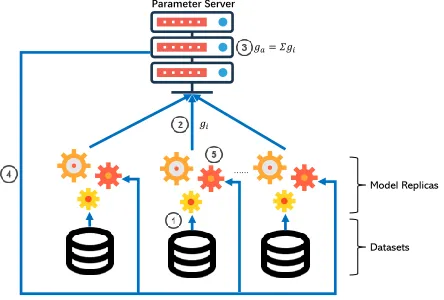
Distributed Machine Learning is a new kind of settings of machine learn-ing, there exist many different settings[31],[26] and we adopt the Parameter-Server(PS) setting[16] in this paper. As shown in Fig 1, in the P-S setting there are many clients and one parameter server. Each client has a private dataset. Note that the data between different clients are of the same type, i.e. medical records. In general, there are five phases in the P-S setting, local training phase, upload phase, aggregate phase, download phase, and update phase.
……
Parameter Server
Model Replicas
Datasets 𝑔𝑎= 𝛴𝑔𝑖
𝑔𝑖
Fig. 1.Distributed Machine Learning, Parameter-Server setting. 1local training, 2
upload gradients, 3aggregate gradients, 4download gradients, 5update the local model.
Distributed Selective SGD Learning the parameters of a model is not easy, especially for a complex model, i.e. neural networks. The methods that solve this problem are typically variants of gradient descent algorithm(GD)[11]. Among these algorithms, stochastic gradient descent(SGD) is a drastic simplification that computes the gradients over a subset(mini-batch) of the whole dataset while maintains high accuracy.
Letw be the vector of all parameters in a model, wi is the i-th element of w. LetEbe the error function which can be based onL2norm or cross-entropy. The update rule of SGD for a parameterwi is
wi =wi−α ∂Ei ∂wi
(1) whereαis the learning rate andEiis the error computed over the mini-batchi. Note that the update of each parameter is independent, so that the client can send a portion of gradients which are important instead of all gradients to reduce communication[17], which we use in this paper.
Linear Regression Givenntraining data samplesxi, each containsdfeatures and the corresponding labels yi, where yi = ±1. Training a linear regression model is a process to learn a functionf such thatf(xi) =yi. Linear regression has many applications in real life, i.e. detecting diseases in medical research.
In linear regression, the function f is a linear operation and can be repre-sented as the inner product ofxi and the coefficient vectorw:
f(xi) = d
X
j=1
xijwj=xi·w (2)
Multi-Layer Perceptron Deep Learning aims to extract more complex fea-tures than traditional machine learning models. MLP is one basic form of deep learning models.
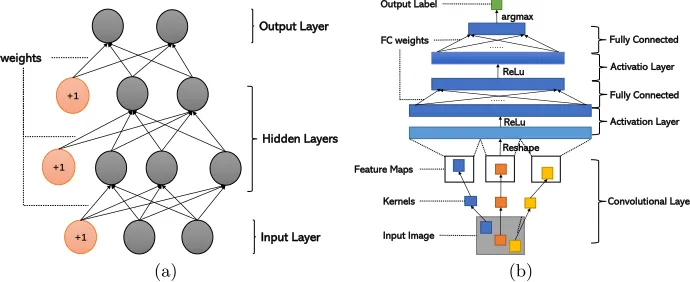
Fig 2(a) shows a typical MLP with two hidden layers, each node represents a neuron, it receives the output of the neurons of previous layers plus a bias from a special neuron. Then it computes a weighted average of its inputs. Finally, the neuron applies a non-linear function to the weighted average.
+1 +1
+1
Input Layer Hidden Layers Output Layer
weights
(a)
…… ……
Input Image Kernels Feature Maps FC weights
Convolutional Layer Activation Layer Activatio Layer
Fully Connected Fully Connected Output Label
ReLu argmax
ReLu
Reshape
(b)
Fig. 2.Neural Networks. (a) is for MLP, (b) is for CNN.
Convolutional Neural Networks CNN has gained much more attention in the past decades owing to its superb accuracy. While there are many different CNNs, they all share a similar structure.
As shown in Fig 2(b), the input to a CNN is represented as a matrixXwhere each element corresponds to the value of a pixel. Pictures can have multiple color channels, i.e. RGB, in which case the picture is represented as a multidimensional matrix, i.e. tensor. Compared to MLP, CNN has additive layers: (i)Convolution layer,(ii) (Mean or Max)-Pooling layer, both play important roles.
2.2 Secure Computation
Secret-Sharing. Shamir’s Secret Sharing[1] is a powerful cryptographic prim-itive which allows a client to split a secret into nshares, so that any less than
t shares reveal no information about the original secret while any t shares can recover the secret.
Definition 1. Shamir’s Secret Sharing scheme consists of a sharing algorithm
S and a reconstruct algorithmR.
S takes a secret s, a thresholdt, andnas inputs, outputs nshares of s
with t≤n.
R takes the threshold t, a subset of the shares with size m as inputs, and
recovers the secret s
R({hsi0,hsi1, ...,hsim}, t)→s (4)
with m≥t.
Correctness requires that ∀s ∈ F, ∀t, n(t ≤ n), if {hsi0,hsi1, ...,hsin} are shares of s, then any subsets of size m(m ≥ t) could reconstruct the original secret s.
Security requires that any subsets of shares of sizem0(m0 ≤t−1) disclose no information about s, which means that∀s, s0 ∈Fand two subsets of shares
with size m0(m0 ≤t−1), no polynomial-time adversary A can distinguish the distribution of the two subsets
|P r[A({hsi0, ...,hsim0}) = 1]−P r[A({hs0i0, ...,hs0im}) = 1]| ≤
1
p(x) (5) wherep(·) is a positive polynomial andxis sufficiently large.
Secret Sharing with information-theoretic MAC. The Shamir’s Secret Sharing scheme can only against semi-honest adversaries, but not resist mali-cious modifications. So we import a variant of information-theoretic Message Authentication Code(MAC)[12].
Definition 2. Secret Sharing scheme with information-theoretic MAC consists
of a sharing algorithmS, a reconstruct algorithmR, an authentication function
δ, a verification functionυ, and a global keyα.
S takes a secret s, the function δ, the threshold t, and n as inputs, and
outputs their shares
S(s,δ, t, n)→ {(hsi0, ...,hsin),(hδ(s)i0, ...,hδ(s)in)} (6)
Rtakes the threshold t, the function υ and the subsets of shares as inputs,
and outputs s
R(({hsi0, ...,hsim}),({hδ(s)i0, ...,hδ(s)im}),υ, t)→s (7)
if υ(s,δ(s), α) = 1, elseR(·)returns ⊥.
Noteδ(s) =α·s modpandυ(·) = 1 if and only if the reconstructed sand
δ(s)satisfy δ(s) =α·s modp.
Correctness and privacy against the semi-honest adversary are identical to what we have mentioned in Shamir’s Secret Sharing scheme.
3
System Architecture
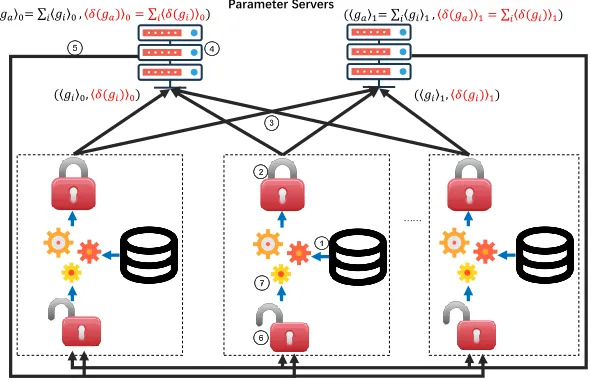
Our scheme is based on distributed machine learning except that we introduce two or more non-collude servers like[23,29], to protect the privacy. However, the servers in our protocols are not responsible for storing data or training the model but aggregating the gradients.
Instead of uploading the plain gradients to one parameter server in dis-tributed machine learning, the clients share gradients after each training epoch and upload these shares to corresponding servers in our protocols.
In this paper, we propose two protocols,ΓsashandΓsam. InΓsash, we require the servers are semi-honest or honest-but-curious and at mostt−1 servers can collude. In Γsam, we enhance our security capabilities to against servers-only malicious adversary via Secret Sharing with information-theoretic MAC.
……
Parameter Servers
( 𝑔𝑖 0,𝛿(𝑔𝑖)0) ( 𝑔𝑖 1,𝛿(𝑔𝑖)1)
( 𝑔𝑎 0= σ𝑖𝑔𝑖 0,𝛿(𝑔𝑎)0= σ𝑖𝛿(𝑔𝑖)0) ( 𝑔𝑎 1= σ𝑖𝑔𝑖 1,𝛿(𝑔𝑎)1= σ𝑖𝛿(𝑔𝑖)1)
Fig. 3. Architecture for our protocols with two parameter servers. 1local training, 2
share the gradients(and MACs), 3upload gradients’ shares(and MACs’ shares), 4
aggregate gradients’ shares(and MACs’ shares), 5download aggregated gradients’ shares(and MACs’ shares), 6reconstruct aggregated gradients(, MACs and verify),
7
update the local model and train it again(or abort). Note that MACs are for mali-cious security.
3.1 Γsash−Protocol for Semi-honest Security
each client establishes a TLS/SSL secure channel with each server to protect the integrity of the shares.
Next, each client trains the model using private data locally and computes the gradientsg as Equation 1.
The elements ofgare all float-point decimal numbers, which are not suitable for arithmetic operations in secure computations. So we have to encode all the elements ofg as integers in a large finite field.
For instance, we can multiply them by a large scaling factor and truncate the results as integers modulop,pis a big prime. When decode, we could determine the sign of an encoded element and divide the scaling factor2. As shown in the experiments, the errors introduced by truncation are so small that have little impacts on the final model.
Note that the clients can only encode and share a portion of gradients which are important, and we uses(iup)to indicate them.
Next, the clienti sharesgi ashgii0,hgii1, ...,hgiiN−1, sendshgiij and s (up) i to thej-th server. Note that both encoding and secret sharing can be accelerated via vectorization.
On the other hand, the servers would wait a while to receive enough se-cret shares, i.e. all the sese-cret shares, and then compute the sese-cret shares of the aggregated gradients according to{s(iup)}
hgaij =
X
i
hgiij (8)
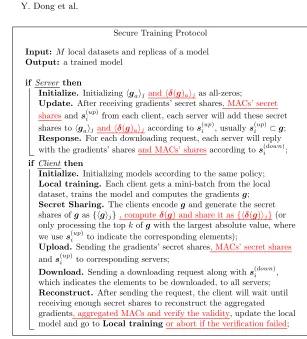
After the aggregation, the servers will reply to clients’ requestss(idown)with the aggregated shares, s(idown) indicates the elements to be downloaded. The details are in Fig 4. We will prove the correctness and security below.
Correctness. In Γsash, the parameter servers are responsible for aggregating the gradients’ shares, which is in secret sharing form. To prove our protocol’s correctness, we importlemma1, which we prove inAppendix A.1.
Lemma 1. The addition of secret shares is the secret shares of the sum. For
example,{hxii}are the secret shares of xand{hyii}are the secret shares of y,
then{hzii =hxii+hyii} are the secret shares ofz=x+y.
According to lemma 1, we know that each server aggregates one of the secret shares of ga rightly. So in the end, the clients will receive enough secret shares and reconstruct thega.
Security. In Γsash, we consider the security of the training protocol against semi-honest adversaries with three different threat models, namely users-only threat model where some users are corrupted, servers-only threat model where some servers are corrupted, and users-servers threat model where some users and servers are controlled by adversary.
2
Theorem 1 (Privacy in Semi-honest Adversary). The protocol Γsash is
secure in presence of semi-honest adversaries, meaning they leak no sensitive information about the honest clients’ gradients, as long as the adversary can
only corrupt no more than t−1servers and M −2clients.
In the users-only threat model, what the adversaryAcan get about honest clients is the sum of their gradients.
X
j∈honest. gj =
X
i∈all gi−
X
k∈corrupted
gk (9)
Even the number of corrupted clients are M −2, A get no information about the gradients towards a particular client. So we can protect the honest clients’ privacy.
In the servers-only threat model, we require A can only corrupt up to t− 1 servers. So A can not distinguish the gradients’ shares from pseudorandom numbers under Shamir’s Secret Sharing scheme, which meansAcan not violate clients’ privacy.
From users-only threat model and servers-only threat model, we can know that evenAcorruptt−1 servers andM−2 clients, whatAcan get is as in the users-only threat model since the corrupted servers leak no private information.
3.2 Γsam−Protocol for Servers-only Malicious Security
Protocol Γsash can against semi-honest adversary, but not ensure that servers will sum up the gradients honestly, which means if a server is controlled by a malicious adversary M, he can launch an attack,i.e. poisoning attack. For instance,Mcan replace the gradients’ shares with random values to reduce the performance of the final model.
In order to prevent this kind of attacks, we proposeΓsam, a protocol based on Secret Sharing with information-theoretic MAC, which can detect servers’ malicious behaviors. So inΓsam, in addition to sharing the gradients, the clients have to compute and share the gradients’ MAC δ(g). And the servers have to aggregate the shares ofδ(g). The details are in Fig 4.
Correctness. In protocol Γsash we have proved that the sum of secret shares is the secret shares of the sum. Now we bring in lemma2, we give its proof in Appendix A.2.
Lemma 2. The sum of homomorphic MACs is the MAC of the sum. For
ex-ample, δ(x) and δ(y) are homomorphic MACs of x and y, respectively, then
δ(x) +δ(y)is the homomorphic MAC ofx+y.
As long as the clients compute homomorphic MACs of gradients, we have that the sum of the MACs is the MAC of the sum of gradients on the basis oflemma
Security. The privacy of Γsam is the same as Γsash, and we can prevent the corrupted servers from malicious modification with a servers-only threat model.
Theorem 2 (Resistance to Malicious Adversary in servers-only threat model).The protocolΓsamis secure against malicious adversaries in the
servers-only threat model, meaning the adversary can not launch active poisoning attacks
without detection, as long as the adversary can only corrupt no more thant−1
servers.
As long as the global secret keyαis only known to clients, the possibility that Mcan construct a valid MAC for an arbitrary secretsis equal to the possibility that Mcan get α. So we have
P r(M(δ, s) = 1) = 1
2dlogpe (10)
As long as the primepis sufficient large, the possibility is negligible.
AssumingM modifies the hgiu to launch a poisoning attack. So he would add the modified shares to aggregated shares, which denoted as hgai0u. If hgai0u is downloaded and the client would try using it to reconstruct thega
g0a=R({hgaii}i∈{t},i6=u∪ {hgai0u}) (11)
Also, the client can reconstruct δ(ga) at the same time.
It is obvious that the possibilityυ(α,g0a,δ(ga)) = 1 is negligible as long as αis unknown to theMand no more thant−1 servers could collude.
Secure Training Protocol
Input: M local datasets and replicas of a model
Output: a trained model
if Serverthen
Initialize. Initializinghgaij andhδ(g)aijas all-zeros;
Update. After receiving gradients’ secret shares, MACs’ secret
sharesands(iup)from each client, each server will add these secret
shares tohgaij andhδ(g)aij according tos
(up)
i , usuallys
(up)
i ⊂g;
Response. For each downloading request, each server will reply
with the gradients’ sharesand MACs’ sharesaccording tos(idown);
ifClientthen
Initialize. Initializing models according to the same policy;
Local training. Each client gets a mini-batch from the local
dataset, trains the model and computes the gradientsg;
Secret Sharing. The clients encodegand generate the secret
shares ofgas{hgij}, computeδ(g) and share it as{hδ(g)ij}(or
only processing the topkofgwith the largest absolute value, where
we uses(iup)to indicate the corresponding elements);
Upload. Sending the gradients’ secret shares, MACs’ secret shares
ands(iup)to corresponding servers;
Download. Sending a downloading request along withs(idown),
which indicates the elements to be downloaded, to all servers;
Reconstruct. After sending the request, the client will wait until
receiving enough secret shares to reconstruct the aggregated
gradients, aggregated MACs and verify the validity, update the local
model and go toLocal trainingor abort if the verification failed;
1
Fig. 4.Details for our protocol. Note that the red-and-underlined parts are only re-quired for malicious protocolΓsam(not necessary for semi-honest protocolΓsash).
4
Experiments
4.1 Environment
Our experiments are executed on three Intel(R) Xeon(R) CPU E5-2650 v3@ 2.30GHz servers with each has 64G RAM in the LAN setting.
We simulate 2 parameter servers and 32 clients. All protocols have been implemented in Python3 language, and we use Tensorflow 1.13.13 library, this popular machine-learning library has been used by major Internet companies such as Google.
3
4.2 Experiments setup
In our experiments, we use MNIST as our training set. And we compare all re-sults with two baseline scenarios. The first is the basic federate learning Γf l, which consists of one parameter server and 32 clients with no secure tech-niques. The other scenario is Google’s Secure Aggregation protocol Γsag[25], which masks the gradients before uploading4. All the protocols are executed synchronously.
For all the scenarios, we implement linear regression, MLP, and CNN. We compare them in accuracy, convergence rate and performance in detail below.
4.3 Experiments Results
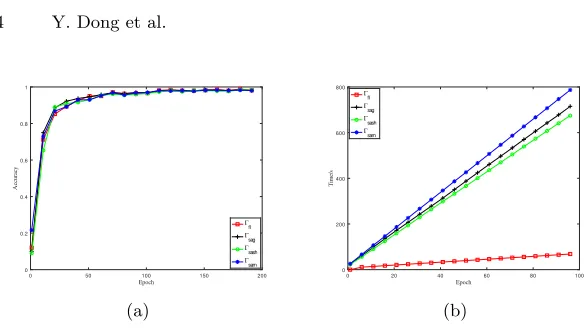
Accuracy We compare the same model in different scenarios, we find that our accuracies in the semi-honest and malicious setting are both nearly to the accuracy ofΓf l. The highest accuracy’s drop is within 0.01 for CNN and MLP, and 0.02 for linear regression.
We plot the accuracy changes along with the training epochs. And we show that with the increasing of the training epochs, the influence produced by en-coding a float-number as a big integer is being smaller and smaller. For instance, Fig.5(a) shows that in a CNN, the curve for Γsash almost coincides with the curve forΓf l. And we get similar results for linear regression and MLP, we plot them inAppendix Bdue to the space limit.
The best accuracies for each model in all protocols are shown in Table 1.
Table 1.Accuracy for each model in all protocols.
Model
Protocol
Γf l Γsag Γsash Γsam
Linear Regression 0.929 0.924 0.918 0.913
MLP 0.979 0.977 0.978 0.974
CNN 0.997 0.994 0.995 0.991
Convergence Rate Our experiments also illustrate that the convergence rates in all protocols over training epochs are at the same level, the secure techniques do not influence the results much.
For instance, the convergence rates ofΓsash andΓsam are almost the same as Γf l for CNN. From Fig 5(a), it is obvious that the models all approach 0.95 at around 50 epochs and reach 0.99 at around 100 epochs in different protocols.
4
0 50 100 150 200 0
0.2 0.4 0.6 0.8 1
Epoch
A
cc
ur
ac
y
Γ fl Γsag Γ
sash Γsam
(a)
0 20 40 60 80 100
0 200 400 600 800
Epoch
T
im
e/
s
Γ fl Γsag Γ
sash Γsam
(b)
Fig. 5.Experimental results of CNN. (a) is for accuracy, (b) is for performance.
Performance Our protocols can be divided into offline phase and online phase naturally. In the offline phase, the clients mainly generate random numbers in-dependently. We run the process 10 times for each model and take the average as the result. The details are in Table 2. Note that protocol Γsag needs around 22.81 seconds in our setting to negotiate keys between clients, and we do not include it in Table 2.
Table 2.Offline performances(seconds, 100 epochs).
Model
Protocol
Γf l Γsag Γsash Γsam
Linear Regression 0 11.90 0.60 1.19
MLP 0 110.53 14.24 27.47
CNN 0 243.92 21.77 41.44
From Table 2 we can see thatΓsashis around 10×faster thanΓsag, andΓsam is around 5×faster thanΓsag.
As for the online phase, we plot the running time along with the epochs for CNN in Fig 5(b). It is illustrated that our semi-honest protocol Γsash is faster thanΓsag evenΓsag is in the best situation. For example, the running time for Γsash is 701.85 seconds, whileΓsag needs 744.68 seconds, both run 100 epochs. As for our malicious protocolΓsam, the running time is a little longer, which is around 819.99 seconds.
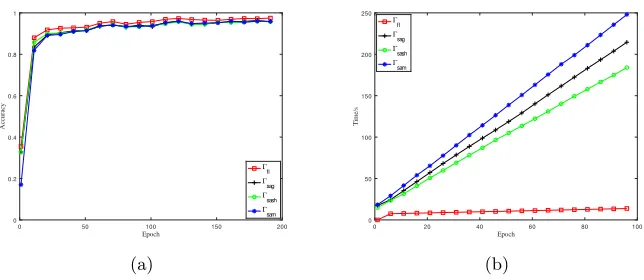
to privacy-preserving deep learning methods based on HE[28], our improvements are dramatically where they need 2.25 hours for MLP and 7.3 hours for CNN. Note that we plot the figures for linear regression and MLP inAppendix B.
On the other hand,Γsagonly needs one parameter server, butΓsashandΓsam need two or more parameter servers, and we require that at most t−1 servers could collude. However, import two or more servers is a common method for distributing machine learning, and it is easy to satisfy this security requirement in practice. Meanwhile, inΓsag the parameter server would learn the aggregated gradients and even the trained model, but in Γsash and Γsam the parameter servers can learn nothing. What’s more, our protocols are more robust than
Γsag, since we allow n−t servers to halt at worst but Γsag must ensure the parameter server runs normally.
5
Conclusion
We introduce a novel secure computation framework for distributed machine learning that achieves high accuracy and performance by combining distributed machine learning with secret sharing. In contrast to previous state-of-the-art frameworks, we improve the efficiency of more than 10×and maintain the re-quired security in semi-honest. Besides, we propose a verifiable protocol against servers-only malicious modifications based on information-theoretic MAC. We evaluated our framework on linear regression, MLP, and CNN and achieve excel-lent results both in accuracy and performance. What’s more, combining differ-ential privacy with distributed machine learning is a promising solution against inferring attacks, which can enhance our security as well. We leave it for future work.
6
Acknowledgements
We are grateful to the anonymous reviewers for their comprehensive comments. And we thank Xiangfu Song, Yiran Liu from Shandong University for helpful discusssions on MPC, and Junming Ke from Singapore University of Technology and Design for his help. This work was supported by
References
1. Shamir A. How to share a secret[J]. Communications of the ACM, 1979, 22(11): 612-613. https://doi.org/10.1145/359168.359176
2. Lindell Y, Pinkas B. Privacy-preserving data mining[C]//Annual Interna-tional Cryptology Conference. Springer, Berlin, Heidelberg, 2000: 36-54. https://doi.org/10.1145/335191.335438
4. Du W, Han Y S, Chen S. Privacy-preserving multivariate statistical analysis: Lin-ear regression and classification[C]//Proceedings of the 2004 SIAM international conference on data mining. Society for Industrial and Applied Mathematics, 2004: 222-233. https://doi.org/10.1137/1.9781611972740.21
5. Sanil A P, Karr A F, Lin X, et al. Privacy-preserving regression modelling via distributed computation[C]//Proceedings of the tenth ACM SIGKDD interna-tional conference on Knowledge discovery and data mining. ACM, 2004: 677-682. https://doi.org/10.1145/1014052.1014139
6. Jagannathan G, Wright R N. Privacy-preserving distributed k-means clustering over arbitrarily partitioned data[C]//Proceedings of the eleventh ACM SIGKDD international conference on Knowledge discovery in data mining. ACM, 2005: 593-599. https://doi.org/10.1145/1081870.1081942
7. Yu H, Vaidya J, Jiang X. Privacy-preserving svm classification on ver-tically partitioned data[C]//Pacific-Asia Conference on Knowledge Dis-covery and Data Mining. Springer, Berlin, Heidelberg, 2006: 647-656. https://doi.org/10.1007/1173113974
8. Slavkovic A B, Nardi Y, Tibbits M M. ” Secure” Logistic Regression of Horizontally and Vertically Partitioned Distributed Databases[C]//Seventh IEEE International Conference on Data Mining Workshops (ICDMW 2007). IEEE, 2007: 723-728. https://doi.org/10.1109/ICDMW.2007.114
9. Bunn P, Ostrovsky R. Secure two-party k-means clustering[C]//Proceedings of the 14th ACM conference on Computer and communications security. ACM, 2007: 486-497. https://doi.org/10.1145/1315245.1315306
10. Vaidya J, Yu H, Jiang X. Privacy-preserving SVM classification[J]. Knowledge and Information Systems, 2008, 14(2): 161-178. https://doi.org/10.1007/s10115-007-0073-7
11. Bottou L. Large-scale machine learning with stochastic gradient de-scent[M]//Proceedings of COMPSTAT’2010. Physica-Verlag HD, 2010: 177-186. https://doi.org/10.1007/978-3-7908-2604-316
12. Damgrd I, Pastro V, Smart N, et al. Multiparty computation from somewhat ho-momorphic encryption[C]//Annual Cryptology Conference. Springer, Berlin, Hei-delberg, 2012: 643-662. https://doi.org/10.1007/978-3-642-32009-538
13. Nikolaenko V, Ioannidis S, Weinsberg U, et al. Privacy-preserving ma-trix factorization[C]//Proceedings of the 2013 ACM SIGSAC confer-ence on Computer & communications security. ACM, 2013: 801-812. https://doi.org/10.1145/2508859.2516751
14. Wu S, Teruya T, Kawamoto J. Privacy-preservation for stochastic gradient descent application to secure logistic regression[J]. The 27th Annual Conference of the Japanese Society for Artificial Intelligence 27, 2013, 1-4.
15. Song S, Chaudhuri K, Sarwate A D. Stochastic gradient descent with differentially private updates[C]//2013 IEEE Global Conference on Signal and Information Pro-cessing. IEEE, 2013: 245-248. https://doi.org/10.1109/GlobalSIP.2013.6736861 16. Li M, Andersen D G, Park J W, et al. Scaling distributed machine
learning with the parameter server[C]//11th USENIX Symposium on Op-erating Systems Design and Implementation (OSDI 14). 2014: 583-598. https://doi.org/10.1145/2640087.2644155
17. Shokri R, Shmatikov V. Privacy-preserving deep learning[C]//Proceedings of the 22nd ACM SIGSAC conference on computer and communications security. ACM, 2015: 1310-1321. https://doi.org/10.1145/2810103.2813687
19. Abadi M, Chu A, Goodfellow I, et al. Deep learning with differen-tial privacy[C]//Proceedings of the 2016 ACM SIGSAC Conference on Computer and Communications Security. ACM, 2016: 308-318. https://doi.org/10.1145/2976749.2978318
20. Gascn A, Schoppmann P, Balle B, et al. Secure Linear Regression on Vertically Partitioned Datasets[J]. IACR Cryptology ePrint Archive, 2016, 2016: 892. 21. Regulation (EU) 2016/679 of the European Parliament and of the Council of 27
April 2016 on the protection of natural persons with regard to the processing of personal data and on the free movement of such data, and repealing Directive 95/46/EC (GDPR). Official Journal of the European Union, L119, May 2016. 22. Gilad-Bachrach R, Dowlin N, Laine K, et al. Cryptonets: Applying neural networks
to encrypted data with high throughput and accuracy[C]//International Confer-ence on Machine Learning. 2016: 201-210.
23. Mohassel P, Zhang Y. Secureml: A system for scalable privacy-preserving machine learning[C]//2017 IEEE Symposium on Security and Privacy (SP). IEEE, 2017: 19-38. https://doi.org/10.1109/SP.2017.12
24. Liu J, Juuti M, Lu Y, et al. Oblivious neural network predictions via minionn transformations[C]//Proceedings of the 2017 ACM SIGSAC Con-ference on Computer and Communications Security. ACM, 2017: 619-631. https://doi.org/10.1145/3133956.3134056
25. Bonawitz K, Ivanov V, Kreuter B, et al. Practical secure aggregation for privacy-preserving machine learning[C]//Proceedings of the 2017 ACM SIGSAC Con-ference on Computer and Communications Security. ACM, 2017: 1175-1191. https://doi.org/10.1145/3133956.3133982
26. Lin Y, Han S, Mao H, et al. Deep gradient compression: Reducing the commu-nication bandwidth for distributed training[J]. arXiv preprint arXiv:1712.01887, 2017.
27. Riazi M S, Weinert C, Tkachenko O, et al. Chameleon: A hybrid secure computa-tion framework for machine learning applicacomputa-tions[C]//Proceedings of the 2018 on Asia Conference on Computer and Communications Security. ACM, 2018: 707-721. https://doi.org/10.1145/3196494.3196522
28. Phong L T, Aono Y, Hayashi T, et al. Privacy-preserving deep learning via ad-ditively homomorphic encryption[J]. IEEE Transactions on Information Forensics and Security, 2018, 13(5): 1333-1345. https://doi.org/10.1109/TIFS.2017.2787987 29. Wagh S, Gupta D, Chandran N. SecureNN: 3-Party Secure Computation for Neural Network Training[J]. Proceedings on Privacy Enhancing Technologies, 2019, 1: 24. https://doi.org/10.2478/popets-2019-0035
30. Nasr M, Shokri R, Houmansadr A. Comprehensive privacy analysis of deep learn-ing: Stand-alone and federated learning under passive and active white-box infer-ence attacks[J]. arXiv preprint arXiv:1812.00910, 2018.
31. Yang Q, Liu Y, Chen T, et al. Federated machine learning: Concept and applica-tions[J]. ACM Transactions on Intelligent Systems and Technology (TIST), 2019, 10(2): 12. https://doi.org/10.1145/3298981
32. Juvekar C, Vaikuntanathan V, Chandrakasan A. GAZELLE: A Low Latency Framework for Secure Neural Network Inference[C]//27th USENIX Security Sym-posium (USENIX Security 18). 2018: 1651-1669.
A
Proof of Correctness
A.1 Lemma 1
Proof. Suppose we have two secrets,s0 and s1, and we share both in Shamir’s
Secret Sharing scheme with two polynomial-functions
f(x) =a0+a1·x+...+at−1·xt−1 modp
g(x) =b0+b1·x+...+bt−1·xt−1 modp
(12)
wheref(0) =a0=s0,g(0) =b0=s1 andpis a large prime.
In order to compute the shares, we can evaluatef(x) andg(x) atndifferent pointsf(x0), f(x1), ..., f(xn−1) andg(x0), g(x1), ..., g(xn−1) respectively.
Then we will turn to getting the shares ofs0+s1. We define a new polynomial-function
h(x) = (a0+b0) + (a1+b1)·x+...+ (at−1+bt−1)·xt−1 modp (13) Obviously,h(x) is a polynomial-function of degreet−1 withtcofficients and
h(0) =s0+s1. On the one hand,h(xi) is the shares fors0+s1, and on the other hand, we can confirm
h(xi) = (a0+b0) + (a1+b1)·xi+...+ (at−1+bt−1)·xti−1
= (a0+a1·xi+...+at−1·xti−1) + (b0+b1·xi+...+bt−1·xti−1) =f(xi) +g(xi) modp, 0≤i≤n−1
(14)
So that the shares ofs0+s1 can be computed by adding the corresponding shares ofs0 ands1.
A.2 Lemma2
Proof. Suppose we havex0, x1, ..., xn−1and a secret keyα. We could the compute
the MAC ofxi
δ(xi) =α·xi modp, 0≤i≤n−1 (15) Then we can also compute the MAC ofxi’s sum:
δ( n−1
X
i=0
xi) =α·( n−1
X
i=0
xi) modp (16)
Then it is easy to confirm
δ( n−1
X
i=0
xi) = (α·x0) + (α·x1) +...+ (α·xn−1) modp =δ(x0) +δ(x1) +...+δ(xn−1) modp
= n−1
X
i=0
δ(xi) modp
(17)
B
Accuracy and Performance for linear regression and
MLP
B.1 Linear regression
0 50 100 150 200
0 0.2 0.4 0.6 0.8 1 Epoch A cc ur ac y Γfl Γ sag Γ sash Γsam (a)
0 20 40 60 80 100 0 10 20 30 40 50 60 T im e/ s Epoch Γfl Γ sag Γ sash Γsam (b)
Fig. 6.Experimental results of linear regression. (a) is for accuracy, (b) is for perfor-mance.
B.2 MLP
0 50 100 150 200
0 0.2 0.4 0.6 0.8 1 Epoch A cc ur ac y Γ fl Γ sag Γ sash Γ sam (a)
0 20 40 60 80 100
0 50 100 150 200 250 T im e/ s Epoch Γfl Γ sag Γ sash Γsam (b)