Article
Optimization of Guide Vane Closing Schemes of
Pumped Storage Hydro Unit Using an Enhanced
Multi-Objective Gravitational Search Algorithm
Jianzhong Zhoua,b,*,Yanhe Xua,b,*, Yang Zhenga,b, Yuncheng Zhanga,b
a School of Hydropower and Information Engineering, Huazhong University of Science and Technology, Wuhan 430074, China
b Hubei Key Laboratory of Digital Valley Science and Technology, Huazhong University of Science and Technology, Wuhan 430074, China
Abstract:The optimization of guide vane closing schemes (OGVCS) of pumped storage hydro unit (PSHU) is the research field of cooperative control and optimal operation of pumped storage, wind power and solar power generation. This paper presents a OGVCS model of PSHU considering the rise rate of the unit rotational speed and the specific node pressure of each hydraulic unit, as well as various complicated hydraulic and mechanical constraints. OGVCS model is formulated as a multi-objective optimization problem to optimize conflictive objectives, i.e., unit rotational speed and water hammer pressure criteria. In order to realize the efficient solution of the OGVCS model, an enhanced multi-objective bacterial-foraging chemotaxis gravitational search algorithm (EMOBCGSA) is proposed to solve this problem, which adopts population reconstruction, adaptive selection chemotaxis operator of local searching strategy and Elite archive set to efficiently solve the multi-objective problem. Especially, novel constraints-handling strategy with eliminating and local search based on violation ranking is used to balance various hydraulic and mechanical constraints. Finally, simulation cases of complex extreme operating conditions (i.e., load rejection and pump outage) of ‘single tube-double units’ type PSHU system are conducted to verify the feasibility and effectiveness of the proposed EMOBCGSA in solving OGVCS problem. The simulation results indicate that the proposed EMOBCGSA can provide lower rise rate of the unit rotational speed and smaller water hammer pressure than other method established recently while considering various complex constraints in OGVCS problem.
Keyword: pumped storage hydro unit; guide vane closing schemes; multi-objective optimization; enhanced multi-objective bacterial-foraging chemotaxis gravitational search algorithm (EMOBCGSA); hydraulic and mechanical constraints
1. Introduction
In recent years, in order to improve the global greenhouse effect and the carbon dioxide emissions, wind power, solar power generation, biomass energy and other renewable energy to maintain rapid development momentum in China[1, 2]. Grid installed capacity and power generation of new energy continued to grow, which effectively alleviate the economic development of coal, oil and other fossil energy dependence, promoting the reform of the energy structure and the development of green energy. However, due to wind and solar power are intermittent and random fluctuation characteristics, makes the grid for renewable energy consumptive ability seriously insufficient, has intensified the contradiction between the development and utilization of new energy.
* Corresponding Author: Jianzhong Zhou, Yanhe Xu. Tel.: +86 02787543127. E-mail address:
[email protected] (J.Z.), [email protected] (Y.X.).
As a special energy storage power supply, wind pumped storage plant (PSP) and solar power-PSP are used as the most common centralized and large-scale renewable energy complementary operation means[3-7]. The flexibility of PSP makes up for the randomness and heterogeneity of wind power and solar power generation, which is helpful to improve the reliability of the power grid and promote the integration of renewable energy variables.
The optimization of guide vane closing schemes (OGVCS) of PSHU is the research field of cooperative control and optimal operation of pumped storage, wind power and solar power generation. During the dynamic process of extreme condition (i.e. load rejection or pump outage) with the non optimal closing law, the rise of the unit rotational speed and the water hammer pressure will exceed the maximum design value, which cause the runaway speed of the PSHU, abnormal vibration or active guide vane asynchronous and other negative phenomena[8, 9]. OGVCS plays an important role in ensuring the security and stability of the power grid, and several methods have been proposed to deal with the OGVCS problem. Based on the characteristics of the rigid water-column pressure during the transient process, Ref [10] proposed a two-phase guide-vane closing scheme and three-phase valve-closing schemes to control the pulsating pressures and the runaway speed. Ref [11] analysing the effect of valve closure on the water-hammer pressure and laid the theoretical foundation for improving the turbine guide-vane closure. In order to avoid the operating point from the ‘S’ characteristic area, Kuwabara et al. proposed a curved closing scheme that could effectively decrease the water-hammer pressure[12]. Additionally, appropriate two-phase closing scheme[13, 14] and misaligned guide-vane method[15-17] also have been applied to control the fluctuation of PSHU. Three-phase valve-closing and curved closing scheme exerted high demands on the governor servomotor, which are difficult to realize in PSP. Meantime, misaligned guide-vane method can significantly increase the pulsating pressure and the runner radial forces during start-up process of PSHU[17]. Therefore, the optimal closing schemes are required to realize optimal coordinated operation of PSP and new energy generation technologies based on deeply analysis of operational mechanism and flow characteristics of PSHU.
Fully consider the complex hydraulic, mechanical and electrical coupling characteristics and nonlinear dynamic response process of PSHU, a multi-objective optimization model of guide vane closing schemes is established in this paper, which includes hydraulic and mechanical multiple constraint factors. The OGVCS problem is a complex, multi-objective and multi-constraint optimization problem, which aims to reasonably control the rotational speed, water hammer pressure of volute, draft tube, surge tank and so on, simultaneously. Multi-objective intelligent optimization algorithm is an effective way to solve complex multi-objective problems. Many intelligent optimization algorithms, such as PSO, GSA and so on, are widely used in solving multi-objective optimization problems multi-objective particle swarm optimization (MOPSO) [18, 19], non-dominated sorting genetic algorithm-II (NSGA-II) [20], multiobjective differential evolution (MODE) [21, 22], multi-objective gravitational search algorithm (MOGSA) [23, 24] and multi-objective bee colony optimization algorithm (MOBCO) [25, 26], have been proposed to solve the complex multi-objective optimization problems with practical modeling of coupling constraints efficiently. However, premature phenomenon and local convergence are still common obstacles to the performance of these stochastic searching algorithms. Bacterial-foraging chemotaxis gravitational search algorithm (BCGSA) is enhanced by Pbest-Gbest-guided movement, adaptive elastic-ball method and chemotaxis operator strategy of bacterial-foraging algorithm [27]. Global exploration and local exploitation performance of BCGSA have been proved by ref [27]. Inspired by the NSGA-II, EMOBCGSA has been introduced to deal with the OGVCS by reconstructing the optimal structure and mechanism. Finally, cases of complex extreme operating conditions of ‘single tube-double units’ type PSHU system are conducted to verify the feasibility and effectiveness of the proposed EMOBCGSA in solving OGVCS problem.
BCGSA. Section 5 illustrates the practical solving procedure for OGVCS problem and experiment results along with a few discussions, respectively. The conclusions are summarized in section 6.
2. Numerical calculation model of PSHU system
‘single tube-double units’ type PSHU system is a kind of coupling system of hydraulic, mechanical and electrical factors, simplified mainly into four parts, namely reservoir, pressure water pipeline, surge tank and pumped storage hydro unit. Fig.1 shows the schematic diagram of ‘single tube-double units’ type PSHU system of this paper, we divide the system into reservoir of upstream and downstream, eight pressure water pipelines, surge tank of upstream and downstream, two PSHU. In this section, mathematical model each link is illuminated respectively.
Fig.1 Structure of ‘single tube-double units’ type PSHU system
2.1 Model of pressure water pipeline
And, the characteristics method is employed in the modeling of pressure water pipeline, basic motion equation and continuous equation of unsteady flow in pressure pipeline can be expressed by the formulas (1) and (2) [28]. Solving the formulas (1) and (2) using the method of characteristics, which transforms formulas into a simplified equation set in the range of the characteristic line
dx a
dt = ± . The simplified equation set is described as the formulas (3) and (4).
motion equation: | | 0
t 2
V V V g H f V V
x x D
∂ + ∂ + ∂ + =
∂ ∂ ∂ (1)
continuous equation: a2 V V( H sin ) H 0
g x x α t
∂ + ∂ + +∂ =
∂ ∂ ∂ (2)
C+
: 2
| | 0 2
dH a dQ af
Q Q
dt gA dt gDA
dx a dt
+ + =
=
(3)
C−
:
2 | | 0
dt 2
dH a dQ af Q Q
gA dt gDA
dx a dt
− − =
= −
(4)
where V is the flow velocity, H is piezometric head, a is water hammer velocity, f is friction coefficient, D is pipeline diameter, α is the angle between the line and a horizontal surface of each section of the pipeline center, V and H respectively is the function of pipe length x and time t,
A is pipe section area, Q is water flow in pipe section.
The difference network is constructed by the above simplified equation set, then the finite difference method is used to solve the problem. Fig.2 shows the characteristic line difference mesh. For Fig.2, the length of L pipeline is divided into N segment, the length of each segment is
/ x L N
Fig.2 x-t characteristic line difference mesh
Diagonal AP satisfies the condition:Δ = Δx a t, Diagonal BP satisfies the condition:Δ = − Δx a t . The motion equation is calculated the line integral from A point to P point along the C+ line; the continuous equation is calculated the line integral from B point to P point along the C− line; and the calculation formula of integral is described as the formulas (5) and (6).
2
( ) ( ) | | 0
2
P
P A P A
A
a f
H H Q Q Q Q dx
gA gDA
− + − +
= (5)2
( ) ( ) | | 0
2
P
P B P B
B
a f
H H Q Q Q Q dx
gA gDA
− − − −
= (6)Finally, the correct processing and analog computation of boundary conditions for PSHU system in the transient process of the research and control are very important. The boundary conditions are a conduit or a terminal connected, including: upstream reservoir, upstream surge tank, series nodes, bifurcated pipe nodes, ball valve, PSHU, downstream surge tank and downstream reservoir. Besides surge tank and PSHU, the other boundary conditions as well as spiral case and tail pipe usually can be considered as pressure water pipeline.
2.2 Model of surge tank
C
H
1 i
Q
+ SH
iQ
S
Q
1A
2
A
S
H
R
H
Fig.3 The schematic diagram of the impedance surge tank
2
2 1 ( ) 2
S C R
R S S S
C S
R S
S
H H H
H K Q Q
dH
Q A
dt K Q K
gA
= +
=
=
=
(7)
where HS, QS are the surge tank bottom pressure and flow, A1 is the area of impedance orifice,
C
H , A2 are the elevation and area of surge tank, KR is bottom orifice flow loss coefficient.
2.3 Model of PSHU
PSHU is composed of pump-turbine and generator, which are the key component of the PSHU system. At present, the pump-turbine modeling based on the characteristic curves has been widely used. In this paper, pump-turbine is be described as the torque function and flow function of guide vane opening, generator rotational speed and water head, shown as formula (8) [32]. The analytic expression of nonlinear functions of fm( )⋅ and fq( )⋅ are difficult to obtain. However, based on the
characteristic curves (Fig.4), torque and flow of the pump-turbine at a certain time can be calculated by means of interpolation or nonlinear function fitting. In order to overcome obstacle of single input-multiple output during the process of interpolation calculating, Logarithmic-Curve-Projection method for the mathematical transformation of characteristic curves is adopted [33].
( , , ) ( , , )
t m
q
m f y x h q f y x h
=
=
Fig.4 The characteristic curves of pump-turbine
In this paper, only the PSHU rotational speed change of standalone running at the isolated power grid is considered[34]. The dynamic equation of the synchronous generator when considering the load characteristics
is simplified as the formula (9):
0
( ) 1
( ) ( ) a g
x s
mt s −mg s =T s e+ (9)
where x is the generator rotational speed, Ta is the inertial time constant of the generator, eg is
the adjusting coefficient of the generator, and mg0 is the load disturbance which is representing the load change.
3. OGVCS problem formulation
The dynamic response characteristics of the unit and the hydraulic influence of the large fluctuation condition of the PSHU are analyzed under the condition of different guide vanes closing law. Considering two objectives of the increase of unit rotational speed and pressure appreciation of each node in the hydraulic unit, the optimal model of the guide vane closing law is established.
3.1 Objective function
3.1.1 rotational speed objective
Rising rotational speed is one of the main characteristics of the pumped storage unit when the load rejection or pump power off condition. In extreme cases, non optimal guide vane closing schemes and even lead to runaway phenomenon, huge centrifugal force rotating parts may cause mechanical damage, vibration and noise. The minimize rotational speed objective Objx of OGVCS problem can be expressed as follows:
, ,
1
(max ) / pu
N
x i r i r i
i
Min Obj x x x
=
=
( )- (10)where Npu is the number of units in a hydraulic unit, xi is rotational speed of i unit during the
3.1.2 water hammer pressure objective
In order to minimize the pressure of each hydraulic unit, comprehensive considering the volute end pressure, tail pipe inlet pressure and surge tank water level value, the water hammer pressure objective function Objpre is established as follows:
_ , _ , _ _
1
) pu
N
pre P vol e i dra s i L sur up sur down
i
Min Obj w P P w L L
=
=
( + + ( + ) (11)where Pvol e i_ , , Pdra s i_ , are the maximum value of the volute end pressure and tail pipe inlet pressure for i unit, Lsur up_ , Lsur down_ are the maximum value of the upstream surge tank and downstream surge tank, wP, wL are weight coefficient of water hammer pressure and water level in the surge
tank.
3.2 Multiple constraints
The OGVCS problem should satisfy the following equality and inequality constraints: (1) Rising rotational speed constraint
For calculation of regulation guarantee and transient process of PSHU system, there is a clear maximum constraint value cons tantx for the rise value of rotational speed when all kinds of extreme
cases occur.
, cons tant
x i x
Obj ≤ (12)
(2) Limit of rotational speed fluctuation
In this paper, the limit of the times of rotational speed fluctuation is introduced in order to realize the good dynamic quality of the large fluctuation condition process.
,
( cons tant )
cons tant
xr
xf x i obj
xf xf
N num Obj
N = ≥ ≤
(13)where cons tant
xr
obj is rising rate constant for dynamic quality requirements, Nxf is fluctuation
times, cons tantxf is constraint constant of fluctuation times.
(3) Volute pressure constraint
The maximum corrected value and the pressure constraint of the volute inlet pressure considering the pressure fluctuation and the calculation error is described as follows:
_ , _ , _ , ,
_ , _
7% ( ) 10%
cons tant
vol s i vol s i n vol s i vol i vol s i Pmvol s
Pm P H P P
Pm
= + × + − ×
≤
(14)
where Pvol s i_ , , Pvol i, and Pmvol s i_ , are maximum calculated value, initial value and maximum corrected value of volute inlet pressure for i unit, Hn is the net head, cons tantPmvol s_ is constraint
constant of Pvol s i_ , .
(4) Draft tube inlet pressure constraint
_ , _ , , _ ,
_ ,
_ ,
3.5% ( ) 10%
0 conventional condition 5 successive load rejection
dra s i dra s i n dra i dra s i dra s i
dra s i
Pm P H P P
Pm m Pm m = − × − − × ≥ ≥ − (15)
(5) The surge water level limits _ _ _ _ _ _ _ _ cons tant cons tant cons tant cons tant sur up Lsur up
sur up lsur up
sur down Lsur down
sur down lsur down
L l L l ≤ ≥ ≤ ≥ (16)
where Lsur up_ and
l
sur up_ are maximum and minimum value of surge water level of upstream surge tank, Lsur down_ andlsur down_ are maximum and minimum value of surge water level of downstream surge tank, others are corresponding constraint constant.(6) Speed governor oil velocity limit
If the PSHU guide vane closing time is too short, the governor control slope of the curve of high precision. In order to meet the so short closing time, servomotor oil speed must be large enough, which will cause major safety accidents. Therefore, this paper takes into account the limit factor of the slope control of the governor, and transforms it into the guide vane closing rate.
/ _ max/
Y t Y Tr
Δ ≤ (17)
where ΔY and Y_ maxis change value and rated maximum value guide vane opening, t is guide vane closing time, Tr is minimum closing time limit.
4. Methodology of enhanced multi-objective BCGSA
4.1 Overview of BCGSA
BCGSA is improved from standard gravitational search algorithm (GSA) by introducing the strategies: Pbest-Gbest-guided movement, adaptive elastic-ball method and chemotaxis operator strategy. Then the specific processes of BCGSA are as follows.
Step 1: Initialization. Randomly initialize the agent of population position and velocity.
Step 2: Fitness calculation and information save. Calculate the fitness of agents according to their initial position, storing the current position of each agent Pbest(t) as the best record position of the
agent and position of best agent Gbest(t) as the best position in global.
Step 3: Update best(t), worst(t), and Mi(t) for i = 1,2,. . .,N.
Step 4: Calculate the gravitational constant in the current iteration and acceleration for each agent.
Step 5: Update agents’ velocity d i
v and position d i
x with formulas (18) and (19)[35].
1 1 2 2 3
( 1) ( ) ( ) ( ( ) ( )) ( ( ) ( ))
d d d d d d d
i i i ibest i best i
v t+ = ⋅r v t +a t + ⋅ ⋅c r P t −x t + ⋅ ⋅c r G t −x t (18)
( 1) ( ) ( )
d d d
i i i
x t+ =x t +v t (19)
where r1, r2 and r3 are random variables in the range [0,1], c1 and c2 are learning genes in the range [0,2], Pibest( )t is the best position that i-th agent has ever suffered until time t, Gbest( )t is the
global best position in the agents until time t.
Step 6: Judge whether the new position of the agent is beyond the boundary. Invoke the adaptive elastic-ball program ( formula (20) ) to handle the new position which is against the boundary. Besides, there are few rest agents against the boundary whose position will be reset by formula (21) [36].
( ) ( ), ( ) ( ) and ( ) ( ) ( ) ( ), ( ) ( ) and ( ) ( )
d d d
i i i
d d d
i i i
if x t Ub d up x t Ub d x t Ub d up
if x t Lb d down Lb d x t x t Lb d down
ζ ζ
> = − = − ⋅
< = − = + ⋅
( ) ( ( ) ( )) ( )
d i
x t =rand Ub d⋅ −Lb d +Lb d (21)
where ζ is the adaptive attenuation coefficient of reflective power, Ub d( ) and Lb d( ) are upper and lower boundary limit in the d-th dimension, respectively.
Step 7: Evaluate the fitness in accordance with the new position of each agent, storing position of best agent Xbest and worst agent Xworst in the current iteration.
Step 8: Chemotaxis operator [37] is conducted for Xbest and Xworst.
(1) Initialize parameters Nc, Ns and C i( ). Where Nc is the number of chemotaxis steps, Ns is the number of swim steps.
(2) Tumble. Generate a random vector with each element Δd( )i , d=1,2, ,⋅⋅⋅ D, a
random number on [−1,1].
(3) Move. Define unit length random direction φ( )j in j-th chemotaxis, then updates the best agent [ 1 , 2 , , , , ]
best best best best best
d D
X = x x ⋅⋅⋅x ⋅⋅⋅ x and worst agent [ 1 , 2 , , , ]
worst worst worst worst worst
d D
X = x x ⋅⋅⋅ x ⋅⋅⋅ x
according to formulas (22) and (23).
( ) ( ) ( ) ( ) T i j i i φ = Δ
Δ Δ (22)
( , 1) ( , ) ( ) ( )
x i j+ =x i j +C iφ j (23)
where Xbest is the agent of the best fitness, Xworst is the agent of the worst fitness, x i j( , ) is
the position of the i-th agent in the j-th chemotaxis.
(4) Swim. Compute fitness of obtained new agent x i j( , +1), then compare fitness i( ,j+1) and ( , )
fitness i j . If the fitness i( ,j+1) is better, save the new agent as best
new
X or worst
new
X and start agent swimming, then let m=0 and repeat the formula (23) following this tumble direction until m=Ns; else let n=Ns directly, this is the end of the while statement.
(5) Repeat (1) to (4) until Nc reaches the stop criteria. And replace Gbest and Gworst by Xnew, only
when best new
X and worst new
X is better.
Step 9: Compare the obtained fitness of a new position x ti( +1) with fitness of Pibest( )t and
( )
best
G t while i changes from 1 to N. If x ti( +1) has a better fitness value, replace position of Pibest( )t
and Gbest( )t by x ti( +1).
Step 10: Repeat Step 3 to Step 9 until the stop criteria reached.
4.2 The basic definition of multi-objective optimization problem
Generally, the multi-objective minimize optimization problem of n dimensions decision variable and m dimensions subunit objectives can be described as follows:
1 2
1 2
M in ( ) {min ( ), min ( ),..., min ( )} ( ) 0 ( 1, 2,..., )
( ) 0 ( 1, 2,..., ) ( , ,..., )
m
j
k
n
y F x f x f x f x
subject to g x j J
h x k K
x x x x
= = ≥ = = = = (24) ( )i RD
where [ , ,...,f f1 2 fm] are m dimensions of objective vectors, F x( ) is mapping function from decision space to object space, g xj( )≥0 (j=1, 2,..., )J defines the J inequality constraints,
( ) 0 ( 1, 2,..., )
k
h x = k= K defines the K inequality constraints,x=( , ,..., )x x1 2 xn is m dimensions decision variable space.
Due to the conflictive relationship among multiple subobjectives, a set of non-dominated solution exist rather than only one optimal solution. thus the key concept of Pareto optimality [38, 39] associated with the trade-off between conflictive objectives is adopted.
(1) Pareto dominance relation
f
X is a feasible solution set, x1 and x2 are feasible solutions, [ ,x x1 2]∈Xf , if x1 dominates
2
x , note as x1fx2, if and only if
1 2 1 2
{∀ =k 1, 2,..., |m f xk( )≤ f xk( )} {∧ ∃ ∈l (1, 2,..., ) | ( )m f xl < f xl( )} (25)
(2) Pareto optimal solution
For a given multi-objective optimal problem, if x*∈Xf is the Pareto optimal solution, if and
only if
*
:
f
x X x x
¬∃ ∈ f (26)
(3) Pareto optimal solution set
The set of all Pareto optimal solutions is called the Pareto optimal solution set P*.
* { |* : *}
f
P = x ¬∃ ∈x X xfx (27)
(4) Pareto optimal front
The Pareto optimal solution set corresponding to the objective vector value in the objective domain space is called the Pareto optimal front PF*.
* * * * *
1 2
{ ( ) { ( ), ( ),..., m( )}
PF = F x = f x f x f x (28)
4.3 Enhanced multi-objective BCGSA
The BCGSA is based on the single objective optimization design, which does not have the ability to deal with multi-objective optimization problems. Therefore, based on the BCGSA, this section reconstructs the optimal structure and mechanism of solving multi-objective optimization problems.
4.3.1 Population reconstruction
For multi-objective optimization, the non inferior relationship analysis between individuals in a population becomes complicated and fuzzy, how the individuals are reasonable Pareto ordering to improve the computational efficiency and ergodicity of multi-objective optimization algorithm is essential. Therefore, this paper further introduced a fast non dominated sorting method, comprehensive analysis method, and the crowding-distance is calculated based on the individual level and at the basis of the new design method of the quality of individual crowding-distance calculation, and then complete the whole population structure reconstruction.
(1) Non-dominated sorting
In order to realize the distribution and diversity of population of the BCGSA algorithm in dealing with multi-objective optimization problems in this group, inspired by NSGA-II [20], the fast non dominated sorting method is applied to divide the population into a number of levels, the specific steps are as follows:
Step1: If any individual d i
Step2: In the whole population, the individuals of rank=1 are excluded; then repeat Step1 until obtain the individual solution set of the second layer, and the individual attributes of the rank=2 are given.
Step3: By analogy, repeat Step 2 until the completion of the entire population of non dominated sort. Assuming that the population size is 7, the objective number is 2, and the layering schematic is shown in Fig.5.
Fig.5 The layering schematic of population
(2) Crowding-distance calculation
Further, another attribute of each layer individual is given a “crowding-distance”. Crowding-distance [20] is an important indicator for evaluating the density distribution of the non dominated solutions, which can be used to evaluate the relative distance between a single individual and its surroundings. And, the aggregation density of non inferior individuals with small crowding distance. The formula for calculating the crowding-distance is as follows:
max min 2
1, 1,
1
max min 2 1, 2,
1
max min 2
1, ,
1
[( ) / ( )] , [2, 1]
[ ] = 2[( ) / ( )] , 1
2[( ) / ( )] ,
L
p l p l l l
l L
distance l l l l
l L
Nr l Nr l l l
l
f f f f p Nr
p f f f f p
f f f f p Nr
− + = = − = − − ∈ − Γ − − = − − =
(29)where Γ[ ]p distance is crowding-distance of individual p, fp l, is fitness value of objective l of individual p, L is the number of objective, max
l
f and min
l
f are maximum and minimum fitness values for individuals in each layer of the L dimensional objective.
Thus, each individual consists of two attributes: the layer number and the crowding-distance. Depending on these two attributes can be defined between individual preference relations. i is superior to j, if and only if:
( ) ( )
( ) ( ), [ ]distance [ ]distance
rank i rank j
rank i rank j i j
<
= Γ > Γ
(30)
(3) Individual quality calculation
Step1: In the rank=1, the fitness values of the individuals with the smallest value of l objective functions and the maximum crowding-distances are set to 1, and the fitness value of other individuals is 2.
Step2: In the rank=2, set all the individual fitness values to 3.
Step3: Repeat step 2, individual fitness value of rank≥3 is set to (rank+1), thus completing all layers of individual fitness assignment.
Step4: Calculate individual quality by formula (31).
1 ( ) ( ) ( ) ( ) ( ) ( ) ( ) ( ) i i i i N j j
fit t worst t m t
best t worst t m t M t m t = − = − =
(31)4.3.2 Multi-objective adaptive chemotaxis operation
For multi-objective adaptive chemotaxis operation, the selection of Gbest and Gworst is the key
to speed up the convergence of EMOBCGSA. In order to avoid the premature and maintain the diversity of the population, the concept of constraint violation, as shown in formula(32), is introduced in the selection process. Combined with individual crowding-distance, calculate the probability of individual selection in rank=1 and rank=max, as shown in formula (33). By means of formulas (32) and (33) to adaptive calculate the probability of individual selection, then the tracking targets (Gbest
and Gworst) of multi objective chemotaxis operation are determined by the roulette wheel method.
1
1
nc
ic ic
ic ic
ic ic ic
s nc
ic ic
ic ic
ic ic ic
value Lu value Lu Lu Ld voilation Ld value value Ld Lu Ld = = − ≥ − = − ≤ −
(32) 1 1 1/ 1 , 1/ [ ] 2 , [ ] v d s s N v v s distance N distance d voilationSp if voilation
voilation p s Sp otherwise d ε = = × > = Γ × Γ
(33)where voilations is constraint violation of individual s, valueic constraint value is of constraint ic
, Luic and Ldic are the upper and lower limits of constraint ic, nc is the number of constraints;
s
p is selection probability of s, ε is feasible margin of constraint failure depth evaluation (if
s
voilation >ε , and individual s is infeasible solution), Nv and Nd are number of infeasible
solutions and feasible solutions, Sp1 and Sp2 are initial selected probability constant of infeasible solution and feasible solution.
4.3.3 Multi-objective velocity update strategy
For velocity update formula (18) of EMOBCGSA, Gbest and Pbest need to be redefined when
dealing with multi objective problems. The selection mechanism of Gbest has been detailedly
introduced in section 4.3.2, and d ( )
ibest
P t is the location of the optimal memory of the individual i on the d dimension of the t generation. The selection method of Pbest can be carried out according to
4.3.4 The update and maintenance of elite archive set
The elite archive set (EAS) is used to store the non dominated solutions obtained during EMOBCGSA evolution, and provide guidance for the evolution of a population. In the actual operation of the algorithm, the newly generated individual g
s
np and the original individual g s
p are added to EAS when g
s
np and g s
p are mutually reciprocal domination. EAS update and maintenance strategies are as follows(NQ is the capacity of EAS):
(1) If the current capacity of EAS is zero, the elite candidates are added directly to the EAS. (2) If the EAS is not empty, and the elite candidate is not dominated by any elite individual in the original EAS, the elite candidate is added to the EAS. At the same time, the initial elite individual who is dominated by the candidate elite is removed from the EAS.
(3) If the number of elite individuals stored in EAS has exceeded NQ, the EliteSet truncation method is used to maintain it.
All the individuals will be selected by the non dominated sorting, and the first NQ individuals with larger crowding-distance will be stored in EAS, and the redundant individuals will be removed from there.
5. Numerical experiments and analysis
5.1 Proposed EMOBCGSA approach for OGVCS problem
Depending on the mathematical description of the optimization objectives and constraints, OGVCS is a multi-objective optimization problem with multiple variables and multiple nonlinear constraints. The objectives and constraints involve a lot of hydraulic and mechanical factors, so it is urgent to get an efficient algorithm to solve the model. In this section, the procedure of the proposed EMOBCGSA for solving OGVCS problem with complex constraints is described, and corresponding constraints-handling strategy will be discussed later. The generalized procedure can be given in follows.
5.1.1 Population initialization
T
Tf
Tt
Y
( , )
Tf Y
Fig.6 Schematic diagram of the straight line closure and the broken line closure
From Fig.6, T and [ , , ]Tf Y Tt are the decision variables of two kinds of closing law, respectively. Take the broken line closure as an example, assuming that the optimized ‘single
tube-PT
N units’ type PSHU system, the individual a can be constructed as matrix Ua with 3×NPT. Ua
is described as formula (34), Np is the size of population. Individuals can be randomly initialized by formula (35).
1,1 1,2 1, 1,
2,1 2,2 2, 2,
3,1 3,2 3, 3,
... ...
... ... ...,
... ...
, 1, 2,
PT PT
PT
n N
a n N
n N
Tf Tf Tf Tf
U Y Y Y Y a
Tt Tt Tt Tt
Np
= =
(34)
min max min
1, 1, 1, 1,
min max min
1, 1, 1, 1,
min max min
1, 1, 1, 1,
(0,1) ( )
(0,1) ( ) 1, 2,...,
(0,1) ( )
n n n n
n n n n PT
n n n n
Tf Tf rand Tf Tf
Y Y rand Y Y n N
Tt Tt rand Tt Tt
= + × −
= + × − =
= + × −
(35)
where Tf1,maxn and Tf1,minn are the upper and lower limits of Tf , Y1,maxn and Y1,minn are the upper and
lower limits of Y, Tt1,maxn and Tt1,minn are the upper and lower limits of Tt.
5.1.2 Constraints-handling strategy
In this section, based on the concept of constraint violation, a novel constraints-handling strategy with eliminating and local search based on violation ranking are used to balance various hydraulic and mechanical constraints is proposed to deal with OGVCS problem. The speed governor oil velocity limit of the governor can be dealt with after the initialization and update of the individual, and the additional constraint is to judge whether the individual has violated the constraint condition after the OGVCS problem is solved. Therefore, constraints-handling strategy can be divided into two parts: pre repair and post repair.
Pre repair is mainly aimed at the speed governor oil velocity constraints. The processing steps are as follows:
Step 1: For individual i , calculate the closing rate for each segment ΔY t/ , judge the relationship between ΔY t/ with the rated closing rate Y_ max/Tr.
Step 2: If ΔY t Y/ > _ max/Tr, the closing rate of the guide vanes assigned to this segment is _ max/
Y Tr, reverse calculation closing time t new_ , then replace t with t new_
.
Step 3: Repeat step 1 and step 2, until all of the individuals constraints have been repaired. (2) Post repair
The OGVCS problem is solved by the individuals who have been pre repaired. According to the calculation value of the transient process of each hydraulic unit of PSHU system and formula (32), calculate the total amount of constraint violation voilationi. If voilationi ≠0, according to eliminate
and local search strategy based on violation ranking for post repair, detailed steps are as follows: Step 1: Do a descending sort for individuals of voilationi ≠0.
Step 2: Introduce coefficient Cv of constraint violation, if voilationi <Cv, start local iterative
search procedure; randomly generated Δyi, and position of inflection point of two segment type
broken line closure is updated to Yi + Δyi, calculate the OGVCS problem; repeat the above local
iterative search procedure until voilationi =0 or meet required local search steps.
Step 3: Repeat step 1, complete local iterative search for individuals who are voilationi <Cv,
eliminate individuals who is voilationi ≠0.
5.1.3 Outline of EMOBCGSA for solving OGVCS problem
The process of OGVCS problem solving with EMOBCGSA is described as follows, and the flowchart is illustrated in Fig.7.
Step 1: Set guide vane closing mode and corresponding parameters; initialize the control parameters [NQ Np G, , max,G0, , , ,β c c Nc Ns1 2 , ] of the EMOBCGSA, set the evolutionary current algebra g =1.
Step 2: According to formula (34) and (35) construct and initialize individuals of a population. Step 3: Complete the constraints pre repair of individuals; simulation solving the OGVCS problem, Objx and Objpre are calculated by formula (10) and (11) respectively; complete the
constraints post repair; the non dominated sorting of the population was conducted to determine the number of layer and crowding-distance of the population, and all the non dominated individuals of the rank=1 layer to meet the constraints were added to EAS.
Step 4: Population evolution.
(1) Population reconstruction. Calculate G t( ), Pibest( )t and Gbest( )t , the M ti( ) of the
individual is calculated by the number of ranks and crowding-distance.
(2) Multi-objective chemotaxis operation. Determine the tracking target Gbest( )t and ( )
worst
G t of multi-objective chemotaxis operation, update Gbest( )t and Gworst( )t of population by chemotaxis operation.
(3) Individual updates. Calculating the resultant gravity force and update velocity of individual; updating the individual based on the multi-objective velocity update strategy.
x
Obj Objpre
max
g G<
best
G Gworst
Fig.7 The flowchart of EMOBCGSA for solving OGVCS problem
5.2 Experiments study and anaysis
5.2.1 Experiment scenarios and parameters setting
simulation conditions of the experiment are set as shown in Table 2, four scenarios of guide vane closing modes are used for model validation experiments.
Table 1 Actual physical parameters of the PSP and PSHU
runner diameter (m)
rated speed(rad/min) rated flow (m3/s)
rated head/lift(m) rated load (MW)
3.85 500 62.09 540 306
Table 2 Setting and description of system simulation operating conditions
condition upper reservoir water level(m)
lower reservoir
water level(m)) load change detailed description
load rejection 735.45 181 100%→0
Upper: check the flood level.
Head: Near the rated head.
Output: rated.
Condition:sudden load rejection. Guide vane: normally closed
pump outage 735.45 184.11 100%→0
Upper: dead water level
Lift: lowest.
Iutput: rated.
Condition: outage of maximum pumping flow.
Guide vane: normally closed.
Four scenarios of guide vane closing mode are described as follows:scenario 1, straight line closure, the same guide vane closing time of two units; scenario 2, straight line closure, the different guide vane closing time of two units; scenario 3, two segment type broken line closure, the same guide vane closing time of two units; scenario 4, two segment type broken line closure, the different guide vane closing time of two units. In this work, the parameters set: NP=100 , NQ=30 ,
max 200
G = , G0=30 , β =10 , c1 =c2 =2.0 , Nc=5 , Ns=5 . Also, in order to overcome the randomness of three heuristic algorithms, 30 trials are tried and average results are obtained.
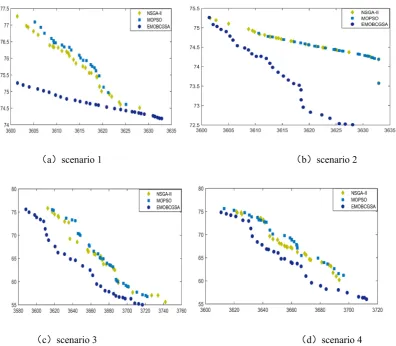
5.2.2 Load rejection condition
and Objpre, which proves that the method proposed in this paper can balance and optimize both the
rising rate of rotation and the water hammer pressure at the same time.
(a)scenario 1 (b)scenario 2
(c)scenario 3 (d)scenario 4
Fig.8 The Pareto front obtained by different algorithms
Comparative analysis of EMOBCGSA Pareto non dominated set by the four scenarios, as shown in Fig.9. From Fig.9, it is clear that the non dominated solution set obtained in scenario 3 is more close to the true Pareto optimal front, and has the sets of minimum water hammer pressure, lowest rising rotational speed and the most balanced of the two objectives. Therefore, under load rejection condition, the closure of scenario 3 can make the PSHU system operation safer and more stable. In Table 3, the Objpre is presented in an ascending order and Objx is presented in a descending order.
2
/ H O m
pre Obj
/%
x
Obj
Fig.9 The Pareto front obtained by different scenarios under load rejection
Table 3 The detailed Pareto optimal schemes obtained of EMOBCGSA by different scenarios under load rejection
scheme
scenario 1 scenario 2 scenario 3 scenario 4
Objpre Objx Objpre Objx Objpre Objx Objpre Objx
1 3601.5 75.26 3601.4 75.27 3588.3 75.60 3610.9 74.83
2 3602.7 75.19 3602.1 75.08 3591.9 74.99 3614.5 74.51
3 3604 75.14 3604.6 74.90 3598 74.38 3617.7 74.21
4 3605.9 75.08 3605.3 74.79 3600.2 73.87 3621.1 73.95
5 3607.2 75.03 3605.8 74.68 3604.3 73.43 3626.1 73.11
6 3608.4 74.98 3606.6 74.54 3608 73.02 3630.1 72.95
7 3609.8 74.89 3608.7 74.43 3609.6 71.38 3631.6 71.34
8 3610.9 74.84 3608.9 74.43 3611.2 70.08 3632.6 69.68
9 3612.2 74.78 3609.2 74.36 3613.4 68.96 3636.1 68.42
10 3614 74.74 3611.1 74.26 3620.6 67.60 3639.4 67.79
11 3615.1 74.70 3612.4 74.11 3623.6 66.27 3642.6 66.88
12 3616.5 74.67 3612.7 74.09 3631 65.94 3643.9 66.79
13 3617.3 74.64 3614.2 73.86 3637.5 64.87 3647.6 66.30
14 3618.5 74.61 3616.1 73.66 3643 64.62 3650.6 66.04
15 3619.1 74.58 3617.1 73.57 3650.9 63.41 3652.7 64.77
16 3620.9 74.53 3618.1 73.52 3659.1 62.48 3655.2 64.76
17 3622.6 74.49 3618.5 73.40 3662 61.38 3659.7 64.03
18 3624 74.46 3618.5 73.15 3666.4 59.48 3660.5 63.83
19 3625 74.43 3618.7 73.05 3670.8 59.01 3663.9 63.74
20 3626.4 74.40 3618.9 72.96 3675.7 58.06 3666.7 63.14
21 3627 74.38 3620.2 72.83 3679.9 57.83 3670.1 61.03
23 3628.4 74.34 3622.3 72.76 3687.5 56.94 3680.3 58.92
24 3629.1 74.32 3622.7 72.74 3691.2 56.69 3684.1 58.21
25 3630.9 74.27 3623.8 72.67 3695.3 56.59 3692.7 58.05
26 3631.3 74.25 3624.2 72.65 3697.9 56.35 3698.8 57.45
27 3631.4 74.25 3624.3 72.56 3704.2 56.30 3706.8 56.57
28 3631.9 74.22 3625.3 72.55 3708.4 55.33 3709.6 56.35
29 3632.4 74.20 3625.6 72.53 3712.7 55.22 3710.8 56.34
30 3632.9 74.19 3628.1 72.51 3716.8 55.02 3712.3 56.03
Additionally, in order to verify availability of the proposed constraints-handling strategy, best
pre
Obj and Objx schemes of scenario 3 is taken as the compromise schemes in our study. The
simulation results of PSHU transition process and the corresponding index values are shown in Fig.10, Table 4 and Table 5. It can be seen clearly from the chart and tables that the transition process of the corresponding scheme satisfies the above definition of multiple constraints and has a good dynamic response process of PSHU.
Table 4 The index values of minimum Objx and Objpre schemes of scenario 3 (I)
schemes
volute end Objx draft inlet volute end Objx draft inlet
min max % min max min max % min max
1# 2#
minimum Objx 549.3 896.6 27.5 69.32 99.26 549.3 896.6 27.5 69.32 99.26
minimum Objpre 509.6 817.9 37.8 69.33 98.66 509.6 817.9 37.8 69.33 98.66
Table 5 The index values of minimum Objx and Objpre schemes of scenario 3 (II)
schemes
upstream surge water level downstream surge water level
initial min max initial min max
minimum Objx 734.53 731.1 746.2 182.63 166.9 189.3
x
Obj Objpre
Fig.10 The transient process of minimum Objx and Objpre schemes of scenario 3
5.2.3 pump outage condition
Under pump outage condition, comparative analysis of EMOBCGSA Pareto non dominated set by the four scenarios, as shown in Fig.11. From Fig.11, it is evident that the non dominated solution set obtained in scenario 4 is more close to the true Pareto optimal front, and has the sets of best Objpre
, Objx and the most balanced of the two objectives. In Table 6, the Objpre is presented in an
ascending order and Objx is presented in a descending order, and select schemes at the inflection
the closing time of the guide vane is extremely important to the transient process of the PSHU under pump outage condition.
2
/ H O m
pre Obj
/%
x
Obj
Fig.11 The Pareto front obtained of EMOBCGSA by different scenarios under pump outage
Table 6 The detailed Pareto optimal schemes obtained of EMOBCGSA by different scenarios under pump outage
scheme
scenario 1 scenario 2 scenario 3 scenario 4
Objpre Objx Objpre Objx Objpre Objx Objpre Objx
1 3361.6 -7.293 3355.3 -13.15 3335.4 183.9 3314.7 177.4
2 3366.4 -8.185 3357.4 -14.71 3337.9 178.2 3315.5 166.7
3 3371.6 -9.177 3360.2 -16.81 3338.1 155.6 3316.5 159.9
4 3374.7 -10.29 3363.8 -19.29 3340.3 140.9 3317.5 150.5
5 3377.6 -11.11 3366.8 -20.98 3344.3 126.1 3318.3 143.5
6 3381 -12.01 3370.2 -22.67 3346.4 110.9 3318.9 134.6
7 3384.4 -13.08 3372.8 -24.30 3348.1 94.90 3319.5 129.8
8 3388.2 -14.17 3375.5 -25.85 3350.3 74.55 3320.5 110.4
9 3392.8 -15.66 3379.1 -28.80 3352.6 73.83 3320.8 99.44
10 3396.7 -16.87 3381.6 -31.07 3355.1 65.14 3321.2 91.33
11 3401.3 -18.29 3385.3 -34.20 3357.2 45.14 3321.6 79.87
12 3407.8 -20.45 3387.6 -37.63 3365.2 41.95 3322.4 66.53
13 3412.1 -21.65 3390.1 -41.09 3366.4 26.95 3322.8 53.77
14 3414.6 -22.60 3395.5 -46.54 3367.6 10.41 3323.2 39.78
15 3419.4 -24.13 3396 -50.54 3368.8 -9.210 3323.8 26.65
16 3422.1 -25.05 3396.4 -53.54 3370 -17.39 3324.8 13.22
17 3427.7 -27.40 3396.8 -58.54 3371.2 -27.95 3325.2 0
18 3431.3 -29.40 3397.2 -61.54 3373.7 -28.17 3326 -9.580
19 3435.1 -32.39 3397.6 -64.54 3384.6 -37.42 3326.4 -18.38
20 3437.4 -33.53 3397.9 -66.65 3391 -47.83 3327.2 -29.40
21 3439 -34.84 3404.9 -68.17 3401.3 -52.89 3327.6 -40.40
22 3442.7 -37.02 3412 -68.33 3405.2 -54.67 3328 -49.40
24 3447.9 -39.68 3426.9 -68.64 3424.1 -56.17 3329.6 -59.40
25 3452.6 -42.96 3431 -68.76 3433 -56.52 3330.4 -59.42
26 3457.6 -46.25 3435 -68.84 3437.7 -56.68 3334 -59.44
27 3462.9 -50.36 3445.2 -68.92 3446.8 -56.90 3335.6 -59.46
28 3464.1 -55.95 3453.5 -69.03 3451.2 -57.01 3337.2 -59.46
29 3465.7 -61.56 3461 -69.14 3458.6 -57.21 3338.4 -59.47
30 3466.7 -64.87 3469.3 -69.75 3467.1 -57.49 3340 -59.48
Fig.12 The transient process of 15 schemes by different scenarios
Table 7 The index values of 15 schemes by different scenarios (I)
scenario
volute end Objx draft inlet volute end Objx draft inlet
min max % min max min max % min max
1# 2#
scenario 1 427.9 696.7 87.89 84.51 114.9 427.9 696.7 87.89 84.51 114.9
scenario 2 427.7 690.3 76.73 83.14 124.8 432.7 679.9 87.04 84.09 127.6
scenario 3 436.2 670.8 -14 86 110.3 436.2 670.8 -14 86 110.3
Table 8 The index values of 15 schemes by different scenarios (II)
scenario
upstream surge water level downstream surge water level
initial min max initial min max
scenario 1 734.52 700.5 726 182.64 175 192.5
scenario 2 734.52 700.7 725.8 182.64 175.1 192.3
scenario 3 734.52 704.9 722.6 182.64 177.1 191.6
scenario 4 734.52 703 724.2 182.64 176.1 192
6. Conclusion
In this paper, an EMOBCGSA method is proposed to solve the OGVCS problem while considering the various hydraulic and mechanical constraints. The significant innovations of the proposed method are mainly focused on the following three aspects: (1) Based on numerical calculation model of PSHU system, a multi objective optimization model is established, which includes hydraulic and mechanical multiple factors. (2) To improve the convergence speed and ergodicity of the algorithm, novel population reconstruction strategy, multi-objective adaptive chemotaxis operation and velocity update method, and EAS update and maintenance strategy is introduced to improve the standard BCGSA. (3) Heuristic constraint-handling strategy with eliminating and local search based on violation ranking is proposed to handle the various constraints of OGVCS problem instead of traditional penalty function, which can improve the computing efficiency. Finally, to verify the feasibility and effectiveness of the proposed EMOBCGSA method, the ‘single tube-double units’ type PSHU system model based on actual parameters of one PSP is established and Pareto non-inferior solutions under load rejection and pump outage condition by different scenarios are obtained. The comparison and analysis for optimization results between EMOBCGSA and others algorithms indicate that the proposed method can obtain better schemes with better Objpre and Objx, and the Pareto optimal solutions of EMOBCGSA possess the preferable
quality and better distribution.
Acknowledgement
This work was supported by the National Natural Science Foundation of China (NSFC) (No. 51239004, 91547208 and 51579107).
References
1. Ge, Q., Solar and Wind Power in Hybird Energy Systems in China. Savonia-ammattikorkeakoulu 2014.
2. Zhong, Y.; Lu, P.; Cao, C.; Jin, B.; Jiang, H., China′s Advances in New Energy Technology and Advice on Future Development. Sino-Global Energy 2011.
3. Anagnostopoulos, J. S.; Papantonis, D. E., Pumping station design for a pumped-storage wind-hydro power plant. Energy Conversion & Management 2007, 48, (11), 3009-3017.
4. Ding, H.; Hu, Z.; Song, Y., Stochastic optimization of the daily operation of wind farm and pumped-hydro-storage plant. Renewable Energy 2012, 48, (6), 571–578.
6. Kazempour, S. J.; Moghaddam, M. P.; Haghifam, M. R.; Yousefi, G. R., Risk-constrained dynamic self-scheduling of a pumped-storage plant in the energy and ancillary service markets. Energy Conversion & Management 2009, 50, (50), 1368–1375.
7. De Marchis, M.; Milici, B.; Volpe, R.; Messineo, A., Energy Saving in Water Distribution Network through Pump as Turbine Generators: Economic and Environmental Analysis. Energies 2016, 9, (11).
8. Pavesi, G.; Cavazzini, G.; Ardizzon, G., Numerical Analysis of the Transient Behaviour of a Variable Speed Pump-Turbine during a Pumping Power Reduction Scenario. Energies 2016, 9, (7). 9. Wang, Z.; Zhu, B.; Wang, X.; Qin, D., Pressure Fluctuations in the S-Shaped Region of a
Reversible Pump-Turbine. Energies 2017, 10, (1).
10. Zeng, W.; Yang, J. D.; Hu, J. H.; Yang, J. B., Guide-Vane Closing Schemes for Pump-Turbines Based on Transient Characteristics in S-shaped Region. Journal of Fluids Engineering-Transactions of the Asme 2016, 138, (5).
11. Azoury, P. H.; Baasiri, M.; Najm, H., Effect of Valve-Closure Schedule on Water Hammer. Journal of Hydraulic Engineering 1986, 112, (10), 890-903.
12. Kuwabara, T.; Katayama, K.; Nakagawa, H.; Hagiwara, H. In Improvements of transient performance of pump turbine upon load rejection, Power Engineering Society Summer Meeting, 2000; 2000; pp 1783-1788 vol. 3.
13. Yu, X.; Zhang, J.; Miao, D., Innovative Closure Law for Pump-Turbines and Field Test Verification. Journal of Hydraulic Engineering 2015, 141, (3), 05014010.
14. Zhang, J.; Hu, J.; Hu, M.; Fang, J.; Chen, N. In Study on the Reversible Pump-Turbine Closing Law and Field Test, ASME 2006 Joint U.s.-European Fluids Engineering Summer Meeting Collocated with the International Conference on Nuclear Engineering, 2006; 2006; pp 931-936.
15. Liu, J. T.; Liu, S. H.; Sun, Y. K.; Wu, Y. L.; Wang, L. Q., Numerical simulation of pressure fluctuation of a pump-turbine with MGV at no-load condition. Iop Conference 2012, 15, (6), 2036. 16. Pannatier, Y.; Kawkabani, B.; Nicolet, C.; Simond, J. J.; Schwery, A.; Allenbach, P., Investigation of Control Strategies for Variable-Speed Pump-Turbine Units by Using a Simplified Model of the Converters. IEEE Transactions on Industrial Electronics 2010, 53, (9), 3039-3049.
17. Sun, H.; Xiao, R.; Liu, W.; Wang, F., Analysis of S Characteristics and Pressure Pulsations in a Pump-Turbine With Misaligned Guide Vanes. Journal of Fluids Engineering 2013, 135, (5), 511011. 18. Clarke, J.; Jr, M. L., Multi-objective particle swarm optimization of binary geothermal power
plants. Applied Energy 2015, 138, 302-314.
19. Wang, H. G.; Liang, M. A., Multi-objective particle swarm optimization. Computer Engineering & Applications 2008, 45, (4), 82-85.
20. Deb, K.; Pratap, A.; Agarwal, S.; Meyarivan, T., A fast and elitist multiobjective genetic algorithm: NSGA-II. IEEE Transactions on Evolutionary Computation 2002, 6, (2), 182-197.
21. Basu, M., Economic environmental dispatch using multi-objective differential evolution. Applied Soft Computing Journal 2011, 11, (2), 2845-2853.
22. Lu, Y.; Zhou, J.; Hui, Q.; Ying, W.; Zhang, Y., Environmental/economic dispatch problem of power system by using an enhanced multi-objective differential evolution algorithm. Energy Conversion & Management 2011, 52, (2), 1175-1183.
23. Li, C.; Zhou, J.; Peng, L.; Wang, C., Short-term economic environmental hydrothermal scheduling using improved multi-objective gravitational search algorithm. Energy Conversion & Management 2015, 89, 127–136.
24. Ajami, A.; Armaghan, M., Application of multi-objective gravitational search algorithm (GSA) for power system stability enhancement by means of STATCOM. International Review of Electrical Engineering 2012, 7, (4), 4954-4962.
25. Zhou, J.; Lu, P.; Li, Y.; Wang, C.; Yuan, L.; Mo, L., Short-term hydro-thermal-wind complementary scheduling considering uncertainty of wind power using an enhanced multi-objective bee colony optimization algorithm. Energy Conversion & Management 2016, 123, 116-129. 26. Low; Hean, M. Y.; Chandramohan; Mahinthan; Choo; Seng, C., Application of multi-objective
27. Xu, Y.; Zhou, J.; Xue, X.; Fu, W.; Zhu, W.; Li, C., An adaptively fast fuzzy fractional order PID control for pumped storage hydro unit using improved gravitational search algorithm. Energy Conversion & Management 2016, 111, 67-78.
28. Wylie, Fluid Transients in Systems. Prentice-Hall 1993.
29. Kung, C.; Yang, X., Energy interpretation of hydraulic transients in power plant with surge tank. Journal of Hydraulic Research 1993, 31, (6), 825-840.
30. Vournas, C. D.; Papaioannou, G., Modelling and stability of a hydro plant with two surge tanks. IEEE Transactions on Energy Conversion 1995, 10, (2), 368-375.
31. Zeng, Y.; Guo, Y.; Zhang, L.; Xu, T.; Dong, H., Nonlinear hydro turbine model having a surge tank. Mathematical & Computer Modelling of Dynamical Systems 2012, 19, (1), 1-17.
32. Li, C.; Zhou, J., Parameters identification of hydraulic turbine governing system using improved gravitational search algorithm. Energy Conversion & Management 2011, 52, (1), 374-381.
33. Xu, Y.; Zhou, J.; Zhang, Y.; Fu, W.; Zheng, Y.; Zhang, X. In Parameter Optimization of Robust Non-fragile Fractional Order PID Controller for Pump Turbine Governing System, 2016 Sixth International Conference on Instrumentation & Measurement, Computer, Communication and Control (IMCCC), 21-23 July 2016, 2016; 2016; pp 15-18.
34. Chen, Z.; Yuan, X.; Ji, B.; Wang, P.; Tian, H., Design of a fractional order PID controller for hydraulic turbine regulating system using chaotic non-dominated sorting genetic algorithm II. Energy Conversion & Management 2014, 84, 390-404.
35. Eberhart, R. C.; Shi, Y. In Particle swarm optimization: developments, applications and resources, Evolutionary Computation, 2001. Proceedings of the 2001 Congress on, 2001; 2001; pp 81-86 vol. 1.
36. Chen, Z. H.; Yuan, X. H.; Tian, H.; Ji, B., Improved gravitational search algorithm for parameter identification of water turbine regulation system. Energy Conversion and Management 2014, 78, 306-315.
37. Passino, K. M., Biomimicry of bacterial foraging for distributed optimization and control. Control Systems IEEE 2002, 22, (3), 52-67.
38. Deb, K.; Mohan, M.; Mishra, S., Evaluating the ε-Domination Based Multi-Objective Evolutionary Algorithm for a Quick Computation of Pareto-Optimal Solutions. Evolutionary Computation 2005, 13, (4), 501.