Decryption failure is more likely after success
Nina Bindel and John M. Schanck
Institute for Quantum Computing, University of Waterloo, Canada
Abstract. The user of an imperfectly correct lattice-based public-key encryption scheme leaks information about their secret key with each decryption query that they answer—even if they answer all queries suc-cessfully. Through a refinement of the D’Anvers–Guo–Johansson–Nilsson– Vercauteren–Verbauwhede failure boosting attack, we show that an adver-sary can use this information to improve his odds of finding a decryption failure. We also propose a new definition ofδ-correctness, and we re-assess the correctness of several submissions to NIST’s post-quantum standardization effort.
Keywords: public-key cryptography, lattice-based cryptography, decryp-tion failure
1
Introduction
Imperfectly correct lattice-based encryption schemes carry risks that perfectly correct schemes do not. Namely, whenever the decryption procedure fails it indicates “some correlation between the secret key and the encryption randomness” that reveals “information about the secret key” [21]. This is widely acknowledged. And yet, if one notes thatsuccessful decryption indicates alack of correlation in precisely the same way, the consequence is startling: the user of an imperfectly correct lattice-based encryption scheme leaks information about their secret key with each decryption query that they answer. In this work, we show that an adversary can use information from successful decryptions to improve his odds of causing a decryption failure.
First, let us head off some objections. One might object that “[non-failing ciphertexts] will contain negligible information about the secret” [9]. For many schemes, we agree. However, even if a single ciphertext provides negligible infor-mation, an adversary might submitmany non-failing ciphertexts.
We have seen several attempts to plot lattice-based encryption schemes along axes of size and security. These plots mask differences in correctness, even when they accurately represent tradeoffs between size and security against known attacks (c.f. [3]). We believe that an accurate andconcreteassessment of correctness will enable a more fair comparison of the candidates.
Contributions. Our main contributions are: (1) a refinement of the D’Anvers– Guo–Johansson–Nilsson–Vercauteren–Verbauwhedefailure boosting attack [5]; and (2) a new definition of correctness that is tailored for de-randomized en-cryption schemes. We also provide software1 to calculate the correctness of FrodoKEM [21], Saber [6], Kyber [25], and (some parameter sets of) Round5 [14]. We partially validate our calculations with experiments on FrodoKEM.
Our refinement of failure boosting. We focus on the Lindner–Peikert en-cryption scheme [19], as it underlies all of the imperfectly correct lattice-based public-key encryption schemes that have been submitted to NIST. The correctness condition of these schemes can be stated as
−t≤ hs, ei ≤t (1)
wheresis a vector related to the secret key,eis a vector related to the ciphertext randomness, andtis a system parameter.
An instantiation of the Lindner–Peikert scheme is said to beδ-correct if the probability that Equation (1) is violated for a random honestly generatedsand a random honestly generated eis at most δ. The condition that eis honestly generated is reasonable when the scheme isde-randomized, e.g. when the Fujisaki– Okamoto transformation is used. In this case, the adversary needs the help of a random oracle to generate a valid ciphertext. The random oracle severely limits the adversary’s ability to cause a decryption failure: if the adversary generatesC ciphertexts, then his probability of causing a decryption failure is no more than Cδ, by a union bound.
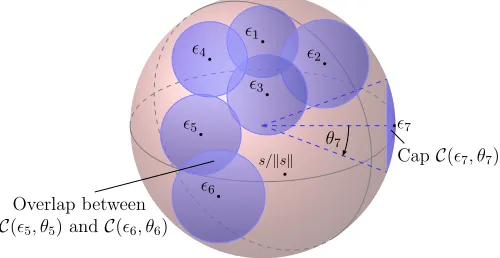
The adversary’s success probability may be far lower thanCδ. A key observa-tion is that if Equaobserva-tion (1) is satisfied for somee, then it is likely to be satisfied for alle0 that areclose toe. One can quantify theoverlap between queries and, in doing so, show that a sequence of queries with small overlap are more likely to cause a decryption failure than a sequence of queries with large overlap. An adversary cannot hope to achieve a success probability ofCδ (on average) unless he submits sequences of queries with no overlap. We depict the overlap of a sequence of queries in Figure 1 and give a precise definition in Section 4.
In a failure boosting attack, the adversary improves his odds of triggering a decryption failure by searching for values of ethat are of large norm. More precisely, the failure boosting adversary generates ciphertextsc(i), 1 ≤i≤C, with the help of the random oracle, and selects Q ≤C ciphertexts to query. Previous analyses of failure boosting [9, 16, 5] assume that the adversary decides
1
1 2
3
5
6 4
θ7
7
CapC(7, θ7)
Overlap between
C(5, θ5) andC(6, θ6)
s/ksk
Fig. 1: A user who successfully decrypts ciphertextsc(1), . . . , c(7)reveals that their secret, s, does not lie in theblue region. The ciphertext randomness determines the pointsi:=e(i)/ke(i)k2. The cap angleθi is determined byke(i)k2andksk2. The probability that a further query,c(8), causes a decryption failure depends on the extent to which the cap of angleθ8about8 intersects the blue region.
whether to queryc(i)by looking only atc(i). In effect, previous analyses ignore the overlap between queries. In contrast, we allow the adversary to minimize the overlap between his queries.
Our focus here is on finding one decryption failure. After observing a de-cryption failure, the adversary should switch to a different strategy such as the recently proposeddirectional failure boosting of D’Anvers, Rossi, and Virdia [7]. We will not discuss the process of estimating the secret from a collection of failures. For further background on failure boosting, and reaction attacks on lattice-based schemes more generally, see [8, 16, 5].
Correctness definition. We propose an alternative definition of δ-correctness to the one by Hofheinz–H¨ovelmanns–Kiltz [18]. The correctness experiment in [18] provides the adversary with the secret key. In contrast, our experiment provides the adversary only with the public key and a decryption oracle, and can therefore be run inside an IND-CCA experiment. More importantly, our definition allows a more fine-grained analysis of the impact of adaptive decryption queries on de-randomized encryption schemes. We give our formal definition in Section 3.
2
Preliminaries
Notation. For a finite setX we writex←$X to say thatxis sampled uniformly from X. For a distributionχ on X, we writex←χ to say that xis sampled according to χ. We denote the joint distribution of x ← χ1 and y ← χ2 by χ1×χ2. Ifχ1andχ2are distributions on an abelian group, and (x, y)←χ1×χ2, then we denote the distribution of x+y by χ1∗ χ2 where (χ1∗ χ2)(z) = P
2.1 Definition of PKEs and KEMs
A public-key encryption schemeP= (Keygen,Encr,Decr) is defined over a finite message spaceM, a ciphertext spaceC, a secret key spaceSKand a public key spacePK. In particular,Keygenis a randomized algorithm returning sk∈ SK
and pk∈ PK;Encris a randomized, or de-randomized, algorithm that takes as input a public key pk and a message msg∈ Mand outputs a ciphertextc∈ C;
Decr is a deterministic algorithm that takes as input sk∈ SK andc ∈ C and returns either a message msg∈ Mor a special symbol⊥∈ M/ indicating failure.
A key encapsulation meachanism (KEM) K= (Keygen,Encaps, Decaps) is defined over a ciphertext space C, the secret key spaceSK, a public key space
PK, and the key spaceK. In particular,Keygenis a randomized algorithm that returns pk∈ PK and sk∈ SK;Encapsis a randomized algorithm that takes as input pk∈ PK and outputsc∈ C andk∈K; Decaps(sk, c) is a deterministic algorithm that upon input sk∈ SKandc∈ C, returnsκ∈Kor a special symbol
⊥∈/K indicating thatcis not a valid ciphertext.
Fujisaki–Okamoto transform. The Fujisaki–Okamoto (FO) transform [12, 13, 10] can be used to construct an adaptively secure KEM from passively secure public-key encryption (PKE). Hofheinz, H¨ovelmanns, and Kiltz provide a decomposition of the FO transform into a sequence of simpler transformations [18]; Bernstein and Persichetti provide a complementary analysis [4]. These works emphasize that the FO transform performs three tasks:
– Derandomization: A probabilistic PKE is transformed into a deterministic PKE by fixing the coins used in encryption to a hash of the message.
– Reencryption: A deterministic PKE is transformed into a rigid2deterministic PKE that returns an error symbol,⊥, whenever the message obtained by decryptingcdoes not reencrypt to c.
– Hashing: A rigid deterministic PKE is transformed into an IND-CCA KEM that encrypts a random message and outputs a hash of this message as the session key.
Hofheinz, H¨ovelmanns, and Kiltz handle the derandomization and reencryp-tion with a single transformareencryp-tion calledT. Suppose thatP= (Keygen,Encr,Decr) is a probabilistic PKE, that G : M → R and H : M × C → K are ran-dom oracles, and that F : KF × C → K is a pseudorandom function fam-ily. Then P1 = T[P, G] = (Keygen,Encr1,Decr) is a derandomized PKE with
Encr1(pk,msg) :=Encr(pk,msg; G(msg)).
Hofheinz, H¨ovelmanns, and Kiltz provide variants of the hashing step called U6⊥ andUmsg6⊥ . TheU6⊥ transformation is defined in Figure 2. TheUmsg6⊥ trans-formation is defined similarly but with the encapsulation key equal toH(msg) rather thanH(msg, c).
2
Keygen():
1 (pk,sk1)←Keygen()
2 sk2←$KF
3 sk←(sk1,sk2)
4 return (pk,sk)
Encaps(pk):
1 msg←$M
2 c←Encr1(pk,msg)
3 K←H(msg, c) 4 return (K, c)
Decaps((sk1,sk2), c):
1 msg←Decr1(sk1, c)
2 if msg =⊥: 3 returnF(sk2, c)
4 returnH(msg, c)
Fig. 2: The algorithms of the U6⊥[P1, H, F] = (Keygen,Encaps,Decaps) KEM.
δ-correctness. Hofheinz, H¨ovelmanns, and Kiltz [18, Section 2.1] define δ -correctness for a PKE as follows.
Definition 1 (δ-correctness for PKEs).A public-key encryption schemeP= (Keygen,Encr,Decr)isδ-correct if
E
max
msg∈MPr[Decr(sk, c)6=msg |c←Encr(pk,msg)]
≤δ, (2)
where the expectation is taken over(pk, sk)←Keygen(). Equivalently,δ-correctness means that for all (possibly unbounded) adversariesA,Pr[CORAP]≤δ, where the correctness gameCOR is defined in Figure 3.
The definition is carefully crafted to obtain a security proof of theTtransform— the derandomization step during the Fujisaki–Okamoto transformation [12, 13, 10] (cf. Appendix 2.1). Moreover, Theorem 3.1 of [18] states (in part) that ifP is δ-correct, thenT[P,G] isδ1-correct whereδ1(qG)≤qG·δandqG is the number of
queries that the adversary makes to G.
2.2 Lindner–Peikert encryption scheme
The Lindner–Peikert scheme [19] is a passively secure public-key encryption scheme based on the learning with errors (LWE) problem [24]. It obtains smaller keys and ciphertexts than earlier LWE encryption schemes [24, 15] by using the LWE hardness assumption twice in its security reduction.
Parameters. The system parameters are (R, q, k, χs, χe, χe0) whereRis thebase ring,qis the integer modulus,kis theR-module rank, χsandχeare probability distributions supported onRk, andχe0 is a probability distribution supported on
R. The base ring must have the additive structure ofZmfor some positive integer
m. The Z-module rank, or dimension, of the system isn=km. We refer toχs as thesecret distribution, and toχe andχe0 as theerror distributions. Another
important derived parameter is the error thresholdt, cf. Section 4.
by expressing them over the power basis {1, x, x2,· · ·, xm−1}, i.e. we use the
coefficient embedding. We identify the power basis with the standard basis of
Rm. For a ∈ R, we write kak1 = Pi hxi, ai
, kak2 = p
ha, ai, and kak∞ =
maxi hxi, ai
. For elements a = (a1, . . . , ak) and b = (b1, . . . , bk) of a rank k module overRwe writeha, bi=ha1, b1i+· · ·+hak, bki. We write ¯rfor the adjoint of the “multiplication byr” map, i.e.ha, rbi=h¯ra, bi. WithR=Zwe haver= ¯r. WithR=Z[x]/(xm+ 1) we have that ¯ris the image ofrunderx7→ −xm−1.
Message encoding. The message space is a subset ofRthat is defined by maps
encodeanddecode. These maps must satisfydecode(encode(msg)) = msg for all bit strings msg in the domain ofencode. A typical choice for a plain LWE system is encode:{0,1} →Zanddecode:Z→ {0,1} withencode(msg) = msg· bq/2c
anddecode(msg) ={0 if |msg modq| ∈[0, q/4); 1 otherwise}. We call this the
standard encoding. Observe that decode(encode(msg) +δ) = msg if |δ| < q/4, so we say that the standard encoding has an error threshold of t =q/4. The
standard b-bit encoding is defined similarly: it divides [0, q/2) into 2b intervals and has an error threshold ofq/2b+1. Elements of{0,1}b·msgcan be encoded into elements ofR by extending the standardb-bit encoding component wise on the power basis.
Algorithms. The key generation, encryption and decryption routines of the passively secure encryption scheme are as follows.
– Keygen(): Sample ak×kmatrixAwith each coefficient chosen independently from the uniform distribution on R/q. Sample k×1 vectors s1 and s2 independently fromχs. Computeb = (s1−As2) modq. The public key is (A, b). The secret key is (s1, s2).
– Encr(msg,(A, b)): Sample 1×k vectorse1 and e2 independently from χe. Samplee3 fromχe0. Compute the ciphertext (c1, c2) with
c1= (e1A+e2) modq, c2= (e1b+e3+encode(msg)) modq.
– Decr((c1, c2),(s1, s2)): To decrypt (c1, c2) using the secret key (s1, s2), let v= (c1s2+c2) modqand outputdecode(v).
3
Correctness in an adaptive setting
that is derandomized using their T transformation has a correctness error of δ(qG)≤qG·δ[18, Theorem 3.1].
The loss of correctness caused by derandomization is often ignored in practice. For example, the authors of the FrodoKEM NIST submission correctly calculate theone-shot correctness (the probability of decryption failure for a random key and random ciphertext) of their IND-CPA PKE [21, Section 2.2.7]. They note that the one-shot correctness is equal to theδ-correctness [21, Equation 2]. They then apply the Ttransformation and claim that the correctness of the resulting IND-CCA PKE is equal to the one-shot correctness of the underlying IND-CPA PKE [21, Section 2.2.10]. This claim is not justified.
And yet, a full factorqGloss of correctness does not seem realistic. To address this, we propose the following alternative to theδ(qG)-correctness. This definition restricts the adversary’s time,t, and number of decryption queries,qd.
Definition 2 (δ(qd, t)-correctness for PKEs).LetPbe a derandomized PKE against a (classical or quantum) adversaryAmaking at mostqd(classical) queries to its decryption oracle D and running in timet. We say,P isδ(qd, t)-correct if
Pr[COR-adAPKE→1]≤δ(qd, t),
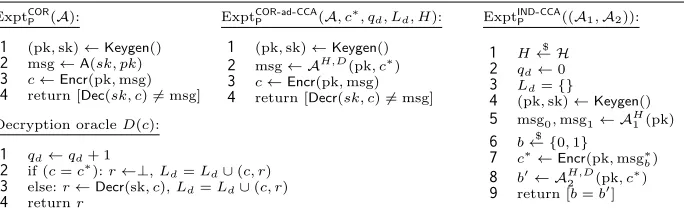
where the correctness game COR-adis defined in Figure 3.
In contrast to the HHK correctness experiment (COR in Figure 3), our correctness experiment (COR-ad in Figure 3) does not provide the adversary with the user’s secret key, and can be run as part of the IND-CCA security experiment3 In this case we call itCOR-ad-CCA.
It is important to note that runningCOR-ad-CCAinside the IND-CCA exper-iment does not change the power of the IND-CCA adversary; in particular, the number of decryption queriesq0
d inCOR-ad-CCAis no more than the number of decryption queriesqd inIND-CCA. As such, one can obtain an upper bound on the IND-CCA security of a scheme given theδ(qd, t)-correctness of a scheme and an attack that violates IND-CCA security using decryption failures.
4
Correctness of the Lindner–Peikert scheme
Suppose that (c1, c2) is an honest encryption of msg to a user with public key (A, b) and secret keys= (s1, s2). Let (e1, e2, e3) be the noise that was used to generate (c1, c2), and let e = (e1, e2). Decryption will be successful, i.e., the decrypting party will recover msg exactly, as long as
ke1s1+e2s2+e3k∞< t, (3)
wheret is the error threshold. The exact one-shot probability of failure can be calculated from Equation 3 (our software does this). However, we will use a
3
ExptCOR P (A):
1 (pk,sk)←Keygen() 2 msg←A(sk, pk) 3 c←Encr(pk,msg) 4 return [Dec(sk, c)6= msg]
ExptCOR-ad-CCA P (A, c
∗, q
d, Ld, H):
1 (pk,sk)←Keygen() 2 msg← AH,D(pk, c∗)
3 c←Encr(pk,msg) 4 return [Decr(sk, c)6= msg]
ExptIND-CCA
P ((A1,A2)): 1 H← H$
2 qd←0
3 Ld={}
4 (pk,sk)←Keygen() 5 msg0,msg1← AH
1(pk) 6 b← {$ 0,1}
7 c∗←Encr(pk,msg∗b) 8 b0← AH,D
2 (pk, c
∗)
9 return [b=b0] Decryption oracleD(c):
1 qd←qd+ 1
2 if (c=c∗):r←⊥,Ld=Ld∪(c, r)
3 else:r←Decr(sk, c),Ld=Ld∪(c, r)
4 returnr
Fig. 3:COR andIND-CCA experiment for any PKEP;COR-ad-CCA experiment for a (derandomized) PKE P.
slightly weaker condition to analyze the the probability of failure in an adaptive setting. First, an application of the triangle inequality gives
ke1s1+e2s2k∞< t− ke3k∞. (4)
Then, by fixing someγ≥ ke3k∞and using properties of the max-norm and inner
product that we discussed in Section 2.2, we have
ke1s1+e2s2k∞= max
0≤i<m h¯s, xiei
< t−γ. (5)
A geometric interpretation. LetS be the unit sphere inRd. We denote the angular distance between pointsuandvin Rd by
θ(u, v) = arccos
hu, vi
kuk2· kvk2
, (6)
where arccos(x)∈[0, π]. Thespherical cap of angleθaboutuis
C(u, θ) ={v∈ S:θ(u, v)≤θ}. (7)
Equation (5) tells us that eachsuccessful decryption reveals some geometric information abouts, as explained next. By restating the conditionhs, e¯ i< t−γ (without the absolute value bars that appear in Equation (5)) in terms of the
angular distance,
θ(¯s, e) = arccos
hs, e¯ i
ksk2· kek2
>arccos
t−γ
ksk2· kek2
=θ∗, (8)
A heuristic assumption. We measure the volume of subsets of S ⊂ Rd using the (d−1)-dimensional spherical probability measure,σ. This measure is normalized such thatσ(S) = 1. If uis a point onS andv is drawn uniformly fromS, then the probability thatθ(u, v)≤θisC(θ) =σ(C(u, θ)). It is important to note that C(θ) does not depend onu. We assume the following heuristic in our analysis.
Heuristic 1 (Spherical symmetry) For fixeds¯and e←χe×χe, the proba-bility that θ(¯s, e)≤ϕ, for any0< ϕ < π/2, isC(ϕ). Equivalently,e/kek2 “looks
like” a uniformly random point onS.
If Heuristic 1 holds true, the probability thatecauses a decryption failure is at least 2C(θ∗). It may even be as large as 2mC(θ∗), due to the maximization over iin Equation (5).
Remark 1. Previous analyses of failure boosting [5] have modeled the distribution ofχe×χewith a spherically symmetric Gaussian distribution. In contrast, our software uses the exact distribution of χe×χe. Our experiments in Section 6 indicate that the spherical symmetry assumption is reasonable for Frodo640. Further experiments are needed for other schemes.
4.1 The efficacy of a query set
Recallθ∗ of the previous section. We writeθ*
α(β;z) = arccos (z/αβ) with 0≤ θ*
α(β;z)≤ π
2. We are primarily interested in the case α=ksk2 andβ=kek2. In later sections we will takeαto be an approximation toksk2. We writeθα*(e;z) in place of the cumbersome notationθ*
α(kek2;z), and we suppress the dependence onzwhen it is clear.
We refer toe= (e1, e2) as the “query”, rather than (c1, c2). We also ignore both the absolute value bars and the maximization overiin Equation (5). This way queries are one-to-one with spherical caps, and each query can be thought of as “exploring” some cap; by queryingethe adversary learns whether or not ¯s lies inC(θ*α(e)).
We define theefficacy of a setE of queries to be the fraction of the sphere that the corresponding caps cover:
Effα(E) =σ [ e∈E
Ce, θ*α(e) !
. (9)
Under the spherical symmetry heuristic, the probability that an adversary causes a decryption failure is proportional to the efficacy of his queries. An intelligent adversary will maximize the efficacy of his queries while minimizing the number of queries that he makes. Adversaries are constrained both by their computational power and by the need to collaborate with a random oracle.
In the notation of Definition 2, an instantiation of the Lindner–Peikert scheme isδ(qd, t)-correct if
for allE of size|E| ≤qdthat an adversary can produce in timet. It is important to note that some instantiations exchange more than one element of R; for instance, FrodoKEM exchanges 64 elements of Z. For such instantiations the right hand side of Equation (10) should be 2`mEffα(E) where`is the number of coefficients exchanged. Assuming spherical symmetry, the actual correctness error can be anywhere between 2 Effα(E) and 2`mEffα(E), as the failure events may not be independent.
4.2 Approximating the efficacy
The efficacy of a query set may be difficult to compute exactly. Using the principle of inclusion-exclusion, we can write ak-th order approximation to Effα(E) as
Effα(k)(E) = X F⊂E 0<|F|≤k
(−1)|F|+1·σ \ e∈F
Ce, θ*α(e)
!
. (11)
Maximizing the second-order approximation,
Effα(2)(E) =X e∈E
C(θ*α(e))− X
{e,e0}⊂E
σC(e, θ*α(e))∩ C(e0, θ*α(e0)), (12)
already presents quite a challenge. We do not consider algorithms for approxi-mating the efficacy here, but we note that techniques from the near-neighbor search literature, e.g. [2], may be useful for producing high-efficacy query sets.
4.3 The efficacy of a random query set
A first-order approximation to the efficacy of a random query set, normalized by the query set sizeN, is
Qα(χ1, χ2) = lim N→∞
1 NE
h
Effα(1)(V)i (13)
where the expectation is taken over setsV of N elements drawn independently fromχ1×χ2. Equation (13) can also be written as the expected size of a cap with respect to the 2-norm distribution ofv drawn fromχ1×χ2,
Qα(χ1, χ2) = X j>0
Pr [kvk2=j]·C
θα*(j). (14)
5
Heuristic analysis of NIST candidates
approximation to the efficacy ignores the overlap between queries; it thereby overestimates efficacy and underestimate correctness. Since we are ignoring the overlap, we expect our results to closely mirror those of D’Anvers, Guo, Johansson, Nilsson, Vercauteren, and Verbauwhede from [5]. The calculations that we perform are quite different and serve as an independent check on their results.
We analyze Saber [6], the R5ND PKE 0d and R5N1 PKE 0d parameter sets of Round5 [14], Frodo [21], and Kyber [25]; all of which are second round candidates in NIST’s post-quantum standardization effort.
5.1 Overview
We caution the reader that the following sketch of our analysis is only accurate for Frodo. The treatment of the other schemes is described in Appendix A.
Let χ be a distribution onR. We write kχk2 and|h1, χi|, respectively, for the distribution ofkrk2 and|h1, ri|whenr←χ. The topu-th quantile ofkχk2 is the largestβ ∈Z+ for which Prr←χ[krk2≥β]≥1/u. We writeχ(u) for the distribution ofr←χconditioned on the event thatkrk2≥β. It is important to note thatχ(1) =χ.
We assume that the user has drawn a secret keysfrom χs(v)×χs(v), for some v ≥ 1. A random user does so with probability 1/v2. Unless otherwise stated we take v= 2, i.e., we assume that the user has a key of above-median length in both components. We evaluate correctness using Qα(·,·) which depends on theγ of Equation (5) throughθ*
α. We takeαequal to the expected norm ofs, and we takeγ equal to the top 100-th quantile4of|h1, χe0i|. We account for the
absolute value bars in Equation (5) but ignore the maximization over 0≤i < m. By doing so, we are estimating theper-coordinate failure rate: the probability of a failure in the first coordinate of the coefficient embedding.
To first order, an adversary who samples (e1, e2) from χe(u)×χe(u) and who discards all ciphertexts with |h1, e3i| < γ can expect a query set of size 1/(2 Qα(χe(u), χe(u))) to include a query that causes a decryption failure (cf. Equation (10)). A classical adversary expects to make approximately 100u2 queries to the random oracle per sample. A quantum adversary, using Grover’s algorithm, expects to make approximately 10u superposition queries to the random oracle per sample.
5.2 Comparison with one-shot failure rate
Before presenting the results of our analysis, we recall that the one-shot failure probability is the probability that Equation (3) is violated for (s1, s2)←χs×χs, (e1, e2)←χe×χe, ande3←χe0. Theorem 3.1 of [18] states that a de-randomized
scheme with a one-shot failure rate ofδisδ1≤qG·δcorrect against an adversary who generates qG ciphertexts. Table 1 lists the one-shot failure probabilities
4
for Kyber512, R5ND1PKE0d, Frodo640, R5N11PKE0d, and LightSaber5. Each parameter set is advertised as meeting NIST’s level 1 security category, so it is reasonable to assume that generating, say,qG= 2128ciphertexts has lower cost than breaking the scheme. The corresponding values of δ1 are all larger than 2−60. We find this concerning, as Section 3.3 (resp. Section 4.4 against quantum adversaries) of [18] states potentially large integer multiple ofδ1 in the upper bound on the adversary’s success probability in the IND-CCA game.
5.3 Comparison of NIST candidates
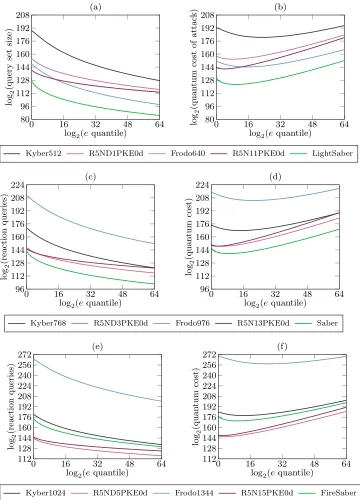
The results of our analyses of Kyber512, R5ND1PKE0d, Frodo640, R5N11PKE0d, and LightSaber are shown in Figure 4. There are subtleties to each analysis, but one can largely imagine that the lines on the left and right of Figure 4 plot u7→1/(2 Qα(χe(u), χe(u))) andu7→10u/(2 Qα(χe(u), χe(u))) respectively. We give more details in Appendix A.
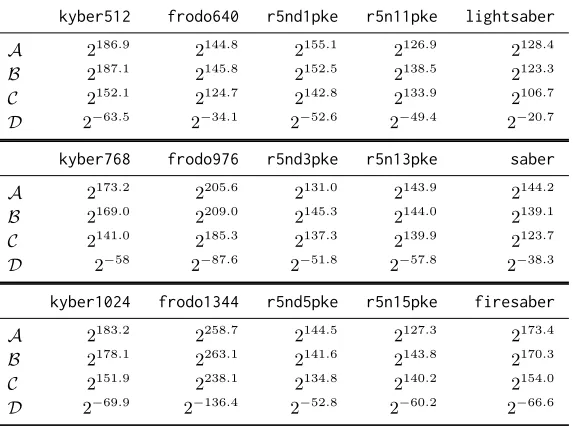
An adversary who is not constrained in the number of queries that he can submit will minimize cost. As can be seen from Figure 4 and Table 1, after minimizing the cost of the attack, the number of queries in an effective query set ranges from 2106.7 for LightSaber to 2152.1 for Kyber512. The attacks differ in cost per query. Of course, an honest user will not answer so many queries.
NIST suggests that “[f]or the purpose of estimating security strengths, it may be assumed that the attacker has access to the decryptions of no more than 264 chosen ciphertexts” [22]. An adversary with this constraint will spend more time per query to improve the efficacy of a smaller query set.
An attacker who can perform a total of 2128 quantum operations will per-form roughly 264 operations per query and submit 264 queries. Let us briefly assume that our first-order approximation to the efficacy is accurate. Our ex-periment in the following section provides some indication that the overlap between random queries may be negligible, and supports this assumption. The attaker may then be thought of as randomly sampling from a query set of size 1/(2 Qα(χe(264), χe(264))), which is the right-most point in Figure 4. Let us also briefly assume that the elements of the adversary’s query set are equally likely to cause a decryption failure. Under these assumptions, theδ(264,2128)-correctness of LightSaber is 264/284.7 = 2−20.7. This should be compared with theδ
1 cor-rectness of 2−0.4 that we alluded to in Section 5.2. Theδ(264,2128)-correctness of the other schemes, under the same assumptions, is given in Table 1.
6
Experiments
Both the spherical symmetry heuristic and the accuracy of the first-order ap-proximation to the efficacy need to be examined further. As a first step, we have
5
Note that our analysis should roughly coincide with the one-shot failure probability whenu=v= 1. We expect some discrepancy due to our treatment ofe3 and the
0 16 32 48 64 80 96 112 128 144 160 176 192 208
log2(equantile)
log
2
(query
set
size)
Kyber512 R5ND1PKE0d Frodo640 R5N11PKE0d LightSaber
0 16 32 48 64
80 96 112 128 144 160 176 192 208
log2(equantile)
log 2 (quan tum cost of attac k ) (a) (b)
0 16 32 48 64
96 112 128 144 160 176 192 208 224
log2(equantile)
log
2
(reaction
queries)
Kyber768 R5ND3PKE0d Frodo976 R5N13PKE0d Saber
0 16 32 48 64
96 112 128 144 160 176 192 208 224
log2(equantile)
log 2 (quan tum cost) (c) (d)
0 16 32 48 64
112 128 144 160 176 192 208 224 240 256 272
log2(equantile)
log
2
(reaction
queries)
Kyber1024 R5ND5PKE0d Frodo1344 R5N15PKE0d FireSaber
0 16 32 48 64
112 128 144 160 176 192 208 224 240 256 272
log2(equantile)
log 2 (quan tum cost) (e) (f)
Fig. 4: The predicted size of a query set of unit efficacy (a, c, e) and the quan-tum cost of producing such a query set (b, d, f). “Quanquan-tum cost” is based on Grover’s algorithm and has units of “superposition queries to a random oracle”. Plots (a) and (b) are NIST level 1 schemes. Plots (c) and (d) are NIST level 3 schemes. Plots (e) and (f) are NIST level 5 schemes. Data embedded in PDF:
, , , , , ,
, , , , , ,
, , .
kyber512 frodo640 r5nd1pke r5n11pke lightsaber
A 2186.9 2144.8 2155.1 2126.9 2128.4
B 2187.1 2145.8 2152.5 2138.5 2123.3
C 2152.1 2124.7 2142.8 2133.9 2106.7
D 2−63.5 2−34.1 2−52.6 2−49.4 2−20.7
kyber768 frodo976 r5nd3pke r5n13pke saber
A 2173.2 2205.6 2131.0 2143.9 2144.2
B 2169.0 2209.0 2145.3 2144.0 2139.1
C 2141.0 2185.3 2137.3 2139.9 2123.7
D 2−58 2−87.6 2−51.8 2−57.8 2−38.3
kyber1024 frodo1344 r5nd5pke r5n15pke firesaber
A 2183.2 2258.7 2144.5 2127.3 2173.4
B 2178.1 2263.1 2141.6 2143.8 2170.3
C 2151.9 2238.1 2134.8 2140.2 2154.0
D 2−69.9 2−136.4 2−52.8 2−60.2 2−66.6
Table 1: AdversaryAsends random queries to random users. AdversariesBand
C target a fixed user that has a random, above-median norm, key. AdversaryB
sends queries of above-median norm to the user. AdversaryC sends queries with norm in the topu-quantile for the value ofuthat minimizes his total quantum cost, i.e. he choosesubased on the local minima in Figure 4 (Plot b, d and f). AdversaryDis restricted to 264 queries and 2128quantum operations. Rows A,
B, andC give the expected number of queries that the adversary submits before causing a decryption failure. Row A is the reciprocal of the one-shot failure probability for a single coordinate. Rows B andC are values of 1/(2 Qα(·,·)). RowDgives the value ofδ(264,2128) under the assumptions of Section 5.3. The impact ofmand`are suppressed throughout.
performed experiments with a variant of Frodo640. Since the decryption failure rate of Frodo640 is too small for us to observe experimentally, we have used q= 213 rather thanq= 215. We have kept the rest of the parameters the same. This variant has a one-shot failure rate of 2−11.7.
In the notation of Section 5.1, we takeαto be the expected value of ksk2 when s is drawn from χs(v)×χs(v). The “Predicted” row in Table 2 gives 1/(2 Qα(χ1(u), χ1(u))). The “Observed” row gives 1/f wheref is the fraction of failures that we observed.
kχskquantile 20 210 220
kχekquantile 20 210 220 20 210 220 20 210 220
Predicted 211.4 29.8 29.1 29.8 28.4 27.8 29.1 27.8 27.3 Observed 211.1 29.4 28.7 29.4 28.0 27.4 28.8 27.4 26.9
Table 2: Results of the experiment of Section 6. We did not run the experiment to completion for the columns withkχek= 220. The values reported in those columns are averages over ≈218, rather than 221, coordinates.
the total number of coordinates with errors, not the number of encapsulations that fail. In other wordsf is the fraction of errors observed in 512·64·64 = 221 coordinates.
If 1/(2 Qα(χ1(u), χ1(u))) is a good approximation to the size of an effective query set, and each element of an effective query set is equally likely to cause a failure, then we expect 1/f to tend to 1/(2 Qα(χ1(u), χ1(u))) as we average over many keys and encapsulations. As can be seen in Table 2, we observed a fraction of failures such thatf /(2 Qα(χ1(u), χ1(u)))≈2−0.4 in each case. This provides some indication that our heuristics are reasonable for Frodo640. Further experiments are needed for the other schemes.
7
Conclusion and future work
We have presented a decryption failure attack on the Lindner–Peikert scheme that exploits dependencies between failure events. In contrast with previous attacks, our attack leverages information from adaptive queries. The adversary improves his odds of causing a decryption failure by choosing his next query as a function of his past queries—even those queries that were answered successfully.
Our results do not necessarily call for a re-parametrization of the schemes that we have analyzed. However, like previous analyses of failure boosting, they show that the one-shot failure probability is not a reliable indicator of the difficulty of causing decryption failures. We hope that our work stimulates discussion on what an acceptableδ(qd, t)-correctness is for various security levels.
The general message that successful queries can leak information about the secret key may be applicable to other constructions as well. Drucker–Gueron– Kostic [11] have already pointed out the risk of ignoring the factor qG loss of
tightness in de-randomizing the code-based scheme BIKE [1].
8
Acknowledgements
Special thanks to Kathrin H¨ovelmanns for insights on the correctness definition for PKEs, Jan-Pieter D’Anvers for helpful discussions and for providing us with a copy of [7], and Steve Weiss for computer systems support. NB is supported by NSERC Discovery Accelerator Supplement grant RGPIN-2016-05146. This work was supported by IQC. IQC is supported in part by the Government of Canada and the Province of Ontario
References
1. Aragon, N., Barreto, P., Bettaieb, S., Bidoux, L., Blazy, O., Deneuville, J.C., Gaborit, P., Gueron, S., Guneysu, T., Aguilar Melchor, C., Misoczki, R., Persichetti, E., Sendrier, N., Tillich, J.P., Z´emor, G., Vasseur, V.: BIKE. Tech. rep., National Institute of Standards and Technology (2019), available athttps://csrc.nist.gov/ projects/post-quantum-cryptography/round-2-submissions
2. Becker, A., Ducas, L., Gama, N., Laarhoven, T.: New directions in nearest neighbor searching with applications to lattice sieving. In: Krauthgamer, R. (ed.) 27th SODA. pp. 10–24. ACM-SIAM (Jan 2016)
3. Bernstein, D.J.: Visualizing size-security tradeoffs for lattice-based encryption. Cryptology ePrint Archive, Report 2019/655 (2019), https://eprint.iacr.org/ 2019/655
4. Bernstein, D.J., Persichetti, E.: Towards KEM unification. Cryptology ePrint Archive, Report 2018/526 (2018),https://eprint.iacr.org/2018/526
5. D’Anvers, J.P., Guo, Q., Johansson, T., Nilsson, A., Vercauteren, F., Verbauwhede, I.: Decryption failure attacks on IND-CCA secure lattice-based schemes. In: Lin, D., Sako, K. (eds.) PKC 2019, Part II. LNCS, vol. 11443, pp. 565–598. Springer, Heidelberg (Apr 2019)
6. D’Anvers, J.P., Karmakar, A., Roy, S.S., Vercauteren, F.: SABER. Tech. rep., National Institute of Standards and Technology (2019), available athttps://csrc. nist.gov/projects/post-quantum-cryptography/round-2-submissions
7. D’Anvers, J.P., Rossi, M., Virdia, F.: (One) failure is not an option: Bootstrapping the search for failures in lattice-based encryption schemes. Cryptology ePrint Archive, Report 2019/1399 (2019),https://eprint.iacr.org/2019/1399
8. D’Anvers, J.P., Vercauteren, F., Verbauwhede, I.: On the impact of decryption failures on the security of LWE/LWR based schemes. Cryptology ePrint Archive, Report 2018/1089 (2018),https://eprint.iacr.org/2018/1089
9. D’Anvers, J.P., Vercauteren, F., Verbauwhede, I.: The impact of error dependencies on ring/mod-LWE/LWR based schemes. In: Ding, J., Steinwandt, R. (eds.) Post-Quantum Cryptography - 10th International Conference, PQCrypto 2019. pp. 103–115. Springer, Heidelberg (2019)
11. Drucker, N., Gueron, S., Kostic, D.: On constant-time QC-MDPC decoding with negligible failure rate. Cryptology ePrint Archive, Report 2019/1289 (2019),https: //eprint.iacr.org/2019/1289
12. Fujisaki, E., Okamoto, T.: Secure integration of asymmetric and symmetric encryp-tion schemes. In: Wiener, M.J. (ed.) CRYPTO’99. LNCS, vol. 1666, pp. 537–554. Springer, Heidelberg (Aug 1999)
13. Fujisaki, E., Okamoto, T.: Secure integration of asymmetric and symmetric encryp-tion schemes. Journal of Cryptology 26(1), 80–101 (Jan 2013)
14. Garcia-Morchon, O., Zhang, Z., Bhattacharya, S., Rietman, R., Tol-huizen, L., Torre-Arce, J.L., Baan, H., Saarinen, M.J.O., Fluhrer, S., Laarhoven, T., Player, R.: Round5. Tech. rep., National Institute of Stan-dards and Technology (2019), available at https://csrc.nist.gov/projects/ post-quantum-cryptography/round-2-submissions
15. Gentry, C., Peikert, C., Vaikuntanathan, V.: Trapdoors for hard lattices and new cryptographic constructions. In: Ladner, R.E., Dwork, C. (eds.) 40th ACM STOC. pp. 197–206. ACM Press (May 2008)
16. Guo, Q., Johansson, T., Nilsson, A.: A generic attack on lattice-based schemes using decryption errors with application toss-ntru-pke. Cryptology ePrint Archive, Report 2019/043 (2019),https://eprint.iacr.org/2019/043
17. Hamburg, M.: Three Bears. Tech. rep., National Institute of Stan-dards and Technology (2019), available at https://csrc.nist.gov/projects/ post-quantum-cryptography/round-2-submissions
18. Hofheinz, D., H¨ovelmanns, K., Kiltz, E.: A modular analysis of the Fujisaki-Okamoto transformation. In: Kalai, Y., Reyzin, L. (eds.) TCC 2017, Part I. LNCS, vol. 10677, pp. 341–371. Springer, Heidelberg (Nov 2017)
19. Lindner, R., Peikert, C.: Better key sizes (and attacks) for LWE-based encryption. In: Kiayias, A. (ed.) CT-RSA 2011. LNCS, vol. 6558, pp. 319–339. Springer, Heidelberg (Feb 2011)
20. Lu, X., Liu, Y., Jia, D., Xue, H., He, J., Zhang, Z., Liu, Z., Yang, H., Li, B., Wang, K.: LAC. Tech. rep., National Institute of Stan-dards and Technology (2019), available at https://csrc.nist.gov/projects/ post-quantum-cryptography/round-2-submissions
21. Naehrig, M., Alkim, E., Bos, J., Ducas, L., Easterbrook, K., LaMac-chia, B., Longa, P., Mironov, I., Nikolaenko, V., Peikert, C., Raghu-nathan, A., Stebila, D.: FrodoKEM. Tech. rep., National Institute of Stan-dards and Technology (2019), available at https://csrc.nist.gov/projects/ post-quantum-cryptography/round-2-submissions
22. National Institute of Standards and Technology (NIST): Submission requirements and evaluation criteria or the post-quantum cryptography standardization process (2017), available at https://csrc.nist.gov/csrc/media/projects/ post-quantum-cryptography/documents/call-for-proposals-final-dec-2016. pdf
23. Poppelmann, T., Alkim, E., Avanzi, R., Bos, J., Ducas, L., de la Piedra, A., Schwabe, P., Stebila, D., Albrecht, M.R., Orsini, E., Osheter, V., Pater-son, K.G., Peer, G., Smart, N.P.: NewHope. Tech. rep., National Institute of Standards and Technology (2019), available athttps://csrc.nist.gov/projects/ post-quantum-cryptography/round-2-submissions
25. Schwabe, P., Avanzi, R., Bos, J., Ducas, L., Kiltz, E., Lepoint, T., Lyubashevsky, V., Schanck, J.M., Seiler, G., Stehl´e, D.: CRYSTALS-KYBER. Tech. rep., National Institute of Standards and Technology (2019), available athttps://csrc.nist.gov/ projects/post-quantum-cryptography/round-2-submissions
A
Details of our analysis for each scheme
A.1 Secret and error distributions
Definition 3 (Modulus switching function). The modulus switching func-tion is defined by [[x]]rq = bxrqemodr with bxrqe computed over R. It is also extended component-wise to vectors and matrices.
Definition 4 (Compression artifact distribution). The compression arti-fact distribution with parameters randq is the distribution ofy−[[z]]qr wheny is drawn uniformly fromZ/q andz= [[y]]rq.
Definition 5 (Centered binomial distribution). The centered binomial dis-tribution of parameter wassigns probability 221w
2w x+w
tox∈Z.
Definition 6 (Fixed weight distribution). The fixed weight trinary distri-bution of parameterw in dimensiondis the uniform distribution on all 2w d
w
vectors in Zd that have exactly dw/2e coefficients equal to +1, exactly bw/2c
coefficients equal to−1, and the remainingd−w coefficients equal to0.
A.2 Compression and learning with rounding
Some variants of the Lindner–Peikert scheme have additionalrounding parameters
r0,r1, and r2. They compress the public key to (A,[[b]]r0
q ) and the ciphertext to ([[c1]]r1
q ,[[c2]] r2
q ). Note that ifri = qthen no compression occurs in the cor-responding component. If b0 = [[b]]r0
q then there is some v1 ∈ Z/q such that [[b0]]qr
0 = (v1−As2) modq. Likewise, ifc
0
1= [[c1]] r1
q then there is somev2∈Z/q such that [[c01]]qr
1 = (e1A+v2) modq, and if c
0
2 = [[c2]] r1
q then there is some v3 ∈ Z/q such that [[c02]]
q
r2 = (e1A+v3+encode(msg)) modq. Variants that use well chosen rounding parameters can omit thes1,e2, ande3 terms in key generation and encryption; thecompression artifacts v1,v2, andv3 take their place. Such schemes are said to be based on the Learning With Rounding problem (LWR). The difference between LWE and LWR is immaterial for our purposes; we simply incorporate the compression artifact noise into the distributions ofs1, e2, ande3.
A.3 Frodo
q= 216,t= 211). All three use the standardb-bit encoding, and therefore have an error threshold oft=q/2b+1. Each parameter set takesχ
s=χe=χ×nwhere χis an approximation to a discrete Gaussian distribution on Z. We refer to [21, Table 2] for the exact definition ofχ. Our analysis is as described in Section 5.1.
A.4 Kyber (second round)
Kyber is an instantiation of the Lindner–Peikert scheme overR=Z[x]/(x256+ 1).
The second round NIST submission [25] includes three parameter setskyber512 (m = 256, k = 2, n = 512, q = 3329, r0 = q, r1 = 210, r2 = 23), kyber768 (m= 256,k= 3,n= 768,q= 3329,r0=q,r1= 210,r2= 24), andkyber1024 (m= 256, k= 4, n= 1024, q= 3329,r0=q,r1= 211,r2= 25). All three use the standard 1-bit encoding. All three parameter sets samples1, s2,e1, and e2 fromη×2n, whereη2is the centered binomial distribution of parameter 2.
We writeρr for the compression artifact distribution with parametersrand q. We model e1 as being drawn from η×2n; we modele2 as being drawn from (η2∗ρr1)×n; and we model e3 as being drawn from (η2∗ρr2)×m. Due to the difference in size between the coefficients of e1ande2, it seems unlikely that the spherical symmetry heuristic is reasonable. We adapt our analysis as follows.
Letχ1×χ2be the distribution from which the adversary drawse= (e1, e2). We will assume thatχ1andχ2(viewed as distributions on the coefficient embedding of Rk) are invariant under permutations of the standard basis. Let z
1 and z2 be the expected values of ke1k2 and ke2k2 respectively. Let w =
p z2/z1, e∗ = (e1·w, e2/w), s∗ = (s1/w, s2·w), and observe that hs¯∗, e∗i=hs, e¯ i. We
apply the analysis of Section 5.1, but we takeαto be the expected value ofks∗k2 and we compute Qα with respect to the scaled distributionsχ1·w andχ2/w. The expected values ofke1·wk2 andke2/wk2 are both
√
z1z2. By assumption onχ1 andχ2, this implies that all 2ncoefficients ofe∗ have the same expected size. While this does not imply that the distributions are spherically symmetric, it does make the assumption of spherical symmetry more plausible.
A.5 Saber
Saber is a learning with rounding variant of the Lindner–Peikert scheme that uses the base ringR=Z[x]/(x256+ 1). The submission proposes three parameter sets lightsaber(m= 256,k= 2,q= 213,r
0= 210,r1= 210,r2= 23,w= 10),saber (m= 256, k= 3,q= 213,r
0 = 210,r1 = 210,r2 = 24,w= 8), and firesaber (m= 256,k= 4,q= 213,r0= 210, r1= 210,r2= 26). All three parameter sets sample s2and e1from the centered binomial distribution of parameterµ,η×n
µ , for theµ listed in [6, Table 1]. Recall thats1 =e2=e3= 0 for learning with rounding variants.
all of the proposed parameter sets. The coefficients of (e1, v2) are not identically distributed, so the spherical symmetry assumption is suspect. However, the inner product is unchanged if we write ¯s= ( ¯v1,v¯2) ande= (e1, s2). Moreover, unlike the original vectors, the coefficients of sandeare identically distributed. There is still a slight complication: the adversary has control over one component of sand one component ofe. If the adversary chooses particularly large values of e1 andv2, then the spherical symmetry assumption will again be violated. We compensate for this by applying the same re-scaling trick from our analysis of Kyber.
A.6 Round5 (R5N1∗PKE 0d)
Round5 is a collection of learning with rounding instantiations of the Lindner– Peikert scheme. The R5N1 ∗ PKE 0d parameter sets of Round5 take R = Z. The second round NIST submission includes three parameter sets [14, Table 13] r5n11pke0d(n= 636, q= 212,b = 2,r
0= 29, r1= 29, r3= 26, w= 114), r5n13pke0d(n= 876,q= 215,b= 3,r
0= 211, r1= 211,r3= 27,w= 446), and r5n15pke0d(n= 1217,q= 215,b= 4,r
0= 212, r1= 212,r3= 29,w= 462). All three use fixed weightwvectors fore1 ands2. Since there are no large values of e1, the adversary will invest all of his effort in finding large values ofv2, As with Saber, we swap components between vectors and apply the re-scaling trick from our analysis of Kyber. The only difference is that we compute Qαwith respect the honest distribution ofe1and theu2-th quantile of kv2k.
A.7 Round5 (R5ND∗0d)
The R5ND∗ 0d parameter sets of Round5 takeR=Z[x]/(1 +x+· · ·+xm). The
specification includes three parameter sets [14, Table 11]r5nd1pke0d(m= 586, q = 213, b = 1, r
0 = 29, r1 = 29, r3 = 24, w = 182), r5nd3pke0d (m = 852, q= 212,b= 1,r
0= 29, r1= 29,r3= 25,w= 212), andr5nd5pke0d(m= 1170, q= 213,b = 1,r
0 = 29, r1 = 29, r3 = 25, w= 222). We apply essentially the same analysis as for R5N1∗ 0d. However, the choice of ring presents a slight obstacle as the adjoint does not preserve spherical symmetry.
Multiplication by a fixed element of R, say a = a0+a1x+a2x2+· · ·+ am−1xm−1, is a linear operation on the coefficient embedding. Specifically, it
corresponds to left multiplication by them×mmatrix [a]i,j =ai−j−a−(j+1) where the index arithmetic is modulom+1 andam= 0. It follows that the adjoint of multiplication by ais multiplication by ¯a where ¯a =a0+ (am−am−1)x+ (am−1−am−2)x2+· · ·+ (a1−a0)xm−1. Note that thex0andx1coefficients are
![Fig. 2: The algorithms of the U̸⊥ [P1, H, F] = (Keygen, Encaps, Decaps) KEM.](https://thumb-us.123doks.com/thumbv2/123dok_us/7990424.1326213/5.612.133.482.117.179/fig-algorithms-u-p-keygen-encaps-decaps-kem.webp)