Dynamic Key-Aggregate Cryptosystem on
Elliptic Curves for Online Data Sharing
Sikhar Patranabis, Yash Shrivastava and Debdeep Mukhopadhyay
Department of Computer Science and Engineering Indian Institute of Technology Kharagpur
{sikhar.patranabis, yash.shrivastava, debdeep}@cse.iitkgp.ernet.in
Abstract. The recent advent of cloud computing and the IoT has made it imperative to have efficient and secure cryptographic schemes for on-line data sharing. Data owners would ideally want to store their data/files online in an encrypted manner, and delegate decryption rights for some of these to users with appropriate credentials. An efficient and recently proposed solution in this regard is to use the concept of aggregation that allows users to decrypt multiple classes of data using a single key of con-stant size. In this paper, we propose a secure and dynamic key aggregate encryption scheme for online data sharing that operates on elliptic curve subgroups while allowing dynamic revocation of user access rights. We augment this basic construction to a generalized two-level hierarchical structure that achieves optimal space and time complexities, and also efficiently accommodates extension of data classes. Finally, we propose an extension to the generalized scheme that allows use of efficiently com-putable bilinear pairings for encryption and decryption operations. Each scheme is formally proven to be semantically secure. Practical experi-ments have been conducted to validate all claims made in the paper. Keywords:Key-Aggregate Cryptoystem, Online data sharing, Semantic security, Dynamic access rights
1
Introduction
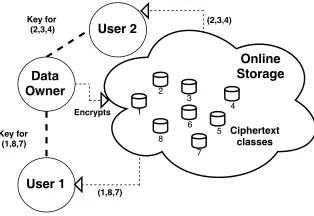
Fig. 1: Example of Online Data Sharing
with a secure and efficient online data sharing scheme that allows updates to user access rights on the fly.
A n¨aive (and extremely inefficient) solution is to have a different decryption key for each ciphertext class, and share them accordingly with users via secured channels. A more efficient proposition is the key-aggregate encryption (KAC) scheme proposed in [3] that combines the power of individual decryption keys, for ciphertext classes in a given subset, into a single key for that subset. This key is specific to the designated subset, meaning that it cannot be used to decrypt any ciphertext class outside that subset. KAC derives its roots from the seminal work by Bonehet.al.[4] that allows broadcasting of data (encrypted by the same public key) among multiple users, each of whom possess their own private keys for decryption. Both these schemes make use of bilinear mappings on multiplicative cyclic groups.
Contributions: In this paper, we propose a basic key-aggregate scheme on
additive elliptic subgroups that delegate decryption rights to multiple ciphertext classes using a single constant sized key. The scheme is dynamic in nature, that is, it allows the data owner to revoke access rights of users without having to change the entire set-up, unlike in the existing KAC scheme. We then generalize this scheme into a two-level construction that allows flexible public key extension and maintains constant ciphertext size, while avoiding many of the pitfalls of earlier hierarchical schemes. We provide a formal proof of semantic security for the generalized scheme. We further extend the generalized scheme to allow using popular and efficiently implementable elliptic curve pairing schemes. We compare the time and space requirements of the proposed generalized scheme under various operating configurations. We also compare the performance of our proposed scheme, in terms of key size and resource utilization, with that of other existing schemes in literature.
Organization:The rest of the paper is organized as follows. Section 2 provides
key extension in Section 5, and prove its semantic security. A further extension for the generalized scheme that allows using efficiently implementable pairings is introduced and proved semantically secure in Section 6. Experimental results using Tate pairings based implementations of the extended scheme are presented in Section 7. Finally Section 8 concludes the paper.
2
Related Work
In this section we present a brief overview of public and private key cryptographic schemes in literature for secure online data sharing. While many of them focus on key aggregation in some form or the other, very few have the ability to provide constant size keys to decrypt an arbitrary number of encrypted entities.
2.1 Hierarchical Encryption
One of the most popular techniques for access control in online data storage is to use a pre-defined hierarchy of secret keys [5–8] in the form of a tree-like structure, where access to the key corresponding to any node implicitly grants access to all the keys in the subtree rooted at that node. For instance, [9] uses repeated evaluations of a pseudo-random function/block cipher on a fixed secret to generate a tree hierarchy of symmetric keys. Some more advanced schemes [10–12] extend access control to cyclic and acyclic graphs. A major disadvantage of hierarchical encryption schemes is that granting access to only a selected set of branches within a given subtree warrants an increase in the number of granted secret keys. This in turn blows up the size of the key shared. Thus while hierarchical cryptosystems provide a neat key delegation mechanism when all files in a given branch is to be shared, its efficiency drops drastically as the complexity of the delegation increases.
2.2 Compact Key Symmetric Encryption
Compact key encryption for the symmetric key setting has been used in [13, 14] to solve the problem of concisely transmitting large number of keys in the broadcast scenario. The basic methodology is to divide the entire ciphertext space into a finite set of classes, followed by a constant size aggregate key generation for the set of classes to be delegated. This scheme thus solves the problem of multi-class delegation faced by hierarchical schemes. However, symmetric key sharing via a secured channel is costly and not always practically viable for many applications on the cloud. Some other schemes in the symmetric key setting also attempt to reduce the key size [15], but they are not aimed at decryption key delegation and are hence not very relevant to the present discussion.
2.3 Compact Key Identity-Based Encryption
user. Proposed initially in [16], IBE was concretized by the proposition of two very widely cited and popular IBEs - The Boneh-Franklin scheme [17] and Cocks’ encryption scheme [18]. An IBE system comprises of a trusted private key gen-erator that holds a master-secret key and issues a secret key to each user based on the user identity. Each user receives a message that has been encrypted using her id and some public parameters, and can decrypt the same using the secret key allotted to her by the trusted party. Compact key IBEs have been proposed in [19] and [20]. The former approach involves the use of random oracles while the latter shuns the use of oracles. Both these schemes allow aggregation of keys; however each key must come from a different identity division. Fuzzy IBE [21] allows for a single compact key to decrypt multiple ciphertexts, but they must have been encrypted under a closed set of identities, and the scheme does not work in practical scenarios for arbitrary identities.
2.4 Attribute Based Encryption
Attribute-based encryption (ABE) [22–24] allows each user to be identified by a set of attributes. An encrypted file stored in cloud can only be decrypted by an user who has access to the corresponding secret key. The secret key is securely transmitted to the user who satisfies the access control policies set by the data owner. A major drawback of this scheme is that each time the access right to a particular user is revoked the entire ciphertext has to be recrypted in the cloud. The idea of ABE has been extended to shared keys for user groups in [25] with the focus on collusion resistance and not on key size compression.
2.5 Proxy Re-Encryption
Proxy re-encryption is another technique to achieve fine-grained access control and scalable user revocation in unreliable clouds [26]. In this method the data owner and a semi trusted proxy cloud share a secret key in advance, with which the cloud can be delegated to re-encrypt data on behalf of the data owner. The semi-trusted proxy re-encrypts the data using the data owner’s public key, thus converting it into a file that can in turn be decrypted by the secret key of the client. In the whole process, the proxy has no knowledge of the data being sent. An extension to this technique has been proposed in [27] that allows the cloud servers to automatically re-encrypt data based on their internal clocks, without any external trigger. However, proxy re-encryption essentially transfers the responsibility for secure key storage from the delegatee to the proxy and is susceptible to collusion attacks. It is also important to ensure that the transfor-mation key of the proxy is well protected, and every decryption would require a separate interaction with the proxy, which is inconvenient for applications on the cloud.
2.6 Key-Aggregate Cryptosystems (KAC)
cryp-tosystem that uses constant size ciphertexts such that efficient delegation of decryption rights for any set of ciphertexts are possible. When a user demands for a particular subset of the available classes of data, the data owner computes an aggregate key which integrates the power of the individual decryption keys corresponding to each class of data. However, KAC as proposed in [3] suffers from three major drawbacks, each of which we address in this paper. First of all, the security assumption of KAC seems to be the Bilinear Diffie Hellman Exponent (BDHE) assumption [28]; however no concrete proofs of semantic se-curity are provided by the authors in [3]. Secondly, with respect to user access rights, KAC is a static scheme in the sense that once a user is in possession of the aggregate key corresponding to a subset of files from data owner, the owner cannot dynamically revoke the permission of the client for accessing one or more updated files. Since dynamic changes in access rights is extremely common in online data storage, this scenario needs to be tackled. Finally, the public key extension of KAC proposed in [3] is extremely cumbersome and resource con-suming since registration of each new public key-private key pair requires the number of classes to be extended by the original number of classes.
3
Preliminaries
We begin by formally defining the Key Aggregate Cryptosystem (KAC), and stating the complexity assumptions used to prove the security of the encryption schemes proposed in this paper.
3.1 The Key Aggregate Cryptosystem (KAC)
A key aggregate cryptosystem is an ensemble of the following randomized algo-rithms:
1. Setup(1λ, n): Takes as input the number of ciphertext classes n and the
group order parameterλ. Outputs the public parameterP K. Also computes a secret parametertused for encryption which is not made public. It is only known to data owners with credentials to control client access rights.
2. Keygen(): Outputs the public and master-secret key pair :
(P K =γP, msk=γ).
3. Encrypt(P K, i, m): Takes as input the public key parameter P K, the
ci-phertext classiand the messagem. Outputs the ciphertextCcorresponding to the messagembelonging to classi.
4. Extract(msk=γ,S): Takes as input the master secret key γand a subset
S ⊂ {1,2,· · ·, n}. Computes the aggregate key KS and the dynamic access
control parameterU. The tuple (KS, U) is transmitted via a secure channel
to users that have access rights toS.
5. Decrypt(KS, U,S, i,C={c1, c2, c3}): Takes as input the aggregate keyKS
3.2 Semantic Security of KAC
We now define the semantic security of a key-aggregate encryption system against an adversary using the following game between an attack algorithmAand a chal-lenger B. BothAand Bare given n, the total number of ciphertext classes, as input. The game proceeds through the following stages.
1. Init:AlgorithmAbegins by outputting a setS ⊂ {1,2,· · · , n}of receivers
that it wishes to attack. For each ciphertext classi ∈ S, challenger B per-forms theSetUp-i,Challenge-iandGuess-isteps. Note that the number of iterations is polynomial in|S|.
2. SetUp-i: Challenger B generates the public param, public key P K, the
access parameterU, and provides them toA. In addition,B also generates and furnishes A with the aggregate key KS that allows A to decrypt any ciphertext classj /∈ S.
3. Challenge-i: ChallengerBperforms an encryption of the secret messagemi
belonging to theithclass to obtain the ciphertextC. Next,Bpicks a random
b∈(0,1). It setsKb=mi and picks a randomK1−bfrom the set of possible
plaintext messages. It then gives (C, K0, K1) to algorithmAas a challenge.
4. Guess-i: The adversary A outputs a guess b0 of b. If b0 = b, A wins and
the challengerBloses. Otherwise, the game moves on to the next ciphertext class inS until all ciphertext classes inS are exhausted.
If the adversary Afails to predict correctly for all ciphertext classes inS, only then A loses the game. Let AdvKACA,n denote the probability that A wins
the game when the challenger is givenn as input. We say that a key-aggregate encryption system is (τ, , n) semantically secure if for all τ-time algorithmsA
we have that |AdvKACA,n − 12| < where is a very small quantity. Note
that the adversary Ais non-adaptive; it chooses S, and obtains the aggregate decryption key for all ciphertext classes outside of S, before it even sees the public parametersparamor the public keyP K.
3.3 The Complexity Assumptions
We now introduce the complexity assumptions used in this paper. In this section, we make several references to bilinear non-degenerate mappings on elliptic curve sub-groups, popularly known in literature as pairings. Hence it seems logical to provide a brief background on bilinear pairing based schemes on elliptic curve sugroups.
Bilinear Pairings: We present a brief outline of the necessary facts about
bilinear pairings on elliptic curves that are used in the forthcoming discussion. LetK=Fpbe a field of prime orderp, and let an elliptic curve overKbe defined
by the Weierstrass [28] equation:
where a1, a2, a3, a4, a5 ∈K. The curve must be non-singular. In particular,
ifchar(K)6= 2,3, the equation takes the special form y2=x3+a
4x+a6 with
4a43+ 27a62 6= 0. Let K=Fpk be the smallest extension field of K=Fp that
contains the qth roots of unity. Here, k is called the embedding degree with
respect to K andq. We denote the set ofq-torsion points on the elliptic curve asE(K)[q] (q-torsion points essentially have orderq).
A pairing is a bilinear map defined over elliptic curve subgroups. LetG1and
G2be two such additive cyclic subgroups of the same prime orderqand letGT
be a multiplicative group, also of order q with identity element 1. Let P and Q be generators for G1 and G2 respectively. A pairing ˆe0 : G1×G2 −→ GT
satisfying the following the following properties is said to be a bilinear mapping.
– Bilinear:∀P1, P2∈G1, Q1, Q2∈G2, anda, b∈Z, we have the following:
ˆ e0(aP
1, bQ1) = ˆe0(P1, Q1)ab
ˆ e0(P
1+P2, Q1) = ˆe0(P1, Q1) ˆe0(P2, Q1)
ˆ e0(P
1, Q1+Q2) = ˆe0(P1, Q1) ˆe0(P1, Q2)
– Non-degeneracy: If for allPi∈G1,eˆ0(P1, Q1) = 1 thenQ1=0. Alternatively,
ifP andQbe the generators forG1andG2respectively where neither group
only contains the point at infinity, then ˆe0(P, Q)6= 1
– Computability: There exists an efficient algorithm to compute ˆe0(R, S)∀R∈
G1, S∈G2
It is important to note thatG1 andG2 could be identical groups as well.
The First Complexity Assumption: Our first complexity assumption is the
l-BDHE problem [4] in a bilinear elliptic curve subgroup G, defined as follows.
Given a vector of 2l+ 1 elements (H, P, αP, α2P,· · ·, αlP, αl+2P· · ·, α2lP) ∈
G2l+1as input, and a bilinear pairing ˆe0:G1×G1−→GT output ˆe0(P, H)α l+1
∈
GT. Since αl+1P is not an input, the bilinear pairing is of no real use in this
regard. Using the shorthand Pi =αiP, an algorithm A is said to have an
ad-vantagein solvingl-BDHE if
P r[A(H, P, P1, P2,· · ·, Pl, Pl+2· · ·, P2l) = ˆe0(Pl+1, H)]≥, where the
probabil-ity is over the random choice ofH, P ∈G, random choice ofα∈Zq and random
bits used by A. The decisional version ofl-BDHE for elliptic curve subgroups may be analogously defined. LetY(P,α,l)= (P, P1, P2,· · · , Pl, Pl+2· · ·, P2l). An
algorithmBthat outputsb∈ {0,1}has advantagein solving decisionall-BDHE in Gif |P r[B(P, H, Y(P,α,l),eˆ0(Pl+1, H)) = 0]-P r[B(G, H, Y(P,α,l), T) = 0]| ≥ ,
where the probability is over the random choice ofH, P ∈G, random choice of
The Second Complexity Assumption: We next define the (l, l)-BDHE prob-lem over a pair of equi-prime order bilinear elliptic curve subgroups G1 with
generatorP andG2 with generatorQ. Given a vector of 3l+ 2 elements
(H, P, Q, αP, α2P,· · ·, αlP, αl+2P· · · , α2lP, αQ, α2Q,· · ·, αlQ) as input, where
P and αiP ∈
G1 and H, Q, αiQ ∈ G2 , along with a bilinear pairing ˆe00 :
G1×G2−→GT, output ˆe0(P, H)α l+1
∈GT. Sinceαl+1P is not an input, the
bi-linear pairing is of no real use in this regard. Using the shorthandPi=αiP and
Qi=αiQ, an algorithmAis said to have an advantagein solving (l, l)-BDHE if
P r[A(H, P, Q, P1, P2,· · · , Pl, Pl+2· · ·, P2l, Q1,· · ·, Ql) = ˆe0(Pl+1, H)]≥where
the probability is over the random choice of P ∈ G1, H, Q ∈ G2, random
choice ofα∈Zq and random bits used byA. We may also define the decisional (l, l)-BDHE problem over elliptic curve subgroup pairs as follows. LetY(P,α,l)=
(P, P1, P2,· · · , Pl, Pl+2· · · , P2l) and Y(0Q,α,l) = (Q, Q1, Q2,· · · , Ql). Also let H
be a random element inG2. An algorithmBthat outputs b∈ {0,1} has
advan-tagein solving decisionall-BDHE inGif|P r[B(P, Q, H, Y(P,α,l), Y(0Q,α,l),eˆ0(Pl+1, H))
= 0]-P r[B(G, H, Y(P,α,l), Y(0Q,α,l), T) = 0]| ≥, where the probability is over the
random choice ofP ∈G1,H, Q∈G2, random choice ofα∈Zq, random choice
ofT ∈GT and random bits used byB. We refer to the left and right probability distributions asL0-BDHE and R0-BDHE respectively. Thus, it can be said that the decision (τ, , l, l)-BDHE assumption for elliptic curves holds in (G1,G2) if
noτ-time algorithm has advantagein solving the decisional (l, l)-BDHE prob-lem over elliptic curve subgroupsG1 andG2. To the best of our knowledge, the
(l, l)-BDHE problem has not been introduced in literature before.
Proving the Validity of the Second Complexity Assumption: We prove
here that the decision (τ, , l, l)-BDHE assumption for elliptic curves holds in equi-prime order subgroups (G1,G2) if the decision (τ, , l)-BDHE assumption for
elliptic curves holds inG1. Let ˆe0:G1×G1−→GT and ˆe00:G1×G2−→GT be
bilinear pairings. Also, letPandQare the generators forG1andG2respectively.
We first make the following observation.
Observation 1: Since G1 and G2 have the same prime order (say q), there
exists a bijectionϕ:G1−→G2 such thatϕ(aP) =aQfor alla∈Zq. Similarly,
sinceGT also has orderq, there also exists a mappingφ:GT −→GT such that
φ( ˆe0(H
1, H2)) = ˆe00(H1, ϕ(H2)) for allH1, H2∈G1.
Let A be a τ-time adversary that has advantage greater than in solving the decision (l, l)-BDHE problem over equi-prime order subgroups (G1,G2). We
build an algorithmBthat has advantage at leastin solving thel-BDHE problem inG1. AlgorithmBtakes as input a randoml-BDHE challenge (P, H, Y(P,α,l), Z)
where Z is either ˆe0(P
l+1, H) or a random value in GT. B computes YQ,α,l0
by setting Qi = ϕ(Pi) for i = 1,2,· · ·, l. B also computes H0 = ϕ(H) ∈
G2 and Z0 = φ(Z) ∈ Z. then randomly chooses a bit b ∈ (0,1) and sets
Tb as Z0 and T1−b as a random element in GT. The challenge given to A is
((P, Q, H0, Y(P,α,l), YQ,α,l0 ), T0, T1). Quite evidently, when Z = ˆe0(Pl+1, H) (i.e.
the input to B is a l-BDHE tuple), then ((P, Q, H0, Y(P,α,l), YQ,α,l0 ), T0, T1) is
φ( ˆe0(P
l+1, H)) = ˆe00(Pl+1, H0). On the other hand, if Z is a random element in
GT (i.e. the input to B is a random tuple), then T0 and T1 are just random
independent elements ofGT.
Now, A outputs a guess b0 of b. If b0 = b, B outputs 0 (indicating that Z = ˆe0(P
l+1, H)). Otherwise, it outputs 1 (indicating thatZ is random in GT).
A simple analysis reveals that if (P, H, Y(P,α,l), Z) is sampled from R-BDHE,
P r[B(G, H, Y(P,α,l), Z) = 0] = 12, while if (P, H, Y(P,α,l), Z) is sampled from L
-BDHE, |P r[B(G, H, Y(P,α,l), Z)]− 12| ≥ . So, the probability that B outputs
correctly is at least, which in turn implies that B has advantage at leastin solving thel-BDHE problem. This concludes the proof.
4
The Proposed Dynamic Key-Aggregate Cryptosystem:
The Basic Case
In this section, we present the design of our proposed dynamic key-aggregate storage scheme on additive elliptic curve subgroups assuming that there are n ciphertext classes. Our scheme ensures that the ciphertext and aggregate key are of constant size, while the public parameter size is linear in the number of ciphertext classes. Unlike the scheme proposed in [3], the proposed scheme allows dynamic revocation of user access rights without having to massively change the system parameters. We also present a proof of security for the proposed scheme.
4.1 The Basic Construction of Dynamic KAC
Let G be an additive cyclic elliptic curve subgroup of prime order q, where
2λ ≤q ≤2λ+1, such that the point P is a generator for G. Also, let GT be a
multiplicative group of order q with identity element 1. We assume that there exists an efficiently computable bilinear pairing ˆe0 :
G×G −→ GT. We now
present the basic construction of our proposed key-aggregate encryption scheme. The scheme consists of the following five phases.
1. Setup(1λ, n): Randomly pick α ∈
Zq. Compute Pi = αiP ∈ G for i =
1,· · ·, n, n+ 2,· · ·,2n. Output the system parameter as
param= (P, P1,· · · , Pn, Pn+2,· · · , P2n). The system also randomly chooses
a secret parametert∈Zq which is not made public. It is only known to data
owners with credentials to control client access rights.
2. Keygen(): Pickγ∈Zq, output the public and master-secret key pair :
(P K =γP, msk=γ).
3. Encrypt(P K, i, m): For a message m∈GT and an index i∈ {1,2,· · · , n},
randomly choose r ∈ Zq and let t0 = t+r ∈ Zq. Then the ciphertext is
computed as
C= (rP, t0(P K+Pi), m.eˆ0(Pn, t0P1)) = (c1, c2, c3)
4. Extract(msk=γ,S): For the set S of indicesj the aggregate key is
com-puted as
and the dynamic access control parameter U is computed as tP. Thus the net aggregate key is (KS, U) which is transmitted via a secure channel to
users that have access rights toS.
5. Decrypt(KS, U,S, i,C={c1, c2, c3}): Ifi /∈ S, output⊥. Otherwise return
the message ˆ
m=c3eˆ0(KS +Pj∈S,j6=iPn+1−j+i, U+c1)/( ˆe0(Pj∈SPn+1−j, c2)).
The proof of correctness of this scheme is presented below.
ˆ
m=c3
ˆ
e0(K
S+Pj∈S,j6=iPn+1−j+i, U+c1)
ˆ
e0(P
j∈SPn+1−j, c2)
=c3
ˆ
e0(P
j∈SγPn+1−j+Pj∈S,j6=iPn+1−j+i, t0P)
ˆ
e0(P
j∈SPn+1−j, t0(P K+Pi))
=c3
ˆ
e0(P
j∈SγPn+1−j, t0P) ˆe0(Pj∈S(Pn+1−j+i)−Pn+1, t0P)
ˆ
e0(P
j∈SPn+1−j, t0P K) ˆe0(Pj∈SPn+1−j, t0Pi))
=c3
ˆ
e0(P
j∈SPn+1−j+i, t0P)
ˆ
e0(Pn+1, t0P) ˆe0(P
j∈SPn+1−j, t0Pi))
=c3
ˆ
e0(P
j∈SPn+1−j+i, t0P)
ˆ
e0(Pn+1, t0P) ˆe0(P
j∈SPn+1−j+i, t0P))
=m
ˆ
e0(Pn, t0P
1)
ˆ
e0(P
n+1, t0P)
=m
4.2 Dynamic Access Control
An important aspect of the proposed scheme is the fact that it allows the data owner to dynamically update user access permissions. In KAC [3], once the data owner issues an aggregate key corresponding to a set of ciphertext classes to a user, revoking the user’s access permissions to the same is not possible without changing the master secret key. However, changing the master secret key each time an user’s access privileges to a ciphertext class need to be updated, is a very expensive option and may not be practically feasible. Our scheme, on the other hand, offers a solution to this problem by allowing the data owner to dynamically update user access privileges.
parameter was only embedded as part of the ciphertext itself, and could not be used to control access rights of users. Moreover, sinceU is of constant size and needs to be transmitted only when changed (and not for every encryption), there is no significant degradation in performance.
4.3 Performance and Efficiency
The decryption time for any subset of ciphertext classes S is essentially dom-inated by the computation of WS = Pj∈SPn+1−j+i. However, if a user has
already computed P
j∈S0Pn+1−j+i for a subset S0 similar to S, then she can
easily compute the desired value by at most |S − S0| operations. For similar
subsets S andS0, this value is expected to be fairly small. A suggested in [4],
for subsets of very large size(n−r, r n), an advantageous approach could be to pre-compute Pj=n
j=1Pn+1−j+i corresponding to i = 1 to n, which would
allow the user to decrypt using onlyrgroup operations, and would require only r elements ofparam. Similar optimizations would also hold for the encryption operation where pre-computation ofPj=n
j=1Pn+1−j is useful for large subsets.
It is important to note that our proposed scheme fixes the number of cipher-text classes beforehand, thus limiting the scope for ciphercipher-text class extension. The only way to increase the number of classes is to change the public key pa-rameters, which would therefore require some kind of administrative privileges, and cannot be done by an user for her own purposes. However, in online data sharing environments, users may wish to register their own public key-private key pairs for new ciphertext classes according to their own requirements. Such an extension to the scheme would make extremely convenient and attractive to potential users. A proposal made in [3] recommends that the user be allowed to register new public-private key pairs, at the cost of increasing the number of ciphertext classes by neach time. This is both impractical and wasteful. In the next section, we present a two-tier generalization of our scheme that tackles this issue in a more economical fashion. We provide a proof of semantic security for the base case presented here. As will be shown later, this proof is a special case of the proof for the generalized scheme presented in the next section.
4.4 Formal Proof of Semantic Security
In this section we formally prove the security of the proposed generalized key-aggregate encryption scheme.
The Reduced Scheme: The ciphertextC= (c1, c2, c3) output by theEncypt
operation essentially embeds the value ofminc3by multiplying it with ˆe0(Pn, t0P1).
The main secret is thus ˆe0(P
n, t0P1) = ˆe0(Pn+1, t0P), the knowledge of which is
transmitted using (c1, c2), and is decrypted using the aggregate key KS and
simply uses the reduced ciphertext (c1, c2), the aggregate key KS and the
dy-namic access parameter U to successfully transmit and decrypt the value of ˆ
e0(P
n+1, t0P). We prove the semantic security of thisreduced scheme
parameter-ized with a given number of ciphertext classesn, which also amounts to proving the semantic security of our original encryption scheme for the same number of ciphertext classes.
The Adversarial Model: We make the following assumptions about the
ad-versaryA:
1. The adversary has the aggregate key that allows her to access any ciphertext class other than those in the target subsetS, that is, she possessesKS. 2. The adversary has access to the public parametersparamandP K, and also
possesses the dynamic access parameterU.
The Proof of Security: The security proof presented here uses the first
com-plexity assumption stated in 3.3. Let Gbe a bilinear elliptic curve subgroup of
prime orderqandGT be a multiplicative group of orderq. Let ˆe0 :G×G−→GT
be a bilinear non-degenerate pairing. We claim that for any pair of positive in-tegers n, n0(n0 > n), the reduced key-aggregate encryption scheme over elliptic curve subgroups is (τ, , n0) semantically secure if the decision (τ, , n)-BDHE
assumption holds inG.
Proof:Let for a given inputn0,Abe aτ-time adversary that has advantage
greater thanin solving thereduced schemeparameterized with a fixedn. Using
A, we build an algorithm B that has advantage at least in solving the n -BDHE problem inG. AlgorithmB takes as input a randomn-BDHE challenge (P, H, Y(P,α,n), Z) (whereZis either ˆe0(Pn+1, H) or a random value inGT), and
proceeds as follows.
1. Init:BrunsAand receives the setS of ciphertext classes thatAwishes to
be challenged on. For each ciphertext classi ∈ S, B performs the SetUp
-i, Challenge-i and Guess-i steps. Note that the number of iterations is
polynomial in|S|.
2. SetUp-i: B should generate the public param, public keyP K, the access
parameterU, and the aggregate key KS and provide them to A. They are generated as follows.
– paramis set as (P, YP,α,n).
– P K is set asuP −Pi whereuis randomly chosen fromZq. – KS is set as P
j /∈S(uPn+1−j−(Pn+1−j+i)). Note that KS is equal to
P
j /∈Sαn+1−jP K, in accordance with the specification provided by the
scheme. Moreover,Bis aware thati /∈ S (implyingi6=j), and hence has all the resources to computeKS.
– U is set as some random element inG.
3. Challenge-i: To generate the challenge for the ciphertext classi,Bcomputes (c1, c2) as (H−U, uH). It then randomly chooses a bit b ∈(0,1) and sets
Tb as Z and T1−b as a random element in GT. The challenge given toA is
((c1, c2), T0, T1). We claim that whenZ = ˆe0(Pn+1, H) (i.e. the input toBis
an-BDHE tuple), then ((c1, c2), T0, T1) is a valid challenge toA. SinceP is
a generator ofG,H =t0P for somet0∈Zq, resulting in the following.
– U =tP for somet∈Zq
– c1=H−U = (t0−t)P=rP wherer=t0−t
– c2=uH=ut0P =t0(uP) =t0(uP−Pi+Pi) =t0(P K+Pi) – Kb=Z= ˆe0(Pn+1, H) = ˆe0(Pn+1, t0P)
On the other hand, ifZ is a random element in GT (i.e. the input to B is
a random tuple), thenK0 andK1are just random independent elements of
GT.
4. Guess-i: The adversary A outputs a guess b0 of b. If b0 = b, B outputs 0
(indicating that Z = ˆe0(P
n+1, H)), and terminates. Otherwise, it goes for
the next ciphertext class inS.
If A returns b0 6= b for each ciphertext class i ∈ S. In the latter case, B
outputs 1 (indicating thatZ is random inGT). We now analyze the probability
that B gives a correct output. If (P, H, Y(P,α,n), Z) is sampled from R-BDHE,
P r[B(G, H, Y(P,α,n), Z) = 0] = 12, while if (P, H, Y(P,α,n), Z) is sampled from
L-BDHE,|P r[B(G, H, Y(P,α,n), Z)]−12| ≥. So, the probability thatBoutputs
correctly is at least 1−(1−)|S| ≥, implying thatB has advantage at least in solving the n-BDHE problem inG. This concludes the proof.
5
A Generalized Version of Dynamic KAC
In this section, we focus on building an efficiently extensible version of our pro-posed scheme that allows an user to economically increase the number of ci-phertext classes while registering a new public key-private key pair. We adopt the idea presented in [4] to develop a hierarchical structure that has multiple instances (sayn1) of the original scheme running in parallel. Each such instance
in turn provides locally aggregate keys for n2 ciphertext sub-classes. Each
ci-phertext class thus now has a double index (i1, i2) where 1 ≤ i1 ≤ n1 and
1≤i2≤n2. This allows the overall setup to handlen=n1n2 classes. However,
it is important to note that all the instances can use the same public parameters. This interaction among the instances helps to largely improve performance. We further point out that while in [4], the generalized construction offers a trade-off between the public parameter size and the ciphertext size, our generalized scheme actually reduces the public parameter size without compromising on the size of the ciphertext. Further, addition of a single new key increases the num-ber of classes only byn2and not byn. Settingn2nthus achieves significant
5.1 The Construction of the Generalized KAC
Let n2 be a fixed positive integer. Our proposed n2-generalized key-aggregate
encryption scheme over elliptic curve subgroups is as described below. It may be noted that the bilinear additive elliptic curve sub-groupGand the multiplicative group GT, as well as the pairing ˆe0 are the same as in the basic scheme. The
algorithm sets up n1 = bn/n2c instances of the basic scheme, each of which
handles n2 ciphertext classes. The original scheme is thus a special case of the
extended scheme withn1= 1 andn2=n.
1. Setup(1λ, n
2): Randomly pick α ∈ Zq. Compute Pi = αiP ∈ G for i =
1,· · ·, n2, n2+ 2,· · · ,2n2. Output the system parameter as
param= (P, P1,· · · , Pn2, Pn2+2,· · ·, P2n2). The system randomly chooses a secret parametert∈Zq which is not made public. It is only known to data
owners with credentials to control client access rights.
2. Keygen(): Pick γ1, γ2,· · · , γn1 ∈ Zq, output the public and master-secret
key pair :
(P K=(pk1, pk2,· · ·, pkn1) = (γ1P, γ2P,· · ·, γn1P),msk=(γ1, γ2,· · · , γn1)).
3. Encrypt(pki1,(i1, i2), m): For a message m ∈ GT and an index (i1, i2) ∈
{1,2,· · · , n1} × {1,2,· · ·, n2}, randomly chooser∈Zq and lett0 =t+r∈
Zq. Then compute the ciphertext C=(rP, t0(pki1+Pi2), m.eˆ
0(P
n2, t
0P 1)) =
(c1, c2, c3).
4. Extract(msk=γ,S): For the set S of indices (j1, j2) the aggregate key is
computed asKS = (k1S, k2S,· · · , k
n1
S ) =
(P
(1,j2)∈Sγ1Pn2+1−j2,
P
(2,j2)∈Sγ2Pn2+1−j2,· · ·,
P
(n1,j2)∈Sγn1Pn2+1−j2) and the dynamic access control parameter U is computed as tP. Thus the net aggregate key is (KS, U) which is transmitted via a secure channel to
users that have access rights to S. Note that kjS1 = P
(j1,j2)∈Sα
n+1−jpk j1 forj1= 1,2,· · · , n1.
5. Decrypt(KS, U,S,(i1, i2),C={c1, c2, c3}): If (i1, i2)∈ S/ , output⊥.
Other-wise return the message
ˆ m=c3
ˆ
e0(ki1
S+
P
(i1,j2 )∈S,j26=i2Pn2 +1−j2 +i2,U+c1)
ˆ
e0(P
(i1,j2 )∈SPn2 +1−j2,c2)
.
ˆ
m=c3
ˆ
e0(ki1
S +
P
(i1,j2 )∈S,j26=i2Pn2 +1−j2 +i2, U+c1)
ˆ
e0(P
(i1,j2 )∈SPn2 +1−j2, c2)
=c3
ˆ
e0(P
(i1,j2 )∈Sγi1Pn2 +1−j2+
P
(i1,j2 )∈S,j26=i2Pn2 +1−j2 +i2, t
0P)
ˆ
e0(P
(i1,j2 )∈SPn2 +1−j2, t0(pki1+Pi2)
=c3
ˆ
e0(P
(i1,j2 )∈Sγi1Pn2 +1−j2, t
0P) ˆe0(P
(i1,j2 )∈S(Pn2 +1−j2 +i2)−Pn2 +1, t
0P)
ˆ
e0(P
(i1,j2 )∈SPn2 +1−j2, t0pki1) ˆe0(
P
(i1,j2 )∈SPn2 +1−j2, t0Pi2)
=c3
ˆ
e0(P
(i1,j2 )∈SPn2 +1−j2 +i2, t
0P)
ˆ
e0(P
n2 +1, t0P) ˆe0(
P
(i1,j2 )∈SPn2 +1−j2, t0Pi2)
=c3
ˆ
e0(P
(i1,j2 )∈SPn2 +1−j2 +i2, t
0P)
ˆ
e0(Pn
2 +1, t0P) ˆe0(
P
(i1,j2 )∈SPn2 +1−j2 +i2, t0P)
=m
ˆ
e0(P
n2, t
0P
1)
ˆ
e0(P
n2 +1, t0P)
=m
(1)
5.2 Semantic Security of the Generalized KAC
The Reduced Generalized Scheme: As in the original scheme, we may
analogously define a reduced version of the generalized encryption scheme. We note that once again, in the generalized scheme, the ciphertextC = (c1, c2, c3)
output by theEncyptoperation essentially embeds the value ofminc3by
mul-tiplying it with ˆe0(P
n2, tP1). Consequently, the security of our proposed scheme is equivalent to that of areduced generalized key-aggregate encryption scheme that simply uses the reduced ciphertext (c1, c2), the aggregate key KS and the
dynamic access parameter U to successfully transmit and decrypt the value of ˆ
e0(P
n2, t
0P
1) = ˆe0(Pn2+1, t
0P). We prove the semantic security of this reduced
scheme parameterized with a given number of ciphertext classes n2 for each
instance, which also amounts to proving the semantic security of our original en-cryption scheme for the same number of ciphertext classes. Note that the proof of security is independent of the number of instancesn1that run in parallel. The
adversarial model is the same as in the case of the proof for the basic scheme.
The Security Proof: The security proof presented here uses the first
complex-ity assumption stated in 3.3. LetGbe a bilinear elliptic curve subgroup of prime orderqandGT be a multiplicative group of orderq. Let ˆe0:G×G−→GT be a
bilinear non-degenerate pairing. For any pair of positive integersn2, n0(n0 > n2)
our proposedn2-generalized reduced key-aggregate encryption scheme over
ellip-tic curve subgroups is (τ, , n0) semantically secure if the decision (τ, , n2)-BDHE
assumption holds inG. We now prove this statement below.
Proof:Let for a given inputn0,Abe aτ-time adversary that has advantage
greater thanfor thereduced scheme parameterized with a givenn2. We build
G. AlgorithmBtakes as input a randomn2-BDHE challenge (P, H, Y(P,α,n2), Z) whereZ is either ˆe0(P
n2+1, H) or a random value inGT. AlgorithmB proceeds as follows.
1. Init:AlgorithmBrunsAand receives the setS of ciphertext classes thatA
wishes to be challenged on. For each ciphertext class (i1, i2)∈ S,Bperforms
theSetUp-(i1,i2), Challenge-(i1,i2) andGuess-(i1,i2) steps. Note that
the number of iterations is polynomial in|S|.
2. SetUp-(i1,i2):Bshould generate the publicparam, public keyP K, the
ac-cess parameterU, and the aggregate keyKS. For the iteration corresponding to ciphertext class (i1, i2), they are generated as follows.
– paramis set as (P, YP,α,n2).
– Randomly generateu1, u2,· · ·, un1∈Zq. Then, setP K=
(pk1, pk2,· · ·, pkn1), withpkj1 =uj1P−Pi2 forj1= 1,2,· · ·, n1.
– SetKS = (k1
S, k 2 S,· · · , k
n1
S ), wherek
j1
S is set as P
(j1,j2)∈S/ (uPn2+1−j2− (Pn2+1−j2+i2)). Then,k
j1
S =
P
(j1,j2)∈S/ α
n2+1−j2pk
j1,which is as per the scheme specification. Note thatBknows that (i1, i2)∈ S/ , and hence has
all the resources to compute this aggregate key forS.
– U is set as some random element inG.
Note that sinceP,α,U and theuj1 values are chosen uniformly at random, the public key has an identical distribution to that in the actual construction. 3. Challenge-(i1,i2): To generate the challenge for the ciphertext class (i1, i2),
Bcomputes (c1, c2) as (H−U, ui1H). It then randomly chooses a bitb∈(0,1) and setsKb asZandK1−bas a random element inGT. The challenge given
toAis ((c1, c2), K0, K1).
We claim that whenZ = ˆe0(P
n2+1, H) (i.e. the input to B is a n2-BDHE tuple), then ((c1, c2), K0, K1) is a valid challenge toA. We prove this claim
here. we point out that P is a generator of G and so H = t0P for some t0∈Zq. PuttingH ast0P gives us the following:
– U =tP for somet∈Zq
– c1=H−U = (t0−t)P=rP forr=t0−t
– c2=ui1H = (ui1)t
0P=t0(u
i1P) =t
0(u
i1P−Pi2+Pi2) =t
0(pk
i1+Pi2)
– Kb=Z= ˆe0(Pn2+1, H) = ˆe
0(P
n2+1, t
0P)
On the other hand, ifZ is a random element in GT (i.e. the input to B is
a random tuple), thenK0 andK1are just random independent elements of
GT.
4. Guess-(i1,i2): The adversaryAoutputs a guessb0 ofb. Ifb0=b,Boutputs
0 (indicating thatZ= ˆe0(P
n2+1, H)), and terminates. Otherwise, it goes for the next ciphertext class inS.
If after|S|iterations,b0 6=bfor each ciphertext class (i1, i2)∈ S, the algorithmB
outputs 1 (indicating thatZ is random inGT). We now analyze the probability that B gives a correct output. If (P, H, Y(P,α,n2), Z) is sampled from R-BDHE, P r[B(G, H, Y(P,α,n2), Z) = 0] =
1
2, while if (P, H, Y(P,α,n2), Z) is sampled from L-BDHE,|P r[B(G, H, Y(P,α,n2), Z)]−
1
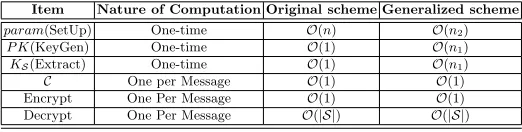
Table 1: Comparison between the Basic and Generalized schemes
Item Nature of Computation Original scheme Generalized scheme
param(SetUp) One-time O(n) O(n2)
P K(KeyGen) One-time O(1) O(n1)
KS(Extract) One-time O(1) O(n1)
C One per Message O(1) O(1) Encrypt One Per Message O(1) O(1) Decrypt One Per Message O(|S|) O(|S|)
correctly is at least 1−(1 2−)
|S| ≥ 1
2 +. ThusB has advantage at least in
solving then2-BDHE problem. This concludes the proof.Note that the instance
of this proof withn1= 1andn2=nserves as the proof of security for the basic
KAC scheme proposed in Section 4.
Performance Trade off with the Basic Scheme: We compare the
vari-ous parameter sizes for the proposed original and extended schemes in table 1. We note that SetU p and KeyGen are both one-time operations, and for a given subset S, the Extract operation is also performed once to generate the corresponding aggregate key KS. The most important advantage that the
gen-eralized scheme provides is the user’s ability to efficiently extend the number of ciphertext classes. As far as encryption and decryption are concerned, encryption should ideally take the same time for both schemes, while decryption is actually expected to be faster for the generalized construction asn2≤n.
5.3 A Flexible Extension Policy
If a user needs to classify her ciphertexts into more thatnclasses, she can register for additional key pairs (pkn1+1, mskn1+1), · · ·, (pkn1+l, mskn1+l) as per her requirements. Each new key registration increases the number of classes byn2,
wheren2≤n. The idea of under-utilization stems from the fact that registration
of each public-private key pair increases the number of classes byn2. However,
it is not necessary that all the existing classes are utilized at any given point of time. For instance, a user may at any point of time want to registerlnew private-public key pairs, however she will in all probability not use up allln2additional
classes of messages that could be encrypted using the newly registered keys. We stress here is that, unlike in the public key extension scheme proposed in [3] where the values of n1andn2 are fixed to 1 andnrespectively, our generalized
construction provides a choice of n1 and n2 so that the system administrator
could choose pair of values suited to their requirements.
We propose a metric to quantify the under-utilization of ciphertext classes for a given configuration of the system. Let us assume that at some instance of time, there are n1+l private-public key pairs registered in the system, andci
classes corresponding to each key are being utilized. We define the utilization coefficient as 1+1ξ, whereξ=−1
n1
Pn1
i=1ci6=0log(
ci
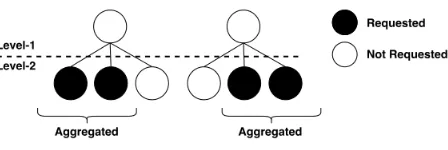
Fig. 2: A Practical Request Scenario in the Hierarchical Setting
The value is maximum when ci =n2∀i= 1,2,· · ·, n2. Note thatci= 0 implies
that no subclasses under the given keypkiare being utilized, which is equivalent
to not registering the key at all.
To stress the importance of the flexible extension policy, we provide a sim-plified example here. We consider two possible configurations of the extended scheme. In the first configuration, n1= 1 andn2=n, which is essentially
iden-tical to the public key extension scheme proposed in [3]. The other configuration has n1 >1 and n2 < n. Now assume that before extension, both schemes
uti-lizedcciphertext classes out of thenpossible classes, equally distributed across all key pairs. Now suppose a situation arises where an user needs to register l more key pairs, and utilizesz < n2classes corresponding to each key. In the first
configuration, we haveξ1=−l+11 (llog(nz) + log(nc)), while for the second
config-uration,ξ2=−l+1n1(l(log(nz2)) +n1log(nc)). Now forl >(logn1n1−1) log(zc)−1,
ξ2< ξ1. Thus for any value of (n1, n2) other than (1, n), there exists a value of
l for which the scheme achieves better utilization coefficient. Sincel is expected to increase in a dynamic scenario, our public key extension scheme eventually performs better than the scheme suggested in [3].
5.4 Advantage over Hierarchical Encryption Based Schemes
Although the generalized scheme has a two level hierarchy (with each of then1
6
Extending the Generalized KAC for Efficient Pairings
on Elliptic Curve Subgroups
The encryption schemes proposed so far use the assumption that the ellip-tic curve pairing bilinear pairing ˆe0 :
G1×G1 −→ GT satisfies the property
ˆ
e0(P, P) 6= 1, where P is the generator for G
1. In this section, we propose an
extension to the generalized n2-scheme that allows using pairings of the form
ˆ e00 :
G1 ×G2 −→ GT, where G1 and G2 are two elliptic curve subgroups of
the same prime order. The motivation behind this extension is that many pop-ular pairing algorithms such as the Tate [29], Eta [30], and Ate [31] pairings are defined over two distinct elliptic curve subgroups G1 and G2 of the same
order. Many efficient implementations of such pairings on sensor nodes such as TinyTate [32] have been proposed in literature. This motivates us to modify our scheme in a manner that allows using such well-known pairings. The modified encryption scheme described below allows using a pairing ˆe00:
G1×G2−→GT
withP generator ofG1 andQgenerator ofG2.
6.1 Construction of the Extended KAC
1. Setup(1λ, n2): Randomly pick α∈ Zq. Compute Pi = αiP ∈ G1 for i =
1,· · ·, n2, n2+ 2,· · · ,2n2andQi =αiQ∈G2 fori= 1,· · ·, n2. Output the
system parameter as
param= (P, P1,· · ·, Pn2, Pn2+2,· · · , P2n2,Q, Q1,· · ·, Qn2). The system also randomly chooses secret parameterst ∈Zq which is not made public. It is only transferred through a secure channel to data owners with credentials to control client access rights.
2. Keygen(): Pick γ1, γ2,· · · , γn1 ∈ Zq, output the public and master-secret
key tuple:
(P K1=(pk11, pk12,· · ·, pk1n1) = (γ1P, γ2P,· · ·, γn1P),P K
2=
(pk21, pk22,· · ·, pk2n1) = (γ1Q, γ2Q,· · ·, γn1Q),msk=(γ1, γ2,· · · , γn1)). 3. Encrypt(pki1,(i1, i2), m): For a message m ∈ GT and an index (i1, i2) ∈
{1,2,· · · , n1}×{1,2,· · · , n2},randomly chooser∈Zqand lett0=t+r∈Zq.
Then compute the ciphertext as
C=(rQ, t0(pk2
i1+Qi2), m.eˆ
00(P
n2, t
0Q
1)) = (c1, c2, c3).
4. Extract(msk=γ,S): For the set S of indices (j1, j2) the aggregate key is
computed asKS = (k1S, k2S,· · · , k
n1
S ) =
(P
(1,j2)∈Sγ1Pn2+1−j2,
P
(2,j2)∈Sγ2Pn2+1−j2,· · ·,
P
(n1,j2)∈Sγn1Pn2+1−j2) and the dynamic access control parameter U is computed as tQ. Thus the net aggregate key is (KS, U) which is transmitted via a secure channel to
users that have access rights toS. Note that kjS1 = P
(j1,j2)∈Sα
n+1−jpk1
j1 forj1= 1,2,· · · , n1.
5. Decrypt(KS, U,S,(i1, i2),C={c1, c2, c3}): If (i1, i2)∈ S/ , output⊥.
Other-wise return the message
ˆ m=c3
ˆ
e00(ki1
S+
P
(i1,j2 )∈S,j26=i2Pn2 +1−j2 +i2,U+c1)
ˆ
e00(P
(i1,j2 )∈SPn2 +1−j2,c2)
The proof of correctness of this scheme is presented below.
ˆ
m=c3
ˆ
e00(ki1
S +
P
(i1,j2 )∈S,j26=i2Pn2 +1−j2 +i2, U+c1)
ˆ
e00(P
(i1,j2 )∈SPn2 +1−j2, c2)
=c3
ˆ
e00(P
(i1,j2 )∈Sγi1Pn2 +1−j2, t
0Q) ˆe00(P
(i1,j2 )∈S(Pn2 +1−j2 +i2)−Pn2 +1, t
0Q)
ˆ
e00(P
(i1,j2 )∈SPn2 +1−j2, γi1(t0Q)) ˆe00(
P
(i1,j2 )∈SPn2 +1−j2, αi2(t0Q))
=c3
ˆ
e00(P
(i1,j2 )∈SPn2 +1−j2 +i2, t
0Q)
ˆ
e00(Pn
2 +1, t0Q) ˆe00(
P
(i1,j2 )∈SPn2 +1−j2 +i2, t0Q)
=m
6.2 Semantic Security of the Extended KAC
The proof of security uses a reduced version of the extended KAC scheme, anal-ogous to the reduced scheme used for proving the security of the generalized KAC. The adversarial model is also the assumed to be the same as for the gen-eralized KAC. The proof uses the (l, l)-BDHE assumption proposed in 3.3. Let
G1 and G2 be additive elliptic curve subgroups of prime order q, and GT be
a multiplicative group of order q. Let ˆe00 :
G1×G2 −→GT be a bilinear
non-degenerate pairing. We claim that for any pair of positive integersn2, n0(n0 > n2)
our proposed extension to then2-generalized reduced key-aggregate encryption
scheme over elliptic curve subgroups is (τ, , n0) semantically secure if the decision
(τ, , n2, n2)-BDHE assumption holds in (G1,G2). We prove the claim below.
Proof:Let for a given inputn0,Abe aτ-time adversary that has advantage
greater thanfor thereduced scheme parameterized with a givenn2. We build
an algorithm B that has advantage at least in solving the (n2, n2)-BDHE
problem in G. Algorithm B takes as input a random (n2, n2)-BDHE challenge
(P, Q, H, Y(P,α,n2),YQ,α,n0 2
, Z) whereZ is either ˆe00(P
n2+1, H) or a random value in GT. AlgorithmBproceeds as follows.
1. Init:AlgorithmBrunsAand receives the setS of ciphertext classes thatA
wishes to be challenged on. For each ciphertext class (i1, i2)∈ S,Bperforms
theSetUp-(i1,i2), Challenge-(i1,i2) andGuess-(i1,i2) steps. Note that
the number of iterations is polynomial in|S|.
2. SetUp-(i1,i2):Bshould generate the publicparam, public keysP K1, P K2,
the access parameterU, and the aggregate keyKS. For the iteration corre-sponding to ciphertext class (i1, i2), they are generated as follows.
– paramis set as (P, Q, YP,α,n2, Y
0
Q,α,n2).
– Randomly generateu1, u2,· · ·, un1∈Zq. Then, set P K1=(pk1
1, pk12,· · · , pk1n1), wherepk
1
j1 is set asuj1P−Pi2 forj1= 1,2,· · · , n1, and set
P K2=(pk21, pk22,· · · , pk2n1), wherepk
2
j1 is set as uj1Q−Qi2 forj1= 1,2,· · · , n1
– KS is set as (k1 S, k
2 S,· · ·, k
n1
S ) wherek
j1
S
=P
this implieskj1
S =
P
(j1,j2)∈S/ α
n2+1−j2pk1
j1, as is supposed to be as per the scheme specification. Note thatBknows that (i1, i2)∈ S/ , and hence
has all the resources to compute this aggregate key forS.
– U is set as some random element inG2.
Note that since P, Q, α, U and the uj1 values are chosen uniformly at random, the public key has an identical distribution to that in the actual construction.
3. Challenge-(i1,i2): To generate the challenge for the ciphertext class (i1, i2),
Bcomputes (c1, c2) as (H−U, ui1H). It then randomly chooses a bitb∈(0,1) and setsKb asZandK1−bas a random element inGT. The challenge given
toAis ((c1, c2), K0, K1).
We claim that whenZ = ˆe00(P
n2+1, H) (i.e. the input to B is a n2-BDHE tuple), then ((c1, c2), K0, K1) is a valid challenge toA. We prove this claim
here. we point out thatQ is a generator of G2 and so H = t0P for some
t0∈Zq. PuttingH ast0Qgives us the following: – U =tQfor somet∈Zq
– c1=H−U = (t0−t)Q=rQwherer=t0−t – c2=ui1H = (ui1)t
0Q=t0(u
i1Q) =t
0(u
i1Q−Qi2+Qi2) =t
0(pk2
i1+Qi2)
– Kb=Z= ˆe0(Pn2+1, H) = ˆe0(Pn2+1, t
0Q)
On the other hand, ifZ is a random element in GT (i.e. the input to B is
a random tuple), thenK0 andK1are just random independent elements of
GT.
4. Guess-(i1,i2): The adversaryAoutputs a guessb0 ofb. Ifb0=b,Boutputs
0 (indicating thatZ= ˆe00(P
n+1, H)), and terminates. Otherwise, it goes for
the next ciphertext class inS.
If after|S|iterations,b0 6=bfor each ciphertext class (i1, i2)∈ S, the algorithmB
outputs 1 (indicating thatZ is random inGT). We now analyze the probability
that Bgives a correct output. If (P, H, Y(P,α,n2), Z) is sampled fromR
0-BDHE,
P r[B(G, H, Y(P,α,n2), Z) = 0] =
1
2, while if (P, H, Y(P,α,n2), Z) is sampled from L0-BDHE,|P r[B(G, H, Y(P,α,n2), Z)]−
1
2| ≥. So, the probability thatBoutputs
correctly is at least 1−(12−)|S| ≥ 1
2 +. ThusB has advantage at least in
solving the (n2, n2)-BDHE problem. This concludes the proof.
7
Experimental Results Using Tate pairings
In this section we present experimental results from our implementations of the extended generalized scheme using Tate pairings on BN-curves using 256 bit primes [33]. All our experiments have been carried out on an AMD Opteron (TM) Processor 6272×16 with a clock frequency 1.4 GHz. The details of our implementations of Tate Pairings are summarized in Appendix A.
7.1 Space and Time Complexities
Table 2: Space Complexities
n1 n2 param P K msk KS U Total (in bytes) (in bytes) (in bytes) (in bytes) (in bytes) (in KB) 1 100 16112 144 40 72 64 16.046875 2 50 8112 240 56 120 64 8.390625 4 25 4112 432 88 216 64 4.796875 5 20 3312 528 104 264 64 4.171875
10 10 1712 1008 184 504 64 3.390625
20 5 912 1968 344 984 64 4.171875 25 4 752 2448 424 1224 64 4.796875 50 2 432 4848 824 2424 64 8.390625 100 1 272 9648 1624 4824 64 16.046875
Table 3: Time Complexities
n1 n2 SetU p KeyGen Encrypt Extract Decrypt Total (in clock cycles) (in clock cycles) (in clock cycles) (in clock cycles) (in clock cycles) (in clock cycles) 1 100 2920000 10000 7932000 47000 16095000 27004100 2 50 1410000 30000 8065000 53000 16110000 25668000 4 25 690000 60000 8130000 81000 16284000 25245000 5 20 590000 70000 8091000 96000 16379000 25226000
10 10 280000 140000 7957000 170000 16049000 25136000
20 5 130000 270000 8070000 320000 16361000 25151000 25 4 120000 350000 8256000 370000 16239000 25836000 50 2 50000 680000 8265000 712000 16398000 26105000 100 1 30000 1360000 8201000 1315000 16142000 27048000
0.2 0.4 0.6 0.8 0
0.2 0.4 0.6 0.8 1
Subset Size (as a fraction of total classes)
Ratio
of
Key
Size
(Aggregate/Hierarc
hical)
Fig. 4: Key Size ratio - Proposed Aggregate Scheme vs Hierarchical Scheme
chosen subsets of the n= 100 ciphertext classes. Table 3 summarizes the time complexity for various operations of the scheme for different values of (n1, n2).
The results have been averaged over 100 randomly chosen subsets of then= 100 ciphertext classes. The encryption and decryption operation complexities are further averaged over 10 message transmissions corresponding to each subset. We point out that both the overall space and time requirements are minimum forn1=n2= 10 =
√
n, which proves the usefulnesss of the generaalization.
7.2 Comparison with Hierarchy Based Schemes
Next, we compare specifically the key size required for the proposed extended scheme, for different values ofn1 andn2(again corresponding ton= 100), with
Fig. 6: Utilization coefficient vs Newly Registered Keys
uses a hierarchy depth of 2, we use the same for the hierarchical construction as well, withn1nodes in level 0, andn2level 1 nodes in the subtree rooted at each
level 0 node. Figure 4 summarizes the findings. Evidently, lower the value ofn1,
better the key aggregation, hence lower the ratio.
7.3 Utilization Coefficient Comparison
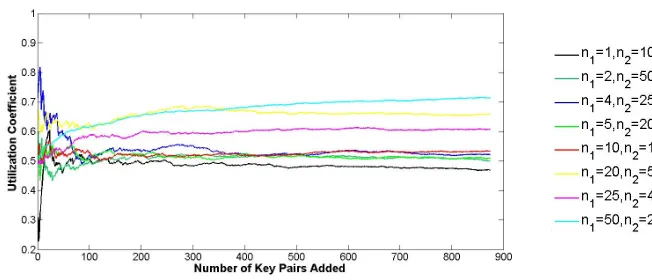
Finally we compare the utilization-coefficient of the extended scheme for various values ofn1 andn2 (corresponding to n= 100) with increase in the number of
registered key pairs l, where each key pair increases the number of classes by n2. We leave out the configurationn1 =n, n2= 1 because that always leads to
an utilization coefficient of 1 but is impractical due to huge space requirements. Figure 6 demonstrates that that beyond a certain value of l, the combination (1, n) proposed in [3] has a lower utilization coefficient that all other combina-tions of (n1, n2) for a given n. This emphasizes the advantage of making the
choice of (n1, n2) flexible.
8
Conclusions and Future Work
classes is pre-defined to some fixedn. To deal with this issue, we next proposed a generalized two-level construction of the basic scheme that runs n1 instances
of the basic scheme in parallel, with each instance handling key aggregation for n2 ciphertext classes. This scheme provides two major advantages. First of all,
it allows dynamic extension of ciphertext classes by registering of new public key-private key pairs without affecting other system parameters. Secondly, it provides a wide range of choices forn1 andn2 that allows efficient utilization of
ciphertext classes while also achieving optimum space and time complexities. Fi-nally, we extend the generalized scheme to allow the use of popular and efficiently implementable bilinear pairings in literature such as Tate Pairings that operate on multiple elliptic curve subgroups instead of one. Each of the three proposed schemes have been proven to be semantically secure. Experimental studies have demonstrated the superiority of our proposed scheme over existing ones in terms of key size as well as efficient utilization of ciphertext classes. A possible future work is to make the proposed schemes secure against chosen ciphertext attacks.
References
1. Cong Wang, Sherman S.-M. Chow, Qian Wang, Kui Ren, and Wenjing Lou. Privacy-preserving public auditing for secure cloud storage. Cryptology ePrint Archive, Report 2009/579, 2009. http://eprint.iacr.org/.
2. Sherman SM Chow, Cheng-Kang Chu, Xinyi Huang, Jianying Zhou, and Robert H Deng. Dynamic secure cloud storage with provenance. InCryptography and
Secu-rity: From Theory to Applications, pages 442–464. Springer, 2012.
3. Cheng-Kang Chu, Sherman SM Chow, Wen-Guey Tzeng, Jianying Zhou, and Robert H Deng. Key-aggregate cryptosystem for scalable data sharing in cloud storage. Parallel and Distributed Systems, IEEE Transactions on, 25(2):468–477, 2014.
4. Dan Boneh, Craig Gentry, and Brent Waters. Collusion resistant broadcast encryp-tion with short ciphertexts and private keys. InAdvances in Cryptology–CRYPTO 2005, pages 258–275. Springer, 2005.
5. Selim G Akl and Peter D Taylor. Cryptographic solution to a problem of access control in a hierarchy.ACM Transactions on Computer Systems (TOCS), 1(3):239– 248, 1983.
6. Gerald C Chick and Stafford E Tavares. Flexible access control with master keys.
InAdvances in CryptologyCRYPTO89 Proceedings, pages 316–322. Springer, 1990.
7. Wen-Guey Tzeng. A time-bound cryptographic key assignment scheme for access control in a hierarchy. Knowledge and Data Engineering, IEEE Transactions on, 14(1):182–188, 2002.
8. Giuseppe Ateniese, Alfredo De Santis, Anna Lisa Ferrara, and Barbara Masucci. Provably-secure time-bound hierarchical key assignment schemes.Journal of
cryp-tology, 25(2):243–270, 2012.
9. Ravinderpal S Sandhu. Cryptographic implementation of a tree hierarchy for access control. Information Processing Letters, 27(2):95–98, 1988.
10. Yan Sun and KJ Liu. Scalable hierarchical access control in secure group commu-nications. InINFOCOM 2004. Twenty-third AnnualJoint Conference of the IEEE
11. William C King and Bjorn Hjelm. Centralized key management, March 24 2015. US Patent 8,990,555.
12. Mikhail J Atallah, Marina Blanton, Nelly Fazio, and Keith B Frikken. Dynamic and efficient key management for access hierarchies.ACM Transactions on Information
and System Security (TISSEC), 12(3):18, 2009.
13. Josh Benaloh, Melissa Chase, Eric Horvitz, and Kristin Lauter. Patient controlled encryption: ensuring privacy of electronic medical records. InProceedings of the
2009 ACM workshop on Cloud computing security, pages 103–114. ACM, 2009.
14. Josh Benaloh. Key compression and its application to digital fingerprinting. Tech-nical report, TechTech-nical Report TechTech-nical Report, Microsoft Research, 2009. 15. Basel Alomair and Radha Poovendran. Information theoretically secure encryption
with almost free authentication. J. UCS, 15(15):2937–2956, 2009.
16. Adi Shamir. Identity-based cryptosystems and signature schemes. InAdvances in
cryptology, pages 47–53. Springer, 1985.
17. Dan Boneh and Matthew Franklin. Identity-based encryption from the weil pairing.
SIAM Journal on Computing, 32(3):586–615, 2003.
18. Clifford Cocks. An identity based encryption scheme based on quadratic residues.
InCryptography and coding, pages 360–363. Springer, 2001.
19. Fuchun Guo, Yi Mu, and Zhide Chen. Identity-based encryption: how to decrypt multiple ciphertexts using a single decryption key. InPairing-Based Cryptography–
Pairing 2007, pages 392–406. Springer, 2007.
20. Fuchun Guo, Yi Mu, Zhide Chen, and Li Xu. Multi-identity single-key decryption without random oracles. InInformation Security and Cryptology, pages 384–398. Springer, 2008.
21. Amit Sahai and Brent Waters. Fuzzy identity-based encryption. In Advances in
Cryptology–EUROCRYPT 2005, pages 457–473. Springer, 2005.
22. Vipul Goyal, Omkant Pandey, Amit Sahai, and Brent Waters. Attribute-based encryption for fine-grained access control of encrypted data. InProceedings of the
13th ACM conference on Computer and communications security, pages 89–98.
Acm, 2006.
23. John Bethencourt, Amit Sahai, and Brent Waters. Ciphertext-policy attribute-based encryption. In Security and Privacy, 2007. SP’07. IEEE Symposium on, pages 321–334. IEEE, 2007.
24. Melissa Chase. Multi-authority attribute based encryption. InTheory of
cryptog-raphy, pages 515–534. Springer, 2007.
25. Ming Li, Shucheng Yu, Yao Zheng, Kui Ren, and Wenjing Lou. Scalable and secure sharing of personal health records in cloud computing using attribute-based encryption. Parallel and Distributed Systems, IEEE Transactions on, 24(1):131– 143, 2013.
26. Giuseppe Ateniese, Kevin Fu, Matthew Green, and Susan Hohenberger. Improved proxy re-encryption schemes with applications to secure distributed storage. ACM
Transactions on Information and System Security (TISSEC), 9(1):1–30, 2006.
27. Qin Liu, Chiu C Tan, Jie Wu, and Guojun Wang. Reliable re-encryption in unreli-able clouds. InGlobal Telecommunications Conference (GLOBECOM 2011), 2011 IEEE, pages 1–5. IEEE, 2011.
28. Victor Miller. Use of elliptic curves in cryptography. InAdvances in
Cryptology-CRYPTO85 Proceedings, pages 417–426. Springer, 1986.
30. Florian Hess, Nigel P Smart, and Frederik Vercauteren. The eta pairing revisited.
Information Theory, IEEE Transactions on, 52(10):4595–4602, 2006.
31. Chang-An Zhao, Fangguo Zhang, and Jiwu Huang. A note on the ate pairing.
International Journal of Information Security, 7(6):379–382, 2008.
32. Leonardo B Oliveira, Diego F Aranha, Eduardo Morais, Felipe Daguano, Julio L´opez, and Ricardo Dahab. Tinytate: Computing the tate pairing in resource-constrained sensor nodes. In Network Computing and Applications, 2007. NCA
2007. Sixth IEEE International Symposium on, pages 318–323. IEEE, 2007.
33. Santosh Ghosh, Debdeep Mukhopadhyay, and Dipanwita Roychowdhury. Se-cure dual-core cryptoprocessor for pairings over barreto-naehrig curves on fpga platform. Very Large Scale Integration (VLSI) Systems, IEEE Transactions on, 21(3):434–442, 2013.
34. Paulo SLM Barreto and Michael Naehrig. Pairing-friendly elliptic curves of prime order. InSelected areas in cryptography, pages 319–331. Springer, 2006.
35. Paulo S. L. M. Barreto and Michael Naehrig. Pairing-friendly elliptic curves of prime order. Cryptology ePrint Archive, Report 2005/133, 2005. http://eprint.iacr.org/.
36. Augusto Jun Devegili, Michael Scott, and Ricardo Dahab. Implementing cryp-tographic pairings over barreto-naehrig curves. In Pairing-Based Cryptography–
A
Implementation of Tate pairings Using BN Curves
A.1 The Tate pairing
We first provide a brief overview of the Tate pairing. Let Kbe a field of prime order p, and let an elliptic curve E(K) over K be defined by the Weierstrass [28] equation. Also, Let K = Fpk be the smallest extension field of K = Fp
that contains theqthroots of unity. We refer tokas the embedding degree with
respect toKandq. Further, we refer to the set ofq-torsion points on the elliptic curve asE(K)[q] (q-torsion points essentially have orderq). Before defining the Tate pairing, we briefly state the Miller’s function [28]. Let [a]P denote the multiplication of a point P ∈ E by a scalar a ∈ Z (equivalent to adding P a
times), and let O ∈ E denote the point at infinity. A Miller function is any rational function onE that has a divisor of the form
(fq,P) =q(P)−([q]P)−(q−1)O. (2)
A Miller function has q zeros atP, one pole at [q]P and q−1 poles atO. For every pointQ6=P,[q]P,0, we have (fq,P)∈K
∗
. We now define the Tate pairing over elliptic curves.
The Tate pairing eT : G1×G2 −→ GT is a well-defined, non-degenerate,
bilinear pairing withG1=E(K)[q],G2=E(K)/qE(K), andGT =K
∗
/(K∗)q.
Let P ∈ E(K)[q] and Q ∈ E(K)/qE(K). Then the Tate pairing of P, Q is computed as
eT(P, Q) =fq,P(Q) pk−1
q (3)
Properties: Tate pairing satisfies following properties that make the pairing
suitable for use in cryptography.
– Well defined:eT(O, Q) = 1 for all Q∈E(K) and eT(P, Q)∈(K
∗
)q for all P∈E(K)[q] and allQ∈qE(K).
– Bilinearity: For allP, P1, P2∈E(K)[q] andQ, Q1, Q2∈E(K), we have
– eT(P1+P2, Q) =eT(P1, Q)·eT(P2, Q).
– eT(P, Q1+Q2) =eT(P, Q1)·eT(P, Q2).
– Non-degeneracy: For each pointE(K)[q]\O there is some point Q∈E(K) such thateT(P, Q)∈/(K)q.
A.2 Pairing Friendly Curves
Barreto and Naehrig [34] developed a method for constructing a method for constructing pairing-friendly elliptic curves over prime fields, with prime order and embedding degree k = 12. The equation of the curve isE : y2 =x3+b,
characteristic ofFp are parameterized as:
t(x) = 6x2+ 1
n(x) = 36x4−36x3+ 18x2−6x+ 1
p(x) = 36x4−36x3+ 24x2−6x+ 1
respectively. Such a curve is often referred to in literature a Barreto-Naehrig or BN curve. Since every point on the BN curve has ordern, the value ofq(a large prime dividing the curve order) can be taken to be the same asn.
Suitability of Barreto-Naehrig curves: BN curves are especially well suited
for the 128-bit security level. This is because, if p is 256-bit prime, then the Pollards rho method for computing discrete logarithms in E(Fp) has running
time approximately 2128, as does the number field sieve algorithm for computing
discrete logarithms in the extension field Fp12. The biggest advantage of using BN curves is that they admitsextic twists with degree six, implying that there exists a distortion map between Fp2 and Fp12. This is of great advantage from the computational point of view since many computations can now be restricted to the field Fp2. The other advantage of using BN curves is their flexibility in terms of order of the primep. Barreto and Naehrig have defined in [34] a whole family of BN curves to choose from, corresponding to primes of any given order.
Barreto-Naehrig curve used in implementation The BN curve used in
our implementation for 256 bit primes is given by
E:Y2=X3+ 3 (4)
with BN parameterx= 6000000000001F2D(in hexadecimal). The correspond-ing prime p(x) = 36x4−36x3+ 24x2−6x+ 1 is a 256-bit prime of Hamming
weight 87, n(x) = 36x4−36x3+ 18x2−6x+ 1 is 256-bit prime of Hamming
weight 91, and t−1 =p−r= 6z2+ 1 is a 128-bit integer of Hamming weight
28(heret=p+ 1−ris the trace ofE). Note that the choice ofpis made such that p≡7(mod8), p≡4(mod9)p≡1(mod6). The reason for this is as follows.
1. The first condition ensures that −2 is a quadratic non-residue. 2. The second condition ensures efficient computation of cube roots [35]. 3. The third condition ensures that there exists ξ∈ Fp2 such thatW6−ξ is
irreducible overFp2[W].
A.3 The Finite Field Extensions