Menzies Building
Monash University Wellington Road
CLAYTON Vic 3168 AUSTRALIA
Telephone: from
overseas:
(03) 9905 2398, (03) 9905 5112
61 3 9905 2398 or
61 3 9905 5112
Fax numbers:
from overseas:
(03) 9905 2426, (03)9905 5486
61 3 9905 2426 or 61 3 9905 5486
[email protected]
Paper presented to the Pacific Economic Cooperation Council,
Human Resource Development Task Force Meeting, Taipei,
Republic of China, 21-23 June, 1995.
Coordinating Policies for
Human Resources
Development
by
G.A. Meagher
Centre of Policy Studies
Monash University
General Paper No. G-118 March 1996
ISSN 1 031 9034 ISBN 0 7326 0732 9
The Centre of Policy Studies (COPS) is a research centre at Monash University devoted to quantitative analysis of issues relevant to Australian economic policy. The Impact Project is a cooperative venture between the Australian Federal Government and Monash University, La Trobe University, and the Australian National University. COPS and Impact currently operate as a single unit at Monash University with the task of constructing a new economy-wide policy model to be known as MONASH. This initiative is supported by the Industry Commission on behalf of the Commonwealth Government, and by several other sponsors. The views expressed herein do not necessarily represent those of any sponsor or government.
C
ENTRE
of
P
OLICY
S
TUDIES
and
the
I
MPACT
i
In its recent White Paper on Employment and Growth, the Australian Government announced a comprehensive new agenda to supplement its existing employment policies. It includes the following major elements:
• reforms to labour market assistance; • training and education reforms;
• a reconstructed social security system; • a regional strategy;
• workplace agreements; and • microeconomic reforms.
An important consideration in the implementation of such a multi-faceted policy program is that its various elements are not independent of each other. While the Government has been at pains to ensure that the program is coherent in a qualitative sense, its quantitative assessment of the interdependencies between the program's elements has been limited.
In this paper, we consider some of the issues associated with coordinating policies for human resources development, using the White Paper and the National Vocational Education and Training (VET) Strategy to provide a context for the discussion. In particular, we review the role of the MONASH forecasting system as a vehicle for coordinating the training plans of decentralised advisory bodies within the National VET Strategy. We also describe how the system can be used to delineate interdependencies in the Government's program, and include a quantitative assessment of effects of proposed microeconomic reforms on the demand for labour in particular occupations.
iii
1 Introduction 1
2 Reducing Unemployment: the White Paper Perspective
2
3 The National Strategy for Vocational Education and
Training 6
4 Planning the Allocation of VET Resources 8
4.1 The MONASH Forecasting System 8
4.2 Forecasting Employment by Occupation 10
4.3 Forecasting Training Needs 16
5 Microeconomic Reform and Training Needs 16
6 Concluding Remarks 18
References 19
LIST OF TABLES
1 Average Rates of Growth,
Components of GDP and Employment by Industry, Historical Data (1986-87 to 1993-94) and
Forecasts (1993-94 to 2001-02). 12
2 Average Employment Growth Rates,
ASCO Major Groups, 1993-94 to 2001-02. 13
3 Industry Contributions to Occupational Employment Growth, 1993-94 to 2001-02,
Salespersons and Personal Service Workers, and
HUMAN RESOURCES DEVELOPMENT
by
G.A.MEAGHER
Centre of Policy Studies, Monash University
1. Introduction
In May 1993, the Australian Government initiated a major review of the Australian labour market when it commissioned a high level Committee on Employment Opportunities to prepare an effective response to the problem of unemployment. After seven months of deliberation, and after consulting widely with the Australian community, the Committee published a discussion paper (or Green Paper) explaining the choices and trade-offs Australia would need to make to restore full employment and offering a range of ideas for alleviating the problem of long-term unemployment. A further period of consultation followed before the Government released its
White Paper on Employment and Growth in May 1994. The Government left no doubt as to what it considered to be the most important issue in the HRD/labour market area, or in any policy area for that matter, when it declared that "reducing unemployment ...is the greatest challenge facing Australians today".1
In the White Paper the Government announced a comprehensive new agenda to supplement its existing employment policies. It includes the following major elements:
• reforms to labour market assistance to help unemployed Australians get their fair share of jobs in the current recovery of the economy;
• training and education reforms to broaden and deepen the skills base and equip young people for work in the modern Australian economy;
• a reconstructed social security system from which disincentives to work have been removed;
• a strategy to help the regions of Australia more effectively share in the nation's prosperity and contribute to the national effort;
• agreements in the workplace to produce a more flexible and responsive workforce;
• microeconomic reforms and an industry policy to remove impediments to competition and create an environment that will enable firms to perform at their best and assist them to develop international markets.
1 The Green Paper is referenced as Committee on Employment Opportunities (1993)
An important consideration in the implementation of such a multi-faceted policy program is that its various elements are not independent of each other. Training reforms are likely to become the focus of workplace agreements. The appropriate spatial provision of training services will depend on changes in regional policy. Changes to labour market assistance must be properly integrated with other social security reforms. Micro-economic reforms favour the employment of particular skills and hence affect the kind of training reforms required. While the Government has been at pains to ensure that the program is coherent in a qualitative sense, its quantitative assessment of the interdependencies between the program's elements has been limited.
In this paper, we consider some of the issues associated with coordin-ating policies for human resources development, using the White Paper and the National Vocational Education and Training (VET) Strategy to provide a context for the discussion. The remainder of the paper is organised into five sections. Section 2 gives a general review of the reforms of the White Paper and Section 3 describes the particular role of the National VET Strategy. In Section 4 we introduce the MONASH forecasting system and describe its use as a vehicle for coordinating the training plans of decentralised advisory bodies within the National VET Strategy. Section 5 describes how the system can be used to delineate interdependencies in the Government's program and includes a quantitative assessment of effects of proposed microeconomic reforms on the demand for labour in particular occupations. The concluding section considers extensions of the system to address distri-butional and international HRD issues.
2. Reducing Unemployment: the White Paper Perspective
In the Government's strategy for reducing unemployment, the key ingredient is economic growth. Since 1993, the Australian economy has made a strong recovery from recession and, in the medium term, economic growth is not expected to be limited by insufficient demand. However, in past recoveries, domestic demand has tended to run ahead of the ability to expand output, resulting in a shortage of national saving, excessive reliance on foreign borrowing and an unsustainable current account deficit. Hence, if it is to achieve high rates of economic growth, Australia must maintain or improve its international competitiveness. This implies that economic policy should be directed particularly at achieving high rates of productivity growth and low rates of inflation.
The Government has adopted a range of policies designed to improve productivity and competitiveness. Prominent among them are reforms to education and training and microeconomic reforms that we shall consider in some detail later. These reforms are supported by:
• measures to encourage enterprise bargaining, which directly links wage increases to productivity improvements;
• the Accord commitment to wage outcomes consistent with an inflation rate comparable with those of Australia's major trading partners; and
• labour market programs that enable unemployed people, and espec-ially long term unemployed people, to compete effectively for jobs. Traditionally, the system of wage determination in Australia was one in which basic wage rates were set on a centralised quasi-judicial basis, and "over-award" payments were negotiated at the enterprise level. The adver-sarial nature of the system, and the fact that ultimate power over the content of awards rested with a third party (the Arbitration Commission), tended to discourage employers and employees from taking responsibility for enhancing productivity in their joint interest. Furthermore, the traditional system had a tendency to deliver wage outcomes well in excess of those that could be justified by productivity improvements, as was clearly demon-strated in the periods leading up to the 1974-75 and 1982-83 recessions.
In 1983, the Government and the Australian Council of Trade Unions struck an "Accord" that has been crucial in achieving more responsible wage outcomes since that time. In recent years, the Accord has facilitated a gradual decentralisation of the wages system, culminating in the Industrial Relations Reform Act 1993. The new system emphasises productivity based wage bargaining which will allow real wages to increase over time without adding to inflation. It also emphasises enterprise agreements which will allow employers, employees and their unions to work together to develop new work and management practices better suited to their specific circumstances. That is, the new system shifts responsibility away from distant third parties to the parties in the workplace, providing the flexibility to adapt more readily to changes in the economic environment.
Closely related to its industrial relations reforms is the Government's competition policy. In 1993, the Government commissioned an independent inquiry into the most appropriate form and structure of a National Competition Policy. In its report (Hilmer, 1993), the Committee recommended:
• the general application of trade practices legislation governing anti-competitive conduct to all businesses, including government and unincorporated enterprises;
• a systematic process for review and reform of regulatory restrictions on competition, with any such restrictions measured against a public interest test;
• a legally based regime for providing access to essential facilities that cannot be duplicated economically;
• a national prices oversight mechanism for markets of firms where competition is deficient;
• pro-competitive principles to be adopted where public monopolies are corporatised or privatised; and
• competitive neutrality between public and private businesses where they compete.
These recommendations formed the basis of the National Policy adopted by the Council of Australian Governments (COAG) in March 1995. The greater competition in product markets fostered by this policy is important for industrial relations because it provides an incentive for employees to secure their jobs and their incomes by ensuring that their work practices are the best available.2
To tackle the problem of long term unemployment, the Government has introduced a Job Compact. As with other labour market programs, the Compact is designed not so much to increase, but to complement, economic growth in reducing unemployment. The primary motivation for this policy is a desire to ensure that no section of the Australian community be excluded from the benefits of the economic recovery. However, long term unemployment does affect productivity growth because it results in job vacancies being filled more slowly. People who have been unemployed for long periods are likely to lose their skills, motivation and access to word of mouth information on job vacancies. Some employers view a long spell of unemployment as a signal that an individual is unsuitable for work. Hence long term unemployed people can become detached from the labour force and employers will take longer to find suitable workers. Long term unemployment can also affect the industrial relations climate because, if there is a large number of such people who are not considered to be effective competitors for jobs, pressures for wage increases will emerge while unemployment remains unacceptably high.
2 For an analysis of the economic effects of the Hilmer reforms that uses a similar
The major elements of the Job Compact include:
• more intensive case management;
• training and support to ensure that the unemployed person is job ready;
• a job for 6 to 12 months, primarily in the private sector;
• a training wage which combines employment with training leading to recognised and transferable skills;
• specific projects in regions where other employment opportunities are limited;
• intensive job search assistance and referral to suitable vacancies at the end of the Job Compact job, to maximise the employment outcomes for those assisted; and
• stronger penalties for job seekers who do not meet their obligations under the Job Compact.
The Job Compact has been complemented by reforms to the Social Security system to ensure that unemployed income support recipients have the financial incentive to take up job opportunities when they become available.
The Government's approach to reducing unemployment includes numerous other components that are less directly related to the usual concerns of human resources development, and we shall not describe them here.3 Rather we note that the reforms generally reflect a significant shift away from government intervention in favour of a greater reliance on decentralised decision making and market coordination. This situation creates a role for information systems with an economy wide perspective to supplement local market signals in guiding economic decision making. Such systems can reduce inefficiencies that arise because decentralised decision makers have different views about the development of the economy as a whole or because they have insufficient information to take account of the effects of their plans on each other. We can give concrete meaning to these ideas by considering their application to the provision of training.
3. The National Strategy for Vocational Education and Training
Reform of the training and education system is central to the Government's employment strategy. A more skilled and adaptable workforce committed to producing high quality goods and services will respond better to changing technology and industry demands and improve the capacity of the economy for rapid growth. The White Paper identifies vocational education and training as being in particular need of attention and foreshadows a system which:
3 They include national savings policy (Fitzgerald, 1993), regional development
• responds to industry concerns about the content and relevance of training, and which engages industry in determining the direction of training reform;
• offers a variety of paths including traineeships based in schools, Training and Further Education (TAFE) colleges and industry, and which can be adapted to the needs of people at different stages of their working lives;
• is based on a competitive market, consisting of both public and private training providers; and
• concerns itself with what individuals can do, rather than how long they have spent in the system.
In January 1994, the Australian National Training Authority (ANTA) was established by agreement between the Commonwealth, State and Territory governments. Central to the agreement is the National Strategy for Vocational Education and Training (ANTA, 1994) which incorporates the training reforms of the White Paper and is organised around four main themes:
• responsiveness, so that diversity, choice and cooperation are maximised between the full range of training providers - public, private and industry;
• quality, so that those achieving at the highest standards are supported and incentives are offered to others to reach those standards;
• accessibility, so that all Australians who want and need training can get it; and
• efficiency, so that value for money and accountability are emphasised and administrative arrangements are streamlined and simplified. To promote the first of these objectives, i.e., responsiveness to the needs of industry, a network of industry training and advisory bodies (ITABs) has been set up. The ITABs' responsibilities include the development of "industry-credible, high-quality industry training plans as frameworks for identifying training needs in each industry, and for considering resource requirements".4 In determining these plans, ITABs typically rely, not on any
formal forecasting methodology, but on digesting quantitative and qualitative information about their industries from a variety of sources. The process has been described recently as follows:
"As the forums through which industries express their education and training needs, ITABs are well placed to articulate (industry) advice to state and national training authorities through formal instruments such as training plans and profiles. As industry consultation is a core role built into all the activities of ITABs, it is possible to develop, with adequate resources, a comprehensive profile of industries' expressed training needs by working with industry on an ongoing basis. Some research methodologies deployed by ITABs include industry meetings and forums, structured interviews,
training needs analyses, industry surveys and questionnaires, and functional analysis. Enterprise based projects can also provide invaluable qualitative data about VET needs and the training environment in business. ... The effectiveness of such qualitative research is largely dependent on the extent to which industry needs, as expressed by industry, can be tapped, interpreted and integrated." 5
Responsiveness is an essential component of the National VET Strategy. However, if the Strategy is also to be efficient, it cannot simply rely on the needs expressed by business via the ITABs as a basis allocating training resources. Because these needs are typically determined independently for each industry, there is no presumption that they reflect a common view about the likely evolution of the economy as a whole, and hence there is no presumption that they will form a coherent plan for the economy as a whole. Indeed, to the extent that individual ITABs (and their advisers from industry) must compete against each other for a limited pool of training funds, there will be a tendency for training needs to be overstated. Just as it is essential for the Strategy to be responsive to the needs of business as expressed by business, it is also essential that it incorporate a mechanism that coordinates these expressed needs into a coherent whole. Such an economy wide perspective is provided by the information system described in the next section.
4. Planning the Allocation of VET Resources
Since 1993, the Centre of Policy Studies (COPS) at Monash University has been preparing year-by-year forecasts for the Australian economy extending over a total planning horizon of eight years. To be useful for planning the disposition of HRD resources, a forecasting system must be very detailed and, in the COPS forecasts, this requirement is achieved via a large dynamic general equilibrium model, the MONASH model. Among the subscribers to the forecasts are ANTA and five government agencies responsible for the provision of VET services at State (or provincial) level. These agencies rely, in part, on the MONASH forecasting system to coordinate the training plans put forward by the ITABs. In this section we describe the various stages in the coordination process.
4.1 The MONASH Forecasting System
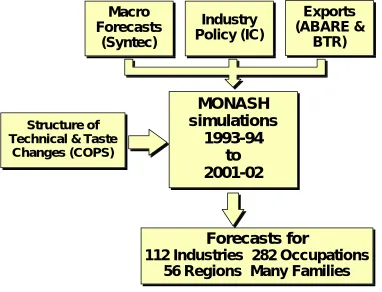
The elements of the forecasting system are set out in Figure 1. A
MONASH simulation takes as inputs:
• information about prospects for the macro economy provided by the commercial forecasting agency Syntec Economic Services;
• forecasts for export prices and volumes compiled by the Australian Bureau of Agricultural and Resource Economics (ABARE) and the Bureau of Tourism Research (BTR);
• Industry Commission (IC) estimates of changes in protection implied by the industry policies of the government;
• estimates of future changes in technology and consumer tastes based on research undertaken by COPS.6
The results of a MONASH simulation include detailed forecasts of output and employment by industry, occupation and region. For the purposes of the national and State training agencies, the forecasts of employment by occupation are of most interest. As we shall see presently, the factors that influence the employment prospects for particular occupations are many and varied.
Industry
Policy (IC)
Macro
Forecasts
(Syntec)
Exports
(ABARE &
BTR)
MONASH
simulations
1993-94
to
2001-02
Forecasts for
112 Industries 282 Occupations
56 Regions Many Families
Structure of
Technical & Taste
Changes (COPS)
Figure 1. The MONASH Forecasting System
The first role of a formal forecasting system is to supply a framework for incorporating relevant data into the forecasting process. Published data accessed by MONASH includes the national accounts, input-output tables, State accounts, population censuses, foreign trade statistics, capital stock statistics, and income and expenditure surveys. Additional unpublished material is prepared by the Australian Bureau of Statistics especially for the system. Moreover, as a formally specified system, MONASH requires all its
6 The project is reported in Dixon and McDonald (1993). An extension of the
data to be consistent. If any inconsistencies do exist in the primary sources, they must be reconciled before the data can be included. This consistency requirement makes the system especially powerful as a framework for organising data.
As well as data about the past, formal or model-based forecasts must rest upon informed opinion about future changes in variables that are exo-genous to (i.e., determined outside) the model. MONASH is quite adaptable in this regard. It already incorporates the views of many expert bodies and can accommodate more detailed exogenous forecasts as they become available. It can also produce alternative forecasts corresponding to compet-ing views about the future. Just as for historical data, all opinions formally incorporated in a particular forecast must be consistent with each other. A forecaster using MONASH must either seek a consensus between the expert bodies involved in forecasting the exogenous variables or impose his/her own judgement to resolve any outstanding differences before the forecast can proceed. In other words, the MONASH system provides a framework for coordinating both historical data and expert opinion about the future that bear on the training issue.
4.2. Forecasting Employment by Occupation 7
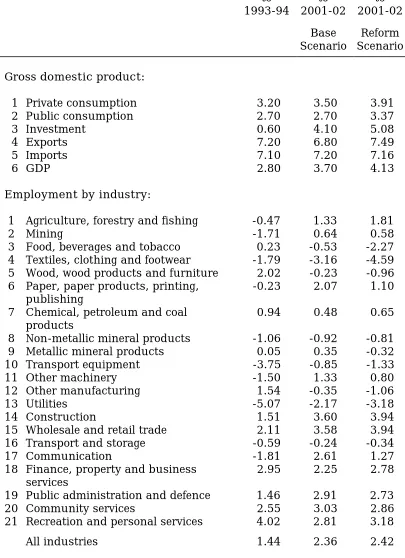
A MONASH forecast of employment by occupation results from a four stage process that begins with the Syntec macroeconomic forecasts. Syntec's approach recognises that, as an exporter of primary products, Australia is very dependent on developments in the world economy. Syntec expects slow and sustained recovery in world economic growth, with recovery in the United States eventually stimulating recovery in Japan and Europe. Hence commodity prices are expected to gradually strengthen, generating an improvement in Australia's terms of trade and allowing gross domestic product (GDP) to growth at an average rate of about 3.7% per annum over the period 1993-94 to 2001-02. A feature of the Syntec forecasts with important structural implications is the rapid expansion of exports and imports relative to GDP. That is, the trend established during the period 1986-87 to 1993-94 is expected to continue. The Syntec forecasts for GDP and its components are presented in the first panel of Table 1.8
The second stage in the process is to convert the forecast for aggregate output (or GDP) into forecasts of output by industry. The structural fore-casts supplied by the expert bodies indicated in Figure 1 are incorporated at this stage. For Australia's traditional agricultural and mining exports, ABARE forecasts good prospects (i.e., growth rates in excess of 4.5% per annum) for Non-ferrous metal ores and Meat products, middle prospects (in the range 1.5% to 4.5%) for Wool, Iron ore, Black coal and Processed metal ores, and poor prospects (less than 1.5%) for Grains, Fishing, Sugar, and Oil
7 The discussion in this section draws on Adams et al. (1994).
8 Although MONASH generates forecasts on an annual basis, we report only
and gas. International tourism has grown very rapidly in Australia in recent years and now accounts for more than 10% of aggregate export receipts. The BTR expects international tourism to continue to grow strongly at about 7.5% per annum during the forecast period, with extra growth in the Olympic year 2000-01. At the industry level, tourism enhances the growth prospects of Air transport, Entertainment and leisure, Restaurants and hotels
and Personal services. The government's program of phased reductions in barriers against manufactured imports, as interpreted for the MONASH
model by the Industry Commission, results in poor prospects for Textiles, clothing and footwear and Motor vehicles and parts. The COPS forecasts of changes in consumer tastes and intermediate input using technical change are also included at this stage. As examples of the effects of these changes, the former type favours growth in the output of Vegetables but inhibits growth for Tobacco and Alcoholic beverages; the latter type favours the use of
Electronic equipment.9
Forecasts of output by industry are converted to forecasts of employment by industry at the third stage. Results of the conversion for twenty one industries are shown in the second panel of Table 1. The output and employment forecasts are related by production functions which determine the increase in output associated with given increases in inputs (capital and labour) and a given rate of primary factor saving technical change. The influence of capital growth and technical change can produce quite different output and employment forecasts for some industries. The change in capital inputs depends critically on whether an industry was under- of over-capitalised in the base period (i.e., on whether the rate of return in the industry was above or below the average across industries). An industry with a relatively high rate of return attracts investment and enjoys a relatively high rate of capital growth. For a given rate of output growth and technical change, this implies a relatively low rate of employment growth. Similarly, an industry with a relatively rapid rate of technical change will tend to have a relatively low rate of growth in employment. Thus, for Utilities, output is forecast to grow at a healthy 3.29% per annum (not shown in Table 1) while employment contracts by 2.17% per annum. For this industry, primary factor saving technical change is responsible for significant job losses at the same time as it reduces costs and provides a source of output growth.
The final stage in the process is to convert the employment forecasts from an industry basis to an occupational basis. Results for eight occupations are reported in Table 2.10 Employment growth for a particular
occupation can be decomposed into a component due to the growth in aggregate employment, a component (the industry share effect) due to
9 As indicated in Figure 1, MONASH produces output and employment forecasts for
112 industries in 56 regions. For reasons of space, we present only national employment forecasts for 21 industries in this paper.
10 For occupations, MONASH produces employment forecasts by region for the 282
Table 1. Average Rates of Growth, Per Cent Per Annum
Historical Forecast Forecast Economic Variable Data
1986-87 1993-94 1993-94 to to to 1993-94 2001-02 2001-02
Base Reform Scenario Scenario
Gross domestic product:
1 Private consumption 3.20 3.50 3.91 2 Public consumption 2.70 2.70 3.37 3 Investment 0.60 4.10 5.08 4 Exports 7.20 6.80 7.49 5 Imports 7.10 7.20 7.16 6 GDP 2.80 3.70 4.13
Employment by industry:
1 Agriculture, forestry and fishing -0.47 1.33 1.81 2 Mining -1.71 0.64 0.58 3 Food, beverages and tobacco 0.23 -0.53 -2.27 4 Textiles, clothing and footwear -1.79 -3.16 -4.59 5 Wood, wood products and furniture 2.02 -0.23 -0.96 6 Paper, paper products, printing,
publishing
-0.23 2.07 1.10 7 Chemical, petroleum and coal
products
0.94 0.48 0.65 8 Non-metallic mineral products -1.06 -0.92 -0.81 9 Metallic mineral products 0.05 0.35 -0.32 10 Transport equipment -3.75 -0.85 -1.33 11 Other machinery -1.50 1.33 0.80 12 Other manufacturing 1.54 -0.35 -1.06 13 Utilities -5.07 -2.17 -3.18 14 Construction 1.51 3.60 3.94 15 Wholesale and retail trade 2.11 3.58 3.94 16 Transport and storage -0.59 -0.24 -0.34 17 Communication -1.81 2.61 1.27 18 Finance, property and business
services
Occupation Aggregate Industry Occupational Employment
Employment Share Share by
Effect Effect Occupation
Base Scenario:
1 Managers and administrators 2.36 -0.12 0.97 3.21
2 Professionals 2.36 0.26 1.15 3.77
3 Para-professionals 2.36 0.21 -0.36 2.21
4 Tradespersons 2.36 -0.07 -0.94 1.35
5 Clerks 2.36 0.08 -0.36 2.08
6 Salespersons and personal service workers 2.36 0.63 1.01 4.00 7 Plant and machine operators, and drivers 2.36 -1.43 -0.97 -0.04
8 Labourers and related workers 2.36 -0.27 -1.30 0.79
9 All occupations 2.36 0.00 0.00 2.36
Reform Scenario:
1 Managers and administrators 2.42 0.05 0.97 3.44
2 Professionals 2.42 0.17 1.15 3.74
3 Para-professionals 2.42 0.04 -0.36 2.10
4 Tradespersons 2.42 -0.09 -0.94 1.39
5 Clerks 2.42 0.06 -0.36 2.12
6 Salespersons and personal service workers 2.42 0.82 1.01 4.25 7 Plant and machine operators, and drivers 2.42 -1.67 -0.97 -0.22
8 Labourers and related workers 2.42 -0.30 -1.30 0.82
9 All occupations 2.42 0.00 0.00 2.42
9 All occupations 2.42 0.00 0.00 2.42
changes in the distribution of employment across industries and a com-ponent (the occupational share effect) due to changes in the distribution of employment across occupations within industries. The forecast for aggregate employment is already known from Table 1 as 2.36% per annum. The industry share effects can be computed from the growth rates in employ-ment by industry using an (industry by occupation) employemploy-ment matrix obtained from the Population Census. The occupational share effects are considered to be primarily due to technical change, and are forecast by ex-trapolating from historical values on the basis of informed judgement. The forecasts in Table 2 are based on recent unpublished work by the author using quarterly Labour Force Survey data for the period May 1986 to May 1994.11 The table indicates that, in general, occupational share effects are
at least as important as industry share effects in determining employment by occupation.
The occupation with the best employment growth prospects is
Salespersons and personal service workers. Of its total forecast growth of 4.00% per annum, 1.01 percentage points are accounted for by the occupational share effect. The remainder, or 2.99 percentage points, can be attributed to changes in employment by industry. Moreover, the contribution of each industry can be identified separately using the method set out in Table 3. The first column of the table shows how Salespersons
were distributed across industries in 1993-94, the base period for the
MONASH simulation. The second column shows the average growth rate for each industry over the eight year planning horizon (i.e., the growth rate reported in Table 2), and the third column shows the total growth rate over the planning horizon. If the employment share (from the first column) is multiplied by the total growth rate (from the third column), one obtains the contribution (in the fourth column) made by the industry to the employment growth of the occupation. Thus, over the period 1993-94 to 2001-02, employment of Salespersons is forecast to increase by 26.56% due to changes in employment by industry (i.e., excluding the occupational share effect). Of this amount, 17.02 percentage points, or somewhat more than half, can be attributed to growth in employment in the Wholesale and retail trade industry. In other words, the employment prospects for Salespersons
are good partly because Salespersons are heavily concentrated in an industry (Wholesale and retail trade) where employment is growing more quickly (3.58 per cent per annum) than aggregate employment (2.36 per cent per annum).
11 Apart from some preliminary estimates by the author reported in Meagher (1994),
Rank Occupation/Industry Employment Average Total Contri-Share Growth Growth bution 1993-94 Rate Rate
6 Salespersons and personal service workers
1 15 Wholesale and retail trade 0.52 3.58 32.52 17.02
2 21 Recreation and personal services 0.14 2.81 24.78 3.48
3 20 Commumity services 0.12 3.03 27.01 3.23
4 18 Finance, property and business services 0.12 2.25 19.51 2.33
5 16 Transport and storage 0.03 -0.25 -1.94 -0.06
6 3 Food, beverages and tobacco 0.01 -0.53 -4.13 -0.06 7 19 Public administration and defence 0.01 2.91 25.77 0.27 8 6 Paper, paper products, printing, publish 0.01 2.07 17.84 0.15
Other industries 0.03 0.67 5.53 0.19
All industries 1.00 2.99 26.56
7 Plant and machine operators, and drivers
1 16 Transport and storage 0.29 -0.25 -1.94 -0.56
2 15 Wholesale and retail trade 0.11 3.58 32.52 3.58
3 14 Construction 0.07 3.59 32.65 2.31
4 4 Textiles, clothing and footwear 0.07 -3.16 -22.65 -1.58
5 20 Commumity services 0.05 3.03 27.01 1.30
6 2 Mining 0.05 0.64 5.21 0.25
7 9 Metallic mineral products 0.05 0.34 2.79 0.13
8 3 Food, beverages and tobacco 0.05 -0.53 -4.13 -0.19
Other industries 0.27 1.06 8.82 2.40
All industries 1.00 0.93 7.64
The occupation with the poorest employment prospects is Plant and machine operators, and drivers. The industry contributions for this occupation are shown in the second panel of Table 3. Its prospects are poor because
Operators and drivers are relatively concentrated in the contracting
Transport and storage industry and because, within industries, employment is shifting away from Operators and drivers in favour of other occupations (i.e, its occupational share effect is negative). The poor prospects for employment in the Transport and storage industry reflect different technological developments that have been reducing the demand for the industry's output and are expected to continue to do so.
4.3 Forecasting Training Needs
The MONASH system is a sophisticated tool for determining consistent economy wide forecasts of the demand for labour by occupation. However, as a vehicle for coordinating the views of the ITABs, it is certainly not beyond improvement. One major problem is that insufficient linkages have yet been established between the "tops down" forecasting methodology employed by MONASH and the "bottoms up" methodology employed by the ITABs. Hence not all relevant information garnered by the ITABs at the grass roots level is currently finding its way into the MONASH forecasting process. Moreover, to determine training needs, one also needs to know about the supply side of the labour market. This includes a description of the occupations and/or skills of
• the existing workforce,
• people who are currently in training and will enter the workforce during the planning period,
• migrants who will arrive during the period, and
• people who will leave the workforce, due to retirement, for example, during the period.
Supply side models that address these issues do exist in some of the State training agencies but, as yet, they are only linked to the MONASH system in an informal way. They are important for the future of the VET Strategy and occupy a prominent position on the current research agenda.
5. Microeconomic Reform and Training Needs
Microeconomic reform has been a primary focus of economic policy in Australia for more than a decade. It is directed at improving productivity by creating an environment in which resources are allocated to their most productive uses and firms use the most efficient methods of production. In a recent review, Filmer and Dao (1994) listed the following major initiatives undertaken during the period:
• deregulation of financial markets;
• reductions in protection;
• introduction of new performance and accountability standards in government business enterprises;
• improvements in efficiency in the general government sector;
• rationalisation of business regulations;
• a reduction in the overlap among the levels of government;
• tax reform;
• labour market reform; and
• reforms to the education system.
They went on to estimate the gains in labour productivity that would result from a number of new proposals that they classified into four main groups:
• reform in the private sector, including labour market reform and improvement in management practices;
• the phasing down of tariffs and subsidies to the manufacturing and agricultural sectors;
• improvement in the delivery of government services; and
• the continuation of infrastructure reform. particularly in the sectors dominated by government business enterprises.
These reforms are related to the White Paper in only a loose way, but they can serve our current purpose by providing a general indication of the extent of the interdependency between the microeconomic and training reforms.
6. Concluding Remarks
In this paper we have argued that formal disaggregated economic models have a role to play in coordinating policies for human resources development. The argument was developed mainly in the context of the Australian National Vocational Education and Training Strategy where the following considerations are apposite:
• Forecasting is an essential element of the Strategy.
• The need for forecasting is immediate and, at any point in time, the best use must be made of existing forecasting tools. That is, even if deficiencies can be identified in existing methods for projecting future labour demand, many decisions about training simply cannot await the creation of new methods to rectify those deficiencies.
• The efficient allocation of training resources requires an economy-wide forecasting perspective, such as that embodied in the MONASH
forecasting system.
• The MONASH system provides a powerful framework for coordinating data, expert opinion and independent ITAB assessments of industry training needs.
• The MONASH system provides a versatile tool for analysing the effects of other HRD policies, such as microeconomic reform, on the demand for different types of labour, and hence it can usefully contribute to the coordination of those policies.
However, the efficacy of formal models like MONASH is not restricted to training issues, and two other areas of application come readily to mind. Firstly, if the employment forecasts are extended into income forecasts, formal modelling provides a means of coordinating social security policies with other HRD policies. An example of this kind of use of the MONASH
References
Adams, P.D., P.B.Dixon, D.McDonald, G.A.Meagher and B.R.Parmenter (1994), "Forecasts for the Australian Economy Using the MONASH Model", International Journal of Forecasting, 10, 557-571.
Australian National Training Authority (1994), Towards a Skilled Australia: A National Strategy for Vocational Education and Training, Brisbane.
Commonwealth of Australia (1994a), Working Nation: The White Paper on Employment and Growth, Australian Government Publishing Service, Canberra.
Commonwealth of Australia (1994b), Working Nation: Policies and Programs, Australian Government Publishing Service, Canberra.
Committee on Employment Opportunities, Commonwealth of Australia (1993), Restoring Full Employment, A Discussion Paper, Australian Government Publishing Service, Canberra.
Department of Employment, Education and Training (1991), Australia's Workforce in the Year 2001, Australian Government Publishing Service, Canberra.
Diplock, J. (1995), "The Intersection of Training Reform and Industrial Relations: Conflict or Synergy?", paper presented to the Conference on Vocational Education and Training: Towards a Skilled Australia, Brisbane, February.
Dixon, P.B. and D.McDonald (1993), "An Explanation of Structural Changes in the Australian Economy: 1986-87 to 1990-91", Background Paper No. 29, Economic Planning Advisory Council, Canberra, June.
Filmer, R. and D.Dao (1994), Economic Effects of Microeconomic Reform, Economic Planning Advisory Council Background Paper No. 38, Australian Government Publishing Service, Canberra.
Fitzgerald, V.W. (1993), National Saving, Australian Government Publishing Service, Canberra.
Hertel, T.W. (1995) (ed), Global Trade Analysis: Modeling and Applications, Cambridge University Press, New York (forthcoming).
Hilmer, F.G. (1993), National Competition Policy, Australian Government Publishing Service, Canberra.
Huff, K.M., R.McDougall, K.R.Pearson and A.A.Powell (1995), "Medium-run Consequences for Australia of an APEC Free-Trade Area: CGE Analyses using the GTAP amd MONASH Models", General Paper No. G-111, Centre of Policy Studies, Monash University, Melbourne, April.
Jackson, T (1995), "Skills for the Future: Targeting Resources to Industry Needs", paper presented to the Conference on Vocational Education and Training: Towards a Skilled Australia, Brisbane, February.
Maddern, J.R. (1995), "The Impact of Implementing the Hilmer Report on the National and State Economies", paper presented to the Economic Modelling Workshop, Centre of Policy Studies, Monash University, March.
Malakellis, M and P.B.Dixon (1994), "The Economic Implications of an Improvement in Labour Productivity: Comparative Dynamic Results from the MONASH Model", in C.Hargreaves (ed), A Comparison of Economy-Wide Models of Australia, Economic Planning Advisory Commission Paper No.2, Australian Government Publishing Service, Canberra.
Malakellis, M and P.B.Dixon (1995), "Microeconomic Reform and Labour Market Adjustment Costs", paper presented to the Australian Labour Market Research Workshop, University of Melbourne, February.
Meagher, G.A. (1994), "Structural Change and the Dispersion of Earnings", paper presented to the 23rd General Conference of the International Association for Research in Income and Wealth, New Brunswick , Canada, August.
Meagher, G.A. (1995), "Forecasting Changes in the Distribution of Income: an Applied General Equilibrium Approach", in A.Harding (ed), Microsimulation and Public Policy, North-Holland, Amsterdam (forthcoming).
Sloan, J. (1994), "An Economist's Guide to the Industrial Relations Reform Act", Agenda, 1(1), 13-23.