ISSN: 2319-8753
I
nternational
J
ournal of
I
nnovative
R
esearch in
S
cience,
E
ngineering and
T
echnology
(An ISO 3297: 2007 Certified Organization)
Vol. 2, Issue 9, September 2013
Copyright to IJIRSET www.ijirset.com 5056
Study of flow and interaction parameters of Aspirin
in NS, DNS, RL, and pure water system at 298.15K,
303.15K, 308.15K, 310.15K and 313.15K.
Arun B. Nikumbh*
1, Ganesh K. Kulkarni
1and Ravindra C. Bhujbal
2Associate professor, P. G. Department of Chemistry, S. S. G. M. College, Kopargaon- 423601, University of Pune, (M.S.), India1
Asst. Professor, Department of Chemistry, Hon. B. J. College, Ale, Pune-412411. University of Pune, (M.S.), India2
ABSTRACT: The measurements of densities and viscosities of drug aspirin in pure water NS (Normal Saline), DNS (Dextrose with Normal Saline) and RL (Ringer lactate) systems have been made at 298.15K, 303.15K, 308.15K, 310.15K and 313.15K using a bi-capillary pycknometer and Ubbelohde viscometer. The density and viscosity data have been analyzed and used to explain the flow and molecular interaction parameters of drug aspirin in aqueous solutions as well as in presence of additives. Jones-Dole equation, Masson equation, Roots equation and Moulik equation have been verified at different temperatures. The drug interact with various ions, molecules, biological membranes present in the biological system is an important phenomenon and can be understood with the evaluated parameters.
Keywords: Aspirin, density, viscosity, partial molar volume, B-coefficient.
I.INTRODUCTION
In solution chemistry the interpretation of molecular interactions are based on the theories like Van't Hoff, Gibbs, Debye-Hückel and Onsagar. The simple physical properties like density and viscosity play important role to explain the molecular interaction in aqueous solutions. Drugs which alter the pain sensitivity or removes pain from body parts are called pain killers or analgesics.
The drugs in any solid dosage form or suspension when administered will first change into drug solution in body fluids. So, dissolution rate is important factor affecting the rate of absorption. When a drug is more rapidly or completely absorbed from solution, it is very likely that its absorption will be dissolution limited. Viscosity limits the dissolution rate and thereby affects the rapid absorption. Surender Singh1 showed rapid absorption of aqueous sodium salicylate in plasma than in aqueous solution.
Acetylsalicylic acid belongs to class of drug referred to as non-steroidal anti-inflammatory drugs. Aspirin is clinically useful as analgesics, anti-inflammation, antipyretic, anti-thrombolytic and anti-rheumatic. Acetylsalicylic acid act by inhibiting the cyclooxygenase (COX) activity resulting in decrease synthesis of prostaglandin, leukotriene and thromboxane precursors which is the ubiquitous enzyme that catalyze the initial step in the synthesis of prostanoids .
It is useful in the treatment of pain, inflammation, and rheumatics’ conditions. It is also useful in preventing formation of thrombus in certain cardiovascular diseases.2 Importance of such drugs create an interest to study flow and interaction parameters at different temperatures. Such information play important role in pharmaceutical and medicinal chemistry.
ISSN: 2319-8753
I
nternational
J
ournal of
I
nnovative
R
esearch in
S
cience,
E
ngineering and
T
echnology
(An ISO 3297: 2007 Certified Organization)
Vol. 2, Issue 9, September 2013
Copyright to IJIRSET www.ijirset.com 5057 changes the water structure, as a result it also changes the solution viscosity. The variation of viscosity of solution with solute concentration is related to the size of the solute, nature of the solute as well as solute-solvent interaction.4
The drug–water molecular interaction and their temperature dependence play an important role in the understanding of drug action.5 Transport property measurements are a powerful tool to study the behavior of various solutes in solutions. Drug actions i.e. drug reaching the blood stream, its extent of distribution, its binding to the receptors and finally producing the physiological action, all depend on various physicochemical properties chiefly decided by various interactions like ionic or covalent, charge transfer, hydrogen bonding, ion–dipole interactions, or hydrophobic interactions. The transport property measurements throw light on solute–solvent interactions which correlate with the structure making– breaking propertyof the solutes and solvents.6
The parameters like apparent molar volume, density, viscosity A and B coefficient and Jone-Dole parameters are useful to focus the solute-solvent interactions and to understand different biochemical reactions at 310.15 K i.e. at body temperature. It also enables to enrich the data at various composition and temperatures.
II. EXPERIMENTAL A. Materials:
Aspirin of high purity was obtained re-crystallized and then used. De-ionized water with a specific conductance of < 10-6 S.cm-1 was used for the preparation of solutions at room temperature in a molarity range (4×10⁻³ to 1.45×10⁻²) mol.L-1. The precision of balance used was ±1×10⁻⁵g.
B. Density measurements:
The bi-capillary pycknometer is calibrated by measuring the density of triple distilled water. The different concentrations of aspirin were prepared in pure water in NS, DNS and RL. The density measurements were carried out at various temperatures. The uncertainties in the reported densities are of ± 1.13 ×10⁻⁴g.cm-3.
C. Viscosity measurements:
The solution viscosities are measured with an uncertainty of ± 2.4×10⁻⁴ mPa.s by using Ubbelohde viscometer. The viscosity measurements were performed at T = (298.15 to 313.15) K. The temperature of thermostat was maintained with an accuracy of ±0.01 K. The flow time will be measured at the accuracy of ±0.01 s.
The six-seven compositions in the range (0.0145M to 0.0040M) of solutions of aspirin were prepared in NS, DNS, RL and pure water.
D. Data evaluation:
The apparent molar volume, фv , was obtained from the observed densities using the following equation7-10
ф (1)
Where M2, C, ρ and ρ0 are the molar mass of the aspirin, concentration (mol.L-1), and the densities of the solution and the
solvent, respectively.
The apparent molar volume фv was plotted against the square root of concentration (C½) in accordance with the
Masson’s equation11
фv = ф + Sv.C½ (2)
Where ф is the limiting apparent molar volume and Sv a semi-empirical parameter which depends on nature of solvent,
solute, and temperature. Its value for large organic solutes is not of much significance5.
The observed viscosities for the aqueous solutions of aspirin were plotted in accordance with Jones-Dole equation12
(3)
Where ηr = (η/ηo) and η, ηo are viscosities of the solution and solvent respectively, C is the molar concentration. The linear
plots for (ηr -1)/C½ versus C½ were expected and obtained for the aspirin. The B-coefficients were obtained from the linear
ISSN: 2319-8753
I
nternational
J
ournal of
I
nnovative
R
esearch in
S
cience,
E
ngineering and
T
echnology
(An ISO 3297: 2007 Certified Organization)
Vol. 2, Issue 9, September 2013
Copyright to IJIRSET www.ijirset.com 5058 solute-solvent interactions. The interactions can also be evaluated from following models such as Moulik14 and Root15 equation
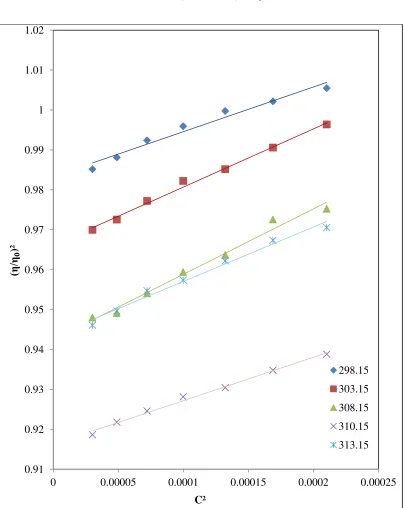
ηr2 = M + KC2 (4)
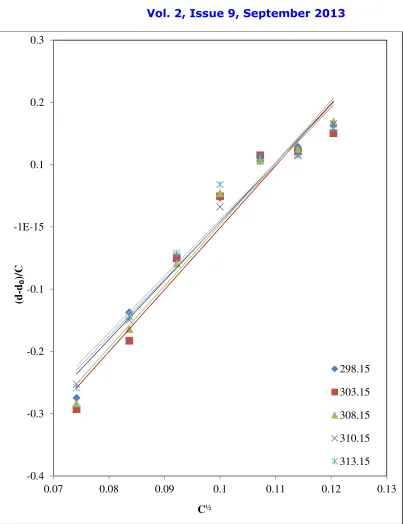
(d- do)/C = A - B C½ (5)
III. RESULTS AND DISCUSSION
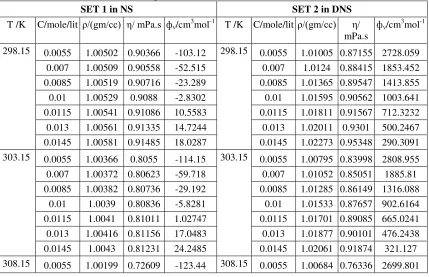
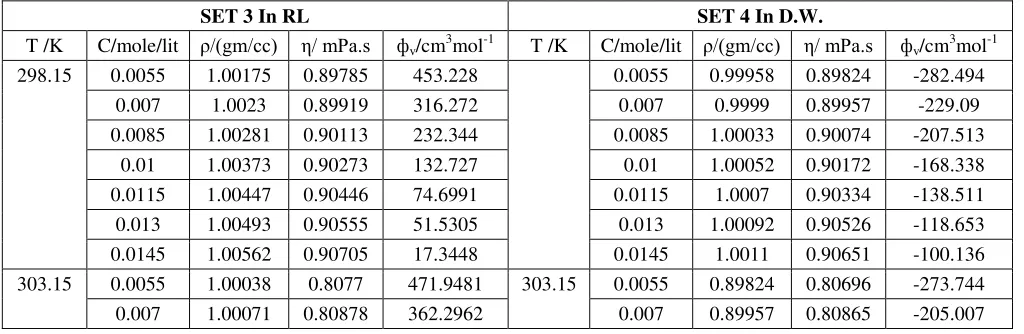
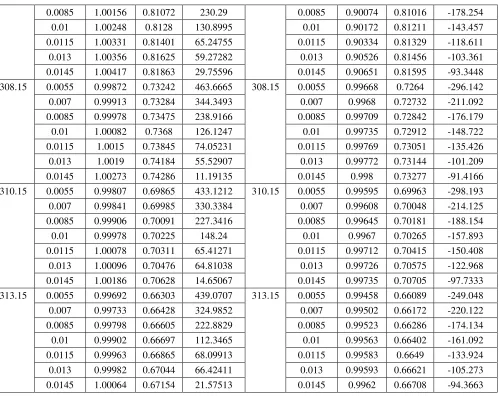
In table 1, the values of the densities, apparent molar volumes and viscosities of aspirin in NS, DNS, RL and pure distilled water are reported. In all sets the densities and viscosities of solutions increases with increase in concentration of solution. At higher temperatures the densities and viscosities becomes smaller. The apparent molar volumes фv’s are calculated by
using equation 1.The linear dependence of фv on concentration is observed for all the concentrations investigated. Figure
1-4 shows plots of apparent molar volume фv of aspirin against square root of concentration over the temperature range
293.15 K to 313.15K for different solvent systems..
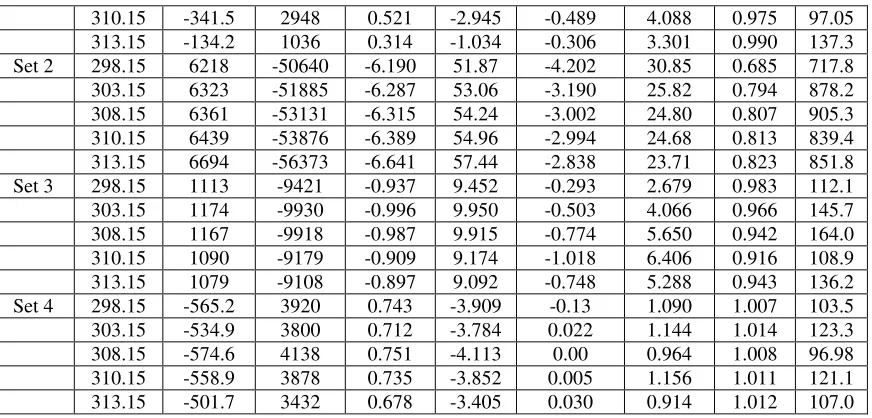
The partial molar volume фv
0 have been calculated from the intercept of linear plots using equation 2. The ф v
0
values are listed in table 2. The фv0 values for set 2 and 3 are positive, while that for set 1 and 4 are negative. The фv0 value
provides information regarding the ion-solvent interactions, drug hydrophobicity and hydration properties. The lower negative фv0 values suggest stronger hydrogen bonding 5.
The фv 0
values increases with rise in temperature for all sets performed16, except set 3. The positive values of Sv
obtained from the slope indicate strong inter and intra molecular interactions for set 1 and 4. The magnitude of Sv do not
show specific trend with temperature. The strong solute-solvent interactions reflects weak solute-solute interactions. Table 1: Density, apparent molar volume and viscosity of aspirin in NS, DNS, RL and pure
distilled water at different temperatures.
SET 1 in NS SET 2 in DNS
T /K C/mole/lit ρ/(gm/cc) η/ mPa.s фv/cm3mol-1 T /K C/mole/lit ρ/(gm/cc) η/
mPa.s
фv/cm3mol-1
298.15 0.0055 1.00502 0.90366 -103.12 298.15 0.0055 1.01005 0.87155 2728.059 0.007 1.00509 0.90558 -52.515 0.007 1.0124 0.88415 1853.452 0.0085 1.00519 0.90716 -23.289 0.0085 1.01365 0.89547 1413.855 0.01 1.00529 0.9088 -2.8302 0.01 1.01595 0.90562 1003.641 0.0115 1.00541 0.91086 10.5583 0.0115 1.01811 0.91567 712.3232 0.013 1.00561 0.91335 14.7244 0.013 1.02011 0.9301 500.2467 0.0145 1.00581 0.91485 18.0287 0.0145 1.02273 0.95348 290.3091 303.15 0.0055 1.00366 0.8055 -114.15 303.15 0.0055 1.00795 0.83998 2808.955 0.007 1.00372 0.80623 -59.718 0.007 1.01052 0.85051 1885.81 0.0085 1.00382 0.80736 -29.192 0.0085 1.01285 0.86149 1316.088
ISSN: 2319-8753
I
nternational
J
ournal of
I
nnovative
R
esearch in
S
cience,
E
ngineering and
T
echnology
(An ISO 3297: 2007 Certified Organization)
Vol. 2, Issue 9, September 2013
Copyright to IJIRSET www.ijirset.com 5059 0.007 1.00206 0.72675 -68.39 0.007 1.00923 0.77754 1824.681
0.0085 1.00213 0.72771 -32.771 0.0085 1.01135 0.78286 1289.537 0.01 1.0022 0.72812 -7.8375 0.01 1.01409 0.79498 854.213 0.0115 1.00229 0.72896 8.85282 0.0115 1.01601 0.80429 602.2885
0.013 1.00272 0.72989 -4.454 0.013 1.01895 0.81874 331.6535 0.0145 1.00326 0.73122 -22.591 0.0145 1.02097 0.83981 179.1546 310.15 0.0055 1.00134 0.70172 -152.64 310.15 0.0055 1.00589 0.73115 2735.672 0.007 1.00141 0.70279 -91.313 0.007 1.0082 0.74476 1863.846 0.0085 1.0015 0.70382 -53.984 0.0085 1.01111 0.7533 1230.536 0.01 1.00158 0.70516 -26.853 0.01 1.0129 0.76668 896.9958 0.0115 1.00162 0.70631 -3.3199 0.0115 1.01576 0.78001 559.2696 0.013 1.00171 0.70714 10.9346 0.013 1.01801 0.78922 345.4719 0.0145 1.00262 0.70794 -34.34 0.0145 1.02024 0.79473 177.2601 313.15 0.0055 0.99961 0.66465 -54.477 313.15 0.0055 1.004 0.69226 2846.196 0.007 1.00005 0.66614 -67.096 0.007 1.00707 0.70208 1843.773 0.0085 1.00026 0.6679 -48.156 0.0085 1.00921 0.7154 1302.523 0.01 1.00026 0.6691 -13.863 0.01 1.01201 0.72099 858.8757 0.0115 1.00035 0.67077 3.64438 0.0115 1.01455 0.73366 553.1505 0.013 1.00056 0.67193 7.86552 0.013 1.01695 0.74146 328.5461 0.0145 1.00167 0.67295 -50.96 0.0145 1.01955 0.75535 136.8752
Table 1: Continued….
SET 3 In RL SET 4 In D.W.
T /K C/mole/lit ρ/(gm/cc) η/ mPa.s фv/cm 3
mol-1 T /K C/mole/lit ρ/(gm/cc) η/ mPa.s фv/cm 3
mol-1 298.15 0.0055 1.00175 0.89785 453.228 0.0055 0.99958 0.89824 -282.494
0.007 1.0023 0.89919 316.272 0.007 0.9999 0.89957 -229.09 0.0085 1.00281 0.90113 232.344 0.0085 1.00033 0.90074 -207.513
ISSN: 2319-8753
I
nternational
J
ournal of
I
nnovative
R
esearch in
S
cience,
E
ngineering and
T
echnology
(An ISO 3297: 2007 Certified Organization)
Vol. 2, Issue 9, September 2013
Copyright to IJIRSET www.ijirset.com 5060 0.0085 1.00156 0.81072 230.29 0.0085 0.90074 0.81016 -178.254
0.01 1.00248 0.8128 130.8995 0.01 0.90172 0.81211 -143.457 0.0115 1.00331 0.81401 65.24755 0.0115 0.90334 0.81329 -118.611 0.013 1.00356 0.81625 59.27282 0.013 0.90526 0.81456 -103.361 0.0145 1.00417 0.81863 29.75596 0.0145 0.90651 0.81595 -93.3448 308.15 0.0055 0.99872 0.73242 463.6665 308.15 0.0055 0.99668 0.7264 -296.142 0.007 0.99913 0.73284 344.3493 0.007 0.9968 0.72732 -211.092 0.0085 0.99978 0.73475 238.9166 0.0085 0.99709 0.72842 -176.179 0.01 1.00082 0.7368 126.1247 0.01 0.99735 0.72912 -148.722 0.0115 1.0015 0.73845 74.05231 0.0115 0.99769 0.73051 -135.426 0.013 1.0019 0.74184 55.52907 0.013 0.99772 0.73144 -101.209 0.0145 1.00273 0.74286 11.19135 0.0145 0.998 0.73277 -91.4166 310.15 0.0055 0.99807 0.69865 433.1212 310.15 0.0055 0.99595 0.69963 -298.193 0.007 0.99841 0.69985 330.3384 0.007 0.99608 0.70048 -214.125 0.0085 0.99906 0.70091 227.3416 0.0085 0.99645 0.70181 -188.154 0.01 0.99978 0.70225 148.24 0.01 0.9967 0.70265 -157.893 0.0115 1.00078 0.70311 65.41271 0.0115 0.99712 0.70415 -150.408 0.013 1.00096 0.70476 64.81038 0.013 0.99726 0.70575 -122.968 0.0145 1.00186 0.70628 14.65067 0.0145 0.99735 0.70705 -97.7333 313.15 0.0055 0.99692 0.66303 439.0707 313.15 0.0055 0.99458 0.66089 -249.048 0.007 0.99733 0.66428 324.9852 0.007 0.99502 0.66172 -220.122 0.0085 0.99798 0.66605 222.8829 0.0085 0.99523 0.66286 -174.134 0.01 0.99902 0.66697 112.3465 0.01 0.99563 0.66402 -161.092 0.0115 0.99963 0.66865 68.09913 0.0115 0.99583 0.6649 -133.924 0.013 0.99982 0.67044 66.42411 0.013 0.99593 0.66621 -105.273 0.0145 1.00064 0.67154 21.57513 0.0145 0.9962 0.66708 -94.3663
Table 2: The flow and interaction parameters of aspirin solutions in the temperature range (298.15 to 313.15K).
Masson equation Roots equation Jone-Dole equation
Moulik equation
T /K фv⁰ Sv A B A B M K
ISSN: 2319-8753
I
nternational
J
ournal of
I
nnovative
R
esearch in
S
cience,
E
ngineering and
T
echnology
(An ISO 3297: 2007 Certified Organization)
Vol. 2, Issue 9, September 2013
Copyright to IJIRSET www.ijirset.com 5061 The viscosities (η) of solutions are listed in table 1.The η values increases with concentration and decreases with rise in temperature. This suggests the existence of molecular interactions occurring in the system. The viscosity data have been analyzed by using Jones –Dole equation 3. Where η and η0 are the viscosity of solute and solvent, respectively. The
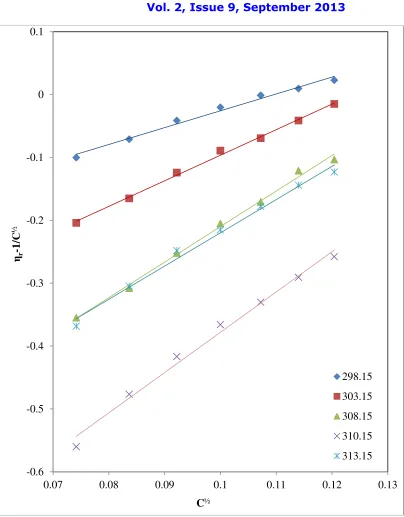
linear plots were observed for Jones Dole, Massons, Roots and Moulik equations. (figure 1-4).The flow and interaction parameters are reported in table no. 2.
Figure 2 shows the variation of (ηr-1)/C ½
against square root of concentration over the temperature range 293.15 K to 313.15K for different sets performed. A is constant independent of concentration and B is Jones-Dole coefficient represents measure of order and disorder introduced by solute into the solution, positive B-coefficient shows strong alignment of solvent towards solute and is related to the effect of the ions on the structure of water 17,18. The strong interaction immobilizes the neighboring solvent molecules and presents large obstruction to viscous flow of solution thereby increasing viscosity. Thus the present system behaves as structure maker.
The parameters obtained from Masson equation, Root’s equation, Jones-Dole equation, Moulik equation are listed in table 2. The observed values of A are negative and of B are positive. The positive values of B at all temperatures indicate water structuring17. M & K values are positive, M shows small magnitudes than K.
IV. CONCLUSIONS
Study of flow and interaction parameters of aspirin in presence of additives such as NaCl, KCl, Dextrose, Sodium lactate etc. at different temperatures suggests that
1. The values of фv0 at all temperatures are negative for set 1 and 4 , suggest the weak ion-solvent interactions in aqueous
solution, that may have the implication for the permeation of those molecules through biological membranes. 2. The Sv values are positive for set 1 and 4 suggesting strong ion-ion interactions.
3. The positive values of Jones-Dole coefficient B at all temperatures indicates water structuring behavior.
4. In aqueous solution the values of partial molar volume are positive/ negative and decrease with the extent of hydrogen bonding. Lower the partial molar volume value, stronger is the hydrogen bond. Positive values of B suggesting strongly hydrated solute indicating structure promoting tendency i.e. kosmotropes (structure makers).
ISSN: 2319-8753
I
nternational
J
ournal of
I
nnovative
R
esearch in
S
cience,
E
ngineering and
T
echnology
(An ISO 3297: 2007 Certified Organization)
Vol. 2, Issue 9, September 2013
Copyright to IJIRSET www.ijirset.com 5062 Figure 1: Plot of фv versus C½ for aspirin solution in RL at different temperatures.
-100
0
100
200
300
400
500
600
0.06
0.07
0.08
0.09
0.1
0.11
0.12
0.13
ɸ
v
C
½
ISSN: 2319-8753
I
nternational
J
ournal of
I
nnovative
R
esearch in
S
cience,
E
ngineering and
T
echnology
(An ISO 3297: 2007 Certified Organization)
Vol. 2, Issue 9, September 2013
Copyright to IJIRSET www.ijirset.com 5063 Figure 2: plot of (ηr -1)/ C
½
versus C½ of aspirin solutions in RL at different temperatures.
-0.6
-0.5
-0.4
-0.3
-0.2
-0.1
0
0.1
0.07
0.08
0.09
0.1
0.11
0.12
0.13
η
r-1/
C
½
C
½
ISSN: 2319-8753
I
nternational
J
ournal of
I
nnovative
R
esearch in
S
cience,
E
ngineering and
T
echnology
(An ISO 3297: 2007 Certified Organization)
Vol. 2, Issue 9, September 2013
Copyright to IJIRSET www.ijirset.com 5064 Figure 3: plot of (d-d0)/C versus C½ for aspirin solutions in RL at different temperatures.
-0.4
-0.3
-0.2
-0.1
-1E-15
0.1
0.2
0.3
0.07
0.08
0.09
0.1
0.11
0.12
0.13
(d
-d
)/C
C
½
ISSN: 2319-8753
I
nternational
J
ournal of
I
nnovative
R
esearch in
S
cience,
E
ngineering and
T
echnology
(An ISO 3297: 2007 Certified Organization)
Vol. 2, Issue 9, September 2013
Copyright to IJIRSET www.ijirset.com 5065 Figure 4: plot of (η/η₀)² versus C² for aspirin solutions in RL at different temperatures.
0.91
0.92
0.93
0.94
0.95
0.96
0.97
0.98
0.99
1
1.01
1.02
0
0.00005
0.0001
0.00015
0.0002
0.00025
(η
/η
)²
C²
ISSN: 2319-8753
I
nternational
J
ournal of
I
nnovative
R
esearch in
S
cience,
E
ngineering and
T
echnology
(An ISO 3297: 2007 Certified Organization)
Vol. 2, Issue 9, September 2013
Copyright to IJIRSET www.ijirset.com 5066 REFERENCES
[1] Essentials of Pharmacology, Surender Singh, Academa publishers, 2004, 1st edition, General Pharmacology, Section-1, Chapter 1.2, Page No.10.
[2] OYENIYI YJ*1 AND ITIOLA OA2, IJBPAS, “Pharmaceutical Evaluation of Direct Compressible Acetylsalicylic Acid Tablets Containing Sawdust
Microcrystalline Cellulose”, 1(3) pp 195-203, (April, 2012),
[3] Nikam, P.S., Ansari, H.R. and Hasan, M., “density and Viscosity Studies of Glucose and Fructose Solutions in Aqueous and 0.5mol dm3 Aqueous
NH4Cl”, J. Mol. Liq, 87(1) pp 97-105, (Aug 2000)
[4] Md. Monimul Huque1*, A.N.M. Hamidul Kabir 2, Md. Nurul Huda 2, Shaila Kabir 3, “Study of Physico-chemical Properties of Paracetamol and
Aspirin in Water-Ethanol System”, Bangladesh Pharmaceutical Journal; Vol. 13, No. 2 pp 13-19, ISSN 0301-4606, (July 2010)
[5] Muhammad Javed Iqbal *, Mansoora Ahmed Chaudhry, “Thermodynamic study of three pharmacologically significant drugs: Density, viscosity,
and refractive index measurements at different temperatures”, J. Chem. Thermodynamics 41 221–226 (2009).
[6] S. Chauhan, V.K. Syal, M.S. Chauhan, Poonam Sharma, “Viscosity studies of some narcotic– analgesic drugs in aqueous–alcoholic mixtures at 25
°C”, J. Mol. Liqs.136, pp161-164, (2007)
[7] Andreu A M, Ernesto V and Penna M P , “Apparent Molar Volumes of Strontium Nitrate and Copper(II) Chloride in Ethanol + Water at 298.15 K” , J. Chem. Eng. Data, 44 (1), pp 86-92, (1999)
[8] Ernesto V, Francisco J R and Andreu A M, “Apparent Molar Volumes of Calcium Nitrate in 1-Propanol + Water at 298.15 K”, J. Chem. Eng. Data, 44(6), pp 1212-1215, (1999).
[9] P S Nikam and A B Nikumbh, “Ionic Viscosity B-Coefficients of Tetraalkyl Ammonium Chlorides in (0 to 100) Mass Water + Methanol at 298.15
K”, J.Chem. Eng. Data, 47(3), pp 400-404, (2002)
[10] A. B. Nikumbh & G. K. Kulkarni, “Volumetric and transport properties of l-isoleucine in aqueous ethanol”, Journal of Chemistry & Material Research, Vol.-2, No- 5, ISSN 2225-956 (online), 2012.
[11] Masson D O, “Solute molecular volumes in relation to the salvation and ionization”, Philos, Mag, 8 , 218 (1929).
[12] G. Jones, M. Dole, “The viscosity of aqueous solutions of strong electrolytes with special reference to barium chloride”, J. Am. Chem. Soc. 51 , pp2950-2964 (1929)
[13] H Falkenhagen, M Dole, “Viscosity of electrolyte solutions and its significance to the Debye theory”, Zeitschrift Fur Physik , 30, pp 611-616 (1929).
[14] Moulik S P and Thomas J. “Proposed viscosity-concentration equation beyond Einstein region”, Phy. Chem, 72 , pp 4682-84, (1968). [15] Root W C, “An Equation Relating Density and Concentration”, J. Am. Chem. Soc. 55(2), 850-851, (1933).
[16] A. Ali, Shahjahan, “Volumetric, Viscometric and Refractive Index Behaviour of Some α-Amino Acids in Aqueous Tetrapropylammonium Bromide
solutions at Different temperatures”. J. Iranian Chem. Soc.3(4), pp 340-350 (2006).
[17] R. A. Robinson, R. H. Stokes, Electrolytic solutions, Butterworth Scientific Publications, London, 1959.
[18] B.Haribar,N.T.Southall, V. Vlachy, K.A. Dill, “How Ions Affect the Structure of Water”, J. Am. Chem. Soc. 124(41),