c e-ISSN: 2348-6848, p- ISSN: 2348-795X Volume 3, Issue 01, January 2016
International Journal of Research (IJR)
Available at http://internationaljournalofresearch.orgSecurity Fundamentals in Internet of Things
A. M. Chandrashekhar
Asst. Professor, Department of Computer Science and Engineering, SJCE, Mysuru , Karnataka,India
Chaitra K. V.
M Tech Student, Department of Computer Science and Engineering, SJCE, Mysuru , Karnataka,India
Sandhya Koti
M Tech Student, Department of Computer Science and Engineering, SJCE, Mysuru , Karnataka,India Abstract:
With growing number of smart devices per person and at each individual’s homes, it is estimated that the number of objects connected to the Internet is higher than the number of people connected to it. This trend is only gaining popularity with more and more objects now interfacing with the Internet. This in-turn creates a network of smart devices that are closely integrated with the physical world, thereby providing increased efficiency and economic benefit. This is collectively termed as Internet of Things - IoT. Just like all other technology enhancements, IoT also brings up threats and security issues that need to be considered before application of the technology in various fields.
This document provides a framework that describes the threats that will be seen at each level of IoT and the major issues needed to be addressed before implementing a secure system.
Keywords – Internet of Things (IoT); Security threats; Security vulnerabilities; Cyber attacks; Sensors; Intelligent computing
I. INTRODUCTION
In the past decade, there has been tremendous growth in the use of electronics and smart devices that are in use, leading to huge voluminous production and consumption of network data [1]. It is estimated that a staggering 75 billion devices will be connected to the internet by 2020.
Internet of Things (IoT) is the technology wherein more and more small and embedded devices get linked to the Internet. IoT describes the present and a future where several physical objects in our day to day lives will get connected with the internet and thereby get identified by surrounding objects and work in unison with them. This change in paradigm which brings in a network of several smart decentralized devices also brings up a new angle to security. Increased number of connected devices opens up more doorways for cyber-crime. With variety of devices and sensors in place, there are different kinds of vulnerabilities that exist and each of these needs to be looked into, to enable a solid foundation for IoT.
This paper provides a comprehensive study of various facets of security related to IoT. This paper is structured as follows: Section II describes the vulnerabilities, threats and attacks to which IoT is susceptible. Section III provides an overview of
the domains of IoT system in which security needs to be implemented. Section IV describes the security architecture of the IoT system. Section V highlights the challenges in developing a secure architecture for IoT systems. Section VI concludes the paper summarising the different aspects of a secure IoT system.
II. ATTACKS ON IOT SYSTEM The IoT devices may become vulnerable to cyber-attacks for the below reasons:
i. Many of the IoT devices are small or
embedded devices operating without any human supervision and hence an attacker can easily gain access to them.
ii. Communication of most of the IoT devices
happens over wireless networks where eavesdropping or man-in-the-middle attacks could be possible.
iii. Due to low power and low resource
constraints, implementing complex security algorithms on IoT systems is not always feasible.
c e-ISSN: 2348-6848, p- ISSN: 2348-795X Volume 3, Issue 01, January 2016
International Journal of Research (IJR)
Available at http://internationaljournalofresearch.orgFigure 1: Attacks on IoT System
A. Physical Attacks
These attacks include reverse engineering and microprobing attacks. In case of reverse engineering, the attacker may have gained access to the technology used in the device, apply this knowledge it to understand the internal architecture and functionality of the device and thereby become capable of breaching the device security. In case of microprobing attacks, the attacker may tamper the device by accessing the chip surface directly.
B. Side Channel Attacks
These attacks include timing attacks and power analysis attacks. Based on the size of the input data and the cryptographic algorithms used, attackers are now able to compromise the IoT systems by timing analysis. Studying the power consumed by the various cryptographic devices [4], attackers are now able to extract keys and other secret information from the IoT devices.
C. Environment Attacks
Heterogeneity and the distributed nature of the IoT devices and most of them operating in an outdoor insecure environment make them vulnerable to these attacks [5].
D. Network Attacks
With most of the recent devices working in a wireless environment, the broadcast messages sent through the devices are susceptible to attacks. Routing attacks are the most common kid of these attacks. Others include node capture, eavesdropping, message corruption, traffic analysis etc.
E. Cryptanalysis attacks
Brute force attacks, dictionary attacks and replay attacks to gain access to passwords or misuse the acquired passwords fall into this
category. Decryption of the encryption
algorithms used by securing passwords or secure keys through various cyber-attacks is also carried out.
F. Software Attacks
These include manipulation of the controller
software to change configurations with
intentions of harming the system and its users. These also include Denial of Service (DoS) attacks whereby the system or resource is made unavailable to its intended users.
III. SECURITY DOMAINS OF IOT
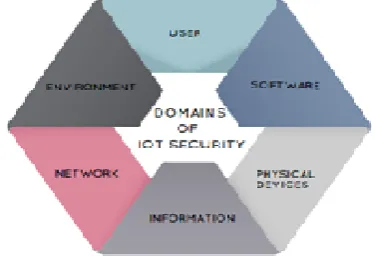
The security implementation in any IoT system needs to encompass the domains as shown in figure 2:
Figure 2: IoT Security Domains A. User
There must be appropriate user
authentication and authorisation
mechanisms in place to secure the IoT
system. The whole system becomes
susceptible to attacks when the user identification is illegitimate. Every user must be associated with a set of access rights and permission to use the resources in the system.
B. Software
c e-ISSN: 2348-6848, p- ISSN: 2348-795X Volume 3, Issue 01, January 2016
International Journal of Research (IJR)
Available at http://internationaljournalofresearch.orgprone to deliberate software attacks such as viruses, worms, Trojan horses.
C. Physical Devices
The physical components of the IoT system have to be protected from any type of physical tampering or logical probing. The security requirements of the system must not be compromised even when these devices are nabbed.
D. Information
The confidentiality and integrity of the information stored in the IoT system must be preserved. The accesses to the information must be monitored to ensure that no privacy policies are violated.
E. Network
Since most of the communications
between IoT devices are through
broadcasting over wireless transmission medium, maintenance of security and reliability of the network is a major concern.
F. Environment
The environment to run the IoT applications must be secure. Attacks on the environment of the IoT system are easier than the device itself. In order to prevent misuse at the application level there must be security measures implemented in the runtime environment.
IV. ARCHITECTURE OF IOT
The IoT systems are used in critical
applications such as military surveillance,
healthcare, medical services, intelligent
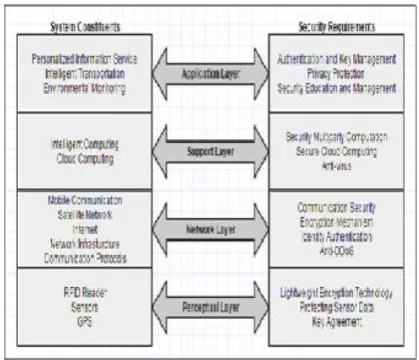
transportation, intelligent home etc. The security architecture [6] of such crucial system has to be robust enough to counter attacks at various levels and provide reliable and sustainable environment. The security architecture of IoT system consists of four generic layers as shown in figure 3.
Figure 3: Security Architecture for IoT System
A. Perceptual Layer
The most basic layer is the perceptual layer which consists of all the physical devices used to collect data from the real world entities. The devices are heterogeneous in nature – different types of
sensors, RFID readers, and global
positioning system devices. All the data collected from different types of sensors are consolidated and stored. These data need to be protected using various encryption algorithms. Since the sensors are resource constrained with respect to computation and power, complex cryptographic algorithms cannot be used. Specialized lightweight algorithms are to be employed to provide integrity and authenticity to the data.
B. Network Layer
The network layer ensures reliable transmission of information from the perceptual layer. This layer lays the infrastructural framework for all the networking protocols needed for effective communication between the components of
the IoT system. The existing
communication mechanisms cannot be directly employed in case of the IoT system.
This layer requires confidentiality,
reliability and integrity mechanisms to provide a resilient environment countering the network attacks and also provide security during communication between devices.
c e-ISSN: 2348-6848, p- ISSN: 2348-795X Volume 3, Issue 01, January 2016
International Journal of Research (IJR)
Available at http://internationaljournalofresearch.orgThe support layer furnishes the architecture with a suitable platform to support the applications of the system. This layer acts as the bridge between the hardware based network layer and the software based application layer. The platform must support all types of intelligent computing [7] to boost the capabilities of the underlying technologies such as cloud computing, grid computing. The support layer must embed strong security mechanisms for the pertinent technology in order to ensure smooth functioning of the system.
D. Application Layer
The application layer is the topmost
and terminal layer of the security
architecture of IoT system. This layer provides personalized services to the end users. The application built upon this layer
may be a surveillance system,
environmental monitor, intelligent
transportation etc. The diverse security needs of the individual applications include
authentication, privacy protection [8],
access control, password and key
management.
V. CHALLENGES
The challenges [9][10] that arise while developing a secure architecture for IoT systems mainly consist of:
1. The sensors embedded in the IoT system are
battery powered –low energy devices. These sensors have to be exploited judiciously during enforcement of secure transmissions to minimize the energy consumption and hence make the system energy efficient.[11][12]
2. IoT devices employ broadcast mechanism
for communication. This is a power draining process and also vulnerable to
many attacks. Developing specialized
routing algorithms for communication is laborious and may not be feasible all the time.[13][14]
3. The nodes of IoT system have limited
computing power and hence complex
cryptographic algorithms requiring
considerable computations are not feasible for IoT system. Developing lightweight cryptographic algorithms optimised for these devices are both expensive and time consuming.[15][16]
4. IoT system aims at interconnecting
heterogeneous devices to achieve
communication among them. The
challenging task here is to achieve interoperability among these devices in its network by providing a common platform for communication. With such diverse
platforms adopted, implementation of
security needs to be standardised. [17][18]
5. Ensuring the integrity of the data sent and
the confidentiality of the data collected to/from IoT devices or sensors has become mandatory. Sensitive data collected by IoT
devices is one of the potential
vulnerabilities of the system.[19][20]
6. Considering the ubiquity of IoT systems in
the current generations, the toughest task is
to fulfil the information privacy
requirements. Poor encryption mechanisms, backdoors or weak links could make the system more susceptible to serious issues like information leakage or misuse.[21][22]
7. Considering the huge volume of data and
heterogeneity of devices, the current network security approaches may not be directly applicable to IoT domain. Proper measures suitable to the applications need to be devised to ensure security.[23][24]
8. Every IoT device is slightly different. Every
configuration of IoT system thus needs to implement pertinent security mechanisms. Abstraction of security parameters is not possible.[25][26]
9. Appropriate care need to be taken to
upgrade or patch the security vulnerabilities during the maintenance phase to make the
system sustainable with evolving
technologies.[27][28]
10. Current technological advancements compel
c e-ISSN: 2348-6848, p- ISSN: 2348-795X Volume 3, Issue 01, January 2016
International Journal of Research (IJR)
Available at http://internationaljournalofresearch.orgefforts centred on quick deployment security becomes an afterthought[29][30].
VI. CONCLUSION
The study of threats and attacks on IoT systems is an exhaustive area if we dwell into the application specifics. In this paper, we have surveyed the security challenges and attacks that are almost basic for most of the deployments of IoT systems[31][32]. Keeping in mind the various vulnerability and threat factors discussed in this paper and implementing the counter measures in every phase of development lifecycle of IoT systems, will be crucial for the future maintenance and manageability of the systems[33]. This will also ensure reduction in cost, and sustainability of the product.
In summary, rapid development of IoT for various environments and applications, need to be supplemented with appropriate security measures so as to ensure its steady growth in the future as well as to satisfy consumer and business requirements.
REFERENCES:
[1] Michael J. Covington, Rush Carskadden,
“Threat Implications of the Internet of Things”; 5th International Conference on Cyber Conflict K. Podins, J. Stinissen, M. Maybaum, 2013
[2] Sachin Babar, Antonietta Stango, Neeli
Prasad, Jaydip sen, Ramjee Prasad, “Proposed Embedded Security Framework for Internet of Things (IoT)” ; IEEE Wireless Communication, Vehicular Technology, Information Theory and Aerospace & Electronic Systems Technology (Wireless VITAE), 2011
[3] Srivats Ravi, Anand Raghunathan, Paul
Kocher, Sunil Hattangady, “Security in Embedded System: Design challenges” ; Transactions on Embedded Computing systems, Vol. 3, Issue 3, 2004
[4] Colin O’Flynn, Zhizhang Chen, “Power
Analysis Attacks against IEEE 802.15.4 Nodes”; International Association for Cryptologic Research, 2015
[5] Hagai Bar-El, “An Introduction to side
Channel Attacks”; White paper, Discretix
Technologies Limited.
[6] Mainetti L, Mighali V, Patrono L, “A
Software Architecture Enabling the Web of Things” ; Internet of Things Journal, IEEE, Vol. 2 , Issue: 6 , Page: 445- 454, 2015
[7] Chen Qiang , Guang-ri Quan , Bai Yu, Liu
Yang, “Research on Security Issues of the Internet of Things”; International Journal of Future Generation Communication and Networking, Vol.6, No.6, Page: 1-10,2013
[8] Tuhin Borgohain , Uday Kumar , Sugata
Sanyal , “Survey of Security and Privacy Issues of Internet of Things”Ebraheim Alsaadi, Abdallah
Tubaishat, “Internet of Things: Features,
Challenges, and Vulnerabilities”; International Journal of Advanced Computer Science and Information Technology (IJACSIT) Vol. 4, No. 1, Page: 1-13, 2015
[9] Hua-Dong Ma, “Internet of Things:
Objectives and Scientific Challenges”; Journal Of Computer Science And Technology, Vol. 26(6), Page: 919–924, 2011
[10] A. M. Chandrashekhar and K. Raghuveer,
“Fusion of Multiple Data Mining Techniques for Effective Network Intrusion Detection – A Contemporary Approach”, Proceedings of The 5th International Conference on Security of Information and Networks (SIN 2012), 2012, pp 33-37.
[11] A. M. Chandrashekhar and K. Raghuveer,
“An Effective Technique for Intrusion Detection using Neuro-Fuzzy and Radial SVM Classifier”, The Fourth International Conference on Networks & Communications (NetCom-2012), 22~24, Dec- 2012.
[12] A. M. Chandrashekhar and K. Raghuveer ,
“Intrusion Detection Technique by using K-means, Fuzzy Neural Network and SVM classifiers”, 2013 IEEE International Conference on Computer Communication and Informatics (ICCCI -2013), 4~06,Jan2013, IEEE Catalog Number: CFP1308R-ART, ISBN Number: 978-1-4673-2907-1.
[13] A. M. Chandrashekhar and K. Raghuveer,
c e-ISSN: 2348-6848, p- ISSN: 2348-795X Volume 3, Issue 01, January 2016
International Journal of Research (IJR)
Available at http://internationaljournalofresearch.orgInternational Conference on Communication and Signal Processing (ICCSP),2014, pp 672-676.
[14] A. M Chandrashekhar A M and K.
Raghuveer, “Hard Clustering Vs. Soft Clustering: A
Close Contest for Attaining Supremacy in Hybrid NIDS Development”, Proceedings of International Conference on Communication and Computing (ICC - 2014), Elsevier science and Technology Publications.
[15] A. M. Chandrashekhar and K. Raghuveer,
“Amalgamation of K-means clustering algorithem with standard MLP and SVM based neural networks to implement network intrusion detection system”, Advanced Computing, Networking, and Informatics –Volume 2(June 2014), Volume 28 of the series Smart Inovation, Systems and Technologies pp 273-283.
[16] A. M Chandrashekhar A M and K.
Raghuveer, “Diverse and Conglomerate
Modi-operandi for Anomaly Intrusion Detection Systems”, International Journal of Computer Application (IJCA) Special Issue on “Network Security and
Cryptography (NSC)”,2011.
[17] A. M. Chandrashekhar and K. Raghuveer,
“Performance evaluation of data clustering techniques using KDD Cup-99 Intrusion detection data set”, International Journal of Information and Network Security (IJINS), ISSN: 2089-3299, Vol-1, No.4, October 2012, pp. 294~305.
[18] A. M. Chandrashekhar and K. Raghuveer,
“Fortification of hybrid intrusion detection system using variants of neural networks and support vector machines”, International Journal of Network Security & Its Applications (IJNSA) ISSN: 0974-9330[online]& 0975-2307[print].Vol.5, Number 1, January 2013.
[19] A. M. Chandrashekhar and K. Raghuveer ,
“Improvising Intrusion detection precision of ANN based NIDS by incorporating various data
Normalization Technique – A Performance
Appraisal”, International Journal of Research in Engineering & Advanced Technology(IJREAT), Volume 2, Issue 2, Apr-May, 2014.
[20] Puneeth L Sankadal ,A. M Chandrashekhar,
“Network Security situation awareness system”
International Journal of Advanced Research in
Information and Communication
Engineering(IJARICE), Volume 3, Issue 5, May 2015.
[21] Prashanth G M, A.M.Chandrashekhar,
“Secured infrastructure for multiple group communication” International Journal of Advanced Research in Information and Communication Engineering (IJARICE), Volume 3, Issue 5, May 2015.
[22] Sowmyashree K.K, A.M.Chandrashekhar,
“Pyramidal aggregation on Communication
security” International Journal of Advanced Research in Computer Science and Applications (IJARCSA), Volume 3, Issue 5, May 2015.
[23] Huda Mirza Saifuddin,
A.M.Chandrashekhar, “Exploration of the
ingredients of original security” International Journal of Advanced Research in Computer Science and Applications(IJARCSA), Volume 3, Issue 5, May 2015.
[24] Syed Tahseen
Ahmed,A.M.Chandrashekhar, “Analysis of Security
Threats to Database Storage Systems” International Journal of Advanced Research in data mining and Cloud computing(IJARDC), Volume 3, Issue 5, May 2015.
[25] Yadunandan Huded, A.M.Chandrashekhar,
“Advances in Information security risk practices” International Journal of Advanced Research in data mining and Cloud computing (IJARDC), Volume 3, Issue 5 May 2015.
[26] Madhura S Hegde, A.M.Chandrashekhar,
“A Survey:Combined impact of cryptography and
steganography” International Journal of
Engineering Research (IJOER), Volume 3, Issue 5, May 2015.
[27] Koushik P, A.M.Chandrashekhar,
“Information security threats, awareness and coginizance” International Journal for Technicle research in Engineering(IJTRE), Volume 2, Issue 9, May 2015.
[28] Rahil kumar Gupta and
A.M.Chandrashekhar, “Role of information security
c e-ISSN: 2348-6848, p- ISSN: 2348-795X Volume 3, Issue 01, January 2016
International Journal of Research (IJR)
Available at http://internationaljournalofresearch.orgInternational Journal of Research (IJR) Volume 2, Issue 6, May 2015.
[29] A. M. Chandrashekhar, Hariprasad M,
Manjunath A, “The Importance of Big Data Analytics in the Field of Cyber Security”, Volume 3, Issue 11, JAN-2016.
[30] A. M. Chandrashekhar, Arpitha, Nidhishree
G, “Efficient data accessibility in cloud with privacy
and authenticity using key aggregation
cryptosystem”, International Journal for
Technological research in Engineering (IJTRE), Volume 3, Issue 5, JAN-2016.
[31] A. M. Chandrasekhar, Jagadish Revapgol,
Vinayaka Pattanashetti, “Security Issues of Big Data in Networking”, International Journal of Scientific Research in Science, Engineering and Technology (IJSRSET), Volume 2, Issue 1, JAN-2016.
[32] A. M. Chandrashekhar, Anjana D, Muktha