Tracking and Shooting Robot
1
vivek Mamidala;
2harish Cherukoori &
3n Rakesh Goud
1 2 3
B.Tech, B V Raju Institute of Technology, Vishnupur, Narsapur, Medak District
1
[email protected]
,
2[email protected]
,
3[email protected]
Abstract—
The Tracking and Shooting Robot is an
autonomous bot that tracks the objects based on its
color and targets the object using a gun prototype.
The project is primarily concerned with the
deployment of two different tasks, i.e Tracking the
object and aiming the tracked object once it comes
to rest.
Keywords— open CV; Robotics; Artificial
Intelligence; Gun Prototype; Tracking
I.
INTRODUCTION
Robots are used successfully in many areas today,
particularly in industrial production, military
operations,
deep
sea
drilling,
and
space
exploration.
Everything around us is becoming
automatic, autonomous and smart because of these
artificial giants. These advantages of the present
day technology can solve the extreme version
problems of the mankind. It is very difficult for the
humans to keep track of the things in the extreme
fields (like excess heat, humid and cold conditions
etc). For example it is very difficult for the humans
to keep track of the animals in the rainforests and
jungles manually. By the enforcement of this
project we want to replace the human authority
with an autonomous robot. We want to employ this
robot in the extreme weather conditions where the
normal beings cannot work or are unable to work
efficiently. For example if we consider a company
that manufactures the automobile spares. The
company manufactures many different kinds of
spares which vary in shape, colour and dimension.
In such a big manufacturing unit, thousands of
spares are produced every hour and when these
spares
passes through the quality check to examine for
any wear and tear in the spares. The human eyes
can detect the drastic and large damages but not
the minute defects in such a less time and hence
the quality of the auto spares decrease and loses its
quality and trust among the public. But if we
replace the human activity with this robot and
initially we create a database of the original and
exact spare then the robot can track and detect the
perfect spares and rejects the defected ones
II.
SYSTEM ARCHITECTURE
The system architecture of this proposed system consists of 5 blocks.
Figure-1:Block Diagram
A camera is used to capture real time video
streaming and it will be sent to the PC for image
processing. PC will use open CV software to
detect the objects of a predefined color and to
implement algorithm to detect the rotation
required by servo motors to target the object. PC
and Arduino are interfaced using USB-UART
Bridge. Arduino will control the rotation of
servomotors so that they move according to the
object movement. Gun prototype will shoot the
object once the servos rotate according to the
instructions by Arduino.
III. IMPLEMENTATION
HARDWARE:
The Arduino Uno is a microcontroller board based
on the ATmega328 (datasheet). It has 14 digital
input/output pins (of which 6 can be used as PWM
outputs), 6 analog inputs, a 16 MHz crystal
oscillator, a USB connection, a power jack, an
ICSP header, and a reset button.The Uno differs
from all preceding boards in that it does not use the
FTDI USB-to-serial driver chip. Instead, it features
the Atmega8U2 programmed as a USB-to-serial
converter.
Atmel ATmega328 microcontroller operating at 5
V with 2Kb of RAM, 32 Kb of flash memory for
storing programs and 1 Kb of EEPROM for
storing parameters. The clock speed is 16 MHz,
which translates to about executing about 300,000
lines of C source code per second.
Figure-2:ARDUINO
Components in the project are connected as shown in figure.
Figure-3:PROJECT SETUP
The wire used to connect PC/laptop and Arduino will acts as USB-UART Bridge it will enable the PC/Laptop to send serial data to Arduino.Two Servo motors are connected to the Arduino at digital pins 9,10.gun prototype is attached to the vertical servo motor and it is connected to the Arduino at GND,13 pins.
SOFTWARE:
The Arduino integrated development environment (IDE) is a cross-platform application written in Java, and derives from the IDE for the Processing programming language and the Wiring projects. Arduino programs are written in C or C++. The Arduino IDE uses the GNU toolchain and AVR Libc to compile programs, and uses avrdude to upload programs to the board. Object detection and tracking is done using openCV with Visual Studio 2012, and the web server interface was designed using HTML and PHP.
IV.
ALGORITHM & FLOWCHART
ALGORITHM:
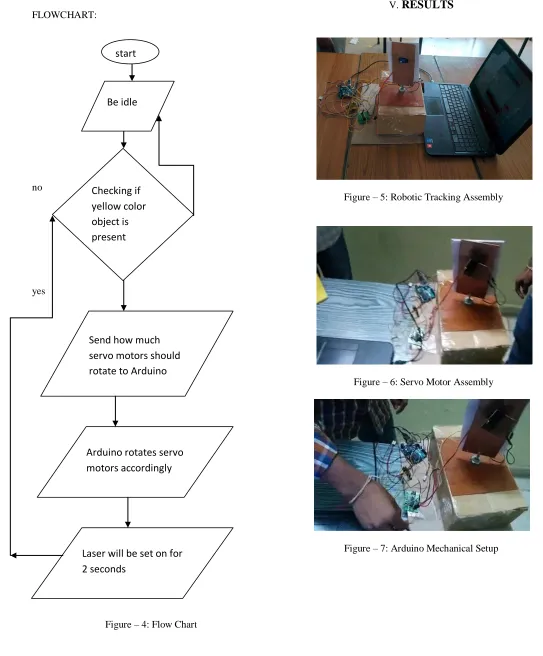
Step – 1: Initialize Arduino,PC,UART Module. Step – 2:Be idle
Step – 3: If yellow color object is present No: go to Step-2
Yes: go to step 4
Step – 4: send how much servo motor should rotate to Arduino
FLOWCHART:
no
yes
Figure – 4: Flow Chart
V.
RESULTS
Figure – 5: Robotic Tracking Assembly
Figure – 6: Servo Motor Assembly
Figure – 7: Arduino Mechanical Setup start
Checking if yellow color object is present
Be idle
Send how much servo motors should rotate to Arduino
Arduino rotates servo motors accordingly
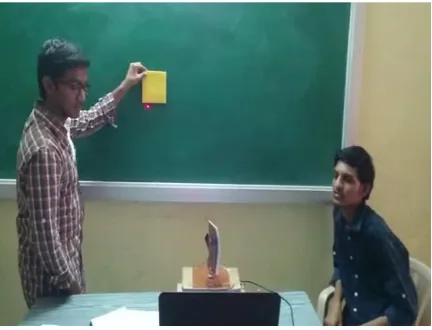
Figure – 8: Tracking Yellow Color Object
Figure – 9: Tracking Yellow Color Object 2
Figure – 10: Tracking Yellow Color Object 3
Figure – 11: Coordinates of Yellow Colored Object
Figure – 12: Coordinates of Yellow Colored Object
VI.
CONCLUSION
We have successfully implemented an autonomous robot that tracks and targets the object on the color basis. We have tested and took a lot of observations within our limited resources and found the results to be efficient. We have not only detected a single color object but also the multicolor objects.
ACKNOWLEDGEMENT
in doing a lot of Research and i came to know about so many new things we are really thankful to them.
And, secondly i would also like to thank my parents and friends who helped me a lot in finalizing this project within the limited time frame.
REFERENCES
[1]R. C. Gonzales, R. E. Woods, Digital Image Processing, Reading, MA: Addison-Wesley, 1995.
[2] R.C. Gonzalez and R. E, Woods(2008), Digital Image Processing, Pearson Education, 3rd Edition. | [4] BeagleBoard-xM Rev C System Reference Manual(2010),http://beagleboard.org, Revision 1.0.
[3] G. Bradski and A. Kaehler(2008), Learning OpenCV, OReilly Publications.
[4] Babu R. V., Sures S. and Makur A.(2010) Online adaptive radial basis function network for robust object tracking. Computer Vision and Image Understanding, 114(3):297–310.
[5] S K Teoh, VooiVoon Yap, Chit Siang and Soh Patrick Sebastian.(2012), “Implementation and Optimization of Human Tracking System using ARM Embedded Platform.” 2012 4th International Conference on Intelligent and Advanced Systems (ICIAS2012), IEEE, 353-356