Institute of Acoustics Workshop on Innovation in Speech Processing, Stratford -on-Avon, May, 2001
LEARNING ON THE JOB: THE APPLICATION OF
MACHINE LEARNING WITHIN THE SPEECH DECODER
M A Huckvale Department of Phonetics and Linguistics, University College London, Gower Street, London WC1E 6BT, U.K.
G J A Hunter Department of Phonetics and Linguistics, University College London, Gower Street, London WC1E 6BT, U.K.
1. INTRODUCTION
The current approach to the training of large vocabulary continuous speech recognition (LVCSR) systems involves the use of large corpora of text and labelled audio recordings [1]. These resources are analysed and statistics extracted so that the recogniser can determine the likelihood that the observed signal would have been generated from each sentence it proposes. The analysis of corpora is performed off-line, using statistical language models of the text (often trigram models of words), and acoustic models of the signal (often hidden Markov models of phonemes).
To this off-line processing, recent years have seen a growth in the use of methods of adaptation in which the general statistical models are tuned to the specific characteristics of a given speaker, a given acoustic environment or a given topic. These adaptation processes modify the stored characteristics of the language model and the acoustic model to improve the probability that the correct interpretation would have given rise to the observed signal.
No one would argue that these components provide a perfect model of the true statistical distribution of words and sounds. Weaknesses in typical acoustic models include:
q crude modelling of the interdependencies between the acoustic forms of
different phones
q no model of systematic pronunciation variation across different contexts or
speakers
q little exploitation of durational or pitch cues
q no exploitation of knowledge of style, emotion, or physiological state of the
speaker
Weaknesses in typical language models include
q restriction to short-distance dependencies within sentence (trigram models) q little exploitation of topic or meaning or grammaticality
q poor predictive power for novel or rare events
Machine Learning in the Speech Decoder–Huckvale and Hunter
These weaknesses are, of course, opportunities for research; and much effort has been spent at looking at these.
There are also many weaknesses that can be seen within the decoder: how these statistical components are exploited in recognition. Weaknesses here include:
q arbitrary balancing of probabilities between the acoustic and language
models
q ignorance of interactions between the acoustic model and the language
model
q assumptions that words don’t overlap in time q inability to deal with disfluencies and restarts
These are less common areas for research.
Thus we arrive at the present situation in which work is required on many fronts, but each aspect may in itself only provide a modest improvement in performance. It is as if there are many small weaknesses rather than one significant problem. A serious consequence of this situation in speech recognition research is that workers on one small aspect do not know what effect their ‘improvements’ will have in combination with the work of others. We have been working in the area of morphology for speech recognition [2] but we do not know whether the improvements we’ve seen will show up in combination with more sophisticated language models or with state-of-the-art acoustic models.
In this paper we are looking towards a ‘third way’. Rather than try to build better statistical models, or try to find ways of adapting them to the context, we seek to apply general machine learning principles within the decoder. Thus the decoder will monitor and modify its own behaviour by ‘learning on the job’. This work is very much in the exploratory stage. We do not yet know whether the approach will make any significant impact. We do not yet know how it relates to other work in improving language models and acoustic models. We do not even know the best way to make it work.
Our learning decoder is able to relate the correct transcription of an utterance to the complete list of hypotheses that it generated during its attempt at decoding the signal. By looking at the correct and incorrect hypotheses over large numbers of training utterances, it tries to find features of these hypotheses that correlate with their correctness (or with their incorrectness). The aim is not to replace the language model or acoustic model, nor to act as an alternative to adaptation. Instead the machine learning should identify and compensate for common errors made during decoding. Those features that correlate with correct can be used to improve the score of probably correct hypotheses, and those features that correlate with incorrect can be used to worsen the score of probably incorrect hypotheses. We can use data held-out from training to evaluate the effect of the learning component.
proof-of-Machine Learning in the Speech Decoder–Huckvale and Hunter
concept. In section 4 we reflect on the promises offered by the technique and make suggestions for further investigations.
2. Supervised machine learning in the decoder
The aim of the machine learning system is toq uncover characteristic features of sentence fragment hypotheses which correlate
with the correctness of the hypothesis, and
q deliver a probability to the decoder that a sentence fragment is correct given the
features that it exhibits.
We describe each of these in turn.
2.1 Selection of features
What features of a sentence fragment hypothesis would assist in determining its probability of being correct? Any features we choose should be complementary to the information provided by the acoustic model and the language model.
In terms of acoustic information, these features might be based on:
q articulation rate, tempo variations, segment durations q fundamental frequency, voice quality
q articulatory quality q level of background noise
q detection of speaker, accent, style, emotion or physiological state
In terms of linguistic information, these features might be based on:
q collocational information about words across whole sentences q measures of grammaticality
q measures of semantic relationships between words
Although many of these aspects of language are likely to influence how a listener decodes an utterance, it is just very complicated to see how they can all be modelled independently and all incorporated in the decoding.
Worse, in many cases we don’t know the relative importance of the different features, not how they interact. It is very hard to judge the utility of the information provided by a feature. We may run into the problem highlighted by Rosenfeld [3] that we will never have enough data to model rare events - because they are rare.
Machine Learning in the Speech Decoder–Huckvale and Hunter
∑ ∑
= ==
=
=
=
=
=
1 , 0 0,1)
)
(
)
|
(
log(
)
,
(
)
,
(
f g i i ig
y
p
f
f
g
y
p
g
y
f
f
p
y
f
MI
(1)We can choose features with high mutual information shown between the feature and the known correctness of a hypothesis. Features with high mutual information may be useful in predicting correctness or incorrectness and are saved for evaluation in combination.
2.2 Probability modelling of features
Given some signal S and some hypothesis W, we normally calculate the probability that a hypothesis is an interpretation of a signal using Bayes’ theorem
p(W|S) = p(S|W).p(W)/p(S) (2)
Where p(S|W) is the probability that the hypothesis generated the signal calculated by the acoustic model, and p(W) is the probability of the hypothesis itself, as calculated by the language model. The decoder seeks to find the single hypothesis that maximises p(W|S).
To incorporate knowledge about some additional features of a hypothesis F(W) not covered by the language model, we can extend the language model to incorporate the prediction of some property y indicating the correctness of the hypothesis:
p’(W,y) = p(W).p(y|F(W)) (3)
assuming that the language model and the predictions from the features are independent. The probability that a hypothesis is correct given the features of the hypothesis can be expressed in terms of an exponential model of the form
]
exp[
1
]
exp[
))
(
|
(
∑
∑
+
=
=
i i i i i if
f
W
F
correct
y
p
λ
λ
(4)where fi is 1 if the feature i is present in the list F(W). The {?i} are constants found from training data. A particular benefit of this model is that the {?i} can be estimated using the principle of maximum entropy. Here the least constraining assumptions are drawn from the training data. The {?i} are found by maximising the entropy function
∑
+
∑
+
∑
−
=
Ψ
x i i
i i i
i
f
p
f
x
p
(
)
log(
1
exp[
])
(
)
)
(
λ
λ
λ
(5)Machine Learning in the Speech Decoder–Huckvale and Hunter
3. Experiment
3.1 Materials
Text material for training and testing was selected from the British National Corpus [6]. 80M word of text was reserved for training, and the rest for testing. The corpus was pre-processed to remove all punctuation except for sentence markers, and to convert all numeric items and abbreviations to whole words. A vocabulary of 65,000 words was generated from the most common words in the training portion.
For this experiment we used 1000 spoken sentences taken from the testing portion of the BNC, 100 each from 5 male and 5 female speakers of British English. These were converted to word lattices using the Abbot system [7] with a 65,000-word pronunciation dictionary adapted from BEEP [8] and supplemented with pronunciations from a letter-to-sound system. Abbot was run with parameters provided by Steve Renals to increase the maximum number of hypotheses considered per node to 100. A language model was constructed for the 65,000-word lexicon using the 80Mword training portion of the BNC. This was performed using the CMU-Cambridge toolkit [9] using Good-Turing discounting.
Decoding of the word lattices using the language model was performed by the UCL decoder, which is able to report node-by-node the currently considered sentence fragment hypotheses for each time step in the word lattice. These hypotheses always extend from the start of the sentence to a word that ends at the current node. They are marked with an overall log probability found during decoding from the acoustic model and the language model.
3.2 Preparation
The hypotheses produced during the decoding of the 1000 sentences were marked for correctness using the known transcription. For training and testing the maximum entropy feature model, we used only those hypotheses that originated from nodes where a correct answer was present within the top 100 hypotheses. This gave us a total of 430,000 hypotheses, of which 26,000 were correct. On average each hypothesis contained 5.65 words.
10% of the data (10 sentences) was reserved from each speaker for testing; the rest was input to the training procedure.
3.3 Feature generation
Machine Learning in the Speech Decoder–Huckvale and Hunter
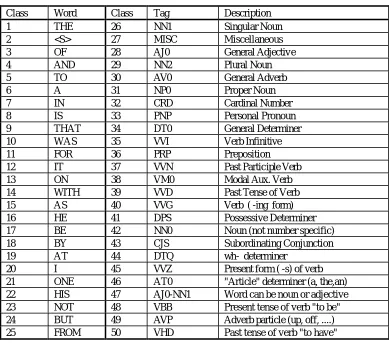
suitable mapping from each word to one of 50 classes. The list of classes is shown in table 1
Table 1 - Word Classes
Class Word Class Tag Description 1 THE 26 NN1 Singular Noun 2 <S> 27 MISC Miscellaneous 3 OF 28 AJ0 General Adjective 4 AND 29 NN2 Plural Noun 5 TO 30 AV0 General Adverb 6 A 31 NP0 Proper Noun 7 IN 32 CRD Cardinal Number 8 IS 33 PNP Personal Pronoun 9 THAT 34 DT0 General Determiner 10 WAS 35 VVI Verb Infinitive 11 FOR 36 PRP Preposition 12 IT 37 VVN Past Participle Verb 13 ON 38 VM0 Modal Aux. Verb 14 WITH 39 VVD Past Tense of Verb 15 AS 40 VVG Verb ( -ing form) 16 HE 41 DPS Possessive Determiner 17 BE 42 NN0 Noun (not number specific) 18 BY 43 CJS Subordinating Conjunction 19 AT 44 DTQ wh- determiner
20 I 45 VVZ Present form ( -s) of verb 21 ONE 46 AT0 "Article" determiner (a, the,an) 22 HIS 47 AJ0-NN1 Word can be noun or adjective 23 NOT 48 VBB Present tense of verb "to be" 24 BUT 49 AVP Adverb particle (up, off, ....) 25 FROM 50 VHD Past tense of verb "to have"
Using these word classes, collocational features were proposed as follows: feature F(m,n) is 1 if and only if word-class m occurs in the hypothesis before word class n. Thus each hypothesis is converted to a (sparse) vector of 2500 bits.
3.4 Feature Winnowing
To determine which of the 2500 features had some potential for predicting the correctness of the hypothesis, a first ‘winnowing’ stage was implemented using a mutual information criterion as described in section 2.1.
Machine Learning in the Speech Decoder–Huckvale and Hunter
3.5 Maximum entropy modelling
From the list of 50 features showing the greatest mutual information, maximum entropy models are made using a greedy algorithm (following [5]) that considers first the best model with one feature, then the best second feature that can be added to the first, the best third feature that can be added to the first two, and so on.
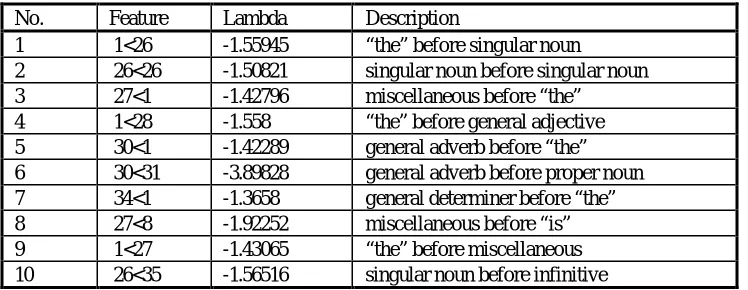
The maximum entropy modelling halts when the additional benefit of adding another feature falls below some threshold. A typical example of a model of 10 features is shown in table 2.
Table 2 - Example Maximum Entropy Model
No. Feature Lambda Description
1 1<26 -1.55945 “the” before singular noun
2 26<26 -1.50821 singular noun before singular noun 3 27<1 -1.42796 miscellaneous before “the” 4 1<28 -1.558 “the” before general adjective 5 30<1 -1.42289 general adverb before “the” 6 30<31 -3.89828 general adverb before proper noun 7 34<1 -1.3658 general determiner before “the” 8 27<8 -1.92252 miscellaneous before “is” 9 1<27 -1.43065 “the” before miscellaneous 10 26<35 -1.56516 singular noun before infinitive
Note that all the lambda values are negative, indicating that these features reduce the likelihood of any hypothesis containing these features being correct. Features that increased the likelihood of a hypothesis being correct were found by the winnowing procedure but they did not find their way into any maximum entropy model.
At first sight these features of incorrect hypotheses do not look particularly odd. However a feature is useful if its frequency of occurrence is different in correct and incorrect hypotheses. Thus the fixation on the use of ‘the’ may simply indicate that the recogniser is hypothesising this word too often.
3.6 Evaluation
To evaluate the feature selection and maximum entropy models, the 10% of data reserved for testing was processed through the word-class mapping and feature extraction stages. The overall score for each hypothesis was then adjusted using equations (3) and (4) for each of the selected features and calculated lambda parameters found from the 90% of data used for training. The procedure was then repeated 10 times for each possible division between test and training.
Machine Learning in the Speech Decoder–Huckvale and Hunter
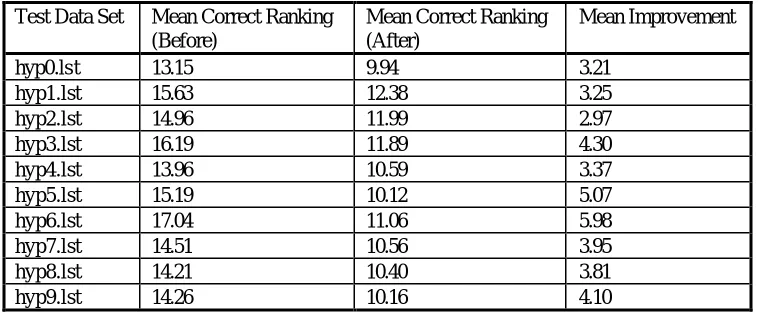
Table 3 - Change in Ranking of First Correct Hypothesis
Test Data Set Mean Correct Ranking (Before)
Mean Correct Ranking (After)
Mean Improvement
hyp0.lst 13.15 9.94 3.21
hyp1.lst 15.63 12.38 3.25
hyp2.lst 14.96 11.99 2.97
hyp3.lst 16.19 11.89 4.30
hyp4.lst 13.96 10.59 3.37
hyp5.lst 15.19 10.12 5.07
hyp6.lst 17.04 11.06 5.98
hyp7.lst 14.51 10.56 3.95
hyp8.lst 14.21 10.40 3.81
hyp9.lst 14.26 10.16 4.10
Overall the mean ranking of the correct answer improved by 4 places, from an average rank of 14.9 to an average rank of 10.9. The results seem consistent across each rotation of data. We have not yet determined how these improvements in ranking affect word recognition score. For this experiment we simply wanted to show that the maximum entropy model made consistent changes to scores in the right direction.
4. Discussion
The experiment described above is only a first attempt at applying the idea of machine learning within the decoder, and serves only as a proof of concept that the idea holds some promise. We made many arbitrary decisions in feature analysis and in modelling and these can almost certainly be improved.
Now that we have the basic framework for experimentation we would like to look at: 1. choosing word classes on the basis of either grammatical functionality, or on the
basis of how the word contributes to meaning
2. choosing other features based on the position of the word with respect to words that become before and after it
3. finding the best way to exploit the modified scores in the decoder: whether the modifications should be actually incorporated with scores from the acoustic model and language model, or whether they should be used simply to help rank hypotheses within a node.
4. determining the effect of the machine learning on word accuracy
5. determining the effect of the machine learning on sentences drawn from a different corpus spoken by speakers outside the training set.
Machine Learning in the Speech Decoder–Huckvale and Hunter
Acknowledgements
Gordon Hunter is supported by a research studentship from the U.K Engineering and Physical Sciences Research Council. Some of the work reported here was conducted under the EPSRC project “Enhanced Language Modelling”, Grant No GR/L81406. Thanks to Alex Fang for help with the BNC corpus and the generation of the language models.
References
[1] S. Young. Large Vocabulary Continuous Speech Recognition: A Review. In IEEE Signal Processing Magazine, 13(5), 1996, 45-57.
[2] A.C. Fang, M.A. Huckvale. Enhanced Language Modelling with Phonologically Constrained Morphological Analysis. In Proceedings of the IEEE International Conference on Acoustics, Speech, and Signal Processing, 5-9 June 2000, Istanbul, Turkey.
[3] R. Rosenfeld. Incorporating Linguistic Structure into Statistical Language Models. In Philosophical Transactions of the Royal Society of London A, 358, 2000, 1311-1324.
[4] J.A. Nelder, R. Mead. A simplex method for function minimization. In The Computer Journal, vol.7, 1965, The British Computer Society, 308-313.
[5] A. Berger, S. Della Pietra, V. Della Pietra. A maximum entropy approach to natural language processing. In Computational Linguistics, 22, 1996, pp1-36.
[6] L. Burnard. Users Reference Guide for the British National Corpus. Oxford University Computing Services, Oxford, 1995.
[7] M. Hochberg, S. Renals, A. Robinson. ABBOT: The CUED Hybrid Connectionist-HMM Large Vocabulary Recognition System. In Proc. Language Technology Workshop, Austin Texas, Jan 1995. Morgan Kaufmann.
[8] A. Robinson, BEEP Pronunciation Dictionary. Retrieved from World Wide Web: ftp://svr-ftp.eng.cam.ac.uk/pub/comp.speech/dictionaries/beep.tar.gz
[9] P. Clarkson, R. Rosenfeld. Statistical Language Modeling using the CMU-Cambridge Toolkit. In Proc. Eurospeech 97, 1997.