Implementing Token-Based Obfuscation under
(Ring) LWE
Cheng Chen1, Nicholas Genise2, Daniele Micciancio2, Yuriy Polyakov3,4, and Kurt Rohloff3
1 MIT CSAIL 2
UCSD 3 NJIT 4
Duality Technologies, Inc.
October 7, 2019
Abstract. Token-based obfuscation (TBO) is an interactive approach to cryptographic program obfuscation that was proposed by Goldwasser et al. (STOC 2013) as a potentially more practical alternative to conven-tional non-interactive security models, such as Virtual Black Box (VBB) and Indistinguishability Obfuscation. We introduce a query-revealing variant of TBO, and implement in PALISADE several optimized query-revealing TBO constructions based on (Ring) LWE covering a rela-tively broad spectrum of capabilities: linear functions, conjunctions, and branching programs.
Our main focus is the obfuscation of general branching programs, which are asymptotically more efficient and expressive than permutation branch-ing programs traditionally considered in program obfuscation studies. Our work implements read-once branching programs that are signifi-cantly more advanced than those implemented by Halevi et al. (ACM CCS 2017), and achieves program evaluation runtimes that are two or-ders of magnitude smaller. Our implementation introduces many algo-rithmic and code-level optimizations, as compared to the original the-oretical construction proposed by Chen et al. (CRYPTO 2018). These include new trapdoor sampling algorithms for matrices of ring elements, extension of the original LWE construction to Ring LWE (with a hard-ness proof for non-uniform Ring LWE), asymptotically and practically faster token generation procedure, Residue Number System procedures for fast large integer arithmetic, and others.
We also present efficient implementations for TBO of conjunction pro-grams and linear functions, which significantly outperform prior imple-mentations of these obfuscation capabilities, e.g., our conjunction obfus-cation implementation is one order of magnitude faster than the VBB implementation by Cousins et al. (IEEE S&P 2018). We also provide an example where linear function TBO is used for classifying an ovar-ian cancer data set. All implementations done as part of this work are packaged in a TBO toolkit that is made publicly available.
1
Introduction
Program obfuscation has long been of interest to the cyber-security commu-nity. Obfuscated programs need to be difficult (computationally hard) to re-verse engineer, and have to protect intellectual property contained in software from theft. For many years, practical program obfuscation techniques have been heuristic and have not provided secure approaches to obfuscation based on the computational hardness of mathematical problems. In this regard, there have been multiple recent attempts to develop cryptographically secure approaches to program obfuscation based on the computational hardness of mathematical problems (see [9] for a survey of these approaches). There are multiple defi-nitions used for cryptographically secure program obfuscation. Two prominent definitions are Virtual Black Box and Indistinguishability Obfuscation.
Virtual Black Box (VBB) obfuscation is an intuitive definition of secure program obfuscation where the obfuscated program reveals nothing more than black-box access to the program via an oracle [40]. VBB is known to have strong limitations [10, 15, 37]. The most significant limitation is that general-purpose
VBB obfuscation is unachievable [10].
To address limitations of VBB, Barak et al. [10] define a weaker security notion ofIndistinguishability Obfuscation (IO) for general-purpose program ob-fuscation. IO requires that the obfuscations of any two circuits (programs) of the same size and same functionality (namely, the same truth table) are compu-tationally indistinguishable. The IO concept has been of current interest, with recent advances to identify candidate IO constructions based on multi-linear maps [34, 48, 49, 50]. There has also been recent work to implement multi-linear map constructions [4, 21, 27, 41, 47]. Recent results show that these constructions might not be secure [23, 26]. The only IO construction supporting general func-tions that is not subject to any attack to date is the work by Garg et al.[31]. These cryptographically secure program obfuscation capabilities have also been considered impractical due to their computational and storage inefficiencies.
There have also been attempts to securely obfuscate under the VBB model (and its variants) certain special-purpose functions, such as point, conjunction, and evasive functions, using potentially practical techniques. For example, there have been several approaches to obfuscating point functions [6, 12, 28]. Unfortu-nately, point functions have limited applicability.
Both VBB and IO arenon-interactivemodels of program obfuscation where the obfuscated program is made available to a computationally bound adversary. The adversary can then run a large number of queries (bounded only by its com-putational power) against the obfuscated program. In many practical scenarios, e.g., classification problems, the obfuscated program can be potentially learned by analyzing input-output maps.
the obfuscated program for a given input and then interacts with a trusted hardware to obtain the decryption of the result [16, 39]. In the TBO model, the user obtains a special token before executing the obfuscated program and then finds the decrypted result by herself [38]. The latter model is more flexible and can support the use cases where the tokens are pre-generated offline, i.e., the trusted hardware does not need to be accessible to the user.
To illustrate TBO, consider a scenario where a vendor publishes an intensive obfuscated program and provides tokens representing the rights to run the pro-gram on specific inputs. When a user wants to input a query xto the program, she also gets a token for x from the vendor, and then executes the obfuscated program. This allows the vendor to offload the computation to the user without fear of leaking nontrivial information about the program. Another key feature for TBO is the ability to obfuscate learnable functions which cannot be obfus-cated under the VBB model. These learnable functions are why general-purpose VBB obfuscation does not exist in-general [10]. TBO can be used on learnable functions since the vendor controls what input-output data is revealed.
1.1 Our Contributions
Our work introduces a query-revealing variant of TBO (where input queries are in the clear), which is more efficient than the query-hiding TBO model proposed in [38] based on functional encryption/reusable garbled circuits. Our variant is adequate for most obfuscation scenarios as program inputs are typically not hidden. Query-revealing TBO (QR-TBO) thus provides an efficient method to obfuscate the classes of functions that can be learned.
We develop optimized constructions, implement them in PALISADE, and re-port experimental results for the TBO of several types of programs under (Ring) LWE, including linear functions, conjunctions [20], permutation branching pro-grams [20], and general branching propro-grams [24].
Our most significant contribution is the optimized implementation for the TBO of general branching programs based on the theoretical construction for constrained-hiding constrained PRFs proposed in [24]. We evaluate the perfor-mance of our implementation for a program that finds a Hamming distance between two strings of equal length. The evaluation runtime of our implementa-tion, which supports more than 500 accepting states, is two orders of magnitude smaller than the implementation [41] for a simpler program (with about 100 states; note that the construction from [41] was subsequently broken in [24]). The main optimizations introduced in our implementation include:
1. Development of an efficient Residue Number System (RNS) ring variant of construction [24], requiring a hardness proof for non-uniform Ring LWE, and RNS scaling and lattice trapdoor sampling procedures.
2. New algorithms for lattice trapdoor sampling of matrices of ring elements. 3. Improved key generation and evaluation algorithms for token generation
4. A larger alphabet for encoding bits in the input, which reduces the multlin-earity degree of the construction.
5. Significantly tighter correctness constraints, which reduce the main func-tional parameter.
6. Many code-level and system optimizations, which are of independent interest for other lattice primitives.
We also present efficient implementations of the TBO for permutation branch-ing programs, conjunction programs, and linear functions. Our performance re-sults for conjunction obfuscation suggest that this implementation is faster by one order of magnitude and requires a 3x smaller program size, as compared to the prior recent distributional VBB conjunction obfuscation implementation [27]. The linear function obfuscation is first introduced in this work, and outperforms prior constructions based on functional encryption.
All our implementations of TBO constructions and lower-level lattice algo-rithms are added as modules to PALISADE, thus effectively providing a TBO toolkit that is made publicly available.
1.2 Related Work
The TBO construction in [38] is formulated for the case of hidden queries using reusable garbled circuits, which in their turn can be built on top of a functional encryption (FE) scheme. This implies that a TBO scheme can be derived from an FE scheme by treating a secret key for evaluating a specific function on encrypted data as a token.
General FE constructions are currently impractical. One approach is based on a combination of key-policy attribute-based encryption and fully homomor-phic encryption [38]. The state-of-the-art results in key-policy attribute encryp-tion [33] suggest these schemes are still inefficient, and hence their use in FE where each attribute bit needs to be encrypted with FHE is currently not prac-tical. Initial experimental results for multi-input FE are presented in [21] but they are far from practical.
However, more efficient constructions exist for simpler functions, such as inner products. For instance, Agrawal et al. proposed an FE for inner prod-uct predicates as an extension of identity-based encryption using dual Regev’s public key encryption scheme (based on LWE) and lattice trapdoor sampling. Another FE construction for inner product predicates builds directly on top of dual Regev’s public key encryption scheme [1] (our construction for inner prod-ucts is asymptotically smaller and faster as shown later in this work). Several works considered the scenario of function-hiding inner product encryption where the result of inner product is computed while keeping both input vectors hid-den [13, 44]. The experimental results for the scheme based on the Symmetric External Diffie-Hellman (SDXH) assumption for bilinear groups are presented in [44].
non-interactive program obfuscation models. This enables more efficient construc-tions for TBO. For instance, our linear function (inner product) construction based on LWE is significantly faster (by orders of magnitude) than function-hiding inner product encryption based on SDXH in [44], as can be seen from comparing Table 1 in our work with Table 1 in [44].
More recently, the works of [11,14] present an efficient scheme for obfuscating conjunctions. However, both schemes are in the non-standard generic group ad-versarial model (where the adversary can only attack by using group operations) and use distributional VBB security. This leads to a significant security gap com-pared to our standard LWE construction which has a strong, simulation-based security definition5.
1.3 Organization
In view of the complexity of TBO for general branchining programs, we use sim-pler constructions to introduce the concepts and optimizations that ultimately apply to the obfuscation of general branching programs. We start with linear functions, then move to conjunction programs, and finally discuss pemutation and general branching programs.
2
Preliminaries
We denote the integers modulo q as Zq :=Z/qZ. Our implementation utilizes power-of-two cyclotomic polynomial ringsR=Z[x]/hxn+ 1iandRq =R/qR, where n is a power of 2 and q is an integer modulus. An element in the ring is represented via the coefficient embedding, or by its vector of coefficients. Importantly, we measure the norm of a ring element, or a vector of ring el-ements, through this coefficient embedding. The norm is the Euclidean norm unless stated otherwise.
The discrete Gaussian distribution over a latticeΛ⊂Rnis defined with prob-ability mass proportional to ρc,σ(x) = e−πkx−ck
2/σ2
and is denoted as DΛ,c,σ, where c∈Rn is the center and σ is the distribution parameter. If the centerc is omitted, it is assumed to be set to zero. When discrete Gaussian sampling is applied to cyclotomic rings, we denote discrete Gaussian distribution asDR,σ. In this work, all discrete Gaussian sampling over rings is done in the coefficient representation (representing a polynomial by its coefficient vector)6.
We useUq to denote discrete uniform distribution overZq andRq. We define k=dlog2qeas the number of bits required to represent integers inZq.
5 The recent work in [30] cannot be straight-forwardly adapted to a QR-TBO scheme
since their CHCPRFs are only proved secure in the weaker, indistinguishablity se-curity definition instead of our simulation-based definition.
6 R
2.1 Double-CRT (RNS) Representation
Our implementation utilizes the Chinese Remainder Theorem (referred to as in-teger CRT) representation to break multi-precision inin-tegers in Zq into vectors of smaller integers to perform operations efficiently using native (64-bit) integer types. The integer CRT representation is also often referred to as the Residue-Number-System (RNS) representation. We use a chain of same-size prime mod-uli q0, q1, q2, . . . satisfying qi ≡ 1 mod 2n. Here, the modulus q is computed as Ql−1
i=0qi, where l is the number of prime moduli needed to represent q. All polynomial multiplications are performed on ring elements in polynomial CRT representation where all integer components are represented in the integer CRT basis. Using the notation proposed in [35], we refer to this representation of polynomials as “Double-CRT”.
2.2 Ring Learning with Errors
The following distinguishing problem, originated by Regev and modified to an algebraic version [51], will be our source of cryptographic hardness.
Definition 1. (Gaussian-secret, cyclotomic-RLWE). Let R be a power-of-two cyclotomic ring of dimensionnoverZ,q≥2 be integer used as a modulus, and
m >0. Let DR,σ be a discrete Gaussian distribution overRq (sampled over R,
then taken moduloq). Then, the (Rl, m, q,D
R,σ,DR,σ)RLWE problem is to
dis-tinguish between the following two distributions:{(A,sTA+eT)} and{(A,uT)},
where, s← Dl
R,σ,A← U(Rq)l×m,e← DRm,σ andu← U(Rqm)7.
Note, the hardness of discrete-Gaussian-secret (R)LWE is usually called the
normal form of (R)LWE [5, 52].
The LWE assumption is often extended to its multi-secret form. We will only need the multi-secret case when R = Z, and pseudorandomness follows from LWE [53, Lemma 2.9]. Specifically, theκ-secret (n, q, m,DZ,σ)LWE distribution is (A,AS+E) where A ← U(Zm×n
q ), S ← D n×κ
Z,σ , and E ← D m×κ
Z,σ . We will need the hardness of multi-secret LWE when the noise distribution is p· DZ,σ instead ofDZ,σ, wherepdoes not divideq. The pseudorandomness of LWE with error drawn fromp· DZ,σ is equivalent to LWE with error fromDZ,σ (proved by multiplying by pandp−1).
2.3 GGH15 Encoding
We will use the generalized GGH15 construction [34] given in [24], called γ-GGH15. Here we give a brief description, though for a complete description, see Section 2 of [24]. The main idea is that the γ-GGH15 construction provides a way to multiply matrices homomorphically under the security of LWE.
First, we give the parameters and variables. Fix some ringRq. Let` >0 be a fixed computation length, (Mi,b ∈ Rqw×w)i∈[`],b∈{0,1} be a collection of binary,
7
scalar matrices to be used as a form of computation, e.g. a matrix-branching program, and let (si,b ∈ Rq)i∈[`],b∈{0,1} be a tuple ring elements. Let γ(M, s)
be a function mapping (M, s) to another matrix satisfyingγ(M, s)γ(M0, s0) = γ(MM0, ss0). The three choices of γ we will use are γ(M, s) = s, γ(M, s) =
M⊗s, and γ(M, s) =diag(s,M⊗s) where diag(·,·) is a diagonal matrix. For an x ∈ {0,1}`, define the matrix subset products Z
x = Q`i=1Zi,xi given any tuple of matrices (Zi,b)i∈[`],b∈{0,1}.
Theγ-GGH15 construction, given as input the matrices (Mi,b, si,b)i∈[`],b∈{0,1}
along with an additional matrixA`, returns the matrixA0 as well as the tuple (Di∈[`],b∈{0,1}) satisfyingA0Dx≈γ(Mx, sx)A` modqfor anyx∈ {0,1}`.
2.4 Query-Revealing TBO
Here we define TBO with restricted queries. Our definition is similar to [38], though weaker since the input query xis in the clear. Let λbe a security pa-rameter throughout the following two definitions.
Definition 2 (Query-Revealing TBO).Letn=n(λ)∈N. A query-revealing
TBO scheme for a class of circuits{Cn}n∈N, where eachCn is a set ofn-bit-input
circuits, is a tuple of probabilistic polynomial-time algorithms(Setup,Obfuscate,TokenGen)
with the following properties:
– Setup(1λ)takes as input a security parameterλand returns a secret keyosk.
– Obfuscate(osk, C ∈ Cn) takes as input a circuit C, a secret key osk, and
outputs an obfuscated circuitO.
– TokenGen(osk, x) takes as input the secret key osk and some input x ∈ {0,1}n, and returns a tokentk
x.
We requireO(tkx) =C(x) with all but negligible probability.
Next, we define the security game in Figure 1. We abbreviate (Obfuscate,
TokenGen) as (Obf,TG). In Figure 1, OS(·, C)[[stS]] is an oracle that on inputxfromA2, runsS2with inputsC(x),x(note that it was 1|x|in the query-hiding TBO of [38]), and the current state ofS, stS.S2responds with a fake tk∗x and a new state st0S which OS will feed to S2 on the next call. OS returns tk∗x toA2.
Definition 3 (Security). The TBO scheme is secure if there exists a pair of PPT simulation algorithms (S1,S2)such that for all PPT adversaries(A1,A2),
the two probabilistic experiments defined in Figure 1 are computationally indis-tinguishable {ExprealtOB,A(1λ)} ≈c{ExpidealtOB,A,S(1λ)}.
3
QR-TBO of Linear Functions
Expreal tOB,A(1
λ):
osk←Setup(1λ) (C,stA)←A1(1λ) O←Obf(osk,C)
α←ATG(osk,·)
2 (C,O,stA) Returnα
ExpidealtOB,A,S(1 λ
):
(C,stA)←A1(1λ) (O∗,stS)←S1(1λ,1|C|) α←AOS(·,C)[[stS]]
2 (C,O
∗
,stA)
Returnα
Fig. 1: TBO security game.
r= osk as the secret key,TokenGencomputes an inner product with the input and the key tkx=hr,xi, andObfuscate takes a function w and returns the information-theoretically secureo=w+r. To evaluate the obfuscated program on input x, the user computesho,xi −tkx=hw,xi. This simple scheme illus-trates the main idea behind our LWE-based linear QR-TBO scheme. One clear drawback of the information-theoretically secure scheme is that each obfuscation requires a new secret key, the size of the program. On the other hand, our LWE scheme can use the same secret key to obfuscate many programs.
We now present an LWE secret-key scheme that can be used for the TBO of linear functions. Note, the linear functional encryption scheme of [1] can be used to instantiate a less efficient TBO scheme for linear functions. We provide a comparison in Appendix A.
3.1 LWE Secret Key Scheme for Evaluating Linear Weighted Sums
The purpose of this scheme is to perform evaluation on obfuscated tests for
linear functions. The evaluation function can be described as N
P
i=1
wixi, where
x= (x1, . . . , xN)∈ZNp andw = (w1, . . . , wN)∈ZNp refer to data and weights, respectively. Here,N is the dataset size (number of variables in the linear func-tion). In the obfuscation case, the weights are encrypted and data (inputs) are in clear. For each input, a new token is generated.
It is also possible to invert this problem by encrypting the inputs and storing the weights in the clear. Each vector of weights would then require a token. This formulation would apply to use cases where the function is public but data need to stay encrypted.
The scheme is a tuple of functions, which includes ParamGen, KeyGen,
Obfuscate,TokenGen, andEval, where the functions are defined as follows:
– ParamGen(1λ, N, p) : Given a security parameter λand system parameters N andp, select an integer modulusq, LWE security parametern, and discrete Gaussian distributionχwith standard deviationσ/√2π.
– Obfuscate(SK,w)→O. Choose a random vector a∈Zn
q and error values (numbers)ei∈Zq generated usingχ. Compute the obfuscated program
O:=ha,b:={ha,sii+pei+wi} N i=1
i
.
– TokenGen(SK,x) → t. Generate tokens for data x as t:= N
P
i=1
xisi ∈ Znq. For each distinct data input, a separate token needs to be generated.
– Eval(O,t,x)→µ. Compute¯
¯ µ:=
N
X
i=1
bixi− ha,ti modp.
The scheme is correct, i.e., ¯µ = N
P
i=1
wixi, as long as the noise does not cause a wrap-around w.r.t. modq. Indeed,
N
X
i=1
bixi− ha,ti= N
X
i=1
xi· ha,sii+p· N
X
i=1 xiei
+ N
X
i=1
wixi− ha, N
X
i=1
xisii=p· N
X
i=1 xiei+
N
X
i=1 wixi,
where the first term in the result is eliminated after applying modp. For the evaluation to be correct, the following correctness constraint has to be satisified:
p· N X i=1 xiei
∞ < q/4.
Note on key generation. Another alternative for key generation is to compute secret keys as AES(K,i). More specifically, we can generate a secret key K for AES and do encryptions of a counter to generate 128-bit random sequences. These sequences would then be used for random numbers in Zq. In this scenario, we need to store only the nonceK and can generate a particular key on the fly. In other words, the space requirements for the secret key vectors are limited by the value of n (negligibly small from the practical perspective). This method is also supported by our implementation.
Security The obfuscated programOis secure under LWE. We prove the secu-rity of the TBO scheme using Definition 2.
Theorem 1. The LWE secret-key scheme for evaluating linear weighted sums is secure under QR-TBO (Definition 2).
is sparse (especially if the locations of some zeros are known) or some weight components are correlated, the number of queries is even smaller. This implies that the maximum number of queries for which tokens can be generated should be selected based on the dimension N as well as sparsity and other possible special properties of the weights vectorw.
Application to Binary Linear Classifiers The TBO of linear functions can be applied for prediction using linear classifiers. As an example, we consider in Section 7 a binary linear Support Vector Machine (SVM) classification model that can be represented as a vector of weights and a bias [29,43], and obfuscated using the linear TBO scheme. To convert the weights and bias from real numbers to integers, we multiply the real numbers by scaling factors and round them to achieve the desired accuracy. The plaintext moduluspis chosen large enough to avoid a wrap-around when computing the linear weighted sum.
4
QR-TBO of Conjunctions
We next consider a construction for the token-based obfuscation of conjunctions based on Ring LWE. Our TBO construction is a significantly optimized variant of the bit-fixing construction for constraint-hiding constrained PRFs proposed in Section 5.1 of [20]. We chose the example of conjunctions to give a fair com-parison with a prior recent non-interactive (distributional VBB) conjunction obfuscation construction implemented in [27] and introduce several major opti-mizations used in the next section for the TBO of more general programs, i.e., branching programs.
Compared to the non-interactive conjunction obfuscation construction im-plemented in [27] (and originally formulated in [19]), the TBO construction has several advantages w.r.t. both security and efficiency. The construction [19,27] is secure under entropic (non-standard) Ring LWE while the current construction is secure under LWE. The token-based security model allows one to limit the number of queries versus the unbounded number of queries in the case of [27] (the latter would allow the adversary to learn the full pattern unless a relatively long pattern with high entropy is used). Our complexity analysis (and exper-imental results later in the paper) show that the program size and evaluation runtime in the case of TBO are significantly smaller. The only drawback of TBO is the need to have a trusted party generating tokens (either in advance or for each query on demand).
4.1 Definition of Conjunctions
We define a conjunction as a function onL-bit inputs, specified asf(x1, . . . , xL) =
V
vectorsv∈ {0,1, ?}L, where we defineFv(x1, . . . , xL) = 1 iff for alli∈[L] we have xi=vi or vi=?. We refer to?as a “wildcard”.
This type of conjunctions is used in machine learning to execute or approxi-mate classes of classifiers [45,57]. Conjunctions can be used to encode binary clas-sifiers but with some additional restrictions due to the wild-card-based (rather than arbitrary) format of patterns. A more detailed discussion on conjunctions and their applications is presented in [27].
4.2 Conceptual Model
The scheme for the TBO of conjunctions includes the same tuple of functions as the TBO for linear functions (Section 3.1) but the concept of token is used differently. The conceptual workflow is defined as follows:
– ParamGen: Generate lattice parameters based on the length of the pattern and security level.
– KeyGen: Generate trapdoor key pairs and an unconstrained master secret key. The unconstrained key corresponds to a pattern of all wild cards (which accepts any pattern).
– Obfuscate: An obfuscated program (constrained key) for a given pattern is generated by replacing the master key elements with random samples where a specific bit is fixed (no changes are made for wild cards in the input pattern).
– TokenGen: Compute a vectory0∈ R1×m
p , which is a result of evaluating the PRF, to generate the token using the master (unconstrained) key.
– Eval: Evaluate the obfuscated program using the constrained key (obfuscated program) and output a vectory∈ R1×m
p , where Rp =Zp[x]/hxn+ 1i. Com-parey withy0; if they match, output 1 (True), otherwise output 0 (False).
The output ofTokenGen is the PRF value, and is used as the “token” in this case. If the token for the unconstrained key (master seret key) matches the output for the constrained key (obfuscated program), the result is 1 (True).
The TokenGen procedure is executed for each input by a trusted party. The Eval operation is executed by a public (untrusted) party. ParamGen,
KeyGen, and Obfuscate are offline operations. EvalToken and Eval are
online operations in the scenario where a token generator is available to generate a token for each input on demand.
We next describe the algorithms for each function.
4.3 Algorithms for TBO Functions
The main difference of the TBO model as compared to the distributional VBB model [27] is the interaction between untrusted and trusted components of the system. This bounds the number of evaluation queries and prevents exhaustive search attacks that the distributional VBB construction is amenable to.
The main optimizations w.r.t. the construction in [20] include the use of a larger (non-binary) alphabet for encoding words of the pattern, an asymptoti-cally and practiasymptoti-cally faster procedure (with much smaller storage requirements) for generating the tokens, and significantly tighter correctness constraints.
Algorithm 1 Key generation functionKeyGen(1λ)
fori = 0..Ldo
Ai,Tie :=TrapGen(1λ)
fori = 1..Ldo forb = 0..2w-1do
si,b← DR,σ returnKM SK:=
{si,b}i∈{1,..,L},b∈{0,..,2w−1},{Ai,Tie }i∈{0,..,L}
The key generation algorithm is listed in Algorithm 1. The prameter L = dL/we is the effective length of conjunction pattern, w is the number of bits per word of the pattern,si,b∈ Ris the i-th word secret-key component for the b-th value of the current word,Ai ∈ R1q×m is the public key for thei-th word,
e
Ti ∈ R2q×κ is the trapdoor for the i-th word, κ is the number of digits used in Gaussian sampling, and m= 2 +κ. The key generation procedure includes two major steps: generatingLtrapdoors (the definition ofTrapGenis given in Appendix G) and computing the unconstrained key asL ×bshort ring elements. As compared to the construction in [20], we optimized the master secret key generation to only sample short ring elements si,b (without calling com-plex lattice trapdoor sampling for these short ring elements), which reduces the storage and speed complexity for the unconstrained key by a factor ofO(m2). In the original construction, the size of the master key was approximately the same as the obfuscated program. In summary, the storage requirement for the keys in our construction is O(Lbn) +O(L(m+ 2κ)n) integers in Zq versus O(m2Lbn) +O(L(m+ 2κ)n) integers in the original construction. Storing the secret keys rather their GGH15 encodings does not effect the security of the construction in the TBO model as the trusted party is allowed to have access to the secret keys by definition.
Algorithm 2 Obfuscation
functionObfuscate(v∈ {0,1,∗}L
, KM SK, σ) fori = 1..Ldo
Build binary mask M (0’s correspond to wild-card bits, 1’s correspond to fixed bits)
forb = 0..2w-1do
if (b∧M)6= (v∧M)then ri,b← DR,σ
else
ri,b:=si,b
Di,b:=EncodeAi−1→Ai(Tie−1, ri,b, σ) returnπv:=
A0,{Di,b}i∈[L],b∈{0,...,2w−1}
of encoding levels (multi-linearity degree). When the fixed bits in the encoded word match the fixed bits in the pattern being obfuscated, the obfuscated pro-gram uses the short ring elements si,b from the unconstrained key. Otherwise, new short ring elementsri,b specific to the obfuscated program are generated.
TheObfuscateprocedure relies on anEncodealgorithm for the directed-encoding ring instantiation to encode each word of the conjunction pattern. The
Encodealgorithm is depicted in Algorithm 3 and is the same GGH15 directed
encoding procedure as described in [27]. The lattice trapdoor sampling procedure
GaussSampis described in Appendix G.
The storage requirement for the obfuscated programπv isO(Lbm2n) .
Algorithm 3 Directed encoding functionEncodeAi→Ai+1(Ti, r, σ)
ei+1← DR,σ∈ Rq1×m. bi+1:=rAi+1+ei+1∈ R1×m
q
Ri+1:=GaussSamp(Ai,Ti,bi+1, σt, σs)∈ Rmq×m return Ri+1
Algorithm 4Token Generation: Evaluation by a trusted party (using the mas-ter secret key)
functionTokenGen(x∈ {0,1}L,KM SK) ∆:=AL[1]QLi=1si,x[1+(i−1)w:iw] return y0:=b2
q∆e ∈Z n 2
scalar product with the second ring element of the public key A0 (in contrast to vector-matrix products in [20]), which reduces the computational complexity by a factor ofO(m2).
Algorithm 5 shows the psedocode for the evaluation of a given input using the obfuscated program (constrained key).
Algorithm 5 Evaluation using the obfuscated program functionEval(x∈ {0,1}L
,πv,y0) Dπ:=A0
fori = 1..Ldo
Dπ:=DπDi,x[1+(i−1)w:iw]∈ Rq1×m y:=b2
qDπ[1]e ∈Z n 2 return(y=y0)
In this case, the tokeny0 is generated using a lattice PRF. We do not need to perform the comparison of all polynomial coefficients in y0 and y. Instead we can perform it for the number of coefficients that makes the probability of a false positive negligibly small. In our experiments, we chose this number to be 128. Dropping a fixed number of bits from a PRF retains all security measures. Next, we note that the probability of comparison error is linear in the number of coefficients compared under the heuristic that the coefficients are independent and uniformly distributed over Zq. Let B be our bound on the GGH15 noise. Then, the probability of a rounding error in a comparison of the entire output is less than (nmd)4B
q since there are two “bad” regions ofZq of size 2B corre-sponding to rounding errors and there arenmdZq-coefficients being rounded to bits (nmdbits)8. By only comparingαbits, we can replace this byα· 4B
q . The choice of αand the probability upper-bound for a comparison error will affect the modulus size (Appendix D).
4.4 Security
The TBO construction for conjunctions is secure under Definition 2 for QR-TBO under Ring LWE. The proof showing that the existence of constraint-hiding constrained PRF implies an the existence of a QR-TBO scheme is presented in Appendix C. Further, we are able to base security on plain RLWE instead of small-entryARLWE [17]. See Remark 1 in Appendix C for more details.
4.5 Setting the Parameters
Ring-LWE trapdoor construction.The trapdoor secret polynomials are gen-erated with a noise widthσ, which is at least the smoothing parameter estimated
8
aspln(2nm/)/π,wherenmis the maximum ring dimension andis the bound on the statistical error introduced by each randomized-rounding operation [54]. Fornm≤214and≤2−80, we choose a value ofσ≈4.578.
Short Ring Elements in Directed Encoding.For short ring elements si,b, ri,b and noise ring elements, we use error distribution with the distribution parameterσ. This implies we rely on Ring-LWE for directed encoding.
G-Sampling. OurG-sampling procedure requires thatσt= (t+ 1)σ. This guarantees that all integer sampling operations (noise widths) insideG-sampling are at least the smoothing parameterσ, which is sufficient to approximate the continuous Gaussian distribution with a negligible error.
Spectral normσs. Parameterσsis the spectral norm used in computing the Cholesky decomposition matrix (it guarantees that the perturbation covariance matrix is well-defined). To bound σs, we use inequality σs > s1(X)σt, where
X is a sub-Gaussian random matrix with parameterσ [54]. Lemma 2.9 of [54] states thats1(X)≤C0σ
√
nκ+√2n+C1
,where C0 is a constant andC1 is at most 4.7. We can now rewriteσs asσs> C0σσt
√
nκ+√2n+ 4.7.In our experiments we usedC0= 1.3, which was found empirically.
Modulus q. The correctness constraint for a conjunction pattern with L words (L ≥2) is expressed asq >210P−1
e Be(βσs √
mn)L−1, whereBe= 6σ, β= 6,Pe= 2−20, and all other parameters are the same as in [27]. The derivation details are presented in Appendix D.
Ring Dimension n. All of the security proofs presented in [20] for the constraint-hiding constrained PRF directly apply to our construction, which implies that the TBO of conjunctions is secure under Ring LWE. To choose the ring dimension, we run the LWE security estimator9(commit a2296b8) [3] to find the lowest security levels for the uSVP, decoding, and dual attacks following the standard homomorphic encryption security recommendations [22]. We choose the least value ofλ for all 3 attacks on classical computers based on the estimates for the BKZ sieve reduction cost model, and then multiply it by the number of encoded matrices, corresponding to the number of Ring LWE problems that need to be solved.
Dimension m. The dimensionm was set to 2 +κfollowing the logic de-scribed in [27].
Word sizew. We foundw= 8 to be the optimal value for all our experi-ments, using the same procedure as in [27].
4.6 Comparison with Construction in [27]
As the building blocks and many underlying parameters for the TBO construc-tion are the same as for the distribuconstruc-tional VBB constructon [27], we can directly compare them. The noise constraints are approximately the same as the smaller depth in the TBO construction (by 1) is compensated by the extra factor of approximately 25P−1
e introduced by the rounding. The construction in [27] re-quires computing two product chains versus just one product chain in our TBO
9
construction. All other parameters are the same. This implies that the TBO construction should be at least twice faster in obfuscation and evaluation, and requires 2x smaller storage for the obfuscated program. We provide their exper-imental comparison later in the paper.
From the security perspective, the TBO model can be used to bound the number of queries and restrict the format of inputs, thus overcoming the main security limitation of the conjunction obfuscation construction discussed in [27].
5
QR-TBO of Branching Programs
In this section we present a construction for the TBO of more general classes of programs, namely permutation and general branching programs. For permuta-tion branching programs, we develop an optimized variant of the constrained-hiding constrained PRF construction presented in Section 5.2 of [20]. For gen-eral branching programs, we adapt the private constrained PRF10 construction of [24] (Section 7.2) to rings and add several optimizations to it. Both classes of branching programs are integrated in the same framework, hence we deal with one general construction for the TBO of branching programs. The TBO construction is secure under Ring LWE.
The construction for the TBO of branching programs builds on top of the same procedures as the TBO for conjunctions discussed in Section 4 and then adds an extra layer dealing with matrix branching programs. Conceptually speak-ing, the TBO of conjunctions may be considered as a simple special case of the TBO for branching programs. In this section we focus on the aspects specific to branching programs, implying that all other underlying building blocks and parameters are the same as for the TBO of conjunctions.
Compared to the constructions in [24] and [20], our construction includes the following optimizations: (1) significantly improved key generation and evalu-ation algorithms for the token generator (both runtime and storage requirements are dramatically reduced), (2) much tighter correctness constraints (using lower values of main parameters and Central Limit Theorem/subgaussian analysis), and (3) a larger alphabet for encoding input bits.
5.1 Matrix Branching Programs
First, we provide the main definitions of branching programs supported by our construction.
Definition 4. (Matrix branching programs [24]) Let l, L∈N be the bit-length of the inputx∈ {0,1}land the index of the branching program. Letf :{0,1}l→ {0,1}Lbe the input-to-index map andF:{0,1}L→ {0,1}lbe the index-to-input
map.
10
A dimension-u, length-L matrix branching program overl-bit inputs consists of an input-to-index mapf, a sequence of pairs of0-1matrices, and two disjoint sets of target matricesP0 andP1:
Γ =
f,{Mi,b∈ {0,1}u×u}i∈[L],b∈{0,1},P0,P1 .
This branching program decides the languageL⊆ {0,1}l defined as
L(x) =
(
0Mf(x)=Qi∈[L]Mi,F(i)∈P0, 1Mf(x)=Qi∈[L]Mi,F(i)∈P1.
The dimension u and length L are typically referred to as the width and length of a matrix branching program.
Looking ahead, the applications in this paper may require additional con-straint on the target setsP0,P1to perform the correct functionality.
The following 2 types are supported by our TBO construction.
Definition 5. (Permutation branching programs: Type II branching programs in [24])
1. Mi,b’s are permutation matrices
2. The target sets P0,P1 satisfy e1·P1 = {e1}; e1·P0 ={e2}, where ei ∈ {0,1}1×u denotes the unit vector with theithcoordinate being 1, and the rest
being 0.
Permutation branching programs can be used to represent NC1circuits. Bar-rington’s theorem converts any depth-δBoolean circuits into an oblivious branch-ing program of lengthL≤4δcomposed of permutation matrices{M
i,b}i∈[L],b∈{0,1}
of dimensionu (by defaultu= 5). Evaluation is done by multiplying the ma-trices selected by input bits, with the final output Iu×u or au-cycleP
i, where i∈ {0,1}, recognizing 0 and 1, respectively. In practice, we can manually con-struct branching programs with shorter lengthLand smaller widthuthan those provided by the general conversion of Barrington’s Theorem.
Note that the branching programs obtained by Barrington’s theorem directly satisfy Definition 5.
Definition 6. (General branching programs: Type I branching programs in [24]). For vectorv∈ {0,1}1×u, the target setsP
0,P1satisfyv·P1={01×u};v·P0⊆ {0,1}1×u\ {01×u}.
General branching programs can be used to represent formulas in Conjunctive Normal Form (CNF) (see [24] for two specific representations of CNFs).
Algorithm 6 Key generation for branching programs functionKeyGen(1λ)
fori = 0..Ldo
Ai,Tie :=TrapGen(1λ),Ai∈ Rqd×dm J:=e1;AJ:=JA0
fori = 1..Ldo forb = 0..2w-1do
si,b← DR,σ returnKM SK:=
{si,b}i∈{1,..,L},b∈{0,..,2w−1},{Ai,Tie }i∈{0,..,L},AJ
5.2 TBO Construction
At a high level, the TBO construction for branching programs has the same functions as the one for the TBO of conjunctions. The main difference is in how the programs are encoded.
In the case of conjunctions, each bit is encoded as a short ring element s (we ignore here for simplicity the larger-alphabet optimization). For branching programs, each bit is encoded as a square matrix of ring elements, which is a tensor product of a matrix with 0’s and 1’s by a random short ring element.
We define the encoding function asγ(M, s). For permutation programs, we haveγ(M, s) =M⊗s. For general branching programs,γ(M, s) =diag(s,M⊗ s), where diag refers to a function building a diagonal matrix. If u is the di-mension of the matrix M, then γ(M, s) for permutation branching programs is a u×u square matrix of ring elements, and γ(M, s) for general branching programs is a (u+ 1)×(u+ 1) square matrix of ring elements.
Algorithm 7 Obfuscation for branching programs functionObfuscate({Mi,b}i∈[L],b∈{0,1}, KM SK, σ)
fori = 1..Ldo forb = 0..2w
-1do
c
Mi,b=Qw
j=1M(i−1)w+j,bj ∈R d×d q
Di,b:=EncodeAi−1→Ai(Tie−1, γ(Mi,bc , si,b), σ)
returnπv:=
AJ,{Di,b}i∈[L],b∈{0,...,2w−1}
Next we describe the TBO algorithms focusing on the discussion of differences brought about by the encoding of matrix branching programs. To present the same procedures for both types of branching programs, we usedas the dimension ofγ(M, s) rather than the dimensionuof the underlying matrixM.
Algorithm 8 Directed encoding for matrices functionEncodeAi→Ai+1(Tie ,S∈ Rqd×d, σ)
Ei+1← Dd×dm
R,σ ∈ Rq d×dm
. Bi+1:=SAi+1+Ei+1∈ Rd×dm
q
Ri+1:=GaussSamp(Ai,Tie ,Bi+1, σt, σs)∈ Rdmq ×dm return Ri+1
and (2) the increased dimensions for both public key and secret trapdoors (a squared×dincrease as compared to the conjunction case). Note thatJ:= (1,v) for general branching programs and J := Id for permutation programs. The
TrapGen algorithm used in this case is a generalization for the module-LWE probem, which is discussed in Section 6.1 and Appendix F.
Algorithm 9 Evaluation by a trusted party (using the master secret key) functionTokenGen(x∈ {0,1}L,KM SK)
∆:=AL[1]QLi=1si,x[1+(i−1)w:iw] return y0:=b2
q∆e ∈Z n 2
The obfuscation and encoding procedures are presented in Algorithms 7 and 8. Conceptually the obfuscation procedure is similar to Algorithm 2 but deals with the encoding of matrices of d×d short ring elements corresponding to the matrix branching program, rather than individual short ring elements in the conjunction construction. This implies that the storage requirements are at least d2 larger as compared to conjunctions (they are actually more due to increased noise requirements). TheMci,b is introduced to support a larger alphabet (word size) when encoding the program, which is a major optimization compared to the constructons in [24] and [20].
Algorithm 9 lists the pseudocode forTokenGen, the evaluation using un-constrained key. The computational complexity is the same as for conjunctions, andO(dm) smaller than for the original branching program construction [24].
Algorithm 10 Evaluation using the obfuscated program functionEval(x∈ {0,1}L
,πv,y0) Dπ:=AJ
fori = 1..Ldo
Dπ:=DπDi,x[1+(i−1)w:iw]∈ Rq1×dm y:=b2
Algorithm 10 shows the pseudocode for the evaluation using the obfuscated program (constrained key). The main difference compared to Algorithm 5 for conjunctions is that we multiply byAJ rather than A0 to satisfy the security requirements for the TBO of general branching programs. The computational complexity isO(d2) higher than in the case of conjunctions.
5.3 Security
The TBO construction for permutation branching programs is secure under Def-inition 2 for QR-TBO under Ring LWE. The proof showing that the existence of constraint-hiding constrained PRF (also referred to as private constrained PRF) implies the existence of a QR-TBO scheme is presented in Appendix C, and we can rely on plain RLWE since the construction from [20] only needs small-entry
ARLWE for pseudorandomness, which is not a requirement in Definition 2. See Remark 1 in Appendix C for more details.
The security of general branching programs can be provable based on RLWE with an increase in the secret dimension and secret distribution width, from si,b ∈ R toSi,b ∈ Rz×z forz = logt(q), wheret is the Gaussian width ofSi,b. See Remark 2 in Appendix H for more details.
5.4 Parameter Selection
The correctness constraint for branching programs with L words (L ≥ 2) is
expressed as q > 210P−1 e BJBe
6σs √
dmn
L−1
, where Bj = d for general branching programs and Bj = 1 for permutation branching programs, and σs = C0σσt
√
dnκ+√2n+ 4.7. All other parameters are the same as for the TBO of conjunctions. The derivation details are presented in Appendix E.
5.5 Efficiency of Branching Programs
The general branching program represention is typically significantly more effi-cient than the permutation representation [24]. The programs with l-bit input can be represented as general branching programs of length l. In the case of permutation programs, the length of branching programs typically has to be at leastl2 or the width has to be set to at least 2l [24], which leads to a dramatic performance degradation when the lengthlis increased and makes the permuta-tion branching program approach nonviable for most useful practical scenarios. Hence in this work we present experimental results only for general branching programs.
5.6 Application: Hamming Distance
strings of equal lengthKis below a certain thresholdT. The Hamming distance is defined as the number of positions at which the corresponding symbols of the strings are different. We denote asφ∈ {0,1, ?}lthel-bit string to be obfuscated. Note that wildcard values are allowed.
The following branching program can be used to represent this problem:
1. Initialization, for all i∈[K],b∈ {0,1}, letMi,b:=IT+1. 2. Ifφi = 0, setMi,1:=N.
3. Ifφi = 1, setMi,0:=N.
4. Forb∈ {0,1}, setMl,b:=Ml,bR.
Here,N∈ {0,1}(T+1)×(T+1)is a matrix whereN
i,i+1= 1,NT+1,T+1= 1 and all other values are set to 0;R∈ {0,1}(T+1)×(T+1)is a matrix whereR
T+1,T+1= 1 and all other values are set to 0. The vectorv∈ {0,1}T+1 is [1 0 0. . .0].
This branching program has the length ofK and width ofT+ 1.
6
Efficient Lattice Trapdoor Algorithms
In this section, we describe the underlying lattice trapdoor mechanism used in our construction and its efficient algorithms. The trapdoor technique is an opti-mized instantiation of the MP12 framework [54] (which in turn is an optiopti-mized instantiation of [36]). In addition, we introduce an algorithm,SampleMat, used to sample a perturbation of arbitrary dimension over R efficiently. This algo-rithm may be of independent interest and is described in Appendix F.
The pseudocode for trapdoor generation and sampling is given in Appendix F. In short, TrapGentakes as input a security parameter and outputs a pseudo-random matrix A over Rq along with a trapdoor matrixT with small entries overR. This trapdoorTallows us to sample discrete Gaussian preimage vectors
xoverRsuch thatAx modq=uforugiven as an input. Sampling a discrete Gaussian matrix X over Rwhere AX = U modq is done by sampling each column ofXindependently.
6.1 Perturbation Sampling for the General Covariance Matrices of Ring Elements
We now discussSampleMat, needed to extend the efficient perturbation sam-pling methods of [32] to the broad, module-LWE setting. Specifically,
Sam-pleMat replaces [32]’s algorithm Sample2z. This new algorithm may be of
6.2 RNS Algorithms
We implemented all procedures for the TBO constructions of conjunctions and branching programs in the Double-CRT (RNS) representation, which supports parallel operations over vectors of fast native integers (64-bit for x86-64 archi-tectures). There are many benefits of using the Double-CRT representation, and new algorithms have recently been proposed [2, 7, 33, 42]. The two procedures that require special handling are the lattice trapdoor sampling inEncode and the scale-and-round operation inTokenGen andEval.
Lattice trapdoor sampling calls digit decomposition for each polynomial co-efficient in the G-sampling step. The conventional digit decomposition is not compatible with RNS, and requires expensive conversion to the positional (multi-precision) format to extract the digits. Instead, we use a CRT representation of the gadget matrix that was recently proposed in [33], which allows us to perform “digit” decomposition directly in RNS. We discuss the changes introduced by the use of CRT representation for the gadget matrix, as compared to the trapdoor algorithms in [27], in Appendix G.
For the scale-and-round operation, we utilize the RNS scaling procedure pro-posed in [42] for the decryption in the Brakerski/Fan-Vercauteren homomorphic encryption scheme. The technique is based on the use of floating-point operations for some intermediate computations.
7
Implementation and Results
7.1 Software Implementation
We implemented the TBO constructions in PALISADE v1.3.1 [55], an open-source lattice cryptography library. PALISADE uses a layered approach with four software layers, each including a collection of C++ classes to provide en-capsulation, low inter-class coupling and high intra-class cohesion. The software layers are (1) cryptographic, (2) encoding, (3) lattice, and (4) arithmetic (prim-itive math).
Our TBO toolkit is a new PALISADE module called “tbo”, which includes the following new features broken down by layer: (1) TBO of linear functions, conjunctions, and branching programs in the cryptographic layer; (2) variants of GGH15 encoding in the encoding layer; and (3) trapdoor sampling for matrices of ring elements in the lattice layer.
Several lattice- and arithmetic-layer optimizations are also applied for run-time improvements. OpenMP loop parallelization is used to achieve speedup in the multi-threaded mode.
7.2 Experimental Testbed
Table 1: Single-threaded execution times and program size of an obfuscated bi-nary linear SVM classifier for an ovarian cancer data set with 4,000 features [25]; n= 2048, log2p= 25,dlog2qe= 52,λ≥128,σ= 8/√2π.
Mode Key Program sizeKeyGen Obf. TokenGen Eval [KB] [KB] [ms] [ms] [ms] [ms] w/ AES 0.023 31.3 0.40 515 492 0.27 w/o AES 64,032 31.3 1,204 78.3 55.9 0.27
Table 2: Execution times and program size for conjunction obfuscation;λ≥80. L # n dlog2qelog2tProgram sizeObf. TokenGen Eval EvalTotal [bits] threads [GB] [min] [ms] [ms] [ms]
Token-Based Obfuscation
32 1 4096 180 20 11.6 23.5 1.3 75.8 77.1 32 14 4096 180 20 11.6 5.1 0.6 11.0 11.6 64 28 8192 360 20 300 52.5 4.0 269.9 273.9
Optimized Distributional VBB Obfuscation [27]
32 14 4096 180 15 36.8 12.4 – – 53.0
of memory, which had Linux CentOS 7 and g++ (GCC) 7.3.1 installed. The ex-periments for conjunction and branching program obfuscation were performed using a server computing node with 2 sockets of Intel(R) Xeon(R) CPU E5-2680 v4 @ 2.40GHz, each with 14 cores. 500GB of RAM was accessible for the experiments. The node had Fedora 26 OS and g++ (GCC) 7.1.1 installed.
7.3 TBO of Linear Functions
To demonstrate an application of TBO for linear functions, we present perfor-mance results for a high-resolution ovarian cancer data set from the FDA-NCI Clinical Proteomics Program Databank11. The data set was generated using a WCX2 protein array, and includes 95 controls and 121 subjects with ovarian cancer. The number of features used in classification is 4,000. An extensive de-scription of this data set can be found in [25].
Table 1 shows the execution times and storage requirements for two different modes of linear function TBO: (1) when secret keys are generated on the fly using a counter mode of AES and (2) when secret keys are pre-generated using uniform random distribution. The first mode requires minimal space for secret keys, and is beneficial when the linear dimension N is large. However, it minimizes the storage at the expense of higher token generation runtime. The second mode has fast token generation runtime and is a better option when N is relatively small (less than 1,000).
The results in Table 1 suggest that linear function TBO performs well even for a relatively high number of features. The total evaluation time, which is a
11
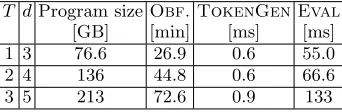
Table 3: Execution times and program size for TBO of the branching program checking whether two 24-bit strings (one of them is obfuscated) have a Hamming distance less than T; # threads = 28, n = 4096, dlog2qe = 180, log2t = 20, λ≥80.
T dProgram sizeObf. TokenGen Eval [GB] [min] [ms] [ms] 1 3 76.6 26.9 0.6 55.0 2 4 136 44.8 0.6 66.6 3 5 213 72.6 0.9 133
sum of TokenGen and Eval, is under 1 second in both modes. The obfusca-tion runtime and program size are also small. The accuracy of the classificaobfusca-tion results is almost as high as for the linear SVM classification in the clear. To confirm this, we trained the linear SVM model using the data for all 216 sub-jects and then ran obfuscated classification, yielding no false positives and no false negatives. The scheme is based on exact integer arithmetic and uses ap-proximations only during the encoding of real numbers into integers by standard fixed-precision techniques. The number of decimal digits can be chosen as high as needed without dramatically affecting the performance.
The above results imply that the obfuscation of linear SVMs is already prac-tical, as long as the number of queries (and possibly the format of query inputs) is adequately restricted by the token generator based on the statistical properties of the classifiers being obfuscated.
7.4 TBO of Conjunctions
Table 2 presents the peformance results for the TBO of 32-bit and 64-bit con-junctions, along with the results for an optimized implementation of the distri-butional VBB obfuscation [19, 27] of 32-bit conjunctions for comparison.
The TBO of 32-bit conjunctions is close to being practical, with a total evaluation runtime of 11.6 milliseconds, obfuscation runtime of 5.1 minutes, and program size of 11.6 GB for a setting with more than 80 bits of security. As compared to the distributional VBB results presented in [27] for the same lattice parameters, the evaluation is 10.1x faster, obfuscation is 7.4x faster, and program size is 3.3x smaller. As TBO provides a mechanism for bounding the number of queries, this construction is also more secure. For a more complete picture, we also ran experiments for the optimized distributional VBB implementation (using the same RNS and low-level optimizations as in our TBO implementation) to provide a fair comparison of the runtimes for the TBO and distributional VBB security models. The experimental speed-ups due to the use of the TBO model are 4.6x for evaluation time and 2.4x for obfuscation time, which are somewhat higher than predicted by our high-level complexity analysis in Section 4.
Here, we chose 14 (matching the number of cores per socket) as the number of threads as the main parallelization dimension in both evaluation and obfuscation ism= 11, and increasing the number of threads further than that degrades the performance due to multi-threading overhead. The speed-ups in the evaluation and obfuscation runtimes are 6.6x and 4.6x, respectively, with the maximum theoretical limit for this case being 11. This suggests there is room for further loop parallelization optimizations.
Our 64-bit conjunction obfuscation results are much further from being prac-tical, mainly due to a large program size requirement. On the other hand, they are significantly better than prior distributional VBB results for the same lattice parameters. For instance, the evaluation is 9x faster, obfuscation is 7.7x faster, and program size is 2.5x smaller.
7.5 TBO of Branching Programs
Table 3 shows the performance results for the TBO of general branching pro-grams using the Hamming distance problem as an example application. Note that d= 5 corresponds to the classical Barrington’s theorem permutation branching program case. Hence these results can be used for benchmarking the TBO of both permutation and general branching programs of lengthL = 24 bits.
The results suggest that the program size is the main efficiency limitation of the TBO for branching programs, which is due to the large size of the GGH15 encoding matrices (in this case, we have 3d2×256 ofm×mmatrices with ring elements of dimensionn). Even for the case of the Hamming distance threshold of 3 and 24-bit strings, the TBO construction requires 213 GB to store the obfuscated program. At the same time, the evaluation and obfuscation runtimes are much closer to being practical.
The best prior results for general branching programs are provided by Halevi
et al. for general read-once branching programs [41]. Although this construc-tion was subsequently broken using a rank attack in [24], it can be used as a benchmark for comparison because the construction uses many similar building blocks (but for the case of matrices rather than rings), such as GGH15 encoding and Micciancio-Peikert lattice trapdoors. The obfuscation and evaluation times for a 24-bit program with about 100 states are 67 minutes and 13 seconds, re-spectively [41]. Our results for a Hamming distance program obfuscation with more than 500 states on a comparable system are 72.6 minutes and 0.13 sec-onds, respectively. The total storage requirements appear to be similar, but they are harder to compare due to implementation differences. In summary, our im-plementation evaluates more complex branching programs about two orders of magnitude faster, and is not vulnerable to known attacks.
8
Conclusion
branching program) constructions still need to be further improved. The impor-tant benefit of TBO is the ability to support the obfuscation of certain programs, such as some binary classifiers, that can be learned under the non-interactive models of VBB or IO. This is solely from the token generator’s ability to limit the number of queries and restrict allowed inputs.
9
Acknowledgements
We gratefully acknowledge the input and feedback from Vinod Vaikuntanathan and Shafi Goldwasser. This work was sponsored by the Defense Advanced Re-search Projects Agency (DARPA) and the Army ReRe-search Laboratory (ARL) un-der Contract Numbers W911NF-15-C-0226 and W911NF-15-C-0233. The views expressed are those of the authors and do not necessarily reflect the official policy or position of the Department of Defense or the U.S. Government.
References
1. Abdalla, M., Bourse, F., De Caro, A., Pointcheval, D.: Simple functional encryption schemes for inner products. In: Katz, J. (ed.) Public-Key Cryptography – PKC 2015. pp. 733–751. Springer Berlin Heidelberg, Berlin, Heidelberg (2015)
2. Al Badawi, A., Polyakov, Y., Aung, K.M.M., Veeravalli, B., Rohloff, K.: Imple-mentation and performance evaluation of rns variants of the bfv homomorphic encryption scheme. IEEE Transactions on Emerging Topics in Computing (2019) 3. Albrecht, M., Scott, S., Player, R.: On the concrete hardness of learning with errors.
Journal of Mathematical Cryptology 9(3), 169–203 (10 2015)
4. Apon, D., Huang, Y., Katz, J., Malozemoff, A.J.: Implementing cryptographic program obfuscation. Cryptology ePrint Archive, Report 2014/779 (2014) 5. Applebaum, B., Cash, D., Peikert, C., Sahai, A.: Fast cryptographic primitives
and circular-secure encryption based on hard learning problems. In: Advances in Cryptology - CRYPTO 2009, 29th Annual International Cryptology Con-ference, Santa Barbara, CA, USA, August 16-20, 2009. Proceedings. pp. 595– 618 (2009). https://doi.org/10.1007/978-3-642-03356-8 35, https://doi.org/10. 1007/978-3-642-03356-8\_35
6. Bahler, L., Di Crescenzo, G., Polyakov, Y., Rohloff, K., Cousins, D.B.: Practical implementation of lattice-based program obfuscators for point functions. In: HPCS 2017. pp. 761–768 (2017)
7. Bajard, J.C., Eynard, J., Hasan, M.A., Zucca, V.: A full rns variant of fv like some-what homomorphic encryption schemes. In: Avanzi, R., Heys, H. (eds.) Selected Areas in Cryptography – SAC 2016. pp. 423–442 (2017)
8. Banerjee, A., Peikert, C., Rosen, A.: Pseudorandom functions and lattices. In: EUROCRYPT 2012. pp. 719–737 (2012)
9. Barak, B.: Hopes, fears, and software obfuscation. Commun. ACM59(3), 88–96 (Feb 2016)
11. Bartusek, J., Lepoint, T., Ma, F., Zhandry, M.: New techniques for obfuscating con-junctions. In: EUROCRYPT (3). Lecture Notes in Computer Science, vol. 11478, pp. 636–666. Springer (2019)
12. Bellare, M., Stepanovs, I.: Point-function obfuscation: A framework and generic constructions. In: Kushilevitz, E., Malkin, T. (eds.) TCC 2016. pp. 565–594 (2016) 13. Bishop, A., Jain, A., Kowalczyk, L.: Function-hiding inner product encryption. In:
ASIACRYPT 2015. pp. 470–491 (2015)
14. Bishop, A., Kowalczyk, L., Malkin, T., Pastro, V., Raykova, M., Shi, K.: A simple obfuscation scheme for pattern-matching with wildcards. In: CRYPTO (3). Lecture Notes in Computer Science, vol. 10993, pp. 731–752. Springer (2018)
15. Bitansky, N., Canetti, R., Cohn, H., Goldwasser, S., Kalai, Y.T., Paneth, O., Rosen, A.: The impossibility of obfuscation with auxiliary input or a universal simulator. In: Garay, J.A., Gennaro, R. (eds.) CRYPTO 2014. pp. 71–89 (2014)
16. Bitansky, N., Canetti, R., Goldwasser, S., Halevi, S., Kalai, Y.T., Rothblum, G.N.: Program obfuscation with leaky hardware. In: Lee, D.H., Wang, X. (eds.) ASI-ACRYPT 2011. pp. 722–739 (2011)
17. Boneh, D., Lewi, K., Montgomery, H.W., Raghunathan, A.: Key homomorphic prfs and their applications. In: CRYPTO 2013. pp. 410–428 (2013)
18. Brakerski, Z., Gentry, C., Vaikuntanathan, V.: (leveled) fully homomorphic en-cryption without bootstrapping. In: Innovations in Theoretical Computer Science 2012. pp. 309–325 (2012)
19. Brakerski, Z., Vaikuntanathan, V., Wee, H., Wichs, D.: Obfuscating conjunctions under entropic ring lwe. In: Proceedings of the 2016 ACM Conference on Innova-tions in Theoretical Computer Science. pp. 147–156. ITCS ’16 (2016)
20. Canetti, R., Chen, Y.: Constraint-hiding constrained prfs for nc1 from lwe. Cryptol-ogy ePrint Archive, Report 2017/143 (2017),https://eprint.iacr.org/2017/143
21. Carmer, B., Malozemoff, A.J., Raykova, M.: 5gc: Multi-input functional en-cryption and program obfuscation for arithmetic circuits. In: ACM CCS’17. pp. 747–764 (2017)
22. Chase, M., Chen, H., Ding, J., Goldwasser, S., Gorbunov, S., Hoffstein, J., Lauter, K., Lokam, S., Moody, D., Morrison, T., Sahai, A., Vaikuntanathan, V.: Security of homomorphic encryption. Tech. rep., HomomorphicEncryption.org, Redmond WA (July 2017)
23. Chen, Y., Gentry, C., Halevi, S.: Cryptanalyses of candidate branching program obfuscators. In: Coron, J.S., Nielsen, J.B. (eds.) EUROCRYPT 2017. pp. 278–307 (2017)
24. Chen, Y., Vaikuntanathan, V., Wee, H.: Ggh15 beyond permutation branching programs: Proofs, attacks, and candidates. In: Shacham, H., Boldyreva, A. (eds.) CRYPTO 2018. pp. 577–607 (2018)
25. Conrads, T.P., Fusaro, V.A., Ross, S., Johann, D., Rajapakse, V., Hitt, B.A., Steinberg, S.M., Kohn, E.C., Fishman, D.A., Whitely, G., et al.: High-resolution serum proteomic features for ovarian cancer detection. Endocrine-related cancer 11(2), 163–178 (2004)
29. Cristianini, N., Shawe-Taylor, J., et al.: An introduction to support vector machines and other kernel-based learning methods. Cambridge university press (2000) 30. Davidson, A., Katsumata, S., Nishimaki, R., Yamada, S.: Constrained prfs for
bit-fixing (and more) from owfs with adaptive security and constant collusion re-sistance. Cryptology ePrint Archive, Report 2018/982 (2018), https://eprint. iacr.org/2018/982
31. Garg, S., Miles, E., Mukherjee, P., Sahai, A., Srinivasan, A., Zhandry, M.: Secure obfuscation in a weak multilinear map model. In: Hirt, M., Smith, A. (eds.) TCC 2016. pp. 241–268 (2016)
32. Genise, N., Micciancio, D.: Faster gaussian sampling for trapdoor lattices with arbitrary modulus. In: EUROCRYPT 2018. pp. 174–203 (2018)
33. Genise, N., Micciancio, D., Polyakov, Y.: Building an efficient lattice gadget toolkit: Subgaussian sampling and more. In: Advances in Cryptology – EUROCRYPT 2019. pp. 655–684 (2019)
34. Gentry, C., Gorbunov, S., Halevi, S.: Graph-induced multilinear maps from lattices. In: Dodis, Y., Nielsen, J.B. (eds.) TCC 2015. pp. 498–527 (2015)
35. Gentry, C., Halevi, S., Smart, N.P.: Homomorphic evaluation of the AES circuit. In: Safavi-Naini, R., Canetti, R. (eds.) CRYPTO 2012. pp. 850–867 (2012) 36. Gentry, C., Peikert, C., Vaikuntanathan, V.: Trapdoors for hard lattices and new
cryptographic constructions. In: STOC ’08. pp. 197–206 (2008)
37. Goldwasser, S., Kalai, Y.T.: On the impossibility of obfuscation with auxiliary input. In: FOCS’05. pp. 553–562 (Oct 2005)
38. Goldwasser, S., Kalai, Y., Popa, R.A., Vaikuntanathan, V., Zeldovich, N.: Reusable garbled circuits and succinct functional encryption. In: STOC ’13. pp. 555–564 (2013)
39. Goyal, V., Ishai, Y., Sahai, A., Venkatesan, R., Wadia, A.: Founding cryptography on tamper-proof hardware tokens. In: Micciancio, D. (ed.) Theory of Cryptography. pp. 308–326. Springer Berlin Heidelberg, Berlin, Heidelberg (2010)
40. Hada, S.: Zero-knowledge and code obfuscation. In: Okamoto, T. (ed.) ASI-ACRYPT 2000. pp. 443–457 (2000)
41. Halevi, S., Halevi, T., Shoup, V., Stephens-Davidowitz, N.: Implementing bp-obfuscation using graph-induced encoding. In: ACM CCS ’17. pp. 783–798 (2017) 42. Halevi, S., Polyakov, Y., Shoup, V.: An improved rns variant of the bfv
homomor-phic encryption scheme. In: Matsui, M. (ed.) CT-RSA 2019. pp. 83–105 (2019) 43. Hastie, T., Tibshirani, R., Friedman, J.: The Elements of Statistical Learning: Data
Mining, Inference, and Prediction. Springer Science & Business Media (2009) 44. Kim, S., Lewi, K., Mandal, A., Montgomery, H., Roy, A., Wu, D.J.:
Function-hiding inner product encryption is practical. In: Catalano, D., De Prisco, R. (eds.) Security and Cryptography for Networks. pp. 544–562 (2018)
45. Kubat, M.: An Introduction to Machine Learning. Springer Publishing Company, Incorporated, 1st edn. (2015)
46. Langlois, A., Stehl´e, D.: Worst-case to average-case reductions for module lattices. Des. Codes Cryptography75(3), 565–599 (2015)
47. Lewi, K., Malozemoff, A.J., Apon, D., Carmer, B., Foltzer, A., Wagner, D., Archer, D.W., Boneh, D., Katz, J., Raykova, M.: 5gen: A framework for prototyping ap-plications using multilinear maps and matrix branching programs. In: ACM CCS ’16. pp. 981–992 (2016)
Table 4: Asymptotic complexity of our construction vs. the LWE construction based on functional encryption of inner products in [1]; m >(N+n+ 1) logq; computational complexity is expressed as the number of modular integer multi-plications and additions
Space complexity Computational complexity Scheme MSK a/MPK t O Obfuscate TokenGen Eval
Ours N nlogq nlogq nlogq(N+n) logq O(N n) O(N n) O(N+n) [1] N nlogq N mlogq nlogq(N+n) logq O(mn+N m) O(N n) O(N+n)
49. Lin, H., Pass, R., Seth, K., Telang, S.: Indistinguishability obfuscation with non-trivial efficiency. In: Cheng, C.M., Chung, K.M., Persiano, G., Yang, B.Y. (eds.) PKC 2016. pp. 447–462 (2016)
50. Lin, H., Tessaro, S.: Indistinguishability obfuscation from trilinear maps and block-wise local prgs. In: Katz, J., Shacham, H. (eds.) CRYPTO 2017. pp. 630–660 (2017) 51. Lyubashevsky, V., Peikert, C., Regev, O.: On ideal lattices and learning with errors
over rings. In: Gilbert, H. (ed.) EUROCRYPT 2010. pp. 1–23 (2010)
52. Lyubashevsky, V., Peikert, C., Regev, O.: A toolkit for ring-LWE cryptography. In: EUROCRYPT. vol. 7881, pp. 35–54. Springer (2013)
53. Micciancio, D.: On the hardness of learning with errors with binary secrets. Theory of Computing14(1), 1–17 (2018)
54. Micciancio, D., Peikert, C.: Trapdoors for lattices: Simpler, tighter, faster, smaller. In: Advances in Cryptology–EUROCRYPT 2012, pp. 700–718. Springer (2012) 55. Polyakov, Y., Rohloff, K., Ryan, G.W.: PALISADE lattice cryptography library.
https://git.njit.edu/palisade/PALISADE(Accessed November 2018)
56. Regev, O.: On lattices, learning with errors, random linear codes, and cryptogra-phy. J. ACM56(6), 34:1–34:40 (2009)
57. Xiao, Y., Mehrotra, K.G., Mohan, C.K.: Efficient classification of binary data stream with concept drifting using conjunction rule based boolean classifier. In: Ali, M., Kwon, Y.S., Lee, C.H., Kim, J., Kim, Y. (eds.) IEA/AIE 2015. pp. 457– 467 (2015)
![Table 1: Single-threaded execution times and program size of an obfuscated bi-nary linear SVM classifier for an ovarian cancer data set with 4,000 features [25];n = 2048, log2 p = 25, ⌈log2 q⌉ = 52, λ ≥ 128, σ = 8/√2π.](https://thumb-us.123doks.com/thumbv2/123dok_us/7963967.1320978/23.612.156.446.159.206/single-threaded-execution-program-obfuscated-classier-ovarian-features.webp)