Improved Quantum Multicollision-Finding
Algorithm
Akinori Hosoyamada1,2, Yu Sasaki1, Seiichiro Tani3, and Keita Xagawa1
1
NTT Secure Platform Laboratories, NTT Corporation. 3-9-11, Midori-cho, Musashino-shi, Tokyo 180-8585, Japan.
2 Department of Information and Communication Engineering, Nagoya University, Furo-cho, Chikusa-ku, Nagoya 464-8603, Japan.
3 NTT Communication Science Laboratories, NTT Corporation. 3-1, Morinosato-Wakamiya, Atsugi-shi, Kanagawa 243-0198, Japan.
{hosoyamada.akinori,sasaki.yu,tani.seiichiro,xagawa.keita}@lab.ntt.co.jp
Abstract. The current paper improves the number of queries of the pre-vious quantum multi-collision finding algorithms presented by Hosoya-madaet al.at Asiacrypt 2017. Let anl-collision be a tuple ofldistinct inputs that result in the same output of a target function. In cryptology, it is important to study how many queries are required to findl-collisions for random functions of which domains are larger than ranges. The pre-vious algorithm finds anl-collision for a random function by recursively calling the algorithm for finding (l−1)-collisions, and it achieves the average quantum query complexity of O(N(3l−1−1)/(2·3l−1)), where N is the range size of target functions. The new algorithm removes the redundancy of the previous recursive algorithm so that different recur-sive calls can share a part of computations. The new algorithm finds an l-collision for random functions with the average quantum query com-plexity ofO(N(2l−1−1)/(2l−1)), which improves the previous bound for alll≥3 (the new and previous algorithms achieve the optimal bound for l= 2). More generally, the new algorithm achieves the average quantum
query complexity ofO
c3N/2N
2l−1−1 2l−1
for a random functionf:X →Y
such that|X| ≥ l· |Y|/cN for any 1 ≤cN ∈ o(N 1
2l−1). With the same
query complexity, it also finds a multiclaw for random functions, which is harder to find than a multicollision.
Keywordspost-quantum cryptography, quantum algorithm, multiclaw, multicollision
1
Introduction
quantum computers can impact on other cryptographic schemes including cryp-tographic hash functions.
A multicollision for a functionf denotes multiple inputs tof such that they are mapped to the same output value. In particular, anl-collision denotes a tuple ofl distinct inputsx1, x2,· · · , xl such thatf(x1) =f(x2) =· · ·=f(xl).
A multicollision is an important object in cryptography. Lower bounds on the complexity of finding a multicollision are sometimes used to derive security bounds in the area of provable security (e.g., security bounds for the schemes based on the sponge construction [JLM14]). In a similar context, the complex-ity of finding a multicollision directly impacts on the best cryptanalysis against some constructions. Furthermore, multicollisions can be used as a proof-of-work for blockchains. In digital payment schemes, a coin must be a bit-string the validity of which can be easily checked but which is hard to produce. A micro-payment scheme, MicroMint [RS96], defines coins as 4-collisions for a function. If 4-collisions can be produced quickly, a malicious user can counterfeit coins. Some recent works prove the security of schemes and protocols based on the assumption that there exist functions for which it is hard to find multicolli-sions [BKP18,BDRV18,KNY18].
Hosoyamadaet al.[HSX17] provided a survey of multicollision finding algo-rithms with quantum computers. They first showed that an l-collision can be produced with at mostO(N1/2) queries on average to the target random function with range size N by iteratively applying the Grover search [Gro96,BBHT98]
l times. They also reported that a combination of Zhandry’s algorithm with
l= 3 [Zha15] and Belovs’ algorithm [Bel12] achievesO(N10/21) forl= 3, which is faster than the simple application of Grover’s algorithm. Finally, Hosoya-mada et al. presented their own algorithm that recursively applies the colli-sion finding algorithm by Brassard, Høyer, and Tapp [BHT98]. Their algorithm achieves the average query complexity of O(N(3l−1−1)/(2·3l−1)) for everyl ≥2. Forl= 3 andl= 4, the complexities areO(N4/9) andO(N13/27), respectively, and the algorithm works as follows.
– To search for 3-collisions, it first iterates the O(N1/3)-query quantum al-gorithm for finding a 2-collision O(N1/9) times. Then, it searches for the preimage of any one of theO(N1/9) 2-collisions by using Grover’s algorithm, which runs withO(N4/9) queries.
– To search for 4-collisions, it iterates theO(N4/9)-query quantum algorithm for finding a 3-collisionO(N1/27) times. Then, it searches for the preimage of any one of theO(N1/27) 3-collisions withO(N13/27) queries.
As demonstrated above, the recursive algorithm by Hosoyamadaet al.[HSX17] runs (l−1)-collision algorithm multiple times, but in each invocation, the algo-rithm starts from scratch. This fact motivates us to consider reusing the com-putations when we search for multiple (l−1)-collisions.
of the algorithm. Consider the problem of finding an l-collision of a random functionf:X →Y, where l≥2 is an integer constant and |Y|=N. In addi-tion, suppose that there exists a parameter cN ≥1 such that cN =o(N
1 2l−1)
and |X| ≥ l· |Y|/cN. Then, the new algorithm achieves the average quantum query complexity of O
c3N/2N
2l−1−1 2l−1
. In particular, if we can take cN as a constant, then our algorithm can find an l-collision of a random function with
O
N
2l−1−1 2l−1
queries on average, which improves the previous quantum query
complexity O
N
3l−1−1 2·3l−1−1
[HSX17] and matches with the lower bound proved
by Liu and Zhandry [LZ18].
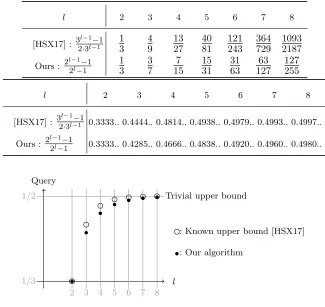
The complexities for smalll’s are listed in Table 1. A comparison between them can be found in Figure 1. Our algorithm finds a 2-collision, 3-collision, 4-collision, and 5-collision of SHA3-512 with 2170.7, 2219.4, 2238.9, and 2247.7 quan-tum queries, respectively, up to a constant factor (Table 2).
Moreover, our new algorithm finds multiclaws for random functions, which are harder to find than multicollisions: An l-claw for functions fi: Xi → Y for 1 ≤ i ≤ l is defined as a tuple (x1, . . . , xl) ∈ X1 × · · · ×Xl such that
fi(xi) = fj(xj) for all (i, j). If there exists a parameter cN ≥ 1 such that
cN = o(N
1
2l−1) and |X
i| ≥ |Y|/cN for each i, our quantum algorithm finds anl-claw for random functionsfi’s with O
c3N/2N
2l−1−1 2l−1
quantum queries on
average. In particular, if we can takecN as a constant, then our algorithm can find anl-claw withO
N
2l−1−1 2l−1
quantum queries.
In this paper, we do not provide the analyses of other complexity measures such as time/space complexity and the depth of quantum circuits, but it is not difficult to show with analyses similar to those in Ref. [HSX17] that the space complexity and the circuit depth are the same order as the query complexity up to a polylogarithmic factor.
Hereafter, we only consideraverage quantum query complexity over random functions as the performance of algorithms unless stated otherwise.
Paper Outline. The remaining of this paper is organized as follows. In sec-tion 2, we describe notasec-tions, definisec-tions and settings. In secsec-tion 3, we review previous works related to the multicollision-finding problem. In section 4, we provide our new quantum algorithm and its complexity analysis. In section 5, we conclude this paper.
Concurrent Work. Very recently, Liu and Zhandry [LZ18] showed that for every integer constantl ≥2,ΘN12(1−
1 2l−1)
Table 1.Query complexities ofl-collision finding quantum algorithms. Each fraction denotes the logarithm of the number of queries to the baseN. The query complexity asymptotically approaches 1/2 aslincreases.
l 2 3 4 5 6 7 8
[HSX17] : 32l−·31l−−11 1 3
4 9
13 27
40 81
121 243
364 729
1093 2187
Ours : 2l −1−1
2l−1
1 3
3 7
7 15
15 31
31 63
63 127
127 255
l 2 3 4 5 6 7 8
[HSX17] : 3l −1−1
2·3l−1 0.3333..0.4444..0.4814..0.4938..0.4979..0.4993..0.4997..
Ours : 2l −1−1
2l−1 0.3333..0.4285..0.4666..0.4838..0.4920..0.4960..0.4980..
Query
l 1/3
1/2 Trivial upper bound
2 3 4 5 6 7 8
: Our algorithm
: Known upper bound [HSX17]
Fig. 1.Quantum query complexity for finding anl-collision. “Query” denotes the log-arithm of the number of queries to the baseN.
Table 2.The number of queries required to find anl-collision of SHA3-512. The num-bers in the first row are obtained from the concrete bound given in [HSX17, Thm.5.1], and those in the second row are obtained from the concrete bound given in Theorem 2 withk= 2.
l 2 3 4 5
[HSX17, Thm 5.1] 2179 2238 2260 2268
function. That is, they gave an improved upper bound and a new lower bound on the average case. The comparisons are summarized as follows:
– Liu and Zhandry consider the l-collision case that |X| ≥ l|Y|, where X is the domain and Y is the range. We treat the case that |X| ≥ l
cN|Y| holds
for any positive value cN ≥ 1 which is ino(N
1
2l−1). We also consider the
multiclaw case.
– Their exponent 12(1− 1
2l−1) is the same as ours
2l−1−1 2l−1 .
– They give the upper boundON12(1− 1 2l−1)
, while we giveOc3N/2N12(1− 1 2l−1)
. WhencN is a constant, our bound matches their bound.
– They give a lower bound, which matches with their and our upper bound.
We finally note that our result on an improved l-collision finding algorithm for the case |X| ≥ l|Y| with query complexityON12(1−
1 2l−1)
is reported in the Rump Session of Asiacrypt 2017.
2
Preliminaries
For a positive integer M, let [M] denote the set {1, . . . , M}. In this paper,
N denotes a positive integer. We assume that l is a positive integer constant. We focus on reducing quantum query complexities for finding multicollisions and multiclaws. Unless otherwise noted, all sets are non-empty and finite. For sets X and Y, Func(X, Y) denotes the set of functions from X to Y. For each
f ∈Func(X, Y), we denote the set {f(x) |x∈ X} by Im(f). For a set X, let
U(X) denote the uniform distribution overX. For a distributionDon a setX, let x ∼ D denote that x is a random variable that takes a value drawn from
X according to D. When we say that an oracle of a function f: X → Y is available, we consider the situation that each elements ofX andY are encoded into suitable binary strings, and the oracle gate Of: |x, zi 7→ |x, z⊕f(x)i is available.
Anl-collision for a function f: X →Y is a tuple of elements (x1, . . . , xl, y) in X`×Y such that f(x
i) =f(xj) =y andxi 6=xj for all 1 ≤i6=j ≤l. An
l-collision is simply called a collision for l = 2, and called a multicollision for
l ≥ 3. Moreover, an l-claw for functions fi:Xi → Y for 1 ≤ i ≤ l is a tuple (x1, . . . , xl, y)∈X1× · · · ×Xl×Y such thatf1(x1) =· · ·=fl(xl) =y. Anl-claw is simply called aclaw forl= 2, and called a multiclaw forl≥3.
This paper focuses on the settings of interest in the context of cryptography. Formally, our goal is to solve the following two problems.
Problem 1 (Multicollision-finding problem, average case).Letl≥2 be a positive integer constant, andX, Y denote non-empty finite sets. Suppose that a function
F: X→Y is chosen uniformly at random and given as a quantum oracle. Then, find anl-collision forF.
Problem 2 (Multiclaw-finding problem, average case). Let l ≥ 2 be a positive integer constant, and X1, . . . , Xl, Y denote non-empty finite sets. Suppose that functions fi: Xi → Y(1 ≤ i ≤ l) are chosen independently and uniformly at random, and given as quantum oracles. Then, find anl-claw forf1, . . . , fl.
Roughly speaking, Problem 1 is easier to solve than Problem 2. Suppose that F:X → Y is a function, and we want to find an l-collision for F. Let
X1, . . . , Xl be subsets ofX such that Xi∩Xj =∅ fori6=j and SiXi =X. If (x1, . . . , xl, y) is anl-claw forF|X1, . . . , F|Xl, then it is obviously anl-collision
for F. In general, an algorithm for finding an l-claw can be converted into one for finding an l-collision. To be precise, the following lemma holds.
Lemma 1. Let X, Y be non-empty finite sets, andX1, . . . , Xl be subsets of X such that Xi∩Xj = ∅ for i 6= j and SiXi = X. If there exists a quantum algorithmAthat solves Problem 2 for the setsX1, . . . , Xl, Y by making at mostq quantum queries with probability at leastp, then there exists a quantum algorithm B that solves Problem 1 for the setsX, Y by making at mostq quantum queries with probability at least p.
How to measure the size of a problem also changes depending on which context we are in. In the context of cryptography, the problem size is often regarded as the size of the range of functions in the problem rather than the size of the domains, since the domains of cryptographic functions such as hash functions are much larger than their ranges. Hence, we regard the range size|Y| as the size of Problem 1 (and Problem 2) when we analyze the complexity of quantum algorithms.
In the context of quantum computation, there exist previous works on prob-lems related to ours [Bel12,Amb04,Tan09,BDH+01] (element distinctness prob-lem, for example), but those works usually focus on the worst case complexity and regard the domain sizes of functions as the problem size. In particular, there does not exist any previous work that studies multiclaw-finding problem for general lin the average case, to the best of authors’ knowledge.
3
Previous Works
3.1 The Grover Search and Its Generalization
Theorem 1. Let X be a non-empty finite set andf:X → {0,1} be a function such that t/|X| < 17/81, where t = |f−1(1)|. Then, there exists a quantum algorithm BBHT that finds x such that f(x) = 1 with an expected number of quantum queries to f at most
4|X|
p
(|X| −t)t ≤
9 2·
r
|X|
t .
If f−1(1) =∅, thenBBHTruns forever.
Theorem 1 implies that we can find l-collisions and l-claws for random func-tions with O(√N) quantum queries, if the sizes of range(s) and domain(s) of function(s) areΘ(N): Suppose that we are given random functionsfi:Xi→Y for 1 ≤ i ≤ l, where |X1|, . . . ,|Xl|, and |Y| are all in Θ(N), and we want to find anl-claw for those functions. Take an elementy∈Y randomly, and define
Fi: Xi → {0,1} for each i byFi(x) = 1 if and only if fi(x) = y. Then, effec-tively, by applyingBBHTto each Fi, we can find xi∈Xi such thatfi(xi) =y for each iwith O(√N) quantum queries with a constant probability. Similarly we can find an l-collision for a random function F: [N] → [N] with O(√N) quantum queries. In particular, O(√N) is a trivial upper bound of Problem 1 and Problem 2.
3.2 The BHT Algorithm
Brassard, Høyer, and Tapp [BHT98] developed a quantum algorithm that finds 2-claws (below we call itBHT).4BHTfinds a claw for two one-to-one functions
f1:X1 →Y and f2: X2 →Y as sketched in the following. For simplicity, here we assume|X1|=|X2|=|Y|=N. Under this setting,BHTfinds a 2-claw with
O(N1/3) quantum queries.
Rough Sketch ofBHT :
1. Construction of a list L. Take a subset S ⊂X1 of size N1/3 arbitrarily. For eachx∈S, compute the valuef1(x) by making a query and store the pair (x, f1(x)) in a listL.
2. Extension to a claw. Define a function FL: X2 → {0,1} by FL(x0) = 1 if and only if the value f2(x0) ∈ Y appears in the list L (i.e., there exists
x1 ∈ S such that f2(x0) = f1(x1)). ApplyBBHT to FL and find x2 ∈ X2 such thatf2(x2) appears inL.
3. Finalization. Find (x1, f1(x1)) ∈ L such that f1(x1) = f2(x2), and then output (x1, x2).
4
As in our case, the BHT algorithm also focus on only quantum query complex-ity. Although it runs in time ˜O(N1/3) on an idealized quantum computer, it re-quires ˜O(N1/3) qubits to store data in quantum memories. Recently Chailloux et al. [CNS17] has developed a quantum 2-collision finding algorithm that runs in time
˜
Quantum query complexity. BHTfinds a claw with O(N1/3) quantum queries. In the first step, the listL is constructed by makingN1/3 queries tof
1. In the second step, since|FL−1(1)|=|f2−1(f1(S))|is equal toN1/3,BBHTfindsx2with
O(pN/N1/3) =O(N1/3) quantum queries tof
2(note that we can evaluateFL by making one query tof2). The third step does not require queries. Therefore
BHTfinds a collision by makingO(N1/3) quantum queries in total in the worst case.
Extension to a collision-finding algorithm. It is not difficult to show that
BHTworks for random functions. Thus,BHTcan be extended to the quantum collision-finding algorithm as mentioned in section 2. Suppose we want to find a (2-)collision for a random functionF:X →Y. Here we assume |X|= 2N and |Y|=N for simplicity. Now, choose a subsetX1⊂X of sizeN arbitrarily and let X2: = X \X1. Then we can find a collision for F by applying the BHT algorithm introduced above to the functions F|X1 and F|X2, since a claw for
them becomes a collision forF.
3.3 The HSX Algorithm
Next, we introduce a quantum algorithm for finding multicollisions that was developed by Hosoyamada, Sasaki, and Xagawa [HSX17] (the algorithm is de-signed to find only multicollisions, and cannot find multiclaws). Below we call their algorithmHSX.
The main idea ofHSXis to apply the strategy ofBHTrecursively: To find an
l-collision,HSX calls itself recursively to find many (l−1)-collisions, and then extend any one of those (l−1)-collisions to anl-collision by applyingBBHT.
Rough Sketch of HSX : In what follows, N denotes |Y|. Let us denote HSX(l) by the HSX algorithm for finding l-collisions. HSX(l) finds an l-collision for a random function f:X →Y with|X| ≥l· |Y|as follows.
Recursive call to construct a list Ll−1. ApplyHSX(l−1) tof N1/3
l−1
times to obtainN1/3l−1
many (l−1)-collisions. Store those (l−1)-collisions in a listLl−1.
Extension to an l-collision. DefineFl−1:X → {0,1}byFl−1(x0) = 1 if and
only if there exists an (l−1)-collision (x1, . . . , xl−1, y) ∈ Ll−1 such that (x1, . . . , xl−1, x0, y) forms an l-collision for f, i.e.,f(x0) =y andx0 6=xi for 1≤i≤l−1. ApplyBBHTtoFl−1 to findxl∈X such thatFl−1(xl) = 1.
Finalization. Find (x1, . . . , xl−1, y) ∈ Ll−1 such that Fl−1(xl) = y. Output (x1, . . . , xl−1, xl, y).
queries on average. In its first step,HSX(l) makesN1/3l−1·O(N(3l−2−1)/2·3l−2) =
O(N(3l−1−1)/2·3l−1) quantum queries. Moreover, in its second step,HSX(l) makes
O(pN/N(3l−2−1)/2·3l−2
) =O(N(3l−1−1)/2·3l−1) quantum queries by usingBBHT. The third step does not make quantum queries. Therefore it follows thatHSX(l) makesO(N(3l−1
−1)/2·3l−1
) quantum queries in total.
4
New Quantum Algorithm
Mclaw
This section gives our new quantum algorithmMclaw that finds anl-claw with
O(c3N/2N(2l−1−1)/(2l−1)
) quantum queries for random functionsfi:Xi →Y for 1≤i≤l, where|Y|=Nand there exists a real valuecN with 1≤cN ∈o(N
1 2l−1)
such that N
cN ≤ |Xi| holds for all i. Roughly speaking, this means that, an l
-collision for a random functionf: X→Y, where|Y|=N and|X| ≥l·N, can be found with O(N(2l−1−1)/(2l−1)) quantum queries, which improves the previous result [HSX17] (see section 2).
Our algorithm assumes that|X1|, . . . ,|Xl|are less than or equal to|Y|. How-ever, it can also be applied to the functions of interest in the context of cryp-tography, i.e., the functions of which domains are much larger than ranges, by restricting the domains of them to suitable subsets.
The main idea of our new algorithm is to improve HSX by getting rid of its redundancy: To find an l-collision,HSXrecursively calls itself to find many (l−1)-collisions. OnceHSXfinds an (l−1)-collisionγ= (x1, . . . , xl−1, y), it stores
γ in a list Ll−1,discards all the data that was used to find γ, and then start to
search for another (l−1)-collisionγ0. It is inefficient to discard data every time an (l−1)-collision is found, and our new algorithm Mclaw reduces the number of quantum queries by reusing those data. We note that our algorithm Mclaw
can solve the multiclaw-finding problem as well as the multi-collision finding problem.
We begin with describing our algorithm in an intuitive manner, and then give its formal description.
4.1 Intuitive Description and Complexity Analysis
We explain the idea of how to develop the BHT algorithm, how to develop a quantum algorithm to find 3-claws from BHT, and how to extend it further to the case of finding anl-claw for anyl.
First, collectt1many 1-claws forf1and store them in a listL1. This first step makest1 queries. Second, extend one of 1-claws inL1 to a 2-claw forf1 andf2, by usingBBHT, and output the obtained 2-claw. SinceBBHTmakesO(pN/t1) queries to make a 2-claw fromL1, this second step makesO(
p
N/t1) queries (see Theorem 1). Overall, the above algorithm makesq2(t1) =t1+
p
N/t1 quantum queries up to a constant factor. The function q2(t1) takes its minimum value 2·N1/3 whent
1=N1/3. By settingt1=N1/3, the BHT algorithm is obtained.
From BHT to a 3-claw-finding algorithm. Next, we show how the above strategy to develop the BHT algorithm can be extended to develop a 3-claw-finding algorithm. Let fi:Xi →Y be one-to-one functions for 1≤i ≤3. Our goal here is to find a 3-claw for f1, f2, andf3 withO(N3/7) quantum queries. For simplicity, below we assume |X1| = |X2| = |X3| =|Y| =N. Let t1, t2 be parameters that define the number of 1-claws forf1 and that of 2-claws for f1 andf2, respectively. (They will be fixed later.)
First, collectt1 many 1-claws for f1 and store them in a list L1. This first step makes t1 queries. Second, extend 1-claws in L1 to t2 many 2-claws for f1 andf2 by usingBBHT, and store them in a listL2. Here we do not discard the list L1 until we construct the list L2 of size t2, while the HSXalgorithm does. Since BBHT makes O(pN/t1) queries to make a 2-claw from L1, this second step makes t2·O(
p
N/t1) queries ift2=o(t1) (see Theorem 1). Finally, extend one of 2-claws inL2 to a 3-claw forf1,f2, andf3 by usingBBHT, and output the obtained 3-claw. This final step makesO(pN/t2) queries. Overall, the above algorithm makesq3(t1, t2) =t1+t2·
p
N/t1+
p
N/t2quantum queries up to a constant factor. The function q3(t1, t2) takes its minimum value 3·N3/7 when
t1=t2·
p
N/t1=
p
N/t2, which is equivalent tot1=N3/7 andt2=N1/7. By settingt1=N3/7andt2=N1/7, we can obtain a 3-claw finding algorithm with
O(N3/7) quantum queries.
l-claw-finding algorithm for general l. Generalizing the above idea to find a 3-claw, we can find anl-claw for generall as follows. Letfi:Xi →Y be one-to-one functions for 1≤i≤l. Our goal here is to find anl-claw for f1, . . . , fl. For simplicity, below we assume that |X1| =· · · =|Xl| =|Y| =N holds. Let
t1, . . . , tl−1 be parameters withti=o(ti−1) fori= 2, . . . . , l.
First, collectt1 many 1-claws for f1 and store them in a list L1. This first step makes t1 queries. In thei-th step for 2≤i≤l−1, extendti many (i− 1)-claws in Li−1 to ti many i-claws forf1, . . . , fi by using BBHT, and store them in a listLi. Here we do not discard the listLi−1 until we construct the listLi of sizeti. SinceBBHTmakesO(
p
N/ti−1) queries to make ani-claw fromLi−1, thei-th step makesti·O(
p
N/ti−1) queries. Finally, extend one of (l−1)-claws in Ll−1 to an l-claw for f1, . . . , fl by using BBHT, and output the obtained l -claw. This final step makesO(pN/tl−1) queries. Overall, this algorithm makes
ql(t1, . . . , tl−1) =t1+t2· p
N/t1+· · ·+tl−1· p
N/tl−2+ p
l·N(2l−1−1)/(2l−1) when t1 =t2·
p
N/t1 =· · · = tl−1·
p
N/tl−2 =
p
N/tl−1,
which is equivalent toti=N(2
l−i−1)/(2l−1)
. By settingti=N(2
l−i−1)/(2l−1)
, we can find anl-claw withO(N(2l−1−1)/(2l−1)) quantum queries. Our new quantum algorithmMclawis developed based on the above strategy for random functions.
4.2 Formal Description
Here we formally describe our quantum multiclaw-finding algorithm Mclaw. A formal complexity analysis of Mclaw is given in the next subsection, and this subsection only describes how the algorithm works.
LetN be a sufficiently large integer and suppose that|Y|=N holds. Below we assume that|Xi| ≤ |Y|holds for alli. This is a reasonable assumption since, if there is an algorithm that solves Problem 2 in the case that|Xi| ≤ |Y| holds for all i, then we can also solve the problem in other cases: If |Xi|>|Y| holds for some i, take a subset Si ⊂ Xi such that |Si| =|Y| and find an l-claw for
f1, . . . , fi−1, fi|Si, fi+1, . . . , fl. Then thel-claw is also anl-claw forf1, . . . , fl.
Here we introduce a corollary that follows from Theorem 1.
Corollary 1. Let X, Y be non-empty finite sets, f:X →Y be a function, and
L0 ⊂ Y be a non-empty subset. Then there exists a quantum algorithm MTPS
that findsxsuch that f(x)∈L0 with an expected number of quantum queries to
f at most 9p5|X|/|f−1(L0)|.
LetFL0: {1, . . . ,5} ×X → {0,1}be the boolean function defined byFL0(α, x) =
1 if and only if α = 1 and f(x) ∈ L0. A quantum circuit that computes FL0
can be implemented with two oracle calls tof. Then, run BBHTonFL0. Since
|{1, . . . ,5} ×X| = 5|X| and |FL−01(1)| ≤ |X| ≤17/81· |{1, . . . ,5} ×X| always
hold, we can show that the corollary follows from Theorem 1.
Our algorithm is parametrized by a positive integerk ≥ 2, and we denote the algorithm for the parameter k by Mclawk. Mclawk can be applied in the situation that there exists a parameter cN ≥ 1 such that cN is in o(N
1 2l−1)
and |Xi| ≥ |Y|/cN holds for each i. We impose an upper limit on the number of queries that Mclawk is allowed to make: We design Mclawk in such a way that it immediately stops and aborts if the number of queries made reaches the
limit specified by the parameter Qlimitk := k·169lc 3/2 N ·N
2l−1−1
2l−1 . The upper
limitQlimitk is necessary to prevent the algorithm from running forever, and to make the expected value of the number of queries converge. We also define the parameters controlling the sizes of the lists:
Ni: =
( N
4cN (i= 0),
N
2l−i−1
2l−1 (i≥1).
(1)
Algorithm 1Mclawk
Input: Randomly chosen functionsf1, . . . , fl(fi:Xi→Y and|Xi| ≤ |Y|)).
Output: Anl-claw forf1, . . . , flor⊥.
Stop condition: If the number of queries reachesQlimitk, stop and output⊥.
L1, . . . , Ll← ∅,L01, . . . , L0l← ∅.
fori= 1 toldo
forj= 1 tod4cN·Niedo
if i= 1then
Takexj∈X1 that does not appear inL1,y←f1(xj). //1 query is made
else
Findxj ∈Xi whose imagey: =fi(xj) is inL0i−1 by runningMTPS onfi
andL0i−1. //multiple queries are made end if
Li←Li∪ {(x(1), . . . , x(i−1), xj, y)},L0i←L0i∪ {y}.
Li−1←Li−1\ {(x(1), . . . , x(i−1), y)},L0i←L
0
i−1\ {y}. end for
end for
Return an element (x(1), . . . , x(l);y)∈Llas an output.
4.3 Formal Complexity Analysis
This section gives a formal complexity analysis ofMclawk. The goal of this section is to show the following theorem.
Theorem 2. Assume that there exists a parameter cN ≥1 such that cN is in
o(N
1
2l−1) and |Xi| ≥ 1
cN|Y| holds for each i. If |Y| = N is sufficiently large, Mclawk finds an l-claw with a probability at least
1−1
k −
2l
N −l·exp −
1 15·
N
1 2l−1
cN
!
, (2)
by making at most
Qlimitk =k·169lc 3/2 N ·N
2l−1−1
2l−1 (3)
quantum queries, wherek is any positive integer2 or more.
This theorem shows that, for each integer k≥2,Mclawk finds anl-claw with a constant probability by makingO
c3N/2N
2l−1−1 2l−1
queries.
For later use, we show the following lemma.
Lemma 2. LetX, Y be non-empty finite sets such that|X| ≤ |Y|. Suppose that a function f:X→Y is chosen uniformly at random. Then
Pr f∼U(Func(X,Y))
|Im(f)| ≥ |X|
2 −
p
|X|ln|Y|/2
≥1− 2
|Y| (4)
Proof. Note that, for eachx∈X,f(x) is the random variable that takes value in Y. Moreover,{f(x)}x∈X is the set of independent random variables. Let us define a functionΦ: Y×|X|→
NbyΦ y1, . . . , y|X|=
Y \ {yi}1≤i≤|X|
. ThenΦ
is 1-Lipschitz, i.e.,
Φ(y1, . . . , yi−1, yi, yi+1, . . . , y|X|)−Φ(y1, . . . , yi−1, yi0, yi+1, . . . , y|X|)
≤1 (5)
holds for arbitrary choice of elements y1, . . . , y|X|, and y0i in Y. Now we apply the following theorem toΦ.
Theorem 3 (McDiarmid’s Inequality (Theorem 13.7 in [MU17])). Let
M be a positive integer, and Φ: Y×M: → N be a 1-Lipschitz function. Let {yi}1≤i≤M be the set of independent random variables that take values inY. Let
µdenote the expectation value Ey1,...,yM[Φ(y1, . . . , yM)]. Then
Pr y1,...,yM
[Φ(y1, . . . , yM)≥µ+λ]≤2e−2λ
2/M
(6)
holds.
Apply the above theorem with M = |X|, λ = p|X|ln|Y|/2, and yx = f(x) for each x ∈ X (here we identify X with the set {1, . . . ,|X|}). Then, since
E[Φ(y1, . . . , yM)] =|Y|(1−1/|Y|)| X|
holds, we have that
Pr f∼U(Func(X,Y))
h
Φ(y1, . . . , yM)≥ |Y|(1−1/|Y|)
|X|
+p|X|ln|Y|/2i≤ 2 |Y|.
In addition, it follows that
|Y|(1−1/|Y|)|X|≤ |Y|e−|X|/|Y|≤ |Y| 1−|X| |Y| +
1 2
|X| |Y|
2!
=|Y| − |X|
1−1 2
|X| |Y|
≤ |Y| −|X|
2 , (7)
where we used the assumption that |X| ≤ |Y| for the last inequality. Since
Φ(y1, . . . , yM) = |Y \Im(f)| and |Im(f)| = |Y| − |Y \Im(f)| hold, it follows that |Im(f)|is at least
|Y| −
|Y| −|X|
2 +
p
|X|ln|Y|/2
= |X|
2 −
p
|X|ln|Y|/2 (8)
with a probability at least 1− 2
|Y|, which completes the proof. ut
Proof (of Theorem 2). We show that eq. (2) holds. Let us define good(i) to be the event that
Claim. For sufficiently largeN,
Prhgood(i)i≥1− 2
N −exp
−1 15·
Ni−1
cN
. (10)
holds.
Proof. In this proof we consider the situation thatMclawk has finished to make
Li−1and before starting to makei-claws. In particular, we assume that|Li−1|=
|L0i−1|=d4cNNi−1e.
Letpregood(i) be the event that |Im(fi)| ≥ dN/3cNe holds. Since cN is in
o(N2l1−1), we have that |Xi|
2 −
p
|Xi|ln|Y|/2≥
l
N 3cN
m
holds for sufficiently large
N. Hence
Prhpregood(i)i≥1− 2
|Y| (11)
follows from Lemma 2.
Let us identifyX andY with the sets{1, . . . ,|X|}and{1, . . . ,|Y|}, respec-tively. Let Bj be the j-th element in Im(f). Let χj be the indicator variable that is defined byχj= 1 if and only ifBj∈L0i−1, and define a random variable
χ byχ: =P
jχj. Thenχ follows the hypergeometric distribution. We use the following theorem as a fact.
Theorem 4 (Theorem 1 in [HS05]).LetK=K(n1, n, m)denote the hyper-geometric random variable describing the process of counting how many defec-tives are selected whenn1items are randomly selected without replacement from
nitems among which there arem defective ones. Letλ≥2. Then
Pr [K−E[K]<−λ]< e−2αn1,n,m(λ2−1) (12)
holds, where
αn1,m,n= max
1
n1+ 1
+ 1
n−n1+ 1
,
1
m+ 1+ 1
n−m+ 1
. (13)
Apply the above theorem with n1 = dN/3cNe, n = N, and m = |L0i−1| = d4cNNi−1e, for the random variable χ under the condition that |Im(fi)| = dN/3cNeholds. Letequaldenote the event that|Im(fi)|=dN/3cNeholds. Then
E[χ|equal] = n1m
n ≥ 4
3Ni−1 holds, and we have that
Pr
χ−E[χ|equal]<−1
4E[χ|equal]
equal
≤exp
−2
1
m+ 1+ 1
n−m+ 1
((E[χ|equal]/42−1
≤exp
− 1
15m(E[χ|equal])
2 ≤exp
−1 15·
Ni−1
cN
for sufficiently large N, where we use cN = o(N
1
2l−1) in evaluating αn 1,m,n.
Hence
Pr [χ≥Ni−1|equal]≥1−exp
−1 15·
Ni−1
cN
(15)
holds, which implies that
PrhIm(f)∩L0i−1
≥Ni−1
pregood
(i)i
= Prhχ≥Ni−1
pregood
(i)i
≥Pr [χ≥Ni−1|equal]
≥1−exp
−1 15·
Ni−1
cN
. (16)
Therefore we have that
Prhgood(i)i>Prhgood(i) pregood
(i)i
·Prhpregood(i)i
= PrhIm(f)∩L0i−1
≥Ni−1
pregood
(i)i
·Prhpregood(i)i
≥
1− 2
|Y| 1−exp
−1 15·
Ni−1
cN
≥1− 2 |Y| −exp
−1 15·
Ni−1
cN
, (17)
which completes the proof. ut
Let good denote the event good(1) ∧ · · · ∧good(l). Then we can show the following claim.
Claim. For sufficiently largeN, it holds that
E[Q|good]≤ 1
kQlimitk, (18)
whereQis the total number of queries made byMclawk.
Proof. Let us fixiandj. LetQ(ji)denote the number of queries made byMclawk in thej-th search to constructi-claws, andQ(i)denoteP
jQ (i)
j . In thej-th search to construct i-claw, we searchXi forxwith fi(x)∈L0i−1, where there exist at least |L0i−1∩Im(f)| ≥ Ni−1−j+ 1 answers in Xi under the condition that
good(i) occurs. From Corollary 1, the expected value of the number of queries made byMTPSin thej-th search to constructi-claws is upper bounded by
9
q
5|Xi|/|fi−1(L0i−1)| ≤9
q
5|Xi|/|L0i−1∩Im(f)| ≤21
p
N/Ni−1 (19)
Hence it follows that
EhQ(i)
good
(i)i =E
X
j
Q(ji)
good(i)
= X
j
EhQ(ji)
good
(i)i
≤ X
1≤j≤d4cNNie
21pN/Ni−1≤
169c3N/2N
2l−1−1
2l−1 (i= 1)
85cNN
2l−1−1
2l−1 (i≥2)
for sufficiently largeN. Hence we have thatE[Q|good] =P
iE
h
Q(i) good
(i)i is upper bounded by
169c3N/2N
2l−1−1 2l−1 +
l
X
i=2 85cNN
2l−1−1
2l−1 ≤169lc3/2
N ·N
2l−1−1 2l−1 = 1
kQlimitk,
which completes the proof. ut
From the above claims it follows thatE[Q] is upper bounded by
E[Q|good] +E[Q| ¬good] Pr[¬good]≤
1
k + Pr[¬good]
·Qlimitk, (20)
and Pr [¬good] is upper bounded by P
iPr
h
¬good(i)i, which is further upper bounded by
X
i
2
N + exp
− 1 15·
Ni−1
cN
≤ 2l
N +l·exp −
1 15·
N
1 2l−1
cN
!
. (21)
From Markov’s inequality, the probability thatQreachesQlimitk is at most
Pr [Q≥Qlimitk]≤
E[Q]
Qlimitk ≤ 1
k+ Pr[¬good]. (22)
The event “Qdoes not reachQlimitk” implies thatMclawkfinds anl-claw. Thus, from eq. (21) and eq. (22), the probability that Mclawk finds anl-claw is lower bounded by
1−1
k −
2l
N −l·exp −
1 15·
N
1 2l−1
cN
!
, (23)
which completes the proof. ut
5
Conclusion
which improves the previous upper bound O(N(3l−1)/(2·3l−1)) by Hosoyamada et al. [HSX17]. In fact, our algorithm can find an l-claw of random functions
fi: [N]→[N] for 1≤i≤lwith the same average complexityO
N(2l−1−1)/(2l−1). In describing the algorithm, we assumed for ease of analysis and understanding that intermediate measurements were allowed. However, it is easy to move all measurements to the final step of the algorithm by the standard techniques. In this paper, we focused only on query complexity, and did not provide the analyses of other complexity measures. However, it is not difficult to show that the space complexity and the depth of quantum circuits are both bounded by
˜
ON(2l−1−1)/(2l−1). For applications to cryptanalyses, it is of interest to fur-ther study time-and-memory-efficient variants.
References
Amb04. Andris Ambainis. Quantum walk algorithm for element distinctness. In
45th Symposium on Foundations of Computer Science (FOCS 2004), 17-19 October 2004, Rome, Italy, Proceedings, pages 22–31, 2004.
BBHT98. Michel Boyer, Gilles Brassard, Peter Høyer, and Alain Tapp. Tight bounds on quantum searching. Fortschritte der Physik: Progress of Physics, 46(4-5):493–505, 1998.
BDH+01. Harry Buhrman, Christoph D¨urr, Mark Heiligman, Peter Høyer, Fr´ed´eric Magniez, Miklos Santha, and Ronald de Wolf. Quantum algorithms for element distinctness. In Proceedings of the 16th Annual IEEE Conference on Computational Complexity, Chicago, Illinois, USA, June 18-21, 2001, pages 131–137, 2001.
BDRV18. Itay Berman, Akshay Degwekar, Ron D. Rothblum, and Prashant Nalini Vasudevan. Multi-collision resistant hash functions and their applications. InAdvances in Cryptology - EUROCRYPT 2018 - 37th Annual International Conference on the Theory and Applications of Cryptographic Techniques, Tel Aviv, Israel, April 29 - May 3, 2018 Proceedings, Part II, pages 133–161, 2018.
Bel12. Aleksandrs Belovs. Learning-graph-based quantum algorithm for k -distinctness. In53rd Annual IEEE Symposium on Foundations of Computer Science, FOCS 2012, New Brunswick, NJ, USA, October 20-23, 2012, pages 207–216, 2012.
BHT98. Gilles Brassard, Peter Høyer, and Alain Tapp. Quantum cryptanalysis of hash and claw-free functions. InLATIN ’98: Theoretical Informatics, Third Latin American Symposium, Campinas, Brazil, April, 20-24, 1998, Proceed-ings, pages 163–169, 1998.
BKP18. Nir Bitansky, Yael Tauman Kalai, and Omer Paneth. Multi-collision resis-tance: a paradigm for keyless hash functions. In Proceedings of the 50th Annual ACM SIGACT Symposium on Theory of Computing, STOC 2018, Los Angeles, CA, USA, June 25-29, 2018, pages 671–684, 2018.
Information Security, Hong Kong, China, December 3-7, 2017, Proceedings, Part II, pages 211–240, 2017.
Gro96. Lov K. Grover. A fast quantum mechanical algorithm for database search. In
Proceedings of the Twenty-Eighth Annual ACM Symposium on the Theory of Computing, Philadelphia, Pennsylvania, USA, May 22-24, 1996, pages 212–219, 1996.
HS05. Don Hush and Clint Scovel. Concentration of the hypergeometric distribu-tion. Statistics & probability letters, 75(2):127–132, 2005.
HSX17. Akinori Hosoyamada, Yu Sasaki, and Keita Xagawa. Quantum multicollision-finding algorithm. InAdvances in Cryptology - ASIACRYPT 2017 - 23rd International Conference on the Theory and Applications of Cryptology and Information Security, Hong Kong, China, December 3-7, 2017, Proceedings, Part II, pages 179–210, 2017.
JLM14. Philipp Jovanovic, Atul Luykx, and Bart Mennink. Beyond 2c/2security in sponge-based authenticated encryption modes. InAdvances in Cryptology - ASIACRYPT 2014 - 20th International Conference on the Theory and Application of Cryptology and Information Security, Kaoshiung, Taiwan, R.O.C., December 7-11, 2014. Proceedings, Part I, pages 85–104, 2014. KNY18. Ilan Komargodski, Moni Naor, and Eylon Yogev. Collision resistant hashing
for paranoids: Dealing with multiple collisions. InAdvances in Cryptology -EUROCRYPT 2018 - 37th Annual International Conference on the Theory and Applications of Cryptographic Techniques, Tel Aviv, Israel, April 29 -May 3, 2018 Proceedings, Part II, pages 162–194, 2018.
LZ18. Qipeng Liu and Mark Zhandry. On finding quantum multi-collisions. IACR Cryptology ePrint Archive, 2018:1096, 2018.
MU17. Michael Mitzenmacher and Eli Upfal. Probability and computing: Random-ization and probabilistic techniques in algorithms and data analysis. Cam-bridge university press, 2017.
RS96. Ronald L. Rivest and Adi Shamir. Payword and micromint: Two simple mi-cropayment schemes. InSecurity Protocols, International Workshop, Cam-bridge, United Kingdom, April 10-12, 1996, Proceedings, pages 69–87, 1996. Tan09. Seiichiro Tani. Claw finding algorithms using quantum walk. Theor.
Com-put. Sci., 410(50):5285–5297, 2009.
Zha15. Mark Zhandry. A note on the quantum collision and set equality problems.