DECIM: Detecting Endpoint Compromise
In Messaging
Full Version∗
Jiangshan Yu†‡ § Mark Ryan § Cas Cremers ¶
Abstract
We present DECIM, an approach to solve the challenge of detecting endpoint compromise in messaging. DECIM manages and refreshes encryption/decryption keys in an automatic and transparent way: it makes it necessary for uses of the key to be inserted in an append-only log, which the device owner can interrogate in order to detect misuse. We propose a multi-device messaging protocol that exploits our concept to allow users to detect unauthorised usage of their device keys. It is co-designed with a formal model, and we verify its core security property using the Tamarin prover. We present a proof-of-concept implementation providing the main features required for deployment. We find that DECIM messaging is efficient even for millions of users.
The methods we introduce are not intended to replace existing methods used to keep keys safe (such as hardware devices, careful pro-cedures, or key refreshment techniques). Rather, our methods provide a useful and effective additional layer of security.
1
Introduction
Spurred by government surveillance [1–3] and users’ desire for strong security [4], a new trend of using end-to-end secure communication has spread. Large companies and security communities have started to deploy
∗An extended abstract of this work appeared at IEEE TIFS, 2017. †Corresponding author, [email protected]
‡SnT, University of Luxembourg.
and provide message services with end-to-end encryption, which include Ap-ple iMessage, Facebook WhatsApp, Google End-to-End email encryption, and Telegram Messenger, to millions of users.
One challenge in providing end-to-end encrypted messaging concerns how to authenticate public keys. Even though methods based on the CA-model (e.g. S/MIME) and the web-of-trust (e.g. OpenPGP) have been available for decades, they have failed to be widely deployed because of the security and usability concerns [5]. Recently, CIRT [6] and CONIKS [7] have been proposed to solve the key authentication problem for messaging, by making all issued key bindings transparent to end-users. Both CIRT and CONIKS support multiple devices, and detect misbehaviours or compromise of the key certification authority. However, while these services provide a good level of protection on users’ communication, they still rely on the assumption that the end-device cannot be compromised. Yet, this assumption is rather hard to justify in practice: new software vulnerabilities [8–10] are discovered every day, and malware is common on mobile devices such as phones and tablets [11] as well as on traditional platforms like desktop PCs.
Signal [12] (formerly TextSecure) moves a step towards handling device compromise. It rotates keys through a ratcheting process (a.k.a. Axolotl protocol), which generates three types of keys, namely root key, chain key, and message key. The root key is a relatively long-term key generated from users’ public keys and updated through the ratchet process. The chain key and message key are ephemeral keys derived from the associated root key. Each chain key is a session key, and the associated message keys are used to encrypt/decrypt messages exchanged in that session. (We refer the reader to [13] for more detail.)
An attacker who learns the chain keys and message keys will not be able to learn messages that have been exchanged in other sessions. However, if the root key has also been compromised, then the attacker is able to perform a man-in-the-middle (MITM) attack to intercept future messages. Additionally, the ratcheting process can lock the attacker out from the point that the attacker discontinued being the MITM. The ratcheting process has been built into several systems including WhatsApp, one of the most popular messaging platforms.
Whilst Signal is an important contribution to message security, it leaves open the question of how to defend against an attacker (e.g., a platform operator or an internet service provider) who is in a unique position to act as a persistent MITM, and has previously compromised a victim’s device.
Endpoint Compromise in Messaging applications.
Contribution Our first contribution is to develop an attacker model in which platforms may beperiodically compromised. That means that they can be compromised by an attacker at any time, but we assume that the victim periodically takes steps to remove malware and eliminate vulnerabilities. Unfortunately, the compromise could have revealed long-term keys. We thus propose security goals that aim to detect the subsequent usage of such keys by the attacker.
Second, we propose an approach for detecting endpoint compromise in messaging (DECIM), to transparently manage ephemeral encryption/decryption keys. It enables users to detect subsequent usage of compromised long-term keys by the attacker even against a persistent MITM attacker, while avoiding the use of expensive and inconvenient manual process for re-authenticating and distributing keys through the underlying PKIs (e.g. applying for a new certificate from a CA), unless attacks are actually detected.
We develop two DECIM protocols. The first is a basic protocol that makes strong assumptions about the participants being simultaneously on-line, and serves mostly to explain the concepts. The second protocol is a more fully developed messaging application, supporting multiple devices per user and allowing the receiver to be offline at the time the sender sends a message.
We provide a proof-of-concept implementation of the detailed messaging application, and conduct a performance evaluation on the system. It shows that the protocol is efficient and scalable: even in an extreme case, i.e. the messaging system has been operating for 100 years with 109 users (each with 3 devices), clients only need to download 2.2 KB extra data for the compromise detection. The memory usage on the server side for enrolling 105 new devices of distinct users is only 410 MB, and it takes roughly 5.7 milliseconds on average for each request.
Our third contribution is the security analysis which shows that the pro-tocols satisfy precise properties expressing software damage containment. Informally, if an attacker controlled device has been recovered from a com-promised state to a secure state, then our system can automatically detect a (persistent) MITM attacker. Therefore the victim will be prompted to manually revoke the key and generate a new one. We use the Tamarin
prover to prove several core properties of our protocol.
main idea of our DECIM protocols in Section 4. The implementation of our messaging protocol is presented in Section 5 in full detail. We analyse the security of our proposal in Section 6, present the performance evaluations in Section 7, and conclude in Section 8.
2
Related work
Axolotl protocol As mentioned previously, the Axolotl protocol imple-mented in Signal [12] uses a ratchet process to handle device compromise against a non-persistent MITM attacker. Similar security guarantees are also provided by other messaging protocols; see [14] for a detailed survey.
FlipIt FlipIt is an abstract game-theoretic framework for modelling
se-curity scenarios similar to the attacker model of our paper. In the FlipIt
game [15], the attacker player moves by compromising a system, and the de-fender player moves by recovering it into a secure state. TheFlipIt paper
explores strategies for defender and attacker, based on an abstract notion of costs associated with moves.
Drifting keys Drifting keys [16] is an approach for detecting device im-personation when an attacker has obtained a copy of pre-shared secret keys stored in constrained devices (such as sensors). Roughly speaking, each key is updated by the sender by appending a random bit. If two inconsistent keys of the same device are detected by the receiver, then it learns that the pre-shared keys at the sender side (i.e. the constrained devices) has been compromised and used by an attacker to impersonate the device.
Certificate transparency Certificate transparency (CT) [18] is a tech-nique proposed by Google aiming to detect mis-issued public key certificates. CT achieves this by recording all issued certificates in an append-only Merkle tree log. CT has been extended to handle revocation [6], and much work on building transparent systems has been proposed based on the concept of CT. Examples include ARPKI [19] and PoliCert [20] for transparent PKI, and CIRT [6] and CONIKS [7] for transparency in messaging systems.
3
Threat model and design goals
t1 t′1 t2 t′2 . . . tn t′n . . .
Figure 1: A device is compromised at time t1, and then restored into a
secure state at time t′1. This cycle is repeated. Thus, the device is in a compromised state during the intervals{(tj, t′j)|j ∈ {1,2,3, . . .}}.
of his/her devices to send a message, and can receive messages on any of them. We useSally andRobert to refer to an arbitrary sender and receiver, respectively.
Threat model The attacker has control over the network and the mes-saging server. This means he can eavesdrop, modify, insert and suppress any messages, and as many of them he wants. In this way, he can act as a persistent MITM. However, we also assume that the parties can oc-casionally communicate short messages, possibly through an independent, low-bandwidth and unreliable channel. The attacker has only partial con-trol of this additional channel — he can intercept, modify and suppress messages, but not all of them all of the time (occasionally, a message will get through)1. In other words, we assume that the attacker can block all communications in one channel, but cannot block all communications in all possible diverse channels.
In addition, the attacker may compromise any user’s devices at any time. After compromising a device, the attacker fully controls it, and can retrieve and store all the data (including secret keys) that are stored on it.
Periodically and routinely, users detect and remove malware on their devices, upgrade the operating system, and install software patches that remove known vulnerabilities. This can put the device back into a trustwor-thy state. The users do not regenerate long-term keys or change passwords unless evidence of a compromised device has been found.
Thus, we assume that devices are periodically trustworthy. An attacker compromises the device by exploiting a vulnerability, and sometime later the device owner restores it into a secure state. This cycle repeats, as illustrated in Figure 1.
The problem Once a device is compromised, then the victim’s secrets stored in the device are exposed to the attacker. Performing security updates
1
and removing malware is insufficient to prevent the attacker masquerading as the victim.
Security goals To solve this problem, our system detects key usages by the attacker. We state our security goal here, and explain how to achieve the goal in the following sections. In the security statements below, we assume a parameter ζ, which is a time period set by the user. A shorter
ζ brings greater security. However, devices are automatically unregistered from the system if they are not used for periods longer thanζ, and have to be re-registered. Thus, a very shortζ reduces usability. Typically,ζ would be about two days. We discussζ and other system parameters later.
In the next section, we develop two protocols: the basic DECIM protocol and the full DECIM messaging application. These offer slightly different guarantees.
• Basic DECIM protocol.
Suppose receiver Robert’s device is compromised during the periods
{(tj, t′j)|j ∈N}. Suppose a message is sent by sender Sally at time t
from a device in a trustworthy state, and the plaintext is obtained by the attacker. Robert can detect this attack provided his device
– was well within a trustworthy state when the message was sent; that is,t′j+ζ≤t≤tj+1−ζ for somej.
• Messaging application (many users each with many devices).
Suppose Robert’s devices are periodically compromised, as before: Di
is compromised during the intervals
{(ti,j, t′i,j) | j ∈ N}. Suppose a message is sent by Sally at time t
from a device in a trustworthy state, and the plaintext is obtained by the attacker. Robert can detect this attack provided, for each of his devicesDi,
– Di was well within a trustworthy state when the message was
sent; that is,t′i,j+ζ ≤t≤ti,j+1−ζ for somej, or
– Di was in a compromised state, but had not been used by Robert
sincet−ζ.
The last condition reflects the fact that one can tell that a device has been compromised if the device was not being used at the time its key was used. Later, in Section 4.2, we show the user interface that allows a user to check this.
4
Overview of DECIM
We present an overview of two protocols for detecting endpoint compro-mise. In the first, the participants are a single sender and a single receiver, assisted by a log maintainer. This situation is too simple to be useful, but serves to illustrate the core concepts. The second protocol is more involved; there are multiple senders and receivers, and each of them has multiple de-vices. This reflects a more realistic situation, and the multiple devices assist in the detection of attacks.
4.1 The basic DECIM protocol
Our solution involves three roles: senders, receivers, and a log maintainer. We assume all of these can be compromised. We assume a log maintainer is capable of receiving data and storing it in an append-only log.
During the bootstrapping phase, the receiver Robert obtains or generates a long-term signing and verification key pair (skR, vkR), and the sender
Sally obtains an authentic copy of vkR. The log maintainer has a signing keyskL, and Robert and Sally have an authentic copy of the corresponding verification key vkL. How these keys are securely distributed is not the
subject of this paper; we assume it can be done through PKIs such as S/MIME [24], PGP [25–27], CIRT [6], or CONIKS [7].
The log maintainer signs and publishesdigests of the log. We use ‘digest’ to denote a short data item that uniquely summarises the log (in practice, it is the root tree hash of a Merkle tree). The maintainer is able to create cryptographic proofs that given data is present or absent from the log. Data is never deleted from the log represented by a given digest.
The log maintainer can also create proofs that a given digest represents an append-only extension of the log represented by a previous digest.
Sally and Robert track the digests issued by the log, all the time checking the proofs issued by the log that later digests represent extensions of earlier ones. Sally and Robert also periodically directly exchange the digests they know about, and request and check proofs of extension of those digests with respect to those they already have. Our assumption that the attacker cannot suppress all messages ensures that they are being presented with the same version of the log.
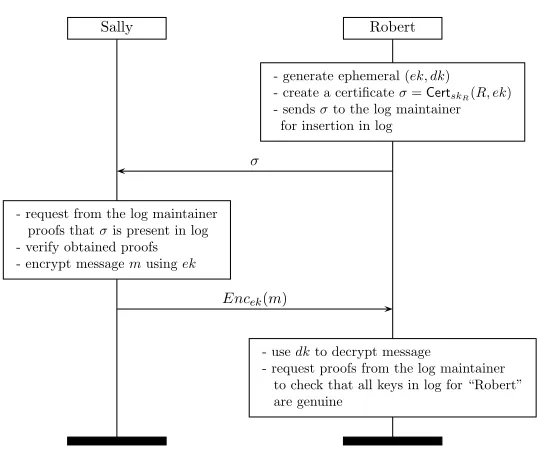
The transmission part of the basic DECIM protocol then runs as follows (see Figure 2).
Sally Robert
- generate ephemeral (ek, dk) - create a certificateσ=CertskR(R, ek)
- sendsσto the log maintainer for insertion in log
σ
- request from the log maintainer proofs thatσis present in log - verify obtained proofs - encrypt messagemusingek
Encek(m)
- usedkto decrypt message
- request proofs from the log maintainer to check that all keys in log for “Robert” are genuine
Figure 2: The basic DECIM protocol. Robert has a pair (skR, vkR) of long
term keys for signature signing and verification. He generates an ephemeral key pair (ek, dk) for encryption, creates the certificateσ=CertskR(R, ek) on ek, and sends the certificate to the log maintainer for insertion into the public log. Meanwhile, Robert also sends the certificate to Sally. After receivingσ, Sally requests from the log maintainer proofs that the certificate is present in the log. If the proof is valid, Sally sends a messagemto Robert encrypted with ek. Robert requests proofs from the log maintainer to enable him to verify whether the log contains signatures that he did not generate.
long-term signing keyskR. He publishes the certificate CertskR(R, ek)
in the log. Publishing the certificate in the log assures Sally that it is a valid encryption key belonging to Robert.
• To send a message, Sally’s device retrieves CertskR(R, ek) from the
log along with a proof of its currency in the log. She encrypts the message with ek and sends it to Robert. Sally will not use a key whose certificate is not in the log.
• Robert’s device receives the encrypted message and decrypts it. Additionally, Robert’s device periodically checks (where the period is determined by the parameterζ) that all the keys ek′ for which a certificate
CertskR(R, ek′) exists in the log were put there by him. If he finds entries in
credentials have been disclosed and abused by an attacker.
The basic protocol assumes that Robert is online at the time that Sally wants to send a message. In the messaging application protocol below, we generalise this to work when Robert is offline.
Intuitively, our protocol design detects compromise attacks because an attacker in possession of Robert’s long term key would have to leave ev-idence of its usage of the key in the log. We give examples of how this detection works in Section 4.3. We perform a formal analysis of our designs in Section 6.
Properties of the log The security of the method requires that an attacker cannot remove information from the log. To achieve this, the log is typically stipulated to be append-only. It is also a requirement that users of the log (including Robert) can verify that no information has been deleted from the log. For this purpose, the log can be organised as a Merkle tree [28] in which data is inserted by extending the tree to the right. Such a log was designed and introduced incertificate transparency [18]. The log maintainer can provide efficient proofs that (A) some particular data is present in the log, and (B) the log is being maintained in an append-only manner. Proof A is referred to asproof of presence (PoP) and proof B is referred to asproof of extension (PoE).
Certificate transparency has been extended to provide proofs that all data associated to some attribute (e.g. keys associated to a user identity) is absent from the log, and proofs that some data associated to some attribute is the latest valid data in the log. The former is referred to as proof of absence, and the latter as proof of currency [6, 7].
4.2 DECIM Messaging application
The DECIM messaging application generalises the basic DECIM proto-col, allowing the users to have multiple devices. Sally can choose any of her devices to send a message, and Robert is able to receive the message on all of his devices. Although this makes the protocol a bit more complicated, it also allows us to obtain a stronger security guarantee, because even if one of Robert’s devices is in an untrustworthy state we are able to leverage security from the other ones.
As before, we assume a log, with the same capabilities mentioned above. We also assume that Robert and the log maintainer have long-term signing and verification key pairs (skR, vkR) (skL, vkL) respectively, and all parties
have authentic copies of the verification keys they need.
• δis the period between the times at which device registration requests are processed. It is set by the log maintainer. We expect it to be typically one hour.
• ϵ is the period between the times at which key update requests are processed. We refer to such periods as “epochs”. It is also set by the log maintainer, and is typically one day.
• ζ is the maximum lifetime of a key. It is set by the user. Different users can choose different values ofζ, subject to the constraint ϵ≤ζ. We expect it to be about two or three days.
The messaging protocol has three main sub-protocols: enrolling, message transmission, and key updates. We describe these in turn.
Enrolling a device To enroll a device Dℓ, Robert needs to install skR
onto it. We assume thatskRis derived from a passphrase that Robert types
into Dℓ. Next, Dℓ needs to create a key pair and publish its certificate in
the log. More precisely:
• Dℓgenerates a new ephemeral encryption key pair (ekℓ, dkℓ) and sends
the certificateCertskR(Dℓ, ekℓ, tℓ) to the log maintainer. Here,tℓis the
key creation time. The key will be used from the current time until the next epoch beginning, for the purpose of encrypting messages for Robert’s device.
• After time δ, the log maintainer has inserted the certificate into the log and sends to Dℓ the list of device certificates CertskR(Di, eki, ti)
for Robert present in the log, together with a proof that the list is complete, and current in the log.
• Dℓ verifies the proof of currency for CertskR(Dℓ, ekℓ, tℓ). It displays
the table (Di, ti) (for each i) to Robert, so he can check that the
devices mentioned are indeed recently used. If Robert sees a device mentioned that he has not recently used, it is evidence of an attack (§ 4.4). Figure 3 presents an example of the envisaged GUI to show
how the information is likely to be presented to Robert.
The device is now ready to be used. When Sally encrypts a message, her device will obtain all the public parts of the current ephemeral keys for Robert from the log, and encrypt the messages with each of them.
Remark. The method of displaying on a user’s device the user’s activities on other devices is well-known (for example, in Gmail, a user can click “last account activity” to see a table of the sessions open by other devices). A crucial difference in our protocol is that the displaying device can fully verify the veracity of the account activity provided by the untrusted log maintainer.
Figure 3: An example of envisaged GUI that presents the table (Di, ti) for i={1,2}to Robert. The ticked box against the “key usage proof” indicates that the proofs about the usage statement (e.g., last update time) have been cryptographically verified.
• To send a message, Sally retrieves CertskR(Di, eki, ti) (for each
avail-ablei) from the log along with proofs of currency. Her device encrypts a copy of the message by using each receivedeki according to the spe-cific end-to-end secure messaging protocol that they both use2. It sends the encrypted message and together with the encrypted k to each of Robert’s devices.
• Robert picks up any of his devices, receives the encrypted message, and decrypts it.
Updating the keys Whenever Robert invokes the messaging app on a device Dℓ, the device checks to see if it is the first time it has run the app during that ϵ-long epoch. If so, it generates a new device key which will become the key for the following epoch. More precisely, on the first invocation during an epoch:
• Dℓ requests and verifies proof of currency for all of the current epoch’s
device certificates CertskR(Di, eki, ti) for each available i. It verifies
that ekℓ is indeed the one it created and sent the previous epoch; if this verification fails, it is evidence of an attack (§ 4.4). Dℓ displays
the table (Di, ti) (each i) to Robert, so he can check that the devices
2
mentioned are indeed recently used. If Robert sees a device mentioned that he has not recently used, it is again evidence of an attack.
• Dℓ next creates a new ephemeral encryption key pair (ek′ℓ, dkℓ′) and
sends the certificateCertskR(Dℓ, ek′ℓ, tℓ) to the log maintainer. Here,tℓ
is the key creation time.
• By the next epoch, the log maintainer has inserted into the log all the device keys thus received. If a device does not send a new key during an epoch, the old key is retained in subsequent epochs until a periodζ
has elapsed. At that time, keys of devices that did not send new keys are revoked.
• When a new key becomes valid, Dℓ securely removes the old key in
the device.
In other words, devices change their key every epoch, and if they don’t do so (because the application is not invoked during a particular epoch) then their key is reused for a certain period, and then revoked. In this last case, the device can’t be used until it re-registers.
4.3 Detecting attacks: examples
To provide intuition on how our protocol allows users to detect attacks, we explain some potential attack detection scenarios. We will present our formal security analysis in Section 6.
Attacks from a third party
Suppose one of Robert’s devices, say his phone, is infected with malware, allowing an adversary to misuse all the keys stored on the device. Suppose the adversary is the messaging service provider acting as a persistent MITM. The adversary may decrypt messages encrypted with ephemeral keys in that epoch, and may create new signed ephemeral keys by using the phone’s long term key and inserting them into the log to perform MITM attacks in future epochs.
Robert routinely performs malware scanning and software patching, which may or may not help him regain the control of his phone depending on the robustness of the malware. It is obvious that one can do nothing for the epoch in which the adversary has all the ephemeral secrets for decryption. We focus on the more interesting case, namely, the security of messages exchanged in future epochs.
If the adversary remains in full control of the phone, then Robert might still be able to detect the device compromise by monitoring the long-term key usage – he notices unexpected usage of phone using the GUI of Figure 3. The figure shows the GUI displayed on another device of Robert’s. It informs him that (so far in the current epoch) the keys corresponding to his phone and his iPad have been active. If Robert has not used his phone in the epoch, then he learns that it has been compromised. The GUI also confirms that the proofs about the usage statement have been cryptographically verified.
Attacks on or by the log maintainer Suppose the log maintainer is malicious or compromised. It may provide fake proofs, or provide no proofs at all. This is readily detected by client software. It may maintain the log incorrectly, either by not correctly recording signed ephemeral keys or by incorrectly recording fake ephemeral keys. These attacks are detected when the key owner requests a complete proof of presence.
A more interesting attack arises if the log maintainer shows different versions of the log to different users. A receiver may see a version in which his ephemeral keys are correctly recorded, while the sender sees a version in which attacker-owned keys are present instead. This would allow the at-tacker to play man-in-the-middle attacks, preventing the sender and receiver ever exchanging information about the log digests they have. In DECIM, users can detect such attacks by gossiping with their contacts, for example, through an out-of-band channel as used in Signal [12], or through a gossip protocol [21–23] as recommended by Google CT [18] and CONIKS [7]. Such a procedure will ensure that the log maintainer is not misbehaving. We refer readers to the referenced work for more detail.
4.4 Responding to attacks
If Robert detects unexpected activity on a device, or some verification fails, this is evidence of an attack. Robert’s response should be to fix the software on his devices. He should generate a new long-term key, in order to prevent attacks occurring (and being detected) due to the disclosure of his current long-term key. The corresponding public key can be distributed using the method used in the bootstrapping phase. Furthermore, he can inform Sally that some of her recent messages to him may have been com-promised.
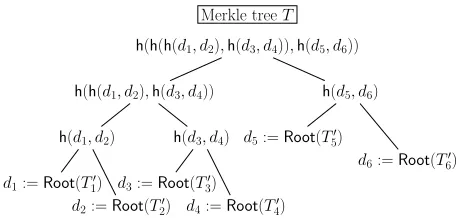
h(h(h(d1, d2),h(d3, d4)),h(d5, d6))
h(h(d1, d2),h(d3, d4))
h(d1, d2)
d1:=Root(T1′)
d2:=Root(T2′)
h(d3, d4)
d3:=Root(T3′)
d4:=Root(T4′)
h(d5, d6)
d5:=Root(T5′)
d6:=Root(T6′)
Merkle treeT
Figure 4: An example of the log containing six updates{d1, d2, . . . , d6}. The
log is an append-only Merkle treeT whose leaves are ordered chronologically.
5
Detailed messaging protocol
In this section we present our proposal’s details in several parts. We first present the log structure in Section 5.1. We then turn to describe the protocol in more detail in Section 5.2. The procedures that ensure that we detect malicious log maintainers are described in Section 5.3. we consider privacy concerns in Section 5.4.
5.1 Log structure
The public log is organised as a tree of trees: the top-level tree is append-only, and its leaves are lexicographically ordered trees.
The top-level tree of the log is implemented by a append-only Merkle tree [28]. The digest of a log is the root hash value and the size of this tree. A Merkle tree is a tree in which every node is labelled with the hash of the labels of its children nodes. Suppose a node has two children labelled with hash values h1, h2. Then the label of this node is h(h1, h2). Merkle
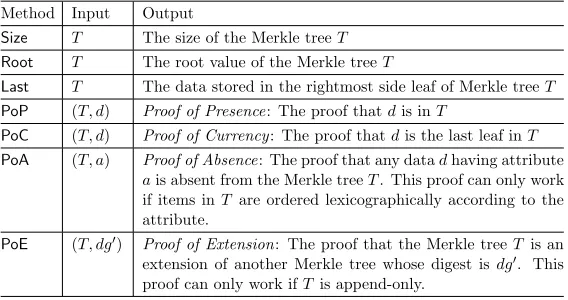
Table 1: The methods supported by the Merkle tree.
Method Input Output
Size T The size of the Merkle treeT
Root T The root value of the Merkle treeT
Last T The data stored in the rightmost side leaf of Merkle treeT
PoP (T, d) Proof of Presence: The proof thatdis inT
PoC (T, d) Proof of Currency: The proof thatdis the last leaf inT
PoA (T, a) Proof of Absence: The proof that any datadhaving attribute
ais absent from the Merkle treeT. This proof can only work if items inT are ordered lexicographically according to the attribute.
PoE (T, dg′) Proof of Extension: The proof that the Merkle treeT is an extension of another Merkle tree whose digest isdg′. This proof can only work ifT is append-only.
The append-only Merkle treeT (as shown in Figure 4) records the entire update history. Items inT are stored only in leaves and ordered chronologi-cally, and each leaf is labelled by the root hash value of another Merkle tree
T′ (presented in Figure 5). Items in T′ are also stored only in the leaves, but ordered according to user identity. Each leaf ofT′ is labelled by users’ identity and a list of ephemeral certificates for different devices of the same user.
We give some examples based on Figure 4 and 5 to show how the proof can be done with our log. We will explain how to verify that the log is maintained correctly — i.e. the log maintainer only appends data inT, and items in everyT′ are ordered lexicographically — in§5.3.
Example of proof of presence To prove that data d′2 for Bob is in T6′
(see Figure 5), the log maintainer only needs to give the data needed to compute the label of parent node fromd′2 to the root of the tree.
PoP(T6′, d′2) = [w, d′1, h(3,4), h(5,7)]
where w = l·l·r is the path to d′2, and l (resp. r) indicates the path to the left (resp. right) child. So, given d′2, Root(T6′), and the proof
PoP(T6′, d′2), one can verify the proof by reconstructing the root valuehT = h(h(h(d′1, d′2), h(3,4)),h((5,7))). IfhT =Root(T6′), then the proof is valid.
Example of proof of currency The proof of currency is the same as the proof of presence, but there is an extra constraint for the verifier to check, namely that the path to the root of the lexicographic tree (e.g., the path from the root tod6 in Figure 4) is of the formr·r . . .·r, i.e., the leaf should
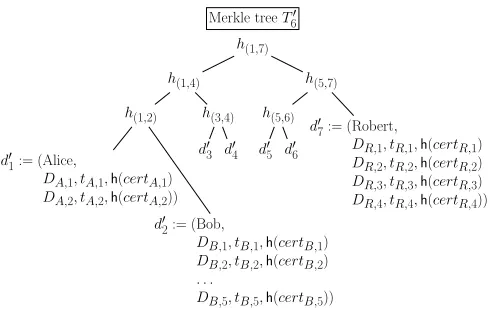
h(1,7)
h(1,4)
h(1,2)
d′1:= (Alice,
DA,1, tA,1,h(certA,1)
DA,2, tA,2,h(certA,2))
d′2:= (Bob,
DB,1, tB,1,h(certB,1)
DB,2, tB,2,h(certB,2)
. . .
DB,5, tB,5,h(certB,5))
h(3,4)
d′3 d′4
h(5,7)
h(5,6)
d′5 d′6
d′7:= (Robert,
DR,1, tR,1,h(certR,1)
DR,2, tR,2,h(certR,2)
DR,3, tR,3,h(certR,3)
DR,4, tR,4,h(certR,4))
Merkle treeT6′
Figure 5: An example of the data structureT′recording data in each update. Items in T′ are ordered lexicographically. For all a, b ∈ [1,7], h(a,b) is the
root hash value of a Merkle tree containing data fromd′atod′b. For example,
h(1,2) =h(d′1, d′2), andh(1,7) =h(h(1,4), h(5,7)). Each leaf of T′ is labelled by (h(ID), (Dj, tj,h(certj))nj=1), such that certj is a certificate on (Dj, ekj, tj) issued by ID, where Dj is the identity of the jth device of ID, ekj is an
(ephemeral) public encryption key, andtj is the issuing time.
Example ofproof of extension To prove that the current version of the log represented byT is an extension of a previous version (Told) containing
four updates (i.e.Root(Told) =h(h(d1, d2),h(d3, d4)) andSize(Told) = 4), the
log maintainer gives h(d5, d6) as the proof. Given the two digests and this
proof, the verifier can verify thatT is extended fromToldby reconstructing Root(T). A well defined algorithm for generating the proof in different cases is presented in §5.1.2 of [18].
Example ofProof of absence To prove that no certificates for user iden-tity ‘Bill’ is included inT6′, the log maintainer needs to prove that any node whose label containing Bill is absent from T6′, by performing the following steps.
• Locate node A such that the user identity contained in its label is lexicographically the largest one smaller than Bill. In our example, the label of node A isd′1 which contains user identity ‘Alice’.
• Locate node B such that the user identity contained in its label is lexicographically the smallest one greater than Bill. In our example, the label of node B isd′2 which contains user identity ‘Bob’.
node is placed in between of them). The former is proved by using proof of presence, and the latter one can be verified by checking the path tod′1 and d′2.
5.2 Messaging protocol details
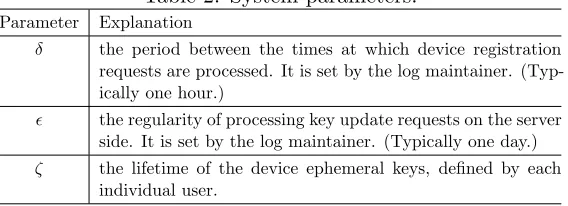
We recall the defined system parameters in Table 2.
Table 2: System parameters.
Parameter Explanation
δ the period between the times at which device registration
requests are processed. It is set by the log maintainer. (Typ-ically one hour.)
ϵ the regularity of processing key update requests on the server side. It is set by the log maintainer. (Typically one day.) ζ the lifetime of the device ephemeral keys, defined by each
individual user.
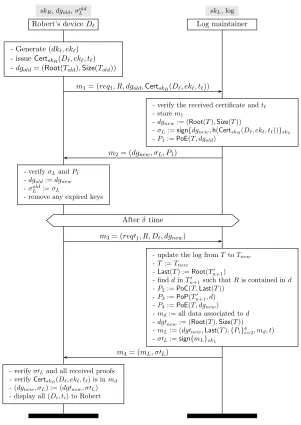
5.2.1 Enrolling a device (Figure 6)
We assume that all Robert’s devices have shared his long-term signing keyskR. To enrol a deviceDℓ, it generates a new ephemeral certificate, and
publishes it in the log. In more detail, as presented in Figure 6:
• Dℓgenerates a new ephemeral key pair (dkℓ, ekℓ) for decryption and en-cryption, respectively. Then,Dℓ issues a certificateCertskR(Dℓ, ekℓ, tℓ)
on (Dℓ, ekℓ, tℓ) by using skR, where tℓ is the key creation time; and
sends the signed registration request
m1 = (req1, R, dgold,CertskR(Dℓ, ekℓ, tℓ)) to the log, where req1 is the
request identity,Ris the identity of Robert, anddgold= (Root(Told),Size(Told))
is the digest of the log that Robert possibly has previously stored (it is likely to happen if Robert is re-enrolling his deviceDℓ).
• After the log maintainer receives the request, it verifies the signature and the certificate, and that tℓ is in the time interval of the current
update epochδ. If they are all valid, it stores the request, and issues a signed confirmationsign{Root(log),Size(log),CertskR(Dℓ, ekℓ, tℓ)}skL,
where log is organised as T, as explained in§5.1. If dgold is provided,
the log maintainer also generates a proofP of extension that the cur-rent log is extended from the log represented bydgold, and sends the
skR,dgold,σoldL
Robert’s deviceDℓ
skL, log
Log maintainer
- Generate (dkℓ, ekℓ)
- issueCertskR(Dℓ, ekℓ, tℓ)
-dgold= (Root(Told),Size(Told))
m1= (req1, R, dgold,CertskR(Dℓ, ekℓ, tℓ))
- verify the received certificate andtℓ - storem1
-dgnew:= (Root(T),Size(T))
-σL:=sign{dgnew,h(CertskR(Dℓ, ekℓ, tℓ))}skL
-P1:=PoE(T, dgold)
m2= (dgnew, σL, P1)
- verifyσLandP1 -dgold:=dgnew -σold
L :=σL
- remove any expired keys
Afterδtime
m3= (req′1, R, Dℓ, dgnew)
- update the log fromTtoTnew -T:=Tnew
-Last(T) :=Root(Tn′+1)
- finddinTn′+1such thatRis contained ind -P2:=PoC(T,Last(T))
-P3:=PoP(Tn′+1, d) -P4:=PoE(T, dgnew) -md:= all data associated tod -dg′new:= (Root(T),Size(T)) -mL:= (dg′new,Last(T),{Pi}4i=2, md, t) -σ′L:=sign{mL}skL
m4= (mL, σ′L)
- verifyσ′Land all received proofs - verifyCertskR(Dℓ, ekℓ, tℓ) is inmd
- (dgnew, σL) := (dg′new, σ′L) - display all (Di, ti) to Robert
Figure 6: The protocol for (re-)enrolling a device. In the protocol, if Robert is re-enrolling his device, thendgoldandσLoldare the previously stored digest
and signature received from the log maintainer, respectively.
• Dℓ verifies the received signature and proof, stores the new digest
dgnewwith signatureσL, and sends the requestm3containing a request
observed digest to the log maintainer afterδ time.
• After each period of lengthδ, the log maintainer updates the log ac-cording to the list of device enrollment requests received from its cus-tomers. The list of requests should be in the form
(Ri,(CertskRi(Di,j, eki,j, ti,j))Pj=1)Mi=1
whereRi is the client identity,P is the number of devices that a client has requested to enroll this update, and M is the total number of clients who have sent the enrollment request for this update.
To update the log, the log maintainer retrieves the current Tn′ such thatRoot(Tn′) =Last(T), and createsTn′+1 by adding each request to the appropriate node ofTn′, where nis the size of the current log. It then extends T with a new rightmost nodeTn′+1.
In addition, the log maintainer proves that the list of certificates (in-cluding the ones in the enrollment request) for each participant Ri
is complete, and current in the log. If Ri has previously observed a
digest dgold of the log, then log maintainer also generates a proof of extension that the current log is extended from the log represented by
dgold. To do so, the log maintainer locates the node labelled with d
forRi inTn′+1, and generates:
– PoP(Tn′+1, d) thatdis present inTn′+1;
– PoC(T, Tn′+1) that the root hash value ofTn′+1 is the label of the rightmost leaf inT; and
– PoE(T, dgold) that the current log is extended from the log
repre-sented bydgold.
So Ri can verify that d— which contains a full list of certificates for his devices (including the newly enrolled ones) — is present in the latest update of the log.
• Dℓverifies the received proofs and signatures. Additionally, it displays the table (Di, ti) (for alli∈[1, P]) to Robert, so he can check that the devices mentioned are indeed recently used. If Robert sees a device mentioned that he has not recently used, it is evidence of an attack that an attacker who has used his long-term key without authorisation and has inserted a certificate for him.
skL, log,vkR
Log maintainer
dgold,σoldL ,vkR,vkL
Sally
skR,dki
Robert’s deviceDi
- generate random numberr -dgold:= (Root(Told),Size(Told))
m1= (req2, R, r, dgold)
-Last(T) :=Root(T′)
- finddinT′such thatRis contained ind -P1:=PoC(T,Last(T))
-P2:=PoP(T′, d) -P3:=PoE(T, dgold) -md:= all data associated tod -dgnew= (Root(T),Size(T))
-mL:= (‘CertResp’, dgnew,Last(T),{Pi}3i=1, md, t) -σL:=sign{mL, r}skL
m2= (mL, σL)
- Verifyt,σL, all received proofs and certificates - setdgold:=dgnewandσoldL :=σL
- extractekifrom each received certificate - create symmetric keyk
m3= ({m}k,{k}eki) for alli
- decrypt{k}ekiby usingdki - decrypt{m}kby usingk
Figure 7: The protocol for sending and receiving a message. In which,σoldL
is the signature received from the log maintainer in the last session. If any of the stated verification checks fails, the agent aborts the protocol.
5.2.2 Sending and receiving a message (Figure 7)
To send a message to Robert, Sally’s device retrieves all the current device certificates for Robert from the log, and encrypts the messages with each of them. More precisely (as presented in Figure 7), to send a message:
• Sally sends request m1 = (req2, R, r, dgold) to the log, where req23 is
the request identity,Ris the identity of Robert,ris a random number, and wheredgold = (Root(Told),Size(Told)) is the digest of the log that Sally received in the last session.
• After receiving the request, the log maintainer locates the leaf whose label d contains R in the latest update T′ (that is represented by the rightmost leaf of T), and generates the proof P1 that Root(T′)
is current in T, proof P2 that d is in T′, and proof P3 that the
cur-rent log is an extension of the log that Sally has previously observed. It then sends m2 to Sally. In particular, m2 is the signed message
(‘CertResp’, dgnew,Last(T), P1, P2, P3, r, md, t), where ‘CertResp’ is a
tag, dgnew = (Root(T),Size(T)), md = (R, (Dj, tj, ekj,Certj)Pj=1) is
the data associated to d, and t is the time to identify the current epoch.
• After receiving the message from the log maintainer, Sally verifies ift
corresponds to the current epoch, and verifies the received signature, proofs, and certificates. If all verifications succeed, she replaces dgold
andσLoldbydgnewandσL, respectively, whereσLis the signature from
the log maintainer.
Her device encrypts a copy of the message with a fresh symmetric key k, and encrypts k with each received eki. It sends the encrypted message and together with the encryptedkto each of Robert’s devices.
• Robert picks up any of his devices, receives the encrypted message, and decrypts it.
Note that in the protocol, if there is no certificate for Robert in the latest update, then a proof of absence that the identity of Robert is not in the latest update is provided to the user.
5.2.3 Updating the keys (Figure 8)
Devices change their key every epoch w.r.t. ϵ, and if they don’t do so (because the application is not invoked on a particular day), then their key will be reused for a certain period (e.g. a few moreϵ), and then will not be included in the log for the next further update epoch. In this last case, the device can’t be used for receiving and reading messages until Robert uses the device again — it will re-register the device automatically. So, after Robert can use this device again in δ time (e.g. one hour). Note that if Robert has un-registered the device, then the device will notautomatically
re-register itself; and Robert has to re-register it manually in this case. More precisely, whenever Robert invokes the messaging app on a device
Dℓ, the device checks to see if it is the first time it has run the app during
that epoch w.r.t. ϵ. If so,
• Dℓ creates a new ephemeral key pair (dkℓ, ekℓ), issues a certificate CertskR(Dℓ, ekℓ, tℓ), which will become the valid key in next epoch,
wheretℓ is the key creation time. Then, he sends the signed request
skR,dkℓold,Certold,dgold,σoldL
Robert’s deviceDℓ
skL, log
Log maintainer
- Generate (dkℓ, ekℓ) and issueCertskR(Dℓ, ekℓ, tℓ)
-dgold= (Root(Told),Size(Told))
m1= (req3, R, dgold,CertskR(Dℓ, ekℓ, tℓ))
- verify the received certificate andtℓ -dgnew:= (Root(T),Size(T))
-σL:=sign{‘Confirmation’, dgnew,h(CertskR(Dℓ, ekℓ, tℓ))}skL
-Last(T) :=Root(T′) - finddinT′such thatRis ind -P1:=PoC(T,Last(T)) -P2:=PoP(T′, d) -P3:=PoE(T, dgold) - storem1
-md:= all data associated tod
m2= (dgnew, md, σL,{Pi}3i=1)
- verifyσL, all received proofs, and thath(Certold) is inmd -dgold:=dgnew
-σold L :=σL - remove expired keys - display all (Di, ti) to Robert
At the end of the epoch w.r.t.ϵ
Update the log similar to the update in Figure 6
Figure 8: The protocol for updating keys. In the protocol, dkoldℓ is the current valid ephemeral secret key,Certold is the corresponding certificate, dgold andσLoldare the digest and signature received from the log maintainer in the last session, respectively.
req34 is the identity of update request, dgold= (Root(Told),Size(Told))
is the digest of the log that he observed in the last session.
• After receiving the request, the log maintainer verifies the signature, timetℓ, and the received certificate. If they are all valid, then it
gener-ates a commitmentσL=sign{‘Confirmation’, dgnew,h(CertskR(Dℓ, ekℓ, tℓ))}skL
that it will put the received new certificate in the log by the end of this epoch. The log maintainer locates the node d for Robert in the latest update of the log, and generates the proofP1that the root hash
value of T′ is the label of the rightmost leaf in T, proof P2 that d is
4
present inT′, and the proofP3 thatT is an extension of the log that
Robert has observed in the last session. Note thatP1 andP2 together
form the proof thatdis the latest update for Robert in the log. The log maintainer sends the generated signature and proofs toDℓ.
• Upon receiving the response,Dℓverifies all signatures and proofs.
Ad-ditionally, it verifies that the hashed certificate (contained ind) forDℓ
in the latest update is indeed corresponding to the one it created and sent in the previous epoch. This verification ensures that no unautho-rised request has been generated and recorded in the current log. (We will explain in the§5.3 that why we don’t need to requireDℓ to verify all history certificates forDℓ in the log are indeed generated by Dℓ.)
If all verifications succeed,Dℓ removes any expired keys stored in Dℓ,
replaces the stored digest of the log with the new one, and displays the table (Di, ti) (for each possiblei) to Robert, so he can check that the devices mentioned are indeed recently used. If Robert sees a device mentioned that he has not recently used, it is evidence of an attack.
• At the turn of the epoch, the log maintainer inserts all received update request into the log. Suppose in the current epoch, the log maintainer which maintains the log (represented by T of size n) has the tree Tn′
containing
(Alice, DA,1, tA,1,h(certA,1) DA,2, tA,2,h(certA,2)),
(Bob, DB,1, tB,1,h(certB,1)
DB,2, tB,2,h(certB,2) . . .
DB,5, tB,5,h(certB,5)),
. . . .
and receives
(Ri,(CertskRi(Di,j, eki,j, ti,j))P ′ j=1)M
′ i=1
for some identity Ri and certificates for its devices Di,j, where P′ is the number of a user’s devices that have sent a key update request, and M′ is the total number of clients who have sent the key update request in this epoch.
To update the log, the log maintainer performs the following steps: Step 1) creates a new treeTn′+1 by copying and pasting the entireTn′; Step 2) replaces the old certificates with the corresponding new ones
inTn′+1;
Step 4) extendsT with a new rightmost nodeRoot(Tn′+1).
Similar to the idea explained in§5.2.1, the log maintainer can provide the proof that the list of certificates (including the ones in the key up-date request) forRi is complete, and current in the log; and the proof that the current log is an extension of the log thatRi has previously
observed.
If a device has not updated ephemeral keys and has been excluded from the latest update by the log maintainer, then the device will automatically re-register itself when the owner has used the device again, so the device will be included in the log and be ready to receive and decrypt messages inδ time.
5.3 Crowd-sourced verification
Since we want to guarantee some security even when the log maintainer is not trusted, we need to monitor the log maintainer’s behaviour to see if the log is maintained correctly. This can be easily verified by allowing any interested party to download and check the entire log at any time. Parties can set themselves up as monitors to perform such checks as a public service. Alternatively or in addition, to avoid having to rely on such monitors, we can use crowd-sourced verification by breaking the verification work into independent little pieces, and distribute each piece to different devices.
First, we need to verify that the log update history recorded in T is maintained in an append-only manner. This is achieved by verifying the proof of extension performed in the protocols for enrolling a device, updating the keys, and sending/receiving a message. Hence, there is no need for any additional verification.
Second, we need to verify that in each update Ti′, items are ordered lexicographically according to the user identity. It can be verified by asking each device to pick a random leaf in an update Ti′, and verify that the user identity recorded in its left (or right) neighbour leaf is lexicographically smaller (resp. greater) than the user identity in the picked leaf.
Third, in our protocol a device only checks its latest certificate in the log, instead of verifying all certificates recorded in the log. So, it cannot guarantee that no attacker-generated certificates have been previously in-cluded in the log. To detect such behaviour, we need to verify that the time of the key generation for the same device in different updates of the log is only going forward. To achieve this, each device picks a random leaf for a user in an updateTi, and verifies that either the record in an update is the
node for the same device of the user in the left (or right) neighbour update
Ti−1 (orTi+1) is no greater (or no smaller) than the time in the picked leaf,
respectively. Additionally, if the two times are equal, then the hash values of the certificates should also be equal. A missing associated record in a new update is evidence of misbehaviour. If no leaf for the user is included in the neighbour update, then a proof of absence that a node containing the user identity is not included in the update is provided.
Remark. Note that these checks ensure that the log is maintained cor-rectly, and the most recently published device key of all user devices are recorded in the latest log update (i.e. the rightmost leaf of the top level tree, see §5.1). Any unexpected record is evidence of misbehaviour of the log maintainer. Thus, to detect the un-authorised usage of the long-term keys, users only need to check their device records against the records in the latest log update, as stated in the protocol for enrolling a device and for updating the keys.
5.4 Privacy considerations
The public log may cause some privacy concerns. For example, depend-ing on deployment specifics, one may want to hide the user identities con-tained in a log against potential spammers, the total number of communi-cations of a user, or the time distribution of a user’s communicommuni-cations, etc. We provide an informal discussion here, and leave a detailed formal study on the privacy of transparent log based systems as a future work.
To hide the user identity, the log maintainer can issue a signature on a user identity, then use a hash value of the signed user identity in the labels of leaves in each log update, rather than containing the user identity directly in the labels (see Figure 5). The signature scheme used should be deterministic and unforgeable, as suggested in [7]. Hence, users that have the recipient’s address can request the signed user identity from the log maintainer, and verify the log; but an attacker who has downloaded the entire log cannot recover the identity of users, based on the unforgeability of the chosen signature scheme. In this case, the nodes in each update treeTi′
will be ordered lexicographically according to the hash value of the signed user identity. In addition, users can also make the log to be only available to a fixed set of contacts. To hide the real number of communications associated to a given client of the log, the client can generate some noise — for example, the client can make ‘spoof queries’ to the log maintainer
6
Security Analysis
We provide all input files required to understand and reproduce our security analysis at [29]. In particular, these include the complete DECIM models. The proof assumes that all users see the same log (a gossip protocol can be used to detect attacks in which different views of the log are presented to different users). We also assume that each user has only one device. The detection of some attacks when a user has multiple devices would need the user’s involvement. A formal study on the user behavior and security analysis with multiple devices is an interesting future work.
Security properties Our messaging protocol achieves both classical secu-rity properties as well as novel ones. In a classical sense, Sally obtains the guarantee that if Robert’s devices are not compromised, then the attacker will not learn the messages she sends.
The more interesting properties are achieved in the cases where Robert’s devices get compromised. In this case, we cannot avoid that messages sent by Sally in the same epoch are also compromised. However, we prove that if any of Sally’s messages from different epochs are compromised, then Robert will be able to detect this.
Formal analysis We analyse the main security properties of the protocol using theTamarinprover [30]. The Tamarin prover is a symbolic analysis
tool that can prove properties of security protocols for an unbounded num-ber of instances and supports reasoning about protocols with mutable global state, which makes it suitable for our log-based protocol. Protocols are speci-fied using multiset rewriting rules, and properties are expressed in a guarded fragment of first order logic that allows quantification over timepoints.
Tamarinis capable of automatic verification in many cases, and it also
supports interactive verification by manual traversal of the proof tree. If the tool terminates without finding a proof, it returns a counter-example. Counter-examples are given as so-called dependency graphs, which are par-tially ordered sets of rule instances that represent a set of executions that violate the property. Counter-examples can be used to refine the model, and give feedback to the implementer and designer.
Modeling aspects We used several abstractions during modeling. We model the Merkle hash trees as lists, similar to the abstraction used in [19].
modeling of the roles directly corresponds to the protocol descriptions in the previous sections. Tamarinprovides built-in support for a Dolev-Yao
style network attacker, i.e., one who is in full control of the network. We also specify rules that enable the attacker to compromise devices and learn their long and short-term secrets.
The final DECIM model consists of 450 lines for the base model, and six main property specifications, examples of which we will give below.
Proof goals We state several proof goals for our DECIM model, exactly as specified in Tamarin’s syntax. Since Tamarin’s property specification
language is a fragment of first-order logic, it contains logical connectives
(|, &, ==>,not, ...) and quantifiers (All, Ex). In Tamarin, proof goals are
marked as lemma. The#-prefix is used to denote timepoints, and “E @ #i” expresses that the eventE occurs at timepointi.
The first goal is a check for executability that ensures that our model allows for the successful transmission of a message. It is encoded in the following way.
lemma protocol_correctness: exists-trace
" /* It is possible that */ Ex d R skR dkR m #i.
/* R received an encrypted message m on device d */ MsgReceived(d, R, skR, dkR, m) @ #i
/* without the adversary compromising any device. */ & not (Ex d2 A ltk dkR #j.
Compromise_Device(d2, A, ltk, dkR) @ #j)"
The property holds if theTamarinmodel exhibits a behaviour in which
one of R’s devices received a message without the attacker compromising any device. This property mainly serves as a sanity check on the model. If it did not hold, it would mean our model does not model the normal (honest) message flow, which could indicate a flaw in the model. Tamarin automati-cally proves this property in a few seconds and generates the expected trace in the form of a graphical representation of the rule instantiations and the message flow.
We additionally proved several other sanity-checking properties to mini-mize the risk of modeling errors.
The second example goal is the core secrecy property with respect to a classical attacker, and expresses that unless the attacker compromises one of Robert’s keys, he cannot learn any messages sent by Sally. Note thatK(m)
is a special event that denotes that the attacker knowsm at this time.
"All R skR ekR m #i.
/* If S sent a message m to R */ ( MsgSent(R, skR, ekR, m) @ #i &
/* without the adversary compromising any of Robert’s devices */
not (Ex #j d sk dkR.
Compromise_Device(d, R, sk, dkR) @ #j) ) ==>
/* then the adversary cannot know m */ (not ( Ex #j. K(m) @ #j) ) "
Tamarinalso proves this property automatically.
The above result implies that if Robert receives a message that was sent by Sally, and the attacker did not compromise his device during the current epoch, then the attacker will not learn the message.
The final property encodes the unique security guarantees provided by our protocol. If the attacker compromises Robert’s device in an epoch, he can use the private ephemeral key to decrypt Sally’s messages in that epoch. We prove that if he uses the compromised long-term key of Robert to learn messages sent by Sally in other epochs, then he will be detected once Robert checks the log.
lemma detect_usage_S_sends:
"All d skR dkR m #i1 #i2 #i3 detectionresult R k. /* If S sent to R an encrypted message m,
where pk(dkR)=ekR */
( MsgSent(R, skR, pk(dkR), m) @ #i1 & /* and the adversary knows m */
K(m) @ #i2 &
/* and the ephemeral key used by the sender was not compromised, i.e., the compromise occurred in a different epoch */
not (Ex #j sk .
Compromise_Device(d, R, sk, dkR) @ #j ) & /* and Robert afterwards checks the log */
CheckedLog(d, R, detectionresult, k ) @ #i3 & #i1 < #i3
) ==>
/* then we detect a compromise */ ( (detectionresult = ’bad’) ) "
The property states that if Sally sends a message when Robert’s device is not controlled by an attacker in the current epoch (but might have been compromised previously), and the attacker learns the message, then Robert detects the fact that his key was previously compromised when he next verifies the log.
The above properties are all proven automatically by the Tamarin
Table 3: The size of messages in different protocols. In which, sizeP is the
size of proofs in the corresponding message, and sizeM is the maximum size
of a message.
Enrolling Fetching keys Updating Crowd-sourced a device from log the keys verification Size of request message 1.6 KB 78 B 1.5 KB -Size of response message 2.5 KB 6.9 KB 2.5 KB 5.9 KB Size of proof in (response) message 2.2 KB 2.2 KB 2.2 KB 5.3 KB Total message size 4.1 KB 7 KB 4 KB 5.9 KB
the order of weeks, with several iterations to debug both the abstract model and the property specifications. The verification process helped us not only to prove, but also to refine the precise security properties of our protocol.
7
Realization in practice
7.1 Estimating communication cost
To check if deployment might be feasible, we estimate the expected cost of our protocol design. As an example, we consider the following scenario. We assume that there are 109users, each user has 3 devices, the log has been operating for 100 years, the log update periodδ for registration request is 1 hour, and the log update epochϵfor certificate update is 1 day.
In this scenario, the size ofTwill be 100·365+100·365·24 = 912500<220, and the size of eachT′ is 109 which is less than 230. In addition, we assume that the size of a hash value is 256 bits (e.g. SHA256), the size of a signature is 64 Bytes (e.g. ECDSA), and the size of a certificate is 1.5 KB.
In addition, we assume that the size of a user (or device) identity is 12 Bytes, and time is in the 64-bit format, a random number is 28 bytes (recommended by TLS 1.2 [31]), each request identifier is 4 bits, and the
size of a digest of a log is 300 bits.
The size of a proof of presence that some data is in T and is inT′ will be at most 640 bytes and 960 bytes, respectively; the size of the proof that a version of the log is extended from a previous version is at most 640 bytes. We present the size of messages in the protocol in our example scenario in Table 3.
the sender needs to download 3 certificates, the size of which is already 4.5 KB.
The results of our analysis indicate that the space cost of our system is acceptable.
7.2 Proof-of-concept log server prototype
To demonstrate the deployment of DECIM in a real-world setting, we built a proof-of-concept prototype of the log server. We implemented a full log server implementation with interfaces, and client-side code for (a) adding users/devices, (b) rotating keys at the end of each epoch, and (c) sending messages. This involves all the operations to manipulate the log (consisting of a tree of trees), produce various proofs, and produce and verify the appropriate signatures. Anticipating a deployment on platforms such as Google’s App Engine, we implemented our code in Python. We use basic caching mechanisms for previously computed results.
On a quad-core 4 GHz Intel Core i7 with 32 GB of memory, we obtain the following times. The times are measured locally and therefore do not include network latency. Performing 100000 (1e05) enrollment requests from distinct users takes 1526 seconds, i.e., 15 milliseconds per request on average. When 100000 (1e05) users enroll 3 devices each, enrollment takes 1708 seconds, i.e., 5.7 milliseconds on average. The delay experienced by the user is therefore dominated by the network latency of transmitting 4.1 KB (Table 3), which is certainly less than a second.
When the tree contains 10000 (1e04) entries, the server produces 100000 (1e05) responses to message queries in 14.1 seconds, i.e., 0.14 milliseconds per message query. Updating a tree by simultaneously adding 10000 (1e04) entries takes about 1 second, which is mostly spent in creating the leaf data structures. Once again, the user’s experience is mostly affected by the network latency, which is small because the data transferred is a few KB.
The memory usage when 100000 (1e05) users enroll one device is 410 MB (computed using “heapy” for the full process, not just reachable objects). If
they enroll three devices each, memory usage increases to 900 MB.
8
Conclusion
End-to-end encryption has become popular in the years since the Snow-den revelations, motivating attackers wishing to intercept messages to in-stead turn their attention to client end-points. To address this, we have presented a novel messaging protocol that offers security guarantees even when an attacker can access all the secret keys in a user’s devices. In partic-ular, (a) the protocol limits the impact of a compromise, since the attacker can only learn messages sent in the same epoch without being detected, and (b) if the attacker uses compromised long-term keys to impersonate users, then the protocol allows the participants to detect this, and therefore to take remedial action. Our protocol supports multiple devices per user, and the multiplicity of devices helps detect attacks by intuitive indicators to users about which (device) keys have recently been active.
The methods we introduce are not intended to replace existing methods used to keep keys safe. Existing technologies such as Axolotl ratcheting, TPMs, smart-cards, and ARM TrustZone are all useful for securing keys. However, none of these technologies are completely secure. For example, even if hardware security is used, malware may be able to trigger usages of the key without having the ability to copy the key. Our methods can also detect such cases. Thus, DECIM adds an additional layer of security that allows users to detect when other layers fail.
Acknowledgment
This work was partially supported by the Fonds National de la Recherche Luxembourg (FNR) through PEARL grant FNR/P14/8149128; and by the HP Research Chair in Cyber Security at Birmingham. We also specially thank Katriel Cohn-Gordon for his assistance on the proof-of-concept imple-mentation and performance evaluation.