Real Time Car Parking System and Parking Fee Display
Using Raspberry Pi
M. Venkata Srinu1
; B. Shiva Shankar2&P.R.Ratna Raju.K3
Assistant Professor, Department of ECE, Madanapalle Institute of Technology & Science1
Angallu, Chittore (Dist.), A.P, India,
M.Tech (DECS), Department of ECE, Madanapalle Institute of Technology & Science2
Assistant Professor, Department of ECE, Madanapalle Institute of Technology & Science3
Angallu, Chittore (Dist.), A.P, India, email1: [email protected]
Abstract – This research paper will discuss on Real-time car parking system and billing display using automatic Number Plate Recognition (NPR) system and a processor named Raspberry pi. The main objective of this research paper is that to reduce the human interaction and providing more convenient to the public at parking locations. This system will use image processing for Number Plate Recognition and for billing details. And finally, the system runs with a pre- programmed processor and to make less human interaction at parking places and at the time of billing.
Keywords: ARM-11Raspberry Pi; USB camera; LCD;
DC motor.
I. INTRODUCTION:
Due to rapid increase in number of vehicles, it is becomes very difficult task to find parking lot for vehicles at parking places. For this Plate Number Recognition has
been introduced. This Plate Number
Recognition (PNR) program has been
researched and developed in Turkey by using Turkey car license-plate extracting and recognition. This model will do the same program but apply the PNR program for any region’s car plate number to evaluate the effectiveness and possibilities of the systems by using their local plate number pattern.
In earlier days more traditional means of license recognition access control were used. Automatic Plate Number recognition APNR system is a real time surveillance system that uses Optical Character Recognition (OCR) on images captured to read Number plate of a vehicle.
APNR system which is used to store the images captured by the camera as well as the text
from the vehicle’s license plate. These
recognition Systems commonly uses infrared lighting, which allows the camera to capture the picture at any time of the day. APNR technology tends to be a region-specific, and is owing to plate variation from place to place. Previously License Plate detection and parking fee billing system is done, but it was developed using MATLAB and the parking fee is printed using the thermal printer [2]. But in this work OpenCV is used rather than MATLAB where it has some advantages over MATLAB which is discussed in below topics.
II. RELATED WORK:
revolutions in the existing technologies. This model makes use of an onboard computer,
which is commonly termed as Raspberry Pi.
It acts as heart of the system. This on board computer can efficiently communicate with the output and input modules which are being used. These Standard systems are comprised of a USB camera for the automated information resources of the License plate. It adds a new important dimension to decision making for the access control at the toll gates and traffic junctions. License plate recognition system can be easily integrated with any physical access control devices like boom barriers and sliding gates for seamless access. To perform this task, Raspberry Pi is programmed using Python [1].
Linux is an Operating System (OS) of a computer, which is assembled under the model of a free and open source software development and distribution.
Previously for Recognition of car License Plate, MATLAB is used for image processing [4]. But it is slightly a bit time taking process hence OpenCV is used.
OpenCV (Open Source Computer Vision) is used over MATLAB, because OpenCV has some advantages. They are related to speed, resources need, Cost and portability. So OpenCV is preferred than MATLAB for License Plate Recognition system [1].
MATLAB is built in Java and it need to convert the programming language to machine language which is understandable to the processor, hence it is time taking process but whereas in OpenCV, it is built in C/C++,
hence OpenCV is directly closer to provide machine language code to the processor to get executed. As a result programs written in OpenCV must faster when comparing to the programs written in MATLAB [1].
III. PROPOSED METHODOLOGY:
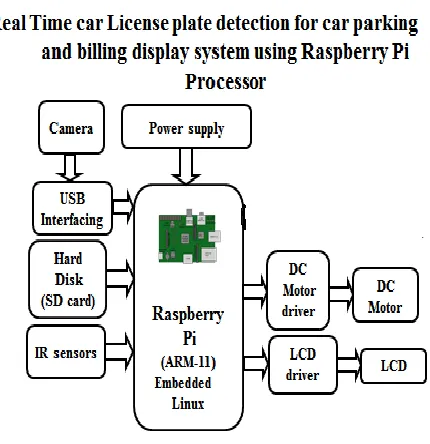
Fig 1 Block diagram of Real-time car parking and Billing Display Using Raspberry pi.
In this paper we are presented automatic license plate recognition ALPR, barrier gate operation system and bill generation using Raspberry pi. We make use of this device to construct an automation system.
Procedure : When any vehicle passes by
details are tagged by the pi then the processor operates the barrier gate using DC motor.For every lot IR sensors are used for detection of filled or empty with the vehicle which facilitates the drivers to park their vehicle without any hassle. When the car gets exit from parking area and when reaches to the exit gate then camera again captures the image which initiates by IR sensor placed at the exit gate. And the time gap will be calculated between the images by the system and displays the billing amount on LCD display unit.
At the entrance, image captured by USB camera will undergo the process called License plate extraction which is clearly explained below.
LICENSE PLATE EXTRACTION:
This is the most critical part in Plate Number Recognition (PNR) system. In this process we use different techniques on image to detect and extract the number details on License plate.
For Detection of License plate details in a captured image here VEDA (Vertical Edge Detection Algorithm) has been used.
Previously different Edge detection techniques are used for detecting License plate in an image. Those techniques are are worked on a principle of horizontal detection which consumes more time to detect the particular license plate region in an image [3]. So, for
this reason VEDA is used for detecting License Plate Detection.
Flow diagram for the Detection of number plate details is showed below.
Fig2: Plate detection Flow diagram
Preprocessing: In image pre- processing,
Firstly, the Color image which is captured is converted into the gray- scale image. And then Adaptive- Thresholding technique is applied on the image to get the binary image. After getting the binary image, the Unwanted Lines Elimination Algorithm (ULEA) is applied to the
image. This algorithm is considered
VEDA (Vertical Edge Detection Algorithm): This algorithm is applied to the image which came from ULEA. This algorithm is used to find particularly the start and end of a characters in the plate [7]. Therefore, the details of number plate will be detected easily, and then character recognition process will be done faster. This algorithm concentrates on intersection of black-white and white-black regions. The center pixel of the mask is located at points (0, 1) and (1, 1). By moving the mask from left to right as showed in below figure, the black–white regions will be found. Therefore, last two black pixels will only be kept. And similarly, the first black pixel in the case of white–black regions will be kept.
Fig3: White-Black & Black-White regions
A mask of size 2*4 is proposed for this process.
(i)
(ii) (iii) (iv)
Fig4: Design of the proposed mask (i) Moving the mask
(ii) Left-Mask, noted as (0,0), (1,0) (iii) Centre-Mask (0,1),(0,2),(1,1),(1,2) (iv) Right-Mask (0,3), (1,3)
In this proposed mask, it is divided into 3 types of sub masks: The first (1st) sub mask is the left mask
“2*2”,the second(2nd) sub mask is the center
“2*1”,and the third(3rd) sub mask is the right mask “2*1”. Simply, after every two pixels are checked at once, the first sub mask is applied so that a 2 pixel width “because two columns are processed” can be considered for the detecting. This process is specified to detect the vertical edges at the intersection of black–white region.
And the unwanted vertical edges are removed from the image by using binary to open the area operator. As VEDA’s output form, the searching process for the License Plate details could be faster and easier because this process searches for the availability of a two pixel width followed by a one pixel width to stand for vertical edge. In addition there is no need to search again once the one pixel width is faced. These two features could make the searching process faster.
Optical Character Recognition:
After completing the license plate
extraction next step is Optical Character
Recognition (OCR), which is used to translate the captured image into alphanumeric text entry [8].
done by using image processing using the method called background subtraction[6][5], but it is the time taking process so it was done by using IR Sensors. When vehicle placed at an empty lot then IR sensor LED will glow and sends an input to the system that lot is filled with a vehicle. Then this will be updated at LCD. When vehicle reaches the exit gate then the above license plate extraction step will be repeat and also compared with the previously stored text (Vehicle License Plate Number) when it matches, time also tagged as exit-time. And time difference is calculated according to the time, bill will be displayed on LCD.
IV RESULTS
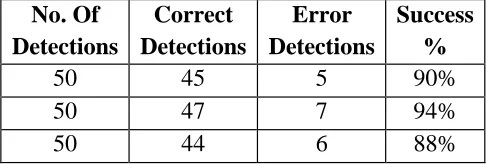
This model has been tested under different scenarios and the results have been tested and this model is able to recognize the plate number, display free parking spaces and guidance parking on LCD. This system’s output is an easy interface for everyone. Plate Number recognition results are shown in below Tables.
No. Of Detections
Correct Detections
Error Detections
Success %
50 46 4 92%
50 47 7 94%
50 43 8 86%
Table 1: Results for Detection of license plate (At Entrance gate)
No. Of Detections
Correct Detections
Error Detections
Success %
50 45 5 90%
50 47 7 94%
50 44 6 88%
Table 2: Results for Detection of license plate (At Exit gate)
After detecting the Number Plate Details at the exit gate, 98% of license plate details were matched successfully and displayed bill according to the parked time of a vehicle.
Evaluation
Edge detector
No. of correctly
detected plates
Detecti on rate
Computati on time
(ms)
VEDA 602/662 91.4% 47.7
Sobel 589/662 88.8% 101.7
V CONCLUSION & FUTURE SCOPE:
The proposed model presents an Integrating feature of all the hardware components which has been used and developed in it with Arm-11 Raspberry Pi. The Presence of each and every module has been reasoned out and placed very carefully. Hence the contributing to the best working unit for an automatic license plate recognition system has been designed perfectly. Secondly, using highly advanced IC’s like ARM1176JZF-S 900 MHz
processor, Linux operating system
technology with the help of growing
technology, the prototype has been
This model can be enhanced using a GSM module and 3G technology. GSM intimates the authorities and the owner of the vehicle if the license plate recognized was unauthorized and 3G technology is used to have an image of the person who with unrecognized number plate based vehicle which helps a lot in security issues. The project can be extended using high efficiency GPS receiver which can give the location of the number plate recognition details in case of emergencies.
REFERENCES
[1] “Automatic License Plate Recognition using OpenCV ” By Pratiksha Jain & Neha Chopra, International Journal of Computer Applications Technology and Research Volume 3– Issue 12, 756 - 761, 2014.
[2] “Automatic Parking Management System & Parking Fee Collection Based on Number Plate Recognition” By M. Rashid & A. Musa, International Journal of Machine Learning and Computing, Vol. 2, No. 2, April 2012
[3] “Automatic License Plate Recognition ” Shyang-Lih Chang & Li-
Shien Chen, IEEE Transactions On
Intelligent Transportation Systems, Vol. 5, No. 1, March 2004
[4] “The Recognition of Car License Plate for an Automatic Parking System” By
Thanongsak Sirithinaphong and Kosin
Chamnongthai, Fifth International
Symposium on Signal Processing and its Applications, ISSPA '99, Brisbane, Australia.
[5] “Intelligent Parking Space Detection System Based on Image Processing” By
R.Yusnita, Fariza orbaya and
Norazwinawati Basharuddin, International Journal of Innovation, Management and Technology, Vol. 3, No. 3, June 2012”.
[6] “Real Time Car Parking system using Image Processing” by Benerjee s &
Ajay Kumar, Electronics Computer
Technology,2011 3rd International Conf. on (Volume:2),2011.
[7] “Detection Of Car-License Plate Using Modified Vertical Edge Detection
Algorithm” by S.Meha Soman &
Dr.N.Jaisankar, Elysium Journal of
Engineering Research & management,
September 2014, Volume-1, Special Issue-1
[8] “Automatic Number Plate
Recognition System For Vehicle
Identification Using Optical Character
Recognition” By Qadri,M. T. & Asif, 2009
in proc. International Conference on
Education Tech. and Computer. IEEE